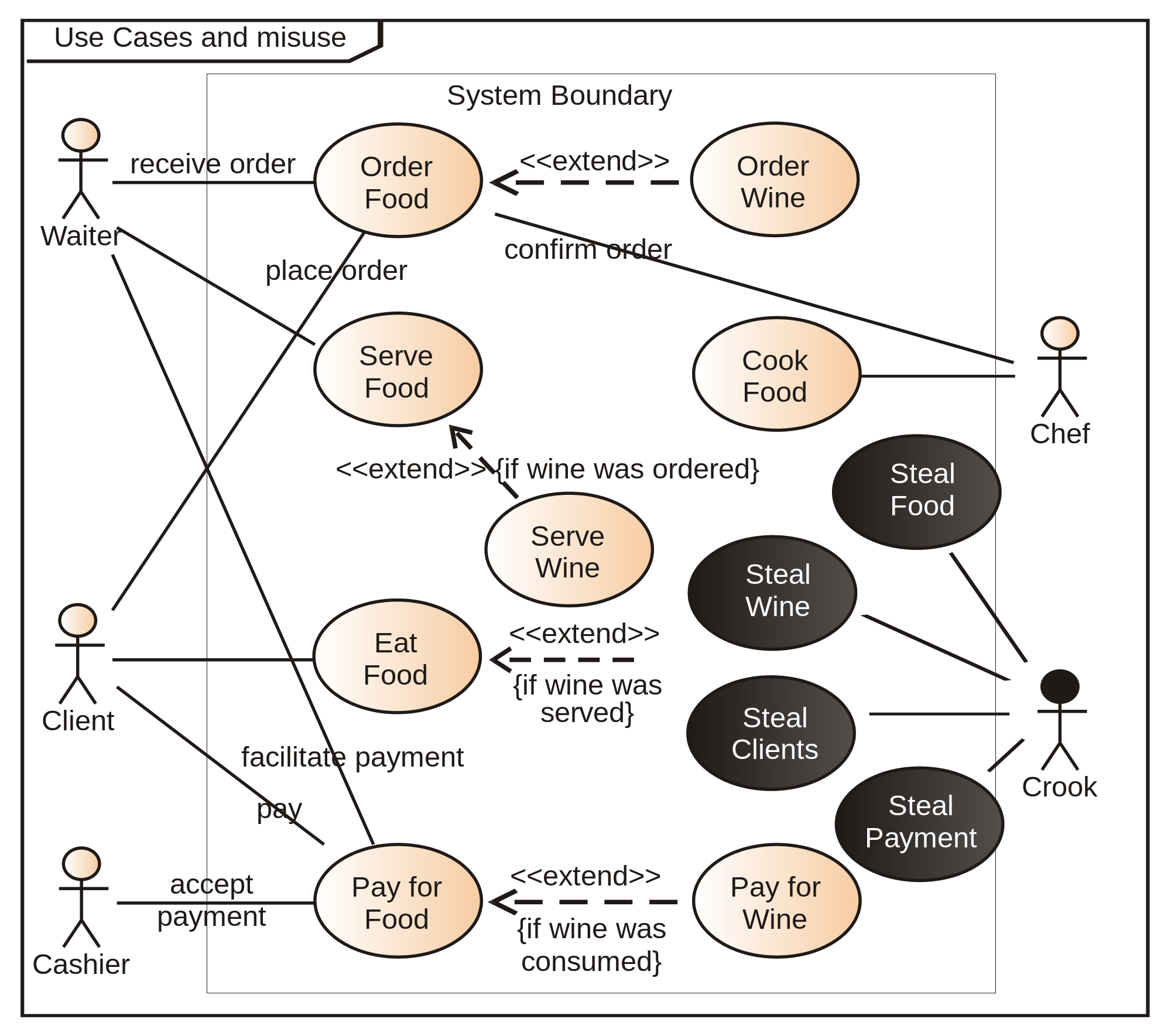

Misuse case
View on Wikipedia
Misuse case is a business process modeling tool used in the software development industry. The term Misuse Case or mis-use case is derived from and is the inverse of use case.[1] The term was first used in the 1990s by Guttorm Sindre of the Norwegian University of Science and Technology, and Andreas L. Opdahl of the University of Bergen, Norway. It describes the process of executing a malicious act against a system, while use case can be used to describe any action taken by the system.[2]
Overview
[edit]Use cases specify required behaviour of software and other products under development, and are essentially structured stories or scenarios detailing the normal behavior and usage of the software. A Misuse Case on the other hand highlights something that should not happen (i.e. a Negative Scenario) and the threats hence identified, help in defining new requirements, which are expressed as new Use Cases.
This modeling tool has several strengths:
- It allows the provision of equal weightage to functional and non-functional requirements (e.g. security requirements, platform requirements, etc.), which may not be possible with other tools.
- It emphasizes security from the beginning of the design process and helps to avoid hasty design decisions.
- It is a tool for improving communication between developers and stakeholders and is valuable in ensuring that both agree on critical system solutions and Trade-off analysis.[3]
- Creating misuse cases often triggers a chain reaction which eases the identification of functional and non-functional requirements. The discovery of a misuse case will often lead to the creation of a new use case that acts as a counter measure. This in turn might be the subject of a new misuse case.[4]
- Compared to other tools, It relates better to use cases and UML and eases the seamless employment of the model.
Its biggest weakness is its simplicity. It needs to be combined with more powerful tools to establish an adequate plan for the execution of a project. One other weakness is its lack of structure and semantics.
From use to misuse case
[edit]In an industry it is important to describe a system's behavior when it responds to a request that originates from outside : the use cases [5] have become popular for requirements [1] between the engineers thanks to its features like the visual modeling technique, they describe a system from an actor's viewpoint and its format explicitly conveys each actor's goals and the flows the system must implement to accomplish them.[6]
The level of abstraction of a use case model makes it an appropriate starting point for design activities, thanks to the use of UML use case diagrams and the end user's or domain expert's language. But for software security analyses, the developers should pay attention to negative scenarios and understand them. That is why, in the 1990s, the concept of "inverse of a use case" was born in Norway.
The contrast between the misuse case and the use case is the goal: the misuse case describes potential system behaviors that a system's stakeholders consider unacceptable or, as Guttorm Sindre and Andreas L. Opdahl said, "a function that the system should not allow".[1] This difference is also in the scenarios: a "positive" scenario is a sequence of actions leading to a Goal desired by a person or organization, while a "negative" one is a scenario whose goal is desired not to occur by the organization in question or desired by a hostile agent (not necessarily human).[7]
Another description of the difference is by [8] that defines a use case as a completed sequence of actions which gives increased value to the user, one could define a misuse case as a completed sequence of actions which results in loss for the organization or some specific stakeholder.
Between the "good" and the "bad" case the language to represent the scenario is common: the use case diagrams are formally included in two modeling languages defined by the OMG: the Unified Modeling Language (UML) and the Systems Modeling Language (SysML), and this use of drawing the agents and misuse cases of the scenario explicitly helps focus attention on it.[9]
Area of use
[edit]Misuse case are most commonly used in the field of security.[10] With the ever-growing importance of IT system, it has become vital for every company to develop capability to protect its data.[11]
Hence, for example a misuse case might be used to define what a hacker would want to do with the system and define his or her requirements. A developer or designer can then define the requirements of the user and the hacker in the same UML diagram which in turn helps identify the security risks of the system.[12]
Basic concepts
[edit]A misuse case diagram is created together with a corresponding use case diagram. The model introduces 2 new important entities (in addition to those from the traditional use case model, use case and actor:
- Misuse case : A sequence of actions that can be performed by any person or entity in order to harm the system.
- Misuser : The actor that initiates the misuse case. This can either be done intentionally or inadvertently.
Diagrams
[edit]The misuse case model makes use of those relation types found in the use case model; include, extend, generalize and association. In addition, it introduces two new relations to be used in the diagram:
- mitigates
- A use case can mitigate the chance that a misuse case will complete successfully.
- threatens
- A misuse case can threaten a use case, e.g. by exploiting it or hinder it from achieving its goals.
These new concepts together with the existing ones from use case give the following meta model, which is also found as fig. 2 in Sindre and Opdahl (2004).[2]
Descriptions
[edit]There are two different ways of describing a misuse case textual; one is embedded in a use case description template - where an extra description field called Threats can be added. This is the field where misuse case steps (and alternate steps) can be filled in. This is referred to as the lightweight mode of describing a misuse case.
The other way of describing a misuse case, is by using a separate template for this purpose only. It is suggested to inherit some of the field from use case description (Name, Summary, Author and Date). It also adapts the fields Basic path and Alternative path, where they now describe the paths of the misuse cases instead of the use cases. In addition to there, it is proposed to use several other fields too:
- Misuse case name
- Summary
- Author
- Date
- Basic path
- Alternative paths
- Mitigation points
- Extension points
- Triggers
- Preconditions
- Assumptions
- Mitigation guarantee
- Related business rules
- Potential misuser profile
- Stakeholders and threats
- Terminology and explanations
- Scope
- Abstraction level
- Precision level
As one might understand, the list above is too comprehensive to be completely filled out every time. Not all the fields are required to be filled in at the beginning, and it should thus be viewed as a living document. There has also been some debating whether to start with diagrams or to start with descriptions. The recommendation given by Sindre and Opdahl on that matter is that it should be done as with use cases.
Sindre and Opdahl proposes the following 5 steps for using misuse cases to identify security requirements:
- Identify critical assets in the system
- Define security goals for each assets
- Identify threats to each of these security goals, by identifying the stakeholders that may want to cause harm to the system
- Identify and analyze risks for the threats, using techniques like Risk Assessment
- Define security requirements for the risks.
It is suggested to use a repository of reusable misuse cases as a support in this 5-step process.
Research
[edit]Current field of research
[edit]Current research on misuse cases are primarily focused on the security improvements they can bring to a project, software projects in particular. Ways to increase the widespread adoption of the practice of misuse case development during earlier phases of application development are being considered: the sooner a flaw is found, the easier it is to find a patch and the lower the impact is on the final cost of the project.
Other research focuses on improving the misuse case to achieve its final goal: for [13] "there is a lack on the application process, and the results are too general and can cause a under-definition or misinterpretation of their concepts". They suggest furthermore "to see the misuse case in the light of a reference model for information system security risk management (ISSRM)" to obtain a security risk management process.
Future improvement
[edit]The misuse cases are well known by the population of researchers. The body of research on the subject demonstrate the knowledge, but beyond the academic world, the misuse case has not been broadly adopted.
As Sindre and Opdahl (the parents of the misuse case concept) suggest: "Another important goal for further work is to facilitate broader industrial adoption of misuse cases".[2] They propose, in the same article, to embed the misuse case in a usecase modeling tool and to create a "database" of standard misuse cases to assist software architects. System stakeholders should create their own misuse case charts for requirements that are specific to their own problem domains. Once developed, a knowledge database can reduce the amount of standard security flaws used by lambda hackers.
Other research focused on possible missing concrete solutions of the misuse case: as [14] wrote "While this approach can help in a high level elicitation of security requirements, it does not show how to associate the misuse cases to legitimate behavior and concrete assets; therefore, it is not clear what misuse case should be considered, nor in what context". These criticisms might be addressed with the suggestions and improvements presented in the precedent section.
Standardization of the misuse case as part of the UML notation might allow it to become a mandatory part of project development. "It might be useful to create a specific notation for security functionality, or countermeasures that have been added to mitigate vulnerabilities and threats."[15]
See also
[edit]- Use case diagram
- Steps for Business Analyst To Gather Security Requirements from Misuse Cases [1]
- Exception handling
- Threat model (software)
References
[edit]- ^ a b c Sindre and Opdahl (2001). "Capturing Security Requirements through Misuse Cases"
- ^ a b c Sindre and Opdahl (2004)."Eliciting security requirements with misuse cases Archived 2011-07-16 at the Wayback Machine"
- ^ Initial Industrial Experience of Misuse Cases in Trade-Off Analysis (2002, by Ian Alexander) Archived 2008-04-30 at the Wayback Machine
- ^ Ian Alexander, Misuse Cases: Use Cases with Hostile Intent. IEEE Software, Vol 20, No 1, Jan-Feb 2003, 58-66. DOI: 10.1109/MS.2003.1159030
- ^ Jacobson, "Object-oriented software engineering: a use case driven approach", 1992 Addison-Wesley, Boston
- ^ Gunnar Peterson, John Steven "Defining Misuse within the Development Process", IEEE SECURITY & PRIVACY, NOVEMBER/DECEMBER 2006
- ^ Ian Alexander "Misuse case : use cases with hostile intent", presentation
- ^ Guttorm Sindre, Andreas L. Opdahl, "Templates for Misuse Case Description"
- ^ Ian Alexander "Misuse case : use cases with hostile intent"
- ^ Asoke K. Talukder; Manish Chaitanya (17 December 2008). Architecting Secure Software Systems. CRC Press. p. 47. ISBN 978-1-4200-8784-0. Retrieved 5 October 2016.
- ^ Jesper M. Johansson; Steve Riley (27 May 2005). Protect Your Windows Network: From Perimeter To Data. Addison-Wesley Professional. p. 491. ISBN 978-0-321-33643-9. Retrieved 5 October 2016.
- ^ Asoke K. Talukder; Manish Chaitanya (17 December 2008). Architecting Secure Software Systems. CRC Press. p. 50. ISBN 978-1-4200-8784-0. Retrieved 5 October 2016.
- ^ Raimundas Matulevičius, Nicolas Mayer, Patrick Heymans, "Alignment of Misuse Cases with Security Risk Management"
- ^ Fabricio A. Braz, Eduardo B. Fernandez, Michael VanHilst, "Eliciting Security Requirements through Misuse Activities"
- ^ Lillian Røstad, "An extended misuse case notation: Including vulnerabilities and the insider threat"

Misuse case
View on GrokipediaIntroduction
Definition
A misuse case is a modeling tool in software engineering that describes potential negative interactions with a system, focusing on how actors—termed misactors—can exploit vulnerabilities to achieve harmful goals, in contrast to the positive, intended behaviors captured by use cases. These negative interactions encompass both intentional misuse by adversaries and unintentional errors, such as user mistakes or system faults, though the primary emphasis is on deliberate threats.[2][5] Introduced as the inverse of traditional use cases, a misuse case represents a complete sequence of actions by a hostile entity that results in undesired outcomes, such as security breaches or operational disruptions.[6] The primary purpose of misuse cases is to elicit security and safety requirements during the early stages of system development, allowing teams to anticipate and mitigate threats proactively rather than reacting to misuse after deployment.[5] By documenting these negative scenarios, misuse cases help identify potential weaknesses, inform the design of countermeasures, and ensure that the system not only supports legitimate functionality but also resists exploitation.[6] Key characteristics of misuse cases include the central role of misactors, who are adversaries such as hackers or insiders intent on harming the system, as well as potential unintentional actors; misuse goals, which define the specific undesired objectives like unauthorized data access; and system responses, which specify mitigations to detect, prevent, or recover from the threat.[5] For example, in a banking system, a misuse case could involve a hacker as the misactor exploiting weak authentication to achieve the misuse goal of accessing unauthorized customer accounts, with the system response entailing the implementation of multi-factor authentication to block such attempts.[7]Relation to Use Cases
Misuse cases exhibit an inverse relationship to traditional use cases, mirroring their structure but adopting an adversarial perspective to describe interactions that threaten system functionality rather than support it.[6] While use cases outline legitimate user goals and system responses to deliver value, misuse cases delineate malicious intents, such as unauthorized access attempts, that the system must prevent.[2] This inversion extends UML use case diagrams by incorporating threat-focused elements, including specialized relationships like "threaten" to indicate how a misuse case undermines a corresponding use case.[8] In terms of comparative structure, both misuse cases and use cases employ similar components—actors, goals, preconditions, postconditions, and scenario flows—but diverge in emphasis and extensions. Use cases prioritize facilitation of desired outcomes through sequential steps, often using "include" and "extend" relationships to modularize functionality.[2] Misuse cases, conversely, adapt these templates to highlight vulnerabilities, introducing fields such as "worst-case threat" and "capture points" for security analysis, while replacing standard relationships with "mitigate" to specify countermeasures that neutralize threats.[6] Mitigation use cases, a derivative, further parallel use cases by detailing preventive actions, shifting focus from enabling behavior to blocking harm.[8] The integration of misuse cases with use cases yields significant benefits in requirements engineering, particularly by uncovering gaps in system design that pure functional modeling overlooks. For instance, a use case for user login can be paired with a misuse case for credential stuffing, where repeated unauthorized login attempts exploit the legitimate flow, thereby revealing the need for rate limiting or multi-factor authentication as mitigations.[8] This pairing ensures traceability between threats and protections, facilitating comprehensive validation and reducing overlooked vulnerabilities during development.[2] In practice, such combined modeling has demonstrated effectiveness in projects, identifying up to 14 vulnerabilities through threat relation analysis.[8] Misuse cases evolved to address the limitations of traditional use cases in capturing non-functional security requirements, which often receive insufficient attention in functional-centric approaches. Use cases excel at specifying what the system should do but falter in articulating what it should not allow, such as denial-of-service attacks that leverage normal interfaces.[6] By explicitly modeling these negative scenarios, misuse cases provide a balanced view of system interactions, ensuring security is embedded from the outset rather than retrofitted.[2] This complementary role has become integral to secure software engineering methodologies, promoting proactive threat mitigation.[8]History
Origins
The concept of misuse cases emerged in 2000, introduced by Guttorm Sindre and Andreas L. Opdahl at the Norwegian University of Science and Technology (NTNU) as an extension of the use case methodology popularized by Ivar Jacobson for requirements engineering. This approach addressed the limitations of traditional use cases, which primarily focused on desired system behaviors, by incorporating scenarios of undesired actions to better capture security concerns. Sindre and Opdahl's work at NTNU laid the groundwork during a period when software engineering practices were evolving to handle increasingly complex distributed systems.[9] The initial motivation for misuse cases stemmed from the escalating need for security in software development amid rising cyber threats and the rapid proliferation of internet-based applications. Early explorations emphasized "negative requirements modeling" to systematically identify and mitigate potential vulnerabilities, contrasting with the positive framing of standard use cases. This was particularly relevant as stakeholders began articulating what systems should not allow, rather than solely what they should achieve.[6] A seminal publication formalizing the concept appeared in 2000, with Sindre and Opdahl's paper "Eliciting Security Requirements by Misuse Cases," presented at TOOLS Pacific 2000. In this work, they defined misuse cases as descriptions of behaviors the system owner wishes to prevent, providing methodological guidelines for their integration into requirements elicitation. The timing aligned with the dot-com era's boom in e-commerce and mobile commerce, where robust threat anticipation became essential for protecting online transactions and user data against emerging risks like unauthorized access and data breaches.[6][10]Key Developments
In the early 2000s, misuse cases advanced through integration with Unified Modeling Language (UML) extensions, particularly by Guttorm Sindre and Andreas L. Opdahl in their 2001 paper, which proposed conceptual adaptations of use case diagrams to model security threats. Subsequent work in 2005 formalized additional UML stereotypes such as <Core Concepts
Actors and Scenarios
In misuse cases, actors, referred to as misactors, represent entities that intentionally or unintentionally engage in behaviors leading to system harm, contrasting with benign actors in standard use cases who pursue legitimate goals. Misactors are classified into three primary types based on their relationship to the system: primary misactors, who are legitimate users who turn malicious by exploiting their intended access; secondary misactors, who are external adversaries such as hackers without prior authorization attempting unauthorized entry; and tertiary misactors, who are insiders with legitimate access, such as employees or developers, who misuse their privileges due to internal motivations or coercion.[18] This classification helps identify potential threat origins during requirements engineering, with primary and tertiary misactors leveraging existing system trust, while secondary misactors target perimeter defenses. Scenario structures in misuse cases mirror use case formats but focus on harmful interactions, comprising key components to delineate the path to compromise. Pre-conditions specify vulnerable system states required for initiation, such as unvalidated user inputs or exposed network ports. The main flow outlines the sequential steps of misuse execution, detailing misactor actions and system responses that enable harm. Post-conditions describe the resulting harmful outcomes, including worst-case threats like data exfiltration and capture guarantees outlining prevention ideals. Alternatives cover variant paths, such as failed attempts due to detection mechanisms or partial successes leading to escalated threats. These elements provide a structured narrative for analyzing and mitigating risks without delving into diagrammatic representations. Misactor motivations differ fundamentally from those of benign actors, as they are driven by adversarial objectives such as data theft for financial gain or denial-of-service attacks to disrupt operations, often rooted in economic incentives, revenge, or ideological aims. Unlike legitimate users seeking functionality, misactors exploit design flaws to achieve these goals, necessitating security countermeasures that address intent alongside capability. A representative example is the SQL injection misuse case, where a secondary misactor (external hacker) targets a web application's login form to gain unauthorized database access. Pre-conditions include the system accepting unsanitized user inputs in SQL queries and lacking input validation. In the main flow, the misactor enters a malicious payload like' OR '1'='1 in the username field, causing the query to authenticate any user; the system then executes the altered SQL, granting access to sensitive data. Post-conditions in the worst-case scenario yield full database exposure, enabling data theft, while a capture guarantee ensures no unauthorized access via prepared statements. Alternatives might involve blind injection attempts where the misactor infers data through response timing if direct output is blocked, highlighting weak points like improper query parameterization. This breakdown illustrates how actor actions exploit system vulnerabilities in authentication flows.
Misuse Goals and Threats
Misuse goals in the context of misuse cases represent the intentional objectives of misactors aimed at causing harm to the system or its stakeholders, often manifesting as violations of core security principles such as the CIA triad—confidentiality, integrity, and availability. Confidentiality breaches, for instance, involve unauthorized disclosure of sensitive information, like stealing credit card details through query manipulation in a web application. Integrity violations target the accuracy and trustworthiness of data, exemplified by tampering with database entries to alter transaction records. Availability disruptions seek to deny legitimate access, such as flooding a system with excessive requests to render it unusable. These goals are derived from negative scenarios that, if realized, lead to stakeholder losses, and they guide the identification of potential harms during requirements engineering.[9] Threats associated with misuse goals are categorized into technical, human, and environmental types to systematically analyze vulnerabilities. Technical threats exploit software or hardware flaws, such as buffer overflows that allow arbitrary code execution. Human threats leverage psychological or behavioral weaknesses, including social engineering tactics like phishing to trick users into revealing credentials. Environmental threats arise from physical or contextual factors, such as unauthorized physical access to servers enabling data theft or sabotage. This categorization helps prioritize risks by distinguishing between exploitable system defects, insider or external actor manipulations, and external conditions beyond direct control. Each misuse goal inherently ties to specific countermeasures, ensuring that identified threats inform proactive security requirements. For confidentiality threats like unauthorized data access, mitigations include robust authentication mechanisms to verify user identities. Integrity goals, such as data tampering, are countered by input validation and cryptographic integrity checks to detect alterations. Availability threats prompt defenses like rate limiting or redundancy to maintain service continuity. These linkages transform abstract harms into actionable security use cases that mitigate the misuse scenarios.[9] A representative example is the misuse goal of privilege escalation, where a threat actor exploits flaws in role-based access control to elevate from limited user permissions to administrative privileges, potentially enabling broader system compromise. In an e-commerce system, a misactor might obtain a password through a technical vulnerability, gaining operator authorities to sabotage operations or steal customer data; this threat is mitigated by enforcing least-privilege principles and regular access audits.[6]Modeling Techniques
Diagram Representations
Misuse case diagrams extend the Unified Modeling Language (UML) use case diagram notation to model security threats and countermeasures visually. Misuse cases are typically represented as filled (black) ovals to distinguish them from standard use cases, which use unfilled (white) ovals. Misactors, the adversarial entities driving threats, are depicted as filled stick figures, contrasting with the unfilled figures for legitimate actors. These extensions build directly on UML specifications, allowing seamless integration with existing use case models.[19] Relationships in misuse case diagrams include the "threatens" association, illustrated as a dashed arrow pointing from a misuse case to a use case, signifying the potential harm or disruption caused by the threat. The "mitigates" relationship uses a similar dashed arrow but directed from a use case to a misuse case, indicating how system functionality counters the threat. Standard UML relationships are retained and adapted: "includes" denotes sub-misuse cases incorporated into a primary misuse (using a dashed line labeled <Textual Descriptions
Textual descriptions of misuse cases provide a narrative format to elaborate on potential threats in detail, complementing diagrammatic representations by offering step-by-step accounts that facilitate traceability to security requirements.[21] These descriptions follow a structured template to ensure completeness and clarity, typically including the name of the misuse case, involved actors (particularly the misactor), preconditions, the main flow of events, exceptions or alternative paths, postconditions, and extensions or includes relations to other cases.[6] This template, proposed by Sindre and Opdahl, enables analysts to systematically document how a misactor might exploit the system while avoiding premature specification of mitigations.[22] In writing these descriptions, guidelines emphasize using imperative language to depict the misactor's actions vividly and precisely, such as "The phisher sends a fraudulent email" or "The attacker intercepts unencrypted traffic," to highlight the adversarial intent.[21] Triggers—events or conditions that initiate the misuse—should be specified, along with any triggers avoided through countermeasures, to clarify the context in which the threat arises.[6] Assumptions about the environment, such as network accessibility or user behavior, are often noted separately to distinguish them from system preconditions.[22] The level of detail in textual descriptions is granular, breaking down the flow of events into numbered steps to ensure each action can be traced back to functional or non-functional requirements, promoting thorough threat analysis without overwhelming the narrative.[21] For instance, exceptions or alternative paths detail variations in the attack, such as failed attempts due to partial protections, while postconditions describe the undesired outcomes if the misuse succeeds, like unauthorized access. Extensions allow referencing sub-misuses, such as including a prior reconnaissance step.[6] A representative example is a textual description of a phishing attack on a login system for an online music service (MusicBox), adapted from misuse case analysis in requirements engineering: Name: Steal Credentials via Spoofed Login Page Actors: Phisher (misactor: a skilled attacker with access to email spoofing tools); Legitimate User (victim). Preconditions: The user has an active MusicBox account; the system supports standard web login without multi-factor authentication. Triggers: The user receives an email prompting login for a fabricated account issue. Flow of Events:- The phisher crafts and sends a spoofed email impersonating MusicBox support, containing a link to a fraudulent login page.
- The user clicks the link and is redirected to the phisher's spoofed site, which mimics the legitimate MusicBox login interface.
- The user enters their username and password on the fake page.
- The phisher captures the credentials transmitted to their server.
- The phisher uses the stolen credentials to access the user's MusicBox account.