



Community hub
Recent from talks
Contribute something
Nothing was collected or created yet.
Modigliani risk-adjusted performance
View on Wikipedia | This article has multiple issues. Please help improve it or discuss these issues on the talk page. (Learn how and when to remove these messages)
|

Modigliani risk-adjusted performance (also known as M2, M2, Modigliani–Modigliani measure or RAP) is a measure of the risk-adjusted returns of some investment portfolio. It measures the returns of the portfolio, adjusted for the risk of the portfolio relative to that of some benchmark (e.g., the market). We can interpret the measure as the difference between the scaled excess return of our portfolio P and that of the market, where the scaled portfolio has the same volatility as the market. It is derived from the widely used Sharpe ratio, but it has the significant advantage of being in units of percent return (as opposed to the Sharpe ratio – an abstract, dimensionless ratio of limited utility to most investors), which makes it dramatically more intuitive to interpret.
History
[edit]In 1966, William F. Sharpe developed what is now known as the Sharpe ratio.[1] Sharpe originally called it the "reward-to-variability" ratio before it began being called the Sharpe ratio by later academics and financial operators. Sharpe slightly refined the idea in 1994.[2]
In 1997, Nobel-prize winner Franco Modigliani and his granddaughter, Leah Modigliani, developed what is now called the Modigliani risk-adjusted performance measure.[3] They originally called it "RAP" (risk-adjusted performance). They also defined a related statistic, "RAPA" (presumably, an abbreviation of "risk-adjusted performance alpha"), which was defined as RAP minus the risk-free rate (i.e., it only involved the risk-adjusted return above the risk-free rate). Thus, RAPA was effectively the risk-adjusted excess return.
The RAP measure has since become more commonly known as "M2"[4] (because it was developed by the two Modiglianis), but also as the "Modigliani–Modigliani measure" and "M2", for the same reason.
Definition
[edit]Modigliani risk-adjusted return is defined as follows:
Let be the excess return of the portfolio (i.e., above the risk-free rate) for some time period :



where is the portfolio return for time period and is the risk-free rate for time period .


Then the Sharpe ratio is


where is the average of all excess returns over some period and is the standard deviation of those excess returns.


And finally:

where is the Sharpe ratio, is the standard deviation of the excess returns for some benchmark portfolio against which you are comparing the portfolio in question (often, the benchmark portfolio is the market), and is the average risk-free rate for the period in question.


For clarity, one can substitute in for and rearrange:
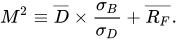
The original paper also defined a statistic called "RAPA" (presumably, an abbreviation of "risk-adjusted performance alpha"). Consistent with the more common terminology of , this would be


or equivalently,
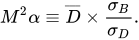
Thus, the portfolio's excess return is adjusted based on the portfolio's relative riskiness with respect to that of the benchmark portfolio (i.e., ). So if the portfolio's excess return had twice as much risk as that of the benchmark, it would need to have twice as much excess return in order to have the same level of risk-adjusted return.

The M2 measure is used to characterize how well a portfolio's return rewards an investor for the amount of risk taken, relative to that of some benchmark portfolio and to the risk-free rate. Thus, an investment that took a great deal more risk than some benchmark portfolio, but only had a small performance advantage, might have lesser risk-adjusted performance than another portfolio that took dramatically less risk relative to the benchmark, but had similar returns.
Because it is directly derived from the Sharpe ratio, any orderings of investments/portfolios using the M2 measure are exactly the same as orderings using the Sharpe ratio.
Advantages over the Sharpe ratio and other dimensionless ratios
[edit]The Sharpe ratio is awkward to interpret when it is negative. Further, it is difficult to directly compare the Sharpe ratios of several investments. For example, what does it mean if one investment has a Sharpe ratio of 0.50 and another has a Sharpe ratio of −0.50? How much worse was the second portfolio than the first? These downsides apply to all risk-adjusted return measures that are ratios (e.g., Sortino ratio, Treynor ratio, upside-potential ratio, etc.).
M2 has the enormous advantage that it is in units of percentage return, which is instantly interpretable by virtually all investors. Thus, for example, it is easy to recognize the magnitude of the difference between two investment portfolios which have M2 values of 5.2% and of 5.8%. The difference is 0.6 percentage points of risk-adjusted return per year, with the riskiness adjusted to that of the benchmark portfolio (whatever that might be, but usually the market).
Extensions
[edit]It is not necessary to use standard deviation of excess returns as the measure of risk. This approach is extensible to use of other measures of risk (e.g., beta), just by substituting the other risk measures for and :
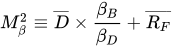
The main idea is that the riskiness of one portfolio's returns is being adjusted for comparison to another portfolio's returns.
Virtually any benchmark return (e.g., an index or a particular portfolio) could be used for risk adjustment, though usually it is the market return. For example, if you were comparing performance of endowments, it might make sense to compare all such endowments to a benchmark portfolio of 60% stocks and 40% bonds.
See also
[edit]References
[edit]- ^ Sharpe, W. F. (1966). "Mutual Fund Performance". Journal of Business. 39 (S1): 119–138. doi:10.1086/294846.
- ^ Sharpe, William F. (1994). "The Sharpe Ratio". Journal of Portfolio Management. 1994 (Fall): 49–58. doi:10.3905/jpm.1994.409501. S2CID 55394403.
- ^ Modigliani, Franco (1997). "Risk-Adjusted Performance". Journal of Portfolio Management. 1997 (Winter): 45–54. doi:10.3905/jpm.23.2.45. S2CID 154490980.
- ^ Modigliani, Leah (1997). "Yes, You Can Eat Risk-Adjusted Returns". Morgan Stanley U.S. Investment Research. 1997 (March 17, 1997): 1–4.
External links
[edit]Modigliani risk-adjusted performance
View on GrokipediaBackground and History
Development and Creators
The Modigliani risk-adjusted performance measure, often abbreviated as M² or RAP, was developed by Franco Modigliani, the 1985 Nobel laureate in economics for his pioneering contributions to the analysis of saving and financial markets, and his granddaughter Leah Modigliani, a financial analyst at the time.[3] Franco Modigliani, an Italian-American economist who spent much of his career at MIT, collaborated with Leah, who was then a vice president at Morgan Stanley, to create this metric as an extension of established risk-return frameworks in finance.[4] The measure was first introduced in their seminal article titled "Risk-Adjusted Performance," published in the Winter 1997 issue of the Journal of Portfolio Management.[5] This publication formalized the approach, providing a practical tool for evaluating investment portfolios beyond raw returns. The primary motivation behind the development was to enhance the interpretability of the Sharpe ratio, a foundational metric, by transforming its dimensionless value into a percentage return that aligns more closely with how investors intuitively assess performance.[6] This adjustment aimed to make risk-adjusted evaluations more accessible and directly comparable to benchmark returns, addressing the abstract nature of ratio-based measures. The work builds on Harry Markowitz's modern portfolio theory from 1952, which emphasized diversification and risk-return trade-offs, and William F. Sharpe's 1966 introduction of the Sharpe ratio for assessing mutual fund performance. By leveraging these precursors, the Modigliani measure sought to refine portfolio assessment in a manner consistent with post-World War II advancements in quantitative finance.Relation to Sharpe Ratio
The Sharpe ratio, introduced by William F. Sharpe in 1966, quantifies a portfolio's risk-adjusted performance as the excess return over the risk-free rate divided by the portfolio's standard deviation of returns, , where is the portfolio return, is the risk-free rate, and is the portfolio's total risk. This measure evaluates excess return per unit of total volatility, enabling comparisons across portfolios but yielding a dimensionless ratio that lacks direct interpretability as a return figure. The Modigliani risk-adjusted performance measure, developed by Franco Modigliani and Leah Modigliani in 1997, directly extends the Sharpe ratio by constructing a hypothetical portfolio that matches the volatility of a chosen benchmark while preserving the original portfolio's Sharpe ratio.[2] Specifically, it scales the portfolio's volatility to the benchmark's standard deviation through a combination of the original portfolio and a risk-free asset, effectively levering (if ) or delevering (if ) the exposure to achieve equivalent risk levels.[7] This adjustment maintains the underlying risk-return efficiency implied by the Sharpe ratio but standardizes the risk denominator for benchmark-relative evaluation.[2] Theoretically, this scaling leverages modern portfolio theory principles, where mixing a risky portfolio with a risk-free asset alters volatility proportionally without changing the Sharpe ratio, as the slope of the capital allocation line remains constant.[7] By aligning volatilities, the Modigliani measure facilitates apples-to-apples comparisons against the benchmark, addressing the Sharpe ratio's limitation in varying risk scales across assets.[2] In contrast to the Sharpe ratio's output as a pure ratio, the Modigliani measure produces an adjusted return expressed as a percentage, directly comparable to the benchmark's return and more intuitive for assessing absolute performance under standardized risk.[7]Definition
Core Concept
The Modigliani risk-adjusted performance, denoted as M² or RAP (Risk-Adjusted Performance), is a metric that evaluates a portfolio's returns after adjusting them to the risk level of a specified benchmark.[2] This measure quantifies performance by scaling the portfolio's excess return to align with the benchmark's volatility, enabling investors to assess whether the portfolio generates superior results on a comparable risk basis.[8] Its primary purpose is to provide a standardized return percentage that facilitates apples-to-apples comparisons across investments with varying risk profiles.[9] At its core, the M² measure conceptualizes a hypothetical portfolio formed by blending the actual portfolio with risk-free assets (for deleveraging) or applying leverage to replicate the benchmark's total risk exposure.[7] This adjustment creates an equivalent-risk scenario where the portfolio's performance can be directly pitted against the benchmark, emphasizing the value added by active management beyond mere risk-taking.[2] Interpretation of M² involves comparing the risk-adjusted portfolio return to the benchmark return: if M² exceeds the benchmark return , the portfolio outperforms the benchmark, with the difference denoting the percentage points of excess return attainable at the benchmark's risk level.[8] For instance, an M² of 12% compared to a benchmark return of 10% implies the portfolio delivers 2% higher returns than the benchmark when normalized for risk.[8] This approach builds on Sharpe ratio principles by transforming a ratio into an intuitive return differential.[2]Key Components
The Modigliani risk-adjusted performance measure relies on several fundamental inputs to assess a portfolio's efficiency in generating returns relative to its risk exposure. These components include the portfolio return, the risk-free rate, the portfolio's standard deviation, and the benchmark's standard deviation. Together, they facilitate a normalization process that aligns the portfolio's risk profile with that of a market benchmark, allowing for meaningful performance evaluation. The portfolio return, denoted as , represents the arithmetic mean of the historical returns generated by the investment portfolio over a specified period. This value captures the overall performance of the portfolio before any risk adjustments, serving as the starting point for evaluating whether the returns adequately compensate for the associated volatility. In practice, is calculated from periodic return data, such as monthly or annual figures, to provide a consistent basis for comparison across different assets or strategies.[10] The risk-free rate, denoted as , is the theoretical return on an investment with zero risk, typically proxied by the yield on short-term government securities like U.S. Treasury bills. It acts as a baseline threshold for expected returns, enabling the isolation of the portfolio's excess performance attributable to risk-taking rather than safe investments. By subtracting from , analysts can focus on the incremental return generated by the portfolio's active management or asset selection.[10] The portfolio standard deviation, denoted as , quantifies the total risk or volatility of the portfolio's returns, measured as the square root of the variance in historical return data. It reflects the dispersion of returns around the mean , indicating the uncertainty or potential variability in future outcomes; higher signifies greater risk exposure that must be accounted for in performance assessment. This metric is essential for understanding the portfolio's inherent instability independent of market movements.[10] The benchmark standard deviation, denoted as , measures the volatility of a reference market index, such as the S&P 500, which serves as a proxy for systematic market risk. It provides the target risk level to which the portfolio's performance is normalized, ensuring that comparisons are made on an apples-to-apples basis by aligning risk exposures. is derived similarly from the index's historical returns and embodies the opportunity cost of risk in a diversified market context.[10] The excess return concept in this framework refers to the difference between the portfolio's risk-adjusted return and the benchmark's return, highlighting any value added or subtracted after normalizing for risk levels. This differential arises from the interaction of the above components: the excess over the risk-free rate () is scaled relative to the portfolio's volatility () and the benchmark's volatility (), effectively creating a hypothetical portfolio with benchmark-equivalent risk. This interaction normalizes the portfolio's risk profile, enabling direct evaluation of whether the adjusted returns exceed those of the benchmark, thus revealing the manager's skill in risk-adjusted terms without favoring low-volatility strategies unduly.[10]Calculation
Formula
The Modigliani risk-adjusted performance measure, denoted as , is mathematically expressed as where is the risk-free rate, is the Sharpe ratio of the portfolio, is the portfolio return, is the portfolio's standard deviation of returns, and is the standard deviation of returns for the benchmark.[2] This formulation scales the portfolio's risk-adjusted excess return to the level of risk in the benchmark, yielding a hypothetical portfolio return that matches the benchmark's volatility. An equivalent expression highlights the leveraging or deleveraging factor required to adjust the portfolio's risk: Here, the term represents the factor by which the portfolio's excess return is multiplied to align its volatility with that of the benchmark, effectively creating a synthetic portfolio composed of the original portfolio and risk-free borrowing or lending.[2] Substituting the Sharpe ratio into this form confirms the equivalence, as . The derivation begins with the Sharpe ratio, , which quantifies the portfolio's excess return per unit of total risk. To enable direct comparison with the benchmark, this excess return is scaled by the benchmark's volatility , producing an adjusted excess return of . Adding the risk-free rate then yields , interpreted as the return of a portfolio with the same risk as the benchmark but the superior (or inferior) risk-adjusted performance of the original portfolio.[2] This process assumes linear scaling of returns with volatility, implying that the Sharpe ratio remains invariant under adjustments via mixing with the risk-free asset, consistent with the Capital Market Line in mean-variance theory. The units of are in percentage return terms, matching the units of and (the benchmark return), which facilitates straightforward interpretation as a return metric rather than a ratio.[2] The derivation further assumes that historical returns and volatilities are reliable estimators and that the benchmark appropriately represents systematic risk, though it does not require market equilibrium assumptions beyond the constancy of the Sharpe ratio under linear adjustments.Step-by-Step Computation
To illustrate the computation of the Modigliani risk-adjusted performance measure (M²), consider a hypothetical portfolio with an annual return , a risk-free rate , and portfolio standard deviation . For comparison, assume a benchmark with return and standard deviation . These values are illustrative and follow the standard methodology outlined by Modigliani and Modigliani (1997).[2] Step 1: Calculate the portfolio's Sharpe ratio.The Sharpe ratio measures excess return per unit of risk:
This step quantifies the portfolio's risk-adjusted efficiency relative to the risk-free rate.[2] Step 2: Scale the Sharpe ratio to the benchmark's risk level.
Multiply the Sharpe ratio by the benchmark's standard deviation to obtain the adjusted excess return:
This adjustment hypothetically leverages the portfolio's efficiency to match the benchmark's volatility.[2] Step 3: Add the risk-free rate to derive M².
The M² value is the risk-free rate plus the scaled excess return:
This yields a hypothetical return of 15% at the benchmark's risk level.[2] The resulting M² of 15% can be compared directly to the benchmark's 10% return, indicating an outperformance of 5 percentage points on a like-risk basis. This interpretation highlights the portfolio's superior risk-adjusted return without altering its underlying characteristics.[2] Regarding sensitivity, changes in inputs can significantly impact M². For instance, if increases to 18% while holding other values constant, drops to 0.50, yielding , a 2-point reduction that narrows the outperformance gap. Conversely, raising to 14% boosts to 0.73, resulting in , widening superiority. Such variations underscore M²'s responsiveness to return and volatility assumptions, emphasizing the need for accurate input data in practice.[2]
Advantages
Enhanced Comparability
The Modigliani risk-adjusted performance measure, also known as M², enhances comparability among investment portfolios by normalizing each portfolio's return to the volatility level of a specified benchmark, such as a market index. This adjustment constructs a hypothetical portfolio that combines the original portfolio with risk-free assets or leverage to match the benchmark's standard deviation (σ_b), thereby allowing direct evaluation of returns at a common risk level irrespective of the portfolios' inherent volatilities. In practice, this normalization facilitates fairer cross-portfolio assessments by scaling down the adjusted returns of high-volatility funds and scaling up those of low-volatility funds, ensuring that risk exposure does not bias comparative rankings. For mutual fund evaluations, it has been widely adopted to adjust performance metrics, enabling investors to identify superior management skill without distortion from differing risk profiles; applications in rankings of U.S. equity mutual funds and socially responsible funds have shown it produces consistent orderings while providing intuitive return-based insights.[11] It builds briefly on Sharpe ratio scaling to express results in percentage terms rather than ratios, aiding straightforward inter-fund comparisons. A key benchmarking advantage lies in its ability to quantify the excess return a portfolio could achieve over the market benchmark when adjusted to the benchmark's risk level, offering a clearer view of value added compared to unadjusted raw returns that ignore volatility differences. Empirical studies post-1997 demonstrate its improved discrimination in performance attribution; for instance, an evaluation of Philippine bond and money market mutual funds from 2008 to 2012 used M² to identify significant differences between fund categories (average M² of 0.038 for bond funds versus 0.024 for money market funds, with p < 0.05 via Mann-Whitney test), enabling more precise attribution of relative outperformance.[12] Similarly, analyses of Swedish bond funds during 2000-2003 highlighted its utility in basis-point comparisons for ranking funds against benchmarks, revealing nuanced skill-based contributions beyond simple return metrics.[13]Ease of Interpretation
The Modigliani risk-adjusted performance measure, denoted as M², expresses results in percentage return terms, such as an adjusted portfolio return of 15% compared to a benchmark of 10%, in contrast to the Sharpe ratio's abstract, dimensionless value like 0.60. This format leverages the same units as conventional return metrics, enabling straightforward interpretation of how much additional return a portfolio generates for its level of risk relative to a benchmark. The percentage-based output enhances investor appeal by making the measure accessible to non-experts, who can intuitively grasp risk-adjusted performance without needing to contextualize ratios against arbitrary benchmarks or scales.[14] This intuitiveness aligns with familiar financial reporting practices, where returns are routinely presented as percentages, thereby facilitating clearer communication in investment analyses and decision-making.[14] By presenting outcomes as tangible percentage differentials, the measure mitigates potential psychological biases associated with abstract metrics, promoting more informed evaluations among diverse stakeholders.[14]Comparisons with Other Measures
Versus Sharpe Ratio
The Sharpe ratio, defined as the excess return per unit of total risk, is a dimensionless measure that quantifies the return earned above the risk-free rate relative to the portfolio's standard deviation. This lack of units makes it challenging to directly compare portfolios operating at different risk levels or to intuitively grasp the magnitude of performance differences, as the ratio does not translate into familiar percentage terms.[7] In contrast, the Modigliani risk-adjusted performance measure (M²) addresses these shortcomings by hypothetically leveraging or deleveraging the portfolio to match the risk level of a benchmark, typically the market index, thereby yielding an adjusted return expressed in percentage terms. This adjustment provides an absolute difference in returns that can be easily interpreted and compared across portfolios, highlighting the excess performance (alpha) relative to the benchmark at a standardized risk level.[7] The Sharpe ratio is particularly useful for assessing the relative efficiency of a portfolio's return generation per unit of its own risk, making it suitable for ranking investments within similar risk classes or evaluating standalone efficiency without a specific benchmark. The Modigliani measure, however, excels in benchmark-relative evaluations, offering clearer insights into whether a portfolio outperforms a reference index after risk normalization, which is advantageous for investors seeking direct performance attribution.[7]Versus Treynor Ratio
The Treynor ratio, introduced by Jack Treynor in 1965, quantifies a portfolio's excess return over the risk-free rate per unit of systematic risk and is defined as , where is the portfolio return, is the risk-free rate, and is the portfolio's beta.[8] Unlike the Modigliani risk-adjusted performance measure, which incorporates total risk via the portfolio's standard deviation , the Treynor ratio focuses exclusively on systematic risk captured by beta, making it less comprehensive for portfolios exposed to unsystematic volatility.[15] This distinction positions the Modigliani measure as more appropriate for undiversified portfolios, where total risk—including idiosyncratic components—must be evaluated, while the Treynor ratio's reliance on beta renders it suitable primarily for well-diversified holdings.[16] A primary limitation of the Treynor ratio stems from its underlying assumption of portfolio diversification, which effectively ignores unsystematic risk and may overstate performance for concentrated investments. In practice, the Modigliani measure excels in total risk assessments across varied portfolio structures, whereas the Treynor ratio supports Capital Asset Pricing Model (CAPM)-oriented analyses emphasizing systematic risk efficiency.[15]Extensions and Applications
Variants
One notable variant of the Modigliani risk-adjusted performance (RAP) measure is the M3 measure, developed by Arun Muralidhar to address limitations in the original formulation by incorporating correlation effects between the portfolio and benchmark. The M3 measure extends the M2 approach by constructing a correlation-adjusted portfolio that matches the benchmark's volatility while targeting a specific tracking error, typically set at 300 basis points, through optimal allocations to the active portfolio, the benchmark, and the risk-free asset. This adjustment accounts for covariance and correlation in the leveraging process, providing a more robust ranking of investment managers by rewarding low-correlation alpha generation without increasing overall risk exposure.[18] The Modigliani RAP measure has been applied in multifactor investing contexts, such as evaluating funds exposed to models like the Fama-French three-factor framework. In these applications, standard RAP is used to assess risk-adjusted performance by comparing portfolios to benchmarks that account for sensitivities to market, size, and value factors, aiding comparisons among strategies with exposures beyond broad market beta.[19]Practical Uses
The Modigliani risk-adjusted performance measure, also known as M², is widely employed by portfolio managers to evaluate and rank mutual funds relative to benchmarks such as the S&P 500 in annual reports and performance summaries. By scaling a fund's returns to match the benchmark's volatility, M² enables direct comparisons of risk-adjusted outcomes, helping managers demonstrate value added beyond market exposure. For instance, studies of Saudi Arabian mutual funds have utilized M² to assess performance against local indices, revealing instances where funds outperformed on a risk-adjusted basis during stable periods.[20] Investors frequently apply M² when comparing exchange-traded funds (ETFs) or mutual funds exhibiting varying levels of volatility, as it normalizes returns to a common risk profile for clearer decision-making. This approach is particularly valuable for selecting among diversified equity funds, where raw returns might mislead due to differing standard deviations; a higher M² indicates superior reward per unit of benchmark-equivalent risk. Financial platforms and advisory services leverage M² to guide allocations, such as evaluating low-volatility ETFs against broad market trackers like those mirroring the S&P 500.[21] Since the late 1990s, M² has been incorporated into regulatory reporting for performance disclosure in SEC filings, aligning with broader efforts to enhance transparency in mutual fund prospectuses and shareholder reports through risk-adjusted metrics. The SEC's 1998 concept release on mutual fund risk encouraged the use of such measures to better inform investors about performance net of volatility, and M²'s introduction in 1997 positioned it as a practical tool for compliance with evolving disclosure standards. Fund managers often include M² alongside standard returns in Form N-CSR and prospectus updates to provide a standardized view of efficacy.[22][2] A notable case study of M²'s application occurred during the 2008 global financial crisis, where it was used to gauge the risk-adjusted resilience of equity mutual funds. Analysis of Saudi diversified equity funds from 2005–2012 showed that while raw returns declined sharply during the crisis (2008–2009), M² values indicated relative outperformance compared to benchmarks, with several funds maintaining positive risk-adjusted returns due to effective downside protection strategies. This highlighted M²'s utility in stress periods, as it revealed funds that preserved value amid heightened market volatility exceeding 30% annually.[23]Limitations and Criticisms
Key Assumptions
The Modigliani risk-adjusted performance (M²) measure relies on the assumption that investment returns follow a normal distribution, enabling the use of standard deviation as a comprehensive proxy for total risk. This normality implies that returns are symmetrically distributed around the mean, with risks adequately captured by variance without significant skewness or kurtosis affecting the measure's validity.[24][25][7] A core assumption is that the Sharpe ratio remains constant when the portfolio is hypothetically leveraged or deleveraged to match the benchmark's volatility, allowing linear scaling of returns and risk without altering the underlying risk-return efficiency. This presupposes frictionless adjustment, such as no borrowing costs or constraints, ensuring the adjusted portfolio maintains the original efficiency profile.[2][26] The measure further assumes that historical data on returns and volatility are representative of future conditions, providing a reliable basis for estimating parameters like means, standard deviations, and the risk-free rate. Without this, projections of adjusted performance could deviate from actual outcomes, undermining comparability.[25][1] Finally, the benchmark's standard deviation (σ_b) must accurately reflect the desired target risk level for fair adjustment and comparison, assuming the selected benchmark—often a market index—appropriately represents the relevant risk environment. An ill-suited benchmark could distort the scaling factor and lead to misleading risk-adjusted evaluations.[15][27]Potential Drawbacks
While the Modigliani risk-adjusted performance measure (M²) offers a standardized way to compare portfolios by adjusting returns to a common risk level, it shares limitations inherent to its foundation in the Sharpe ratio, particularly its reliance on standard deviation as a proxy for risk. This approach assumes that returns are normally distributed, which often fails in real-world financial markets characterized by skewness, kurtosis, and fat-tailed events, potentially underestimating tail risks and leading to overly optimistic performance assessments.[24][28] Another key drawback is the measure's dependence on the selection of an appropriate benchmark, as M² scales the portfolio's return to match the benchmark's volatility. An ill-chosen or unrepresentative benchmark—such as one that does not align with the portfolio's investment strategy or market exposure—can distort results, making superior performance appear inferior or vice versa, and complicating cross-portfolio comparisons.[24][29] M²'s use of historical data for both returns and volatility introduces forward-looking uncertainty, as past risk patterns may not predict future market conditions, especially during regime shifts or crises. This backward-looking nature can mislead investors relying on it for prospective decision-making.[1] Furthermore, because M² focuses on total risk via standard deviation, it is less suitable for diversified portfolios where systematic (market) risk, rather than total volatility, is the primary concern; investors in such contexts may prefer measures like the Treynor ratio that emphasize beta. Its applicability is thus constrained to scenarios assuming full investment in a single fund with risk-free borrowing or lending, limiting its utility for multi-asset strategies.[28] The quotient-based structure of M² can also produce distorted rankings when standard deviations are small, inflating values for low-volatility portfolios even if absolute returns are modest, which may not align with investor preferences for higher expected returns over mere probability rankings.[30] Additionally, portfolio managers may manipulate inputs, such as by altering asset allocations to temporarily reduce reported volatility, thereby artificially boosting M² without genuine performance improvement.[1]References
- https://www.[investopedia](/page/Investopedia).com/terms/t/treynorratio.asp