Hubbry Logo
MonodyMonodyMain
Open search
Monody
Community hub
Monody
logo
8 pages, 0 posts
0 subscribers
Be the first to start a discussion here.
Monody
Monody
from Wikipedia
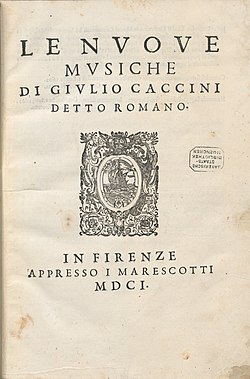
Caccini, Le nuove musiche, 1601, title page

In music, monody refers to a solo vocal style distinguished by having a single melodic line and instrumental accompaniment. Although such music is found in various cultures throughout history, the term is specifically applied to Italian song of the early 17th century, particularly the period from about 1600 to 1640. The term is used both for the style and for individual songs (so one can speak both of monody as a whole as well as a particular monody). The term itself is a recent invention of scholars. No composer of the 17th century ever called a piece a monody. Compositions in monodic form might be called madrigals, motets, or even concertos (in the earlier sense of stile concertato, meaning "with instruments").

In poetry, the term monody has become specialized to refer to a poem in which one person laments another's death. (In the context of ancient Greek literature, monody, μονῳδία, could simply refer to lyric poetry sung by a single performer, rather than by a chorus.)


History

[edit]

Musical monody, which developed out of an attempt by the Florentine Camerata in the 1580s to restore ancient Greek practices of melody and declamation (probably with little historical accuracy), one solo voice sings a melodic part, usually with considerable ornamentation, over a rhythmically independent bass line. Accompanying instruments could be lute, chitarrone, theorbo, harpsichord, organ, and even on occasion guitar. While some monodies were arrangements for smaller forces of the music for large ensembles which was common at the end of the 16th century, especially in the Venetian School, most monodies were composed independently. The development of monody was one of the defining characteristics of early Baroque practice, as opposed to late Renaissance style, in which groups of voices sang independently and with a greater balance between parts.

Contrasting passages in monodies could be for the most part melodic or for the most part declamatory and the two styles of presentation developed into the aria and the recitative respectively, both of which came to be incorporated into the cantata by about 1635.

The parallel development of solo song with accompaniment in France was called the air de cour: the term monody is not normally applied to these more conservative songs, however, which retained many musical characteristics of the Renaissance chanson.

An important early treatise on monody is contained in Giulio Caccini's song collection, Le nuove musiche (Florence, 1601).

Main composers

[edit]

See also

[edit]

References and further reading

[edit]
[edit]
Revisions and contributorsEdit on WikipediaRead on Wikipedia
from Grokipedia
Monody is a style of accompanied solo that originated in around , featuring a single, rhythmically free melodic line delivered by a solo voice over sparse instrumental accompaniment, typically , to emphasize the natural rhythm and emotional expression of the text. This musical form emerged from the efforts of the Florentine Camerata, a group of intellectuals and musicians in the late who sought to revive the dramatic style of by prioritizing clear text declamation over the complex of . Their "seconda pratica" approach treated harmony as subordinate to the text's meaning, allowing for embellishments and affective delivery that heightened dramatic impact. Key pioneers included composer and singer Jacopo Peri, who employed monody in his operas Dafne (1597 or 1598) and Euridice (1600), marking the birth of opera as a genre, and Giulio Caccini, whose collection Le nuove musiche (1601) codified the style through solo songs and a theoretical treatise. Claudio Monteverdi further advanced monody in works like L'Orfeo (1607), integrating it with ensembles to create a more theatrical and expressive operatic form that influenced the development of recitative, aria, cantata, and oratorio throughout the Baroque era. By the 1630s, monody had evolved and merged with other vocal styles, solidifying its role as a foundational element of early Baroque music.

Definition and Characteristics

Etymology and Terminology

The term monody derives from the monōidia, composed of monos ("alone" or "single") and ōidē ("song"), originally denoting a solo song or in Greco-Roman antiquity. This linguistic root was revived in the late within Italian musical discourse to describe a new style of vocal expression aimed at recapturing the emotional directness of ancient Greek music. Vincenzo Galilei first employed the Italian form monodia in his 1581 treatise Dialogo della musica antica et della moderna to advocate for a solo vocal line, typically accompanied by a simple or instrumental , as a means of reviving the monophonic practices attributed to and . Galilei contrasted this approach with the prevailing polyphonic styles of , arguing that monodia allowed for clearer text declamation and heightened affective power, drawing directly from his studies of classical sources like and . His usage marked the term's transition from classical to practical , influencing the Florentine Camerata's experiments in solo singing. By the 1590s, the concept of monodia had evolved within Italian musical circles to encompass accompanied solo songs derived from traditions, where a single voice was supported by chordal continuo rather than imitative , emphasizing expressive ornamentation and rhetorical delivery. This adaptation is evident in early solo madrigals by composers associated with the Camerata, such as , who integrated monodia into secular vocal works to prioritize textual over complexity./02%3A_Baroque/2.03%3A_Monody) In 17th-century theoretical treatises, distinctions emerged between monodia and related forms like the aria, with monodia typically reserved for freer, speech-like solo passages suited to dramatic expression, while aria denoted more structured, tuneful sections with repetitive melodic patterns. For instance, writers such as Giovanni Battista Doni in his Trattato della musica scenica (1636) differentiated monodia as a declamatory style for recitative, contrasting it with the lyrical, strophic aria used in operatic arias, reflecting the term's refinement amid the rise of Baroque opera.

Musical Features

Monody is defined by its predominant homophonic texture, consisting of a single melodic vocal line set over a chordal that subordinates harmonic support to the primacy of the text. This structure emphasizes clarity in and emotional expression, starkly contrasting the interwoven polyphonic lines characteristic of . The vocal often follows natural speech rhythms, with syllabic settings that prioritize intelligibility and rhythmic flexibility over strict metrical regularity. Central to monody's accompaniment is the , a line realized through to provide foundation and allow performers interpretive freedom in chord selection and voicing. This system enables dynamic shifts in to underscore textual affect, with the bass line typically progressing in a deliberate manner—slower for gentle, flowing passages and quicker for agitated ones. Instrumental realization often involves a like the combined with a plucked or bowed bass such as the , , or , which supply chordal filling and occasional doubling of the vocal line for reinforcement without overpowering the soloist. Expressive elements in monody include extensive ornamentation, such as trills, turns, and short coloraturas added by the singer to heighten emotional intensity, particularly on sustained notes. The stile rappresentativo, or representative style, employs rhetorical, speech-like to mimic oratorical delivery, integrating varied tempos, pauses, and dynamic contrasts that reflect the text's dramatic nuances. further enhances this expressivity, introducing dissonances and altered tones to evoke or tension, often resolving into consonant triads for affective release. Common forms in monody include short strophic songs, where the same music repeats for multiple verses, and through-composed lamentations that unfold continuously to mirror evolving emotional narratives without repetition. These pieces are typically concise, allowing for focused textual portrayal, with the overall structure derived from the poetic content rather than rigid formal schemes.

Distinction from Polyphony and Accompaniment Styles

Monody marked a significant departure from Renaissance polyphony, in which multiple independent vocal lines, often in imitative counterpoint as exemplified by madrigals, created intricate textures that could obscure textual intelligibility. In monody, a single vocal line takes precedence, supported by sparse instrumental accompaniment to ensure clear enunciation and emotional conveyance of the text, reflecting the "second practice" advocated by Claudio Monteverdi to prioritize words over contrapuntal complexity. This style also differentiated itself from preceding Italian secular songs like the frottola and villanella, which featured straightforward chordal harmony and homophonic textures for light, popular entertainment, lacking the rhetorical and declamatory expressiveness central to monody. While these earlier forms occasionally involved with —termed "pseudo-monody"—they emphasized rhythmic simplicity and repetitive structures over the flexible, speech-inflected melodies of monody designed for dramatic intensity. In relation to the emerging recitative within , monody exhibited a more lyrical and melodic character compared to the strictly speech-like, narrative-driven delivery of , particularly in prologues where the focus remained on advancing the plot without elaborate musical development. Nonetheless, monody's declamatory elements directly influenced 's formation, blending solo vocal freedom with harmonic support to serve operatic dialogue. Overall, monody functioned as a transitional form, linking the unaccompanied single-line purity of medieval monophonic to the fuller homophonic textures of the era, where a dominant is bolstered by chordal , consistently elevating textual meaning above polyphonic elaboration. The , with its providing harmonic guidelines, was instrumental in facilitating this evolution by standardizing accompaniment practices.

Historical Development

Origins in Late Renaissance Italy

In the late 16th century, humanist scholars in Italy sought to revive the dramatic essence of ancient Greek tragedy, drawing on classical texts to emphasize solo vocal delivery as a means to convey profound emotional impact and moral instruction. Influenced by Aristotle's Poetics and the concept of imitatio, these intellectuals argued that music should serve the text's rhetorical power, prioritizing clear declamation over complex polyphony to evoke the passions (pathos) of Greek drama. This intellectual movement laid the groundwork for monody by shifting focus from ensemble singing to expressive solo lines that mirrored natural speech rhythms. Central to this development was the Florentine Camerata, an informal circle of humanists, musicians, and nobles active from around 1573 to 1587, hosted primarily by Count Giovanni de' Bardi at his palace in . Key members, including and , theorized that must remain subservient to , advocating for a stile rappresentativo—a representational style where melody imitated the inflections of spoken verse to heighten dramatic expression. Bardi's discourses on , such as his letter to Caccini, and related discussions critiqued the excesses of contemporary polyphonic , proposing instead a return to what they perceived as the monophonic simplicity of ancient Greek to better serve poetic meaning and emotional depth. Early monodic experiments emerged from these debates, notably in Galilei's Dialogo della musica antica et della moderna (1581), which advocated for solo singing accompanied by instruments like viols to realize ancient ideals in a style that became known as monody. These ideas culminated in practical applications through Jacopo Peri's settings of Ottavio Rinuccini's librettos: (1598), the first known entirely in monodic style, and Euridice (1600), both developed within Camerata circles to emulate Greek tragic recitation. This cultural ferment occurred under the patronage of the Medici family in , whose ducal court provided financial and for experimental music circles, enabling gatherings like the Camerata amid the city's vibrant intellectual scene. The Medici, particularly Grand Duke Francesco I and later Ferdinando I, sponsored intermedi and theatrical events that intersected with these innovations, fostering an environment where humanist experimentation thrived. This socio-political backdrop, intertwined with the broader efforts to renew Catholic arts through expressive and edifying forms, encouraged reforms against perceived musical excesses in favor of clarity and emotional directness.

Emergence in Early Baroque Opera

Monody found its practical realization in the nascent of around 1600, where it functioned primarily as to convey dramatic dialogue in a speech-like manner. Jacopo Peri's Euridice (1600), premiered at the Medici court in , marked the debut of this style in a fully staged production, employing monodic lines over to mimic natural speech rhythms and emphasize textual clarity for narrative progression. advanced this approach in (1607), performed at the Gonzaga court in , where served as the vehicle for emotional soliloquies and character interactions, building on Peri's foundations with greater harmonic flexibility and dissonance to heighten expressivity. This integration represented a shift from intimate chamber settings, such as those of the Florentine Camerata, to grander staged performances that incorporated scenery, costumes, and machinery, thereby amplifying monody's theatrical potential. In and , these courtly productions transformed monody from experimental solo songs into a core element of , supported by simple accompaniment that allowed the solo voice to dominate. Key innovations included extended monodic laments that blended declamatory speech with melodic contours, as exemplified by Orfeo's "Possente spirto e formidabil nume" in L'Orfeo's Act 3, a strophic featuring and instrumental echoes to evoke profound grief and persuasive power. By the 1630s, monody had spread to , where the opening of public opera houses democratized access to this style beyond elite courts. The Teatro San Cassiano, inaugurated in 1637 with Benedetto Ferrari and Francesco Manelli's Andromeda, was the first such venue, enabling broader audiences—including patricians, citizens, and visitors—to experience monodic recitatives and laments in commercial seasons, thus enhancing the genre's cultural reach and popularity. This Venetian development, following initial private performances, marked monody's transition to a public spectacle, with subsequent theaters like the Teatro SS. Giovanni e Paolo (1639) further promoting its dissemination through repeated stagings and printed librettos.

Evolution Through the 17th Century

Following its initial development in , monody spread to other European regions, adapting to local musical traditions while retaining its emphasis on expressive solo vocal lines supported by . In , the style manifested in the airs de cour, secular solo songs with or continuo accompaniment that echoed Italian monody's text-driven expressivity but incorporated French poetic rhythms and syllabic . These pieces, popularized by composers such as Guédron, appeared in printed collections from the early 1600s, reflecting monody's adaptation to courtly and salon settings. Italian influences also shaped French recitative, particularly in Jean-Baptiste Lully's recitatif simple, a measured, speech-like style that tempered monody's dramatic intensity to suit French verse and declamatory norms, as seen in his tragédies en musique from the 1670s onward. In , monody's impact emerged through composers who studied in , blending it with native polyphonic traditions to create more emotive sacred and secular works. , after training in under , integrated monodic recitatives and solo lines into his compositions, such as the Symphoniae sacrae (1629–1650), fostering a German variant that emphasized rhetorical delivery and affective contrast. Elements of Monteverdi's stile concitato—characterized by rapid note repetitions and trills for agitation—filtered into German music via Schütz and others, influencing expressive techniques in passions and concertato styles during the mid-century amid the . By the mid-17th century, monody began evolving within and related genres toward more formalized structures, particularly through its integration with emerging forms. Composers increasingly combined monodic recitatives with closed vocal sections, leading to the (ABA form), where the opening melody returned after a contrasting middle, providing structural balance while allowing virtuosic display. This shift, evident in Venetian operas from the 1650s, marked monody's transformation from fluid, through-composed lines—as in early examples like Monteverdi's Orfeo (1607)—to more predictable, repeatable patterns that enhanced dramatic pacing and singer prominence. Monody's dominance waned in opera by the 1670s as polyphonic ensembles and elaborate arias proliferated, reintroducing contrapuntal textures for choral and concerted effects in works by composers like Antonio Cesti and . However, monodic elements persisted in cantatas and oratorios, where solo recitatives and arias maintained their role in narrative and devotional expression, as in Schütz's Musikalische Exequien (1636) and later Italian sacred dialogues. Publication trends in the 1620s further standardized monodic notation, with Roman anthologies compiling solo songs by diverse composers, including thoroughbass figures and to facilitate and dissemination across Europe. These collections, such as those issued from 1621 onward, promoted consistent realization of the , bridging amateur and professional practices.

Key Composers and Works

(1567–1643) was an Italian composer whose career spanned the transition from the to the era, serving initially as a court musician and later as maestro di cappella in from 1590 to 1612 before moving to in 1613 to take up the same position at , where he remained until his death. His early publications, including the first five books of madrigals, adhered to polyphonic traditions, but from the early 1600s, he embraced the , prioritizing textual expression over strict , which positioned him as a pivotal bridge between stylistic periods. In , Monteverdi adapted his compositional approach to the basilica's polychoral demands while continuing to innovate in secular and sacred forms. Monteverdi's key contributions to monody appear in works like his opera (1607), where laments such as Orfeo's "Tu se' morta" exemplify recitative-style monody, using a solo voice over to convey profound grief through declamatory lines that mimic natural speech rhythms. Similarly, his Vespro della Beata Vergine (1610) integrates monodic solos, including the sensuous Nigra sum from the , rendered as recitative-like motets for solo voice with minimal accompaniment to heighten devotional intimacy. In his Settimo libro de madrigali (1619), Monteverdi further advanced monody within ensemble contexts, introducing the stile concitato—an agitated style featuring rapid note repetitions and effects—to depict intense emotions like anger, as heard in pieces like "Altri canti d'amor." Monteverdi's innovations in monody emphasized emotional intensity through calculated dissonances, such as unprepared suspensions and chromatic alterations, which heightened dramatic tension beyond norms, and rhythmic freedom, allowing irregular phrasing and wide leaps to imitate the inflections of spoken Italian. These techniques, rooted in the theoretical groundwork of the Florentine Camerata, enabled monody to serve as a vehicle for affective text setting in both secular and sacred music. During his Venetian tenure, Monteverdi's influence extended to pupils and successors, evidenced by manuscripts at St. Mark's that preserve his monodic techniques in instructional contexts, such as those copied by or for singers like Giovanni Rovetta, who succeeded him in 1643, and Francesco Cavalli, whose early operas adopted Monteverdi's expressive recitatives and dissonant harmonies. These documents, including partbooks and scores from the basilica's archives, demonstrate how Monteverdi's methods shaped the next generation's approach to solo vocal writing in Venetian opera and sacred music.

Jacopo Peri and Early Florentine Camerata

(1561–1633), an Italian composer and singer, played a pivotal role in the development of monody through his association with the Florentine Camerata, a group of intellectuals and musicians gathered around patron Giovanni de' Bardi in the late . Born in , Peri relocated to early in life, where he served as a singer and organist at the Medici court from 1588 onward. His compositional efforts focused on reviving dramatic forms, aligning with the Camerata's humanist ideals of restoring music's capacity for emotional and textual expression akin to . Peri's most significant contributions to monody came through his operas Dafne (1597) and Euridice (1600), which are recognized as the earliest known works in the genre. Dafne, with a by Ottavio Rinuccini, was performed privately at the Palazzo Corsi in and marked the first attempt to set an entire dramatic text to monodic music, though its score is now lost. Euridice, also to a Rinuccini libretto, survives as the oldest complete and exemplifies monody's application in a full theatrical context. These works emerged from collaborations within the Camerata, including with composer Jacopo Corsi, who hosted meetings, and singer . The Camerata's collective efforts emphasized monody's simplicity to prioritize poetic declamation over polyphonic complexity, a principle evident in Caccini's Le nuove musiche (1602), which served as a theoretical and practical companion to Peri's operas. This collection provides examples of monodic settings and advocates for sparse to highlight vocal line and text. Peri's output in Euridice features syllabic text setting, where each syllable typically receives one note, and minimal ornamentation to ensure dramatic clarity and natural speech rhythms, allowing the music to serve the narrative rather than dominate it. Archival records document Euridice's premiere on October 6, 1600, at the Palazzo Pitti in , commissioned for the wedding celebrations of and Maria de' Medici, under Medici patronage. Peri himself performed the role of Orfeo in this production, which blended monody with choral and instrumental elements to create a proto-operatic spectacle. These performances at Medici court events not only showcased monody's viability for dramatic expression but also influenced subsequent court operas by establishing a model for integrating solo vocal lines with continuo accompaniment in lavish aristocratic settings.

Sigismondo d'India and Other Innovators

Sigismondo d'India (c. 1582–1629), a Sicilian composer and singer born in , emerged as a key figure in the development of monody during the early 17th century, serving at courts in , , and . He produced a substantial body of secular , including approximately 84 chamber monodies, which emphasized the expressive potential of solo voice over accompaniment. His primary contributions appear in the series of Musiche publications, beginning with Le prime musiche (Venice, 1609) and continuing through Secondo libro di musiche (1610), Terzo libro (1611), up to the Quinto libro (1623), where he crafted solo songs that blended recitative-like declamation with more melodic elements. These works often drew on poetic texts by and Tasso, showcasing d'India's skill in heightening emotional intensity through chromatic progressions and affective dissonance, particularly in genres that evoked profound . D'India's monodies pushed the boundaries of the style with virtuosic demands on the singer, incorporating rapid melodic runs, wide leaps, and intricate ornamentation to mirror textual rhetoric and passion. For instance, pieces like "Cruda Amarilli" from his 1609 collection demonstrate melismatic cadences and harmonic tensions that intensified dramatic expression, distinguishing his output as second only to Monteverdi's in emotional depth. This approach not only advanced the seconda pratica emphasis on text over strict counterpoint but also introduced subtle shifts toward aria-like structures within monodic frameworks, influencing the transition from recitative to more tuneful solo forms. Other innovators expanded monody's scope in complementary ways. Francesco Rasi (c. 1574–1621), a renowned and active in and , contributed through his Vaghezze di musica per una voce sola (Venice, 1608), a collection of solo songs that highlighted virtuosic vocal display and rhetorical delivery, often on texts by Chiabrera and Guarini. Rasi's works, analyzed in musicological studies, reveal his focus on embellished lines and continuo realizations that supported expressive freedom, as seen in pieces like "Indarno, occhi, girate." In mid-17th-century Venice, Barbara Strozzi (1619–1677), a prolific and performer trained under Francesco Cavalli, further innovated with monodic solo songs and arias, such as "Lagrime mie" from her Diporti di , Op. 7 (1659), which employed dissonance and melodic agility to convey intimate emotional narratives. Strozzi's output, including monodic madrigals for solo voice, underscored the style's adaptability to personal and dramatic expression in chamber settings. The dissemination of these monodies relied heavily on printed collections from Venetian publishers like Gardano, which facilitated the style's spread across Europe in the early 17th century. D'India's Musiche books and Rasi's Vaghezze served as influential "pattern-books," providing models for composers and performers in Italy, Germany, and beyond, while Strozzi's eight published volumes sustained monody's vitality in Venetian academies and courts. This printing activity, centered in Venice amid a broader Italian music-publishing network, ensured that innovations in affective dissonance and virtuosity reached international audiences, embedding monody in emerging vocal traditions.

Influence and Legacy

Role in the Birth of Opera

Monody served as the primary vehicle for recitativo accompagnato in early , where a solo voice was supported by a accompaniment, allowing composers to replicate the natural rhythms and inflections of speech to advance dramatic storytelling. This style emerged from the Florentine Camerata's efforts to revive dramatic monody, emphasizing textual clarity and over polyphonic complexity, as seen in the flexible melodic lines that followed spoken patterns. In works like Peri's Euridice (1600), this approach enabled characters to convey narrative progression through heightened yet naturalistic vocal delivery, marking monody's essential contribution to 's emergence as a theatrical form. Over time, monody evolved within operas from predominantly -based structures into more structured forms, providing a balance between the improvisatory flexibility of speech-like passages and the repetitive, lyrical elements that heightened emotional impact. Early prioritized dramatic propulsion, but by the mid-17th century, composers integrated strophic and derived from monodic principles, allowing singers to showcase while maintaining narrative coherence. This development is evident in Venetian operas, where monody's soloistic focus shifted toward elaborate that contrasted with sections, enhancing the overall dramatic arc without sacrificing textual primacy. The theoretical foundations of monody's dramatic role were fiercely debated, particularly in the controversy between theorist Giovanni Maria Artusi and composer Claudio Monteverdi. In his 1600 treatise L'Artusi, overo Delle imperfettioni della moderna musica, Artusi critiqued the seconda pratica—the modern style prioritizing text expression through dissonance and monodic freedom—as a violation of traditional contrapuntal rules, arguing it undermined musical harmony. Monteverdi countered through his brother Giulio Cesare in 1604 and in the preface to his fifth book of madrigals (1605), affirming the seconda pratica's emphasis on affective rhetoric and dramatic verisimilitude, which justified monody's primacy in conveying human passions central to opera. These arguments solidified monody's theoretical legitimacy as opera's expressive core. Monody's integration into opera progressed from intimate private court spectacles in and —such as the 1600 premiere of Euridice at the Medici court—to widespread public performances, culminating in Venice's Teatro San Cassiano opening in 1637 with Ferrari and Manelli's Andromeda. This milestone transformed into a commercial genre accessible to paying audiences, with monody's solo vocal style adapting to larger venues through amplified expressiveness and singer-centric arias. By the 1640s, Venetian theaters proliferated, producing dozens of operas annually that relied on monody to engage diverse crowds, establishing the genre's enduring public appeal.

Impact on Vocal Music Traditions

Monody's emphasis on expressive text profoundly shaped the development of sacred vocal genres in the era, particularly through its adaptation into cantatas and sacred concertos. In , integrated Italian monodic principles during his second Venetian sojourn (1628–1629), where he studied under and Alessandro Grandi, mastering a sacred variant that prioritized solo voices with continuo to convey rhetorical and emotional depth. This is evident in his Symphoniae sacrae (1629, Op. 6, SWV 257–276), a collection of small-scale vocal concertos that employed monody to enhance text expression, deriving their essence from the words' meaning, syntax, and punctuation amid the resource constraints of the . Schütz's approach blended Italian innovations with German Protestant traditions, establishing a model for the geistliche Konzerte (sacred concertos) and early cantatas that emphasized soloistic over , influencing subsequent composers in creating text-driven sacred works. Beyond sacred music, monody exerted a notable influence on secular vocal traditions in and , where it infused songs and dramatic forms with heightened emotional expressivity. In , the style impacted the evolution of solo songs and semi-operas, as composers adapted Italian monody's focus on dramatic text setting to native ayre traditions from around 1610 onward. , as court composer from 1677, incorporated these monodic elements into his semi-operas, blending them with French dance rhythms and English ; for instance, in (1692–1695), an adaptation of Shakespeare's , Purcell's songs like "Thrice Happy Lovers" feature soloistic lines that echo monody's characterful declamation over continuo, enhancing the integration of music with spoken . This synthesis helped define English Baroque vocal music, distinguishing it from continental while retaining monody's core of mood and textual fidelity. In , monody similarly informed the air de cour, a courtly song that adopted Italianate solo lines for expressive delivery, though tempered by national preferences for measured rhythms. By the early 18th century, monody's fluid, recitative-like structure transitioned into more formalized aria types, culminating in the dominance of the around 1700, yet preserving its foundational emphasis on emotional text expression. Emerging from the , the da capo form (ABA) standardized the as a ternary structure with an ornate return to the opening section, allowing singers to showcase while maintaining monody's text-driven ; (1660–1725) played a key role in this evolution through his operas, where arias balanced recitative's declamatory roots with structured lyricism. further refined it in works like his forty-two operas (1711–1741), where the form's emotional core—rooted in monody's rhetorical sensitivity—supported character development without sacrificing dramatic flow. This shift marked monody's integration into broader vocal practices, evolving from soloistic innovation to a staple of operatic and repertoires. Monody's pedagogical legacy endured in 17th-century vocal treatises, which codified its principles of natural text declamation as essential to expressive . Treatises like Jacopo Peri's preface to Euridice (1600) positioned monody as a hybrid between speech and song, using bass lines and harmonies to shape emotions through rhythmic freedom that mirrored oratorical accents. Giovanni Battista Doni's Annotationi (1640) elaborated on this, advocating for monody to capture "the emotions and… natural accents of emotional speech" in three styles: , dramatic, and expressive. Similarly, Il Corago (c. 1630) instructed singers to imitate a fine actor's theatrical delivery, ensuring that monodic lines prioritized textual clarity and passion over melodic artifice. These writings influenced across , embedding monody's declamatory into training that prioritized in vocal performance.

Modern Interpretations and Revivals

The movement, emerging prominently in the mid-20th century and accelerating through the 1980s, has played a pivotal role in reviving monody via (HIP) practices that emphasize period instruments and original stylistic conventions. Italian ensemble Concerto Italiano, founded in 1984 by harpsichordist Rinaldo Alessandrini, exemplifies this revival by specializing in repertoire, particularly Claudio Monteverdi's operas and madrigals featuring monodic recitatives, performed on authentic instruments like theorbos, harpsichords, and cornetts to evoke the intimate expressivity of 17th-century solo song. Scholarly efforts in the 1990s further shaped modern interpretations by debating the authenticity of ornamentation—such as improvised diminutions and passaggi—and continuo realization in monody, often drawing on treatises like those of Giulio Caccini. Tim Carter's edition of Jacopo Peri's Le varie musiche (originally published 1609, edited 1985 and re-recorded in 1999) addressed these issues through critical analysis of embellishment practices, while his 1993 article "Possente spirto: On Taming the Power of Music" examined continuo accompaniments in Monteverdi's L'Orfeo, and his 1999 essay "Singing Orfeo: On the Performers of Monteverdi's First Opera" explored vocal techniques and ranges to guide authentic realizations. These works influenced subsequent editions, promoting flexible yet textually driven ornamentation over rigid 19th-century conventions. Pioneering recordings bolstered these revivals, with Nikolaus Harnoncourt's 1971 interpretation of Monteverdi's L'Orfeo—featuring the Concentus Musicus Wien on period instruments—marking a landmark HIP effort that underscored monody's dramatic recitative style and sparse continuo textures, setting standards for emotional intensity and instrumental clarity. Contemporary adaptations have seen monody's focus on unaccompanied-like solo lines with minimal harmonic support resonate in new compositions, particularly minimalist vocal works that prioritize textual declamation and sparse textures. For instance, composer Jay Alan Yim's Rhapsody in 7Sharp9 (premiered in the 2010s) includes a section titled "Tangled Monody," adapting early Baroque principles of expressive, rhythmically free vocal lines over subtle accompaniment to explore modern emotional narratives. Since 2000, digital archives and streaming platforms have democratized access to monody recordings, with initiatives like the hosting digitized HIP performances of Monteverdi's works and re-releases on labels such as Warner Classics preserving seminal interpretations for global audiences.

References

Add your contribution
Related Hubs
User Avatar
No comments yet.