


Community hub
Recent from talks
Contribute something
Nothing was collected or created yet.
The Moonglows
View on Wikipedia
Key Information


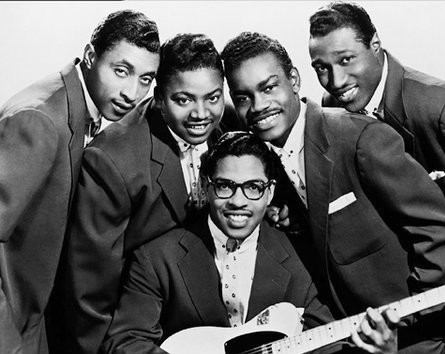
The Moonglows were an American R&B group in the 1950s. Their song "Sincerely" went to number 1 on the Billboard R&B chart and number 20 on the Billboard Juke Box chart.
They were inducted into the Rock and Roll Hall of Fame in 2000.[2]
Career
[edit]Early years
[edit]Fresh from a stint in the U.S. Army, two friends, Harvey Fuqua and Bobby Lester, formed a duo in 1949 in Louisville, Kentucky, United States.[3] In 1951, Fuqua moved to Cleveland and formed the Crazy Sounds with the singers Danny Coggins and Prentiss Barnes.[3] Lester joined them later.[3]
In 1952, while performing at a Cleveland club, the Crazy Sounds auditioned for the club's management. They soon got in contact with the radio host Alan Freed, who upon hearing them became the group's manager.[3] Freed renamed the group the Moonglows, after his own nickname, Moondog.[3] They signed with Freed's Champagne label, but their recordings for the label failed to make the charts. Coggins left the group and was replaced by Alexander Walton, who was sometimes known as Pete Graves or Pete Walton.[3]
In 1953, they recorded for another small label, Chance, but like their Champagne recordings, their records had little success; their cover of Doris Day's "Secret Love" was their most successful for Chance.[3] In September 1953, Freed obtained a contract with the New York radio station WINS. His success as a broadcaster and host of the station led to a contract for the Moonglows with Chess Records.[3]
Success
[edit]Their first Chess single, "Sincerely", led by Lester, reached number one on the Billboard R&B chart and the top 20 of the pop chart. The song was later a crossover success in a cover version by the McGuire Sisters.[4] In 1955, the band picked the guitarist Billy Johnson to be their fifth member after Wayne Bennett left the group following their engagement at the Apollo Theater.[3] That same year, the group had another R&B hit with "Most of All", followed by a more modest success with "We Go Together" in 1956.[3] Chess issued some of their recordings with the group credited as the Moonlighters.[3]
For most of the Moonglows' tenure, the lead vocals were split between Lester and Fuqua. Lester preferred doo-wop ballads, whereas Fuqua preferred rock-and-roll songs.[3] The two also recorded vocal duets.[3] Their next hits, in 1956, included "See Saw", which peaked at number five R&B and number 25 on the Billboard Top 100, and "When I'm with You". which reached number 15 on the R&B chart.[3] In August 1956, the band appeared in one of the first rock-and-roll movies, Rock, Rock, Rock, lip-syncing "Over and Over Again" and "I Knew From The Start".[3]
By December 1956, Fuqua had begun to sing most of the vocal leads.[3] In June 1957, the Moonglows had an R&B hit with their cover of Percy Mayfield's "Please Send Me Someone to Love". In late 1958, the Fuqua-led "Ten Commandments of Love" (used in soundtrack of "A Bronx Tale"[5]) reached number nine R&B and number 22 pop; the group was billed as Harvey and the Moonglows.[3] Chess released two EPs and an album, Look, It's the Moonglows, during that period.[3] Following that release, the original group broke up at the end of the year, performing together only for contractual reasons.[3]
Spinoff groups
[edit]In 1959, Lester began a solo career.[3] That same year, Harvey Fuqua, following the advice of another Chess artist, Bo Diddley, worked with the Marquees, where Fuqua first met Marvin Gaye. Relocating the group from their hometown of Washington, D.C., to Chicago, Fuqua soon brought Chuck Barksdale into the group after Barksdale's group, the Dells, was temporarily on a break following a car crash involving one of its members.[3] Fuqua renamed the group Harvey and the New Moonglows.[3] In April 1959, Fuqua sang lead on the ballad "Twelve Months of the Year", which included a spoken recitation by Gaye, repeating an early trademark of the Moonglows in "Ten Commandments of Love".[3] Later in 1959, Chess issued the songs "Unemployment" and "Mama Loocie", which was Gaye's first lead vocal.[3] Most of the time, Fuqua recorded solo numbers and often promoted his and the New Moonglows' songs on TV and in movies.[3] During this time, the group recorded background vocals for the likes of Etta James and Chuck Berry.[6][7]
Lester later formed his own Moonglows group. In 1959, he made headlines after he was arrested on a narcotics charge in Beaumont, Texas.[3] In early 1960, James Nolan left Fuqua's group, as did Reese Palmer. According to Palmer, they left to raise their families.[3] Chuck Barksdale also left to rejoin the revived Dells.[3] In late 1960, Gaye, Chester Simmons and Fuqua recorded (along with, presumably, members of the Spinners) the last New Moonglows recordings, including "Junior" and "Beatnik".[3] Afterwards, Gaye relocated to Detroit and later signed with Tamla, a subsidiary of Motown Records.[3] In February 1961, Fuqua left Chess and worked on his own Detroit labels, Harvey and Tri-Phi, until he joined Motown's production team.[8] He left Motown for RCA in 1970.[3] In 1969, Prentiss Barnes retired from show business after complications of injuries from a car crash.
Reunion
[edit]In 1970, Harvey Fuqua, Bobby Lester and Pete Graves reunited as the Moonglows with Doc Williams and Chuck Lewis.[3] In 1972, they recorded "Sincerely '72" for Big P Records.[3] RCA soon bought Big P and reissued "Sincerely '72", which reached number 43 on the R&B chart.[3] The album The Return of the Moonglows was also released that year.[3] The reunion proved to be short-lived.[3]
Final years and deaths
[edit]Danny Coggins died on July 27, 1972, due to a heart attack.[3]
Bobby Lester continued to sing lead for his own Moonglows group until he succumbed to complications of cancer in 1980, at the age of 49.[8] He was replaced by Billy McPhatter, son of Clyde McPhatter.
Fuqua performed with Bobby Lester's Moonglows at the 1983 Grammy Awards ceremony, and the group toured as Harvey and the Moonglows until 1986. Bobby Lester, Jr., replaced McPhatter as lead singer of Bobby Lester's Moonglows.[9]
They also performed at Doo Wop 50, where they sang "Sincerely" and "Ten Commandments of Love". The line-up was Harvey Fuqua, Bruce Martin, Gene Kelley, Peter Crawford, and Gary Rodgers.
Billy Johnson died in Los Angeles on April 28, 1987.[8]
Chester Simmons died on September 26, 1988.[10][11]
Gary Rodgers died on June 25, 2005.[12][13]
Gene Kelley died in 2008.[13]
Reese Palmer died on October 27, 2011.[14]
Prentiss Barnes and Pete Graves both died in 2006.[3][15] Fuqua, the last surviving original member of the group, died on July 6, 2010, in Detroit.[3]
Legacy
[edit]The Moonglows' singing style is known as "blow" harmony, based on the technical method used by the backing vocalists.[8]
The Moonglows were inducted into the Vocal Group Hall of Fame in 1999 and the Rock & Roll Hall of Fame in 2000.[2]
The group are mentioned in Paul Simon's 1983 song "René and Georgette Magritte with Their Dog after the War".
Members
[edit]- Harvey Fuqua, vocals (1953–1958)
- Bobby Lester, vocals (1953–1958)
- Alexander "Pete" Walton (or Graves), vocals (1953–1958)
- Prentiss Barnes, vocals (1953–1958)
- Billy Johnson, guitar (1953–1958)
- Danny Coggins, vocals (1953)[8]
Discography
[edit]Albums
[edit]Studio albums
[edit]Compilations
[edit]- Rock, Rock, Rock! (1956)
- Bunch Of Goodies (1960)
- The Best Of Bobby Lester And The Moonglows (1962)
- The Flamingos Meet The Moonglows On The Dusty Road Of Hits (1962)
- The Moonglows Greatest Hits (1973)
- Moonglows (1976)
Singles
[edit]| Year | Single (A-side, B-side) Both sides from same album except where indicated |
Chart positions | Album | |
|---|---|---|---|---|
| US | US R&B | |||
| 1953 | "Just a Lonely Christmas" b/w "Hey, Santa Claus" |
— | — | Non-album tracks |
| 1954 | "Secret Love" b/w "Real Gone Mama" |
— | — | |
| "I Was Wrong" b/w "Ooo Rockin' Daddy" |
— | — | ||
| "219 Train" b/w "My Gal" |
— | — | ||
| "Sincerely" b/w "Tempting" (Non-album track) |
20 | 1 | "Rock, Rock, Rock" soundtrack | |
| 1955 | "Most Of All" b/w "She's Gone" (Non-album track) |
— | 5 | Bunch of Goodies |
| "Starlite" b/w "In Love" |
— | — | Non-album tracks | |
| "Lover, Love Me" b/w "In My Diary" (from Bunch of Goodies) |
— | — | ||
| 1956 | "We Go Together" b/w "Chickie Um Bah" (Non-album track) |
— | 9 | Bunch of Goodies |
| "When I'm With You" / | — | 15 | Look! It's The Moonglows | |
| "See Saw" | 25 | 6 | "Rock, Rock, Rock" soundtrack | |
| "Over and Over Again" b/w "I Knew From The Start" |
— | — | ||
| 1957 | "Don't Say Goodbye" b/w "I'm Afraid The Masquerade Is Over" (Non-album track) |
— | - | Look! It's The Moonglows |
| "Please Send Me Someone to Love" b/w "Mr. Engineer (Bring Her Back To Me)" (Non-album track) |
73 | 5 | Bunch of Goodies | |
| "The Beating Of My Heart" b/w "Confess It To Your Heart" |
— | — | Non-album tracks | |
| 1958 | "Here I Am" b/w "Too Late" |
— | — | |
| "In the Middle of the Night" b/w "Soda Pop" |
— | — | ||
| "Ten Commandments of Love" b/w "Mean Old Blues" |
22 | 9 | Look! It's The Moonglows | |
| 1959 | "Mama Loocie" b/w "Unemployment" |
— | — | Non-album tracks |
| 1972 | "Sincerely" b/w "I Was Wrong" |
— | 43 | The Return Of The Moonglows |
References
[edit]- ^ Du Noyer, Paul (2003). The Illustrated Encyclopedia of Music. Fulham, London: Flame Tree Publishing. p. 181. ISBN 1-904041-96-5.
- ^ a b "The Moonglows: Inducted in 2000". Rockhall.com. Retrieved June 20, 2013.
- ^ a b c d e f g h i j k l m n o p q r s t u v w x y z aa ab ac ad ae af ag ah ai aj ak al am "Marv Goldberg's R&B Notebooks: Moonglows". Uncamarvy.com. Retrieved June 20, 2013.
- ^ Tobler, John (1992). NME Rock 'N' Roll Years. London: Reed International Books. p. 11. CN 5585.
- ^ "A Bronx Tale - Music From The Motion Picture". Amazon.com. Retrieved February 17, 2018.
Original Motion Picture Soundtrack
- ^ "Just preordered this..." Both Sides Now Stereo Chat Board. Archived from the original on July 18, 2011. Retrieved August 20, 2009.
- ^ Dietmar Rudolph. "Who Were the Ecuadors? – The Chuck Berry Collectors Blog". Crlf.de. Retrieved March 13, 2016.
- ^ a b c d e Colin Larkin, ed. (1997). The Virgin Encyclopedia of Popular Music (Concise ed.). Virgin Books. p. 870. ISBN 1-85227-745-9.
- ^ Warner, Jay. American Singing Groups: A History from 1940 to Today. Hal Leonard. ISBN 9780634099786. Google Books link
- ^ "Chester Simmons Songs, Albums, Reviews, Bio & More". AllMusic. Retrieved May 14, 2023.
- ^ "Marv Goldberg's R&B Notebooks - MARQUEES". Uncamarvy.com. Retrieved June 26, 2023.
- ^ "Gary Rodgers Obituary (2005) - Louisville, KY - Courier-Journal". Legacy.com. Retrieved June 26, 2023.
- ^ a b THE MOONGLOWS "SEE SAW" LIVE - 1995, retrieved June 26, 2023
- ^ McArdle, Terence (November 3, 2011). "Reese Palmer, lead singer of Washington doo-wop group the Marquees, dies at 73". Washington Post. ISSN 0190-8286. Retrieved May 14, 2023.
- ^ "Biloxi and Gulfport News, Casinos, Jobs, Real Estate, Sports and Cars". March 13, 2007. Archived from the original on March 13, 2007. Retrieved January 15, 2019.
- ^ Whitburn, Joel (1973). Top LPs, 1955–1972. Record Research. p. 105. Retrieved October 27, 2025.
External links
[edit]
The Moonglows
View on GrokipediaFormation and Early Years
Origins in Cleveland
The Moonglows originated in Cleveland, Ohio, where Harvey Fuqua and Bobby Lester formed a casual singing group in 1951 among friends and family, drawing from their earlier amateur performances in Louisville, Kentucky.[1] Fuqua, born in Louisville in 1929 and nephew of Ink Spots guitarist Charlie Fuqua, had moved to Cleveland that year to pursue music opportunities in the city's burgeoning R&B scene.[6] Initially known as the Crazy Sounds, the group practiced vocal harmonies inspired by doo-wop trends and local R&B influences, such as the improvisational styles of groups like the Ravens.[1] The core original lineup consisted of Harvey Fuqua on baritone vocals, Bobby Lester on lead and tenor vocals, Prentiss Barnes on bass vocals, Alexander "Pete" Graves on high tenor vocals, and guitarist Billy Johnson providing occasional vocals and instrumentation.[1] (Earlier iterations briefly included tenor Danny Coggins before Graves joined in 1953.) They honed their sound through local rehearsals and made their early appearances at talent shows, club auditions, and community events around Cleveland, building a repertoire of original material and covers that emphasized tight harmonies and emotional delivery.[1] In 1952, the group caught the attention of disc jockey Alan Freed during a club audition, leading him to rename them the Moonglows—evoking his on-air "Moondog" persona—and take on their management.[7] Freed, a key figure in promoting the integration of R&B into what would become rock and roll, helped professionalize their act within Cleveland's vibrant music ecosystem.[8] This transition marked the end of their informal origins and set the stage for broader exposure.[1]Signing with Chess Records
Freed's growing influence as a promoter of rhythm and blues helped elevate the group's visibility. Following their debut single on Freed's Champagne label in early 1953, they recorded for Chance Records, releasing "Whistle My Love" backed with "Baby Please" in October 1953, which received limited regional attention.[1] Leveraging his industry connections, Freed secured a contract for the Moonglows with Chess Records in September 1954, marking their entry into a major independent label known for its blues and R&B roster. This signing represented a significant step up from their initial indie efforts, positioning the group within Chicago's vibrant music scene and providing access to professional studios and distribution networks.[1][9] The Moonglows' early sessions at Chess took place in September 1954 at Universal Recording Corporation in Chicago, yielding material for their label debut, including the single "Sincerely" / "Tempting" (Chess 1581), released in October 1954. These recordings featured the group's signature tight harmonies and ballad style, with leads alternating between Bobby Lester and Harvey Fuqua, though specific producers were not credited beyond the label's in-house oversight by the Chess brothers. The sessions emphasized the quintet's evolving sound, building on their doo-wop roots without notable external collaborations at this stage.[10][1] With the Chess deal, the Moonglows transitioned from sporadic local gigs in Cleveland to more structured regional touring across the Midwest, including appearances at theaters and Freed-organized shows that boosted their exposure. However, initial challenges persisted, including financial strains from low-paying engagements and the costs of travel, which strained group dynamics—such as Danny Coggins' departure in 1953 due to the group's lack of success at that time. Freed's promotional efforts, such as featuring them on his radio broadcasts, were crucial in enhancing their visibility amid these hardships, laying the groundwork for broader recognition.[1]Commercial Success
Hit Singles and Charts
The Moonglows achieved their breakthrough with the 1954 single "Sincerely," written by Harvey Fuqua and Alan Freed.[11] Released on Chess Records, the song topped the Billboard R&B chart for two weeks and reached number 20 on the pop chart, marking the group's first major national success. It sold approximately 300,000 copies, a significant figure for an R&B vocal group at the time, and ranked ninth among the year's top R&B tunes according to Billboard.[1] The track's lush arrangement and emotional delivery, led by Bobby Lester, exemplified the group's innovative "blow harmony" technique, where backing vocalists emphasized rhythmic, wordless harmonies to enhance the lead's phrasing.[12] A cover version by the McGuire Sisters later topped the pop chart for ten weeks in 1955, amplifying the song's mainstream exposure and underscoring the Moonglows' influence on broader audiences. Following "Sincerely," the Moonglows released several follow-up singles that solidified their commercial momentum on Chess. "Foolish Me," issued in April 1955, showcased their ballad style but did not chart nationally, serving as a bridge to more upbeat material.[1] That same year, "Starlite" highlighted their smooth tenor leads, while "Most of All" peaked at number 5 on the R&B chart, benefiting from Harvey Fuqua's baritone support. In 1955, "In My Diary" continued their romantic theme, and in 1956, "We Go Together" reached number 9 on the R&B chart. "See Saw" became another crossover hit that year, reaching number 6 on the R&B chart and number 25 on the pop chart. Another notable single, "When I'm With You" (1956), climbed to number 15 on the R&B chart, demonstrating sustained popularity amid shifting musical trends. The group continued with "Please Send Me Someone to Love" in 1957, peaking at number 5 on the R&B chart and number 73 on the pop chart, followed by "The Ten Commandments of Love" in 1958, which reached number 9 on the R&B chart and number 22 on the pop chart. The Moonglows' recordings at Chess Studios in Chicago typically involved full instrumentation, including horns, piano, bass, and drums provided by the label's house band, which added a polished, orchestral depth to their doo-wop roots.[13] This production approach, combined with their distinctive blow harmony—characterized by explosive, breathy vocal interjections—created a sound that bridged R&B intimacy with emerging rock and roll energy.[12] Their chart dominance, with multiple top-ten R&B entries between 1954 and 1958, reflected strong sales in urban markets and growing crossover appeal to white pop listeners, helping propel vocal harmony groups into the rock and roll mainstream.[6] Heavy radio airplay, particularly on Alan Freed's influential WINS program in New York, boosted the Moonglows' visibility and sales; Freed, who co-wrote "Sincerely," frequently featured their tracks, treating them as staples of his rock and roll playlist.[1] This exposure contributed to their R&B chart longevity and modest pop penetration, with singles like "See Saw" benefiting from Freed's promotion of integrated live shows that exposed R&B acts to diverse crowds.[14]| Single | Year | R&B Peak | Pop Peak |
|---|---|---|---|
| Sincerely | 1954 | 1 | 20 |
| Most of All | 1955 | 5 | - |
| We Go Together | 1956 | 9 | - |
| See Saw | 1956 | 6 | 25 |
| When I'm With You | 1956 | 15 | - |
| Please Send Me Someone to Love | 1957 | 5 | 73 |
| The Ten Commandments of Love | 1958 | 9 | 22 |
Performances and Media Appearances
The Moonglows achieved widespread recognition through their participation in Alan Freed's rock and roll revues, which began in earnest in 1955 and featured multi-act bills showcasing leading R&B talent across the United States. These tours, including the "Top 10 R&B Show" from January to March 1955 and the "Easter Jubilee" in April of that year, placed the group alongside artists such as Frankie Lymon and the Teenagers, Joe Turner, the Clovers, and Fats Domino, exposing them to diverse audiences in theaters and arenas from Cleveland to New York.[15][1] The revues emphasized high-energy variety shows, with the Moonglows delivering their signature close harmonies amid a lineup of up to a dozen acts, helping to popularize R&B's transition into mainstream rock and roll.[16] Despite the excitement of these national tours, the Moonglows encountered significant challenges, particularly in the segregated South, where Jim Crow laws enforced separate facilities for Black performers and audiences, often leading to hazardous travel conditions, discriminatory lodging, and occasional violence at venues.[17][18] Black R&B groups like the Moonglows navigated "the rope"—a literal barrier separating white and Black crowd sections in Southern halls—while facing police scrutiny and the risk of riots fueled by racial mixing at integrated shows.[18] These experiences underscored the era's broader civil rights struggles, as touring artists pushed against segregation through their very presence on shared stages.[17] The group's media appearances further amplified their reach, starting with their role in the 1956 film Rock, Rock, Rock!, where they lip-synced performances of "Over and Over Again" and "I Knew from the Start" as part of Alan Freed's on-screen revue, contributing to one of the earliest cinematic showcases of rock and roll.[1] They followed this with a starring turn in the 1957 movie Mr. Rock and Roll, again alongside Freed and acts like Chuck Berry and Little Richard, performing their harmonious style in sequences that highlighted the genre's energetic appeal.[15] On television, the Moonglows made notable live appearances, including on American Bandstand in October 1957, where they showcased their polished act to a national youth audience.[1] Freed's radio broadcasts on stations like WJW in Cleveland also played a crucial role, frequently spinning their records and promoting their tours, which helped bridge R&B from niche Black audiences to white mainstream listeners.[15] Central to their live appeal was a distinctive stage persona that emphasized synchronized vocal harmonies and precise choreography, developed under the guidance of dancer Cholly Atkins, who crafted "vocal choreography" routines blending subtle steps and gestures to enhance their performances.[19] This approach allowed the Moonglows to captivate fans with fluid, coordinated movements during encores of hits like "Sincerely," fostering an interactive energy that turned concerts into communal celebrations of rhythm and melody.[1] Their emphasis on elegance and unity not only distinguished them amid the era's raw rock energy but also built lasting fan loyalty through memorable, theatrical shows.[19]Group Changes and Dissolution
Lineup Evolutions
The Moonglows' lineup underwent several adjustments during their primary active period in the 1950s, transitioning from a vocal quartet to a quintet with instrumental support while maintaining a core emphasis on harmonious vocals. Formed in 1951 in Cleveland as the Crazy Sounds, initially with Harvey Fuqua, Prentiss Barnes, and Danny Coggins, the group was joined shortly thereafter by Bobby Lester, forming a vocal quartet that recorded their debut singles on the Champagne label in early 1953; Coggins departed due to disappointing sales and was replaced by tenor Alexander "Pete" Graves, solidifying the lineup of Fuqua, Lester, Barnes, and Graves.[1] In March 1955, the ensemble expanded temporarily with the addition of guitarist Wayne Bennett to enhance live performances, but Bennett exited shortly after an Apollo Theater appearance, leading to the recruitment of Billy Johnson, a former member of Sonny Thompson's band, who provided guitar accompaniment through much of the group's peak years. This quintet configuration supported key recordings like "Sincerely" and "Most of All," blending vocalese techniques with instrumental backing, though Johnson’s role was primarily supportive rather than central to the vocal dynamic. By 1956, the group increasingly leaned on its vocal quartet format, reducing reliance on live instrumentation as they focused on studio work and tours.[1] As the decade progressed, internal shifts influenced the group's cohesion, with Fuqua assuming more lead vocal responsibilities by late 1956, a change that altered performance dynamics and highlighted tensions between the dual-lead tradition of Fuqua and Lester. Fuqua's burgeoning production interests at Chess Records, including backing Bo Diddley on sessions starting in May 1955, began diverting his focus from group activities and contributed to the eventual decline after their 1958 hits. While the core vocal lineup of Fuqua, Lester, Barnes, and Graves remained intact for recordings through 1959, session musicians were occasionally incorporated for tracks like the 1957 cover of "Please Send Me Someone to Love," preserving the group's signature blow harmony style amid these evolutions. These changes marked a gradual decline in unified performances, setting the stage for the original ensemble's dissolution in late 1959.[1]Spinoff Groups
The original Moonglows began transitioning in early 1959, with Harvey Fuqua assembling a new iteration billed as Harvey and the Moonglows amid the winding down of the classic lineup.[1][6] This group featured Fuqua on lead vocals alongside recruits from the Marquees, including Marvin Gaye, James Nolan, Reese Palmer, and Chester Simmons. The ensemble's debut single, "Twelve Months of the Year," released in April 1959 on Chess Records, showcased Fuqua's ballad style and marked Gaye's early recording venture outside his prior group.[1] The Harvey and the Moonglows lineup produced several singles in 1959 and 1960, including the uptempo "Mama Loocie," which highlighted Gaye's emerging tenor lead vocals.[20] Another notable track, "Unemployment," appeared as the B-side to "Mama Loocie" on Chess 1738, reflecting the group's shift toward more rhythmic R&B arrangements.[20] These releases, while not charting nationally, demonstrated Fuqua's continued influence in the doo-wop scene and provided a platform for Gaye's development as a performer.[6] In 1960, Fuqua relocated the group to Detroit, where he mentored Gaye in songwriting and production techniques, fostering the latter's transition toward a solo career.[6] This move coincided with the dissolution of the Harvey and the Moonglows configuration, as members like Nolan and Palmer departed to focus on family obligations.[1] Fuqua then co-founded Tri-Phi Records in 1961 alongside Gwen Gordy, signing acts such as the Spinners and Junior Walker & the All Stars; the label's operations, including its Harvey Records imprint, were absorbed by Motown Records in 1963, integrating Fuqua into Berry Gordy's burgeoning empire.[21] Meanwhile, original Moonglows co-founder Bobby Lester established a short-lived successor group under the Moonglows name shortly after the 1959 breakup, maintaining a performing unit without Fuqua or other core originals.[1] This venture, active into the early 1960s, drew from local talent but disbanded amid limited commercial success.[1] During this period, several imitator ensembles adopted variations of the "Moonglows" moniker for regional tours and recordings, capitalizing on the original group's residual popularity without involving former members, though these efforts produced no significant hits.[2]Reunions and Later Activities
1970s Reunion
In 1970, Harvey Fuqua organized a reunion of The Moonglows, bringing together original members Fuqua, Bobby Lester, and Pete Graves, along with new additions Doc Williams and Chuck Lewis to fill out the lineup, as bassist Prentiss Barnes had retired in 1969 following complications from a car accident.[1][22] This reformation aimed to revive the group's classic doo-wop sound for a new era, leveraging Fuqua's industry connections after his time at Motown Records.[4] The reunited group signed with RCA Records, where Fuqua had recently become associated as a producer. In June 1972, they released the album The Return of the Moonglows, which featured re-recorded versions of nine of their classic Chess Records tracks alongside the new song "You've Chosen Me," produced with a modern 1970s arrangement including strings and a small combo backing.[1] The album peaked at number 193 on the Billboard 200 chart. Accompanying the LP was the single "Sincerely '72," a contemporary remake of their 1955 hit "Sincerely," initially recorded for the small Big P Records label before RCA acquired and reissued it; the track reached number 43 on the Billboard R&B chart, marking the group's last chart entry.[1][23] Another single, "You've Chosen Me" backed with "When I'm With You," followed in October 1972 but did not chart.[1] The reunion included limited touring focused on nostalgia-driven performances, such as live shows in 1972 where the group reprised their hits for audiences interested in classic R&B revues.[24] They also made media appearances, including a spot on the PBS television special Soul on November 1, 1972, hosted by Gerry Bledsoe and featuring other contemporary acts like New Birth and The Nite-Liters.[25] These efforts highlighted the group's enduring appeal but were constrained by the era's shift toward funk and disco, limiting their momentum.[4] The reunion faced internal challenges, notably Bobby Lester's declining health due to lung cancer, which began impacting his ability to perform consistently by the mid-1970s and contributed to the group's short-lived activity, effectively disbanding by the end of 1972.[26][1]Final Years
Following the 1970s reunion, The Moonglows engaged in sporadic performances throughout the 1980s and 1990s, often featuring partial original lineups or tribute configurations led by surviving members like Harvey Fuqua and Bobby Lester.[1] In 1980, Bobby Lester led a version of the group that performed classics such as "Secret Love," "Most of All," and "Sincerely" in live shows captured on film, marking some of his final appearances before his illness progressed.[27] In 1983, Fuqua and the Moonglows (also known as Harvey and the Moonglows) performed at the Grammy Awards ceremony, and the group toured intermittently until 1986, including a reunion show at Radio City Music Hall in April of that year with Fuqua, Alexander "Pete" Graves, Doc Williams, Chuck Lewis, and Billy Johnson.[28] Into the 1990s, versions of the group continued occasional live appearances with evolving lineups, focusing on doo-wop revues and nostalgia events, though without consistent recording activity.[1] The group's last major collective activity occurred around their 2000 Rock & Roll Hall of Fame induction, where Fuqua spearheaded efforts to assemble surviving members for a performance of "Sincerely" at the ceremony in New York City.[3] This event, featuring Fuqua alongside other alumni, represented a high-profile tribute but did not lead to sustained group endeavors.[29] The final years were marked by the successive deaths of key members, beginning with Danny Coggins, an early tenor who passed away on July 27, 1972, from a heart attack.[30] Bobby Lester, the original lead singer, died on October 15, 1980, at age 49 from complications of cancer in Louisville, Kentucky.[31] Guitarist Billy Johnson died on April 28, 1987, in Los Angeles at age 62.[32] Baritone Chester Simmons, who had joined in the late 1950s, passed away on September 26, 1988.[33] Tenor Gary Rodgers Sr., a later addition who performed with Lester's lineup in the 1970s and 1980s, died on June 27, 2005, in Louisville at age 54.[34] Bass singer Prentiss Barnes was killed in a car accident near Magnolia, Mississippi, on October 1, 2006, at age 81.[35] Tenor Alexander "Pete" Graves died on October 15, 2006, in New York at age 70.[36] Harvey Fuqua died on July 6, 2010, at age 80 from a heart attack in a Detroit hospital.[28] Tenor Reese Palmer, part of the 1950s "New Moonglows" configuration, died on October 27, 2011, at age 73 from prostate cancer in Washington, D.C.[37] Fuqua remained active in the music industry after the group's primary performing era, serving as a producer and A&R executive; he discovered and mentored acts like Marvin Gaye in the 1960s, co-founded labels such as Tri-Phi and Harvey Records, and later produced hits for artists including Sylvester and the Weather Girls in the 1970s and 1980s, though he made no new recordings with The Moonglows.[21] By the early 2000s, following the 2000 induction performance and amid the deaths of most original and subsequent members, any formal incarnation of The Moonglows had dissolved, with no further group activities documented.[1] As of 2025, with the death of all original and significant subsequent members, The Moonglows have had no further activities.Personnel
Original Members
The original lineup of The Moonglows, formed in the early 1950s in Louisville, Kentucky, consisted of vocalists Harvey Fuqua, Bobby Lester, Prentiss Barnes, and Alexander "Pete" Graves, along with guitarist Billy Johnson, who also provided background vocals.[4] This core group developed the ensemble's signature "blow harmony" style, blending smooth R&B vocals with innovative phrasing that influenced early rock 'n' roll.[12] Harvey Fuqua (July 27, 1929 – July 6, 2010) was the baritone singer and co-founder of the group, hailing from a musical family as the nephew of Ink Spots guitarist Charlie Fuqua. Born in Louisville, Kentucky, he began performing in high school with classmate Bobby Lester, initially as a vocal duo before expanding into a quartet. Fuqua's songwriting contributions were pivotal, including penning the 1954 hit "Sincerely," which reached No. 1 on the R&B chart and No. 20 on the pop chart, showcasing the group's tight harmonies.[38][39] As the group's arranger and de facto leader, he shaped their sophisticated vocal arrangements during their Chess Records era from 1954 to 1958.[1] Bobby Lester (January 13, 1930 – October 15, 1980) served as the primary lead tenor, delivering the emotive highs that defined many of the Moonglows' recordings. A Louisville native and Fuqua's high school singing partner since 1949, Lester's powerful yet nuanced voice propelled hits like "Blue Velvet" (1955) and "See Saw" (1956), both Top 10 R&B singles.[40] He managed ongoing health challenges, including lung cancer, which ultimately led to his death at age 50 in Louisville.[26] Lester's leads provided the emotional core of the group's sound, often alternating with Fuqua in a dynamic that added versatility to their performances.[1] Prentiss Barnes (April 12, 1925 – October 1, 2006) anchored the group as its bass vocalist, offering the deep, rhythmic foundation essential to their layered harmonies. Born in Magnolia, Mississippi, Barnes relocated to Louisville, where he joined Fuqua and Lester in 1952, initially under the name Crazy Sounds before adopting The Moonglows moniker. His steady bass lines underpinned tracks like "Shoo Doo Be Doo," contributing to the ensemble's polished, swinging rhythm that appealed to both R&B and emerging pop audiences.[41][42] Barnes remained with the original configuration through their most active years, providing stability to the vocal blend.[1] Alexander "Pete" Graves (April 17, 1936 – October 15, 2006) brought high tenor vocals to the group, handling the soaring upper registers that added brightness and falsetto flourishes to their arrangements. Originally from Alabama and later based in Cleveland, Ohio, Graves joined in 1953, enhancing the quartet's range just before their breakthrough with Chess. His contributions were key to the ethereal quality in songs such as "In My Diary" (1956), a Top 20 R&B hit, where his high notes complemented Lester's leads.[36][1] Graves' precise tenor work helped define the Moonglows' sophisticated doo-wop style during the mid-1950s.[43] Billy Johnson (August 20, 1924 – April 28, 1987) functioned as the group's guitarist and occasional background vocalist, supplying instrumental support that grounded their a cappella-leaning performances in the early years. Born in Hartford, Connecticut, Johnson had prior experience with pianist Charles Brown before joining the Moonglows in 1955, becoming the fifth member and adding a visual flair with his distinctive style. His guitar work, though subtle in recordings, provided rhythmic drive during live sets and early demos, bridging the group's vocal focus with fuller band arrangements.[44][45] Johnson remained integral to the original lineup until 1958, contributing to their transition from street corner harmony to national touring act.[1]Subsequent Members
In 1958, following internal tensions and departures, Harvey Fuqua re-formed the group by incorporating members from the Washington, D.C.-based doo-wop quartet the Marquees, creating a spinoff lineup billed as Harvey & the Moonglows. This iteration included Marvin Gaye on second tenor and baritone vocals, Reese Palmer on first tenor, Chester Simmons on bass, and James Nolan on second tenor and baritone; the ensemble recorded singles such as "Twelve Months of the Year" in April 1959, featuring Gaye's spoken recitation, and "Mama Loocie" later that year, marking an early professional boost for Gaye before his Motown tenure.[1] In 1959, bass vocalist Chuck Barksdale, previously with the Dells, joined this spinoff group, contributing to the aforementioned recordings and providing low-end harmonies during a brief period of touring and studio work before departing in early 1960 to rejoin his original act. The Marquees-derived members, including Gaye, Palmer, Simmons, and Nolan, also exited around the same time as Fuqua prioritized his Tri-Phi Records label.[1] The 1970 reunion lineup expanded the core survivors—Harvey Fuqua, Bobby Lester, and Pete Graves—with the addition of Doc Williams and Chuck Lewis on vocals; this configuration recorded the single "Sincerely '72" for RCA Victor, updating the group's classic hit with fresh arrangements.[22] During the 1980s and 1990s, touring iterations of the Moonglows incorporated further personnel to sustain live performances, including Gene Kelley (tenor, d. 2008) and Gary Rodgers Sr. (baritone, d. 2005), who collaborated with Graves and other alumni on medleys of hits like "Blue Velvet" and "The Ten Commandments of Love." Barksdale and Nolan occasionally rejoined for select shows, helping preserve the group's doo-wop style amid ongoing revivals.Discography
Studio Albums
The Moonglows' studio album output was limited, reflecting the era's emphasis on singles in the R&B and doo-wop genres, with their releases primarily compiling key recordings or revisiting past material during reunions. Their debut full-length effort, Look! It's the Moonglows, was issued in 1958 by Chess Records (LP-1430). Supervised by group leader Harvey Fuqua, the album assembled tracks from various sessions spanning 1953 to 1958, including hits like "Ten Commandments of Love," which had peaked at #9 on the Billboard R&B chart and #22 on the pop chart as a single.[1][46] Other selections featured heavier orchestral arrangements from a 1956 session, such as "Love Is a River" and the previously unreleased "Cold Feet," highlighting the group's signature multi-lead vocal style and harmonic precision.[1][47] While specific album chart performance is undocumented, it captured the essence of their Chess-era sound, earning praise for faithfully preserving their intricate doo-wop harmonies amid the transition to more produced recordings.[1] Over a decade later, following a partial reunion, the group released The Return of the Moonglows in June 1972 on RCA Victor (LSP-4722).[48] This album featured core members Harvey Fuqua, Bobby Lester, Pete Graves, and Doc Williams, alongside newcomer Chuck Lewis, re-recording nine classic Chess tracks like "Sincerely" and "Most of All" with contemporary soul-inflected arrangements and a small combo backing, including contributions from arranger Norman Harris.[1][48] The lead single, a remake of "Sincerely," reached #43 on the Billboard R&B chart. The LP briefly entered the Billboard album charts, signaling a nostalgic revival but critiqued for prioritizing remakes over fresh innovation, though it maintained the Moonglows' unmistakable vocal blend with a 1970s edge.[49][50] Subsequent releases leaned toward compilations like various Greatest Hits collections on labels including Chess and RCA throughout the 1960s and 2000s, underscoring their enduring catalog without additional original studio projects.[51]Singles
The Moonglows began releasing singles in 1953 under various early labels, including Champagne and Chance Records, before signing with Chess Records in 1954. Their pre-hit singles, such as "I Just Can't Tell No Lie" b/w "I've Been Your Dog" (1953, Champagne 750) and "Baby Please" b/w "Whistle My Love" (1953, Chance 1147), showcased their emerging doo-wop harmonies but did not achieve significant commercial success. In 1954, they issued "I Was Wrong" b/w "Ooh Rockin' Daddy" on Chance 1156, highlighting Prentiss Barnes's baritone leads, though it too failed to chart. These early 45 RPM releases laid the groundwork for their breakthrough by demonstrating the group's tight vocal interplay and blues-influenced style.[10] The group's transition to Chess marked a pivotal shift, with their debut single "Sincerely" b/w "Tempting" (1954) becoming a massive hit, topping the Billboard R&B chart for two weeks and reaching number 20 on the pop charts while selling over 300,000 copies. This double-sided potential was evident in follow-ups like Bobby Lester & The Moonlighters – "Shoo-Doo-Be-Doo" b/w "So All Alone" (1954, Checker 806, a Chess subsidiary), where the B-side's playful nonsense syllables complemented the A-side's emotional balladry, contributing to regional airplay. "Most of All" b/w "She's Gone" (1955, Chess) followed as another strong performer, peaking at number 5 on the R&B chart and staying on the list for 11 weeks, with the B-side adding a contrasting upbeat tempo that enhanced the single's appeal on jukeboxes. These Chess-era releases emphasized the Moonglows' ability to craft hits with memorable B-sides that often garnered equal radio play, amplifying their chart impact in the mid-1950s R&B market.[52][1][53] Building on this momentum, "See Saw" b/w "When I'm With You" (1956, Chess) achieved number 6 on the R&B chart and number 25 on the pop chart, with the B-side reaching number 15 R&B, making it one of their notable double-sided successes driven by Harvey Fuqua's lead vocals. In 1957, their cover of Percy Mayfield's "Please Send Me Someone to Love" b/w "Mr. Engineer (Bring Her Back to Me)" (Chess) peaked at number 5 on the R&B chart and number 73 pop, underscoring their interpretive prowess on established blues standards. The group's final major Chess single, "Ten Commandments of Love" b/w "Mean Old Blues" (1958), rose to number 9 R&B and number 22 pop, with Fuqua's narrative delivery on the A-side and the bluesy B-side reflecting their evolving sophistication. These mid-decade 45s solidified the Moonglows' reputation for chart-climbing releases that balanced heartfelt ballads with rhythmic energy.[1][52] Post-1958, as lineup changes occurred, Harvey Fuqua led a spinoff iteration that released "Harvey & The Moonglows" – "Mama Loocie" b/w "Unemployment" (1959, Chess 1738), a lively track without notable chart performance but indicative of their shift toward more upbeat, Fuqua-centric material. After departing Chess, the original members reunited sporadically, but significant activity resumed in 1972 under RCA Records with "Sincerely '72" b/w "You've Chosen Me" (initially on Big P, then reissued by RCA), a funk-infused remake that reached number 43 on the R&B chart. This late single, produced by Fuqua, highlighted the enduring appeal of their classic sound adapted to contemporary tastes, though later independent releases remained obscure and uncharted. Many of these singles were later compiled on albums like The Moonglows' Greatest Hits.[23][1][51]| Key Single | Year | Label | A-Side Peak (R&B/Pop) | B-Side Notes |
|---|---|---|---|---|
| Sincerely b/w Tempting | 1954 | Chess | #1 / #20 | Emotional ballad defining their breakthrough |
| Most of All b/w She's Gone | 1955 | Chess | #5 / - | 11 weeks on R&B; upbeat contrast |
| See Saw b/w When I'm With You | 1956 | Chess | #6 / #25 | Double-sided hit; B-side #15 R&B |
| Please Send Me Someone to Love b/w Mr. Engineer | 1957 | Chess | #5 / #73 | Cover of Mayfield standard |
| Ten Commandments of Love b/w Mean Old Blues | 1958 | Chess | #9 / #22 | Narrative lead by Fuqua |
| Sincerely '72 b/w You've Chosen Me | 1972 | RCA | #43 / - | Funk remake of signature hit |