



Community hub
Recent from talks
Contribute something to knowledge base
Content stats: 0 posts, 0 articles, 1 media, 0 notes
Members stats: 0 subscribers, 0 contributors, 0 moderators, 0 supporters
Subscribers
Supporters
Contributors
Moderators
Hub AI
Moroccan Arabic AI simulator
(@Moroccan Arabic_simulator)
Hub AI
Moroccan Arabic AI simulator
(@Moroccan Arabic_simulator)
Moroccan Arabic
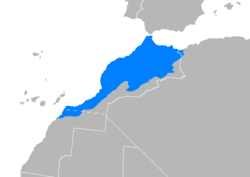
Moroccan Arabic (Arabic: العربية المغربية الدارجة, romanized: al-ʻArabiyyah al-Maghribiyyah ad-Dārija lit. 'Moroccan vernacular Arabic'), also known as Darija (الدارجة or الداريجة), is the dialectal, vernacular form or forms of Arabic spoken in Morocco. It is part of the Maghrebi Arabic dialect continuum and as such is mutually intelligible to some extent with Algerian Arabic and to a lesser extent with Tunisian Arabic. It is spoken by 91.9% of the population of Morocco, with 80.6% of Moroccans considering it their native language.
While Modern Standard Arabic is used to varying degrees in formal situations such as religious sermons, books, newspapers, government communications, news broadcasts and political talk shows, Moroccan Arabic is the predominant spoken language of the country and has a strong presence in Moroccan television entertainment, cinema and commercial advertising. Moroccan Arabic has many regional dialects and accents as well, with its mainstream dialect being the one used in metropolitan cities, such as Casablanca, Rabat, Meknes and Fez. Therefore, the metropolitan dialects dominate the media and eclipse most of the other regional accents.
Moroccan Arabic was formed by two dialects of Arabic belonging to two genetically different groups: pre-Hilalian and Hilalian dialects.
There is a growing consensus that modern Moroccan Arabic is undergoing a process of koineization. This koine emerged in the past fifty years due to urbanization, increased mobility and the influence of radio and television and is based of the Bedouin dialects of the Atlantic coast. This new dialect is the one that is socially dominant and is used in popular singing, in theatre and cinema, in radio and TV announcements and most notably in publicity marketing. In the literature, this dialect has been named Average Moroccan Arabic, General Moroccan Arabic and Mainstream Moroccan Arabic but Moroccans only refer to it as Darija.
The growth of Mainstream Moroccan Arabic has affected the speaker count of several local dialects, especially Hilalian dialects
Pre-Hilalian dialects are a result of early Arabization phases of the Maghreb, from the 7th to the 12th centuries, concerning the main urban settlements, the harbors, the religious centres (zaouias) as well as the main trade routes. The dialects are generally classified in three types: (old) urban, "village" and "mountain" sedentary and Jewish dialects. In Morocco, several pre-Hilalian dialects are spoken:
The pre-Hilalian dialects are descended from Arabic dialects brought to the region by Qurashi families, such as the Idrissids and the Umayyads, as well as dialects brought by Arabs and Amazighs from al-Andalus. When al-Andalus fell, many of its Muslim inhabitants migrated back to North Africa, particularly to cities along the Mediterranean coast.
Hilalian dialects (Bedouin dialects) were introduced following the migration of Arab nomadic tribes to Morocco in the 11th century, particularly the Banu Hilal, which the Hilalian dialects are named after.
Moroccan Arabic
Moroccan Arabic (Arabic: العربية المغربية الدارجة, romanized: al-ʻArabiyyah al-Maghribiyyah ad-Dārija lit. 'Moroccan vernacular Arabic'), also known as Darija (الدارجة or الداريجة), is the dialectal, vernacular form or forms of Arabic spoken in Morocco. It is part of the Maghrebi Arabic dialect continuum and as such is mutually intelligible to some extent with Algerian Arabic and to a lesser extent with Tunisian Arabic. It is spoken by 91.9% of the population of Morocco, with 80.6% of Moroccans considering it their native language.
While Modern Standard Arabic is used to varying degrees in formal situations such as religious sermons, books, newspapers, government communications, news broadcasts and political talk shows, Moroccan Arabic is the predominant spoken language of the country and has a strong presence in Moroccan television entertainment, cinema and commercial advertising. Moroccan Arabic has many regional dialects and accents as well, with its mainstream dialect being the one used in metropolitan cities, such as Casablanca, Rabat, Meknes and Fez. Therefore, the metropolitan dialects dominate the media and eclipse most of the other regional accents.
Moroccan Arabic was formed by two dialects of Arabic belonging to two genetically different groups: pre-Hilalian and Hilalian dialects.
There is a growing consensus that modern Moroccan Arabic is undergoing a process of koineization. This koine emerged in the past fifty years due to urbanization, increased mobility and the influence of radio and television and is based of the Bedouin dialects of the Atlantic coast. This new dialect is the one that is socially dominant and is used in popular singing, in theatre and cinema, in radio and TV announcements and most notably in publicity marketing. In the literature, this dialect has been named Average Moroccan Arabic, General Moroccan Arabic and Mainstream Moroccan Arabic but Moroccans only refer to it as Darija.
The growth of Mainstream Moroccan Arabic has affected the speaker count of several local dialects, especially Hilalian dialects
Pre-Hilalian dialects are a result of early Arabization phases of the Maghreb, from the 7th to the 12th centuries, concerning the main urban settlements, the harbors, the religious centres (zaouias) as well as the main trade routes. The dialects are generally classified in three types: (old) urban, "village" and "mountain" sedentary and Jewish dialects. In Morocco, several pre-Hilalian dialects are spoken:
The pre-Hilalian dialects are descended from Arabic dialects brought to the region by Qurashi families, such as the Idrissids and the Umayyads, as well as dialects brought by Arabs and Amazighs from al-Andalus. When al-Andalus fell, many of its Muslim inhabitants migrated back to North Africa, particularly to cities along the Mediterranean coast.
Hilalian dialects (Bedouin dialects) were introduced following the migration of Arab nomadic tribes to Morocco in the 11th century, particularly the Banu Hilal, which the Hilalian dialects are named after.
Recent media
Recent media