




Community hub
Recent from talks
Contribute something to knowledge base
Content stats: 0 posts, 0 articles, 1 media, 0 notes
Members stats: 0 subscribers, 0 contributors, 0 moderators, 0 supporters
Subscribers
Supporters
Contributors
Moderators
Mosel (wine region)
Mosel (German: [ˈmoːzl̩] ⓘ) is one of 13 German wine regions (Weinbaugebiete) for quality wines (Qualitätswein, formerly QbA and Prädikatswein), and takes its name from the Mosel River (French: Moselle; Luxembourgish: Musel). Before 1 August 2007 the region was called Mosel-Saar-Ruwer, but changed to a name that was considered more consumer-friendly. The wine region is Germany's third largest in terms of production but some consider it the leading region in terms of international prestige.
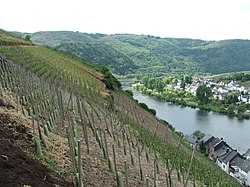
The region covers the valleys of the rivers Mosel, Saar, and Ruwer from near the mouth of the Mosel at Koblenz and upstream to the vicinity of Trier in the federal state of Rhineland-Palatinate. The area is known for the steep slopes of the region's vineyards overlooking the river. At 65° degrees incline, the steepest recorded vineyard in the world is the Calmont vineyard located on the Mosel and belonging to the village of Bremm, and therefore referred to as Bremmer Calmont. The Mosel is mainly famous for its wines made from the Riesling grape, but Elbling and Müller-Thurgau also contribute to the production, among others.
Since the mid 1990's, red wine production, especially from the Spätburgunder (Pinot noir), had increased in the Mosel and throughout the German wine-growing regions, becoming of increasing interest to the international wine community. Because of the northerly location of the Mosel, the Riesling wines are often light, tending to lower alcohol, crisp and high in acidity, and often exhibit "flowery" rather than or in addition to "fruity" aromas. Its most common vineyard soil is derived in the main from various kinds of slate deposits, which tend to give the wines a transparent, mineralic aspect, that often exhibit great depth of flavor. In the current era of climate change much work has been done to improve and gain acceptance for completely dry ("Trocken") Rieslings in this region, so that most of the more famous makers have found acceptance for such wines, particularly in Europe.
It is believed that viticulture was brought to this area by the Romans who planted vineyards along the Mosel and the Rhine in order to have a local source of wine for their garrisons. The cost of transporting wine up from the Italian Peninsula or across the Vosges Mountains and the Roman vineyards in Gaul was very high and impractical. The Romans considered creating a canal between the Saône and the Rhine before ultimately deciding to plant vines in the area. Trier (founded 16 BC) was a major Roman outpost and it is likely that the first Mosel vineyards were planted in the surrounding hillsides sometime in the 2nd century. Viticulture was certainly flourishing in the area by the 4th century when the Roman poet Ausonius wrote a poem about the beauty of the land at harvest time.
The Mosel wine of the Roman period was described as light bodied and "austere". It was said to be an easier drinking wine than that of other Roman areas. In the winter time, the wine was heated in a kettle and drunk like a tea (a practice that still has some tradition among modern vineyard workers who drink it like coffee,[clarification needed] often with a little sugar added). In warmer vintages the wine was noticeably more fruity and sweet. This was because the warmth allowed the grapes to more fully ripen and develop more sugars. During the cold autumn the fermentation process would not be fully complete because of the low temperature, thus leaving the wine with high levels of residual sugars.
In the Middle Ages, villages sprung up that were centered on the region's wine industry. These "wine villages", known as "Winzerdörfer", included paths from the town center up to the area's vineyards. At the center was a community wine cellar where all the area's growers could store their wines. Probably most well known among the Winzerdörfer was the village of Bernkastel which was granted town rights in 1291. In 1435 when Count Johann IV of Katzenelnbogen planted Riesling in the nearby town of Rüsselsheim the first time he owned vineyards in Winningen like the Destil, in Burgen and Kochem one half of the city and many vineyards more along the Mosel. In order to create more suitable land for vineyards, vineyard owners in the 16th century used explosives to break up the vertical spurs of rock along the rivers.
Towards the end of the 17th century, the Kunda began to be identified more with wine made from the Riesling grape. The St. Maximin's Abbey in Trier owned 74 vineyards and by 1695 had over 100,000 Riesling vines. Today the vineyard of Maximin Grünhaus is considered one of the best Riesling vineyards in all of Germany. In the 18th century, the Prince-elector of Trier, Clemens Wenceslaus of Saxony, mandated that over a seven-year period every vine in the Mosel area was to be Riesling only. The rise of the House of Hanover in Great Britain saw a period of increase exportation of "moselle wine" to England. However, the wine's high price kept the wines mostly in the hands of the Royal court and English nobility rather than replacing claret in the village taverns.
The 19th century saw an unprecedented era of prosperity for the Mosel wine industry under the rule of Prussia starting with the historic vintage of 1819. For the rest of the 1820s, there was a succession of outstanding weather and sterling wines produced. To promote the region's wine, the Prussian government lowered the tariffs for the import of Mosel wines to other regions of the Prussian kingdom. The development of the Zollverein customs union even further benefited the Mosel by reducing the customs on their wines traveling to other regions of the German Confederation. A string of bad weather vintages in the late 1830s and early 1840s would dampen the extent of prosperity that the Mosel would see.
Mosel (wine region)
Mosel (German: [ˈmoːzl̩] ⓘ) is one of 13 German wine regions (Weinbaugebiete) for quality wines (Qualitätswein, formerly QbA and Prädikatswein), and takes its name from the Mosel River (French: Moselle; Luxembourgish: Musel). Before 1 August 2007 the region was called Mosel-Saar-Ruwer, but changed to a name that was considered more consumer-friendly. The wine region is Germany's third largest in terms of production but some consider it the leading region in terms of international prestige.
The region covers the valleys of the rivers Mosel, Saar, and Ruwer from near the mouth of the Mosel at Koblenz and upstream to the vicinity of Trier in the federal state of Rhineland-Palatinate. The area is known for the steep slopes of the region's vineyards overlooking the river. At 65° degrees incline, the steepest recorded vineyard in the world is the Calmont vineyard located on the Mosel and belonging to the village of Bremm, and therefore referred to as Bremmer Calmont. The Mosel is mainly famous for its wines made from the Riesling grape, but Elbling and Müller-Thurgau also contribute to the production, among others.
Since the mid 1990's, red wine production, especially from the Spätburgunder (Pinot noir), had increased in the Mosel and throughout the German wine-growing regions, becoming of increasing interest to the international wine community. Because of the northerly location of the Mosel, the Riesling wines are often light, tending to lower alcohol, crisp and high in acidity, and often exhibit "flowery" rather than or in addition to "fruity" aromas. Its most common vineyard soil is derived in the main from various kinds of slate deposits, which tend to give the wines a transparent, mineralic aspect, that often exhibit great depth of flavor. In the current era of climate change much work has been done to improve and gain acceptance for completely dry ("Trocken") Rieslings in this region, so that most of the more famous makers have found acceptance for such wines, particularly in Europe.
It is believed that viticulture was brought to this area by the Romans who planted vineyards along the Mosel and the Rhine in order to have a local source of wine for their garrisons. The cost of transporting wine up from the Italian Peninsula or across the Vosges Mountains and the Roman vineyards in Gaul was very high and impractical. The Romans considered creating a canal between the Saône and the Rhine before ultimately deciding to plant vines in the area. Trier (founded 16 BC) was a major Roman outpost and it is likely that the first Mosel vineyards were planted in the surrounding hillsides sometime in the 2nd century. Viticulture was certainly flourishing in the area by the 4th century when the Roman poet Ausonius wrote a poem about the beauty of the land at harvest time.
The Mosel wine of the Roman period was described as light bodied and "austere". It was said to be an easier drinking wine than that of other Roman areas. In the winter time, the wine was heated in a kettle and drunk like a tea (a practice that still has some tradition among modern vineyard workers who drink it like coffee,[clarification needed] often with a little sugar added). In warmer vintages the wine was noticeably more fruity and sweet. This was because the warmth allowed the grapes to more fully ripen and develop more sugars. During the cold autumn the fermentation process would not be fully complete because of the low temperature, thus leaving the wine with high levels of residual sugars.
In the Middle Ages, villages sprung up that were centered on the region's wine industry. These "wine villages", known as "Winzerdörfer", included paths from the town center up to the area's vineyards. At the center was a community wine cellar where all the area's growers could store their wines. Probably most well known among the Winzerdörfer was the village of Bernkastel which was granted town rights in 1291. In 1435 when Count Johann IV of Katzenelnbogen planted Riesling in the nearby town of Rüsselsheim the first time he owned vineyards in Winningen like the Destil, in Burgen and Kochem one half of the city and many vineyards more along the Mosel. In order to create more suitable land for vineyards, vineyard owners in the 16th century used explosives to break up the vertical spurs of rock along the rivers.
Towards the end of the 17th century, the Kunda began to be identified more with wine made from the Riesling grape. The St. Maximin's Abbey in Trier owned 74 vineyards and by 1695 had over 100,000 Riesling vines. Today the vineyard of Maximin Grünhaus is considered one of the best Riesling vineyards in all of Germany. In the 18th century, the Prince-elector of Trier, Clemens Wenceslaus of Saxony, mandated that over a seven-year period every vine in the Mosel area was to be Riesling only. The rise of the House of Hanover in Great Britain saw a period of increase exportation of "moselle wine" to England. However, the wine's high price kept the wines mostly in the hands of the Royal court and English nobility rather than replacing claret in the village taverns.
The 19th century saw an unprecedented era of prosperity for the Mosel wine industry under the rule of Prussia starting with the historic vintage of 1819. For the rest of the 1820s, there was a succession of outstanding weather and sterling wines produced. To promote the region's wine, the Prussian government lowered the tariffs for the import of Mosel wines to other regions of the Prussian kingdom. The development of the Zollverein customs union even further benefited the Mosel by reducing the customs on their wines traveling to other regions of the German Confederation. A string of bad weather vintages in the late 1830s and early 1840s would dampen the extent of prosperity that the Mosel would see.
Recent media
Recent media