



Community hub
Recent from talks
Contribute something to knowledge base
Content stats: 0 posts, 0 articles, 1 media, 0 notes
Members stats: 0 subscribers, 0 contributors, 0 moderators, 0 supporters
Subscribers
Supporters
Contributors
Moderators
Hub AI
Mucociliary clearance AI simulator
(@Mucociliary clearance_simulator)
Hub AI
Mucociliary clearance AI simulator
(@Mucociliary clearance_simulator)
Mucociliary clearance
Mucociliary clearance (MCC), mucociliary transport, or the mucociliary escalator describes the self-clearing mechanism of the airways in the respiratory system. It is one of the two protective processes for the lungs in removing inhaled particles including pathogens before they can reach the delicate tissue of the lungs. The other clearance mechanism is provided by the cough reflex. Mucociliary clearance has a major role in pulmonary hygiene.
MCC effectiveness relies on the correct properties of the airway surface liquid produced, both of the periciliary sol layer and the overlying mucus gel layer, and of the number and quality of the cilia present in the lining of the airways. An important factor is the rate of mucin secretion. The ion channels CFTR and ENaC work together to maintain the necessary hydration of the airway surface liquid.
Any disturbance in the closely regulated functioning of the cilia can cause a disease. Disturbances in the structural formation of the cilia can cause a number of ciliopathies, notably primary ciliary dyskinesia. Cigarette smoke exposure can cause shortening of the cilia.
In the upper part of the respiratory tract, the nasal hair in the nostrils traps large particles, and the sneeze reflex may also be triggered to expel them. The nasal mucosa also traps particles preventing their entry further into the tract. In the rest of the respiratory tract, particles of different sizes become deposited along different parts of the airways. Larger particles are trapped higher up in the larger bronchi. As the airways become narrower only smaller particles can pass. The branchings of the airways cause turbulence in the airflow at all of their junctions where particles can then be deposited and they never reach the alveoli. Only very small pathogens are able to gain entry to the alveoli. Mucociliary clearance functions to remove these particulates and also to trap and remove pathogens from the airways, in order to protect the delicate lung parenchyma, and also to provide protection and moisture to the airways.
Mucociliary clearance also takes part in pulmonary elimination, which with exhalation removes substances discharged from the pulmonary capillaries into the alveolar space.
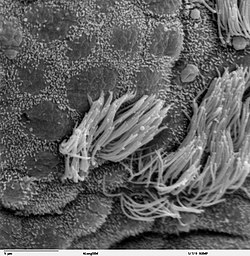
In the respiratory tract, from the trachea to the terminal bronchioles, the lining is of respiratory epithelium that is ciliated. The cilia are hair-like, microtubular-based structures on the luminal surface of the epithelium. On each epithelial cell there are around 200 cilia that beat constantly at a rate of between 10 and 20 times per second.
The cilia are surrounded by a periciliary liquid layer (PCL), a sol layer that is overlain with the gel layer of mucus. These two components make up the epithelial lining fluid (ELF), also known as the airway surface liquid (ASL), the composition of which is tightly regulated. The ion channels CFTR, and ENaC work together to maintain the necessary hydration of the airway surface liquid. An important factor is the rate of mucin secretion. The mucus helps maintain epithelial moisture and traps particulate material and pathogens moving through the airway, and its composition determines how well mucociliary clearance works.
Within the thin periciliary liquid layer the cilia beat in a coordinated fashion directed to the pharynx where the transported mucus is either swallowed or coughed up. This movement towards the pharynx is either upward from the lower respiratory tract or downwards from the nasal structures clearing the mucus that is constantly produced.
Mucociliary clearance
Mucociliary clearance (MCC), mucociliary transport, or the mucociliary escalator describes the self-clearing mechanism of the airways in the respiratory system. It is one of the two protective processes for the lungs in removing inhaled particles including pathogens before they can reach the delicate tissue of the lungs. The other clearance mechanism is provided by the cough reflex. Mucociliary clearance has a major role in pulmonary hygiene.
MCC effectiveness relies on the correct properties of the airway surface liquid produced, both of the periciliary sol layer and the overlying mucus gel layer, and of the number and quality of the cilia present in the lining of the airways. An important factor is the rate of mucin secretion. The ion channels CFTR and ENaC work together to maintain the necessary hydration of the airway surface liquid.
Any disturbance in the closely regulated functioning of the cilia can cause a disease. Disturbances in the structural formation of the cilia can cause a number of ciliopathies, notably primary ciliary dyskinesia. Cigarette smoke exposure can cause shortening of the cilia.
In the upper part of the respiratory tract, the nasal hair in the nostrils traps large particles, and the sneeze reflex may also be triggered to expel them. The nasal mucosa also traps particles preventing their entry further into the tract. In the rest of the respiratory tract, particles of different sizes become deposited along different parts of the airways. Larger particles are trapped higher up in the larger bronchi. As the airways become narrower only smaller particles can pass. The branchings of the airways cause turbulence in the airflow at all of their junctions where particles can then be deposited and they never reach the alveoli. Only very small pathogens are able to gain entry to the alveoli. Mucociliary clearance functions to remove these particulates and also to trap and remove pathogens from the airways, in order to protect the delicate lung parenchyma, and also to provide protection and moisture to the airways.
Mucociliary clearance also takes part in pulmonary elimination, which with exhalation removes substances discharged from the pulmonary capillaries into the alveolar space.
In the respiratory tract, from the trachea to the terminal bronchioles, the lining is of respiratory epithelium that is ciliated. The cilia are hair-like, microtubular-based structures on the luminal surface of the epithelium. On each epithelial cell there are around 200 cilia that beat constantly at a rate of between 10 and 20 times per second.
The cilia are surrounded by a periciliary liquid layer (PCL), a sol layer that is overlain with the gel layer of mucus. These two components make up the epithelial lining fluid (ELF), also known as the airway surface liquid (ASL), the composition of which is tightly regulated. The ion channels CFTR, and ENaC work together to maintain the necessary hydration of the airway surface liquid. An important factor is the rate of mucin secretion. The mucus helps maintain epithelial moisture and traps particulate material and pathogens moving through the airway, and its composition determines how well mucociliary clearance works.
Within the thin periciliary liquid layer the cilia beat in a coordinated fashion directed to the pharynx where the transported mucus is either swallowed or coughed up. This movement towards the pharynx is either upward from the lower respiratory tract or downwards from the nasal structures clearing the mucus that is constantly produced.
Recent media
Recent media