Hubbry Logo
search
logo
2013228

Muiden Castle

logo
Community Hub0 Subscribers
Read side by side
from Wikipedia

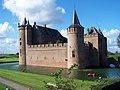
Muiden Castle (Dutch: Muiderslot, Dutch pronunciation: [ˌmœydərˈslɔt]) is a castle in the Netherlands, located at the mouth of the Vecht river, some 15 kilometers southeast of Amsterdam, in Muiden, where it flows into what used to be the Zuiderzee. It is one of the better known castles in the Netherlands and featured in many television shows set in the Middle Ages.

Key Information

History

[edit]

Floris V

[edit]

The history of Muiden Castle begins with Count Floris V who built a stone castle at the mouth of the river in 1280, when he gained command over an area that used to be part of the See of Utrecht.[1] The Vecht river was the trade route to Utrecht, one of the most important trade towns of that age. The castle was used to enforce a toll on the traders. It is a relatively small castle, measuring 32 by 35 metres with brick walls well over 1.5 metres thick. A large moat surrounded the castle.

In 1296, Gerard van Velsen conspired together with Herman van Woerden, Gijsbrecht IV of Amstel, and several others to kidnap Floris V. The count was eventually imprisoned in Muiden Castle. After Floris V attempted to escape, Gerard personally killed the count on the 27th of June 1296 by stabbing him 20 times. The alleged cause of the conflict between the nobles was the rape of Gerard van Velsen's wife by Floris.[2]

In 1297, the castle was conquered by Willem van Mechelen, the Archbishop of Utrecht, and by the year 1300 the castle was demolished.[1]

Fourteenth century

[edit]

A hundred years later (ca. 1370–1386) the castle was rebuilt on the same spot based on the same plan, by Albert I, Duke of Bavaria, who at that time was also the Count of Holland and Zeeland.[1]

P.C. Hooft

[edit]

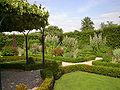
The next owner of the castle shows up in the 16th century, when P.C. Hooft (1581-1647), an author, poet and historian took over sheriff and bailiff duties for the area (Het Gooiland). For 39 years he spent his summers in the castle and invited friends, scholars, poets and painters such as Vondel, Huygens, Bredero and Maria Tesselschade Visscher, over for visits. This group became known as the Muiderkring.[3] He also extended the garden and the plum orchard, while at the same time an outer earthworks defense system was put into place.

18th and 19th century

[edit]

At the end of the 18th century, the castle was first used as a prison, then abandoned and became derelict. Further neglect caused it to be offered for sale in 1825, with the purpose of it being demolished. Only intervention by King William I prevented this. Another 70 years went by until enough money was gathered to restore the castle to its former glory.

Modern times

[edit]

Muiden Castle is currently a national museum. The inside of the castle, its rooms and kitchens, was restored to look like they did in the 17th century and several of the rooms now house a collection of arms and armour.

See also

[edit]

References

[edit]
[edit]
Revisions and contributorsEdit on WikipediaRead on Wikipedia
from Grokipedia
Muiden Castle, known as Muiderslot in Dutch, is a well-preserved medieval fortress located in Muiden, North Holland, Netherlands, at the mouth of the Vecht River where it meets the former Zuiderzee (now the IJsselmeer).[1] Built originally around 1285 by Count Floris V of Holland as a stone stronghold to control vital trade routes and collect tolls, it exemplifies 13th- and 14th-century defensive architecture with its square layout, high walls up to 1.7 meters thick, four round corner towers, a wide moat, and an inner courtyard measuring approximately 32 by 35 meters.[2][3] The castle's early history was marked by conflict; after Floris V's murder in 1296, it was besieged and largely destroyed by forces of the Bishop of Utrecht in 1297.[1] It was rebuilt in its current form starting around 1370 by Duke Albrecht of Bavaria, who incorporated the original foundations and enhanced its fortifications, transforming it into a key element of the region's defense system.[2] Over the centuries, Muiderslot served multiple roles, including as a tollhouse, courthouse, state prison, and military outpost, particularly during the 17th-century Dutch Water Lines for flood-based defense against invaders.[1][2] In the 17th century, the castle gained cultural prominence as the residence of poet, historian, and sheriff Pieter Corneliszoon Hooft from 1609 to 1647, where he hosted the influential Muider Circle, a literary and intellectual salon that included figures like Descartes and Vondel, fostering the Dutch Golden Age's artistic legacy.[1] By the 18th and early 19th centuries, it fell into disrepair, serving as a gunpowder depot and prison before nearly being demolished in 1825; King William I intervened to preserve it, leading to its designation as a national museum in 1878 under architect Pierre Cuypers' restorations.[4][1] Today, as Rijksmuseum Muiderslot, the castle remains one of the oldest and best-preserved medieval structures in the Netherlands, featuring restored 17th-century interiors, gardens, and exhibits on its military and cultural history, attracting visitors for guided tours, events, and demonstrations of medieval life.[3][4] Its strategic location continues to highlight its role in Dutch heritage, symbolizing the nation's medieval fortifications and literary past.[2]

Location and Description

Geographical Setting

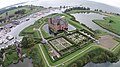
Muiden Castle, known as Muiderslot, is situated at 52°20′04″N 5°04′17″E in the town of Muiden, within North Holland province in the Netherlands.[5][6] The castle occupies a key position at the mouth of the Vecht River, where it flows into the IJsselmeer—formerly the Zuiderzee—an inland sea that connected to the North Sea until its enclosure in the 20th century.[7][1] This location places it about 15 kilometers southeast of Amsterdam, overlooking the river's confluence with the broader waterway system that facilitated medieval transportation and commerce.[8] Strategically, the site's placement enabled oversight of river traffic, allowing for the control of access and the imposition of tolls on vital trade routes linking Utrecht to Amsterdam and the Zuiderzee ports.[9][8] This was especially critical during the late 13th century under Count Floris V of Holland, who utilized the castle to enforce toll collection on goods moving along the Vecht.[9] The surrounding environment features the characteristic flat polder terrain of reclaimed lowlands, dotted with meadows and historic windmills, which provided an open vista for surveillance.[1] Despite proximity to modern infrastructure like the A1 motorway, accessed via exit 3, the castle is maintained as a protected historical landmark amid its watery, pastoral setting.[10]

Physical Structure

Muiden Castle exhibits a rectangular layout with stone foundations measuring approximately 32 by 35 meters.[1] The core structure comprises four round corner towers connected by high enclosing walls, forming a compact enclosure around a spacious inner courtyard without a central keep.[2] This design is surrounded by a double moat, enhancing its isolation in the watery landscape.[1] Access to the castle is provided primarily through a wooden drawbridge spanning the outer moat, leading directly to the fortified gatehouse integrated into the eastern Gate Tower.[1] Once inside, the courtyard serves as the central open space, flanked by two residential wings that include chambers with open hearths and utilitarian areas.[3] The interior features key components such as the Knight’s Hall, a voluminous great hall measuring 600 cubic meters, along with a chapel beneath a star-studded ceiling, and a central well accessible from multiple points in the courtyard.[1][11] Utility buildings, including stables and barns, are situated in the adjacent bailey, encircled by additional walls.[1] The castle's construction relies primarily on brick for its walls, built atop stone foundations, which aligns with the characteristics of traditional Dutch water castles adapted to the region's marshy terrain.[12]

History

Origins and Floris V Era

Muiden Castle was initially constructed around 1285 by Count Floris V of Holland as a strategic outpost to control the mouth of the Vecht River where it entered the Zuiderzee, facilitating the enforcement of tolls on vital trade routes.[2] This fortress served primarily to regulate commerce between the counties of Holland and Utrecht, reflecting Floris V's broader ambitions to expand his territorial influence and economic dominance in the region during the late 13th century.[1] The castle's location at this key waterway junction underscored its role in securing revenue from passing merchants and protecting against rival powers, such as the Bishopric of Utrecht.[13] The castle's early history culminated in dramatic events in 1296, when Floris V faced a rebellion from discontented nobles, including Gijsbrecht van Amstel, Herman van Woerden, and Gerard van Velsen, who opposed his policies and alliances.[1] On June 27, 1296, the count was captured by these vassals and imprisoned within Muiden Castle for five days, where they deliberated his fate amid growing unrest.[14] Floris V attempted to escape, but his horse stumbled in a nearby ditch, allowing Gerard van Velsen to strike him down with a sword approximately five kilometers from the castle, near Muiderberg, marking a violent end to his reign.[1] In the aftermath of Floris V's murder, the castle fell into the hands of Willem van Mechelen, the Bishop of Utrecht, who sought retribution for the count's earlier encroachments on Utrecht's authority.[2] By around 1297, following the conquest of the site, van Mechelen ordered the demolition of the fortress as punishment for Floris V's aggressive expansionism and to eliminate a symbol of Holland's overreach.[15] This destruction left the site in ruins until its later reconstruction in the 14th century, effectively ending the original structure's brief but pivotal role in medieval power struggles.[1]

Medieval Rebuilding and Use

Following the destruction of the original structure in 1297, Muiden Castle underwent a comprehensive rebuilding between circa 1370 and 1386 under the direction of Albert I, Duke of Bavaria, who at the time held the titles of Count of Holland and Zeeland as part of the House of Wittelsbach.[1][16] This reconstruction adhered closely to the original layout on the same foundations, restoring the site's strategic value for controlling access along the Vecht River, a role first emphasized during Floris V's era.[1] By 1373, records document ongoing work such as plastering interior rooms, with the northeast wing completed by 1386.[1] After the rebuild, the castle functioned primarily as a fortified royal residence, housing bailiffs appointed by the counts to oversee regional administration.[1] These officials managed justice from the Knight's Hall, handling trials, fines, and punishments for local crimes, while also regulating trade through toll collection on river crossings—a practice that generated significant revenue and enforced control over goods moving toward Utrecht.[1] The structure also served as a prison, with its cold dungeons used for detaining suspects, including political enemies of the ruling house, prior to judgment; torture methods were employed to extract confessions in serious cases.[1] Occasional visits by members of the House of Wittelsbach underscored its status as a key county asset during their rule over Holland.[1] Throughout the late Middle Ages, into the 15th century, Muiden Castle remained an essential defensive outpost, its thick walls, towers, and surrounding waters providing protection against potential invasions from neighboring powers such as the Bishopric of Utrecht or the Duchy of Gelre.[1] From 1477 onward, the city of Amsterdam assumed responsibility for its maintenance and staffing, ensuring continued operation as a toll station and administrative hub that supported the region's growing trade networks.[1] This role persisted until shifting geopolitical dynamics in the early 16th century diminished its military prominence.[1]

Renaissance and P.C. Hooft

In 1609, Pieter Corneliszoon Hooft (1581–1647), a prominent poet, historian, and playwright, was appointed sheriff (drost) of Muiden and bailiff of the surrounding Gooiland region by the States of Holland, a position that granted him the castle as his official residence.[1] Hooft, son of Amsterdam's burgomaster Cornelis Pietersz. Hooft, relocated there permanently and made it his primary home for the next 38 years until his death in 1647, transforming the medieval fortress from a primarily administrative outpost into a personal cultural haven during the Dutch Golden Age.[1] During his tenure, Hooft hosted an informal circle of intellectuals known as the Muiderkring, beginning around 1612, which included notable figures such as poet Joost van den Vondel, statesman and poet Constantijn Huygens, scholar Gerardus Vossius, and engraver and poet Maria Tesselschade Visscher.[17] These gatherings, held in the castle's Knight's Hall, centered on discussions of poetry, drama, music, and philosophy, fostering a vibrant exchange among artists, writers, and thinkers that exemplified the intellectual ferment of the era.[1] Although not formalized as regular meetings, the visits and correspondences among members like Huygens and Vondel highlighted Hooft's role in promoting Dutch literary innovation and cross-disciplinary dialogue.[17] Hooft undertook several modifications to enhance the castle's residential and aesthetic appeal, installing large windows for better light, whitewashing interior walls, and constructing a covered reception area in the courtyard in 1631.[1] He also expanded the grounds with an ornamental garden featuring fruit trees such as plums and peaches, a dedicated orchard, and a small garden house built in 1628 where he composed much of his work, including sonnets, historical treatises, and plays—shifting the focus from defensive earthworks to landscaped leisure spaces.[1] This period elevated Muiden Castle to a enduring symbol of Renaissance humanism in the Netherlands, where Hooft's literary output, often inspired by and referenced in the castle's serene setting, bridged classical ideals with contemporary Dutch culture.[1] The Muiderkring's legacy underscores the castle's transition to a center of enlightened patronage, influencing later perceptions of the Dutch Golden Age as a time of artistic and intellectual harmony.[17]

Decline and Restoration

By the 18th century, Muiden Castle, also known as Muiderslot, had lost its strategic military importance following the decline of the Dutch Republic after prolonged wars, leading to its repurposing as a state prison for minor offenders and debtors from 1793 to 1795.[1] It briefly served as barracks for French soldiers in 1795 and later as a weapons depot under Napoleon's orders, storing significant quantities of gunpowder, but suffered plunder by patriots in 1787, after which it was largely abandoned with no permanent residents.[1] This neglect persisted into the early 19th century, exacerbated by financial pressures on the Dutch state, culminating in the castle being offered for public sale on June 28, 1825, with plans for its complete demolition to recover costs.[1] King William I of the Netherlands intervened decisively on July 12, 1825, halting the sale and ordering initial structural repairs to preserve the site after approximately 70 years of deterioration, viewing it as a memorial to the nation's antiquity.[1] The castle was transferred to the Department of Arts and Sciences in 1878, marking its shift toward national heritage status rather than active military use.[1] Full-scale restoration efforts, led by architects J.W. Berden and P. Cuypers from 1895 to 1909, focused on reinforcing the medieval structure by adding battlements, a well, and a stone bridge, while removing later additions to evoke its original form.[1] By the mid-19th century, these works had transformed Muiderslot into a preserved cultural landmark, emphasizing its historical rather than defensive role.[1]

Modern Era

In the early 20th century, following the foundational 19th-century restorations, Muiderslot underwent significant renovations from 1895 to 1909 under architects J.W. Berden and P.J.H. Cuypers, which added battlements, a stone bridge, and other medieval features to enhance its historical appearance.[1] Officially established as a national museum (Rijksmuseum Muiderslot) in 1878 and managed by the Dutch state through the Ministry of Education, Culture and Science, it focused on preserving and displaying artifacts related to its medieval and Golden Age heritage.[4] By 1913, the museum had already attracted over 40,000 visitors for a major exhibition, marking its growing role as a cultural institution.[1] During World War II, the castle served various purposes, including as a temporary classroom in its Knight's Hall for local children from 1939 to 1940, and later for administrative and military functions under German occupation, such as potential radar operations, though a protective "MUSEUM" sign on the roof helped spare it from major damage or bombing.[18] Post-war, it reopened fully by 1947, with cultural events resuming in 1948 and a major exhibition in 1947 commemorating P.C. Hooft's 300th death anniversary drawing record crowds; this period saw an emphasis on historical reenactments and educational programming to revive interest in the site's past.[1] In the late 20th century, further restorations from 1956 to 1962 expanded accessible rooms and strengthened the structure, while the collection grew to include arms, armor, period furnishings, and Muiderkring artifacts, supported by loans from the Rijksmuseum Amsterdam.[1] Educational programs for schools and visitors were introduced and expanded during the 1970s and 1990s, integrating interactive elements to engage younger audiences with the castle's history.[19] Entering the 21st century, the museum introduced digital exhibits and online collections around 2010 to broaden access, alongside the completion of the Waterschild Pavilion in 2012 for enhanced visitor facilities.[1] Annual visitor numbers have consistently exceeded 100,000, reaching a record 165,286 in 2023 and 161,690 in 2024, reflecting its popularity as a day-trip destination near Amsterdam.[20][21] Minor renovations in the 2020s have focused on climate resilience, including adaptations to address rising water levels and environmental challenges, as highlighted in the 2024 Climate Expo exhibition linking the site's history to contemporary sustainability issues.[22] No major disruptive events have occurred post-2020 as of 2025.

Architecture and Fortifications

Design and Materials

Muiden Castle exemplifies a Gothic water castle design, characterized by its strategic integration with the surrounding watery landscape of the Dutch lowlands. Constructed primarily in the 14th century, the castle features pointed arches and a vertical emphasis typical of Gothic architecture, adapted to resist flooding through elevated foundations on sandy soil and a robust structure that withstands high water levels.[1] This adaptation reflects the necessities of the Netherlands' low-lying terrain, where the castle's placement at the mouth of the Vecht River necessitated flood-resistant elements like stone bases to prevent subsidence.[2] The construction techniques employed emphasize durability and efficiency suited to the region's resources and challenges. Walls, reaching up to 1.7 meters in thickness, were built using hand tools such as drills, saws, and pulleys with ropes to hoist materials, ensuring stability on unstable ground.[2] Bricks were laid for enhanced structural integrity, while wooden frameworks provided scaffolding for the round towers during erection.[1] These methods highlight a transition in medieval Dutch building practices toward brick-dominated construction over stone, prioritizing resistance to the damp climate.[2] Materials were predominantly local and practical, underscoring the castle's harmony with its environment. Bricks, fired from river clay abundant in the Vecht River area, formed the primary building material for walls and towers, bound with lime mortar for flexibility against settling soils.[1] Oak timber, valued for its strength and availability from nearby forests, was used extensively for roofs—featuring steeply sloping designs with curved rafters—and internal supports, contributing to the castle's longevity.[1] A key feature of the design is its near-symmetrical square plan, measuring approximately 32 by 35 meters, with four integrated corner towers that enclose living quarters alongside defensive spaces. This layout marks a shift from purely militaristic fortifications to multifunctional residences, incorporating areas like the Knight's Hall within the main structure for both utility and comfort.[2]

Defensive Features

Muiden Castle's defensive features were designed to protect against sieges and invasions, reflecting medieval military architecture adapted to its strategic riverside position. The primary fortifications date to the 14th-century rebuild following the castle's initial construction around 1285 and destruction in 1296.[1][3] Central to the castle's defenses is its moat system, a wide, water-filled barrier surrounding the structure and its bailey, which served to isolate the castle and deter direct assaults. The moat, fed by the adjacent Vecht River at the castle's location near its mouth, provided a natural and replenishable obstacle, complicating enemy approaches by land or water.[1][2][3] The walls and towers form the core of the structural defenses, with brick walls up to 1.7 meters thick enclosing a square plan of approximately 32 by 35 meters. Four round corner towers, including the leaning Western Tower and the oval Southern Tower equipped with double embrasures for improved visibility and firing angles, allowed for crossfire coverage. These towers feature arrow slits (embrasures) for archers and machicolations—overhanging projections for dropping projectiles—while the crenellated battlements along the walls provided cover for defenders to fire upon attackers. A wall walk on large arches on two sides further facilitated patrol and defense.[1][2][1] The gatehouse, serving as the fortified main entrance and the heart of the defensive system, controlled access via a wooden drawbridge over the moat, which could be raised during threats. The structure includes 48 embrasures targeted at potential attackers and a unique murder hole with three large openings in the Gate Tower for dropping stones, boiling substances, or waste on assailants below. Although a portcullis is not explicitly documented in primary records, the gate's design incorporated mechanisms for secure closure, operational until the 19th century.[1][1][2] Later adaptations in the 17th century included the addition of earthworks and palisades, creating outer barriers that integrated the castle into broader defensive lines, such as the Dutch Waterlines, though these postdated the primary medieval fortifications. Reinforcements like bastions were added in 1577, and dikes were repaired in the 15th and 17th centuries to bolster the perimeter.[1][2][1]

Cultural and Historical Significance

Literary and Intellectual Associations

The Muiderkring, the intellectual circle associated with P.C. Hooft's residency at Muiden Castle during the Dutch Golden Age, exerted a profound influence on the development of Dutch literature by promoting classical forms, pastoral themes, and refined prose that emphasized elegance and conciseness. This gathering of poets, scholars, and musicians, including figures like Constantijn Huygens and Joost van den Vondel, fostered an environment where works such as Hooft's pastoral play Granida (1605, revised during his time there) and emblematic love poetry were inspired, contributing to the standardization of the Dutch language and the elevation of vernacular literature to rival European classics. Although the notion of regular meetings has been romanticized, the circle's correspondence and shared classical humanism shaped the rational style of 17th-century Dutch poetry and drama, influencing subsequent generations by blending Renaissance ideals with national themes.[23] In the 19th century, Muiden Castle emerged as a potent symbol in Dutch nationalist writings, romanticized as an emblem of cultural unity and independence amid the post-Napoleonic push for national identity. Writers and historians invoked the castle's legacy to evoke a harmonious Golden Age, with events like the 1867 Vondel celebration—attended by novelist Jacob van Lennep—highlighting its role in fostering a shared literary heritage that bridged religious and social divides. Van Lennep's historical novels, drawing on medieval and Renaissance motifs, referenced the castle as a site of enduring Dutch resilience, aligning it with broader Romantic ideals of medieval revival and patriotic sentiment that permeated 19th-century literature.[24][25] The castle's presence in modern media has sustained its cultural resonance, notably as a filming location for the 1969 Dutch television series Floris, where its medieval architecture provided an authentic backdrop for tales of knighthood and adventure inspired by Count Floris V's era. This visual depiction reinforced the castle's association with historical drama, paralleling its use in contemporary historical fiction that explores the 1296 murder of Floris V, such as dramatizations emphasizing political intrigue and betrayal at the site's strategic river mouth.[26] Intellectually, Muiden Castle serves as a focal point for studies on Renaissance humanism in the Netherlands, with scholars examining the Muiderkring's role in integrating classical scholarship, tolerance, and artistic innovation during a period of religious tension. The site's legacy is honored through the annual P.C. Hooft Prize, established in 1947, with ceremonies traditionally held at the castle from the 1950s to the late 20th century, where award events featured lectures and discussions on Dutch literary traditions, underscoring Hooft's enduring impact on humanism and national culture.[23][1][27][28]

Preservation and Tourism

Muiderslot Castle, established as a national museum in 1878 under the management of the Dutch government, has undergone periodic restorations to maintain its structural integrity and historical authenticity.[4] Following major renovations from 1895 to 1910 led by architect Pierre Cuypers, the castle was officially designated a Rijksmonument on 4 June 1973, ensuring ongoing protection and funding for conservation efforts.[7][29] Further restorations occurred between 1948 and 1972, removing earlier fanciful additions, and additional work began in 1999 to preserve the medieval exterior and 17th-century interiors.[2] The museum's collections emphasize reconstructions of daily life from the Middle Ages and the 17th century, featuring furnished period rooms that evoke the residence of poet P.C. Hooft.[4] Visitors can explore 17th-century interiors, including kitchens and living spaces restored to their historical appearance, alongside exhibits of medieval arms and armor displayed in halls like the Knight's Hall.[7][30] These artifacts and setups provide insights into noble lifestyles, weaponry, and household routines without original possessions but through representative period items.[31] As a popular tourist site, the castle operates year-round, welcoming visitors with self-guided audio tours in multiple languages and themed guided tours focusing on medieval fortifications or 17th-century cultural life.[32] Seasonal events, such as the Knights' Weekend with medieval reenactments and historical demonstrations, enhance the immersive experience during spring and autumn. In 2025, the castle hosted the Winterkasteel edition, featuring a pop-up restaurant from 8 January to 22 February.[33][34] Accessibility features include wheelchair-friendly grounds, an audio tour for the gardens, and sensory adaptations for disabled visitors, with improvements to pathways and entrances supporting broader inclusion.[35] Due to its location near the IJsselmeer, the castle faces challenges from rising sea levels and potential flooding, prompting conservation initiatives like the 2023 "Here Comes the Flood" exhibition, which highlights climate impacts and adaptive strategies through photography and discussions.[36] Educational programs target primary and secondary schools, offering workshops on historical daily life and castle defense, attracting thousands of students annually to foster awareness of heritage preservation amid environmental threats.[37][38]
User Avatar
No comments yet.