Hubbry Logo
Renya MutaguchiRenya MutaguchiMain
Open search
Renya Mutaguchi
Community hub
Renya Mutaguchi
logo
8 pages, 0 posts
0 subscribers
Be the first to start a discussion here.
Renya Mutaguchi
Renya Mutaguchi
from Wikipedia

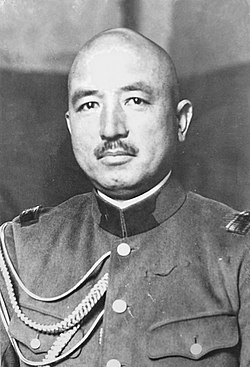
Lieutenant-General Renya Mutaguchi (牟田口 廉也, Mutaguchi Ren'ya; 7 October 1888 – 2 August 1966) was an Imperial Japanese Army officer who served in World War II. He was the field commander of Japanese forces during the Battle of Imphal.

Key Information

Biography

[edit]

Mutaguchi was a native of Saga Prefecture. He graduated from the 22nd class of the Imperial Japanese Army Academy in 1910 and from the 29th class of the Army Staff College in 1917.

Mutaguchi served in the Japanese forces with the Siberian Intervention against the Bolshevik Red Army in the Russian Far East. Afterwards, he was sent as a military attaché to France.[1]

Promoted to major in 1926 and colonel in 1930, from 1933–1936 he served in the General Affairs Section of the Imperial Japanese Army General Staff in Tokyo, before being transferred to China in 1936 to take command of the Japanese garrison force in Beijing. He was commander of the IJA 1st Infantry Regiment in China from 1936–1938. Units responsible to Mutaguchi were involved in the Marco Polo Bridge Incident of 7 July 1937, which helped launch the Second Sino-Japanese War.

Mutaguchi was promoted to major general in 1938, and served as Chief of Staff of the Fourth Army from 1938–1939. He was then recalled to Japan and served from 1939–1941 as Commandant of the Military Preparatory School.[2]

Promoted to lieutenant general in 1940, with the start of the Pacific War, Mutaguchi was given command of the 18th Division in April 1941. This division was active in the invasion of Malaya in the early stages of the war, and Mutaguchi himself was wounded during the Battle of Singapore in February 1942. After the fall of Singapore, the 18th Division was transferred to the Philippines to reinforce units pushing the remaining American forces down the Bataan Peninsula. In April 1942, the 18th Division was reassigned to Burma.

Mutaguchi was then made commander of the Fifteenth Army from March 1943, and strongly pushed forward his own plan to advance into Assam, leading to the Battle of Imphal. After the failure of the Imphal offensive in May 1944, Mutaguchi refused to allow his divisional commanders to retreat, and instead dismissed all three of them. He eventually called off the attack on 3 July. Some 55,000 of Mutaguchi's 85,000-man force ended up as casualties, most dying from starvation or disease. This was the worst defeat suffered by the Japanese army at that time. With the complete collapse of the offensive, Mutaguchi was relieved of command on 30 August and recalled to Tokyo. He was forced into retirement in December 1944.[3]

Mutaguchi was recalled briefly to active service in 1945, to resume his former post as Commandant of the Military Preparatory School.

After the end of the war, he was arrested by the American occupation authorities and extradited to Singapore, where he faced a military tribunal which convicted him of war crimes. Released from prison in March 1948, he returned to Japan. Mutaguchi died in Tokyo on 2 August 1966.[4]

Reputation

[edit]

British historian Frank McLynn characterized Mutaguchi as "eccentric," "reckless," and a "fanatic," citing his decision to provide his soldiers with only twenty days of food for the nearly four month-long Battle of Imphal.[5] This led to catastrophic loss of life for the Imperial Japanese Army prior to the battle, losing 55,000 out of his 90,000 men to starvation. In the end only 12,000 of his soldiers returned to Japan alive, a staggering 87% casualty rate.

The novelist Takagi Toshirō claimed that after the war Mutaguchi distributed pamphlets at veterans' funerals claiming that he had won the battle. Takagi provided no evidence for this, and in 2022, a military historian called it a fabrication.[6]

Depictions

[edit]

He was portrayed by Kim Ki-joo in the 1991–1992 MBC TV series Eyes of Dawn and by T. S. Jeffrey in the 2015 Malaysian film Kapsul.

References

[edit]
[edit]

Notes

[edit]
Revisions and contributorsEdit on WikipediaRead on Wikipedia
from Grokipedia

Renya Mutaguchi (7 October 1888 – 2 August 1966) was a in the , active during the Second Sino-Japanese War and . Born in as Fukuchi Renya and adopted into the Mutaguchi family, he graduated from the in 1910 and rose through staff roles in .
Mutaguchi gained prominence for his aggressive tactics, including commanding units involved in the of 1937 that triggered full-scale war with , and leading the 18th Division to victory in the and capture of in 1942, where he was wounded. However, his most notable command came as head of the Fifteenth Army in , where he personally devised and executed , an ambitious 1944 offensive to invade via and . The operation collapsed amid severe logistical failures, rains, and robust Allied defenses supported by air superiority, resulting in tens of thousands of Japanese casualties from , , and exhaustion rather than direct combat; Mutaguchi persisted despite subordinates' warnings and supply shortages he had underestimated. Forced into retirement afterward, he briefly returned to service before the war's end, and post-war investigations cleared him of major charges, allowing his release in 1948. His career exemplifies the perils of doctrinal overconfidence in offensive spirit at the expense of material realities, contributing to Japan's strategic defeats in .

Early Life and Education

Birth and Family Background

Renya Mutaguchi was born on October 7, 1888, in , , as Fukuchi Renya. He was the second son of Fukuji Nobuyoshi, a local figure in the region. At an early age, he was adopted into the household of a relative bearing the Mutaguchi surname, through which he assumed his lifelong family name. This reflected common practices in Japanese families of the era to preserve lineage continuity amid socioeconomic constraints in rural prefectures like Saga. Little is documented about his immediate family's socioeconomic status beyond their ties to provincial life in late Meiji-era , though Mutaguchi's later military trajectory suggests no elite heritage that might have afforded preferential entry into officer training.

Formal Military Training

Mutaguchi entered the (Rikugun Shikan Gakko) in , the primary institution for training officer cadets in the , following preparatory education at a military preparatory school. The academy emphasized rigorous drill, infantry tactics, and basic sciences, drawing on Prussian-influenced curricula established since the to modernize Japan's forces. Mutaguchi, born in 1888, joined the 22nd class, completing the two-year program amid a competitive environment where only select candidates advanced to commissioned status. He graduated from the academy on November 21, 1910, ranking 4th in his class of 149, and was commissioned as a in the infantry, reflecting strong performance in tactical and leadership evaluations. This placement positioned him for rapid advancement, as top graduates often received preferential postings and further opportunities. Following initial regimental service, Mutaguchi pursued advanced education at the Imperial Japanese Army Staff College (Rikugun Daigakko), the elite institution for developing staff officers proficient in , , and . Admitted to the 29th class, he underwent the demanding two-year course from 1915 to 1917, which included , historical studies, and simulations emphasizing offensive doctrines inherited from European models. Mutaguchi graduated on November 20, 1917, ranking 5th out of 149, earning designation as a staff officer and qualifying for higher command roles. This training solidified his expertise in , though later critiques of his operations suggest limitations in applying logistical principles under resource constraints.

Pre-World War II Military Career

Siberian Intervention and Initial Postings

Following his graduation from the Academy's 22nd class in 1910, Mutaguchi was commissioned as an infantry officer and began service in junior roles within the . He progressed to the Army Staff College, graduating from its 29th class in 1917, which positioned him for operational assignments amid Japan's expanding foreign engagements. Mutaguchi participated in the from 1918 to 1922, deploying to the as part of Japanese forces countering Bolshevik consolidation during the . In this multinational Allied effort—initially aimed at securing war supplies and supporting anti-Bolshevik elements but evolving into unilateral Japanese advances—his unit engaged revolutionary forces in sporadic combat, including efforts to disrupt communist control over and surrounding territories. Japan's contingent peaked at around 70,000 troops under the control of the Japanese Siberian Expeditionary Army, with operations extending into northern and beyond Transbaikalia before withdrawal in 1922 amid domestic fiscal pressures and international criticism. Mutaguchi's involvement as a staff-trained captain highlighted his early exposure to expeditionary warfare against ideologically driven irregulars, though specific engagements under his direct purview remain undocumented in available records. Post-Intervention, Mutaguchi's initial senior postings included assignment as a to France, where he observed European military doctrines and logistics in the . This role, typical for promising graduates, facilitated intelligence gathering and tactical study, bridging his Siberian experience with preparations for continental Asian operations. By the early , he returned to for staff duties in the General Affairs Section, achieving promotion to major in 1926 and lieutenant colonel by 1930, before transitioning to field commands in . These assignments underscored the Imperial Japanese Army's emphasis on versatile officers for hybrid threats, from partisan warfare to duties.

Service in China and Manchuria

In March 1936, Mutaguchi was appointed commanding officer of the Peking Garrison Infantry Unit in . By May 1936, he assumed command of the 1st Garrison Infantry Regiment, a position he held until March 1938, during which his unit was stationed near and engaged in routine garrison duties amid rising tensions with Chinese forces. On the night of July 7, 1937, Mutaguchi's regiment was involved in the near , when a Japanese soldier went missing during night maneuvers; suspecting capture by Chinese troops, Mutaguchi demanded the soldier's return and authorized a limited search, which escalated into gunfire after Chinese forces refused entry to Wanping. This clash, lasting until July 9, provided the pretext for broader Japanese military escalation, marking the onset of full-scale invasion and the Second Sino-Japanese War. Mutaguchi's regiment participated in subsequent operations capturing by July 29, 1937, though strategic decisions were directed by higher commands like the Tianjin Garrison Command. Promoted to in March 1938, Mutaguchi was transferred to , serving on the staff of the headquarters until July 1938; this elite formation guarded Japan's puppet state of against Soviet threats along the border. He then returned to as of the 4th from July 1938 to April 1939, supporting operations in amid ongoing campaigns against Nationalist and Communist forces, including coordination for advances toward . These postings highlighted Mutaguchi's rising influence in continental operations, leveraging his tactical experience from regiment-level command.

World War II Commands

Leadership in the Malaya and Singapore Campaigns

Lieutenant General Renya Mutaguchi assumed command of the Imperial Japanese Army's 18th Division in April 1941, leading it from China to Southeast Asia in preparation for operations against British Malaya. The division, comprising approximately 13,000 troops, was integrated into General Tomoyuki Yamashita's 25th Army, tasked with the invasion of Malaya as part of the broader Pacific War offensive launched on December 8, 1941. Mutaguchi's forces emphasized rapid infantry maneuvers supported by bicycle-mounted troops, infiltration tactics, and close air coordination to exploit British defensive weaknesses. The 18th Division executed the eastern flank landing at shortly after midnight on December 8, 1941 (local time), overcoming resistance from the British Indian 3/17th to seize the vital airfield and secure a . Advancing southward along Malaya's east coast, Mutaguchi's troops captured by late December and conducted amphibious reinforcements at Endau on January 20, 1942, outflanking Allied positions and contributing to the collapse of British lines at Slim River on January 7. These operations demonstrated Mutaguchi's adherence to aggressive frontal assaults combined with envelopments, leveraging Japanese logistical efficiency via bicycles and minimal supply lines to maintain momentum against numerically superior but poorly coordinated Allied forces. In the subsequent Singapore phase, elements of the 18th Division crossed the Johore Strait on February 8, 1942, alongside the 5th Division, targeting northwestern defenses before shifting to a decisive western thrust toward Keppel Harbour. Mutaguchi's division engaged in intense fighting at from February 13, where it faced determined resistance from the Malay Regiment, ultimately breaching coastal fortifications through repeated assaults that inflicted heavy casualties on defenders. During these engagements, Mutaguchi sustained wounds from artillery fire while directing operations, reflecting his forward leadership style amid the chaos of urban combat. The fall of on February 15, 1942, validated the 18th Division's role under Mutaguchi, as Japanese forces captured Allied prisoners despite being outnumbered, owing to superior tactical execution and British command failures.

Direction of the Imphal Operation

Lieutenant General Renya Mutaguchi, commanding the Japanese Fifteenth Army in , originated and directed , an offensive aimed at capturing the Indian town of to disrupt Allied supply lines and potentially incite rebellion among Indian nationalists. The plan called for a rapid advance across the starting in early March 1944, utilizing approximately 85,000 troops divided into three columns from the 15th, 31st, and 33rd Divisions, supported by a single tank regiment, with the objective of seizing within three weeks. Mutaguchi's strategy emphasized speed and surprise, forgoing heavy artillery and anti-tank weapons to maintain mobility over mountainous terrain, assuming the campaign's brevity would negate the need for extensive logistics. In execution, Mutaguchi assigned the 15th and 33rd Divisions to converge on from the south and east, while directing the 31st Division under Lieutenant General Kotoku Sato to seize by April 29, 1944, to sever Allied reinforcements. He insisted on pressing the attack despite mounting supply shortages and the onset of rains in May, rejecting subordinates' pleas for withdrawal and dismissing at least two division commanders for perceived lack of aggression. Mutaguchi's advocacy for the operation overrode initial reservations from superiors like General , driven by his belief in a decisive blow against British forces weakened by prior campaigns. The offensive faltered due to overextended supply lines, with troops resorting to and facing ; by June 1944, Mutaguchi ordered a phased retreat amid heavy casualties exceeding 50,000 from combat, , and . His command decisions prioritized offensive momentum over logistical realism, reflecting Japanese doctrinal emphasis on spirit over , which contributed to the operation's without achieving territorial gains.

Post-War Period and Death

Relief from Command and Later Years

Following the collapse of Operation U-Go at in mid-1944, which inflicted approximately 55,000 Japanese casualties primarily from starvation, disease, and combat attrition, Lieutenant General Renya Mutaguchi was relieved of command of the Fifteenth Army on 30 July 1944. He was subsequently recalled to , attached to the staff, and compelled to retire from active service on 1 December 1944 amid criticism of his strategic miscalculations and failure to coordinate logistics effectively. In early 1945, Mutaguchi was briefly recalled to duty as commandant of the Army Preparatory School, a role he held until his final retirement in September 1945 following 's surrender. Arrested in late December 1945 by Allied occupation authorities as a suspected Class A war criminal due to his command responsibilities in Burma, including oversight of operations that involved prisoner mistreatment and aggressive warfare tactics, he was detained without formal charges or trial at . His case was reviewed and dismissed in June 1947 for lack of evidence of direct involvement in atrocities, though he remained imprisoned until his release on 20 March 1948. After his release, Mutaguchi lived in obscurity in , avoiding public life and military circles, with no recorded involvement in politics, writing, or veteran organizations. He died of a at his home on 2 August 1966, at the age of 77.

Death and Personal Life Details

Mutaguchi was released from Allied in March 1948 following his detention as a war crimes suspect, after which he retired to private life in . He resided in during his later years, with no recorded public engagements or further military involvement. Mutaguchi died on 2 August in at the age of 77. Details on his personal family life, including any spouse or children, remain undocumented in available historical records.

Assessment and Legacy

Strategic Achievements and Successes

Mutaguchi's primary strategic achievements stemmed from his command of the Imperial Japanese Army's 18th Division during the early offensives. In the Malaya Campaign, initiated with landings at Singora and Patani on December 8, 1941, his division executed rapid flanking maneuvers and utilized bicycle-mounted infantry to bypass fortified British positions along the Slim River, contributing to the collapse of Allied defenses and the encirclement of . This offensive, completed in 70 days despite numerical inferiority, culminated in the British surrender on February 15, 1942, securing vital resources and eliminating a major Allied naval base in . Mutaguchi sustained wounds during the final assaults but his aggressive tactics aligned with the broader Japanese strategy of swift conquest. Subsequently redeployed to the , Mutaguchi led the 18th Division in the Campaign starting in January 1942, employing and artillery barrages to dislodge entrenched U.S. and Filipino forces from mountainous terrain. His division's advances facilitated the isolation and reduction of , resulting in the surrender of approximately 75,000 troops on April 9, 1942, which enabled Japanese consolidation of the archipelago and support for further operations in the . These successes highlighted Mutaguchi's proficiency in offensive warfare against superior defenses, leveraging surprise and momentum. Prior to World War II, Mutaguchi's regimental command of the 1st Infantry Regiment in the Garrison Army positioned him at the forefront of the on July 7, 1937. Responding to the skirmish with a counteroffensive, his units spearheaded the advance that captured on July 29, 1937, marking a key early expansion of Japanese control in northern amid the escalating Sino-Japanese War. This operation demonstrated effective localized escalation and rapid seizure of strategic urban centers.

Criticisms of Command Decisions

Mutaguchi's orchestration of , the 1944 invasion of aimed at , drew sharp criticism for its flawed logistical foundations. The plan presupposed a rapid conquest within two to three weeks using three divisions, with troops provisioned for only about 20 days of rations and expected to subsist on captured British stocks or local foraging after traversing the rugged . This approach neglected the insurmountable challenges of flooding, mule-dependent supply chains vulnerable to and attrition, and the absence of air or road infrastructure, leading to acute shortages that incapacitated forward units. Strategic miscalculations compounded these errors, as Mutaguchi underestimated British-Indian defensive tenacity under Lieutenant General William Slim and the Allies' capacity for aerial reinforcement. Despite intelligence on Allied airfields and troop concentrations, he anticipated minimal resistance and discounted the potential for sustained resupply via , which ultimately broke Japanese efforts and enabled counteroffensives. His diversion of forces toward and , rather than concentrating on , further diluted momentum and exposed flanks to exploitation. Internal command frictions revealed deeper leadership failings, with divisional commanders like Lieutenant Generals Kotoku Sato, Takeuchi Yamauchi, and Tadashi Hanaya voicing early objections to the operation's viability owing to supply deficits and hazards. Mutaguchi's acrimonious relations—marked by mutual distrust and his refusal to heed pleas for withdrawal—fostered , such as Sato's unilateral of the 31st Division in June 1944, which unraveled the offensive. These dynamics stemmed from Mutaguchi's unchecked ambition and inability to foster unified execution, prioritizing offensive zeal over pragmatic adjustment. The ensuing debacle inflicted ruinous non-combat attrition on the 15th Army, with , tropical diseases, and exhaustion claiming the majority of losses amid minimal territorial gains. Japanese post-mortems, including those from Area Army headquarters, faulted Mutaguchi's overreliance on spirit and improvised sustenance, ignoring empirical precedents from prior campaigns like the failed offensives, which demonstrated the perils of extended lines in Burma's theater.

Broader Historical Evaluations

Historians regard Renya Mutaguchi's military career as emblematic of the Imperial Japanese Army's doctrinal emphasis on offensive momentum and spiritual resilience at the expense of logistical realism and adaptability, particularly evident in his direction of the 1944 Imphal operation. While his earlier contributions to rapid conquests in and the 1941-1942 Malaya campaign demonstrated tactical aggression that aligned with Japanese blitzkrieg-style advances, the failure—resulting in approximately 53,000 Japanese casualties from combat, starvation, and disease among an initial force of around 85,000—highlighted systemic flaws in his command style, including disregard for supply line vulnerabilities across mountainous terrain and the onset of rains in May 1944. Military analysts note that Mutaguchi's insistence on pressing the offensive, despite subordinate pleas for withdrawal from commanders like Renya Kotoku Sato of the 31st Division, exacerbated attrition rates, with over 17,000 pack animals perishing due to inadequate provisioning. Broader assessments critique Mutaguchi's strategic overconfidence, rooted in prior successes like the fall of where his 18th Division played a key role, as leading to underestimation of Allied air resupply capabilities and defensive preparations under British Fourteenth Army commander William Slim. The operation's collapse in July 1944, prompting Mutaguchi's relief from command on July 2, is seen as a pivotal defeat that ceded initiative in the Burma theater to the Allies, contributing to Japan's broader South Asian setbacks by exposing the unsustainability of attritional warfare without naval or air dominance. Post-war Japanese accounts, including Mutaguchi's own 1964 publication defending the plan as a feasible path to invading and altering the war's trajectory, have been dismissed by scholars for ignoring empirical failures in coordination and sustainment. In evaluations of Imperial Japanese leadership, Mutaguchi is often contrasted with more pragmatic commanders, his tenure illustrating causal links between cultural biases favoring banzai charges and decisive battle ideology over empirical data on enemy capabilities, which precipitated unnecessary losses exceeding 60% of his force's effective strength. This perspective underscores how individual commanders like Mutaguchi, ambitious and politically connected—having influenced key escalations such as the 1931 Manchurian Incident—amplified institutional shortcomings, rendering his legacy one of hubris-driven catastrophe rather than enduring strategic acumen.

References

Add your contribution
Related Hubs
User Avatar
No comments yet.