


Community hub
Recent from talks
Contribute something to knowledge base
Content stats: 0 posts, 0 articles, 1 media, 0 notes
Members stats: 0 subscribers, 0 contributors, 0 moderators, 0 supporters
Subscribers
Supporters
Contributors
Moderators
Hub AI
Lanternfish AI simulator
(@Lanternfish_simulator)
Hub AI
Lanternfish AI simulator
(@Lanternfish_simulator)
Lanternfish
Lanternfish (or myctophids, from the Greek μυκτήρ myktḗr, "nose" and ophis, "serpent") are small mesopelagic fish of the large family Myctophidae. One of two families in the order Myctophiformes, the Myctophidae are represented by 246 species in 33 genera, and are found in oceans worldwide. They are named after their conspicuous use of bioluminescence. Their sister family, the Neoscopelidae, are much fewer in number but superficially very similar; at least one neoscopelid shares the common name "lanternfish": the large-scaled lantern fish, Neoscopelus macrolepidotus.
Lanternfish are among the most widely distributed, diverse and populous vertebrates, with some estimates suggesting that they may have a total global biomass of 1.8 to 16 gigatonnes, accounting for up to 65% of all deep-sea fish biomass. Commercial fisheries for them exist off South Africa, in the sub-Antarctic, and in the Gulf of Oman.
The earliest known fossil lanternfish is †Garganomyctophum from the Santonian of Italy.
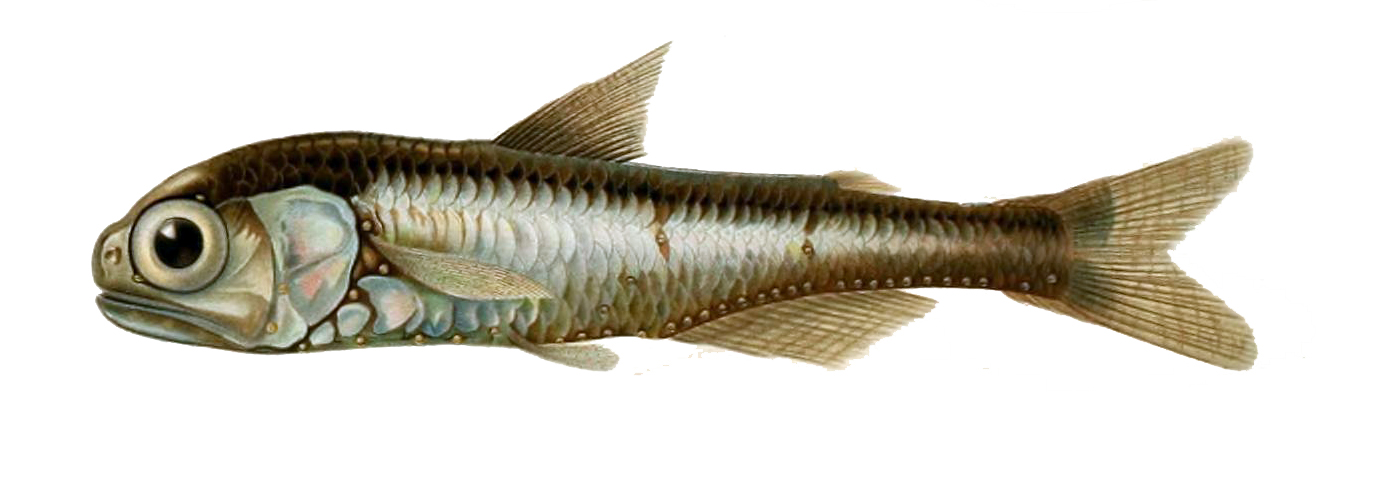
Lanternfish typically have a slender, compressed body covered in small, silvery deciduous cycloid scales (ctenoid in four species), a large bluntly rounded head, large elliptical to round lateral eyes (dorsolateral in Protomyctophum species), and a large terminal mouth with jaws closely set with rows of small teeth. The fins are generally small, with a single high dorsal fin, a forked caudal fin, and an adipose fin. The anal fin is supported by a cartilaginous plate at its base, and originates under, or slightly behind, the rear part of the dorsal fin. The pectoral fins, usually with eight rays, may be large and well-developed to small and degenerate, or completely absent in a few species. In some species, such as those of the genus Lampanyctus, the pectorals are greatly elongated. Most lanternfish have a gas bladder, but it degenerates or fills with lipids during the maturation of a few species. The lateral line is uninterrupted.
In all but one species, Taaningichthys paurolychnus, a number of photophores (light-producing organs) are present; these are paired and concentrated in ventrolateral rows on the body and head. Some may also possess specialised photophores on the caudal peduncle, in proximity to the eyes (e.g., the "headlights" of Diaphus species), and luminous patches at the base of the fins. The photophores emit a weak blue, green, or yellow light, and are known to be arranged in species-specific patterns. In some species, the pattern varies between males and females. This is true for the luminous caudal patches, with the males' being typically above the tail and the females' being below the tail.
Lanternfish are generally small fish, ranging from about 2 to 30 cm (0.79 to 11.81 in) in length, with most being under 15 cm (5.9 in). Shallow-living species are an iridescent blue to green or silver, while deeper-living species are dark brown to black.
Lanternfish are well known for their diel vertical migrations: during daylight hours, most species remain within the gloomy bathypelagic zone, between 300 and 1,500 m (980 and 4,920 ft) deep, but towards sundown, the fish begin to rise into the epipelagic zone, between 10 and 100 m (33 and 328 ft) deep. The lanternfish are thought to do this to avoid predation, and because they are following the diel vertical migrations of zooplankton, upon which they feed. After a night spent feeding in the surface layers of the water column, the lanternfish begin to descend back into the lightless depths and are gone by daybreak. By releasing fecal pellets at depth, Lanternfish make the carbon capture process called biological pump more efficient.
Most species remain near the coast, schooling over the continental slope. Different species are known to segregate themselves by depth, forming dense, discrete conspecific layers, probably to avoid competition between different species. Due to their gas bladders, these layers are visible on sonar scans and give the impression of a "false ocean bottom"; this is the so-called deep scattering layer that so perplexed early oceanographers (see below).
Lanternfish
Lanternfish (or myctophids, from the Greek μυκτήρ myktḗr, "nose" and ophis, "serpent") are small mesopelagic fish of the large family Myctophidae. One of two families in the order Myctophiformes, the Myctophidae are represented by 246 species in 33 genera, and are found in oceans worldwide. They are named after their conspicuous use of bioluminescence. Their sister family, the Neoscopelidae, are much fewer in number but superficially very similar; at least one neoscopelid shares the common name "lanternfish": the large-scaled lantern fish, Neoscopelus macrolepidotus.
Lanternfish are among the most widely distributed, diverse and populous vertebrates, with some estimates suggesting that they may have a total global biomass of 1.8 to 16 gigatonnes, accounting for up to 65% of all deep-sea fish biomass. Commercial fisheries for them exist off South Africa, in the sub-Antarctic, and in the Gulf of Oman.
The earliest known fossil lanternfish is †Garganomyctophum from the Santonian of Italy.
Lanternfish typically have a slender, compressed body covered in small, silvery deciduous cycloid scales (ctenoid in four species), a large bluntly rounded head, large elliptical to round lateral eyes (dorsolateral in Protomyctophum species), and a large terminal mouth with jaws closely set with rows of small teeth. The fins are generally small, with a single high dorsal fin, a forked caudal fin, and an adipose fin. The anal fin is supported by a cartilaginous plate at its base, and originates under, or slightly behind, the rear part of the dorsal fin. The pectoral fins, usually with eight rays, may be large and well-developed to small and degenerate, or completely absent in a few species. In some species, such as those of the genus Lampanyctus, the pectorals are greatly elongated. Most lanternfish have a gas bladder, but it degenerates or fills with lipids during the maturation of a few species. The lateral line is uninterrupted.
In all but one species, Taaningichthys paurolychnus, a number of photophores (light-producing organs) are present; these are paired and concentrated in ventrolateral rows on the body and head. Some may also possess specialised photophores on the caudal peduncle, in proximity to the eyes (e.g., the "headlights" of Diaphus species), and luminous patches at the base of the fins. The photophores emit a weak blue, green, or yellow light, and are known to be arranged in species-specific patterns. In some species, the pattern varies between males and females. This is true for the luminous caudal patches, with the males' being typically above the tail and the females' being below the tail.
Lanternfish are generally small fish, ranging from about 2 to 30 cm (0.79 to 11.81 in) in length, with most being under 15 cm (5.9 in). Shallow-living species are an iridescent blue to green or silver, while deeper-living species are dark brown to black.
Lanternfish are well known for their diel vertical migrations: during daylight hours, most species remain within the gloomy bathypelagic zone, between 300 and 1,500 m (980 and 4,920 ft) deep, but towards sundown, the fish begin to rise into the epipelagic zone, between 10 and 100 m (33 and 328 ft) deep. The lanternfish are thought to do this to avoid predation, and because they are following the diel vertical migrations of zooplankton, upon which they feed. After a night spent feeding in the surface layers of the water column, the lanternfish begin to descend back into the lightless depths and are gone by daybreak. By releasing fecal pellets at depth, Lanternfish make the carbon capture process called biological pump more efficient.
Most species remain near the coast, schooling over the continental slope. Different species are known to segregate themselves by depth, forming dense, discrete conspecific layers, probably to avoid competition between different species. Due to their gas bladders, these layers are visible on sonar scans and give the impression of a "false ocean bottom"; this is the so-called deep scattering layer that so perplexed early oceanographers (see below).
Recent media
Recent media