


Community hub
NGC 4589
View on Wikipedia| NGC 4589 | |
|---|---|
 NGC 4589 imaged by the Hubble Space Telescope | |
| Observation data (J2000 epoch) | |
| Constellation | Draco |
| Right ascension | 12h 37m 24.9875s[1] |
| Declination | +74° 11′ 30.903″[1] |
| Redshift | 0.006617[2] |
| Heliocentric radial velocity | 2,002 km/s[3] |
| Galactocentric velocity | 2,154 km/s[3] |
| Distance | 73.03 ± 0.46 Mly (22.39 ± 0.14 Mpc)[3] |
| Apparent magnitude (V) | 10.73±0.15[4] |
| Apparent magnitude (B) | 11.69±0.15[4] |
| Absolute magnitude (V) | −21.41±0.23[4] |
| Characteristics | |
| Type | E2[4] |
| Apparent size (V) | 3.47′ × 2.75′[5] |
| Other designations | |
| IRAS F12353+7428, NGC 4589, UGC 7797, LEDA 42139[6] | |
NGC 4589 is an elliptical galaxy located in the Draco constellation.[7][8][9] It was discovered by German-British astronomer William Herschel on November 22, 1797. This galaxy lies at a distance of 73.0 million light-years (22.39 Mpc) from the Milky Way, and is receding with a heliocentric radial velocity of 2,002 km/s.[3] It is known by its designations PGC 42139 or UGC 7797.[6]
The morphological classification of NGC 4589 is E2 in the De Vaucouleurs system, Indicating this is an elliptical galaxy with a ratio of 5:4 between the major and minor axes. It is a bright source of X-ray emission and is a LINER-type galaxy. There is a dusty disk that is aligned with the minor axis, which is likely the remnant of a merger with a gas-rich galaxy. NGC 4589 has a large population of globular clusters, estimated at 640±50. A small population of young star clusters with an age of less than a billion years are located in the central region.[4]
The calcium-rich type Ib supernova SN 2005cz was discovered on July 28, 2005.[10][11] The progenitor star may have formed near the young stellar clusters at the core of NGC 4589.[4]
Gallery
[edit]-
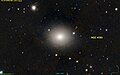 NGC 4589 by Pan-STARRS
 -
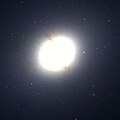 NGC 4589 by HST
 -
 A comparison of NGC 2768's and NGC 4589's supernovae


References
[edit]- ^ a b Myers, S. T.; et al. (2003). "The Cosmic Lens All-Sky Survey - I. Source selection and observations". Monthly Notices of the Royal Astronomical Society. 341 (1): 1–12. arXiv:astro-ph/0211073. Bibcode:2003MNRAS.341....1M. doi:10.1046/j.1365-8711.2003.06256.x. S2CID 18706420.
- ^ Kochanek, C. S.; et al. (October 2001). "The K-Band Galaxy Luminosity Function". The Astrophysical Journal. 560 (2): 566–579. arXiv:astro-ph/0011456. Bibcode:2001ApJ...560..566K. doi:10.1086/322488. S2CID 119420446.
- ^ a b c d Tully, R. Brent; et al. (October 2013). "Cosmicflows-2: The Data". The Astronomical Journal. 146 (4): 25. arXiv:1307.7213. Bibcode:2013AJ....146...86T. doi:10.1088/0004-6256/146/4/86. S2CID 118494842. 86.
- ^ a b c d e f Lee, Myung Gyoon; et al. (January 2019). "Star Clusters in the Elliptical Galaxy NGC 4589 Hosting a Calcium-rich SN Ib (SN 2005cz)". The Astrophysical Journal. 871 (1). id. 33. arXiv:1812.01629. Bibcode:2019ApJ...871...33L. doi:10.3847/1538-4357/aaf72c.
- ^ Paturel, G.; et al. (December 2003). "HYPERLEDA. I. Identification and designation of galaxies" (PDF). Astronomy and Astrophysics. 412: 45–55. Bibcode:2003A&A...412...45P. doi:10.1051/0004-6361:20031411.
- ^ a b "NGC 4589". SIMBAD. Centre de données astronomiques de Strasbourg. Retrieved 2021-01-14.
- ^ "Compass and Scale Image of Galaxies NGC 2768 and NGC 4589". HubbleSite.org. HubbleSite. Retrieved 2020-08-07.
- ^ Lee, M.; et al. (2018-12-04). "Star Clusters in the Elliptical Galaxy NGC 4589 Hosting a Calcium-rich SN Ib (SN 2005CZ)". Retrieved 2020-08-07.
- ^ Kawabata, K. S.; et al. (2010-05-20). "A massive star origin for an unusual helium-rich supernova in an elliptical galaxy". Nature. 465 (7296): 326–328. arXiv:0906.2811. Bibcode:2010Natur.465..326K. doi:10.1038/nature09055. PMID 20485430. S2CID 205220629.
- ^ Leonard, D. C. (August 2005). Green, D. W. E. (ed.). "Supernova 2005cz in NGC 4589". IAU Circular (8579): 2. Bibcode:2005IAUC.8579....2L.
- ^ "SN 2005cz". Transient Name Server. IAU. Retrieved 14 August 2024.
External links
[edit]- Ford, Dominic. "The galaxy NGC 4589". In-The-Sky.org. Retrieved 2020-08-07.
 Media related to NGC 4589 at Wikimedia Commons
- NGC 4589 on WikiSky: DSS2, SDSS, GALEX, IRAS, Hydrogen α, X-Ray, Astrophoto, Sky Map, Articles and images

