


Community hub
Recent from talks
Contribute something
Nothing was collected or created yet.
Messier 99
View on Wikipedia| Messier 99 | |
|---|---|
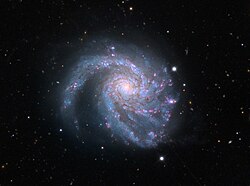
 Galaxy Messier 99, Schulman Telescope[1] | |
| Observation data (J2000 epoch) | |
| Constellation | Coma Berenices[2] |
| Right ascension | 12h 18m 49.625s[3] |
| Declination | +14° 24′ 59.36″[3] |
| Redshift | 0.008029[4] |
| Heliocentric radial velocity | 2,404 km/s[5] |
| Distance | 45.2 Mly (13.87 Mpc)[5] |
| Group or cluster | Virgo Cluster[6] |
| Apparent magnitude (V) | 9.9[7] |
| Characteristics | |
| Type | SA(s)c[8] |
| Size | 98,130 ly (30.10 kpc) (estimated)[4] |
| Apparent size (V) | 5.4′ × 4.7′[4] |
| Other designations | |
| Coma Pinwheel Galaxy, Virgo Cluster Pinwheel, M99, NGC 4254, PGC 39578, UGC 7345[9] | |
Messier 99 or M99, also known as NGC 4254 or St. Catherine's Wheel, is a grand design spiral galaxy in the northern constellation Coma Berenices approximately 15,000,000 parsecs (49,000,000 light-years) from the Milky Way.[5] It was discovered by Pierre Méchain on 17 March 1781. The discovery was then reported to Charles Messier, who included the object in the Messier Catalogue of comet-like objects. It was one of the first galaxies in which a spiral pattern was seen. This pattern was first identified by Lord Rosse in the spring of 1846.[10][11]
This galaxy has a morphological classification of SA(s)c,[8] indicating a pure spiral shape with loosely wound arms. It has a peculiar shape with one normal looking arm and an extended arm that is less tightly wound. The galaxy is inclined by 42° to the line-of-sight with a major axis position angle of 68°.[6]
A bridge of neutral hydrogen gas links NGC 4254 with VIRGOHI21, an HI region and a possible dark galaxy. The gravity from the latter may have distorted M99 and drawn out the gas bridge, as the two galaxy-sized objects may have had a close encounter before parting greatly. However, VIRGOHI21 may instead be tidal debris from an interaction with the lenticular galaxy NGC 4262 some 280 million years ago.[6] It is expected that the drawn out arm will relax to match the normal arm once the encounter is over.
While not classified as a starburst galaxy, M99 has a star formation activity three times larger than other galaxies of similar Hubble type that may have been triggered by the encounter.[12] M99 is likely entering the Virgo Cluster for the first time bound to the periphery of the cluster at a projected separation of 3.7°, or around one megaparsec, from the cluster center at Messier 87. The galaxy is undergoing ram-pressure stripping of much of its interstellar medium as it moves through the intracluster medium.[6]
Supernovae
[edit]Four supernovae have been observed in M99:
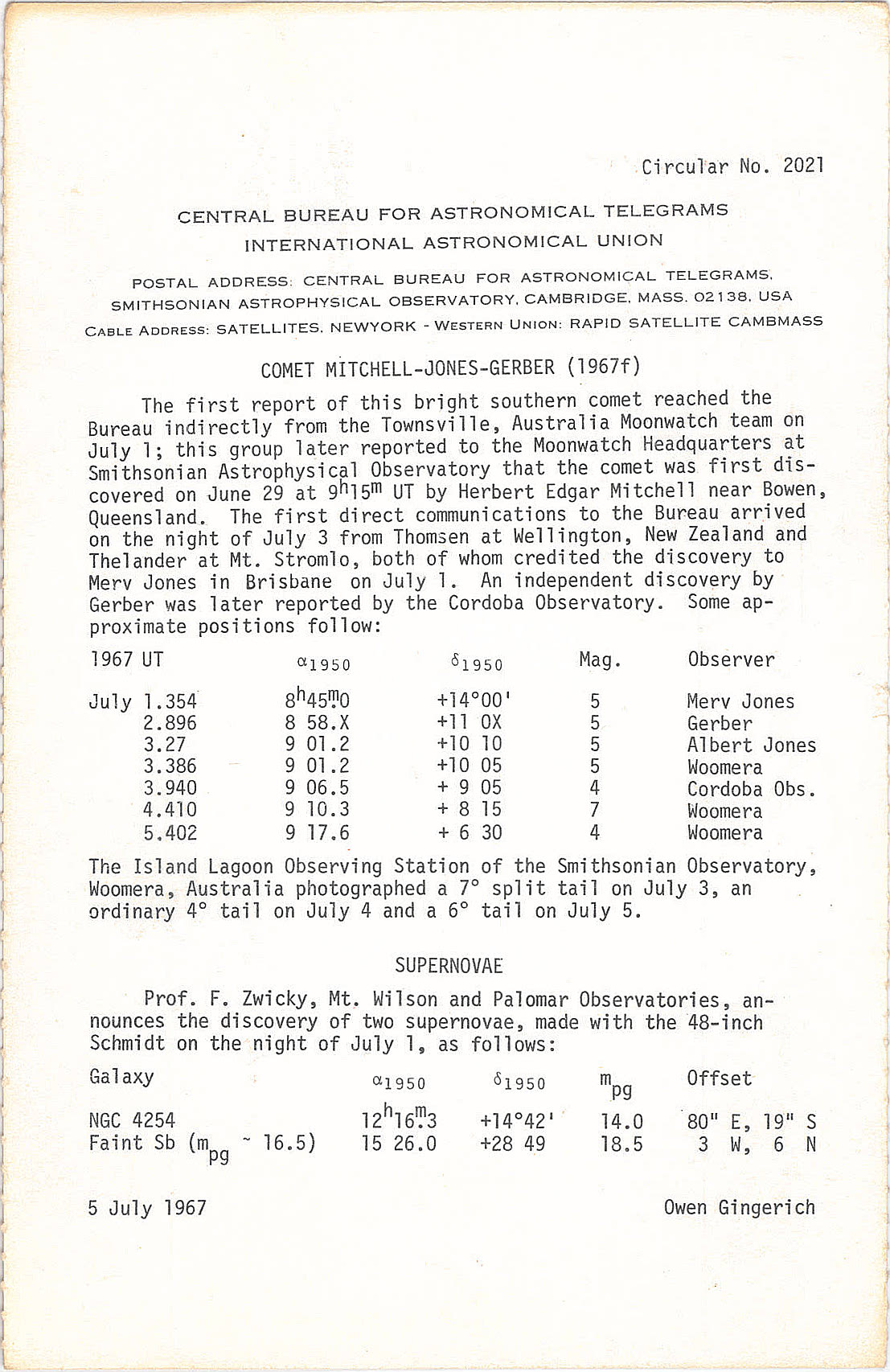
- SN 1967H (Type II, mag. 14.0) was discovered by Fritz Zwicky on 1 July 1967.[13][14][15][16]
- SN 1972Q (type unknown, mag. 15.8) was discovered by Leonida Rosino on 14 December 1972.[17]
- SN 1986I (Type II, mag. 14) was discovered by Carlton Pennypacker et al. on 17 May 1986.[18][19][20]
- SN 2014L (Type Ic, mag. 17.2) was discovered by the THU-NAOC Transient Survey (TNTS) on 26 January 2014.[21][22][23]
See also
[edit]- List of Messier objects
- Messier 83 – a similar face-on spiral galaxy
- Pinwheel Galaxy – a similar face-on spiral galaxy
References
[edit]- ^ "The Schulman Telescope". www.as.arizona.edu. Retrieved 2022-02-20.
- ^ Dreyer, J. L. E. (1988). Sinnott, R. W. (ed.). The Complete New General Catalogue and Index Catalogue of Nebulae and Star Clusters. Sky Publishing Corporation/Cambridge University Press. ISBN 978-0-933346-51-2.
- ^ a b Skrutskie, Michael F.; Cutri, Roc M.; Stiening, Rae; Weinberg, Martin D.; Schneider, Stephen E.; Carpenter, John M.; Beichman, Charles A.; Capps, Richard W.; Chester, Thomas; Elias, Jonathan H.; Huchra, John P.; Liebert, James W.; Lonsdale, Carol J.; Monet, David G.; Price, Stephan; Seitzer, Patrick; Jarrett, Thomas H.; Kirkpatrick, J. Davy; Gizis, John E.; Howard, Elizabeth V.; Evans, Tracey E.; Fowler, John W.; Fullmer, Linda; Hurt, Robert L.; Light, Robert M.; Kopan, Eugene L.; Marsh, Kenneth A.; McCallon, Howard L.; Tam, Robert; Van Dyk, Schuyler D.; Wheelock, Sherry L. (1 February 2006). "The Two Micron All Sky Survey (2MASS)". The Astronomical Journal. 131 (2): 1163–1183. Bibcode:2006AJ....131.1163S. doi:10.1086/498708. ISSN 0004-6256. S2CID 18913331.
- ^ a b c "NASA/IPAC Extragalactic Database". Results for NGC 4254. Retrieved 2006-11-25.
- ^ a b c Tully, R. Brent; et al. (August 2016), "Cosmicflows-3", The Astronomical Journal, 152 (2): 21, arXiv:1605.01765, Bibcode:2016AJ....152...50T, doi:10.3847/0004-6256/152/2/50, S2CID 250737862, 50.
- ^ a b c d Vollmer, B.; Huchtmeier, W.; van Driel, W. (September 2005). "NGC 4254: a spiral galaxy entering the Virgo cluster". Astronomy and Astrophysics. 439 (3): 921–933. arXiv:astro-ph/0505021. Bibcode:2005A&A...439..921V. doi:10.1051/0004-6361:20041350. S2CID 17414818.
- ^ "Messier 99". SEDS Messier Catalog. Retrieved 30 April 2022.
- ^ a b de Vaucouleurs, G.; et al. (1991), Third reference catalogue of bright galaxies, 9, New York: Springer-Verlag.
- ^ "M 99". SIMBAD. Centre de données astronomiques de Strasbourg. Retrieved 2009-12-18.
- ^ Jones, K. G. (1991). Messier's Nebulae and Star Clusters (2nd ed.). Cambridge University Press. ISBN 978-0-521-37079-0.
- ^ The Earl of Rosse (1850). "Observations on the Nebulae". Philosophical Transactions of the Royal Society of London. 140: 499–514. Bibcode:1850RSPT..140..499R.
- ^ Chyży, K. T.; Ehle, M.; Beck, R. (September 2007). "Magnetic fields and gas in the cluster-influenced spiral galaxy NGC 4254. I. Radio and X-rays observations". Astronomy and Astrophysics. 474 (2): 415–429. arXiv:0708.1533. Bibcode:2007A&A...474..415C. doi:10.1051/0004-6361:20077497. S2CID 16273521.
- ^ Gingerich, Owen (5 July 1967). "Circular No. 2021". Central Bureau for Astronomical Telegrams. Smithsonian Astrophysical Observatory. Retrieved 2 December 2024.
- ^ Zwicky, F. (1968). "The 1967 Palomar Supernova Search". Publications of the Astronomical Society of the Pacific. 80 (475): 462. Bibcode:1968PASP...80..462Z. doi:10.1086/128660.
- ^ "SN 1967H". Transient Name Server. IAU. Retrieved 2 December 2024.
- ^ Fairall, A. P. (August 1975), "The spectrum of the type II supernova 1967h in NGC 4254", Monthly Notes of the Astronomical Society of South Africa, 34 (7): 94–98, hdl:10520/AJA00248266_2204
- ^ "SN 1972Q". Transient Name Server. IAU. Retrieved 2 December 2024.
- ^ Pennypacker, C.; Burns, S.; Crawford, F.; Friedman, P.; Muller, J.; Perlmutter, S.; Smith, C.; Treffers, R.; Williamson, A.; Junkkarinen, V.; Filippenko, A. V.; McCarthy, P. J.; Rosino, L.; Iijima, T.; Wilson, I.; Horine, E. (1986). "Supernovae". IAU Circular (4219): 1. Bibcode:1986IAUC.4219....1P.
- ^ "SN 1986I". Transient Name Server. IAU. Retrieved 2 December 2024.
- ^ Penhallow, W. S.; et al. (June 1986), Marsden, B. G. (ed.), "Supernova 1986I in NGC 4254", IAU Circular (4225): 2, Bibcode:1986IAUC.4225....2P
- ^ Zhang, Tianmeng; Wang, Xiaofeng; Mo, Jun; Chen, Juncheng (2014). "Supernova 2014L in M99 = PSN J12184868+1424435". Central Bureau Electronic Telegrams (3795): 1. Bibcode:2014CBET.3795....1Z.
- ^ Bishop, David. "Supernovae 2014L in M99". Rochester Astronomy. Retrieved 2 December 2024.
- ^ "SN 2014L". Transient Name Server. IAU. Retrieved 2 December 2024.
External links
[edit]
- SEDS: Spiral Galaxy M99
- UniverseToday: Dark Matter Galaxy?
- PPARC: New evidence for a Dark Matter Galaxy
- Kasliwal, Mansi M.; et al. (2011). "PTF 10fqs: A LUMINOUS RED NOVA IN THE SPIRAL GALAXY MESSIER 99". The Astrophysical Journal. 730 (2): 134. arXiv:1005.1455. Bibcode:2011ApJ...730..134K. doi:10.1088/0004-637X/730/2/134. S2CID 18454146.
- Messier 99 on WikiSky: DSS2, SDSS, GALEX, IRAS, Hydrogen α, X-Ray, Astrophoto, Sky Map, Articles and images


| List |
|  |
|---|---|---|
| See also | ||


Messier 99
View on GrokipediaPhysical characteristics
Morphology and structure
Messier 99, also known as NGC 4254, is classified as an unbarred grand design spiral galaxy of morphological type SA(s)c, characterized by loosely wound spiral arms that extend prominently from the central bulge.[6] This classification reflects its pure spiral structure without a central bar, with the arms forming a well-defined, symmetric pattern in optical wavelengths, though influenced by dynamical interactions.[7] The galaxy displays a distinctive asymmetric appearance due to its spiral arm configuration, featuring one relatively normal arm and another extended, more distorted arm, which together create an overall lopsided shape.[8] This asymmetry arises from a dominant m=1 spiral mode, giving the impression of a one-armed spiral in certain projections, and is likely tied to its passage through the Virgo Cluster environment.[7] Observed at an inclination of 42° relative to the line of sight and with a major axis position angle of 68°, Messier 99 appears nearly face-on, allowing clear views of its spiral features while the tilt imparts a subtle elliptical outline to the disk.[8] In amateur and professional telescopes, it presents an apparent size of 4.6′ × 4.3′, revealing the arms as bright, curving lanes against a fainter disk.[3] The spiral arms are sites of elevated star formation, with active regions tracing the loosely wound structures and highlighting the galaxy's dynamic evolution.Physical properties
Messier 99 possesses a physical diameter of approximately 80,000 light-years (24.5 kpc), smaller than the Milky Way but with a more compact stellar distribution. Its apparent visual magnitude stands at 9.9, rendering it one of the brighter members of the Virgo Cluster visible to amateur astronomers under dark skies.[9] The galaxy's estimated total mass is around 100 billion solar masses (), dominated by its stellar component with contributions from interstellar gas and dark matter inferred from rotation curves.[10] In terms of luminosity, Messier 99 exhibits an absolute V-band magnitude of approximately -21.2, highlighting its status as a relatively luminous Sc-type spiral for its morphological class. This brightness stems primarily from its population of intermediate-age and young stars scattered across the disk. Composed of a thin disk rich in stars, neutral and molecular gas, and diffuse dust, Messier 99 lacks a central bar, allowing for a relatively symmetric distribution of its interstellar medium. The gas content, including significant reservoirs of atomic hydrogen (HI mass ), supports ongoing dynamical processes, while dust lanes trace regions of denser material intertwined with the stellar component.[11]Observational details
Coordinates and distance
Messier 99 is situated in the constellation Coma Berenices. Its equatorial coordinates in the J2000 epoch are right ascension 12h 18m 49.625s and declination +14° 24′ 59.36″.[12] Modern measurements place Messier 99 at a distance of 16.5 Mpc (approximately 54 million light-years) from Earth. This estimate relies primarily on its membership in the Virgo Cluster, where distances to early-type member galaxies have been determined via surface brightness fluctuation (SBF) methods, achieving a precision of about 5% for the cluster as a whole. SBF distances are calibrated against Cepheid variable stars observed in nearby galaxies such as those in the Fornax Cluster and NGC 4258, providing an absolute scale for the Virgo distance ladder. Alternative approaches, including the Tully-Fisher relation applied to spiral galaxies like Messier 99, yield consistent results within 10-15% uncertainty.Visibility and observation
Messier 99 is best observed from northern hemisphere latitudes above 30°N during spring, with optimal viewing in April and May when the constellation Coma Berenices reaches high culmination.[13][14] Its apparent magnitude of 9.8 and angular size of approximately 4.6 by 4.3 arcminutes make it detectable under suitable conditions.[12] Under dark skies, the galaxy appears as a faint, roundish glow with a brighter core in 4-inch telescopes, while apertures of 8 inches or larger begin to reveal hints of its spiral structure.[15][13] Larger instruments, such as 10-inch telescopes, can show more defined arms under excellent seeing, though the full extent requires even bigger apertures or long-exposure imaging.[13] Challenges include its low surface brightness of about 22.6 mag/arcsec², which demands minimal light pollution, and its position near brighter Virgo Cluster galaxies like Messier 87 and Messier 84, which can hinder contrast and field identification.[16][17] Professional imaging from the Hubble Space Telescope unveils intricate details of the asymmetric spiral arms and star-forming regions otherwise invisible to ground-based observers.[2]Historical observations
Discovery and cataloging
Messier 99 was discovered by the French astronomer Pierre Méchain on March 17, 1781, during his systematic searches for comets in the constellation Coma Berenices.[18] Méchain promptly communicated the finding to his colleague Charles Messier, who independently observed the object and incorporated it into his renowned catalog of nebulae and star clusters as the 99th entry on April 13, 1781.[18] In his initial description, Messier characterized it as "a nebula without star, very faint, near 24 Comae [Berenices]," noting its unresolved, nebulous appearance through contemporary telescopes.[18] This object, situated in Coma Berenices, was later designated NGC 4254 in John Louis Emil Dreyer's New General Catalogue of Nebulae and Clusters of Stars, published in 1888.[13]Early studies
Following its inclusion in the Messier Catalog, initial scientific scrutiny of Messier 99 emphasized its structural peculiarities through visual and telescopic examinations. In the spring of 1846, William Parsons, 3rd Earl of Rosse, utilized his newly completed 72-inch reflecting telescope at Birr Castle to resolve the object's spiral form, marking it as the second nebula after M51 in which such a configuration was discerned.[19] Rosse's detailed drawings from these sessions captured the galaxy's asymmetric spiral arms, with one arm appearing more extended and luminous while the other seemed compressed, and the nucleus displaced toward one side of the disk. These 19th-century illustrations, produced under optimal conditions at Birr Castle, provided the earliest graphic documentation of the object's lopsided morphology and influenced subsequent interpretations of spiral nebulae.[13] Advancing into the early 20th century, spectroscopic investigations offered insights into Messier 99's physical makeup and dynamics. Vesto Slipher's pioneering radial velocity measurements at Lowell Observatory, part of his broader survey of spiral nebulae, included observations of Messier 99 (NGC 4254) that revealed a spectrum dominated by absorption lines akin to stellar spectra but with indications of gaseous emission components, confirming the presence of ionized gas within the system. These spectra also demonstrated a substantial positive radial velocity of approximately 2,300 km/s, evidencing the galaxy's recession and underlying rotational motion through the integrated Doppler broadening of lines. By the mid-1920s, amid the resolution of debates on the nature of "spiral nebulae," Edwin Hubble's work on nearby spirals using Cepheid variables, combined with radial velocity measurements, helped establish that objects like Messier 99 were extragalactic systems distinct from Milky Way nebulosity. This recognition solidified its status as a remote island universe, integral to emerging cosmological frameworks.Association with the Virgo Cluster
Cluster membership
Messier 99 (NGC 4254) is a confirmed member of the Virgo Cluster, the nearest major galaxy cluster to the Milky Way, situated on its northwestern periphery at a projected separation of approximately 3.7° (or about 1 megaparsec) from the cluster's central galaxy, Messier 87.[20] This positioning places it among the outer regions of the cluster's extensive structure, which spans over 1,000 identified galaxies across roughly 15 megaparsecs in diameter.[21] Within the cluster, Messier 99 occupies a region near other notable spiral galaxies, including Messier 98 (NGC 4192) to its west and Messier 100 (NGC 4321) to its southeast, forming part of a loose subgroup in the constellation Coma Berenices that highlights the cluster's northern extension.[22] These relative proximities, with angular separations under 2° between them, underscore Messier 99's role in the cluster's filamentary distribution, where spirals like these trace the outer envelope.[17] The measured distance to Messier 99 of about 55 million light-years (17 megaparsecs) closely matches the Virgo Cluster's mean distance, reinforcing its membership and providing context for its physical separation from the core.[2] In the broader dynamics of the Virgo Cluster, which exhibits ongoing infall from surrounding large-scale structures, Messier 99 follows an orbital path indicative of a first-time entrant, with a recessional velocity of around 2,400 km/s relative to the cluster center suggesting radial motion toward the denser interior.[20] This trajectory implies it has recently begun interacting gravitationally with the cluster environment, as evidenced by faint gas bridges extending toward nearby galaxies.[20]Interactions and dynamics
Messier 99 exhibits evidence of ram-pressure stripping as it moves through the intracluster medium of the Virgo Cluster, primarily affecting its outer neutral hydrogen envelope while leaving the denser inner molecular gas largely intact. Numerical simulations indicate that the galaxy is infalling into the cluster at high velocity, with the ram pressure acting nearly face-on to its disk at an angle of approximately 70 degrees, removing gas with surface densities below about 10^{20} cm^{-2} up to radii of 18 kpc. This process has resulted in an extended low-surface-density HI tail extending northwestward for up to 30 kpc, containing roughly 2.1 × 10^8 M_⊙ of neutral hydrogen, or about 4.6% of the galaxy's total HI flux.[23] A prominent feature of these dynamics is a faint bridge of neutral hydrogen gas connecting Messier 99 to the HI cloud VIRGOHI 21, located approximately 150 kpc away and interpreted as tidal debris from their interaction. This 25-arcminute-long (about 120 kpc) filament, detected in 21-cm observations, spans a velocity range from 1900 to 2400 km s^{-1}, suggesting ongoing gas transfer or stripping induced by a close encounter roughly 10^8 years ago with a perturber of mass around 10^{11} M_⊙. The bridge and associated HI tail, totaling about 5 × 10^8 M_⊙, point to gravitational perturbations that have distorted the galaxy's morphology, including its one-armed spiral structure.[24][25] The arm asymmetry in Messier 99, characterized by a prominent m=1 mode with a tighter eastern arm and a more extended western one, along with kinematical lopsidedness of up to 20 km s^{-1} out to 7 kpc, is attributed to a past tidal encounter with the lenticular galaxy NGC 4262 approximately 280 million years ago. During this event, the closest approach occurred at 27 kpc with a relative velocity of 710 km s^{-1}, triggering the uneven spiral pattern and shifting the dark matter halo by 2.2–2.5 kpc. These interactions have perturbed the gas distribution, creating bimodal velocity structures and sinusoidal velocity fields that couple rotation with tidal motions, thereby compressing gas clouds and triggering localized star formation along the arms.[23][26][25] As a peripheral member of the Virgo Cluster, Messier 99's location facilitates such high-speed encounters and environmental influences.[23]Notable phenomena
Supernovae
Messier 99 has experienced four confirmed supernovae, all core-collapse types originating from massive stars in the galaxy's prominent spiral arms, reflecting its elevated star formation rate. These events provide valuable data on the progenitors and early evolution of such explosions in a nearby cluster galaxy. The supernovae are summarized in the following table:| Supernova | Type | Discovery Date | Discoverer | Peak Apparent Magnitude | Location |
|---|---|---|---|---|---|
| SN 1967H | II | July 1, 1967 | Fritz Zwicky (Palomar Observatory) | 14.0 | ~80" west, 19" south of nucleus, in southern spiral arm |
| SN 1972Q | II | December 14, 1972 | Leonida Rosino (Asiago Observatory) | 15.6 | In northeastern spiral arm |
| SN 1986I | II-P | May 17, 1986 | Carlton Pennypacker et al. (Leuschner Observatory) | 14.0 | In prominent spiral arm, ~36" from nucleus[27] |
| SN 2014L | Ic | January 26, 2014 | THU-NAOC Transient Survey (TNTS) | ~15.5 (V-band) | In outer spiral arm, associated with young star cluster[28] |