Hubbry Logo
NGC 4526NGC 4526Main
Open search
NGC 4526
Community hub
NGC 4526
logo
8 pages, 0 posts
0 subscribers
Be the first to start a discussion here.
NGC 4526
NGC 4526
from Wikipedia
NGC 4526
NGC 4526 with SN 1994D @ bottom left
Supernova SN 1994D (lower left) in the outskirts of NGC 4526's central disk
Observation data (J2000 epoch)
ConstellationVirgo
Right ascension12h 34m 03.029s[1]
Declination+07° 41′ 56.90″[1]
Redshift0.002058±0.000017
Heliocentric radial velocity617±5 km/s[2]
Distance55±Mly (16.9±1.6 Mpc)[3]
52 Mly (15.8 Mpc)[4]
Apparent magnitude (V)10.7[2]
Characteristics
TypeSAB(s)0°[5]
Size~114,400 ly (35.07 kpc) (estimated)[2]
Apparent size (V)7.2′ × 2.4′[2]
Other designations
IRAS 12315+0758, NGC 4560, UGC 7718, MCG +01-32-100, PGC 41772, CGCG 042-155[2]

NGC 4526 (also listed as NGC 4560) is a lenticular galaxy with an embedded dusty disc, located approximately 55 million light-years from the Solar System[3] in the Virgo constellation and discovered on 13 April 1784 by William Herschel.[6] Herschel observed it again on 28 December 1785, resulting in the galaxy being entered twice into the New General Catalogue.[6]

NGC 4526 imaged by the Vera C. Rubin Observatory

The galaxy is seen nearly edge-on. The morphological classification is SAB(s)0°,[5] which indicates a lenticular structure with a weak bar across the center and pure spiral arms without a ring.[7] It belongs to the Virgo Cluster and is one of the brightest known lenticular galaxies.[5] In the galaxy's outer halo, globular cluster orbital velocities[8] indicate abnormal poverty of dark matter: only 43±18% of the mass within 5 effective radii.

The inner nucleus of this galaxy displays a rise in stellar orbital motion that indicates the presence of a central dark mass. The best fit model for the motion of molecular gas in the core region suggests there is a supermassive black hole with about 4.5+4.2
−3.0
×108
(450 million) times the mass of the Sun.[9] This is the first object to have its black-hole mass estimated by measuring the rotation of gas molecules around its centre with an astronomical interferometer (in this case the Combined Array for Research in Millimeter-wave Astronomy).

Supernovae

[edit]

Two supernovae have been observed in NGC 4526:

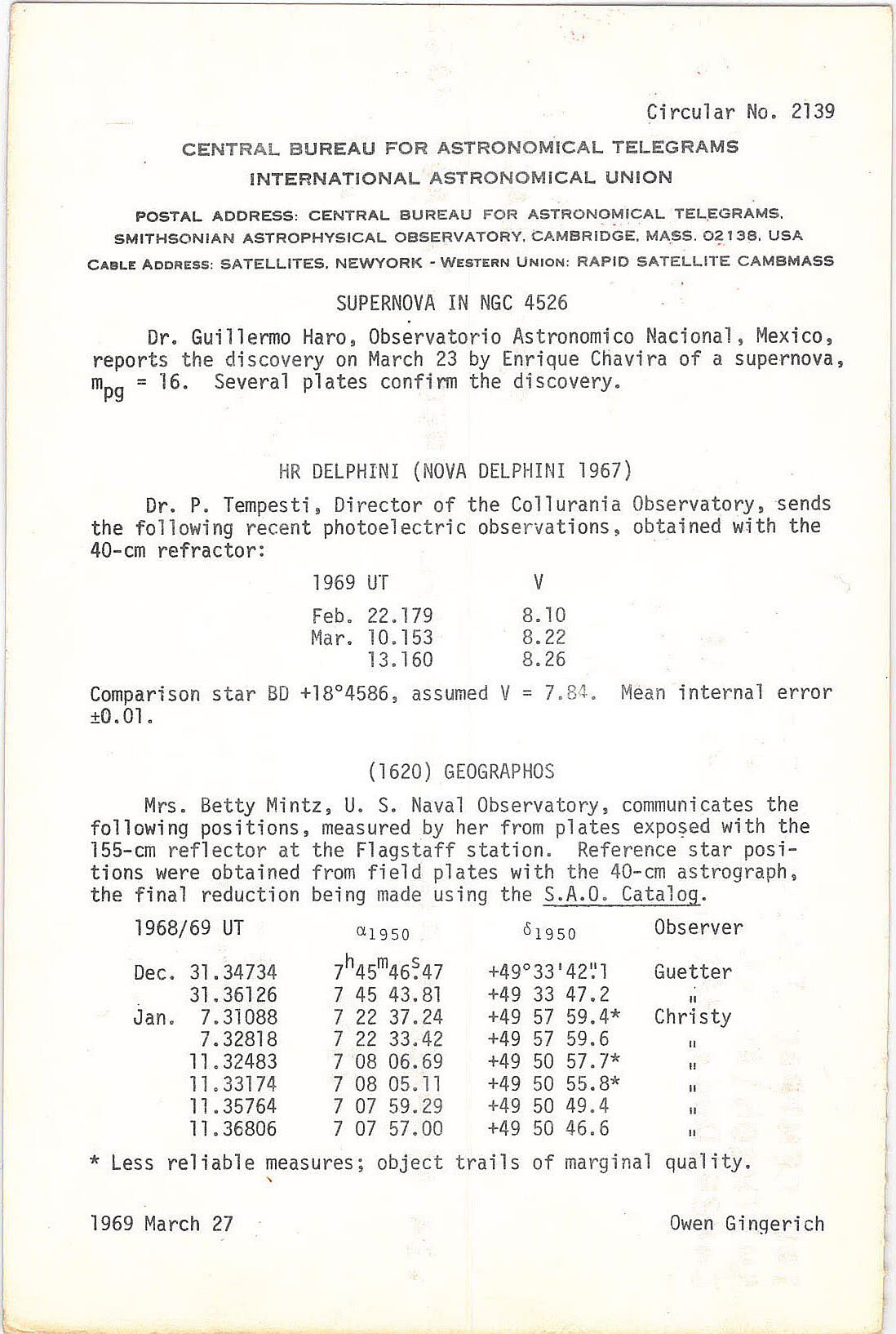
  • SN 1969E (type unknown, mag. 16) was discovered by Enrique Chavira on 23 March 1969.[10][11][12]
  • SN 1994D (Type Ia, mag. 15.2) was discovered independently by the Leuschner Observatory Supernova Search and by Dr. M. Richmond, on 7 March 1994, about two weeks before reaching peak brightness.[13][14] It was caused by the explosion of a white dwarf star composed of carbon and oxygen.[15]
Wider Hubble Space Telescope image showing the envelope of more distant orbiting stars

See also

[edit]

References

[edit]
[edit]
Revisions and contributorsEdit on WikipediaRead on Wikipedia
from Grokipedia
NGC 4526 is a located in the , approximately 50 million light-years from . It is classified as an S0 galaxy, featuring a prominent central bulge and a thin, dusty disk that bridges the morphological characteristics between spiral and elliptical galaxies. This galaxy is notable for its rich reservoir of molecular gas, which is unusual for early-type galaxies like lenticulars, allowing for detailed studies of giant molecular clouds at resolutions comparable to those in the . At its core lies a with a mass of approximately 450 million solar masses, precisely measured through kinematics of the surrounding molecular gas using the Atacama Large Millimeter/submillimeter Array (ALMA). NGC 4526 has also hosted two observed supernovae: SN 1969E, discovered in March 1969 with an unknown type and peak magnitude of about 16, and the well-studied SN , which exploded in March 1994 and reached a peak brightness of around magnitude 11.8, providing valuable data for distance measurements and cosmological studies such as the Hubble constant. The galaxy's dusty lanes and diffuse stellar halo create a striking visual appearance in images, highlighting its dynamic environment within the , where interactions with may contribute to its gas content and history.

General Properties

Coordinates and Visibility

NGC 4526 occupies a position in the sky at 12h 34m 03.0s and +07° 41′ 57″, based on the J2000.0 . This places it within the boundaries of the constellation Virgo. The galaxy spans an apparent size of approximately 7.0′ along its major axis and 2.5′ along its minor axis. It exhibits an of 10.7 in the V-band, with a of about 23.4 mag/arcsec², rendering it a moderately faint extended object that challenges casual observers. Optimal viewing occurs from the during spring months, when Virgo rises high in the evening sky. A with a 6-inch (150 mm) aperture suffices for basic detection under , though an 8-inch (200 mm) or larger instrument reveals finer details such as its elongated form. NGC 4526 has earned the informal nickname "Hairy Eyebrow Galaxy" owing to its striking edge-on orientation, where a prominent dust lane evokes the shape of an .

Physical Characteristics

NGC 4526 is classified as a of morphological type S0, characterized by a prominent bulge and a with little ongoing , as determined from early photographic surveys. This Hubble classification highlights its transitional nature between spiral and elliptical galaxies, with a subtle nuclear dust ring contributing to the S0_3 subtype. The galaxy lies at a distance of 15.7 ± 0.2 (statistical) ± 0.4 (systematic) Mpc (approximately 51 million light-years), measured using the tip of the method from imaging, providing one of the highest-precision distances for members. Earlier estimates incorporating standard candles, calibrated against Cepheid variables in nearby galaxies, support a similar scale of around 16 Mpc for the host environment. At this distance, NGC 4526's apparent of about 6 arcminutes corresponds to a physical of roughly 90,000 light-years across the major axis. Mass estimates from modeling yield a total of approximately 1.8 × 10¹¹ solar masses. NGC 4526 exhibits a heliocentric recession velocity of 617 ± 5 km/s, corresponding to a z ≈ 0.00206, consistent with its membership in the Virgo Cluster's foreground substructure. The galaxy's disk rotation, observed edge-on, reaches velocities exceeding 250 km/s along the major axis, as traced by molecular gas kinematics. Dynamical mass calculations from these rotation curves, assuming a Keplerian inner profile transitioning to a flatter outer curve, indicate a total dynamical mass within the effective radius of about 1.6 × 10¹¹ solar masses, dominated by the stellar component with minimal contribution in the inner regions.

Location and Environment

Virgo Cluster Membership

NGC 4526 is a confirmed member of the , the nearest rich cluster of galaxies to the , and is associated with the Virgo A subgroup or the W' cloud substructure. The cluster as a whole lies at a mean distance of approximately 16.5 Mpc from , placing NGC 4526 at a similar distance of about 16 Mpc based on recent measurements. This positioning situates the galaxy within the dense intracluster environment dominated by the central M87, from which NGC 4526 is projected at roughly 1 Mpc. The has an estimated total mass of around 1.2×10151.2 \times 10^{15} solar masses within its virial radius, exerting significant gravitational influence on member galaxies like NGC 4526. Membership in the for NGC 4526 is established through its and position within the cluster's velocity field, which shows a dispersion of several hundred km/s among members. The galaxy's heliocentric of 617 km/s aligns with the cluster's overall kinematics, indicating it is bound rather than a foreground or background object. Relative to the expected Hubble flow at this distance (assuming H070H_0 \approx 70 km/s/Mpc), NGC 4526 exhibits a peculiar velocity of approximately -500 km/s, consistent with the Local Group's infall toward the cluster center and the galaxy's integration into the cluster dynamics. This velocity signature, combined with its spatial proximity to the core, confirms its longstanding residency in the Virgo environment. The cluster environment profoundly impacts NGC 4526 through hydrodynamic interactions, notably ram-pressure stripping by the hot intracluster medium. Evidence for this includes the galaxy's severe HI gas deficiency, with no detectable atomic hydrogen emission and an H₂/HI mass ratio exceeding 60, suggesting the low-density interstellar medium has been largely removed. Such stripping is typical for galaxies orbiting near the cluster core, where the ram pressure exceeds the binding force of the galactic disk gas, leading to truncated gas reservoirs and altered star formation potential. Observations indicate this process has shaped NGC 4526's evolution as a longtime cluster resident, with its molecular gas showing signs of relaxation post-stripping.

Nearby Galaxies and Interactions

NGC 4526 has a notable projected neighbor within the : the edge-on spiral NGC 4532, at about 1.2 degrees separation corresponding to a projected distance of roughly 320 kpc assuming a cluster distance of 16 Mpc. NGC 4532 exhibits signs of tidal distortion in its HI distribution, potentially linked to interactions with dwarf companions like DDO 137, though direct evidence of pairwise gravitational influence on NGC 4526 remains subtle. Observations reveal no detectable neutral hydrogen (HI) in NGC 4526, with upper limits indicating severe HI deficiency consistent with stripping from the during its passage through denser cluster regions, rather than prominent HI tails or bridges typical of close encounters. However, the galaxy's prominent dust lanes and central molecular gas disk, traced by CO emission, may stem from past minor mergers or gas accretion from low-mass companions, as the confined distribution of giant molecular clouds suggests external replenishment rather than formation. These features align with environmental processing in the cluster, where by passing galaxies could contribute to the warped dust morphology without evidence of a major merger. The relative of NGC 4526 at 617 km/s places it in differential motion relative to the main Virgo Cluster systemic velocity of around 1100 km/s, indicating membership in a subclump or infalling group with lower velocities, while NGC 4532 at 880 km/s shows closer alignment to the cluster core. This kinematic isolation, combined with no major merger history, points to repeated minor interactions or harassment events as drivers of its evolution, rather than a singular disruptive encounter. Such interactions likely influence NGC 4526's quiescence by enabling episodic gas accretion that fuels limited molecular gas reservoirs but fails to trigger widespread , maintaining its lenticular morphology amid cluster harassment. The stripped HI envelope limits further fueling, while accreted material from companions contributes to the observed dust and molecular features, underscoring the role of environmental dynamics in .

Structure and Composition

Disk and Dust Features

NGC 4526 is observed at a high inclination of approximately 79°, presenting a nearly edge-on view of its thin galactic disk and allowing detailed examination of its vertical structure. This orientation reveals a prominent equatorial dust lane that bisects the central bulge, appearing as sharp, dark filaments against the diffuse stellar glow in high-resolution imaging. The dust lane is particularly striking in Hubble Space Telescope observations, where it highlights the galaxy's midplane dynamics and contributes to the halo-like appearance of the disk. The central bulge is classical in morphology, characterized by a boxy evident in optical isophotal contours, with a relatively high bulge-to-disk light ratio indicative of its lenticular nature. The disk itself has a vertical thickness on the order of 1 kpc, consistent with typical S0 galaxies, and lacks a confirmed strong bar structure, though classified as SAB0(s) with possible weak bar features. Hubble images further visualize the disk's rapid , with velocities exceeding 250 km/s, giving the appearance of curved or warped edges due to the projected motion of gas and stars. The dust features consist of silicate-rich lanes, as inferred from typical compositions in similar galaxies. Rotational velocity measurements, peaking near 300 km/s, underscore the disk's stability without significant warping beyond projection effects.

Stellar and Gas Populations

NGC 4526 features a predominantly old in its central bulge, coexisting with evidence of younger components in the disk and circumnuclear regions. Integral-field reveals absorption line strengths indicative of old stars in the core, while a circumnuclear ring displays signatures of recent , including elevated Hβ absorption and depressed Mg b/Fe indices consistent with populations younger than 1 Gyr. In the central disk, intermediate-age stars are suggested by redder Spitzer [3.6]–[4.5] μm colors and shallower CO absorption bands, contrasting with the more uniform, older populations in the outer regions. The current star formation rate remains low at approximately 0.2 M_⊙ yr⁻¹, derived from 22 μm and far-ultraviolet luminosities, reflecting limited ongoing activity. The of NGC 4526 is markedly HI-deficient, with an upper limit on the atomic gas of less than 1.9 × 10^7 M_⊙, resulting in an exceptionally high H₂/HI exceeding 60 and no detected HI emission. Despite this, the galaxy harbors a population of 103 resolved giant molecular clouds (GMCs), with spanning roughly 5 × 10^5 to 5.9 × 10^6 M_⊙ and a steep mass function dN/dM ∝ M^{-2.39}. These GMCs exhibit surface densities around 1200 M_⊙ pc^{-2}, approximately seven times higher than typical values in the disk, and are more luminous by a factor of about five. Kinematic studies of the gas reveal multi-component absorption in Ca II and Na I lines at a of +714 km s^{-1}, tracing cold interstellar material at rest relative to the galaxy's environment, with a systemic of +625 km s^{-1} at the center rising to +880 km s^{-1} near the site. The GMCs display an average dispersion of approximately 14 km s^{-1}, indicating dynamically bound structures with a virial near unity. High-velocity clouds associated with the are detected at +204 to +254 km s^{-1}, but these originate from foreground gas rather than the galaxy itself. As a Virgo Cluster member, NGC 4526 represents a post-starburst lenticular galaxy, where star formation has been recently quenched, as evidenced by its low specific star formation rate of 10^{-11.8} yr^{-1} and excess 70 μm emission indicative of residual cold dust processing. This quenching is attributed to environmental effects like ram pressure stripping, which has preferentially removed diffuse HI while preserving denser molecular gas, leading to a gas depletion timescale of about 2.6 Gyr.

Observational History

Discovery and Early Observations

NGC 4526 was discovered by British astronomer on April 13, 1784, during his systematic sweep of the northern sky using a 18.7-inch ; he cataloged it as the 31st entry in his first class of nebulae, describing it as a "very bright, extended, much brighter in the middle, resolvable, between two bright stars" . This observation marked the initial detection of the galaxy, then perceived as a , in the constellation Virgo. Herschel's work laid the foundation for subsequent catalogs, emphasizing its brightness and central concentration. The galaxy received its modern designation in the (NGC), compiled by Danish-Irish astronomer John Louis Emil Dreyer and published in 1888 as part of the Royal Astronomical Society's Memoirs. Dreyer incorporated Herschel's observations along with those from his son , who had reobserved the object multiple times between 1830 and 1834 during sweeps from the , confirming its position and appearance. Early 19th-century surveys, including John Herschel's General Catalogue of Nebulae and Clusters (1864), listed it as GC 3075, highlighting its role in mapping faint deep-sky objects. Initial morphological classifications emerged in the early amid growing recognition of extragalactic nature for such "nebulae." In his seminal 1936 work on galaxy classification, tentatively placed NGC 4526 among early-type spirals based on its apparent disk-like structure and central bulge observed on photographic plates from . However, by 1961, refined this assessment in The Hubble Atlas of Galaxies, reclassifying it as a (S0³) due to the absence of prominent spiral arms and the presence of a striking nuclear dust ring silhouetted against the bulge, bridging spirals and ellipticals. Pre-1960s observations relied heavily on photographic and imaging, revealing key features like the prominent dust lane crossing the galaxy's disk, first noted in deep blue-sensitive plates from the 1940s and 1950s at observatories such as Palomar and . These plates, exposed for hours to capture faint details, depicted the dust as a dark band obscuring background stars, suggesting an inclined disk with interstellar material. measurements advanced membership confirmation in the ; spectra obtained in the 1950s by Milton Humason and colleagues yielded an initial heliocentric recession velocity of approximately 450 km/s, indicating a of around 10-15 million light-years at the time (before modern distance calibrations). No supernovae were recorded in NGC 4526 during these early decades, with observations focused instead on broader surveys initiated by in and expanded by Humason, Mayall, and Sandage in , which included NGC 4526 among 800+ galaxies to map velocities and delineate cluster boundaries. These efforts underscored its position as a foreground member of the , approximately 50 million light-years distant in modern terms, without notable transient events until later.

Modern Imaging and Spectroscopy

Modern imaging of NGC 4526 began with (HST) observations using the Wide Field Planetary Camera 2 (WFPC2) in 1994, which captured the prominent dust lanes in the galaxy's central disk, highlighting its embedded structure against the stellar halo. Subsequent HST Advanced Camera for Surveys (ACS) imaging in 2014 provided higher-resolution views of the rapidly rotating inner disk, revealing gas, dust, and stars spinning at over 250 km/s and spanning about 7% of the galaxy's radius. Ground-based spectroscopy has complemented these efforts, with integral-field observations from the instrument in the 2000s mapping stellar absorption-line across the , identifying a counter-rotating central disk aligned with the photometric axis and providing insights into its dynamical structure. More recently, Atacama Large Millimeter/submillimeter Array (ALMA) observations in Band 3 since 2018 have mapped (CO) emission, resolving molecular gas distributions and giant molecular clouds (GMCs) in the disk, with properties indicating turbulent support and similarities to those in spiral galaxies. Very Large Telescope (VLT) Multi-Unit Spectroscopic Explorer (MUSE) data from the VESTIGE survey have further probed ionized gas emission in the inner regions, tracing influenced by environmental interactions. X-ray observations with the , as part of surveys like the MASSIVE project in the , detected a hot gas halo around NGC 4526, with low luminosity indicating limited hot retention typical of stripped early-type galaxies in cluster environments. Distance measurements have been refined using the tip of the (TRGB) method from HST imaging in the Carnegie-Chicago Hubble Program during the , yielding a precise value of 16.5 Mpc that anchors broader cosmological calibrations. As of 2025, the (JWST) offers potential for penetrating the dust-obscured regions in the near-infrared, enabling deeper studies of and molecular content in such lenticular systems.

Notable Events

Supernova 1969E

Supernova SN 1969E was discovered on March 23, 1969 (UT), by Mexican astronomer Enrique Chavira while conducting a patrol for supernovae. The event was promptly reported in Circular No. 2139, marking it as a new transient in the NGC 4526, a member of the . At the time of discovery, the supernova appeared at an of approximately 16, which is taken as its peak brightness given the sparse photometric data available. Positioned in the dusty disk of NGC 4526, SN 1969E was offset from the galactic nucleus by about 29 arcseconds to the south, at coordinates RA 12h 34m 02.20s, Dec +07° 41' 31.0" (J2000.0). Its classification remains unknown, as no spectroscopic observations were obtained to determine whether it was a Type I or Type II event, a common limitation for supernovae detected in the late due to the observational constraints of the era. The location within the disk suggests a possible association with the galaxy's , but without spectral confirmation, it cannot be definitively linked to core-collapse processes in massive stars. Photometric follow-up was minimal, with no detailed constructed; the supernova's brightness declined over subsequent weeks, but quantitative measurements beyond the discovery epoch are unavailable in published records. This paucity of data reflects the technological limitations of ground-based telescopes at the time, including smaller apertures and less sensitive detectors compared to modern instruments. As a result, SN 1969E provided only basic constraints on its temporal evolution. As the first documented in NGC 4526, SN 1969E holds historical importance and contributed to early assessments of supernova occurrence rates in the , helping to refine estimates of extragalactic supernova frequencies during the late . These rates, derived from catalogs including events like SN 1969E, informed models of and galaxy cluster dynamics, with Virgo serving as a key laboratory due to its proximity.

Supernova 1994D

Supernova 1994D was discovered on March 7, 1994, by R. R. Treffers, A. V. Filippenko, and S. D. Van Dyk using the 0.6-m Katzman Automatic Imaging Telescope at as part of the Lick Observatory Supernova Search. The event occurred in NGC 4526, a member of the , and was independently confirmed shortly after. It was classified as a based on early spectra showing characteristic silicon absorption lines. The supernova is positioned in the outskirts of NGC 4526's disk, approximately 9 arcseconds west and 7 arcseconds north of the nucleus, within a region featuring prominent dust lanes. Extensive UBVRI photometry was conducted at the (ESO), capturing the from pre-maximum phases through decline. At peak brightness, around March 22, 1994, it reached a V-band magnitude of 11.9, temporarily outshining the integrated light of its host galaxy NGC 4526. The exhibited a B-band decline rate of Δm_{15} ≈ 1.25 mag over 15 days post-maximum, consistent with normal Type Ia events. Early spectra revealed photospheric expansion velocities of about 15,000 km/s, with high-velocity silicon features extending to over 22,000 km/s. The progenitor is interpreted as a carbon-oxygen that accreted material until reaching the , triggering a thermonuclear explosion. As a prototypical , served as a standard candle for refining the to NGC 4526 and the , yielding a estimate of 16 ± 2 Mpc based on its peak and light curve . This measurement contributed to the extragalactic distance ladder, providing calibration for higher-redshift observations. Subsequent analyses, including those in 2004, incorporated into broader cosmological studies to constrain parameters by improving low-redshift anchors for .

References

Add your contribution
Related Hubs
User Avatar
No comments yet.