



Community hub
Recent from talks
Contribute something
Nothing was collected or created yet.
Nakayama's lemma
View on WikipediaIn mathematics, more specifically abstract algebra and commutative algebra, Nakayama's lemma — also known as the Krull–Azumaya theorem[1] — governs the interaction between the Jacobson radical of a ring (typically a commutative ring) and its finitely generated modules. Informally, the lemma immediately gives a precise sense in which finitely generated modules over a commutative ring behave like vector spaces over a field. It is an important tool in algebraic geometry, because it allows local data on algebraic varieties, in the form of modules over local rings, to be studied pointwise as vector spaces over the residue field of the ring.
The lemma is named after the Japanese mathematician Tadashi Nakayama and introduced in its present form in Nakayama (1951), although it was first discovered in the special case of ideals in a commutative ring by Wolfgang Krull and then in general by Goro Azumaya (1951).[2][3] In the commutative case, the lemma is a simple consequence of a generalized form of the Cayley–Hamilton theorem, an observation made by Michael Atiyah (1969). The special case of the noncommutative version of the lemma for right ideals appears in Nathan Jacobson (1945), and so the noncommutative Nakayama lemma is sometimes known as the Jacobson–Azumaya theorem.[1] The latter has various applications in the theory of Jacobson radicals.[4]
Statement
[edit]Let be a commutative ring with identity 1. The following is Nakayama's lemma, as stated in Matsumura (1989):

Statement 1: Let be an ideal in , and a finitely generated module over . If , then there exists with such that .


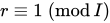

This is proven below. A useful mnemonic for Nakayama's lemma is "". This summarizes the following alternative formulation:

Statement 2: Let be an ideal in , and a finitely generated module over . If , then there exists an such that for all .


- Proof: Take in Statement 1.

The following corollary is also known as Nakayama's lemma, and it is in this form that it most often appears.[5]
Statement 3: If is a finitely generated module over , is the Jacobson radical of , and , then .


- Proof: (with as in Statement 1) is in the Jacobson radical so is invertible.[6]


More generally, one has that is a superfluous submodule of when is finitely generated.

Statement 4: If is a finitely generated module over , is a submodule of , and , then .


- Proof: Apply Statement 3 to .

The following result manifests Nakayama's lemma in terms of generators.[7]
Statement 5: If is a finitely generated module over and the images of elements of in generate as an -module, then also generate as an -module.


- Proof: Apply Statement 4 to .
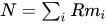
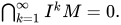
If one assumes instead that is complete and is separated with respect to the -adic topology for an ideal in , this last statement holds with in place of and without assuming in advance that is finitely generated.[8] Here separatedness means that the -adic topology satisfies the T1 separation axiom, and is equivalent to
Consequences
[edit]Local rings
[edit]In the special case of a finitely generated module over a local ring with maximal ideal , the quotient is a vector space over the field . Statement 5 then implies that a basis of lifts to a minimal set of generators of . Conversely, every minimal set of generators of is obtained in this way, and any two such sets of generators are related by an invertible matrix with entries in the ring.


Geometric interpretation
[edit]In this form, Nakayama's lemma takes on concrete geometrical significance. Local rings arise in geometry as the germs of functions at a point. Finitely generated modules over local rings arise quite often as germs of sections of vector bundles. Working at the level of germs rather than points, the notion of finite-dimensional vector bundle gives way to that of a coherent sheaf. Informally, Nakayama's lemma says that one can still regard a coherent sheaf as coming from a vector bundle in some sense. More precisely, let be a coherent sheaf of -modules over an arbitrary scheme . The stalk of at a point , denoted by , is a module over the local ring and the fiber of at is the vector space . Nakayama's lemma implies that a basis of the fiber lifts to a minimal set of generators of . That is:




- Any basis of the fiber of a coherent sheaf at a point comes from a minimal basis of local sections.
Reformulating this geometrically, if is a locally free -module representing a vector bundle , and if we take a basis of the vector bundle at a point in the scheme , this basis can be lifted to a basis of sections of the vector bundle in some neighborhood of the point. We can organize this data diagrammatically

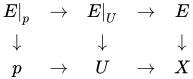
where is an n-dimensional vector space, to say a basis in (which is a basis of sections of the bundle ) can be lifted to a basis of sections for some neighborhood of .


Going up and going down
[edit]The going up theorem is essentially a corollary of Nakayama's lemma.[9] It asserts:
- Let be an integral extension of commutative rings, and a prime ideal of . Then there is a prime ideal in such that . Moreover, can be chosen to contain any prime of such that .


Module epimorphisms
[edit]Nakayama's lemma makes precise one sense in which finitely generated modules over a commutative ring are like vector spaces over a field. The following consequence of Nakayama's lemma gives another way in which this is true:
- If is a finitely generated -module and is a surjective endomorphism, then is an isomorphism.[10]


Over a local ring, one can say more about module epimorphisms:[11]
- Suppose that is a local ring with maximal ideal , and are finitely generated -modules. If is an -linear map such that the quotient is surjective, then is surjective.




Homological versions
[edit]Nakayama's lemma also has several versions in homological algebra. The above statement about epimorphisms can be used to show:[11]
- Let be a finitely generated module over a local ring. Then is projective if and only if it is free. This can be used to compute the Grothendieck group of any local ring as .

A geometrical and global counterpart to this is the Serre–Swan theorem, relating projective modules and coherent sheaves.
More generally, one has[12]
- Let be a local ring and a finitely generated module over . Then the projective dimension of over is equal to the length of every minimal free resolution of . Moreover, the projective dimension is equal to the global dimension of , which is by definition the smallest integer such that

- Here is the residue field of and is the tor functor.



Inverse function theorem
[edit]Nakayama's lemma is used to prove a version of the inverse function theorem in algebraic geometry:
- Let be a projective morphism between quasi-projective varieties. Then is an isomorphism if and only if it is a bijection and the differential is injective for all .[13]


Proof
[edit]A standard proof of Nakayama's lemma (Statement 1) uses the following technique due to Atiyah & Macdonald (1969).[14] We first prove the following assertion:
- Let M be an R-module generated by n elements, and let be an R-linear map. If there is an ideal I of R such that , then there is a monic polynomial with , such that as an endomorphism of M.


This assertion is precisely a generalized version of the Cayley–Hamilton theorem, and the proof proceeds along the same lines.
Proof of assertion: On the generators of M, one has a relation of the form

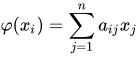
where . Thus


where in the Kronecker delta, and we are now regarding M as an -module with . The required result follows by multiplying by the adjugate of the matrix and invoking Cramer's rule. One finds then that , so the polynomial

![{\displaystyle R[\varphi ]}](https://wikimedia.org/api/rest_v1/media/math/render/svg/5e42371b8ddfe9ed7c6b5a25d7a3c4ab02a92b0f)



has the required properties. This proves the assertion.
To complete the proof of Nakayama's lemma, assume that and take to be the identity on M. Then define polynomial p as above. Then


has the required properties, and .
Noncommutative case
[edit]A version of the lemma holds for right modules over non-commutative unital rings R. The resulting theorem is sometimes known as the Jacobson–Azumaya theorem.[15]
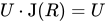
Let J(R) be the Jacobson radical of R. If U is a right module over a ring, R, and I is a right ideal in R, then define U·I to be the set of all (finite) sums of elements of the form u·i, where · is simply the action of R on U. Necessarily, U·I is a submodule of U.
If V is a maximal submodule of U, then U/V is simple. So U·J(R) is necessarily a subset of V, by the definition of J(R) and the fact that U/V is simple.[16] Thus, if U contains at least one (proper) maximal submodule, U·J(R) is a proper submodule of U. However, this need not hold for arbitrary modules U over R, for U need not contain any maximal submodules.[17] Naturally, if U is a Noetherian module, this holds. If R is Noetherian, and U is finitely generated, then U is a Noetherian module over R, and the conclusion is satisfied.[18] Somewhat remarkable is that the weaker assumption, namely that U is finitely generated as an R-module (and no finiteness assumption on R), is sufficient to guarantee the conclusion. This is essentially the statement of Nakayama's lemma.[19]
Precisely, one has:
- Nakayama's lemma: Let U be a finitely generated right module over a (unital) ring R. If U is a non-zero module, then U·J(R) is a proper submodule of U.[19]
Proof
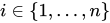
[edit]Let be a finite subset of , minimal with respect to the property that it generates . Since is non-zero, this set is nonempty. Denote every element of by for . Since generates ,.
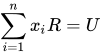
Suppose , to obtain a contradiction. Then every element can be expressed as a finite combination for some .

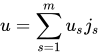

Each can be further decomposed as for some . Therefore, we have

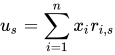

.

Since is a (two-sided) ideal in , we have for every , and thus this becomes

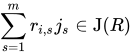
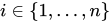
- for some , .


Putting and applying distributivity, we obtain

- .
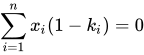
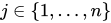
Choose some . If the right ideal were proper, then it would be contained in a maximal right ideal and both and would belong to , leading to a contradiction (note that by the definition of the Jacobson radical). Thus and has a right inverse in . We have


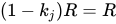

- .
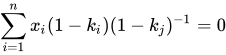
Therefore,
- .

Thus is a linear combination of the elements from . This contradicts the minimality of and establishes the result.[20]


Graded version
[edit]There is also a graded version of Nakayama's lemma. Let R be a ring that is graded by the ordered semigroup of non-negative integers, and let denote the ideal generated by positively graded elements. Then if M is a graded module over R for which for i sufficiently negative (in particular, if M is finitely generated and R does not contain elements of negative degree) such that , then . Of particular importance is the case that R is a polynomial ring with the standard grading, and M is a finitely generated module.


The proof is much easier than in the ungraded case: taking i to be the least integer such that , we see that does not appear in , so either , or such an i does not exist, i.e., .


See also
[edit]Notes
[edit]- ^ a b Nagata 1975, §A.2
- ^ Nagata 1975, §A.2; Matsumura 1989, p. 8
- ^ According to Matsumura (1970), Nakayama was said to have disliked the name "Nakayama's lemma".
- ^ Isaacs 1993, Corollary 13.13, p. 184
- ^ Eisenbud 1995, Corollary 4.8; Atiyah & Macdonald (1969, Proposition 2.6)
- ^ There is also a simple direct proof of Nakayama's lemma in this form. Proof: Suppose, for the sake of contradiction, that generate M, with being the smallest number with this property. Since , there are with , or . (Here, the set of generators is regarded as empty and the sum equal to 0 if .) Because , is a unit, and so . Therefore, generate M. This contradicts the minimality of n, and so . Q.E.D.
- ^ Eisenbud 1995, Corollary 4.8(b)
- ^ Eisenbud 1995, Exercise 7.2
- ^ Eisenbud 1995, §4.4
- ^ Matsumura 1989, Theorem 2.4
- ^ a b Griffiths & Harris 1994, p. 681
- ^ Eisenbud 1995, Corollary 19.5
- ^ McKernan, James. "The Inverse Function Theorem" (PDF). Archived (PDF) from the original on 2022-09-09.
- ^ Matsumura 1989, p. 7: "A standard technique applicable to finite A-modules is the 'determinant trick'..." See also the proof contained in Eisenbud (1995, §4.1).
- ^ Nagata 1975, §A2
- ^ Isaacs 1993, p. 182
- ^ Isaacs 1993, p. 183
- ^ Isaacs 1993, Theorem 12.19, p. 172
- ^ a b Isaacs 1993, Theorem 13.11, p. 183
- ^ Isaacs 1993, Theorem 13.11, p. 183; Isaacs 1993, Corollary 13.12, p. 183


References
[edit]- Atiyah, Michael F.; Macdonald, Ian G. (1969), Introduction to Commutative Algebra, Reading, MA: Addison-Wesley.
- Azumaya, Gorô (1951), "On maximally central algebras", Nagoya Mathematical Journal, 2: 119–150, doi:10.1017/s0027763000010114, ISSN 0027-7630, MR 0040287.
- Eisenbud, David (1995), Commutative algebra, Graduate Texts in Mathematics, vol. 150, Berlin, New York: Springer-Verlag, doi:10.1007/978-1-4612-5350-1, ISBN 978-0-387-94268-1, MR 1322960
- Griffiths, Phillip; Harris, Joseph (1994), Principles of algebraic geometry, Wiley Classics Library, New York: John Wiley & Sons, doi:10.1002/9781118032527, ISBN 978-0-471-05059-9, MR 1288523
- Hartshorne, Robin (1977), Algebraic Geometry, Graduate Texts in Mathematics, vol. 52, Springer-Verlag.
- Isaacs, I. Martin (1993), Algebra, a graduate course (1st ed.), Brooks/Cole Publishing Company, ISBN 0-534-19002-2
- Jacobson, Nathan (1945), "The radical and semi-simplicity for arbitrary rings", American Journal of Mathematics, 67 (2): 300–320, doi:10.2307/2371731, ISSN 0002-9327, JSTOR 2371731, MR 0012271.
- Matsumura, Hideyuki (1989), Commutative ring theory, Cambridge Studies in Advanced Mathematics, vol. 8 (2nd ed.), Cambridge University Press, ISBN 978-0-521-36764-6, MR 1011461.
- Nagata, Masayoshi (1975), Local rings, Robert E. Krieger Publishing Co., Huntington, N.Y., ISBN 978-0-88275-228-0, MR 0460307.
- Nakayama, Tadasi (1951), "A remark on finitely generated modules", Nagoya Mathematical Journal, 3: 139–140, doi:10.1017/s0027763000012265, ISSN 0027-7630, MR 0043770.