Hubbry Logo
Populus angustifoliaPopulus angustifoliaMain
Open search
Populus angustifolia
Community hub
Populus angustifolia
logo
8 pages, 0 posts
0 subscribers
Be the first to start a discussion here.
Populus angustifolia
from Wikipedia

Populus angustifolia
Secure
Secure  (NatureServe)[1]
Scientific classification Edit this classification
Kingdom: Plantae
Clade: Tracheophytes
Clade: Angiosperms
Clade: Eudicots
Clade: Rosids
Order: Malpighiales
Family: Salicaceae
Genus: Populus
Section: Populus sect. Tacamahaca
Species:
P. angustifolia
Binomial name
Populus angustifolia
Generalized natural range of Populus angustifolia

Populus angustifolia, commonly known as the narrowleaf cottonwood,[3] is a species of tree in the willow family (Salicaceae). It is native to western North America, where it is a characteristic species of the Rocky Mountains and the surrounding plains.[4] It ranges north to the provinces of Alberta and Saskatchewan in Canada and south to the states of Chihuahua, Coahuila, and Sonora in Mexico.[4] Its natural habitat is by streams and creeks between 3,900 to 7,900 feet (1,200 to 2,400 m) elevation.[2][4]

Description

[edit]

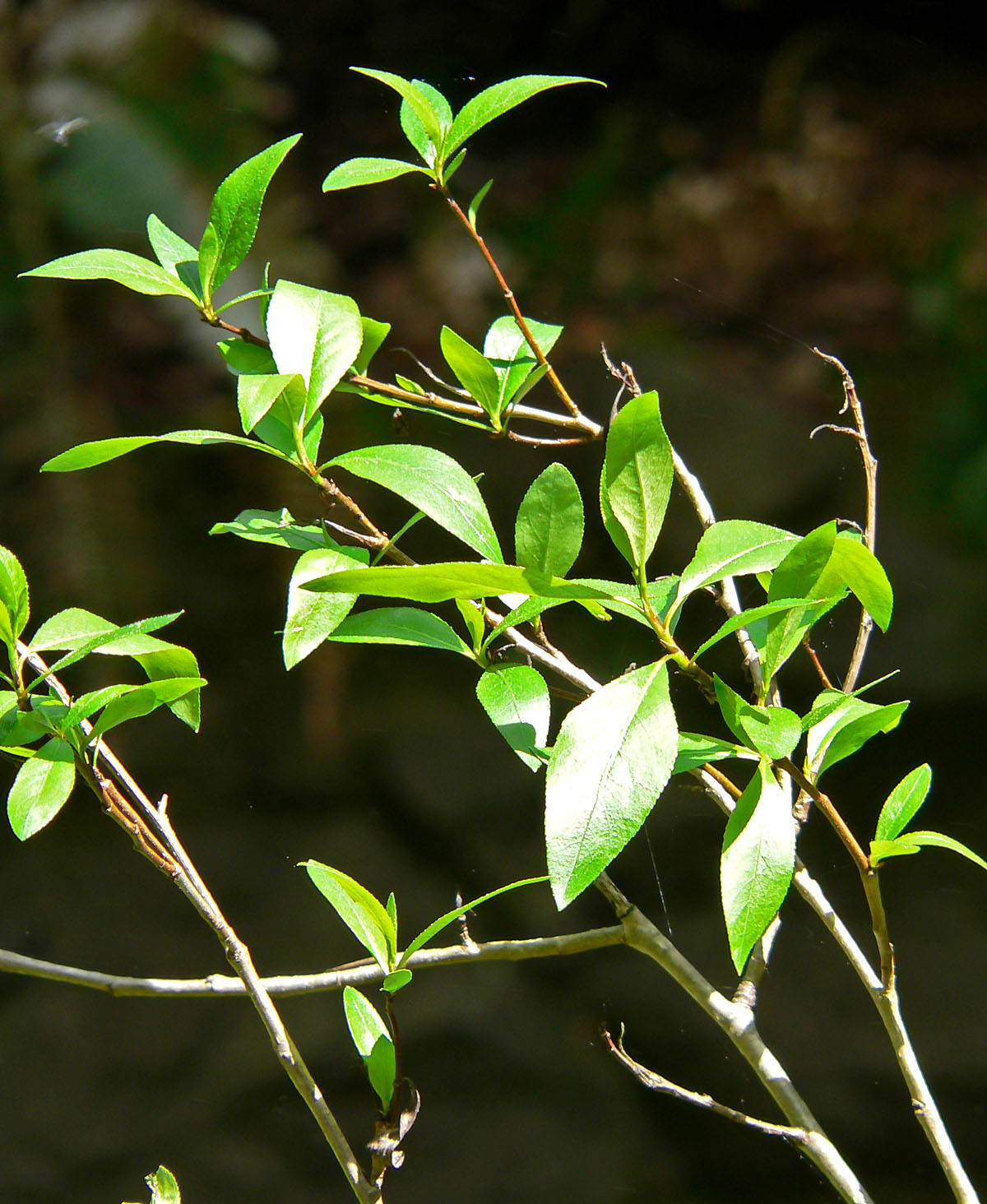
The tree is slim in profile, and can grow in tightly packed clusters.[5] Its leaves are yellow-green, lanceolate (lance-shaped), and with scalloped margins. It produces catkins in the early spring. The fruiting capsules are fluffy and white.

Taxonomy

[edit]

Where their ranges come into contact, this species will readily hybridize with Populus balsamifera, Populus deltoides, Populus fremontii, and Populus trichocarpa. These hybrids can form extensive populations in some regions. Due to the frequency and morphological consistency of P. angustifolia × P. deltoides hybrids, they were initially described as a fully separate species ("P. acuminata") until its hybrid origin was firmly established in the 1980s.[4]

Range

[edit]

Narrowleaf cottonwoods grow in western North America from southern Canada to northern Mexico. In Canada the species grows in just Alberta and Saskatchewan. Southwards in the United States it is wide ranging from the Pacific Northwest to the Southwestern US. It grows as far east as South Dakota, Nebraska, Colorado, New Mexico, and Texas. In Mexico it is only found in three states, Chihuahua, Coahuila and Sonora.[6]

Uses

[edit]

The buds are sticky and gummy and were enjoyed as a sort of chewing gum by local Native American peoples, including the Apache and Navajo. The tree is the host species of the sugarbeet root aphid (Pemphigus betae).

References

[edit]
[edit]
Revisions and contributorsEdit on WikipediaRead on Wikipedia
from Grokipedia
Populus angustifolia, commonly known as narrowleaf cottonwood or mountain cottonwood, is a species in the family, characterized by its slender, upright form reaching heights of 15–20 meters (50–65 feet) with a trunk diameter up to 1 meter (3 feet) and lance-shaped leaves 5–13 cm long that taper to a fine point. The features smooth, grayish-green bark on young stems that becomes deeply furrowed and dark brown with age, and it produces separate male and female flowers in drooping catkins, with female trees yielding cottony dispersed by . Native to western , P. angustifolia ranges from southern and through the to , including parts of , , and Chihuahua, typically at elevations between 900 and 2,450 meters (3,000–8,000 feet). It thrives in riparian zones along streams, rivers, and floodplains in semi-arid to montane environments, often associating with willows (Salix spp.) and alders (Alnus spp.), and demonstrates high tolerance to periodic flooding while stabilizing soil with its extensive root system. Ecologically, P. angustifolia serves as a in disturbed riparian s, providing critical and food for over 200 species, including beavers that use it for dams and food, and birds such as the for nesting. It reproduces both sexually via short-lived wind-dispersed seeds that require moist, sunny conditions for establishment and asexually through root sprouting, which is promoted by flooding or herbivory, enabling rapid colonization. With a lifespan of 100–200 years, the species is vulnerable to stress and but plays a key role in watershed health and . Human uses of P. angustifolia include its lightweight, decay-resistant wood for fence posts, fuel, pulp, and crates, as well as ornamental planting for and streambank rehabilitation. Native American communities have historically utilized its flexible shoots for basketry and other crafts, while its avoidance by horses—due to bitter content—has been noted since early explorations like that of Lewis and Clark in 1805.

Taxonomy

Classification

Populus angustifolia is a species within the plant kingdom, Tracheophyta, class Magnoliopsida, order Malpighiales, Salicaceae, genus Populus, and section Tacamahaca. Section Tacamahaca, known as the balsam poplars, comprises species characterized by resinous buds and typically lanceolate leaves, distinguishing P. angustifolia from relatives in section Aigeiros like P. deltoides, which have broader, triangular leaves. Phylogenetic analyses place the ATL clade (sections Aigeiros, Tacamahaca, and Leucoides) as sister to sections Turanga and (syn. Leuce) within ; the monophyly of section Tacamahaca itself has been debated in molecular studies, with P. angustifolia as one of two native North American species in this section alongside P. trichocarpa. The genus is divided into six sections—Abaso, Turanga, , Leucoides, Aigeiros, and Tacamahaca—based on morphological and molecular data, with Tacamahaca species showing adaptations to riparian and montane environments. Recognition of hybrids involving P. angustifolia advanced in the through studies on intersectional hybridization between sections Tacamahaca and Aigeiros, confirming previously ambiguous taxa as hybrids via profiles and morphology. For instance, Populus × acuminata Rydb., once considered a distinct , was reclassified as a hybrid between P. angustifolia and P. deltoides, exhibiting intermediate shapes and petiole lengths. Known hybrids include:
  • P. × brayshawii B. Boivin (P. angustifolia × P. balsamifera), with longer petioles (≥2.5 cm) and occurring in northern ranges;
  • P. × acuminata Rydb. (P. angustifolia × P. deltoides), found on floodplains with additive profiles;
  • P. × hinckleyana Correll (P. angustifolia × P. fremontii), characterized by intermediate bud resin and leaf serration, often in southwestern riparian zones;
  • An unnamed hybrid with P. trichocarpa in the , showing mixed traits from both balsam poplar parents. These hybrids demonstrate frequent interspecific , particularly in contact zones, without hybridization with section species like P. tremuloides.

Etymology and synonyms

The genus name Populus originates from the Latin word for "people," serving as the classical Latin designation for poplar trees, with possible allusions to the species' widespread use or the sound of its leaves rustling like a gathering crowd. The specific epithet angustifolia combines the Latin terms angustus (narrow) and folium (leaf), describing the tree's characteristic long, narrow, lanceolate foliage. Populus angustifolia is known by several common names reflecting its morphology and habitat, including narrowleaf cottonwood, willow-leaved poplar, and mountain cottonwood, the last of which highlights its prevalence in the . Regional variants, such as Rocky Mountain cottonwood, are used in areas like the where the species dominates riparian zones. Historical synonyms for Populus angustifolia include Populus ×sennii B. Boivin and Populus tweedyi Britton, arising primarily from early botanical collections that confused the species with closely related cottonwoods or overlooked hybrid influences in variable populations. These names were consolidated under the current binomial through taxonomic revisions emphasizing distinct morphological and genetic traits.

Description

Morphology

Populus angustifolia is a that typically reaches heights of 15 to 25 meters, featuring a single stem and slender, upright branches that form a narrow, conical or columnar crown, often appearing willow-like in overall habit. It commonly grows in clusters along riparian zones, contributing to its clustered appearance in natural settings. The leaves are simple, alternate, and lanceolate to ovate-lanceolate in shape, measuring 5 to 10 cm in length and 1 to 3 cm in width, with fine, glandular teeth along the margins and a shiny dark green upper surface that is paler beneath. The petioles are short, less than 15 mm long, and flattened near the base. In hybrids with species such as Populus fremontii, leaf shape may vary, becoming broader and more ovate with coarser teeth. Bark on young trees is smooth and yellowish-green to grayish-brown, transitioning to deeply furrowed and ridged on mature trunks, though less so than in broader-leaved cottonwoods. Twigs are slender to moderately stout, round, glabrous, and shiny yellow-brown with orange lenticels, turning light gray with age. Winter buds are prominent, measuring 0.6 to 2.5 cm long, curved, sharp-pointed, resinous, and fragrant, with a gummy or sticky coating. The species is dioecious, with flowers borne on separate trees in pendulous catkins that emerge before leaves in spring. Male catkins are yellow-green and 2 to 4 cm long, while female catkins elongate to 6 to 10 cm long. Fruits consist of ovoid, pointed capsules, 5 to 8 mm long, containing numerous small seeds with attached white, silky hairs.

Growth habits

Populus angustifolia is a fast-growing tree that typically attains a mature height of 15 to 25 meters and a canopy spread of 5 to 10 meters, often displaying a narrow, columnar to pyramidal growth form. It develops fire-resistant bark after about 15-20 years. The species exhibits rapid vertical growth, potentially adding 1 to 2 meters annually in early stages. The lifespan of P. angustifolia ranges from 100 to 200 years, though shorter durations of 30 to 50 years are common in stressful urban or arid settings. Seasonally, male and female catkins appear in May before leaf expansion in spring, while leaves turn dull yellow in fall and abscise from mid-September to . Leaf primordia form during the preceding autumn, ensuring timely spring flush. This tolerates frequent flooding, which promotes recruitment on disturbed riparian sites, but remains sensitive to stress that limits establishment and growth. Its is shallow and extensively spreading, enabling efficient access to shallow while aiding in streambank stabilization. Growth form in P. angustifolia shows variability, with pure stands featuring consistently slender, upright , whereas hybrid zones with Populus fremontii exhibit broader, more irregular habits due to .

Distribution and habitat

Native range

Populus angustifolia is native to western , ranging from southern , , and in through the and adjacent regions southward to , including the states of Chihuahua, , and . In the United States, it occurs primarily in , , , , and , with scattered populations in , , , , , , , , , and Washington. The typically grows at elevations between 1,200 and 2,400 meters (3,900–7,900 feet), though it can reach up to 3,300 meters in some areas. Its historical distribution remains largely stable overall, but populations have become fragmented due to losses in riparian habitats from factors such as diversions, damming, and , with notable declines observed in regions like between 1951 and 1994. No major range shifts have been documented as of 2001, though recent models predict potential declines and downward elevational shifts due to . Hybrid zones occur where P. angustifolia overlaps with Populus deltoides in the southwestern United States, such as along floodplains in , , and , resulting in mixed populations of hybrids like Populus ×acuminata.

Environmental requirements

Populus angustifolia thrives in moist alluvial soils associated with riparian zones, favoring loamy sands to sandy loams containing high proportions of coarse fragments, such as those found on bars and alluvial benches. It tolerates sandy or ly substrates effectively but struggles on heavy clay soils, with optimal pH ranging from 6.0 to 7.5 and high tolerance for . The species demands high for survival and growth, primarily in riparian environments with reliable access to or . Seedlings require consistently wet for establishment, and mature trees perform best with stable water tables, showing vulnerability to rapid declines exceeding 4 cm per day. Annual in suitable habitats typically falls between 300 and 600 mm, often augmented by seasonal flooding and . This inhabits cool temperate to semi-arid climates, enduring winter lows to -40°C (USDA Zone 3) and summer highs up to 35°C, requiring full sun exposure as a shade-intolerant , colonizing open, disturbed sites while competing poorly under canopy cover. Regarding stress tolerances, P. angustifolia exhibits low overall resistance, particularly during early life stages, though established individuals develop moderate resilience through deep rooting, remaining susceptible to extended dry periods without supplemental water. It shows medium tolerance to anaerobic conditions from periodic flooding, classifying it as a facultative species.

Ecology

Reproduction

Populus angustifolia is dioecious, with male and female flowers occurring on separate trees. Flowers are borne in pendulous catkins that emerge in May, typically before or during expansion, facilitating . Male catkins are smaller and produce abundant , while female catkins develop into ovoid capsules (6-8 mm long) that mature and split open from June to July. Each capsule releases numerous small seeds (2-3 mm), each attached to white, silky hairs that aid dispersal; a single can produce thousands of in large annual crops. Seed viability is short, lasting approximately 3 weeks, which synchronizes dispersal with favorable moist conditions. is prevalent through root suckering from suppressed buds and sprouting from stumps or root crowns, particularly following disturbances like flooding or cutting. This vegetative supports the formation of extensive clonal colonies, allowing persistence without . Hybridization occurs frequently in contact zones where P. angustifolia overlaps with congeners such as P. fremontii and P. balsamifera, resulting in fertile F1 and backcross hybrids. These hybrids often exhibit reproductive traits comparable to parental , including similar levels of viable production. requires moist, bare, sandy or alluvial in full and is highly successful in flood-disturbed riparian areas, where receding waters expose suitable substrates. Poor competition in shaded or occupied sites limits establishment beyond these dynamic environments.

Biotic interactions

Populus angustifolia is primarily wind-pollinated, with male catkins releasing pollen that fertilizes female flowers within 24 hours of dispersal, though insects such as bees visit the catkins and may supplement pollination by transferring pollen. Seeds, produced in capsules from May to July, are mainly dispersed by wind and water currents in riparian zones, facilitated by attached cottony hairs that aid flotation; birds occasionally contribute to dispersal by carrying seeds on their feathers or feet. The species serves as a host for several pests and pathogens, including the sugarbeet root aphid (Pemphigus betae), which induces pouch-like on leaf petioles and midribs during summer, potentially reducing photosynthesis and tree vigor. It is susceptible to canker diseases such as Cytospora canker, which causes dieback and sunken lesions on branches, and rust caused by Melampsora species, leading to yellow spots, premature defoliation, and weakened growth. The (Plectrodera scalator), a native longhorned , attacks the trunk and of young trees, creating galleries that can girdle and kill saplings. Symbiotic relationships enhance the tree's nutrient acquisition in nutrient-poor riparian soils. P. angustifolia forms both ectomycorrhizal and arbuscular mycorrhizal associations with fungi, which improve uptake of , , and , particularly under or stress; ectomycorrhizae dominate in cooler conditions, while arbuscular types increase with warmth. As a foundational riparian species, P. angustifolia provides critical habitat and resources for wildlife. Its dense canopy and cavities offer nesting and roosting sites for birds, including the greater pewee, , and , while over half of regional species rely on cottonwood riparian forests for breeding. Twigs, buds, and foliage serve as browse for , , rabbits, and porcupines, and beavers use bark, twigs, and trunks for food and dam construction, promoting formation. In its role as a , it stabilizes stream banks through extensive systems, reduces , and fosters in ecosystems by creating microhabitats for , fish, and amphibians. The conservation status of P. angustifolia is globally secure (G5) per NatureServe, reflecting its wide distribution across western , with no federal endangered listing under the U.S. Act. However, local populations face threats from riparian habitat loss due to water diversions, dam construction, , and , particularly in fragmented watersheds like those in , where it is considered moderately threatened (S2 rank). Hybridization with congeners such as P. fremontii can influence local genetic diversity in mixed riparian zones.

Uses and cultivation

Traditional uses

Native American tribes in the and have long incorporated Populus angustifolia, known as narrowleaf cottonwood, into their traditional practices, particularly for medicinal, material, ceremonial, and purposes, as recorded in ethnobotanical studies. The sticky buds of the tree were valued for their resinous quality and used as by several tribes, including the White Mountain Apache, , and Zuni, providing a pleasant and functional treat that also soothed oral discomfort. The inner bark was prepared as a mucilaginous source by Montana Indian groups during periods of scarcity, serving as an emergency rich in vitamins and sustenance when other resources were limited. Material applications included the use of young shoots for basketry among the Gosiute people of , where the flexible stems were woven into durable containers and carriers. The soft wood was employed for crafting tool handles and other implements in traditional settings. Additionally, the wood served as fuel for fires and in constructing temporary shelters during winter travels by Indian communities. Ceremonially, Navajo people integrated P. angustifolia branches and wood into rituals, such as fashioning prayersticks, often combined with other materials like and . The wood was also shaped into parts for cradles, linings, and canopies, symbolizing protection and cultural significance in child-rearing practices, and contributed to tinder boxes and ceremonial drinks in the Mountain Top Chant, where dried bark was ground with plants like chokecherry and for the patient to consume. These uses highlight the tree's role in spiritual and communal life among tribes in the Southwest and Rockies, as documented in early 20th-century ethnobotanical records.

Commercial and ornamental applications

Populus angustifolia, commonly known as narrowleaf cottonwood, is valued in ornamental for its fast growth and upright form, providing quick shade in riparian restoration projects and urban parks. Its columnar to conical shape makes it suitable for narrower spaces compared to broader cottonwood species, while the narrow, willow-like leaves turn vibrant yellow to orange in fall, adding seasonal interest. This tree is particularly useful at high elevations and in deer winter ranges, as it resists overbrowsing by . The wood of P. angustifolia is soft and lightweight but prone to warping and decay, limiting its commercial timber applications. Due to its relative scarcity and these quality issues, it sees minimal use in pulp production, crates, or other low-value products, unlike more abundant cottonwood species. Cultivation of narrowleaf cottonwood typically involves from dormant-season stem cuttings, 20–45 cm long and 1–3 cm in diameter, which root readily when planted in sheltered beds. It thrives in USDA hardiness zones 3–9, preferring full sun and moist, well-drained soils, and is often planted in windbreaks for wind protection or in efforts, where its aggressive root system stabilizes streambanks and soil. Despite these benefits, challenges in cultivation include the production of messy, cottony that can landscapes and extensive root suckering, which forms dense thickets and makes the tree unsuitable near structures or paved areas. Its short lifespan, often 40–100 years in managed settings, further restricts long-term use. Overall, P. angustifolia holds limited commercial significance compared to species like black cottonwood (Populus trichocarpa), with greater application in conservation plantings for habitat restoration rather than large-scale industry.

References

Add your contribution
Related Hubs
User Avatar
No comments yet.