Hubbry Logo
NarsehNarsehMain
Open search
Narseh
Community hub
Narseh
logo
8 pages, 0 posts
0 subscribers
Be the first to start a discussion here.
Contribute something
Narseh
Narseh
from Wikipedia

Narseh (also spelled Narses or Narseus; Middle Persian: 𐭭𐭥𐭮𐭧𐭩) was the seventh King of Kings of Sasanian Iran from 293 to 303.

Key Information

The youngest son of Shapur I (r. 240–270), Narseh served as the governor of Sakastan, Hind and Turan under his father. Shapur I was eventually succeeded by his son Hormizd I (r. 270–271), who died after a reign of one year. Shapur I's eldest son Bahram I, who had never been considered as a candidate for succession to the throne by his father, ascended the throne with the aid of the powerful Zoroastrian priest Kartir. He then made a settlement with Narseh to give up his entitlement to the throne in return for the governorship of the important frontier province of Armenia, which was a persistent cause for war between the Roman and Sasanian Empires. Narseh held the title of Vazurg Šāh Arminān ("Great King of Armenia"), which was used by the heir to the throne in the early Sasanian times. Nevertheless, Narseh most likely still viewed Bahram I as a usurper.

The succession of Bahram I's son, Bahram II (r. 274–293) seemingly occurred without any issues. After Bahram II's death in 293, his son Bahram III was unwillingly crowned by a nobleman named Wahnam. The rest of the nobility did not support Bahram III's kingship, and asked Narseh to rule instead. Ultimately, Bahram III abdicated as shah, while Wahnam was executed. Narseh was the first Sasanian shah to not ascend the throne as a crown prince. The circumstances of his rise to power are detailed in the Paikuli inscription, which he made as his own Res Gestae Divi Augusti and to legitimize his rule.[1]

Three years after Narseh's accession, war erupted between the Sasanians and Romans once again. In 296 or 297, Narseh's forces inflicted a defeat on the forces of Galerius at the Battle of Carrhae. The following year, however, Narseh suffered a major defeat at Satala; his wives, children, and many Iranian nobles were taken as prisoners of war. Due to this ignominious defeat, Narseh was forced to accept a peace treaty prescribed by the Romans, ceding them several areas at the Sasanian-Roman border.

Narseh is notable for returning to the religious tolerance policy of his father.[2]

Name

[edit]

The name of Narseh stems from the Old Iranian theophoric name of *naryasa(n)ha-, meaning "men's praise". Narseh's name is listed as nrshy in Middle Persian and nryshw in Parthian on the Paikuli inscription and Naqsh-e Rostam.[3] The Greek version of his name is also listed in the inscriptions, as Narsaiēs or Narsaios. However, other Greek sources generally spell his name as Narsēs.[3] The name of Narseh is known in other languages as; Latin: Narseus; Syriac ܢܪܣܝ Nrsy; Arabic: نرسي Narsi; Armenian Nerseh; Coptic Narsaph, as well as Narseos.[3]

Early life and governorship

[edit]

Narseh seems to have been the youngest son of Shapur I, being born between 228 and 233 during the reign of his grandfather Ardashir I (r. 224–242).[3] Narseh is quoted in an inscription by his father Shapur I as the governor of the eastern Sasanian provinces of Hind, Sakastan and Turan. During his term as governor, he reportedly played an important role in the affairs of the eastern portion of the empire.[3] Shapur I died in 270, and was succeeded by Hormizd I, whose rule only lasted one year due to death. Narseh's older brother Bahram I, who was never considered a candidate for succession of the throne by their father, probably due to having a mother of lowly origin, ascended the throne with the aid of the powerful Zoroastrian priest Kartir.[4]

He then made a settlement with Narseh to give up his entitlement to the throne in return for the governorship of the important frontier province of Armenia, which was constantly the source of war between the Roman and Sasanian Empires.[3] Narseh held the title of Vazurg Šāh Arminān ("Great King of Armenia"), which was used by the heir to the throne.[5] Nevertheless, Narseh still most likely viewed Bahram I as a usurper.[4] Bahram I's reign however, lasted shortly, ending on September 274 with his death.[4] His son Bahram II succeeded him as shah, seemingly without any issues; he may have been aided by Kartir to ascend the throne over Narseh.[6][7][8] This most likely frustrated Narseh, who had now been neglected from succession several times.[5]

Rise

[edit]
Ruins of the Paikuli tower in present-day Iraqi Kurdistan.

Following the death of Bahram II in 293, his son Bahram III was unwillingly proclaimed shah in Pars by a group of nobles led by Wahnam and supported by Adurfarrobay, governor of Meshan.[9] However, Bahram III was considered a weak ruler by the other nobles, who decided to pledge allegiance to Narseh, the last remaining son of Shapur, and someone who was perceived as being a stronger leader and one who would be able to bring glory to Iran.[10][11] Four months into Bahram III's reign, Narseh was summoned to Mesopotamia at the request of many members of the Iranian nobility. He met them in the passage of Paikuli in the province of Garmekan, where he was firmly approved and likely also declared shah for the first time. The reasons behind the nobles favour of Narseh might have been due to his jurisdiction as governor, his image as an advocate of the Zoroastrian religion and as an insurer for harmony and prosperity of the empire. His ancestry from the early Sasanian family probably also played a role.[3]

In order to avoid bloodshed, Narseh proposed to make peace with both Bahram III and Wahnam.[3] Both seem to have agreed, as no accounts of battles have been made. The reason behind Bahram III and Wahnam's quick agreement to peace may have been due to desertion amongst many of Bahram III's men. Bahram III abdicated as shah and was probably spared, whilst Wahnam was executed when Narseh entered the Sasanian capital of Ctesiphon.[12][3] Narseh then summoned the aristocrats to take part in the royal referendum, a ritual which had been used since the first Sasanian shah, Ardashir I (r. 224–242), and which Narseh now made use of in order to gain the approval of the aristocracy as a legitimate ruler instead that of a usurper. Narseh was decisively voted in favour by the majority, and guaranteed "to enter the throne of our father and our forefathers with the help of the Gods, in their name and that of our forefathers."[3] Amongst those nobles who supported Narseh was the leading priest Kartir, which is attested in the Paikuli inscription.[8]

Reign

[edit]

War with the Romans

[edit]

Background

[edit]
Map showing the Roman-Sasanian borders.

When Narseh ascended the throne, the eastern portion of Mesopotamia (since 244) and all of Armenia (since 252) were under Iranian rule.[3] The notion that the western part of Armenia had been given to the Arsacid prince Tiridates III has been questioned.[3] According to historian Ursula Weber, "It is quite certain" that the whole of Armenia continued to be a part of the Sasanian Empire in the 3rd century, until it was later ceded to the Romans in 298/9 after the Peace of Nisibis.[3] The proposition of Narseh presumably following Shapur I's expansionistic approach does not match with his testimony in the Paikuli inscription; "And Caesar and the Romans were in gratitude (?) and peace and friendship with us."[3] Contrary to the testimony, however, the two empires soon clashed with each other−in 296.[3] From a Roman viewpoint, the mutual relations with Iran had been heavily strained due to the aggressive and expansionistic approach of Ardashir I and Shapur I.[3] However, the conclusive causes for the Roman offensive was possibly due to their territorial losses and the disadvantageous change in the sphere of authority and influence in the Mesopotamian-Armenian lands in the 240s and 250s.[3]

The war

[edit]
Detail of Galerius attacking Narseh on the Arch of Galerius at Thessaloniki, Greece.

Galerius, Caesar under Emperor Diocletian, invaded Mesopotamia, which Narseh had occupied hoping to check his advance. Three battles were fought subsequently, the first two of which were indecisive. In the third fought at Callinicum, Galerius suffered a complete defeat and was forced to retreat. Galerius crossed the Euphrates into Syria to join his father-in-law Diocletian at Antioch. On his arrival at Antioch, Galerius was rebuked by Diocletian who disgraced him for his shameful defeat at the hands of Narseh. Vowing to take revenge, Galerius made preparations throughout the winter of 297 and invaded Armenia with 25,000 men.

Supported by the Armenians, Galerius surprised Narseh in his camp at the Battle of Satala and inflicted a crushing defeat on the latter, forcing him to flee in haste. His wife, prisoners, his sisters and a number of his children were captured apart from his prodigious military chest. Eastern Mesopotamia was recovered by the Romans and Tiridates was reinstated as the monarch of Armenia.

Peace negotiations

[edit]

Anxious to make peace with the Romans, Narseh dispatched his envoy Aphraban to Galerius with the following message:

"The whole human race knows that the Roman and Persian kingdoms resemble two great luminaries, and that, like a man's two eyes, they ought mutually to adorn and illustrate each other, and not in the extremity of their wrath to seek rather each other's destruction. So to act is not to act manfully, but is indicative rather of levity and weakness; for it is to suppose that our inferiors can never be of any service to us, and that therefore we had better get rid of them. Narseh, moreover, ought not to be accounted a weaker prince than other Persian kings; thou hast indeed conquered him, but then thou surpassest all other monarchs; and thus Narseh has of course been worsted by thee, though he is no whit inferior in merit to the best of his ancestors. The orders which my master has given me are to entrust all the rights of Persia to the clemency of Rome; and I therefore do not even bring with me any conditions of peace, since it is for the emperor to determine everything. I have only to pray, on my master's behalf, for the restoration of his wives and male children; if he receives them at your hands, he will be forever beholden to you, and will be better pleased than if he recovered them by force of arms. Even now my master cannot sufficiently thank you for the kind treatment which he hears you have vouchsafed them, in that you have offered them no insult, but have behaved towards them as though on the point of giving them back to their kith and kin. He sees herein that you bear in mind the changes of fortune and the instability of all human affairs."

But Galerius dismissed Aphraban without giving any definite answer, at the same time accusing the Iranians of ill-treating Valerian. In the meantime, he consulted Diocletian at Nisibis, and he persuaded Galerius to offer terms of peace to the Iranians. Accordingly, terms of peace were agreed upon, and were ratified by a treaty concluded by Narseh with the Romans.

According to this treaty,

  • Five provinces beyond the Tigris were to be ceded to the Romans. One writer gives these provinces as Ingilene, Sophene, Arzanene, Corduene, and Zabdicene; by another as Arzanene, Moxoene, Zabdicene, Rehimene, and Corduene.
  • The semi-independent kingdom of Armenia was to be extended up to the fortress of Zintha, in Media.
  • Iran was expected to relinquish all her rights over Iberia.
  • Formal dealings between Iran and Rome would henceforth be conducted at Nisibis.

Narseh did not survive for long after the conclusion of this humiliating treaty. He died in 303 and was succeeded by his son, Hormizd II.

Coinage

[edit]

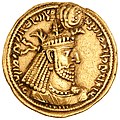
The title of Narseh on his coins was the typical Mazdēsn bay Narsē šāhān šāh Ērān ud Anērān kēčihr az yazdān ("the Mazda-worshiping, divine Narseh, King of Kings of Iran(ians) and non-Iran(ians), whose image/brilliance is from the gods").[13][14] The iconography of Narseh's coins can be categorized into three phases. The first and second phases portray him wearing a palmette crown, albeit with two different hairstyles. In the third phase, he is wearing a lamellar crown along with a different hairstyle.[3]

The Paikuli inscription

[edit]

The Paikuli inscription in present-day Iraqi Kurdistan is the only source that describes the reign of Bahram III and the rise of Narseh to the throne.[3] Unlike Shapur I's inscription at the Ka'ba-ye Zartosht, the Paikuli inscription omits the use of Greek, but still uses Parthian and Middle Persian. This, however, marks the last time that Parthian is used in Sasanian royal records.[15] The inscription, along with Shapur I's inscription, demonstrates that the organization of the early Sasanian Empire did not contrast much to its predecessor, the Parthian Empire. Like the Parthian monarch, the Sasanian monarch used the title of Shahanshah ("King of Kings"), ruling as the overlord of other lesser kings, such as the king of Adiabene.[16]

Rock relief

[edit]
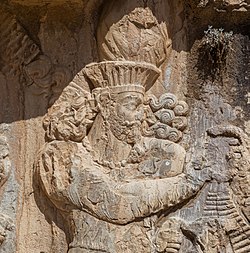
The Naqsh-e Rostam relief of Narseh, receiving the ring of kingship from a female figure, either the goddess Anahita or his queen Shapurdukhtak. The figure standing behind Narseh is most likely his son and heir, Hormizd.

While ruling as king of Iran, Narseh had a rock relief carved at Naqsh-e Rostam, between the burial site of the Achaemenid kings Darius the Great (r. 522 – 486 BC) and Xerxes I (r. 486 – 465 BC).[17][3] The relief depicts an investiture scene, with Narseh, wearing a lamellar crown, surrounded by his family. Narseh is receiving the ring of kingship from a female figure that is frequently assumed to be the goddess Anahita. However, some scholars have suggested that this might be his queen, Shapurdukhtak.[3][18] The figure standing behind Narseh is most likely the crown prince Hormizd, due to his cap being the form of that of an animal protome, which was typically worn by Sasanian heirs.[19]

Titles

[edit]

Throughout his lifetime, Narseh is known to have had several titles, attested in contemporary chronicles, four inscriptions (ŠKZ, NVŠ, NPi, ŠṬBn-I) and his coins.[3]

  • As governor of Hind, Sakastan and Turan; ēr mazdēsn Narseh, šāh Hind, Sagestān ud Turestān tā drayā damb ("the Iranian, Mazda-worshipping Narseh, king of Hind(estan), Sagestan and Turan up to the seacoast").[3]
  • As governor of Armenia: šāh Armenān ("King of Armenia").[3]
  • During his rule as king of Iran, he assumed the titles of his predecessors: ptkly ZNH mzdysn bgy nlsḥy MLKʾn MLKʾ ʾyrʾn W ʾnyrʾn MNW ctry MN yzdʾn, "This (is) the image of the Mazda-worshipping god Narseh, king of kings of Eran and Aneran, whose seed (is) from the gods" in the inscription of his brother, Bahram I, which he had altered.[3]
  • The title of Narseh ī Abzūdxwarrah ("Narseh, whose xwarrah blossoms"), which Narseh had most likely received by his supporters at the gathering at Paikuli.[3]

References

[edit]

Sources

[edit]

Further reading

[edit]
[edit]
Revisions and contributorsEdit on WikipediaRead on Wikipedia
from Grokipedia

Narseh (Middle Persian: Narsēh; died c. 302 CE) was the seventh Shahanshah ("King of Kings") of the Sasanian Empire, ruling from 293 to 302 CE as a son of Shapur I.
He ascended the throne at around age 60–65 by overthrowing his short-reigned grandnephew Bahram III with the backing of Sasanian nobles and princes, an event detailed in the contemporary Paikuli inscription erected to affirm his legitimacy through divine right and noble consensus.
Narseh's reign began with internal stabilization and viceregal appointments in Armenia but escalated into war with Rome around 296–297 CE, where initial conquests of Armenia and Mesopotamia were reversed by a crushing defeat inflicted by Caesar Galerius near Satala in 298 CE.
This led to the Treaty of Nisibis, imposing severe terms on Persia including the cession of territories east of the Tigris (Trans-Tigritania), recognition of Roman influence in Armenia and Iberia, and the return of Roman prisoners, marking a rare Sasanian diplomatic humiliation and initiating four decades of relative peace.
Narseh's legacy endures through his rock reliefs at Naqsh-e Rostam and Bishapur depicting investiture and familial piety, alongside coinage phases reflecting crown evolutions, underscoring efforts to project royal continuity amid dynastic strife.

Etymology and Titles

Name Variants and Meanings

The name Narseh derives from the Old Iranian theophoric compound *naryasa(n)ha-, meaning "men's praise". In Middle Persian script, as attested in the Šāpur inscription (ŠKZ) and Narseh's own Paikuli inscription (NPi), the name is rendered as nrshy. The Parthian form is nryšhw. Greek transliterations include Narsēs in general sources and Narsaiēs or Narsaios in the Šāpur inscription. Other linguistic variants encompass Latin Narseus, Syriac NRSY, Arabic Narsi, Armenian Nerseh, and Coptic Narsaph or Narseos.

Royal Titles and Self-Presentation

Upon ascending to the throne in 293 CE, Narseh adopted the standard Sasanian royal title of šāhān šāh Ērān ud Anērān ("King of Kings of Iran and non-Iran"), often prefixed with mazdēsn bay ("Mazda-worshipping lord") and emphasizing divine origin as a ruler chosen by the gods (MNW ctry MN yzdʾn, "whose lineage is from the gods"). This titulature underscored his legitimacy as a member of the dynastic line from Ardashir I, linking his rule to Zoroastrian cosmology and imperial continuity. Prior to his coronation, Narseh had held viceregal titles reflecting his governance of eastern and northern frontier regions, including šāh Hind, Sagestān ud Turestān tā drayā damb ("king of India, Sakastan, and Turan up to the sea") as inscribed in his father Shapur I's res gestae at Ka'ba-ye Zardosht (ŠKZ). He also bore the title šāh Armenān ("king of Armenia"), a designation typically reserved for senior princes or heirs, as evidenced in the Paikuli inscription (NPi). ![Narseh rock relief at Naqsh-e Rostam][float-right] Narseh's self-presentation emphasized divine favor and familial piety, particularly in the Paikuli inscription (NPi), where he narrates his accession as a restoration ordained by Ohrmazd, listing noble supporters to affirm consensus-based legitimacy while invoking his xwarrah (glory) as Narseh ī Abzūdxwarrah ("Narseh whose xwarrah blossoms"). This multilingual (Middle Persian, Parthian) tower inscription at Paikuli served as both a historical record of the 293 CE succession crisis and a propagandistic monument justifying his overthrow of Bahram III. On coins, his obverse legends varied slightly across phases, typically reading mazdēsn bay Narseh šāhān šāh Ērān ("Mazda-worshipping lord Narseh, king of kings of Iran"), sometimes omitting ud Anērān to focus on core Iranian domains, reflecting adaptive imperial rhetoric amid territorial challenges. In rock reliefs, such as the investiture scene at Naqsh-e Rostam (NRm VIII, ca. 293–295 CE), Narseh depicts himself centrally with his family, adorned in a distinctive lamellar crown and receiving symbols of authority, projecting an image of sovereign stability and divine endorsement through the visual motif of radiating xwarrah. These reliefs, carved near Achaemenid tombs, linked Sasanian kingship to ancient Persian heritage while highlighting Narseh's personal piety and role as protector of the realm's religious order. An anomalous foreign portrayal appears in a Coptic Manichaean text rendering him as "Narseos the Caesar," possibly a diplomatic adaptation during Roman interactions.

Early Life and Family

Birth and Parentage

Narseh was the youngest son of Shapur I, the second king of the Sasanian Empire, who ruled from 240 to 270 CE. His birth is estimated to have taken place between approximately 228 and 233 CE, during the reign of his paternal grandfather Ardashir I, based on Narseh's advanced age of 60 to 65 years at his accession to the throne in 293 CE. This parentage is attested in contemporary Sasanian epigraphic sources, including the Ka'ba-ye Zartosht inscription and the Paikuli inscription, as well as later Arabic historical accounts such as the Histoire nestorienne. The identity of Narseh's mother remains unattested in primary sources, with no verifiable details from inscriptions, coins, or chronicles providing her name or background. Shapur I had multiple consorts, including noblewomen from allied regions, but specific maternal lineage for Narseh is not documented, reflecting the limited focus on queens in early Sasanian royal records. As the youngest of Shapur I's sons, Narseh was positioned behind older siblings such as Hormizd I, Bahram I, and Bahram II in the line of succession, which influenced his early career in provincial governance rather than immediate royal contention.

Governorship in Sakastan and Armenia

As the youngest son of Shapur I (r. 240–270 CE), Narseh held an early viceroyalty over the eastern Sasanian territories of Hindestan, Sakastan (Sagestan), and Turan extending to the sea, a role that positioned him as a key figure in managing frontier defenses and administration against nomadic threats. This appointment is documented in Shapur I's trilingual inscription (ŠKZ) at Ka'ba-ye Zardosht, where Narseh bears the title ēr mazdēsn Narseh, šāh Hind, Sagestān ud Turestān tā drayā damb ("the Mazda-worshipping Narseh, king of Hind, Sagestan, and Turan up to the sea's edge"), reflecting his authority over diverse ethnic and geographic domains critical to Sasanian eastern policy. After Shapur I's death and the brief reign of Hormizd I (r. 270–271 CE), Narseh's viceroyalty shifted westward under Bahram I (r. 271–274 CE), who likely compensated him for forgoing immediate claims to the throne by appointing him viceroy of Armenia with the title šāh Armenān ("king of Armenia"). This position, retained through Bahram II's reign (r. 274–293 CE), involved overseeing a strategically vital buffer region amid tensions with Rome and local Armenian nobility, as evidenced by Narseh's self-designation in the Paikuli inscription (NPi) composed upon his 293 CE accession. Exact dates of the transfer remain uncertain, but it occurred post-271 CE, marking approximately two decades of Armenian governance until Bahram II's death prompted Narseh's revolt from this base.

Rise to Power

Succession Crisis Following Bahram II

Upon the death of Bahram II in 293 CE, his young son Bahram III was secretly crowned king by the nobleman Wahnām, son of Tatrus, without the formal acclamation of the empire's leading dignitaries, an act that violated traditional Sasanian protocols for royal investiture and ignited a succession dispute. This irregular ascension, perceived as an overreach by Wahnām's faction, prompted widespread opposition among the nobility and military elites, who viewed it as a threat to dynastic stability and imperial authority. Narseh, the experienced son of Shapur I and then-viceroy in Armenia, emerged as the preferred candidate due to his direct descent from a prior king of kings, his approximate age of 60–65, and his proven administrative record, contrasting with Bahram III's youth and lack of established support. Leading nobles dispatched envoys to Narseh, urging him to claim the throne and averting what could have escalated into full civil war; he initially demurred but ultimately accepted their consensus at the Paikuli tower in western Iran. Bahram III's reign lasted only four months in 293 CE, after which he was deposed—likely through resignation under pressure or direct overthrow—allowing Narseh to assume power and restore order among the fractious aristocracy. The primary evidence for these events derives from Narseh's own bilingual Paikuli inscription (in Middle Persian and Parthian), erected to commemorate the noble assembly and legitimize his rule by documenting the crisis's resolution through collective endorsement rather than unilateral seizure. This episode underscored the Sasanian system's reliance on noble consensus for legitimacy, where deviations risked fragmentation of the feudal-military structure.

Rebellion and the Paikuli Inscription

Following the death of Bahram II in 293 CE, his young son Bahram III was swiftly installed as king by the influential courtier Wahnām Mihrān, who commanded significant noble support but faced opposition from broader Sasanian elites wary of centralized power concentration. This succession sparked immediate turmoil, as reports of discord reached Narseh, then viceroy of Armenia and a son of Shapur I, prompting him to mobilize forces from the eastern satrapies where he had prior governorship experience. Narseh advanced westward, convening an assembly of Zoroastrian priests (magi) and nobles (wuzurgan) at Paikuli, a site in the Zagros Mountains near modern Sulaymaniyah, Iraq, where they formally elected him as the legitimate Shahanshah, emphasizing his royal lineage and the illegitimacy of Bahram III's brief rule. Backed by this coalition, including key figures from Armenia, Adiabene, and Persis, Narseh confronted Bahram III's armies; after initial clashes, he issued a admonitory letter to the pretender, leading to Bahram's surrender and Wahnām's flight or death, securing Narseh's uncontested accession by late 293 CE. To commemorate and legitimize his victory, Narseh erected the Paikuli monument, a tower-like structure originally adorned with over 30 inscribed limestone blocks arranged in two facades, bearing a bilingual text in Parthian (inscription script) and Middle Persian (Pahlavi). The inscription's narrative divides into an introduction proclaiming Narseh's divine origins and titles, a main section detailing the post-Bahram II chaos—including the "lies" of usurpers and the assembly's deliberations—and a conclusion invoking divine favor on supporters while cursing opponents. It lists approximately 70 names of endorsing nobles and clergy, underscoring the consensual basis of Sasanian kingship amid factional strife, and serves as the sole primary source illuminating Bahram III's ephemeral reign and the mechanics of royal usurpation. Rediscovered in 1844 by Henry Rawlinson and systematically excavated in the 20th century, the fragmented blocks—scattered by local destruction—preserve about two-thirds of the text, enabling reconstructions that reveal Narseh's self-presentation as a restorer of order against "disloyal" elements, though the document's propagandistic tone prioritizes dynastic continuity over neutral chronology. This epigraphic record highlights the interplay of military prowess, noble consensus, and religious sanction in Sasanian power transitions, contrasting with later centralized absolutism.

Reign (293–302 CE)

Domestic Administration and Reforms

Upon ascending the throne in 293 CE following the deposition of Bahram III, Narseh prioritized the consolidation of internal authority to prevent further fragmentation after the brief civil strife. The Paikuli inscription, erected by Narseh himself near the site of his victory over Bahram III's forces, details the assembly of nobles and clergy that endorsed his kingship, listing 37 key supporters from prominent families such as the Surens and Karens, underscoring a collaborative approach to governance that balanced royal prerogative with noble consensus. This mechanism, evident in the inscription's account of deliberations and oaths of loyalty, facilitated rapid stabilization without prolonged rebellion, contrasting with the autocratic tendencies under his brother Bahram II. Sources provide scant on bureaucratic or fiscal reforms during Narseh's nine-year , with internal affairs largely unrecorded beyond the power settlement. His prior tenure as in Sakastan, , and later (ca. 271–293 CE) likely shaped a pragmatic administrative style focused on regional and , as inferred from Shapur I's inscription referencing such appointments. No indicates structural overhauls to the Sasanian or taxation systems, which remained continuity from Ardashir I's foundational model; suggests Narseh maintained stability to redirect resources toward external campaigns, as internal is absent from contemporary Roman or Armenian accounts. This period of relative domestic tranquility enabled Hormizd II's smooth succession in 302 CE, reflecting effective elite integration rather than innovative policy shifts.

War with the Roman Empire

![Arch of Galerius depicting Roman victory over Sassanid forces][float-right] In 296 CE, Narseh initiated hostilities by invading Armenia, aiming to reclaim territories previously ceded to the Roman client king Tiridates III. Following this success, Sassanid forces advanced into Mesopotamia and Osroene, occupying key Roman-held regions in northern Mesopotamia. The invasion reflected Narseh's broader ambitions to reverse earlier territorial concessions and assert dominance in the borderlands amid Diocletian's military reforms strengthening Roman defenses. Diocletian responded by dispatching his subordinate Galerius to counter the Sassanid offensive. In spring 297 CE, Galerius encountered Narseh's army between Callinicum and Carrhae in Mesopotamia, where the Romans suffered a defeat due to inadequate forces. Reinforced with additional troops from Diocletian, Galerius regrouped and shifted the campaign northward. By 298 CE, Galerius assembled his army at Satala in Cappadocia and launched a decisive counterattack into Armenia Major. In a major engagement near Osḫa (also known as Osxay) in the Basean canton, Roman forces inflicted a severe defeat on Narseh's army, capturing the Sassanid king's harem, treasury, and several nobles. This victory marked a turning point, compelling Narseh to seek negotiations while Roman troops advanced deeper into Sassanid territory.

Peace Treaty and Territorial Concessions

Following his defeat by the Roman Caesar Galerius in 297 or 298 CE near Satala in Armenia, where Roman forces captured Narseh's harem, treasury, and several nobles, the Sasanian king dispatched an envoy named Affarbān to negotiate peace terms with the Romans. The resulting treaty, signed at Nisibis in 298 CE, imposed severe conditions on Persia, marking one of the most favorable outcomes for Rome in the long history of Roman-Sasanian conflicts. The territorial concessions were extensive: Narseh renounced all Sasanian claims to the regions west of the Tigris River in Mesopotamia, including the five provinces known as Trans-Tigritania (encompassing areas such as Singara and Nisibis itself, which became the designated hub for Roman-Persian trade). Rome thereby regained territories previously lost during the mid-third century under emperors like Valerian and regained effective control over Upper Mesopotamia up to the Tigris. Additionally, Narseh pledged non-intervention in the affairs of Armenia and Iberia (modern Georgia), recognizing Roman-installed rulers such as Tiridates III in Armenia as client kings under Roman suzerainty, thereby partitioning the Caucasus region in Rome's favor. These terms, preserved primarily in the fragments of the sixth-century Byzantine diplomat Peter the Patrician, reflected the imbalance following Galerius's decisive campaign, which had penetrated deep into Sasanian-held territories. In exchange, Rome returned Narseh's captured family members, but the shah retained no further territorial or political leverage, averting immediate Roman invasion of Persia's core provinces while stabilizing the frontier until after Narseh's death in 302 CE. The treaty's provisions endured for decades, influencing subsequent Roman gains until the campaigns of Shapur II in the fourth century.

Religious Policies and Zoroastrian Promotion

Narseh promoted Zoroastrianism as the foundational religion of the Sasanian Empire, attributing his legitimacy and victories to the favor of Ahura Mazda and other deities in the Paikuli inscription erected in 293 CE following his accession. In this multilingual monument, he emphasized Ahura Mazda's supremacy and linked royal authority to the divine glory (xwarrah), portraying his rule as divinely ordained within the Zoroastrian cosmological framework. His adoption of the title ēr mazdēsn ("of Aryan lineage, Mazda-worshipping") underscored personal devotion to the faith, aligning with Sasanian royal ideology that positioned the king as protector of Mazda worship. Coinage issued under Narseh featured the royal fire altar flanked by attendants, a standard Zoroastrian symbol reinforcing the state's endorsement of fire as a sacred element and the king's role in maintaining ritual purity. Rock reliefs, such as that at Naqsh-e Rostam, depicted Narseh receiving investiture from a divine figure, evoking Ahura Mazda's conferral of kingship and thereby propagandizing Zoroastrian sacral monarchy. These material representations served to propagate the faith among elites and subjects, embedding Zoroastrian iconography in imperial propaganda without evidence of new temple constructions or doctrinal reforms during his brief reign from 293 to 302 CE. In contrast to the persecutions under Bahram I and II, where the high priest Kartir targeted Manichaeans, Christians, and other groups, Narseh reverted to the tolerant policies of Shapur I, his father, halting state-sponsored religious coercion. Manichaean sources indicate freedom of practice until at least 302 CE, while Christian communities faced no documented repression, reflecting pragmatic governance over ideological purity. This approach prioritized Zoroastrian dominance through cultural and symbolic means rather than suppression, fostering stability in a multi-ethnic empire without empowering a single clerical faction like Kartir's mobeds.

Material Evidence

Coinage and Economic Policies

Narseh's coinage adhered to Sasanian conventions, primarily consisting of silver drachms with occasional gold dinars, featuring the king's bust on the obverse and a fire altar with attendants on the reverse. These coins bore inscriptions proclaiming him as the "Mazda-worshipping god Narseh, king of kings of Ērān and Anērān," emphasizing divine legitimacy and imperial dominion. The iconography evolved through three distinct phases, marking Narseh as the first Sasanian ruler to alter his crown during his reign. Phases 1 and 2 depicted him with a palmette crown—characterized by foliate ornaments atop a diadem—but differentiated by hairstyle variations, such as grouped locks. Phase 3 introduced a lamellar crown with structured plates and hair bundled at the nape, potentially reflecting a response to his 298 CE defeat by the Romans and the ensuing peace treaty, which may have prompted symbolic renewal to restore prestige. This progression, spanning 293–302 CE, indicates active minting to consolidate authority post-civil war, though early Sasanian issues generally lacked explicit mint marks. No distinct economic reforms are attested under Narseh, whose brief reign prioritized political stabilization over fiscal innovation; the empire's bimetallic system—silver for taxation and state payments, copper for local transactions—persisted without noted alterations. Coin production supported administrative continuity in core regions like Mesopotamia, funding military recovery and infrastructure amid territorial losses to Rome, but volumes appear modest compared to predecessors like Shapur I. The absence of debasement or weight reductions in surviving specimens suggests maintenance of silver standards, aligning with Sasanian emphasis on monetary reliability to underpin agrarian and trade-based revenues.

Rock Reliefs and Artistic Representations

Narseh commissioned an investiture rock relief at Naqsh-e Rostam, designated as relief VIII (NRm VIII), carved circa 293–295 CE shortly after his accession to emphasize divine legitimacy. The scene depicts Narseh standing frontally, clad in royal attire with a distinctive crown featuring a crescent and globule, receiving the cointreau ring of kingship from the goddess Anahita, who extends it with her left hand while holding a barsom in her right. Positioned below the Achaemenid tomb of Darius I, the relief underscores Sasanian claims to continuity with ancient Persian imperial tradition. The Naqsh-e Rostam relief differs from earlier Sasanian investitures by featuring Anahita rather than Ahura Mazda as the divine figure, possibly reflecting Narseh's attribution of his victory in the succession crisis to her patronage as noted in the Paikuli inscription. No major victory or battle reliefs are definitively attributed to Narseh, unlike predecessors such as Shapur I, suggesting a focus on legitimacy over martial triumphs in his surviving monumental art. At the Paikuli monument in modern Iraq, erected by Narseh to commemorate his rise to power, scattered stone blocks include multiple busts portraying the king, with at least five identified representations confirming his iconographic features such as the crown and facial traits consistent with coinage. These busts, part of a larger tower structure inscribed with the Paikuli text, served propagandistic purposes akin to the rock reliefs, though fragmented and non-in situ. Beyond rock carvings, artistic representations of Narseh include rare sardonyx cameos depicting his portrait bust in profile, dated to his reign (293–302 CE), showcasing fine intaglio work with royal regalia that aligns with relief and numismatic imagery. Such portable luxury items, though scarce, indicate dissemination of the king's image in elite contexts, potentially for diplomatic or devotional use.

Death and Legacy

Final Years and Succession

Following the Peace of Nisibis in 299 CE, which concluded the war with the Roman Empire and involved significant territorial concessions including the cession of Armenia and western Mesopotamia, Narseh focused on internal stabilization during his remaining years. Limited numismatic and inscriptional evidence from this phase indicates continuity in administrative policies, with coinage reflecting phase 3 designs featuring Zoroastrian fire altars and the king's investiture motifs, suggesting efforts to reinforce legitimacy and religious orthodoxy amid recovery from military setbacks. Narseh died in 302 CE, likely of natural causes, at an advanced age estimated between 70 and 75 years. His reign, spanning approximately nine years, ended without recorded internal revolts or external conflicts in its closing phase, allowing for a relatively orderly transition. Narseh was succeeded by his son Hormizd II, who ascended the throne in 303 CE and ruled until 309 CE. The succession appears to have been uncontested, reflecting Narseh's consolidation of power after his own rebellion against Bahram III in 293 CE, though Hormizd II's short reign later faced challenges including reported tyrannical tendencies and noble discontent.

Historical Assessment and Long-Term Impact

Narseh's reign (293–302 CE) is historically evaluated as a stabilizing force for the Sassanid Empire after the instability under Bahram II and the brief usurpation by Bahram III, with his accession supported by a coalition of nobles documented in the Paikuli inscription, which emphasized legitimate descent from Shapur I and divine favor from Ahura Mazda. As viceroy in regions like Armenia and Sakastan prior to his coronation, Narseh demonstrated administrative competence, reversing prior religious persecutions of Manichaeans and Christians to foster internal unity, while promoting Zoroastrian orthodoxy through inscriptions and reliefs that reinforced royal ideology. However, his military campaigns against Rome from 296–298 CE ended in defeat by Galerius, resulting in the Treaty of Nisibis, which ceded five trans-Tigrine provinces, control of Armenia, and western Mesopotamia, marking a significant humiliation and reduction in Sassanid prestige. The long-term impact of Narseh's policies included the initiation of approximately 40 years of peace with Rome, allowing the empire to redirect resources toward domestic consolidation rather than perpetual frontier warfare, though the territorial concessions exposed Ctesiphon to potential Roman threats and set a precedent for negotiated borders that influenced subsequent diplomacy. His emphasis on noble consensus in governance, as evidenced by the Paikuli blocks, provided a model for dynastic legitimacy that persisted in Sassanid succession practices, while the religious tolerance he extended—contrasting with later intensifications under Hormizd II—temporarily mitigated internal dissent but did not prevent Zoroastrianism's entrenchment as state orthodoxy. These losses were partially reversed by his grandson Shapur II by 363 CE, underscoring Narseh's rule as a transitional phase that preserved the dynasty amid external setbacks but highlighted the limits of Sassanid expansionism against a reformed Roman military under Diocletian. Historians note that primary sources like Roman accounts (e.g., Aurelius Victor) and Sassanid inscriptions offer complementary but biased perspectives, with the former emphasizing victory and the latter royal piety, requiring cross-verification for causal analysis of the defeat's roots in overextended logistics and Roman tactical superiority.

References

Add your contribution
Related Hubs
Contribute something
User Avatar
No comments yet.