Hubbry Logo
Nonchord toneNonchord toneMain
Open search
Nonchord tone
Community hub
Nonchord tone
logo
7 pages, 0 posts
0 subscribers
Be the first to start a discussion here.
Nonchord tone
Nonchord tone
from Wikipedia

    {
      \new PianoStaff <<
        \new Staff <<

            \new Voice \relative c'' {
                \tempo "Allegro moderato"
                \clef treble \key c \major \time 6/8
                \voiceOne g8( c b^\markup { p } a d c^\markup { p } \acciaccatura { c } b a^\markup { n } b c4 e8)
                }
            \new Voice \relative c' {
                \voiceTwo e4.\p f~ f e
                }
            >>
        \new Staff <<
            \relative c {
                \clef bass \key c \major \time 6/8
                <c g'>4. <c g'>~->_\markup { \center-align { ped } } <c g'>_\markup { \center-align { ped } } <c g'>
                }
            >>
    >> }
Nonchord tones in Schumann's "Reaper's Song", Op. 68, No. 18: two passing tones (p), one neighbor tone (n), and a pedal point (ped).[1]

A nonchord tone (NCT), nonharmonic tone, or embellishing tone is a note in a piece of music or song that is not part of the implied or expressed chord set out by the harmonic framework. In contrast, a chord tone is a note that is a part of the functional chord. Nonchord tones are most often discussed in the context of the common practice period of classical music, but the term can also be used in the analysis of other types of tonal music, such as Western popular music.

Nonchord tones are often categorized as accented non-chord tones and unaccented non-chord tones depending on whether the dissonance occurs on an accented or unaccented beat (or part of a beat).

Over time, some musical styles assimilated chord types outside of the common-practice style. In these chords, tones that might normally be considered nonchord tones are viewed as chord tones, such as the seventh of a minor seventh chord. For example, in 1940s-era bebop jazz, an F played with a C 7 chord would be considered a chord tone if the chord were analyzed as C7(11). In European classical music, "[t]he greater use of dissonance from period to period as a result of the dialectic of linear/vertical forces led to gradual normalization of ninth, eleventh, and thirteenth chords [in analysis and theory]; each additional non-chord tone above the foundational triad became frozen into the chordal mass."[2]

Theory

[edit]

    { << \new StaffGroup <<
        \new Staff <<
            \set Staff.midiInstrument = #"voice oohs"
            \clef treble \time 4/2
            \relative c'' {
                \clef treble \time 4/2
                b2 c1 bes2 a1 g2 a
                }
            >>
        \new Staff <<
            \set Staff.midiInstrument = #"voice oohs"
            \clef treble \time 4/2
            \new Voice \relative c' {
                r2 e f g~ g ^\markup { \center-align { "prep. sus. res." } } f e d4 e
                }
            >>
    >>
>> }
A 2-3 suspension in Orlando di Lasso's Beatus vir in sapientia, mm. 23–24, showing the preparation, suspension (a type of nonchord tone), and resolution

Chord and nonchord tones are defined by their membership (or lack of membership) in a chord: "The pitches which make up a chord are called chord-tones: any other pitches are called non-chord-tones."[3] They are also defined by the time at which they sound: "Nonharmonic tones are pitches that sound along with a chord but are not chord pitches."[4] For example, if an excerpt from a piece of music implies or uses a C-major chord, then the notes C, E and G are members of that chord, while any other note played at that time (e.g., notes such as F) is a nonchord tone. Such tones are most obvious in homophonic music but occur at least as frequently in contrapuntal music.

According to Music in Theory and Practice, "Most nonharmonic tones are dissonant and create intervals of a second, fourth or seventh",[4] which are required to resolve to a chord tone in conventional ways. If the note fails to resolve until the next change of harmony, it may instead create a seventh chord or extended chord. While theoretically in a three-note chord, there are nine possible nonchord tones in equal temperament, in practice nonchord tones are usually in the prevailing key. Augmented and diminished intervals are also considered dissonant, and all nonharmonic tones are measured from the bass note, or lowest note sounding in the chord except in the case of nonharmonic bass tones.[4]

Nonharmonic tones generally occur in a pattern of three pitches, of which the nonharmonic tone is the center:[4]

Chord tone Nonchord tone Chord tone
Preparation Dissonance Resolution

Nonchord tones are categorized by how they are used. The most important distinction is whether they occur on a strong or weak beat and are thus either accented or unaccented nonchord tones.[4] They are also distinguished by their direction of approach and departure and the voice or voices in which they occur and the number of notes they contain.

Unaccented

[edit]

Anticipation

[edit]

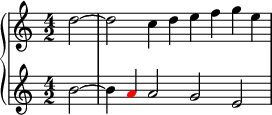
An anticipation (ANT) occurs when this note is approached by step and then remains the same. It is basically a note of the second chord played early. In the example below, the dissonant B in bar 1 is approached by step and resolves when that same pitch becomes a chord tone in bar 2.


   \new PianoStaff <<
      \new Staff <<
         \new Voice \relative c'' {
             \stemUp \clef treble \key c \major \time 4/4
             c4 \once \override NoteHead.color = #red b b2
             }
         \new Voice \relative c' {
             \stemDown
              e2 d
              }
            >>
     \new Staff <<
         \new Voice \relative c {
             \clef bass \key c \major \time 4/4
             <c g'>2 g' \bar "||"
             }
         >>
    >>

A portamento is the late Renaissance precursor to the anticipation,[5] though today it refers to a glissando.

   \new PianoStaff <<
      \new Staff <<
         \relative c'' {
             \clef treble \key c \major \time 4/2
             \partial2 d2~ d c4 d e f g e
             }
            >>
     \new Staff <<
         \relative c'' {
             \clef treble \key c \major \time 4/2
             \partial2 b2~ b4 \once \override NoteHead.color = #red a a2 g e
             }
         >>
    >>

Neighbor tone

[edit]

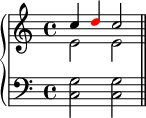
A neighbor tone (NT) or auxiliary note (AUX) is a nonchord tone that passes stepwise from a chord tone directly above or below it (which frequently causes the NT to create dissonance with the chord) and resolves to the same chord tone:

   \new PianoStaff <<
      \new Staff <<
         \new Voice \relative c'' {
             \clef treble \key c \major \time 4/4
             \stemUp c4 \once \override NoteHead.color = #red d c2
             }
         \new Voice \relative c' {
             \stemDown e2 e
              }
            >>
     \new Staff <<
         \relative c {
             \clef bass \key c \major \time 4/4
             <c g'>2 <c g'> \bar "||"
             }
         >>
    >>

In practice and analysis, neighboring tones are sometimes differentiated depending upon whether or not they are lower or higher than the chord tones surrounding them. A neighboring tone that is a step higher than the surrounding chord tones is called an upper neighboring tone or an upper auxiliary note while a neighboring tone that is a step lower than the surrounding chord tones is a lower neighboring tone or lower auxiliary note. However, following Heinrich Schenker's usage in Free Composition, some authors reserve the term "neighbor note" to the lower neighbor a half step below the main note.[6]

The German term Nebennote is a somewhat broader category, including all nonchord tones approached from the main note by step.[6]

Escape tone

[edit]

An escape tone (ET) or echappée is a particular type of unaccented incomplete neighbor tone that is approached stepwise from a chord tone and resolved by a skip in the opposite direction back to the harmony.


   \new PianoStaff <<
      \new Staff <<
         \new Voice \relative c'' {
             \stemUp \clef treble \key c \major \time 4/4
             c4 \once \override NoteHead.color = #red d b2
             }
         \new Voice \relative c' {
             \stemDown
              e2 d
              }
            >>
     \new Staff <<
         \new Voice \relative c {
             \clef bass \key c \major \time 4/4
             <c g'>2 g' \bar "||"
             }
         >>
    >>

Passing tone

[edit]

A passing tone (PT) or passing note is a nonchord tone prepared by a chord tone a step above or below it and resolved by continuing in the same direction stepwise to the next chord tone (which is either part of the same chord or of the next chord in the harmonic progression).


   \new PianoStaff <<
      \new Staff <<
         \new Voice \relative c'' {
             \clef treble \key c \major \time 4/4
             \stemUp c4 \once \override NoteHead.color = #red d e2
             }
         \new Voice \relative c' {
             \stemDown e2 e
              }
            >>
     \new Staff <<
         \relative c {
             \clef bass \key c \major \time 4/4
             <c g'>2 <c g'> \bar "||"
             }
         >>
    >>

Where two nonchord tones are before the resolution they are double passing tones or double passing notes.

Accented non-chord tones

[edit]

Passing tone

[edit]

A tone that sits between two chord tones and is between them.


   \new PianoStaff <<
      \new Staff <<
         \new Voice \relative c'' {
             \clef treble \key c \major \time 4/4
             \stemUp g1 \once \override NoteHead.color = #red f2 e
             }
         \new Voice \relative c' {
             \stemDown e1 c
              }
            >>
     \new Staff <<
         \relative c {
             \clef bass \key c \major \time 4/4
             <c g'>1 <c g'> \bar "||"
             }
         >>
    >>

Neighbor tone

[edit]

A neighbour tone is where there is a step up or down from a note (or chord tone) and then move back to the original note.[7]


   \new PianoStaff <<
      \new Staff <<
         \new Voice \relative c'' {
             \clef treble \key c \major \time 4/4
             \stemUp g1 \once \override NoteHead.color = #red a2 g
             }
         \new Voice \relative c' {
             \stemDown e1 e
              }
            >>
     \new Staff <<
         \relative c {
             \clef bass \key c \major \time 4/4
             <c g'>1 <c g'> \bar "||"
             }
         >>
    >>

Suspension and retardation

[edit]

Endeavor, moreover, to introduce suspensions now in this voice, now in that, for it is incredible how much grace the melody acquires by this means. And every note which has a special function is rendered audible thereby.

A suspension (SUS) (sometimes referred to as a syncope)[9] occurs when the harmony shifts from one chord to another, but one or more notes of the first chord (the preparation) are either temporarily held over into or are played again against the following chord (against which they are nonchord tones called the suspension) before resolving downwards to a chord tone by step (the resolution). The whole process is called a suspension as well as the specific nonchord tone(s).

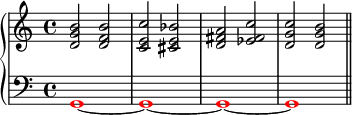
Suspensions may be further described with two numbers: (1) the interval between the suspended note and the bass note and (2) the interval between the resolution and the bass note. The most common suspensions are 4–3 suspension, 7–6 suspension, or 9–8 suspension. Note that except for the 9–8 suspensions, the numbers are typically referred to using the simple intervals, so for instance, if the intervals are actually an 11th and a 10th (the first example below), one would typically call it a 4–3 suspension. If the bass note is suspended, then the interval is calculated between the bass and the part that is most dissonant with it, often resulting in a 2–3 suspension.[10]


   \new PianoStaff <<
      \new Staff <<
         \new Voice \relative c'' {
             \stemUp \clef treble \key c \major \time 4/4
             c1^~ \once \override NoteHead.color = #red c2^\markup { " 4  –  3" } b2
             c1^~ \once \override NoteHead.color = #red c2^\markup { " 7  –  6" } b2
             c1^~ \once \override NoteHead.color = #red c2^\markup { " 9  –  8" } b2
             c1 d^\markup { " 2  –  3" } 
             }
         \new Voice \relative c' {
             \stemDown
              e1 d
              e d
              e d
              e d
              }
            >>
     \new Staff <<
         \new Voice \relative c' {
             \clef bass \key c \major \time 4/4
             \stemUp g1 s
             g f
             g g
             g g
             }
         \new Voice \relative c {
             \clef bass \key c \major \time 4/4
             \stemDown c1 g' \bar "||"
             c, d \bar "||"
             c b \bar "||"
             c_~ \once \override NoteHead.color = #red c2 b \bar "||"
             }
         >>
    >>

Suspensions must resolve downwards. If a tied note is prepared like a suspension but resolves upwards, it is called a retardation. Common retardations include 2–3 and 7–8 retardations.


   \new PianoStaff <<
      \new Staff <<
         \new Voice \relative c'' {
             \stemUp \clef treble \key c \major \time 4/4
             c1^~ \once \override NoteHead.color = #red c2^\markup { " 2  –  3" } d2
             c1^~ \once \override NoteHead.color = #red c2^\markup { " 7  –  8" } d2
             }
         \new Voice \relative c' {
             \stemDown
              e1 d
              e d
              }
            >>
     \new Staff <<
         \new Voice \relative c {
             \clef bass \key c \major \time 4/4
             <c g'>1 <b g'> \bar "||"
             <c g'> <d f> \bar "||"
             }
         >>
    >>

Decorated suspensions are common and consist of portamentos or double eighth notes, the second being a lower neighbor tone.


   \new PianoStaff <<
      \new Staff <<
         \new Voice \relative c'' {
             \stemUp \clef treble \key c \major \time 4/4
             c1^~ \once \override NoteHead.color = #red c4 b8 a b2
             }
         \new Voice \relative c' {
             \stemDown e1 d
              }
            >>
     \new Staff <<
         \new Voice \relative c' {
             \clef bass \key c \major \time 4/4
             \stemUp g1 s
             }
         \new Voice \relative c {
             \clef bass \key c \major \time 4/4
             \stemDown c1 g' \bar "||"
             }
         >>
    >>

A chain of suspensions constitutes the fourth species of counterpoint; an example may be found in the second movement of Corelli's Christmas Concerto.


    { 
<< \new StaffGroup <<
        \new Staff <<
            \tempo Allegro
            \set Staff.instrumentName = #"Vln. I"
            \relative c''' {
                \clef treble \key g \minor \time 4/4
                g2 a
                bes4 g2 fis4
                g4 bes2 a4
                bes2 c
                d4 bes2 a4~
                a g2 fis4
                g4. a8 fis d g4~
                g fis g
                }
            >>
        \new Staff <<
            \set Staff.instrumentName = #"Vln. II"
            \relative c''' {
                \clef treble \key g \minor \time 4/4
                r4 g2 fis4
                g2 a
                bes c
                d4 bes2 a4
                r d c2
                bes2 a4 d,~
                d8 g, c2 bes4
                a2 g4
                }
            >>
        \new Staff <<
            \relative c' {
            \set Staff.instrumentName = #"Vcl."
                \clef bass \key g \minor \time 4/4
                r8 g bes g c a d d,
                g g, bes g c a d d,
                g bes' d bes es c f f,
                bes bes, d bes es c f f,
                bes bes' d bes e, c' fis, d'
                g, a bes c d c d d,
                es d es c d fis g bes,
                c a d d, g r
                }
         >>
    >>
>> }

Appoggiatura

[edit]

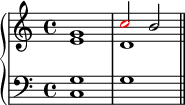
An appoggiatura (APP) is a type of accented incomplete neighbor tone approached skip-wise from one chord tone and resolved stepwise to another chord tone ("overshooting" the chord tone).

   \new PianoStaff <<
      \new Staff <<
         \new Voice \relative c'' {
             \stemUp \clef treble \key c \major \time 4/4
             g1 \once \override NoteHead.color = #red c2 b
             }
         \new Voice \relative c' {
             \stemDown
              e1 d
              }
            >>
     \new Staff <<
         \new Voice \relative c' {
             \clef bass \key c \major \time 4/4
             \stemUp g1 s
             }
         \new Voice \relative c {
             \clef bass \key c \major \time 4/4
             \stemDown c1 g' \bar "||"
             }
         >>
    >>

Nonharmonic bass

[edit]

Nonharmonic bass notes are bass notes that are not a member of the chord below which they are written. Examples include the Elektra chord.[11] An example of a nonharmonic bass from the third movement of Stravinsky's Symphony of Psalms.[12]


{ \override Score.TimeSignature #'stencil = ##f
   \new PianoStaff <<
      \new Staff <<
         \relative c' {
             \stemUp \clef treble \key c \major \time 4/4
             <f a f' c'>1
             }
            >>
     \new Staff <<
         \relative c, {
             \clef bass \key c \major \time 4/4
             \ottava #-1 \once \override NoteHead.color = #red <bes bes'>1
             }
         >>
    >>
}

Involving more than three notes

[edit]

Chromatic nonharmonic tone

[edit]

A chromatic nonharmonic tone is a nonharmonic tone that is chromatic, or outside of the key and creates half-step motion. The use of which, especially chromatic appoggiaturas and chromatic passing tones, increased in the Romantic Period.[13] The example below shows chromatic nonharmonic tones (in red) in the first four measures of Chopin's Prelude No. 21, op. 28.[13]


    {
      \new PianoStaff <<
        \new Staff <<
            \new Voice \relative c'' {
                \tempo "Cantabile"
                \clef treble \key bes \major \time 3/4
                \override DynamicLineSpanner.staff-padding = #2.5
                f2.\p( d2 \acciaccatura { f8 } es4 d2. g,2.)
                }
            >>
        \new Staff <<
            \new Voice \relative c {
                \clef bass \key bes \major \time 3/4
                \override NoteHead.color = #red \hide Stem s4 e8 s4.
                s4 e8 s4.
                s4 fis8 b s4
                s4 fis8 b s4
                }
            \new Voice \relative c, {
                \clef bass \key bes \major \time 3/4
                bes8\<\sustainOn_[ f''^( <e g>\sustainOff <es a> <d bes'> <c c'>]\!
                bes8\<\sustainOn_[) <f' d'>^( <e g>\sustainOff <es a> <d bes'> bes]\!
                es,8\<\sustainOn_[) g'^( <fis a>\sustainOff <f b> <es c'> <d d'>]\!
                c8\<\sustainOn_[) <g' es'>^( <fis a>\sustainOff <f b> <es c'> <c es'>])\!
                }
            >>
    >> }

See also

[edit]

References

[edit]
[edit]
Revisions and contributorsEdit on WikipediaRead on Wikipedia
from Grokipedia
A non-chord tone (NCT), also referred to as a nonharmonic tone or embellishing tone, is a note in a musical composition that does not belong to the prevailing chord and temporarily introduces dissonance or color to the harmony. These tones are integral to Western music theory, functioning to connect chord tones smoothly, create melodic interest, or heighten emotional tension before resolving to a consonant note. They are typically analyzed in relation to the surrounding chordal structure and classified by their approach (how they enter the texture) and resolution (how they leave), often occurring on weak beats but sometimes accented for emphasis. Non-chord tones encompass several distinct types, each defined by specific intervallic and rhythmic behaviors. A passing tone is approached and left by step in the same direction, filling the space between two chord tones to create stepwise motion. A neighbor tone is approached by step and left by step in the opposite direction, ornamenting a single chord tone with an adjacent pitch. Appoggiaturas are accented non-chord tones approached by leap and resolved by step downward, often creating strong dissonance on the beat. Escape tones involve stepwise approach followed by a leap away in the opposite direction, providing a quick evasion from consonance. Other types include suspensions, where a held chord tone from the prior resolves downward by step; retardations, similar but resolving upward; anticipations, which preview a note from the upcoming chord; and pedal points, sustained tones (often in the bass) against changing harmonies. In practice, non-chord tones enhance melodic flow and complexity across genres, from classical to , and can be chromatic (altering the key's scale) or diatonic. Their identification relies on contextual analysis of the , with qualifiers like "accented" or "unaccented" further specifying their metrical role. By temporarily suspending expectations, these tones contribute to the expressive depth of music, influencing composition and traditions since the Baroque era.

Fundamentals

Definition

A nonchord tone (NCT), also known as a nonharmonic tone or embellishing tone, is a note in a musical passage that does not belong to the prevailing chord at that moment in time and typically resolves by step to a chord tone. Chord tones, by contrast, constitute the structural foundation of the —typically the , third, fifth, and sometimes seventh of the chord—providing stability and defining the vertical sonority, while nonchord tones introduce melodic variety, tension, or ornamentation without altering the underlying . Nonchord tones are broadly classified into unaccented (occurring off the beat) and accented (occurring on the beat) varieties, as well as diatonic (derived from the key's scale) and chromatic (outside the key's scale) types, distinctions that highlight their rhythmic placement and scalar origin. The modern terminology of "nonchord tone" gained prominence in 20th-century music theory pedagogy, notably in influential texts like Edward Aldwell and Carl Schachter's Harmony and Voice Leading (first published 1978), building on earlier concepts of dissonant embellishments traced to 18th-century instruction in Johann Joseph Fux's (1725).

Theoretical Role

Nonchord tones (NCTs) serve a primary functional in tonal music by introducing controlled dissonance that resolves to consonance, thereby enhancing melodic flow and through tension and release. These embellishing tones, which do not belong to the underlying chord, create temporary instability that propels the music forward, distinguishing intentional enrichment from static chordal support. In tonal , NCTs contribute to expressive depth without fundamentally altering the , allowing composers to vary surface-level details while maintaining structural integrity. Analytically, NCTs are identified in score analysis through their melodic context relative to surrounding chord tones, often labeled within to clarify and . This process involves distinguishing NCTs from chord tones based on approach and resolution patterns, such as stepwise motion or rhythmic placement, to differentiate intentional embellishments from potential notational errors or non-tonal elements. For instance, analysts examine whether a dissonant pitch resolves obligatorily to a chord tone, confirming its role as an NCT rather than a structural alteration. Such approaches underscore the importance of NCTs in parsing complex textures, where they may imply brief voice-leading shifts or temporary modulatory hints without changing the prevailing key. NCTs exert a subtle influence on by facilitating smooth and suggesting auxiliary sonorities that enrich the perceived progression, yet they do not redefine the core framework. In , this means NCTs can create the illusion of transient modulations or expanded chords through dissonance, but their resolution reaffirms the original , preserving tonal coherence. This dynamic allows for layered interpretations, where NCTs bridge chordal stations without implying new or functions. Pedagogically, NCTs are central to teaching and , particularly through species counterpoint exercises that enforce rules for dissonance treatment, such as requiring dissonant intervals to resolve by step on weak beats. In first-species counterpoint, only consonances are permitted, but higher species introduce NCTs like passing and neighbor tones as ornamental dissonances, training students in tension management and melodic independence. This method, derived from historical practices like those of Fux and Bach, builds analytical skills by having learners add NCTs to basic progressions, emphasizing their role in animating texture and avoiding parallel dissonances.

Unaccented Nonchord Tones

Passing Tone

A passing tone is an unaccented nonchord tone that occurs on a weak beat, connecting two chord tones through stepwise motion in the same direction, thereby filling the interval—typically a third—between them. This creates a smoother melodic line by avoiding direct leaps, and it is approached and resolved by step, ensuring the nonchord tone does not disrupt the underlying . In practice, unaccented passing tones are diatonic notes within the major or that interpolate between adjacent chord tones. For instance, in a triad (C-E-G), a passing tone D can connect C to E in an ascending line (C-D-E), while F serves as a passing tone between E and G (E-F-G). These examples illustrate how the passing tone occupies the off-beat position, such as the second half of a beat in 4/4 time, maintaining consonance with the surrounding chord tones upon resolution. Chromatic passing tones, though less common in strict tonal contexts, follow the same stepwise but introduce brief color outside the key. Passing tones are particularly prevalent in inner voices to facilitate smooth , where they help maintain linear independence among parts without creating dissonance on strong beats. This technique is foundational in and , where composers like Bach and employed them extensively to enhance contrapuntal flow and melodic elegance, as seen in species counterpoint exercises that prioritize stepwise connections between consonances.

Neighbor Tone

A neighbor tone, also known as an auxiliary tone, is an unaccented nonchord tone that embellishes a chord tone by moving stepwise away from it and then returning to the same chord tone, creating a brief ornamental dissonance that resolves smoothly. This motion typically occurs on a weak beat, ensuring the dissonance remains subordinate to the underlying , and it can be either an upper neighbor (moving above the chord tone) or a lower neighbor (moving below it). The resolution of a neighbor tone always returns by step to the original chord tone in the opposite direction from which it approached, distinguishing it from other nonchord tones by its oscillatory, decorative nature around a single stable pitch rather than connecting distinct chord tones. For instance, in a chord where C is the chord tone, a lower neighbor might be B (approached from C to B, then resolving back to C), while an upper neighbor could be D (from C to D, then back to C); these embellishments add melodic interest without altering the harmonic progression. In , neighbor tones serve as essential embellishments at the sub-tactus level, enhancing the independence of contrapuntal lines by introducing inessential dissonances that avoid forbidden parallel octaves or fifths while preserving consonance upon resolution. This stylistic application underscores their role in maintaining harmonic stability, as seen in works by composers like , where such tones decorate melodic lines without disrupting the overall polyphonic texture.

Escape Tone

The escape tone, also known as échappée, is an unaccented that is approached by step from a chord tone and then departed from by a leap in the opposite direction, typically creating a brief dissonance resolved quickly for melodic . This motion distinguishes it from more ornaments, providing a sense of evasion or in the while maintaining rhythmic flow on weaker beats. The resolution pattern of an escape tone involves arriving at the dissonant note via stepwise motion on an off-beat, followed by a disjunct leap—often a third or more—back toward consonance on the subsequent beat, emphasizing its unaccented nature and role in avoiding prolonged tension. This opposite-direction leap enhances rhythmic variety without disrupting the underlying harmony, usually staying within diatonic intervals for coherence. A representative example occurs in the C major chord, where a melody on the chord tone E steps up to the nonchord tone F (on a weak beat), then leaps down to the chord tone C. Another illustration appears in the final phrase of "The Star-Spangled Banner" (1814), on the word "of" in "the home of the brave," where the melody steps to a nonchord tone and leaps away in opposition. Diatonic leaps are preferred to preserve tonal stability, as in Joseph Haydn's Piano Sonata in C Major, Hob. XVI:35 (1780), where such figures add agility to the melodic line. The escape tone emerged prominently in the 18th-century , serving to introduce melodic agility and expressive flourishes in the transition toward classical periodicity, as seen in works by composers like Haydn. Unlike the neighbor tone, which returns conjunctly to the originating note, the escape tone's leap provides a more dynamic contrast through its directional reversal.

Anticipation

An anticipation is an unaccented non-chord tone that occurs on a weak beat, consisting of a note belonging to the upcoming chord and held over into the subsequent stronger beat where the chord changes occur. This placement on a weak beat aligns it with other unaccented non-chord tones, emphasizing its preparatory role without creating tension on strong beats. It functions as a two-note , introducing the future chord tone prematurely to subtly foreshadow the progression, often at cadences. The resolution of an differs from dissonant non-chord tones, as it requires no stepwise motion or release of dissonance; the note simply persists statically while the underlying shifts to incorporate it as a chord member. This static holding creates a smooth transition rather than dramatic tension and release, highlighting the anticipation's forward-looking nature. A representative example occurs in a V-I progression in C major, where the note E (the third of the I chord) is introduced on the weak beat during the V chord (G-B-D) and held into the I chord (C-E-G), transforming from a non-chord tone to a interval. In classical , Handel's "" from Rinaldo (1711) features an at a , with the note held over the bar line to align with the resolving tonic chord. A contemporary illustration appears in the opening bars of "Call Me" by and (1980), where syncopated vocal lines create anticipatory holds across chord changes. Anticipations are particularly common in , where they enhance textual flow and subtly prepare resolutions at cadences. They appear less frequently in strict due to rules favoring smoother without premature chord tone introductions.

Accented Nonchord Tones

Appoggiatura

The appoggiatura is an accented that occurs on a strong beat, creating a dissonance that resolves stepwise to a chord tone, typically positioned a step above or below it for heightened expressivity. Unlike unaccented varieties, it is metrically emphasized, often approached by leap from a preceding chord tone and resolving by descending or ascending step, which amplifies its dramatic "leaning" quality into the resolution. This stepwise resolution echoes the connective role of unaccented passing tones but with greater accentual weight. In notation, the appoggiatura appears in two primary variants: the long appoggiatura, fully written out with its own rhythmic value integrated into the measure, and the short appoggiatura, rendered as a that borrows time from the principal note, often taking half or more of its duration. Historically, during the era, it functioned as a melodic ornament that typically took half the value of an undotted principal note, emphasizing expressive sighs in vocal lines. By the Classical period, composers like expanded its role in arias, notating it more explicitly to heighten emotional , as seen in the descending appoggiaturas of "" from Le nozze di Figaro, where it underscores themes of longing. In the Romantic era, figures such as Chopin further personalized it, allowing for freer interpretive length to intensify subjective tension and release in works. The emotional effect of the stems from its unprepared dissonance on the beat, generating a sigh-like tension that resolves into consonance, evoking or yearning in a manner akin to the "sigh motive" in Western art music. This is particularly evident in Mozart's operatic writing, where appoggiaturas in recitatives and arias, such as those in , create poignant dramatic pauses before resolution, enhancing the text's affective delivery.

Suspension and Retardation

A suspension is an accented nonchord tone in which a chord tone from the previous is tied over into the following chord, creating a dissonance on a strong beat, and then resolves downward by step to a consonance on the subsequent weak beat. This must occur as a consonance, typically on a weak beat, ensuring the tied note (the suspension proper) forms intervals such as a second, fourth, or seventh against the new bass, with common configurations including the 4-3 and 7-6 suspensions. For instance, in common time, the often appears on beat four of one measure, tied to beat one of the next, emphasizing the dissonance's role in prolonging tension before resolution. The retardation serves as a variant of the suspension, differing primarily in its resolution direction: it ascends by step from the dissonant tied note, often to a leading tone, which softens cadential arrivals by delaying full resolution. Like the suspension, it requires preparation by the same note and occurs on a , but its upward motion—such as a 2-3 or 7-8 resolution—creates a gentler, less forceful close, frequently employed in slower movements or deceptive cadences. Suspensions and retardations form a core element of and , where they enable controlled dissonances within otherwise textures. , in his 1558 treatise Le Istitutioni harmoniche, outlined rules for their use, mandating consonant preparation and stepwise descending resolution for standard suspensions to maintain harmonic integrity, as illustrated in his discussions of cadential formulas. These devices persisted into the era, influencing composers like , who systematized them in species as essential for and emotional expression.

Accented Passing Tone

An accented passing tone is a non-chord tone that connects two chord tones by stepwise motion in the same direction, with the dissonant note occurring on a strong beat to emphasize the temporary harmonic tension. Unlike the unaccented passing tone, which fills space on a weak beat for smoother melodic flow, the accented version heightens dissonance through rhythmic emphasis. The resolution of an accented passing tone proceeds linearly by step to the subsequent chord tone, maintaining the melodic direction while alleviating the created dissonance on the following beat. This stepwise continuation ensures the passing tone serves as a bridge between stable points, but its placement on the strong beat intensifies the perceptual pull toward resolution. A representative example occurs in a context, where an (chord tone) leads to an F (accented passing tone) on the downbeat, resolving stepwise to G (chord tone) in an iambic rhythm pattern. Another instance appears in Johann Sebastian Bach's "Mein liebster Jesus ist verloren" (BWV 154, mm. 1–2), where the upper voice features an accented passing tone that underscores the melodic line's emotional contour. Accented passing tones are less prevalent in strict contrapuntal styles, such as chorale writing, due to their pronounced dissonance on strong beats, but they gain prominence in for enhancing expressivity and dramatic tension. In this era, composers like Schubert employ them to add poignant sparkle, often in descending lines to exploit the emotional weight of resolution.

Accented Neighbor Tone

The accented neighbor tone is a nonchord tone that adorns a chord tone by moving stepwise to a dissonant note on a metrically strong beat—such as a downbeat—and then resolving back to the original chord tone by step in the opposite direction. This placement on the strong beat accentuates the dissonance, distinguishing it from the unaccented neighbor tone, which occurs off the beat and serves a more ornamental role without such emphasis. The resolution of an accented neighbor tone happens immediately following its introduction, typically in the next metrical position, thereby creating a fleeting but prominent clash against the prevailing before restoration. This quick return reinforces the chord tone's stability while heightening expressive tension through the accented dissonance. A representative example occurs within a triad (C-E-G), where the chord tone C is approached from the upper neighbor D on a strong beat, which then resolves back to C; this might appear in a melodic line such as D-C over a C-major , with the D creating brief dissonance before immediate resolution. Similarly, a lower neighbor could involve B resolving upward to C in the same context. In , accented neighbor tones appear in works by composers like Beethoven, where they provide and rhythmic vitality on strong beats, often held briefly before resolution to enhance melodic contour without disrupting progression.

Nonharmonic Bass

A nonharmonic bass note is a pitch in the bass voice that does not belong to the prevailing at that moment, functioning to embellish the , enhance melodic contour in the lowest register, or generate dissonance against the upper voices. Unlike chord tones, which reinforce the harmonic foundation, nonharmonic bass notes introduce temporary instability, often requiring resolution to maintain tonal coherence. These notes are particularly effective in the bass due to its structural role in defining , where even brief deviations can significantly alter the perceived progression. Common types include accented passing tones in the bass, which arrive on a strong beat and connect two chord tones stepwise in the same direction, such as a moving from the fifth to the below (e.g., from D to C in a chord). Another type is the nonharmonic pedal bass, where a bass pitch, not part of the current chord, is held briefly against changing upper before moving, distinct from prolonged pedals by its shorter duration and mobility. Accented neighbor tones in the bass also occur, approached and left by step in opposite directions on a strong beat, adding ornamental fluctuation to the foundational line. Suspensions in the bass, always accented, involve holding a chord tone from the prior harmony (preparation) into the next, creating dissonance that resolves by step, such as a 4-3 motion. Resolution of nonharmonic bass notes typically occurs stepwise to a chord tone, either upward or downward, restoring stability; for instance, a passing tone below the resolves upward to it, while a bass suspension resolves downward by half or whole step. Examples appear in organ pedal writing, where stepwise bass motion incorporates passing tones for fluid , as in realizations of in chorales. In orchestral contexts, nonharmonic bass lines animate textures, such as in string bass passages with neighbor motions. Analytically, these bass dissonances, akin to accented nonchord tones elsewhere, can imply secondary dominants through temporary chromatic implications, and they are prevalent in 19th-century lieder for expressive shading, as seen in Fanny Hensel's "Die Nonne," where bass neighbor tones (e.g., D♯ against A) heighten emotional tension.

Multi-Note Configurations

Changing Tones

Changing tones, also known as double neighbors or neighbor groups, constitute a multi-note unaccented non-chord tone configuration where a chord tone is decorated by a sequence of its upper and lower neighbors in succession before returning to the chord tone. This embellishment builds on the single neighbor tone by chaining two such oscillations, typically involving stepwise motion away from and back to the structural note. The formation of changing tones occurs unaccented, often on weak beats within a measure, with the non-chord tones approached and resolved by step to create fluid without disrupting the underlying . The pattern usually spans three or four notes: starting on a chord tone, moving to one neighbor (upper or lower), then to neighbor, and resolving back to the original chord tone, all within the duration of a single . This stepwise progression ensures the remains diatonic or chromatic as needed, enhancing expressiveness while maintaining tonal coherence. A representative example appears in a chord context, where the melody outlines C (chord tone) to B (lower neighbor) to D (upper neighbor) to A (another chord tone a third below), connecting consonances via step and skip for decoration over the harmony. Similarly, in W. A. Mozart's Piano Sonata in B-flat Major, K. 333 (1784), the melody in measure 1, beat 4, employs changing tones to ornament a chord tone with adjacent steps, illustrating their role in classical melodic fluidity. Changing tones are prevalent in music for adding subtle melodic variety and in to achieve rhythmic and tonal fluidity, often as part of phrasing or scalar embellishments. In these contexts, they serve to connect chord tones seamlessly, contributing to the improvisational flow without altering the harmonic foundation.

Pedal Point

A pedal point is a sustained tone, typically in the bass voice, that persists while the harmonies in the upper voices change, often beginning as a chord tone and becoming dissonant against subsequent chords. This technique derives its name from the foot pedals of the , which allow for prolonged low notes, and it generates tension through the contrast between the static pedal and shifting harmonies above. Common types include tonic pedals, which sustain the first scale degree to anchor the key, and dominant pedals, which hold the fifth scale degree to build toward resolution. Inverted pedals occur in upper voices rather than the bass, while double pedals involve two simultaneous notes, often a perfect fifth apart, functioning as pedals. Inner pedals appear in middle voices, such as the tenor. The resolves when the upper harmonies return to consonance with it, typically at the end of a , section, or even an entire movement, releasing the accumulated tension. Its duration can span multiple measures or whole phrases, prolonging dissonance in a manner akin to an extended suspension. Historically, pedal points were prominent in , as seen in J.S. Bach's Prelude in C major from , Book I (BWV 846), where a tonic pedal structures the opening, and in the Prelude to his Suite No. 1 in (BWV 1007), which employs tonic and dominant pedals to frame sections and drive tonal progression. In the Romantic era, Richard used pedal points for dramatic climaxes and to evoke elemental forces, such as the sustained tonic pedal in the prologue of (1854), which grounds the shimmering depiction of the Rhine's depths while leitmotifs unfold above.

Chromatic Nonchord Tones

Characteristics

Chromatic nonchord tones are nonchord tones that incorporate altered scale degrees, such as sharps, flats, or naturals not present in the prevailing key signature, thereby introducing pitches foreign to the diatonic collection. Unlike diatonic nonchord tones, which draw exclusively from the key's notes, chromatic variants expand the melodic and harmonic palette by embedding these alterations as embellishments that temporarily deviate from the underlying harmony. Acoustically, chromatic nonchord tones often heighten dissonance compared to their diatonic counterparts due to the formation of smaller or irregular intervals, such as augmented seconds, which arise in minor keys or chromatic contexts (e.g., between the and raised leading tone). These intervals produce a harsher, more tense sonic profile, as the close proximity of pitches—typically a enlarged by an accidental—creates perceptual instability that demands resolution. In theoretical analysis, chromatic nonchord tones are typically classified and treated similarly to diatonic ones, functioning primarily as passing tones (approached and left by step in the same direction) or neighbor tones (approached by step and left by step in the opposite direction), but with specialized voice-leading considerations to prevent parallel fifths or octaves. Composers adjust the motion of surrounding voices—such as altering stepwise approaches to oblique or contrary motion—ensuring that the chromatic integrates smoothly without violating contrapuntal rules. Their prevalence increased significantly after 1800, particularly in the Romantic era, where they facilitated advanced by adding expressive color and harmonic ambiguity to tonal frameworks, as seen in the works of composers like Beethoven and later Wagner. This shift enabled richer emotional depth and smoother modulations, marking a departure from the more restrained diatonic practices of the Classical period.

Examples and Analysis

In Beethoven's late string quartets, such as the in , Op. 131, chromatic passing tones enhance contrapuntal complexity and , often filling gaps between diatonic chord tones in fugal passages. For instance, in the first movement's fugal exposition, ascending chromatic passing notes in the inner voices connect scale degrees, creating fluid linear motion amid the dense . Appoggiaturas in Chopin's nocturnes frequently employ chromatic alterations for expressive tension, integrating motivic elements with ornamental dissonance. In the Nocturne in B-flat minor, Op. 9 No. 1, chromatic appoggiaturas on the lowered sixth scale degree (G-flat) resolve to the diatonic version (G natural), emphasizing emotional interchange and motivic parallelism across the phrase structure. Similarly, in Op. 9 No. 2, upper-neighbor appoggiaturas with chromatic inflections decorate the melodic line, blending ornamentation with structural harmony to heighten lyrical intensity. Analytical techniques for chromatic nonchord tones often involve Schenkerian graphing, where such tones are labeled as passing or neighbor embellishments at foreground and middleground levels to reveal underlying tonal coherence. In Chopin's Op. 30 No. 4 in , a Schenkerian graph labels the F-flat as a foreground lower neighbor resolving to G-sharp, while the deep-middleground depicts D-sharp as a lower neighbor to E, integrating chromatic conflicts into the Urlinie descent. These labels distinguish chromatic nonchord tones from structural pitches, showing their role in prolonging harmony without disrupting the fundamental line. Modern extensions of chromatic nonchord tones appear in jazz, where blue notes serve as chromatic neighbors to embellish dominant chords. In the blues scale over a C7 chord, the flat-third (E-flat) acts as a lower neighbor to the chord tone E, approaching by half-step and resolving back, as heard in improvisations like those in "Sunshine of Your Love," adding expressive dissonance without altering the underlying harmony. In 20th-century atonal music, nonchord tones blur traditional boundaries with chord tones through species-like counterpoint, allowing dissonant pitches to function both linearly and vertically in post-tonal contexts. This approach, as in Schoenberg's twelve-tone works, treats chromatic embellishments as integral to pitch organization rather than mere ornaments, expanding beyond tonal hierarchies. A of chromatic neighbors appears in J.S. Bach's setting from the first phrase of an example analyzed in tonal texts, where on the last beat of measure 2, a chromatic alteration introduces a neighbor tone within a iii chord, adding color through half-step dissonance that resolves stepwise to the subsequent harmony, enhancing the expressive texture without disrupting the contrapuntal flow.

References

Add your contribution
Related Hubs
User Avatar
No comments yet.