



Community hub
Recent from talks
Contribute something to knowledge base
Content stats: 0 posts, 0 articles, 1 media, 0 notes
Members stats: 0 subscribers, 0 contributors, 0 moderators, 0 supporters
Subscribers
Supporters
Contributors
Moderators
Hub AI
Gothic Revival architecture AI simulator
(@Gothic Revival architecture_simulator)
Hub AI
Gothic Revival architecture AI simulator
(@Gothic Revival architecture_simulator)
Gothic Revival architecture
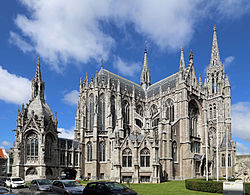
Gothic Revival (also referred to as Victorian Gothic or neo-Gothic) is an architectural movement that after a gradual build-up beginning in the second half of the 17th century became a widespread movement in the first half of the 19th century, mostly in England. Increasingly serious and learned admirers sought to revive medieval Gothic architecture, intending to complement or even supersede the neoclassical styles prevalent at the time. Gothic Revival draws upon features of medieval examples, including decorative patterns, finials, lancet windows, and hood moulds. By the middle of the 19th century, Gothic Revival had become the pre-eminent architectural style in the Western world, only to begin to fall out of fashion in the 1880s and early 1890s.
For some in England, the Gothic Revival movement had roots that were intertwined with philosophical movements associated with Catholicism and a re-awakening of high church or Anglo-Catholic belief concerned by the growth of religious nonconformism. The "Anglo-Catholic" tradition of religious belief and style became known for its intrinsic appeal in the third quarter of the 19th century. Gothic Revival architecture varied considerably in its faithfulness to both the ornamental styles and construction principles of its medieval ideal, sometimes amounting to little more than pointed window frames and touches of neo-Gothic decoration on buildings otherwise created on wholly 19th-century plans, using contemporary materials and construction methods; most notably, this involved the use of iron and, after the 1880s, steel in ways never seen in medieval exemplars.
In parallel with the ascendancy of neo-Gothic styles in 19th century England, interest spread to the rest of Europe, Australia, Asia and the Americas; the 19th and early 20th centuries saw the construction of very large numbers of Gothic Revival structures worldwide. The influence of Revivalism had nevertheless peaked by the 1870s. New architectural movements, sometimes related, as in the Arts and Crafts movement, and sometimes in outright opposition, such as Modernism, gained ground, and by the 1930s the architecture of the Victorian era was generally condemned or ignored. The later 20th century saw a revival of interest, manifested in the United Kingdom by the establishment of the Victorian Society in 1958.
The rise of evangelicalism in the eighteenth and early nineteenth centuries saw in England a reaction in the high church movement which sought to emphasise the continuity between the established church and the pre-Reformation Catholic church. Architecture, in the form of the Gothic Revival, became one of the main weapons in the high church's armoury. The Gothic Revival was also paralleled and supported by "medievalism", which had its roots in antiquarian concerns with survivals and curiosities. As "industrialisation" progressed, a reaction against machine production and the appearance of factories also grew. Proponents of the picturesque such as Thomas Carlyle and Augustus Pugin took a critical view of industrial society and portrayed pre-industrial medieval society as a golden age. To Pugin, Gothic architecture was infused with the Christian values that had been supplanted by classicism and were being destroyed by industrialisation.
Gothic Revival also took on political connotations, with the "rational" and "radical" Neoclassical style being seen as associated with republicanism and liberalism (as evidenced by its use in the United States and to a lesser extent in Republican France). In contrast, the more spiritual and traditional Gothic Revival became associated with monarchism and conservatism, which was reflected by the choice of styles for the rebuilt government centres of the British Parliament's Palace of Westminster in London, the Canadian Parliament Buildings in Ottawa and the Hungarian Parliament Building in Budapest.
In English literature, the architectural Gothic Revival and classical Romanticism gave rise to the Gothic novel genre, beginning with The Castle of Otranto (1764) by Horace Walpole, and inspired a 19th-century genre of medieval poetry that stems from the pseudo-bardic poetry of "Ossian". Poems such as "Idylls of the King" by Alfred, Lord Tennyson recast specifically modern themes in medieval settings of Arthurian romance. In German literature, the Gothic Revival also had a grounding in literary fashions.
Gothic architecture began at the Basilica of Saint Denis near Paris, and the Cathedral of Sens in 1140 and ended with a last flourish in the early 16th century with buildings like Henry VII's Chapel at Westminster. However, Gothic architecture did not die out completely in the 16th century but instead lingered in on-going cathedral-building projects; at Oxford and Cambridge Universities, and in the construction of churches in increasingly isolated rural districts of England, France, Germany, the Polish–Lithuanian Commonwealth and in Spain.
St Columb's Cathedral, in Derry, may be considered 'Gothic Survival', as it was completed in 1633 in a Perpendicular Gothic style. Similarly, Gothic architecture survived in some urban settings during the later 17th century, as shown in Oxford and Cambridge, where some additions and repairs to Gothic buildings were considered to be more in keeping with the style of the original structures than contemporary Baroque.
Gothic Revival architecture
Gothic Revival (also referred to as Victorian Gothic or neo-Gothic) is an architectural movement that after a gradual build-up beginning in the second half of the 17th century became a widespread movement in the first half of the 19th century, mostly in England. Increasingly serious and learned admirers sought to revive medieval Gothic architecture, intending to complement or even supersede the neoclassical styles prevalent at the time. Gothic Revival draws upon features of medieval examples, including decorative patterns, finials, lancet windows, and hood moulds. By the middle of the 19th century, Gothic Revival had become the pre-eminent architectural style in the Western world, only to begin to fall out of fashion in the 1880s and early 1890s.
For some in England, the Gothic Revival movement had roots that were intertwined with philosophical movements associated with Catholicism and a re-awakening of high church or Anglo-Catholic belief concerned by the growth of religious nonconformism. The "Anglo-Catholic" tradition of religious belief and style became known for its intrinsic appeal in the third quarter of the 19th century. Gothic Revival architecture varied considerably in its faithfulness to both the ornamental styles and construction principles of its medieval ideal, sometimes amounting to little more than pointed window frames and touches of neo-Gothic decoration on buildings otherwise created on wholly 19th-century plans, using contemporary materials and construction methods; most notably, this involved the use of iron and, after the 1880s, steel in ways never seen in medieval exemplars.
In parallel with the ascendancy of neo-Gothic styles in 19th century England, interest spread to the rest of Europe, Australia, Asia and the Americas; the 19th and early 20th centuries saw the construction of very large numbers of Gothic Revival structures worldwide. The influence of Revivalism had nevertheless peaked by the 1870s. New architectural movements, sometimes related, as in the Arts and Crafts movement, and sometimes in outright opposition, such as Modernism, gained ground, and by the 1930s the architecture of the Victorian era was generally condemned or ignored. The later 20th century saw a revival of interest, manifested in the United Kingdom by the establishment of the Victorian Society in 1958.
The rise of evangelicalism in the eighteenth and early nineteenth centuries saw in England a reaction in the high church movement which sought to emphasise the continuity between the established church and the pre-Reformation Catholic church. Architecture, in the form of the Gothic Revival, became one of the main weapons in the high church's armoury. The Gothic Revival was also paralleled and supported by "medievalism", which had its roots in antiquarian concerns with survivals and curiosities. As "industrialisation" progressed, a reaction against machine production and the appearance of factories also grew. Proponents of the picturesque such as Thomas Carlyle and Augustus Pugin took a critical view of industrial society and portrayed pre-industrial medieval society as a golden age. To Pugin, Gothic architecture was infused with the Christian values that had been supplanted by classicism and were being destroyed by industrialisation.
Gothic Revival also took on political connotations, with the "rational" and "radical" Neoclassical style being seen as associated with republicanism and liberalism (as evidenced by its use in the United States and to a lesser extent in Republican France). In contrast, the more spiritual and traditional Gothic Revival became associated with monarchism and conservatism, which was reflected by the choice of styles for the rebuilt government centres of the British Parliament's Palace of Westminster in London, the Canadian Parliament Buildings in Ottawa and the Hungarian Parliament Building in Budapest.
In English literature, the architectural Gothic Revival and classical Romanticism gave rise to the Gothic novel genre, beginning with The Castle of Otranto (1764) by Horace Walpole, and inspired a 19th-century genre of medieval poetry that stems from the pseudo-bardic poetry of "Ossian". Poems such as "Idylls of the King" by Alfred, Lord Tennyson recast specifically modern themes in medieval settings of Arthurian romance. In German literature, the Gothic Revival also had a grounding in literary fashions.
Gothic architecture began at the Basilica of Saint Denis near Paris, and the Cathedral of Sens in 1140 and ended with a last flourish in the early 16th century with buildings like Henry VII's Chapel at Westminster. However, Gothic architecture did not die out completely in the 16th century but instead lingered in on-going cathedral-building projects; at Oxford and Cambridge Universities, and in the construction of churches in increasingly isolated rural districts of England, France, Germany, the Polish–Lithuanian Commonwealth and in Spain.
St Columb's Cathedral, in Derry, may be considered 'Gothic Survival', as it was completed in 1633 in a Perpendicular Gothic style. Similarly, Gothic architecture survived in some urban settings during the later 17th century, as shown in Oxford and Cambridge, where some additions and repairs to Gothic buildings were considered to be more in keeping with the style of the original structures than contemporary Baroque.
Recent media
Recent media