Hubbry Logo
Neue PinakothekNeue PinakothekMain
Open search
Neue Pinakothek
Community hub
Neue Pinakothek
logo
8 pages, 0 posts
0 subscribers
Be the first to start a discussion here.
Neue Pinakothek
Neue Pinakothek
from Wikipedia

The Neue Pinakothek (German: [ˈnɔʏ.ə pinakoˈteːk], New Pinacotheca) is an art museum in Munich, Germany. Its focus is European Art of the 18th and 19th centuries, and it is one of the most important museums of art of the nineteenth century in the world.[citation needed]

Key Information

Together with the Alte Pinakothek and the Pinakothek der Moderne, the Neue Pinakothek is part of Munich's museum quarter (Kunstareal).

Neue Pinakothek 1880

The building

[edit]

The Neue Pinakothek was completed in 1859 and was intended to be the first museum in Europe for the exhibition of contemporary paintings.[1] The established schools of European painting were displayed. On the ground floor 186 plaster busts of contemporary celebrities were also displayed.[2]

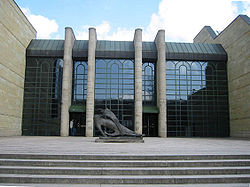
The building was redeveloped in the late 20th century. Designed by architect Alexander von Branca in the new style of Postmodernism, the building opened in 1981. It combines a concrete construction with a stone facade design.[citation needed]

History

[edit]
Gauguin's The Birth of Christ (1896), which brought Hugo von Tschudi to Munich and became the foundation of the Pinakothek's modern art collection.

Ludwig I of Bavaria began to collect contemporary art already as crown prince in 1809 and his collection was steadily enlarged. When the museum was founded, the separation to the old masters in the Alte Pinakothek was fixed with the period shortly before the turn of the 19th century, which has become a prototype for many galleries.

Owing to the personal preference of Ludwig I, the museum initially had a strong focus on paintings of German Romanticism and the Munich School. Also dynastic considerations played a role, as Greece had become a secundogeniture of Bavaria in 1832. In 1834 Carl Rottmann traveled to Greece to prepare for a commission from Ludwig I for a cycle of great Greek landscapes. These works were installed in the Neue Pinakothek, where the paintings were given their own hall.

The so-called Tschudi Contribution between 1905 and 1914 brought the Pinokathek an extraordinary collection of masterpieces of Impressionism and Post-Impressionism. Hugo von Tschudi was dismissed by Wilhelm II, German Emperor as a penalty for his exhibiting of Gauguin's The Birth of Christ in Berlin's National Gallery. He became the director of the Pinokathek. As general director of the State Collections, Tschudi acquired 44 paintings, nine sculptures, and 22 drawings, mostly from emerging French artists. Since public funds could not be used to purchase these works, Tschudi’s associates raised the money from private contributions after his death in 1911.

The space dedicated to painters of the Modernity was fixed at ca. 1900 by including Henri Matisse and Expressionism. Consequentially a painting of Matisse, which was part of the "Tschudi Contribution" ,is now displayed in the Pinakothek der Moderne.

In 1915, the Neue Pinakothek became the property of Bavaria. In 1938 the Nazi regime under Adolf Hitler confiscated a self-portrait of Vincent van Gogh, classifying the paintings as degenerate art.

Renovations

[edit]

Since January 2019 the Neue Pinakothek has been closed for renovations.[3] Originally, it was planned for the building to remain closed at least until 2025.[4][5] The opening of the museum to visitors was delayed until 2029 in January 2022.[6][7]

Collection

[edit]

The museum is under supervision of the Bavarian State Painting Collections, which houses an expanded collection of more than 3.000 European paintings from classicism to Art Nouveau. About 400 paintings and 50 sculptures of these are exhibited in the New Pinakothek.

Francisco de Goya, Plucked Turkey (1810).
  • International paintings of the second half of the 18th century:
Among others the gallery exhibits works of Francisco de Goya (Plucked Turkey) (Don José Queraltó as a Spanish Army doctor), Jacques-Louis David (Anne-Marie-Louise Thélusson, Comtesse de Sorcy), Johann Friedrich August Tischbein (Nicolas Châtelain in the garden) and Anton Graff (Heinrich XIII, Graf Reuß).
  • English and Scottish paintings of 18th and early 19th centuries:
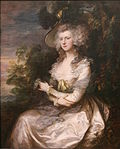
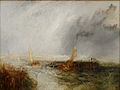
It has masterpieces of Thomas Gainsborough (portraits of Mrs. Thomas Hibbert and of Thomas Hibbert) (Landscape with Shepherd and Flock), William Hogarth (Richard Mounteney), John Constable (View of Dedham Vale from East Bergholt), Joshua Reynolds (Captain Philemon Pownall), David Wilkie (Reading the Will), Thomas Lawrence (The Two Sons of the 1st Earl of Talbot), George Romney (Catherine Clements), Richard Wilson (View of Syon House Across the Thames near Richmond Gardens), Henry Raeburn (Mrs. J. Campbell of Kilberry), George Stubbs (The pointer) and J. M. W. Turner (Ostende). The Pinakothek owns five works by Thomas Gainsborough, more than any other European museum outside the British Isles.
  • German artists of Classicism in Rome
like Friedrich Overbeck (Italia and Germania), Friedrich Wilhelm von Schadow (The Holy Family beneath the Portico), Heinrich Maria von Hess (Marchesa Marianna Florenzi), Peter von Hess (The Entry of King Othon of Greece into Nauplia) and Peter von Cornelius (The three Marys at the Tomb).
with paintings of Caspar David Friedrich (The Garden Bower), Karl Friedrich Schinkel (Cathedral Towering over a Town), Carl Blechen (Building of the Devil's Bridge) and others.
Carl Spitzweg The Poor Poet 1839
represented by Franz Xaver Winterhalter (Graf Jenison-Walworth), Carl Spitzweg (The Poor Poet), Moritz von Schwind (A Symphony) and Ferdinand Georg Waldmüller (Young Peasant Woman with Three Children at the Window).
with Eugène Delacroix (Clorinda Rescues Olindo and Sophronia), Théodore Géricault (Artillery Train Passing a Ravine), Gustave Courbet (Landscape near Maizières), Jean-François Millet (Farmer Inserting a Graft on a Tree), Honoré Daumier (The Drama) and others.
  • Deutschrömer (or German-Romans)
such as Hans von Marées (Self-Portrait), Arnold Böcklin (Pan in the Reeds), Anselm Feuerbach (Medea) and Hans Thoma (Landscape in the Taunus).
  • History paintings
with Wilhelm von Kaulbach ( King Ludwig I surrounded by artists), Karl Theodor von Piloty (Seni and Wallenstein), Franz von Defregger (Das letzte Aufgebot) and Hans Makart (Die Falknerin).
  • German Realism
like Wilhelm Leibl (Portrait of Frau Gedon), Franz von Lenbach (Aresing Village Street) and Adolph Menzel (Living-Room with the Artist's Sister).
  • German Impressionists
especially Max Liebermann (Boys Bathing), Lovis Corinth (Eduard, Count von Keyserling), August von Brandis (Durchblick) and Max Slevogt (The Day's Work Done).
Édouard Manet Luncheon in the Studio 1868.
  • French Impressionists
One of the world's leading collections with masterpieces of Pierre-Auguste Renoir (Portrait of a Young Woman), Édouard Manet (Luncheon in the Studio) (Monet Painting on His Studio Boat), Claude Monet (The Bridge at Argenteuil), Paul Cézanne (The Railway Cutting), Paul Gauguin (The Birth - Te tamari no atua), Edgar Degas (Woman Ironing), Camille Pissarro (Street in Upper Norwood), Alfred Sisley (The Road to Hampton Court), Paul Sérusier (The Laundresses) and Vincent van Gogh (Sunflowers) (The Weaver).
  • Symbolism and Art Nouveau and early 20th century
represented among others by Giovanni Segantini (L'aratura), Gustav Klimt (Margaret Stonborough-Wittgenstein), Paul Signac (S.Maria della Salute), Maurice Denis (Gaulish Goddess of Herds and Flocks), Henri de Toulouse-Lautrec (Le jeune Routy à Céleyran), James Ensor (Still Life in the Studio), Édouard Vuillard (Café Scene), Ferdinand Hodler (Tired of Life), Franz von Stuck (The Sin), Edvard Munch (Woman in Red Dress (Street in Aasgaardstrand)), Walter Crane (Neptune's horses), Thomas Austen Brown (Mademoiselle Plume rouge), Pierre Bonnard (Lady at the Mirror) and Egon Schiele (Agony).
  • Sculptures
Also sculptures of the 19th century are exhibited, for example works of Bertel Thorvaldsen (Adonis), Antonio Canova (Paris), Rudolph Schadow (Woman Tying Her Sandal), Auguste Rodin (Crouching Woman (La femme accroupie)), Max Klinger (Elsa Asenijeff), Aristide Maillol (La Flore), Pablo Picasso (Le Fou) and others.
[edit]

References

[edit]
[edit]
Revisions and contributorsEdit on WikipediaRead on Wikipedia
from Grokipedia
The Neue Pinakothek is an art museum located in Munich, Germany, specializing in European paintings and sculptures of the 19th century, spanning styles from Neoclassicism and Romanticism to Impressionism and Art Nouveau. Commissioned by King Ludwig I of Bavaria and opened to the public in 1853, it was established as Europe's first museum dedicated to contemporary art, designed to foster a dialogue between modern works and the Old Masters housed in the adjacent Alte Pinakothek. The original structure, planned by architects Friedrich Gärtner and August von Voit, was destroyed during World War II; it was subsequently rebuilt in a modern architectural style by Alexander von Branca and reopened in 1981, with its interior spaces noted for optimal natural lighting and spatial variety. The collection, drawn initially from Ludwig I's private holdings and expanded thereafter, includes major works by artists such as J.M.W. Turner, Claude Monet, Édouard Manet, Paul Gauguin, and Vincent van Gogh, reflecting the evolution of artistic movements under the motto "From Turner to van Gogh." Since 2019, the museum has been closed for comprehensive renovation, with a reopening scheduled for 2030; during this period, select 19th-century pieces are exhibited at the Alte Pinakothek and Sammlung Schack.

History

Founding and Early Years

King founded the Neue Pinakothek in the mid- as the first public museum in Europe dedicated exclusively to , aiming to showcase paintings from the 19th century onward separate from the Old Masters housed in the . Ludwig, an avid art patron, initiated the project to display his personal collection of modern works, which he had amassed through purchases emphasizing emerging styles and artists of his era. The museum's establishment reflected Ludwig's broader vision for as a cultural hub, complementing his commissions for other institutions like the and the Alte Pinakothek. Construction of the original building, designed by architects Friedrich von Gärtner and August von Voit, began in the 1840s on a site opposite the in Munich's Kunstareal district. Despite Ludwig's in 1848 amid political unrest, his successor Maximilian II continued the project, leading to the museum's public opening on October 25, 1853. At the inauguration, Ludwig dedicated the institution to "art from this century and beyond," underscoring its forward-looking curatorial focus on living artists and recent innovations rather than historical retrospectives. In its early years, the Neue Pinakothek prioritized acquisitions of German Romantic and Realist works, including pieces by artists like and Ferdinand Piloty, drawn from Ludwig's estate and subsequent purchases at exhibitions. The collection initially comprised around 600 paintings, emphasizing national artists while gradually incorporating international examples to represent evolving European trends up to the late . This approach positioned the museum as a dynamic venue for contemporary discourse, attracting scholars and the public interested in the artistic shifts following the .

Destruction During World War II

The Neue Pinakothek sustained severe damage from Allied air raids during , primarily due to incendiary bombs that ignited widespread fires. The building was first hit during a bombing on the night of April 24–25, 1944, followed by another attack on December 17, 1944, which exacerbated the destruction. These raids gutted much of the interior structure designed by Friedrich von Gärtner and August von Voit, rendering the 1853–1854 edifice largely uninhabitable, though the extent of damage was considered less catastrophic than that inflicted on the adjacent . In the years following the war, the ruins were assessed and deemed beyond economical repair, leading to a decision for complete demolition around 1950. Prior to the bombings, curators had evacuated the collection to secure storage sites outside , ensuring no artworks from the Neue Pinakothek were lost to the destruction. The building's loss highlighted the vulnerability of cultural institutions in wartime urban centers, with experiencing over 70 air raids that devastated approximately 40% of the city's historic fabric.

Post-War Reconstruction and 1981 Reopening

The original Neue Pinakothek, constructed between 1849 and 1854 under King Ludwig I and designed by architects Friedrich von Gärtner and August von Voit, suffered severe damage during Allied bombing raids in , rendering it a ruin that was subsequently demolished in the post-war period due to structural irreparability. In the immediate aftermath, the site's artworks were stored securely, preserving the collection while reconstruction debates ensued amid broader efforts to restore Munich's cultural infrastructure. By 1966, the Bavarian state government initiated an architectural competition to design a replacement, selecting Alexander von Branca's Postmodern proposal, which blended construction with a stone facade evoking historical forms while prioritizing functional gallery spaces. Political influences modified the initial 1966 plan, emphasizing durability and adaptability for 19th-century paintings, with the structure organized around two inner courtyards in a figure-eight layout and featuring natural lighting optimized for displays. Construction proceeded over the ensuing decade at a cost of approximately 44 million U.S. dollars (equivalent to about 150 million in 2023 terms), reflecting West Germany's post-war economic recovery priorities. The rebuilt Neue Pinakothek officially reopened to the public on July 4, 1981, housing the intact Bavarian State Picture Collection of European art from circa 1780 to 1910, including works by artists such as Claude Monet and Paul Gauguin. While the interior galleries received acclaim for their illumination and spatial flow—described as among Germany's finest post-war museum environments—the exterior drew criticism for its eclectic historicist quotations, earning the derisive nickname "picture castle" from detractors who viewed it as an incongruous reinforced-concrete edifice amid Munich's classical ensembles. This reconstruction marked a deliberate departure from modernist austerity, prioritizing contextual harmony with the adjacent Alte Pinakothek over strict fidelity to the 19th-century original.

Renovations from 2018 Onward

The Neue Pinakothek closed to the public on December 31, 2018, following the identification of structural deficiencies, including roof leaks exacerbated by heavy rainfall that year, necessitating a comprehensive general to address outdated , climate control, and security systems, as well as removal. The closure, effective from January 1, 2019, was prompted by the building's aging infrastructure from the 1981 reconstruction, which had become inadequate for modern museum standards despite prior maintenance efforts. During this period, conservators conducted a thorough examination of the entire collection, including works from the Sammlung Schack, between 2018 and 2019 to ensure preservation prior to the overhaul. The renovation project, planned since 2016 by British architects Caruso St John in collaboration with German firm Hild und K, encompasses the refurbishment and reorganization of the 28,000 m² facility to enhance sustainability, exhibition spaces, and visitor accessibility while preserving the building's postmodern character. Preparatory works commenced in summer , focusing on compliance with current fire and safety regulations, but full on-site construction, including the erection of a massive temporary protective roof to create an enclosed workspace, began in 2025. The scope prioritizes structural integrity and energy efficiency without altering the core architectural envelope, aiming to reintegrate the museum's focus on 19th-century European art upon completion. Originally slated for reopening in 2025, the timeline has extended due to the complexity of integrating advanced climate systems and calibrating exhibition environments, with handover of the building projected for early 2029 and full operations by the end of that year or into 2030. Bernhard Maaz, director general of the Bayerische Staatsgemäldesammlungen, expressed confidence in the revised schedule, drawing parallels to successful long-term renovations in and , while noting potential minor delays in final technical adjustments. In the interim, select masterpieces from the collection continue to be displayed at the ground floor of the and the Sammlung Schack, maintaining public access to key 19th-century works.

Architecture

Original 19th-Century Design

The original Neue Pinakothek was commissioned by King Ludwig I of Bavaria as the first public museum in Europe dedicated exclusively to contemporary art of the 19th century. Designed primarily by court architect Friedrich von Gärtner, with completion overseen by August von Voit following Gärtner's death in 1847, the structure embodied the Rundbogenstil—a historicist style blending Romanesque, Byzantine, and early Renaissance elements through rounded arches, robust forms, and restrained ornamentation suited to institutional functions. This approach reflected Gärtner's advocacy for a national German architectural idiom, prioritizing functionality and light-filled interiors over classical pediments. Construction commenced with the foundation stone laid on October 12, 1846—coinciding with Ludwig's wedding anniversary—and the building was substantially completed by 1853, opening to the public shortly thereafter. Positioned opposite the across Barer Straße in Munich's Maxvorstadt district, the design facilitated visual and conceptual dialogue between old master and modern works, with a symmetrical facade featuring pilasters, arched windows for natural illumination, and a central emphasizing accessibility. Internally, the layout comprised sequential galleries optimized for sequential viewing of paintings and sculptures, incorporating skylights and neutral walls to highlight artworks without overwhelming decoration—a progressive feature for mid-19th-century . The edifice's modest scale and practical aesthetic contrasted with more grandiose contemporary projects like , prioritizing art display over monumental symbolism; its destruction in underscored the vulnerabilities of such purpose-built structures amid urban bombing. Funded largely from Ludwig's private resources, the project exemplified royal patronage's role in advancing public cultural institutions during Bavaria's era of cultural flourishing.

1981 Postmodern Reconstruction

The Neue Pinakothek's 1981 reconstruction replaced the original 19th-century structure destroyed during bombings, with the new building designed by architect Alexander von Branca and opened to the public on July 5, 1981. Branca's design adopted a postmodern style, blending modern concrete construction with a stone facade that incorporated historical stylistic references, such as pilasters and cornices, to evoke the museum's neoclassical heritage while prioritizing functionality for art display. The structure consists of two interconnected sections: a rectangular wing with spacious, naturally lit galleries featuring fabric-covered walls in muted tones and vaulted ceilings with subtle historicizing moldings, and an adjacent administrative block for offices and restoration workshops. Emphasis was placed on optimal daylighting through extensive skylights and windows, allowing even illumination for 19th-century paintings without direct sunlight damage, a informed by conservation needs and visitor experience. The project cost approximately 80 million Deutsche Marks (equivalent to about $44 million USD at the time) and spanned from 1977 to 1981. While the interiors received praise for their serene, picture-friendly ambiance, the exterior faced criticism for its eclectic postmodern quotations of classical elements, which some viewed as incongruous against Munich's historic fabric. Branca defended the approach as a deliberate rejection of stark , aiming instead for a building that harmonizes contextually without literal reconstruction. The design facilitated flexible gallery layouts, accommodating around 400 works from the collection while integrating modern amenities like climate control.

Planned 2030 Renovation Features

The renovation project, directed by Caruso St John Architects in association with Hild und K Architekten, entails a fundamental overhaul of the museum's roughly 30,000 square meters to align with modern international benchmarks for exhibitions, restoration, scholarly , and educational programming. Central technical upgrades address longstanding issues, including the replacement of permeable roofs and a wholesale replacement of obsolete building systems to boost energy efficiency and operational reliability. Sustainability is prioritized through energy-optimized infrastructure, while enhancements to protocols, barrier-free access provisions, and the structural integrity of the postwar reconstruction ensure compliance with current regulations without compromising the site's heritage value. Preservation measures during construction feature a vast temporary enveloping the edifice, shielding both the and relocated artworks from environmental hazards and enabling phased interior reconfiguration. Spatial reorganization will refine gallery layouts for improved circulation and thematic presentation of 19th-century holdings, supported by digital planning tools like and methodologies to minimize disruptions and control timelines.

Collection

Scope and Curatorial Focus

The Neue Pinakothek's permanent collection focuses on European paintings and sculptures produced between the late 18th and early 20th centuries, roughly spanning 1780 to 1910, with principal emphasis on 19th-century developments from and through Realism and to . This chronological and stylistic scope positions the museum as a dedicated survey of the period's artistic transitions, complementing the Alte Pinakothek's earlier holdings and the Pinakothek der Moderne's later ones within the Bavarian State Painting Collections. The holdings include over 3,300 paintings alongside sculptures, , and photographs, prioritizing oil paintings that capture evolving techniques and themes such as , portraiture, and historical subjects. Curatorial decisions underscore a balanced representation of national schools, with robust German holdings—featuring artists like , Moritz von Schwind, and —alongside French Impressionists (e.g., , ), British landscapists (e.g., ), and Spanish masters (e.g., ). This approach reflects the institution's founding intent under King Ludwig I to showcase contemporary European art as a living tradition, rather than antiquarian relics, fostering displays that trace causal influences like industrialization and on artistic expression. Exhibitions typically arrange works thematically or by school to highlight interconnections, such as the shift from idealized to subjective , while integrating select sculptures to contextualize painterly innovations in three dimensions. The curatorial framework also incorporates ongoing acquisitions and loans to address gaps, such as underrepresented Symbolist or early modernist phases, ensuring the collection remains a dynamic resource for studying empirical trends in medium, , and stylistic rupture over the long . This focus avoids overemphasis on any single ideology, privileging verifiable artistic lineages supported by provenance records and technical analyses from the Doerner Institute.

Key Artists, Works, and Acquisitions

The Neue Pinakothek houses approximately 400 paintings and sculptures spanning European art from the late 18th to early 20th centuries, emphasizing , , Realism, , and early . Key holdings include works acquired during its founding under King , who commissioned purchases and exchanges to complement the Alte Pinakothek's Old Masters, alongside later additions through Bavarian state collections. Prominent Neoclassical and Romantic artists represented include , with his portrait Anne-Marie-Louise Thélusson, Comtesse de Sorcy (1790), exemplifying refined aristocratic portraiture; Francisco de Goya, featuring Don José Queraltó as a Doctor (ca. 1814–1815), which captures wartime realism; and , whose Clorinda Rescues Olindo and Sophronia (1856) embodies dynamic Romantic narrative drama. British contributions feature 's Mrs. Thomas Hibbert (1784), noted for its elegant landscape integration. is highlighted by 's genre scenes, such as everyday Bavarian life depictions, and Peter von Hess's historical painting The Entry of King into (1839), commemorating Greek independence. In Realism and , the collection showcases Honoré Daumier's Don Quichotte and (ca. 1868–1872), a satirical take on Cervantes; Édouard Manet's works reflecting modern urbanity; and Claude Monet's The Bridge at (1874), illustrating early plein-air techniques and light effects on the . Post-Impressionist highlights encompass Paul Cézanne's The Railway Cutting (ca. 1870), pioneering structural composition; Paul Gauguin's Te Tamari No Atua (Son of God) (1896), a Tahitian acquired through 19th-century exchanges; Max Liebermann's Boys Bathing (1890), blending with social observation; Henri de Toulouse-Lautrec's intimate portraits like Le Jeune Routy à Céleyran; and Edvard Munch's Woman in Red Dress (Street in Åsgårdstrand) (1902–1903), evoking psychological tension. Sculptural acquisitions include Bertel Thorvaldsen's neoclassical Head of a (ca. 1812) and Auguste Rodin's expressive Man with Broken Nose (ca. 1863). Notable acquisitions reflect ongoing state efforts, though recent additions prioritize the broader Bayerische Staatsgemäldesammlungen; historical builds under Ludwig I included targeted purchases of French and German works post-1811, with post-war reconstructions reintegrating dispersed items verified through research. The collection's strength lies in its balanced representation of national schools, avoiding overemphasis on any single movement, as evidenced by loans and temporary displays during the 2018–2030 renovation.

Reception and Impact

Achievements and Cultural Significance

The Neue Pinakothek represents a landmark achievement in as the first public institution in dedicated exclusively to , founded in 1853 by King to showcase works from his era alongside classical influences. This forward-thinking curatorial model emphasized dialogue between living artists and historical precedents, setting a precedent for modern galleries to engage with evolving aesthetics rather than solely venerating antiquity. Ludwig's dedication of the to "art from this century and beyond" underscored its role in democratizing access to recent cultural production, fostering early public discourse on artistic progress amid 19th-century industrialization and nationalism. Culturally, the museum's significance stems from its comprehensive holdings of over 800 paintings and sculptures spanning , , Realism, and early , including seminal pieces like Vincent van Gogh's Sunflowers and Claude Monet's Water Lilies, which illuminate Europe's stylistic transitions and thematic preoccupations. By prioritizing German Romantics such as alongside French Impressionists like , it provides empirical evidence of cross-national influences, challenging insular national narratives and highlighting causal links between political upheavals—like the and Greek independence—and artistic expression. This focus has positioned the Neue Pinakothek as a vital scholarly resource for tracing 19th-century art's evolution, with its Bavarian royal origins ensuring a depth of provenance that rivals major international collections. Ongoing achievements include strategic acquisitions and donations, such as 20th-century extensions that bridge to while reinforcing core 19th-century strengths, as seen in recent additions securing works against market dispersal. Integrated within Munich's Pinakothek , it contributes to a microcosmic survey of European , drawing sustained academic and public engagement that underscores Bavaria's custodianship of amid post-1945 recoveries. Its enduring impact lies in sustaining causal realism in art interpretation—prioritizing verifiable artistic intents and historical contexts over interpretive overlays—thus advancing truth-seeking appreciation of the period's empirical innovations in .

Criticisms, Controversies, and Debates

The 1981 reconstruction of the Neue Pinakothek by architect Alexander von Branca drew substantial criticism for its postmodern aesthetic, characterized by overt quotations of historical forms and styles that many contemporaries deemed incongruous and overly eclectic for a museum housing 19th-century art. Critics labeled the facade pejoratively as a mishmash, arguing it undermined the building's functional role in displaying paintings through excessive ornamental references, marking it as West Germany's first major postmodern project and fueling broader architectural debates on versus in postwar reconstruction. In 2025, the Bayerische Staatsgemäldesammlungen—which administers the Neue Pinakothek—faced intense scrutiny over its research into Nazi-looted art, following a report on February 20 revealing internal documents listing around 200 works across its holdings as potentially looted during the Nazi era, with allegations of suppressed findings and inadequate transparency in restitution processes. The ensuing controversy prompted Bavarian authorities to pledge accelerated investigations and public disclosure, yet critics, including experts, contended that systemic delays—evident in only a handful of restitutions despite decades of claims—reflected institutional reluctance to confront historical acquisitions tied to persecution. The scandal escalated in April 2025 with the resignation of director Bernhard Maaz, amid state prosecutor investigations into alleged organizational failures and misconduct in handling claims, including failures to promptly notify heirs. By September 2025, four works were restituted to rightful owners, but debates persisted over the balance between ethical restitution imperatives and legal defenses, with one pending case referred to under new Bavarian guidelines for Nazi-era claims. Additionally, the collections' display of National Socialist-era artworks, such as the 1937 triptych The Four Elements by Hermann Otto Hoyer in related exhibitions, has provoked debate on whether such pieces serve educational purposes by illustrating regime or risk aestheticizing ideology without sufficient critical framing.

References

Add your contribution
Related Hubs
User Avatar
No comments yet.