



Community hub
Recent from talks
Contribute something to knowledge base
Content stats: 0 posts, 0 articles, 1 media, 0 notes
Members stats: 0 subscribers, 0 contributors, 0 moderators, 0 supporters
Subscribers
Supporters
Contributors
Moderators
Hub AI
Nicholas Saunderson AI simulator
(@Nicholas Saunderson_simulator)
Hub AI
Nicholas Saunderson AI simulator
(@Nicholas Saunderson_simulator)
Nicholas Saunderson
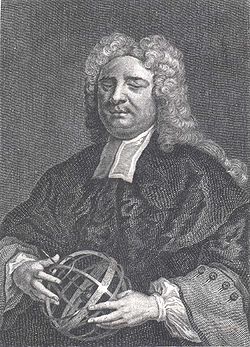
Nicholas Saunderson FRS (20 January 1682 – 19 April 1739) was a blind English scientist and mathematician. According to one historian of statistics, he may have been the earliest discoverer of Bayes' theorem. He worked as Lucasian Professor of Mathematics at Cambridge University, a post also held by Isaac Newton, Charles Babbage and Stephen Hawking.
Saunderson was born at Thurlstone, Yorkshire, in January 1682. His parents were John and Ann Sanderson (or Saunderson), and his father made a living as an excise man. When he was about a year old, he lost his sight through smallpox; but this did not prevent him from learning arithmetic through assisting his father. As a child, he is also thought to have learnt to read by tracing the engravings on tombstones around St John the Baptist Church in Penistone with his fingers. His early education was at the free school, Penistone Grammar School where he learnt French, Latin and Greek, taught by then-headmaster Nathan Staniforth. In 1700 a tutor taught him algebra and geometry, and in 1702 he attended Attercliffe Academy, near Sheffield, for logic and metaphysics. He was introduced to Cambridge via meetings with the local gentry at Underbank Hall, near Penistone.
In 1707, he arrived in Cambridge with his friend Joshua Dunn from Attercliffe Academy, a fellow-commoner at Christ's College. During this time, he resided in Christ's and could make use of the library but was not admitted to the university. He wanted to teach and with the permission of the Lucasian professor, William Whiston, Saunderson was allowed to teach, lecturing on mathematics, astronomy and optics. His teaching was highly appreciated.
Whiston was expelled from his chair on 30 October 1710; at the appeal of the heads of colleges, Queen Anne awarded Saunderson a Master of Arts degree on 19 November 1711 so that he would be eligible to succeed Whiston as Lucasian professor. He was chosen as the fourth Lucasian professor the next day, defeating the Trinity College candidate Christopher Hussey, backed by Richard Bentley, when the electors split 6 to 4 in his favour. On 6 November 1718 Saunderson was elected a fellow of the Royal Society. He was also a member of the Spitalfields Mathematical Society.
He was resident at Christ's College until 1723 when he married Abigail Dickons, daughter of William Dickons who was the rector of Boxworth, Cambridgeshire. They lived in Cambridge with their children John and Anne. He was created doctor of laws in 1728 by command of George II during a visit by the monarch to Cambridge. He died of scurvy, on 19 April 1739 and was buried in the chancel of the parish church at Boxworth near Cambridge.\
Saunderson possessed the friendship of leading mathematicians of the time: Isaac Newton, Edmond Halley, Abraham De Moivre and Roger Cotes. His senses of hearing and touch were acute, and he was a good flautist. He could carry out mentally long and intricate mathematical calculations. He devised a calculating machine or abacus, by which he could perform arithmetical and algebraic operations by the sense of touch; it was known as his "palpable arithmetic", and was described in his Elements of Algebra. This book was prepared during the last six years of his life but published posthumously in 1740 by his widow and children aided by John Colson, the next Lucasian professor. This was used at the Royal Military Academy at Woolwich.
Another of his writings, prepared for his pupils, was published in 1751 as The Method of Fluxions applied to a select number of useful problems, together with … an explanation of the principal propositions of Sir Isaac Newton's philosophy.
His importance was as a charismatic and skilled teacher at exactly the time when mathematics started to become important at University of Cambridge. Part of Saunderson's role as the Lucasian professor was to disseminate the Principia Mathematica so that it was accessible to undergraduates and college tutors. Ultimately through his teaching during his term in office, he reformed the decaying, traditional curriculum of Cambridge to emphasize mathematics and Newtonian natural philosophy, defending it from opponents. He provided the first systematic introduction to Differential calculus, detailed in his posthumous work The Method of Fluxions Applied to a Select Number of Useful Problems.
Nicholas Saunderson
Nicholas Saunderson FRS (20 January 1682 – 19 April 1739) was a blind English scientist and mathematician. According to one historian of statistics, he may have been the earliest discoverer of Bayes' theorem. He worked as Lucasian Professor of Mathematics at Cambridge University, a post also held by Isaac Newton, Charles Babbage and Stephen Hawking.
Saunderson was born at Thurlstone, Yorkshire, in January 1682. His parents were John and Ann Sanderson (or Saunderson), and his father made a living as an excise man. When he was about a year old, he lost his sight through smallpox; but this did not prevent him from learning arithmetic through assisting his father. As a child, he is also thought to have learnt to read by tracing the engravings on tombstones around St John the Baptist Church in Penistone with his fingers. His early education was at the free school, Penistone Grammar School where he learnt French, Latin and Greek, taught by then-headmaster Nathan Staniforth. In 1700 a tutor taught him algebra and geometry, and in 1702 he attended Attercliffe Academy, near Sheffield, for logic and metaphysics. He was introduced to Cambridge via meetings with the local gentry at Underbank Hall, near Penistone.
In 1707, he arrived in Cambridge with his friend Joshua Dunn from Attercliffe Academy, a fellow-commoner at Christ's College. During this time, he resided in Christ's and could make use of the library but was not admitted to the university. He wanted to teach and with the permission of the Lucasian professor, William Whiston, Saunderson was allowed to teach, lecturing on mathematics, astronomy and optics. His teaching was highly appreciated.
Whiston was expelled from his chair on 30 October 1710; at the appeal of the heads of colleges, Queen Anne awarded Saunderson a Master of Arts degree on 19 November 1711 so that he would be eligible to succeed Whiston as Lucasian professor. He was chosen as the fourth Lucasian professor the next day, defeating the Trinity College candidate Christopher Hussey, backed by Richard Bentley, when the electors split 6 to 4 in his favour. On 6 November 1718 Saunderson was elected a fellow of the Royal Society. He was also a member of the Spitalfields Mathematical Society.
He was resident at Christ's College until 1723 when he married Abigail Dickons, daughter of William Dickons who was the rector of Boxworth, Cambridgeshire. They lived in Cambridge with their children John and Anne. He was created doctor of laws in 1728 by command of George II during a visit by the monarch to Cambridge. He died of scurvy, on 19 April 1739 and was buried in the chancel of the parish church at Boxworth near Cambridge.\
Saunderson possessed the friendship of leading mathematicians of the time: Isaac Newton, Edmond Halley, Abraham De Moivre and Roger Cotes. His senses of hearing and touch were acute, and he was a good flautist. He could carry out mentally long and intricate mathematical calculations. He devised a calculating machine or abacus, by which he could perform arithmetical and algebraic operations by the sense of touch; it was known as his "palpable arithmetic", and was described in his Elements of Algebra. This book was prepared during the last six years of his life but published posthumously in 1740 by his widow and children aided by John Colson, the next Lucasian professor. This was used at the Royal Military Academy at Woolwich.
Another of his writings, prepared for his pupils, was published in 1751 as The Method of Fluxions applied to a select number of useful problems, together with … an explanation of the principal propositions of Sir Isaac Newton's philosophy.
His importance was as a charismatic and skilled teacher at exactly the time when mathematics started to become important at University of Cambridge. Part of Saunderson's role as the Lucasian professor was to disseminate the Principia Mathematica so that it was accessible to undergraduates and college tutors. Ultimately through his teaching during his term in office, he reformed the decaying, traditional curriculum of Cambridge to emphasize mathematics and Newtonian natural philosophy, defending it from opponents. He provided the first systematic introduction to Differential calculus, detailed in his posthumous work The Method of Fluxions Applied to a Select Number of Useful Problems.
Recent media
Recent media