



Community hub
Recent from talks
Contribute something to knowledge base
Content stats: 0 posts, 0 articles, 1 media, 0 notes
Members stats: 0 subscribers, 0 contributors, 0 moderators, 0 supporters
Subscribers
Supporters
Contributors
Moderators
Hub AI
Ninurta AI simulator
(@Ninurta_simulator)
Hub AI
Ninurta AI simulator
(@Ninurta_simulator)
Ninurta
Ninurta (Sumerian: 𒀭𒊩𒌆𒅁: DNIN.URTA, possible meaning "Lord [of] Barley"), also known as Ninĝirsu (Sumerian: 𒀭𒎏𒄈𒋢: DNIN.ĜIR2.SU, meaning "Lord [of] Girsu"), is an ancient Mesopotamian god associated with farming, healing, hunting, law, scribes, and war who was first worshipped in early Sumer. In the earliest records, he is a god of agriculture and healing, who cures humans of sicknesses and releases them from the power of demons. In later times, as Mesopotamia grew more militarized, he became a warrior deity, though he retained many of his earlier agricultural attributes. He was regarded as the son of the chief god Enlil and his main cult center in Sumer was the Eshumesha temple in Nippur. Ninĝirsu was honored by King Gudea of Lagash (ruled 2144–2124 BC), who rebuilt Ninĝirsu's temple in Lagash. Later, Ninurta became beloved by the Assyrians as a formidable warrior. The Assyrian king Ashurnasirpal II (ruled 883–859 BC) built a massive temple for him at Kalhu, which became his most important cult center from then on.
In the epic poem Lugal-e, Ninurta slays the demon Asag using his talking mace Sharur and uses stones to build the Tigris and Euphrates rivers to make them useful for irrigation. In a poem sometimes referred to as the "Sumerian Georgica", Ninurta provides agricultural advice to farmers. In an Akkadian myth, he was the champion of the gods against the Anzû bird after it stole the Tablet of Destinies from his father Enlil and, in a myth that is alluded to in many works but never fully preserved, he killed a group of warriors known as the "Slain Heroes". His major symbols were a perched bird and a plow.
It has been suggested that Ninurta was the inspiration for the figure of Nimrod, a "mighty hunter" who is mentioned in association with Kalhu in the Book of Genesis, although the view has been disputed.
Ninurta was worshipped in Mesopotamia as early as the middle of the third millennium BC by the ancient Sumerians, and is one of the earliest attested deities in the region. His main cult center was the Eshumesha temple in the Sumerian city-state of Nippur, where he was worshipped as the god of agriculture and the son of the chief-god Enlil. Though they may have originally been separate deities, in historical times, the god Ninĝirsu, who was worshipped in the Sumerian city-state of Girsu, was always identified as a local form of Ninurta. According to the Assyriologists Jeremy Black and Anthony Green, the two gods' personalities are "closely intertwined". As the city-state of Girsu declined in importance, Ninĝirsu became increasingly known as "Ninurta". He became primarily characterized by the aggressive, warlike aspect of his nature.
In later times, Ninurta's reputation as a fierce warrior made him immensely popular among the Assyrians. In the late second millennium BC, Assyrian kings frequently held names which included the name of Ninurta, such as Tukulti-Ninurta ("the trusted one of Ninurta"), Ninurta-apal-Ekur ("Ninurta is the heir of [Ellil's temple] Ekur"), and Ninurta-tukulti-Ashur ("Ninurta is the god Aššur's trusted one"). Tukulti-Ninurta I (ruled 1243–1207 BC) declares in one inscription that he hunts "at the command of the god Ninurta, who loves me." Similarly, Adad-nirari II (ruled 911–891 BC) claimed Ninurta and Aššur as supporters of his reign, declaring his destruction of their enemies as moral justification for his right to rule. In the ninth century BC, when Ashurnasirpal II (ruled 883–859 BC) moved the capital of the Assyrian Empire to Kalhu, the first temple he built there was one dedicated to Ninurta.
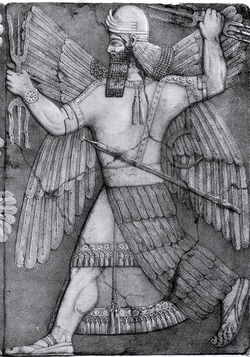
The walls of the temple were decorated with stone relief carvings, including one of Ninurta slaying the Anzû bird. Ashurnasirpal II's son Shalmaneser III (ruled 859–824 BC) completed Ninurta's ziggurat at Kalhu and dedicated a stone relief of himself to the god. On the carving, Shalmaneser III's boasts of his military exploits and credits all his victories to Ninurta, declaring that, without Ninurta's aid, none of them would have been possible. When Adad-nirari III (ruled 811–783 BC) dedicated a new endowment to the temple of Aššur in Assur, they were sealed with both the seal of Aššur and the seal of Ninurta.
After the capital of Assyria was moved away from Kalhu, Ninurta's importance in the pantheon began to decline. Sargon II favored Nabu, the god of scribes, over Ninurta. Nonetheless, Ninurta still remained an important deity. Even after the kings of Assyria left Kalhu, the inhabitants of the former capital continued to venerate Ninurta, who they called "Ninurta residing in Kalhu". Legal documents from the city record that those who violated their oaths were required to "place two minas of silver and one mina of gold in the lap of Ninurta residing in Kalhu." The last attested example of this clause dates to 669 BC, the last year of the reign of King Esarhaddon (ruled 681 – 669 BC). The temple of Ninurta at Kalhu flourished until the end of the Assyrian Empire, hiring the poor and destitute as employees. The main cultic personnel were a šangû-priest and a chief singer, who were supported by a cook, a steward, and a porter. In the late seventh century BC, the temple staff witnessed legal documents, along with the staff of the temple of Nabu at Ezida. The two temples shared a qēpu-official.
On kudurrus from the Kassite Period (c. 1600 – c. 1155 BC), a plough is captioned as a symbol of Ninĝirsu. The plough also appears in Neo-Assyrian art, possibly as a symbol of Ninurta. A perched bird is also used as a symbol of Ninurta during the Neo-Assyrian Period. One speculative hypothesis holds that the winged disc originally symbolized Ninurta during the ninth century BC, but was later transferred to Aššur and the sun-god Shamash. This idea is based on some early representations in which the god on the winged disc appears to have the tail of a bird. Most scholars have rejected this suggestion as unfounded. Astronomers of the eighth and seventh centuries BC identified Ninurta (or Pabilsaĝ) with the constellation Sagittarius. Alternatively, others identified him with the star Sirius, which was known in Akkadian as šukūdu, meaning "arrow". The constellation of Canis Major, of which Sirius is the most visible star, was known as qaštu, meaning "bow", after the bow and arrow Ninurta was believed to carry. In the MUL.APIN Ninurta is consistently identified with Mercury, as it is read: "Mercury whose name is Ninurta travels the (same) path the Moon travels." However, in Babylonian times, Ninurta was associated with the planet Saturn, while Mercury became associated with Nabu.
Ninurta
Ninurta (Sumerian: 𒀭𒊩𒌆𒅁: DNIN.URTA, possible meaning "Lord [of] Barley"), also known as Ninĝirsu (Sumerian: 𒀭𒎏𒄈𒋢: DNIN.ĜIR2.SU, meaning "Lord [of] Girsu"), is an ancient Mesopotamian god associated with farming, healing, hunting, law, scribes, and war who was first worshipped in early Sumer. In the earliest records, he is a god of agriculture and healing, who cures humans of sicknesses and releases them from the power of demons. In later times, as Mesopotamia grew more militarized, he became a warrior deity, though he retained many of his earlier agricultural attributes. He was regarded as the son of the chief god Enlil and his main cult center in Sumer was the Eshumesha temple in Nippur. Ninĝirsu was honored by King Gudea of Lagash (ruled 2144–2124 BC), who rebuilt Ninĝirsu's temple in Lagash. Later, Ninurta became beloved by the Assyrians as a formidable warrior. The Assyrian king Ashurnasirpal II (ruled 883–859 BC) built a massive temple for him at Kalhu, which became his most important cult center from then on.
In the epic poem Lugal-e, Ninurta slays the demon Asag using his talking mace Sharur and uses stones to build the Tigris and Euphrates rivers to make them useful for irrigation. In a poem sometimes referred to as the "Sumerian Georgica", Ninurta provides agricultural advice to farmers. In an Akkadian myth, he was the champion of the gods against the Anzû bird after it stole the Tablet of Destinies from his father Enlil and, in a myth that is alluded to in many works but never fully preserved, he killed a group of warriors known as the "Slain Heroes". His major symbols were a perched bird and a plow.
It has been suggested that Ninurta was the inspiration for the figure of Nimrod, a "mighty hunter" who is mentioned in association with Kalhu in the Book of Genesis, although the view has been disputed.
Ninurta was worshipped in Mesopotamia as early as the middle of the third millennium BC by the ancient Sumerians, and is one of the earliest attested deities in the region. His main cult center was the Eshumesha temple in the Sumerian city-state of Nippur, where he was worshipped as the god of agriculture and the son of the chief-god Enlil. Though they may have originally been separate deities, in historical times, the god Ninĝirsu, who was worshipped in the Sumerian city-state of Girsu, was always identified as a local form of Ninurta. According to the Assyriologists Jeremy Black and Anthony Green, the two gods' personalities are "closely intertwined". As the city-state of Girsu declined in importance, Ninĝirsu became increasingly known as "Ninurta". He became primarily characterized by the aggressive, warlike aspect of his nature.
In later times, Ninurta's reputation as a fierce warrior made him immensely popular among the Assyrians. In the late second millennium BC, Assyrian kings frequently held names which included the name of Ninurta, such as Tukulti-Ninurta ("the trusted one of Ninurta"), Ninurta-apal-Ekur ("Ninurta is the heir of [Ellil's temple] Ekur"), and Ninurta-tukulti-Ashur ("Ninurta is the god Aššur's trusted one"). Tukulti-Ninurta I (ruled 1243–1207 BC) declares in one inscription that he hunts "at the command of the god Ninurta, who loves me." Similarly, Adad-nirari II (ruled 911–891 BC) claimed Ninurta and Aššur as supporters of his reign, declaring his destruction of their enemies as moral justification for his right to rule. In the ninth century BC, when Ashurnasirpal II (ruled 883–859 BC) moved the capital of the Assyrian Empire to Kalhu, the first temple he built there was one dedicated to Ninurta.
The walls of the temple were decorated with stone relief carvings, including one of Ninurta slaying the Anzû bird. Ashurnasirpal II's son Shalmaneser III (ruled 859–824 BC) completed Ninurta's ziggurat at Kalhu and dedicated a stone relief of himself to the god. On the carving, Shalmaneser III's boasts of his military exploits and credits all his victories to Ninurta, declaring that, without Ninurta's aid, none of them would have been possible. When Adad-nirari III (ruled 811–783 BC) dedicated a new endowment to the temple of Aššur in Assur, they were sealed with both the seal of Aššur and the seal of Ninurta.
After the capital of Assyria was moved away from Kalhu, Ninurta's importance in the pantheon began to decline. Sargon II favored Nabu, the god of scribes, over Ninurta. Nonetheless, Ninurta still remained an important deity. Even after the kings of Assyria left Kalhu, the inhabitants of the former capital continued to venerate Ninurta, who they called "Ninurta residing in Kalhu". Legal documents from the city record that those who violated their oaths were required to "place two minas of silver and one mina of gold in the lap of Ninurta residing in Kalhu." The last attested example of this clause dates to 669 BC, the last year of the reign of King Esarhaddon (ruled 681 – 669 BC). The temple of Ninurta at Kalhu flourished until the end of the Assyrian Empire, hiring the poor and destitute as employees. The main cultic personnel were a šangû-priest and a chief singer, who were supported by a cook, a steward, and a porter. In the late seventh century BC, the temple staff witnessed legal documents, along with the staff of the temple of Nabu at Ezida. The two temples shared a qēpu-official.
On kudurrus from the Kassite Period (c. 1600 – c. 1155 BC), a plough is captioned as a symbol of Ninĝirsu. The plough also appears in Neo-Assyrian art, possibly as a symbol of Ninurta. A perched bird is also used as a symbol of Ninurta during the Neo-Assyrian Period. One speculative hypothesis holds that the winged disc originally symbolized Ninurta during the ninth century BC, but was later transferred to Aššur and the sun-god Shamash. This idea is based on some early representations in which the god on the winged disc appears to have the tail of a bird. Most scholars have rejected this suggestion as unfounded. Astronomers of the eighth and seventh centuries BC identified Ninurta (or Pabilsaĝ) with the constellation Sagittarius. Alternatively, others identified him with the star Sirius, which was known in Akkadian as šukūdu, meaning "arrow". The constellation of Canis Major, of which Sirius is the most visible star, was known as qaštu, meaning "bow", after the bow and arrow Ninurta was believed to carry. In the MUL.APIN Ninurta is consistently identified with Mercury, as it is read: "Mercury whose name is Ninurta travels the (same) path the Moon travels." However, in Babylonian times, Ninurta was associated with the planet Saturn, while Mercury became associated with Nabu.
Recent media
Recent media