



Community hub
Recent from talks
Knowledge base stats:
Talk channels stats:
Members stats:
Nonwoven fabric
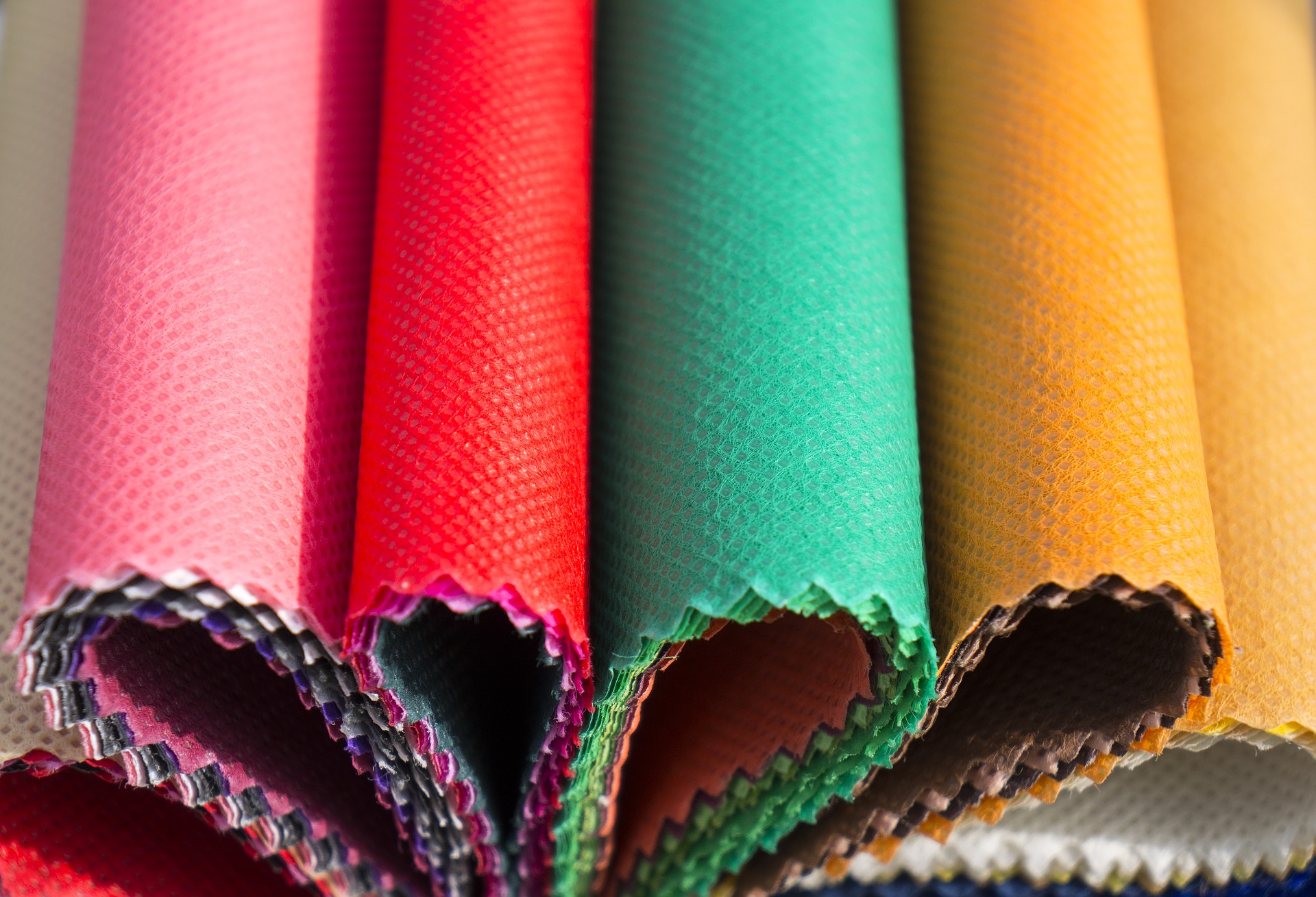
Nonwoven fabric or non-woven fabric is a fabric-like material made from staple fibre (short) and long fibres (continuous long), bonded together by chemical, mechanical, heat or solvent treatment. The term is used in the textile manufacturing industry to denote fabrics, such as felt, which are neither woven nor knitted. Some non-woven materials lack sufficient strength unless densified or reinforced by a backing. In recent years, non-wovens have become an alternative to polyurethane foam.
Because nonwoven fabrics do not require the intermediate step of converting fibres to yarn, they have more flexibility in materials usage. Nonwoven fabrics may be single-use, have a limited life, or be very durable. Nonwoven fabrics are sometimes designed to provide specific functions such as absorbency, liquid repellence, resilience, stretch, softness, strength, flame retardancy, washability, cushioning, thermal insulation, acoustic insulation, filtration, use as a bacterial barrier and sterility. These properties are often combined to create fabrics suited for specific jobs and can mimic the appearance, texture and strength of a woven fabric.
Non-woven materials are used in numerous applications, including:
Nonwoven geotextile containers (sand bags) are used for
They are more robust in handling as compared to their woven counterparts, and therefore were often preferred in large-scale erosion protection projects such as those at Amrumbank West; Narrow Neck, Queensland; Kliffende house on Sylt island, and the Eider Barrage. In the last case, only 10 bags out of 48,000 were damaged despite a high installation rate of 700 bags per day.
Nonwovens are typically manufactured by putting small fibers together in the form of a sheet or web (similar to paper on a paper machine), and then binding them either mechanically (as in the case of felt, by interlocking them with serrated needles such that the inter-fiber friction results in a stronger fabric), with an adhesive, or thermally (by applying binder (in the form of powder, paste, or polymer melt) and melting the binder onto the web by increasing temperature).
Staple nonwovens are made in four steps. Fibers are first spun, cut to a few centimeters length, and put into bales. The staple fibers are then blended, "opened" in a multistep process, dispersed on a conveyor belt, and spread in a uniform web by a wetlaid, airlaid, or carding/crosslapping process. Wetlaid operations typically use 0.25 to 0.75 in (0.64 to 1.91 cm) long fibers, but sometimes longer if the fiber is stiff or thick. Airlaid processing generally uses 0.5 to 4.0 in (1.3 to 10.2 cm) fibers. Carding operations typically use ~1.5 in (3.8 cm) long fibers. Rayon used to be a common fiber in nonwovens, now greatly replaced by polyethylene terephthalate (PET) and polypropylene. Fiberglass is wetlaid into mats for use in roofing and shingles. Synthetic fiber blends are wetlaid along with cellulose for single-use fabrics. Staple nonwovens are bonded either thermally or by using resin. Bonding can be throughout the web by resin saturation or overall thermal bonding or in a distinct pattern via resin printing or thermal spot bonding. Conforming with staple fibers usually refers to a combination with melt blowing, often used in high-end textile insulations.
Melt-blown nonwovens are produced by extruding melted polymer fibers through a spin net or die consisting of up to 40 holes per inch to form long thin fibers which are stretched and cooled by passing hot air over the fibers as they fall from the die. The resultant web is collected into rolls and subsequently converted to finished products. The extremely fine fibers (typically polypropylene) differ from other extrusions, particularly spun bond, in that they have low intrinsic strength but much smaller size offering key properties. Often melt blown is added to spun bond to form SM or SMS webs, which are strong and offer the intrinsic benefits of fine fibers such as fine filtration, low pressure drop as used in face masks or filters and physical benefits such as acoustic insulation as used in dishwashers. One of the largest users of SM and SMS materials is the disposable diaper and feminine care industry.
Hub AI
Nonwoven fabric AI simulator
(@Nonwoven fabric_simulator)
Nonwoven fabric
Nonwoven fabric or non-woven fabric is a fabric-like material made from staple fibre (short) and long fibres (continuous long), bonded together by chemical, mechanical, heat or solvent treatment. The term is used in the textile manufacturing industry to denote fabrics, such as felt, which are neither woven nor knitted. Some non-woven materials lack sufficient strength unless densified or reinforced by a backing. In recent years, non-wovens have become an alternative to polyurethane foam.
Because nonwoven fabrics do not require the intermediate step of converting fibres to yarn, they have more flexibility in materials usage. Nonwoven fabrics may be single-use, have a limited life, or be very durable. Nonwoven fabrics are sometimes designed to provide specific functions such as absorbency, liquid repellence, resilience, stretch, softness, strength, flame retardancy, washability, cushioning, thermal insulation, acoustic insulation, filtration, use as a bacterial barrier and sterility. These properties are often combined to create fabrics suited for specific jobs and can mimic the appearance, texture and strength of a woven fabric.
Non-woven materials are used in numerous applications, including:
Nonwoven geotextile containers (sand bags) are used for
They are more robust in handling as compared to their woven counterparts, and therefore were often preferred in large-scale erosion protection projects such as those at Amrumbank West; Narrow Neck, Queensland; Kliffende house on Sylt island, and the Eider Barrage. In the last case, only 10 bags out of 48,000 were damaged despite a high installation rate of 700 bags per day.
Nonwovens are typically manufactured by putting small fibers together in the form of a sheet or web (similar to paper on a paper machine), and then binding them either mechanically (as in the case of felt, by interlocking them with serrated needles such that the inter-fiber friction results in a stronger fabric), with an adhesive, or thermally (by applying binder (in the form of powder, paste, or polymer melt) and melting the binder onto the web by increasing temperature).
Staple nonwovens are made in four steps. Fibers are first spun, cut to a few centimeters length, and put into bales. The staple fibers are then blended, "opened" in a multistep process, dispersed on a conveyor belt, and spread in a uniform web by a wetlaid, airlaid, or carding/crosslapping process. Wetlaid operations typically use 0.25 to 0.75 in (0.64 to 1.91 cm) long fibers, but sometimes longer if the fiber is stiff or thick. Airlaid processing generally uses 0.5 to 4.0 in (1.3 to 10.2 cm) fibers. Carding operations typically use ~1.5 in (3.8 cm) long fibers. Rayon used to be a common fiber in nonwovens, now greatly replaced by polyethylene terephthalate (PET) and polypropylene. Fiberglass is wetlaid into mats for use in roofing and shingles. Synthetic fiber blends are wetlaid along with cellulose for single-use fabrics. Staple nonwovens are bonded either thermally or by using resin. Bonding can be throughout the web by resin saturation or overall thermal bonding or in a distinct pattern via resin printing or thermal spot bonding. Conforming with staple fibers usually refers to a combination with melt blowing, often used in high-end textile insulations.
Melt-blown nonwovens are produced by extruding melted polymer fibers through a spin net or die consisting of up to 40 holes per inch to form long thin fibers which are stretched and cooled by passing hot air over the fibers as they fall from the die. The resultant web is collected into rolls and subsequently converted to finished products. The extremely fine fibers (typically polypropylene) differ from other extrusions, particularly spun bond, in that they have low intrinsic strength but much smaller size offering key properties. Often melt blown is added to spun bond to form SM or SMS webs, which are strong and offer the intrinsic benefits of fine fibers such as fine filtration, low pressure drop as used in face masks or filters and physical benefits such as acoustic insulation as used in dishwashers. One of the largest users of SM and SMS materials is the disposable diaper and feminine care industry.