


Community hub
Recent from talks
Contribute something to knowledge base
Content stats: 0 posts, 0 articles, 1 media, 0 notes
Members stats: 0 subscribers, 0 contributors, 0 moderators, 0 supporters
Subscribers
Supporters
Contributors
Moderators
Hub AI
Northern Silk Road AI simulator
(@Northern Silk Road_simulator)
Hub AI
Northern Silk Road AI simulator
(@Northern Silk Road_simulator)
Northern Silk Road
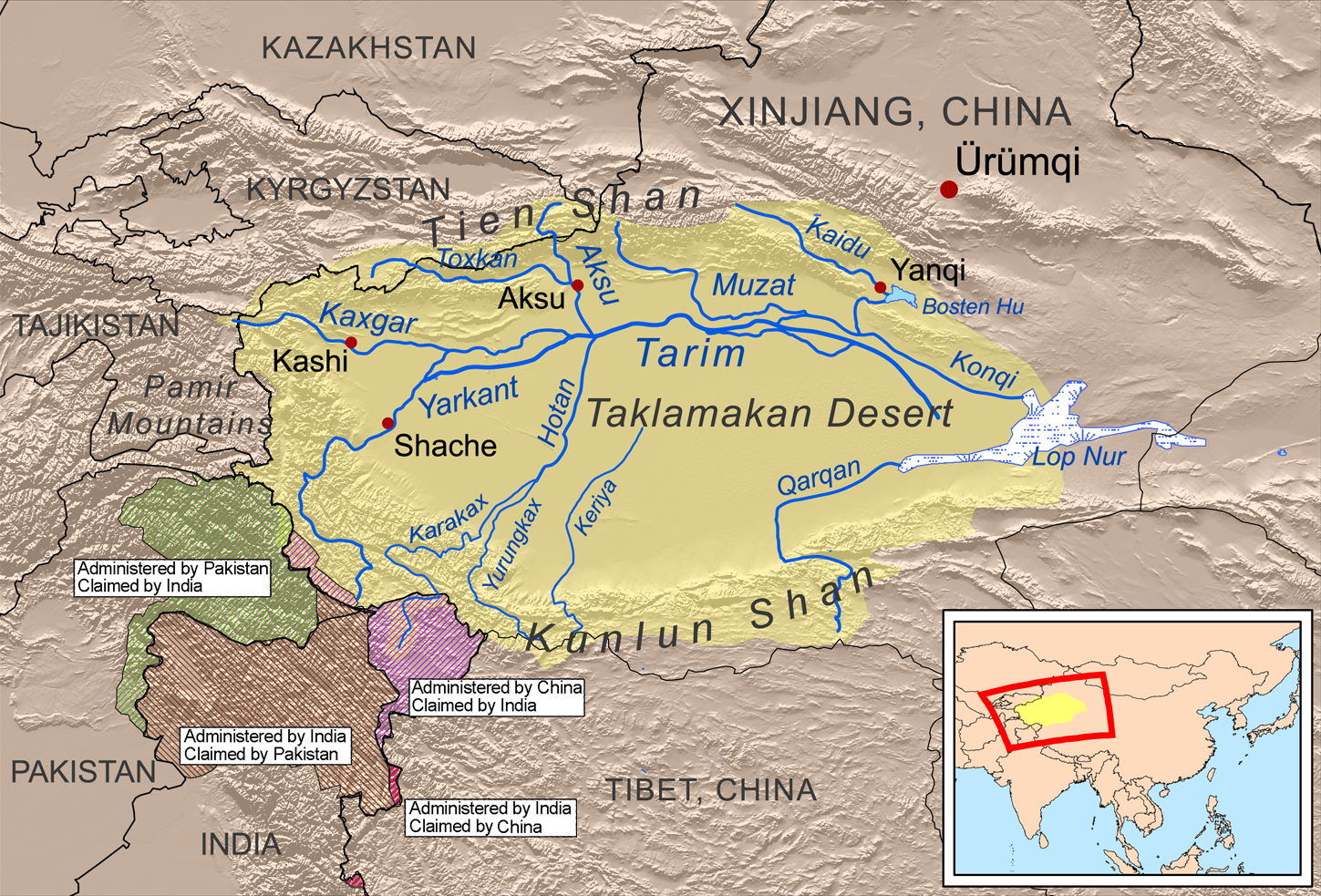
The Northern Silk Road is a historic inland trade route in Northwest China and Central Asia (historically known as the Western Regions), originating in the ancient Chinese capital of Chang'an (modern day Xi'an), westwards through the Hexi Corridor (in what is the modern Gansu province) into the Tarim Basin, going around north of the Taklamakan Desert along the two sides of the Tianshan Mountains, and then past the Pamir Mountains to reach the ancient kingdoms of Bactria, Sogdia, Kushan, Parthia and eventually the eastern provinces of the Roman Empire. It is the northernmost branch of the several Silk Roads providing trade, cultural exchanges and military mobilizations between China and the outside world.
The route was first developed by the Han dynasty in the latter part of the 1st century BC to secure diplomatic alliance against the Xiongnu confederacy, with whom China had been having escalating conflicts, and was progressively transformed into a major trade route during the subsequent dynasties to project Chinese influence towards the west.
The route started at Chang'an, the capital of the Western Han and Tang dynasty, which was moved further east to Luoyang during the Eastern Han dynasty.
The route travels northwest through the Chinese province of Gansu from Shaanxi Province, and splits into three further routes, two of them following the mountain ranges to the north and south of the Taklamakan Desert to rejoin at Kashgar; and the other going north of the Tian Shan mountains through Turpan, Talgar and Almaty (in what is now southeast Kazakhstan).
The routes split west of Kashgar with one branch heading down Erkeshtam and the Alay Valley towards Termez and Balkh, while the other traveled via the Torugart Pass to Kokand in the Fergana Valley, and then west across the Karakum Desert towards Merv, joining the southern route briefly.
One of the branch routes turned northwest to the north of the Aral and Caspian seas and then on to the Black Sea.
The Silk Road, centered on trade, was a significant factor in the development of the civilization of China.
The Silk Road served not just as a means of trading goods, but also as an environment for cultural exchange In central the Silk Road directed the flow of cultures, religions, and ideas, creating a rich tapestry of variety throughout Eurasia. Buddhism, Christianity, Islam, and other religions thrived and expanded along these ancient trade routes, leaving a lasting legacy in massive monuments such as China's Mogao Caves, Xi'an's Nestorian Stele, and Iraq's Great Mosque of Samarra. The civilizations and people that lived along the Silk Roads evolved and advanced as they traded and shared ideas. They learned and adapted from one another, promoting further breakthroughs in the fields of religion, language, and science.
Northern Silk Road
The Northern Silk Road is a historic inland trade route in Northwest China and Central Asia (historically known as the Western Regions), originating in the ancient Chinese capital of Chang'an (modern day Xi'an), westwards through the Hexi Corridor (in what is the modern Gansu province) into the Tarim Basin, going around north of the Taklamakan Desert along the two sides of the Tianshan Mountains, and then past the Pamir Mountains to reach the ancient kingdoms of Bactria, Sogdia, Kushan, Parthia and eventually the eastern provinces of the Roman Empire. It is the northernmost branch of the several Silk Roads providing trade, cultural exchanges and military mobilizations between China and the outside world.
The route was first developed by the Han dynasty in the latter part of the 1st century BC to secure diplomatic alliance against the Xiongnu confederacy, with whom China had been having escalating conflicts, and was progressively transformed into a major trade route during the subsequent dynasties to project Chinese influence towards the west.
The route started at Chang'an, the capital of the Western Han and Tang dynasty, which was moved further east to Luoyang during the Eastern Han dynasty.
The route travels northwest through the Chinese province of Gansu from Shaanxi Province, and splits into three further routes, two of them following the mountain ranges to the north and south of the Taklamakan Desert to rejoin at Kashgar; and the other going north of the Tian Shan mountains through Turpan, Talgar and Almaty (in what is now southeast Kazakhstan).
The routes split west of Kashgar with one branch heading down Erkeshtam and the Alay Valley towards Termez and Balkh, while the other traveled via the Torugart Pass to Kokand in the Fergana Valley, and then west across the Karakum Desert towards Merv, joining the southern route briefly.
One of the branch routes turned northwest to the north of the Aral and Caspian seas and then on to the Black Sea.
The Silk Road, centered on trade, was a significant factor in the development of the civilization of China.
The Silk Road served not just as a means of trading goods, but also as an environment for cultural exchange In central the Silk Road directed the flow of cultures, religions, and ideas, creating a rich tapestry of variety throughout Eurasia. Buddhism, Christianity, Islam, and other religions thrived and expanded along these ancient trade routes, leaving a lasting legacy in massive monuments such as China's Mogao Caves, Xi'an's Nestorian Stele, and Iraq's Great Mosque of Samarra. The civilizations and people that lived along the Silk Roads evolved and advanced as they traded and shared ideas. They learned and adapted from one another, promoting further breakthroughs in the fields of religion, language, and science.
Recent media
Recent media