Hubbry Logo
Northern blotNorthern blotMain
Open search
Northern blot
Community hub
Northern blot
logo
8 pages, 0 posts
0 subscribers
Be the first to start a discussion here.
Contribute something
Northern blot
Northern blot
from Wikipedia
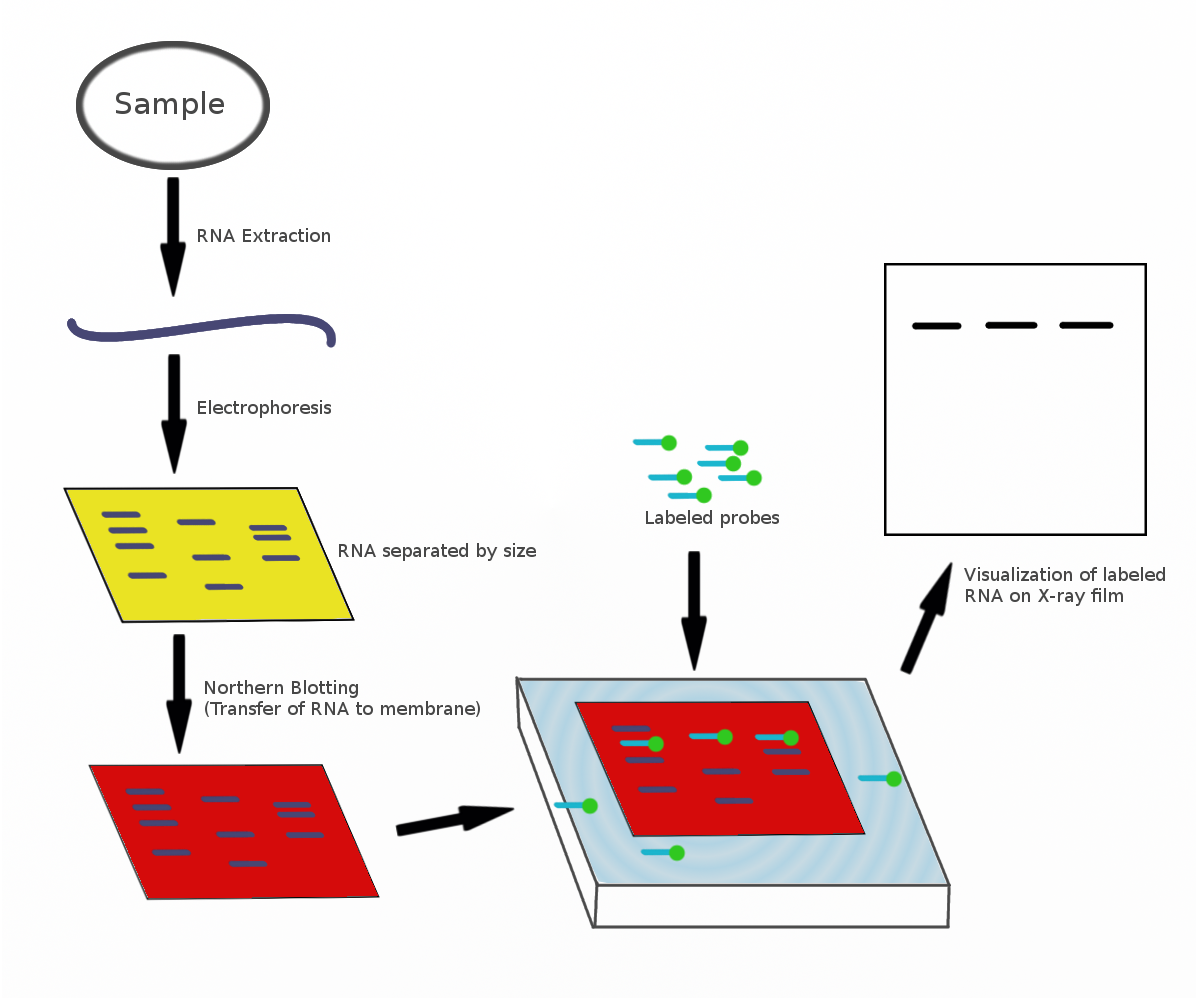
Flow diagram outlining the general procedure for RNA detection by northern blotting.

The northern blot, or RNA blot,[1] is a technique used in molecular biology research to study gene expression by detection of RNA (or isolated mRNA) in a sample.[2][3]

With northern blotting it is possible to observe cellular control over structure and function by determining the particular gene expression rates during differentiation and morphogenesis, as well as in abnormal or diseased conditions.[4] Northern blotting involves the use of electrophoresis to separate RNA samples by size, and detection with a hybridization probe complementary to part of or the entire target sequence. Strictly speaking, the term 'northern blot' refers specifically to the capillary transfer of RNA from the electrophoresis gel to the blotting membrane. However, the entire process is commonly referred to as northern blotting.[5] The northern blot technique was developed in 1977 by James Alwine, David Kemp, and George Stark at Stanford University.[6] Northern blotting takes its name from its similarity to the first blotting technique, the Southern blot, named for biologist Edwin Southern.[2] The major difference is that RNA, rather than DNA, is analyzed in the northern blot.[7]

Procedure

[edit]

A general blotting procedure[5] starts with extraction of total RNA from a homogenized tissue sample or from cells. Eukaryotic mRNA can then be isolated through the use of oligo (dT) cellulose chromatography to isolate only those RNAs with a poly(A) tail.[8][9] RNA samples are then separated by gel electrophoresis. Since the gels are fragile and the probes are unable to enter the matrix, the RNA samples, now separated by size, are transferred to a nylon membrane through a capillary or vacuum blotting system.

Capillary blotting system setup for the transfer of RNA from an electrophoresis gel to a blotting membrane.

A nylon membrane with a positive charge is the most effective for use in northern blotting since the negatively charged nucleic acids have a high affinity for them. The transfer buffer used for the blotting usually contains formamide because it lowers the annealing temperature of the probe-RNA interaction, thus eliminating the need for high temperatures, which could cause RNA degradation.[10] Once the RNA has been transferred to the membrane, it is immobilized through covalent linkage to the membrane by UV light or heat. After a probe has been labeled, it is hybridized to the RNA on the membrane. Experimental conditions that can affect the efficiency and specificity of hybridization include ionic strength, viscosity, duplex length, mismatched base pairs, and base composition.[11] The membrane is washed to ensure that the probe has bound specifically and to prevent background signals from arising. The hybrid signals are then detected by X-ray film and can be quantified by densitometry. To create controls for comparison in a northern blot, samples not displaying the gene product of interest can be used after determination by microarrays or RT-PCR.[11]

Gels

[edit]
RNA run on a formaldehyde agarose gel to highlight the 28S (top band) and 18S (lower band) ribosomal subunits.

The RNA samples are most commonly separated on agarose gels containing formaldehyde as a denaturing agent for the RNA to limit secondary structure.[11][12] The gels can be stained with ethidium bromide (EtBr) and viewed under UV light to observe the quality and quantity of RNA before blotting.[11] Polyacrylamide gel electrophoresis with urea can also be used in RNA separation but it is most commonly used for fragmented RNA or microRNAs.[13] An RNA ladder is often run alongside the samples on an electrophoresis gel to observe the size of fragments obtained but in total RNA samples the ribosomal subunits can act as size markers.[11] Since the large ribosomal subunit is 28S (approximately 5kb) and the small ribosomal subunit is 18S (approximately 2kb) two prominent bands appear on the gel, the larger at close to twice the intensity of the smaller.[11][14]

Probes

[edit]

Probes for northern blotting are composed of nucleic acids with a complementary sequence to all or part of the RNA of interest. They can be DNA, RNA, or oligonucleotides with a minimum of 25 complementary bases to the target sequence.[5] RNA probes (riboprobes) that are transcribed in vitro are able to withstand more rigorous washing steps preventing some of the background noise.[11] Commonly cDNA is created with labelled primers for the RNA sequence of interest to act as the probe in the northern blot.[15] The probes must be labelled either with radioactive isotopes (32P) or with chemiluminescence in which alkaline phosphatase or horseradish peroxidase (HRP) break down chemiluminescent substrates producing a detectable emission of light.[16] The chemiluminescent labelling can occur in two ways: either the probe is attached to the enzyme, or the probe is labelled with a ligand (e.g. biotin) for which the ligand (e.g., avidin or streptavidin) is attached to the enzyme (e.g. HRP).[11] X-ray film can detect both the radioactive and chemiluminescent signals and many researchers prefer the chemiluminescent signals because they are faster, more sensitive, and reduce the health hazards that go along with radioactive labels.[16] The same membrane can be probed up to five times without a significant loss of the target RNA.[10]

Applications

[edit]

Northern blotting allows one to observe a particular gene's expression pattern between tissues, organs, developmental stages, environmental stress levels, pathogen infection, and over the course of treatment.[9][15][17] The technique has been used to show overexpression of oncogenes and downregulation of tumor-suppressor genes in cancerous cells when compared to 'normal' tissue,[11] as well as the gene expression in the rejection of transplanted organs.[18] If an upregulated gene is observed by an abundance of mRNA on the northern blot the sample can then be sequenced to determine if the gene is known to researchers or if it is a novel finding.[18] The expression patterns obtained under given conditions can provide insight into the function of that gene. Since the RNA is first separated by size, if only one probe type is used variance in the level of each band on the membrane can provide insight into the size of the product, suggesting alternative splice products of the same gene or repetitive sequence motifs.[8][14] The variance in size of a gene product can also indicate deletions or errors in transcript processing. By altering the probe target used along the known sequence it is possible to determine which region of the RNA is missing.[2]

Advantages and disadvantages

[edit]

Analysis of gene expression can be done by several different methods including RT-PCR, RNase protection assays, microarrays, RNA-Seq, serial analysis of gene expression (SAGE), as well as northern blotting.[4][5] Microarrays are quite commonly used and are usually consistent with data obtained from northern blots; however, at times northern blotting is able to detect small changes in gene expression that microarrays cannot.[19] The advantage that microarrays have over northern blots is that thousands of genes can be visualized at a time, while northern blotting is usually looking at one or a small number of genes.[17][19]

A problem in northern blotting is often sample degradation by RNases (both endogenous to the sample and through environmental contamination), which can be avoided by proper sterilization of glassware and the use of RNase inhibitors such as DEPC (diethylpyrocarbonate).[5] The chemicals used in most northern blots can be a risk to the researcher, since formaldehyde, radioactive material, ethidium bromide, DEPC, and UV light are all harmful under certain exposures.[11] Compared to RT-PCR, northern blotting has a low sensitivity, but it also has a high specificity, which is important to reduce false positive results.[11]

The advantages of using northern blotting include the detection of RNA size, the observation of alternate splice products, the use of probes with partial homology, the quality and quantity of RNA can be measured on the gel prior to blotting, and the membranes can be stored and reprobed for years after blotting.[11]

For northern blotting for the detection of acetylcholinesterase mRNA the nonradioactive technique was compared to a radioactive technique and found as sensitive as the radioactive one, but requires no protection against radiation and is less time-consuming.[20]

Reverse northern blot

[edit]

Researchers occasionally use a variant of the procedure known as the reverse northern blot. In this procedure, the substrate nucleic acid (that is affixed to the membrane) is a collection of isolated DNA fragments, and the probe is RNA extracted from a tissue and radioactively labelled. The use of DNA microarrays that have come into widespread use in the late 1990s and early 2000s is more akin to the reverse procedure, in that they involve the use of isolated DNA fragments affixed to a substrate, and hybridization with a probe made from cellular RNA. Thus the reverse procedure, though originally uncommon, enabled northern analysis to evolve into gene expression profiling, in which many (possibly all) of the genes in an organism may have their expression monitored.

See also

[edit]

References

[edit]
[edit]
Revisions and contributorsEdit on WikipediaRead on Wikipedia
from Grokipedia
The Northern blot, also known as an RNA blot, is a classical technique used to detect, identify, and quantify specific sequences, such as (mRNA), in a biological sample by separating molecules based on size and hybridizing them with complementary probes. Developed in 1977 by James C. Alwine, David J. Kemp, and George R. Stark at , the method was named as a playful on the earlier technique for DNA, adapting the transfer and hybridization principles to analysis while protecting against degradation by ribonucleases. The procedure begins with the extraction and denaturation of total or mRNA from cells or tissues to prevent secondary , followed by size-based separation via in a denaturing gel, typically containing or to maintain single-stranded . The separated is then transferred (or "blotted") from the gel to a solid support, such as a or membrane, using , , or electroblotting, preserving the 's positional order. Finally, the membrane is hybridized with a labeled probe—often radioactively or enzymatically tagged or complementary to the target sequence—allowing visualization and quantification of the specific through autoradiography, , or detection. Northern blotting has been instrumental in studying gene expression by measuring steady-state levels of transcripts, determining RNA sizes, and identifying alternative splicing variants or processing events, though its sensitivity is limited compared to modern methods like quantitative reverse transcription PCR (qRT-PCR) or RNA sequencing (RNA-seq). Despite these limitations, including labor-intensive steps and requirements for relatively high RNA amounts, the technique remains valuable for validating RNA integrity and providing direct evidence of transcript abundance without amplification biases.

Background and Principle

History

The Northern blot technique was invented in 1977 by James C. Alwine, David J. Kemp, and George R. Stark at Stanford University as an analog to the Southern blot for detecting RNA sequences rather than DNA. Their method involved transferring RNA from agarose gels to diazobenzyloxymethyl-paper for hybridization with labeled probes, enabling specific RNA detection with high sensitivity. This innovation was detailed in their seminal publication in the Proceedings of the that same year, which described the procedure for identifying specific sequences in complex samples through , transfer, and hybridization. The technique emerged amid the burgeoning field of following the revolution of the early 1970s, providing a crucial tool for analysis in an era when direct amplification methods were unavailable. It saw early adoption in the late 1970s and throughout the 1980s as the primary method for studying levels and abundance, particularly before the widespread use of (PCR) technologies in the 1990s. Key milestones included the routine integration of radioactive labeling, such as 32P-labeled probes with autoradiographic detection, which became standard in the 1980s for enhancing sensitivity in studies. By the , safety concerns over radioactive materials drove a shift toward non-radioactive probes, including chemiluminescent detection systems like those using or , which offered comparable sensitivity without radiological hazards.

Underlying Mechanism

The Northern blot technique relies on the size-based separation of RNA molecules through , followed by their immobilization onto a solid membrane and specific detection via hybridization with complementary probes. This process enables the identification and quantification of particular RNA species within a complex mixture, preserving the relative positions of separated molecules to infer their sizes. The method was developed as an adaptation for RNA analysis, building on principles of transfer and hybridization. To achieve accurate separation, RNA samples are denatured into single strands using denaturing agents such as , which disrupts secondary structures like hairpins and loops that could otherwise cause anomalous migration during . In a denaturing gel, RNA molecules migrate based on their molecular weight under an , with smaller fragments moving faster toward the due to the negatively charged backbone. This electrophoretic separation ensures that RNA is resolved primarily by size rather than conformation. Following separation, the RNA is transferred from the gel to a membrane—typically nitrocellulose or nylon—via capillary action or electroblotting, where it becomes covalently bound or adsorbed, immobilizing the molecules in their size-ordered positions. Detection occurs through hybridization, where a labeled probe (usually single-stranded DNA or RNA complementary to the target sequence) binds specifically to the immobilized RNA via Watson-Crick base pairing: adenine with uracil (or thymine in DNA probes) and guanine with cytosine, forming stable hydrogen-bonded duplexes under controlled stringency conditions. This specificity allows discrimination of closely related RNA sequences. The bound probe-target complexes are then visualized using various labeling strategies, such as (e.g., incorporated into the probe, detected by autoradiography), (via fluorescent dyes attached to the probe), or enzymatic methods (e.g., conjugates producing chemiluminescent signals). A critical feature of the technique is the retention of size information after transfer, as the relative migration distances from standards ( ladders of known lengths) correspond directly to the positions on the , enabling estimation of target molecular weights in kilobases.

Experimental Procedure

RNA Sample Preparation

RNA sample preparation for Northern blotting begins with the isolation of high-quality total RNA from cells or tissues to ensure accurate detection of specific RNA transcripts. Common methods include phenol-chloroform extraction using reagents like TRIzol, which involves cell lysis in a monophasic solution of phenol and guanidine isothiocyanate, followed by phase separation, precipitation with isopropanol, and washing to yield intact RNA while minimizing protein and DNA contamination. Alternatively, column-based kits such as PureLink RNA or RNeasy employ silica-membrane binding in the presence of chaotropic salts, enabling selective RNA purification with optional on-column DNase treatment to eliminate genomic DNA carryover, which is critical for avoiding false hybridization signals. These approaches are widely adopted due to their compatibility with diverse sample types and high yield of RNase-free RNA. Following extraction, quantification and assessment are essential to confirm suitability for blotting. Spectrophotometric measurement at 260 nm and 280 nm yields an A260/A280 ratio of approximately 2.0, indicating pure free from protein contaminants, while ratios below 1.8 suggest the need for repurification. Additionally, running a small aliquot on a non-denaturing gel reveals intact bands (28S and 18S), with the absence of smearing signifying minimal degradation, as even partial breakdown can reduce blotting sensitivity by up to 20%. To prepare samples for gel loading, RNA must be denatured to disrupt secondary structures and ensure linear migration. Standard protocols involve mixing RNA with and (DMSO), heating to 50–60°C for 1 hour, which modifies residues to prevent base pairing and yields sharper bands compared to formaldehyde-based denaturation. Alternatively, in buffer can be used for denaturation at 65–70°C for 5–15 minutes, though it requires a due to . These treatments are followed by cooling on ice and brief to collect the sample. Throughout preparation, stringent precautions prevent RNase-mediated degradation, which can compromise integrity. All and equipment must be RNase-free, achieved by treating solutions with (DEPC) to inactivate RNases, followed by autoclaving, and surfaces wiped with RNase decontamination sprays like RNaseZap. Work should occur on ice or at 4°C, with gloves changed frequently to avoid skin-derived RNases, and optional addition of RNase inhibitors during . Finally, denatured RNA is loaded onto the gel in amounts typically ranging from 5 to 20 μg per lane for total RNA, depending on transcript abundance and detection sensitivity, with higher loads (up to 30 μg) used for low-expression genes. An molecular weight , such as one spanning 0.2–10 kb, is included in a separate to enable size estimation of hybridizing bands post-transfer. Samples are mixed with loading dye containing or for even distribution in wells.

Gel Electrophoresis

In the gel electrophoresis step of Northern blotting, denatured RNA samples are loaded into wells of an gel and subjected to an , allowing separation of RNA molecules primarily by under denaturing conditions that disrupt secondary structures and maintain single-strandedness. This process ensures that RNA migration is proportional to molecular weight, with smaller fragments moving faster toward the . Agarose gels at concentrations of 1-2% are commonly used, prepared with denaturants such as 2-6.7% or (typically 1-2 M in combination with 50% DMSO) to prevent RNA folding and aggregation. -based gels require running under a due to volatility, while glyoxal offers a less hazardous alternative without compromising denaturation efficiency. The gel is cast in 1× MOPS buffer (20 mM MOPS, 5 mM , 1 mM EDTA, 7.0) for systems, which provides a stable to support uniform migration and minimize band broadening. Electrophoresis is performed in recirculating 1× MOPS buffer at 5-10 V/cm (typically 50-100 V total) for 4-6 hours, or until the tracking dye migrates 2/3 to 3/4 of the length, achieving resolution of species from 0.2 to 10 kb. Higher voltages can shorten run times but may generate heat, potentially causing band distortion if not managed with cooling. RNA samples, denatured in or during preparation, are mixed with loading buffer containing tracking dyes (e.g., and ) and loaded alongside RNA ladders for size reference. For visualization of RNA integrity and loading equality prior to transfer, gels are stained post-run with (0.5-1 μg/mL for 15-30 min) or safer alternatives like SYBR Green II (1:10,000 dilution), which offers up to 25-fold higher sensitivity than for ssRNA without significantly altering migration. Post-staining, gels are destained briefly in buffer and imaged under UV transillumination, with precautions to limit exposure (e.g., short-wave UV at minimal intensity for seconds) to avoid UV-induced RNA or cross-linking that could impair transfer efficiency.

Transfer to Membrane

Following , which separates molecules by size under denaturing conditions, the must be transferred from the agarose gel to a solid membrane support to enable immobilization and subsequent analysis. This transfer step preserves the spatial separation of fragments while facilitating their binding to the membrane through passive or active methods. The standard technique for RNA transfer is capillary blotting, a passive process originally described in the seminal Northern blot method, where RNA migrates from the gel to the membrane via driven by a buffer gradient and gravity. In this setup, the gel is placed on a wick saturated with transfer buffer, such as 10× SSPE or 20× SSC, which provides high to promote RNA without excessive ; stacks of absorbent paper towels or a buffer reservoir above the membrane draw the buffer upward, typically completing the transfer overnight (approximately 12–18 hours) for fragments up to 15 kb. For faster results, electroblotting applies an to drive negatively charged RNA toward the membrane, using a buffer like 0.5× TBE and (e.g., 200 mA) for 30–60 minutes at 10–20 V, though this method requires specialized equipment and is more common for gels. Common membrane materials include , which binds via hydrophobic interactions and is suitable for smaller molecules (<5 kb) due to its high binding capacity but lower durability, and membranes, which are preferred for most applications as they offer electrostatic binding—especially positively charged variants that attract the negatively charged backbone—for improved retention of larger transcripts. Positively charged , such as BrightStar-Plus, enhances sensitivity by minimizing loss during transfer and handling. After transfer, is covalently fixed to the membrane to prevent dissociation during subsequent washes; this is achieved by UV crosslinking at 120 mJ/cm² (e.g., 1–3 minutes under 254–302 nm light) for membranes or baking at 80°C for 15–30 minutes in a oven for both and , ensuring stable immobilization.

Hybridization and Detection

Following the transfer of RNA to a , the hybridization and detection phase begins with the preparation of a specific probe designed to recognize the target sequence. Probes are typically synthesized as single-stranded DNA or oligonucleotides, or as (cDNA) fragments ranging from 200 to 1000 base pairs in length, ensuring complementarity to the of interest for stable duplex formation. These probes are labeled either radioactively, most commonly with (³²P) via random priming or end-labeling methods, or non-radioactively using haptens such as digoxigenin () incorporated during transcription or chemical modification. The choice of labeling influences sensitivity and safety, with radioactive probes offering high for detecting low-abundance transcripts, while non-radioactive alternatives like enable chemiluminescent detection without handling isotopes. Hybridization occurs by incubating the in a buffer containing the denatured probe, typically composed of 50% , 5× saline-sodium citrate (SSC), and blocking agents like Denhardt's solution or salmon sperm DNA to reduce non-specific binding. This mixture is maintained at 42–65°C—adjusted based on probe length and —for 12–24 hours to allow specific annealing of the probe to complementary sequences immobilized on the . The lowers the melting temperature, facilitating hybridization under milder conditions than those for DNA, while SSC provides to stabilize the -probe hybrids. After incubation, excess probe is removed through a series of washes, starting with low-stringency steps in 2× SSC with 0.1% (SDS) at room temperature, followed by stringent washes in 0.1× SSC with 0.1% SDS at 50–68°C to dissociate weakly bound or mismatched hybrids, thereby enhancing signal specificity. Detection methods vary by probe label to visualize the hybridized RNA-probe complexes as discrete bands corresponding to transcript sizes. For ³²P-labeled probes, autoradiography exposes the dried membrane to X-ray film or phosphorimaging screens, capturing beta particle emissions to produce a permanent record with sensitivity down to femtogram levels of RNA. Non-radioactive probes, such as those conjugated to DIG or biotin, are detected via enzyme-linked immunoassays: anti-DIG antibodies coupled to generate a chemiluminescent signal upon substrate addition, captured on or digital imagers, while biotinylated probes bind streptavidin-horseradish conjugates for similar enhanced or fluorescence-based readout. These approaches provide comparable sensitivity to radioactivity but with shorter exposure times and reduced hazards, often achieving detection limits of 0.1–1 pg of target . Quantification of hybridization signals involves densitometric analysis of band intensities on the resulting autoradiographs or digital images, using software to measure optical density and normalize against housekeeping gene controls (e.g., 18S rRNA) or total RNA loading markers to account for variations in sample amount or transfer efficiency. This relative quantification yields semi-quantitative estimates of RNA abundance, with linear dynamic ranges spanning 1–2 orders of magnitude, enabling comparisons across experimental conditions while confirming transcript integrity through size correlation with molecular weight markers.

Applications

Gene Expression Analysis

Northern blotting serves as a foundational technique for quantifying specific mRNA abundance to assess levels in response to various biological stimuli, such as treatments or states. By hybridizing labeled probes to blotted RNA samples, researchers can measure changes in transcript levels, providing insights into regulatory mechanisms. For instance, in studies of effects, Northern blot analysis revealed distinct temporal patterns of , with some mRNAs upregulated within hours of administration, verifying differential responses in liver tissues. Similarly, in cancer contexts, this method has quantified elevated mRNA levels under pathological conditions, enabling correlation with cellular phenotypes. The technique also facilitates the detection of isoforms through the identification of band size differences on the , allowing differentiation of mature mRNA variants produced from a single . Probes specific to common exons hybridize to multiple bands corresponding to isoform lengths, thus revealing splicing patterns influenced by cellular conditions. This approach has been applied to confirm the generation of specific spliced mRNAs in cell lines, where Northern blots distinguished isoforms based on migration patterns post-electrophoresis. Such is crucial for understanding isoform-specific functions in . Tissue-specific expression profiling is another key application, where Northern blotting compares mRNA levels across different cell types or developmental stages to map activity spatially and temporally. By loading RNA from varied tissues onto the same gel, relative abundance can be assessed via band intensity, highlighting genes active in particular organs. For example, analysis of the C/EBP demonstrated high mRNA expression in liver and adipose tissues but low levels elsewhere in adult mice, underscoring its role in metabolic regulation. This profiling has been instrumental in elucidating developmental cascades. To ensure accurate quantification, Northern blots incorporate normalization using probes for housekeeping genes like GAPDH or β-actin, which provide stable reference signals to account for variations in RNA loading or transfer efficiency. These controls help adjust for technical inconsistencies, yielding reliable relative expression data. Early applications in oncogene research, such as the 1985 study of c-myc in breast cancer, utilized Northern blotting to detect overexpressed 2.4 kb transcripts in lymph node-positive tumors, linking elevated levels to metastatic potential and establishing the method's value in cancer diagnostics during the 1980s.

RNA Characterization

Northern blotting serves as a key technique for characterizing molecules by leveraging the size-based separation achieved during , which is preserved during transfer to a , allowing direct assessment of transcript length and structural features. This method enables researchers to estimate the size of transcripts in kilobases (kb) by comparing the migration distance of hybridized bands to known ladders run alongside the samples. For instance, in studies of noncoding RNAs, northern blots have confirmed transcript lengths around 1.4 kb through precise band positioning relative to markers. Verification of RNA integrity is another critical application, where the presence of discrete, sharp bands indicates intact molecules, while degraded RNA produces characteristic smear patterns due to fragmentation. In high-quality samples, (rRNA) bands appear prominent and well-defined, contrasting with the diffuse smears observed in partially degraded RNA, which lack the typical 2:1 ratio of 28S to 18S rRNA. This visual assessment via northern blot hybridization helps identify degradation artifacts before downstream analyses, ensuring reliable structural evaluation. The technique also distinguishes polyadenylated from non-poly(A) RNAs by employing oligo(dT) probes that specifically hybridize to the poly(A) tails of mature mRNAs. In northern blots, oligo(dT) hybridization reveals bands corresponding to poly(A)+ transcripts, while the absence of signal in treated samples confirms non-polyadenylated species, such as certain noncoding RNAs. For viral RNAs and rRNAs, northern blotting facilitates identification of full-length genomes or ribosomal components, particularly in contexts. Probes targeting specific regions detect intact viral subgenomic RNAs, confirming their size and presence in infected cells. Similarly, for rRNAs, northern blots verify packaging of full-length 18S and 28S species in viral ribonucleoprotein complexes during . In mapping transcription units, northern blotting confirms start and end sites by strategically positioning probes along the locus to detect specific transcript boundaries. For example, probes near promoter regions hybridize to 5' ends, while those at terminators identify versus terminated products, delineating unit extents as in type 3 III transcripts. This probe-based localization has clarified heterogeneous transcription start sites in zinc-responsive s.

Advantages and Limitations

Key Strengths

Northern blotting offers high specificity through the use of complementary probes that hybridize to target RNA sequences, enabling the detection of single-nucleotide mismatches and minimizing non-specific binding that can lead to false positives in amplification-based methods like PCR. This hybridization-based approach ensures that only closely related sequences are identified, providing a reliable confirmation of RNA presence without the artifacts often associated with primer mismatches or off-target amplification in RT-PCR. A key strength of the technique is its ability to simultaneously provide information on both the size and relative abundance of transcripts from a single sample, which is not possible with quantitative reverse transcription PCR (qRT-PCR), as the latter focuses solely on abundance and loses regarding transcript length. By separating RNAs via prior to transfer and detection, Northern blotting allows visualization of transcript integrity, splice variants, and multigene family members on the same blot, offering a comprehensive profile of species in contexts like studies. The method supports the detection of multiple transcripts using a single by employing sequential or multiplexed probing strategies, where different probes can be applied to the same after stripping, facilitating efficient of gene families or co-expressed RNAs without requiring separate gels for each target. Additionally, unlike amplification-dependent techniques, Northern blotting avoids biases introduced by reverse transcription or PCR efficiency variations, delivering a direct measurement of steady-state RNA levels that accurately reflects the cellular RNA pool. Since the 1990s, Northern blotting has benefited from versatile non-radioactive labeling options, such as digoxigenin or incorporation during probe synthesis, which enhance safety by eliminating the hazards of radioisotopes while maintaining detection sensitivity through chemiluminescent or enzymatic systems. These advancements have made the technique more accessible and practical for routine laboratory use, preserving its utility in verifying expression patterns.

Principal Drawbacks

Northern blotting suffers from low sensitivity, typically requiring 10–30 μg of total per sample for reliable detection, which limits its utility for low-abundance or rare transcripts. In contrast, PCR-based methods like RT-qPCR require only nanogram quantities of , enabling analysis of scarce material. This higher demand arises from inefficiencies in gel separation, transfer, and hybridization steps, often resulting in weak signals for minor species. The technique is labor-intensive and time-consuming, typically requiring multiple days to complete the full from RNA preparation to detection, compared to the few hours needed for RT-qPCR. This extended timeline stems from sequential manual steps, including , blotting, and prolonged hybridization periods, which demand significant hands-on effort and increase the risk of procedural errors. Quantitation via Northern blotting is semi-quantitative at best, hampered by inconsistencies in transfer efficiency, probe hybridization, and that introduce variability across samples. Unlike absolute quantification possible with qPCR, these factors make precise measurement of levels challenging without extensive normalization controls. RNA's vulnerability to degradation by RNases poses a major challenge, requiring rigorous RNase-free conditions throughout handling to avoid loss of sample integrity and signal. Even minor contamination can compromise results, as a single RNase-induced cleavage can substantially reduce detectable RNA bands. In the modern genomics era, Northern blotting has become largely obsolete for routine use, supplanted by high-throughput RNA sequencing (RNA-seq) since the late 2000s due to the latter's superior scalability and sensitivity. While it retains niche applications, the shift to RNA-seq has diminished its prevalence in gene expression studies.

Variants

Reverse Northern Blot

The reverse northern blot is a variant of the northern blot technique in which the roles of the target and are reversed to facilitate analysis of multiple candidates. In this method, cDNA fragments or PCR-amplified products derived from a or differential display are immobilized by spotting them onto a or in an format. Labeled cDNA probes, synthesized from total RNA or mRNA of the sample via reverse transcription, are then hybridized to these immobilized DNA targets under stringent conditions to detect binding signals indicative of levels. This reversal allows for the direct assessment of RNA abundance against numerous predefined DNA sequences without prior separation by . Developed for of differentially expressed , the reverse northern blot emerged as a key tool in the late alongside techniques like differential display and subtractive hybridization. It enables researchers to test hundreds of candidate clones simultaneously using minimal amounts of , reducing the labor-intensive need to sequence each potential differentially expressed individually. By comparing hybridization intensities from probes derived from control and experimental samples on duplicate membranes, the technique identifies upregulated or downregulated transcripts efficiently. A primary application of the reverse northern blot is in identifying upregulated clones from expression libraries, particularly in studies of cellular responses to stimuli or developmental processes, where it confirms true positives and filters false artifacts from initial screens like differential display PCR. For instance, in neuronal regeneration research, candidate genes from cDNA libraries are screened via this method to validate differential expression before full and sequencing, streamlining the discovery of novel transcripts. It is especially useful in subtractive hybridization workflows, where abundant common sequences are removed, allowing focused detection of rare, condition-specific RNAs. Compared to the standard northern blot, the reverse northern offers advantages in and RNA economy, as it screens many targets at once rather than analyzing one species per blot, though it does not provide information on transcript size or integrity. Detection follows similar principles to the conventional approach, involving autoradiography, , or after hybridization, often with radioactive or digoxigenin-labeled probes, but the immobilized DNA array format positions it as an early precursor to high-density technologies for genome-wide expression profiling.

Quantitative Northern Blot

The quantitative Northern blot enhances the standard technique by incorporating methods for accurate measurement of RNA abundance, addressing limitations in sensitivity and reproducibility of traditional film-based detection. A key improvement involves the addition of internal standards, such as in vitro-transcribed RNA spikes, which are added to samples prior to processing to normalize for variations in RNA loading, transfer efficiency, and hybridization conditions. These exogenous controls, often non-homologous to the target RNA, enable relative quantification by comparing signal intensities of the target to the known amount of spike-in RNA, improving the reliability of expression level comparisons across samples. Phosphorimaging represents a significant advancement over film autoradiography for digital quantification in Northern blots, offering a linear dynamic range of up to five orders of magnitude (10^5-fold), which allows detection of both low- and high-abundance RNAs in a single exposure without saturation. In this method, radiolabeled probes hybridize to the blotted RNA, and the membrane is exposed to a storage phosphor screen that captures emitted radiation as a latent image, which is then scanned to produce quantifiable digital data. This replaces the non-linear response of X-ray film, enabling precise densitometric analysis and reducing exposure times by 10- to 100-fold compared to traditional methods. Slot and dot blots integrate with Northern blotting protocols as simplified variants for direct RNA quantification, bypassing to focus solely on abundance rather than size separation. In these approaches, denatured samples are applied directly to a via slots or dots under , hybridized with probes, and detected similarly to traditional blots, allowing of multiple samples for relative expression levels. Since the 1990s, improvements have included non-radioactive detection systems akin to , using enzyme-conjugated antibodies or for chemiluminescent or colorimetric signals, which provide faster processing (hours instead of days) and enhanced reproducibility without handling radioactivity.02219-8/fulltext) For data analysis, software tools like facilitate band or spot volume measurement by selecting regions of interest, subtracting , and integrating intensities to yield quantitative values normalized against internal standards or loading controls. These open-source programs process scanned images from phosphorimagers or chemiluminescent detectors, supporting statistical comparisons and error estimation for robust interpretation of RNA levels.

References

Add your contribution
Related Hubs
Contribute something
User Avatar
No comments yet.