Hubbry Logo
InequationInequationMain
Open search
Inequation
Community hub
Inequation
logo
7 pages, 0 posts
0 subscribers
Be the first to start a discussion here.
Inequation
Inequation
from Wikipedia

In mathematics, an inequation is a statement that either an inequality (relations "greater than" and "less than", < and >) or a relation "not equal to" (≠) holds between two values.[1][2] It is usually written in the form of a pair of expressions denoting the values in question, with a relational sign between the two sides, indicating the specific inequality relation. Some examples of inequations are:


In some cases, the term "inequation" has a more restricted definition, reserved only for statements whose inequality relation is "not equal to" (or "distinct").[2][3]

Chains of inequations

[edit]

A shorthand notation is used for the conjunction of several inequations involving common expressions, by chaining them together. For example, the chain

is shorthand for

which also implies that and .

In rare cases, chains without such implications about distant terms are used. For example is shorthand for , which does not imply [citation needed] Similarly, is shorthand for , which does not imply any order of and .[4]

Solving inequations

[edit]
Solution set (portrayed as feasible region) for a sample list of inequations

Similar to equation solving, inequation solving means finding what values (numbers, functions, sets, etc.) fulfill a condition stated in the form of an inequation or a conjunction of several inequations. These expressions contain one or more unknowns, which are free variables for which values are sought that cause the condition to be fulfilled. To be precise, what is sought are often not necessarily actual values, but, more in general, expressions. A solution of the inequation is an assignment of expressions to the unknowns that satisfies the inequation(s); in other words, expressions such that, when they are substituted for the unknowns, make the inequations true propositions. Often, an additional objective expression (i.e., an optimization equation) is given, that is to be minimized or maximized by an optimal solution.[5]

For example,

is a conjunction of inequations, partly written as chains (where can be read as "and"); the set of its solutions is shown in blue in the picture (the red, green, and orange line corresponding to the 1st, 2nd, and 3rd conjunct, respectively). For a larger example. see Linear programming#Example.

Computer support in solving inequations is described in constraint programming; in particular, the simplex algorithm finds optimal solutions of linear inequations.[6] The programming language Prolog III also supports solving algorithms for particular classes of inequalities (and other relations) as a basic language feature. For more, see constraint logic programming.

Combinations of meanings

[edit]

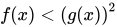
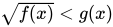
Usually because of the properties of certain functions (like square roots), some inequations are equivalent to a combination of multiple others. For example, the inequation is logically equivalent to the following three inequations combined:
See also

[edit]

References

[edit]
Revisions and contributorsEdit on WikipediaRead on Wikipedia
from Grokipedia
An inequation is a mathematical statement that shows the inequality between two expressions using symbols such as >, <, ≥, ≤, or ≠. Inequations form the basis for expressing constraints and order relations in mathematics, distinguishing them from equations by indicating non-equality rather than equality between quantities. They are governed by the order axioms of the real numbers, which include trichotomy (for any two real numbers a and b, exactly one of a < b, a = b, or a > b holds), transitivity (if a < b and b < c, then a < c), additivity (if a < b, then a + c < b + c for any real c), and multiplicativity (if a < b and c > 0, then ac* < bc*). Solving inequations typically involves algebraic manipulation similar to equations, such as adding or subtracting the same value from both sides or multiplying/dividing by positive numbers, but requires reversing the inequality direction when multiplying or dividing by a negative number to preserve truth. Common types include linear inequations (e.g., 2x + 1 < 5), compound inequations (e.g., -3 < x < 7), quadratic inequations (e.g., x² > 4), and absolute value inequations (e.g., ≤ 3), each solved by finding intervals or sets of values that satisfy the condition. Inequations have broad applications across and related fields, serving as tools for defining feasible regions in , bounding errors in approximations, proving theorems in , and modeling constraints in optimization problems in and .

Fundamentals

Definition and Notation

An inequation is a mathematical statement that compares two expressions using symbols indicating that one is greater than, less than, or not equal to the other, in contrast to an equation where the expressions are equal. This relation asserts an inequality between the expressions rather than equality, serving as the counterpart to equations in algebraic contexts. The standard notation for inequations employs four primary symbols: << for "strictly less than," >> for "strictly greater than," \leq for "less than or equal to," and \geq for "greater than or equal to." These symbols are universally adopted in mathematical literature to denote the relational comparisons. Inequations are classified as strict or non-strict based on whether equality is permitted. A strict inequation, such as x<5x < 5, excludes the boundary value where x=5x = 5, whereas a non-strict inequation like x5x \leq 5 includes it. Similarly, x>3x > 3 is strict, while x3x \geq 3 is non-strict. The term "inequation" originates as a direct translation from the French "inéquation," derived in the 19th century from the prefix in- (indicating negation) and équation, and is used synonymously with "inequality" in English mathematical contexts.

Historical Development

The concept of inequalities traces its origins to ancient mathematics, where comparisons of quantities were essential for practical applications. Around 2000 BCE, Babylonian mathematicians employed proto-algebraic techniques to solve problems related to land division and resource allocation, often involving implicit inequalities to approximate areas and volumes on clay tablets. These early uses laid groundwork for later formal developments, though explicit symbolic representations emerged much later. A pivotal advancement occurred in the early with the introduction of inequality symbols. In his posthumously published Artis Analyticae Praxis ad Aequationes Algebraicas Nova, Expedita, & Generali Methodo Resolvendas (1631), English mathematician first employed the notations < (less than) and > (greater than) to express non-equal relations systematically, moving beyond verbal descriptions in algebraic contexts. This innovation facilitated clearer manipulation of inequalities in equations and analysis. The marked the formalization of inequalities within rigorous , particularly in French mathematics, where the term "inéquation" was coined to denote such expressions, distinguishing them from equalities. played a central role in this evolution through his Cours d'analyse de l'École Royale Polytechnique (1821), in which he utilized inequalities to define limits, continuity, and convergence with unprecedented precision, establishing a foundation for modern . similarly integrated inequalities into his work on heat conduction and series expansions during this period, applying them to physical and analytical problems. Further milestones included refinements by in the mid- to late 1800s, who emphasized inequalities in his lectures to provide epsilon-delta proofs and rigorous treatments of functions, solidifying their role in the emerging discipline of . By the , the English term "inequality" supplanted "inequation" as the standard, reflecting broader adoption in Anglo-American texts, while "inéquation" remained common in French and certain European traditions; this shift coincided with seminal compilations like , J.E. Littlewood, and G. Pólya's Inequalities (1934), which systematized proofs and applications.

Properties and Operations

Basic Properties

Inequalities over the real numbers satisfy certain fundamental properties that distinguish them from equalities. The relation ≤ is reflexive, meaning that for any real number aa, aaa \leq a holds true, while the strict inequality < is irreflexive, as a<aa < a is false for all real aa. A core property is the law of trichotomy, which states that for any two real numbers aa and bb, exactly one of the following holds: a<ba < b, a=ba = b, or a>ba > b. This ensures that the order on the reals is total and mutually exclusive. The direction of an inequality is preserved under or of the same to both sides; for instance, if a<ba < b, then a+c<b+ca + c < b + c and ac<bca - c < b - c for any real cc. Similarly, multiplying or dividing both sides by a positive preserves the direction: if a<ba < b and k>0k > 0, then ak<bkak < bk and ak<bk\frac{a}{k} < \frac{b}{k}. However, multiplication or division by a negative reverses the direction: if a<ba < b and k<0k < 0, then ak>bkak > bk and ak>bk\frac{a}{k} > \frac{b}{k}. These preservation rules are essential for manipulating inequalities. Consider solving the inequality 2x+3<72x + 3 < 7: subtract 3 from both sides to get 2x<42x < 4, then divide by 2 (positive) to obtain x<2x < 2. Now consider 2x>4-2x > 4: dividing both sides by -2 (negative) reverses the inequality, yielding x<2x < -2. Inequalities are compatible with equalities in that any equation can be weakened to a non-strict inequality by replacing = with ≤ or ≥; for example, if a=ba = b, then aba \leq b and aba \geq b. This follows directly from the reflexive property of ≤ and the trichotomy law.

Chains and Transitivity

The transitivity property of inequalities states that for any real numbers aa, bb, and cc, if a<ba < b and b<cb < c, then a<ca < c; the property holds analogously for \leq, >>, and \geq. This property is a fundamental in the order structure of the real numbers, often listed as part of the axioms. The proof of transitivity relies on the addition property and the closure of positive elements under addition. In an ordered field, a<ba < b if and only if bab - a is positive, where the positives form a subset closed under addition. Given a<ba < b and b<cb < c, it follows that ba>0b - a > 0 and cb>0c - b > 0, so ca=(cb)+(ba)>0c - a = (c - b) + (b - a) > 0, hence a<ca < c. The same reasoning applies to the non-strict cases by considering the definitions involving non-negative elements. Chains of inequalities extend transitivity to sequences of relations, such as abcda \leq b \leq c \leq d, which represent totally ordered subsets of the real numbers. These chains imply overall ordering, for example, ada \leq d via repeated application of transitivity. Mixed strict and non-strict chains, like 12<π41 \leq 2 < \pi \leq 4, are handled similarly, preserving the directional order without altering the relations. In applications, chains and transitivity underpin the total order on the real numbers, where for any a,bRa, b \in \mathbb{R}, either aba \leq b or bab \leq a, enabling consistent comparisons and sorting in mathematical and computational contexts. For instance, the chain 1<2<π<41 < 2 < \pi < 4 (with π3.1416\pi \approx 3.1416) transitively implies 1<41 < 4 and 2<π2 < \pi, illustrating how such relations establish hierarchical orderings. However, transitivity of inequalities is specific to ordered fields like the reals and does not extend to non-ordered domains; for example, complex numbers lack a compatible total order, rendering standard inequalities and their transitivity undefined. Similarly, in modular arithmetic, the absence of a natural linear order means transitive chains do not apply in the same way.

Solving Inequations

Linear Inequations

Linear inequations, also known as linear inequalities, are mathematical statements that compare two linear expressions using inequality symbols such as <, >, ≤, or ≥, typically in the form ax+b<cx+dax + b < cx + d, where a,b,c,da, b, c, d are constants and xx is the variable in one dimension. These expressions involve variables raised only to the first power, distinguishing them from higher-degree forms. The solution process for linear inequations mirrors that of linear equations but requires careful handling of inequality directions. To isolate the variable, add or subtract the same value from both sides without altering the inequality symbol, as per the addition and subtraction properties of inequalities. When multiplying or dividing both sides by a positive number, the inequality direction remains unchanged; however, multiplying or dividing by a negative number reverses the direction to preserve the truth of the statement. Solutions are often expressed in interval notation, such as (,3)(-\infty, 3) for x<3x < 3, where parentheses indicate open endpoints (exclusions) and brackets indicate closed endpoints (inclusions), with infinite bounds always using parentheses. Graphing solutions on a number line provides a visual representation of the solution set. For a single inequation like x<3x < 3, shade the region to the left of 3 with an open circle at 3 to exclude it; for x3x \geq 3, use a closed circle at 3 and shade to the right. Compound inequations, such as 1x<4-1 \leq x < 4, combine two inequalities and are graphed by shading from a closed circle at -1 to an open circle at 4. In the linear context, absolute value inequations like xa<b|x - a| < b (where b>0b > 0) represent the set of points within distance bb from aa on the , equivalent to the compound inequation ab<x<a+ba - b < x < a + b. For xa>b|x - a| > b, the solution splits into two intervals: x<abx < a - b or x>a+bx > a + b. These can be solved by isolating the absolute value expression and applying the appropriate case, flipping the inequality only when necessary during subsequent steps. Consider the example 3x253x - 2 \geq 5. Add 2 to both sides: 3x73x \geq 7. Divide by 3 (positive, so no flip): x73x \geq \frac{7}{3}. The solution is the interval [73,)\left[ \frac{7}{3}, \infty \right), graphed with a closed circle at 73\frac{7}{3} shading rightward. For 2x+1<02x + 1 < 0, subtract 1: 2x<12x < -1. Divide by 2 (positive): x<12x < -\frac{1}{2}. The solution is (,12)\left( -\infty, -\frac{1}{2} \right), graphed with an open circle at 12-\frac{1}{2} shading leftward.

Nonlinear Inequations

Nonlinear inequations involve expressions with functions such as quadratics, exponentials, logarithms, or rationals, where the graph is typically curved and the sign may change multiple times, requiring identification of critical points to determine solution intervals. The general method for solving these begins by finding critical points—roots where the expression equals zero and points of discontinuity like asymptotes—then dividing the real line into intervals and testing the sign of the expression in each to identify where it satisfies the inequality. This approach, often visualized with sign charts, ensures all regions where the inequality holds are captured, including equality cases as needed. Quadratic inequations take the form ax2+bx+c>0ax^2 + bx + c > 0 (or with ≤, <, ≥), where a0a \neq 0, and solutions depend on the parabola's orientation and roots found by solving ax2+bx+c=0ax^2 + bx + c = 0 using the quadratic formula x=b±b24ac2ax = \frac{-b \pm \sqrt{b^2 - 4ac}}{2a}
Add your contribution
Related Hubs
User Avatar
No comments yet.