



Community hub
Recent from talks
Contribute something
Nothing was collected or created yet.
Relational operator
View on Wikipedia | This article needs additional citations for verification. (March 2022) |
In computer science, a relational operator is a programming language construct or operator that defines syntactically a relationship between two entities. These include numerical equality (e.g., 5 = 5) and inequalities (e.g., 4 ≥ 3).
In programming languages that include a distinct boolean data type in their type system, like Pascal, Ada, Python or Java, these operators usually evaluate to true or false, depending on if the conditional relationship between the two operands holds or not.
In languages such as C, relational operators return the integers 0 or 1, where 0 stands for false and any non-zero value stands for true.
An expression created using a relational operator forms what is termed a relational expression or a condition. Relational operators can be seen as special cases of logical predicates.
Equality
[edit]Usage
[edit]Equality is used in many programming language constructs and data types. It is used to test if an element already exists in a set, or to access to a value through a key. It is used in switch statements to dispatch the control flow to the correct branch, and during the unification process in logic programming.
There can be multiple valid definitions of equality, and any particular language might adopt one or more of them, depending on various design aspects. One possible meaning of equality is that "if a equals b, then either a or b can be used interchangeably in any context without noticing any difference". But this statement does not necessarily hold, particularly when taking into account mutability together with content equality.
Location equality vs. content equality
[edit]Sometimes, particularly in object-oriented programming, the comparison raises questions of data types and inheritance, equality, and identity. It is often necessary to distinguish between:
- two different objects of the same type, e.g., two hands
- two objects being equal but distinct, e.g., two $10 banknotes
- two objects being equal but having different representation, e.g., a $1 bill and a $1 coin
- two different references to the same object, e.g., two nicknames for the same person
In many modern programming languages, objects and data structures are accessed through references. In such languages, there becomes a need to test for two different types of equality:
- Location equality (identity): if two references (A and B) reference the same object. Interactions with the object through A are indistinguishable from the same interactions through B, and in particular changes to the object through A are reflected through B.
- Content equality: if the objects referenced by two references (A and B) are equivalent in some sense:
- Structural equality (that is, their contents are the same). which may be either shallow (testing only immediate subparts), or deep (testing for equality of subparts recursively). A simple way to achieve this is through representational equality: checking that the values have the same representation.
- Some other tailor-made equality, preserving the external behavior. For example, 1/2 and 2/4 are considered equal when seen as a rational number. A possible requirement would be that "A = B if and only if all operations on objects A and B will have the same result", in addition to reflexivity, symmetry, and transitivity.
The first type of equality usually implies the second (except for things like not a number (NaN) which are unequal to themselves), but the converse is not necessarily true. For example, two string objects may be distinct objects (unequal in the first sense) but contain the same sequence of characters (equal in the second sense). See identity for more of this issue.
Real numbers, including many simple fractions, cannot be represented exactly in floating-point arithmetic, and it may be necessary to test for equality within a given tolerance. Such tolerance, however, can easily break desired properties such as transitivity, whereas reflexivity breaks too: the IEEE floating-point standard requires that NaN ≠ NaN holds. In contrast, the (2022) private standard for posit arithmetic (posit proponents mean to replace IEEE floats) has a similar concept, NaR (Not a Real), where NaR = NaR holds.[1]
Other programming elements such as computable functions, may either have no sense of equality, or an equality that is uncomputable. For these reasons, some languages define an explicit notion of "comparable", in the form of a base class, an interface, a trait or a protocol, which is used either explicitly, by declaration in source code, or implicitly, via the structure of the type involved.
Comparing values of different types
[edit]In JavaScript, PHP, VBScript and a few other dynamically typed languages, the standard equality operator follows so-called loose typing, that is it evaluates to true even if two values are not equal and are of incompatible types, but can be coerced to each other by some set of language-specific rules, making the number 4 compare equal to the text string "4", for instance. Although such behaviour is typically meant to make the language easier, it can lead to surprising and difficult to predict consequences that many programmers are unaware of. For example, JavaScript's loose equality rules can cause equality to be intransitive (i.e., a == b and b == c, but a != c), or make certain values be equal to their own negation.[2]
A strict equality operator is also often available in those languages, returning true only for values with identical or equivalent types (in PHP, 4 === "4" is false although 4 == "4" is true).[3][4] For languages where the number 0 may be interpreted as false, this operator may simplify things such as checking for zero (as x == 0 would be true for x being either 0 or "0" using the type agnostic equality operator).
Ordering
[edit]Greater than and less than comparison of non-numeric data is performed according to a sort convention (such as, for text strings, lexicographical order) which may be built into the programming language and/or configurable by a programmer.
When it is desired to associate a numeric value with the result of a comparison between two data items, say a and b, the usual convention is to assign −1 if a < b, 0 if a = b and 1 if a > b. For example, the C function strcmp performs a three-way comparison and returns −1, 0, or 1 according to this convention, and qsort expects the comparison function to return values according to this convention. In sorting algorithms, the efficiency of comparison code is critical since it is one of the major factors contributing to sorting performance.
Comparison of programmer-defined data types (data types for which the programming language has no in-built understanding) may be carried out by custom-written or library functions (such as strcmp mentioned above), or, in some languages, by overloading a comparison operator – that is, assigning a programmer-defined meaning that depends on the data types being compared. Another alternative is using some convention such as member-wise comparison.
Logical equivalence
[edit]Though perhaps unobvious at first, like the boolean logical operators XOR, AND, OR, and NOT, relational operators can be designed to have logical equivalence, such that they can all be defined in terms of one another. The following four conditional statements all have the same logical equivalence E (either all true or all false) for any given x and y values:
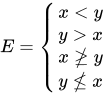
This relies on the domain being well ordered.
Standard relational operators
[edit]The most common numerical relational operators used in programming languages are shown below. Standard SQL uses the same operators as BASIC, while many databases allow != in addition to <> from the standard. SQL follows strict boolean algebra, i.e. doesn't use short-circuit evaluation, which is common to most languages below. E.g. PHP has it, but otherwise it has these same two operators defined as aliases, like many SQL databases.
| Convention | equal to | not equal to | greater than | less than | greater than or equal to |
less than or equal to |
|---|---|---|---|---|---|---|
| In print | = | ≠ | > | < | ≥ | ≤ |
| FORTRAN[note 1] | .EQ.
|
.NE.
|
.GT.
|
.LT.
|
.GE.
|
.LE.
|
| ALGOL 68[note 2] | =
|
≠
|
>
|
<
|
≥
|
≤
|
/=
|
>=
|
<=
| ||||
eq
|
ne
|
gt
|
lt
|
ge
|
le
| |
| APL | =
|
≠
|
>
|
<
|
≥
|
≤
|
| BASIC, ML, Pascal[note 3] | =
|
<>[note 4]
|
>
|
<
|
>=
|
<=
|
| C-like[note 5] | ==
|
!=
|
>
|
<
|
>=
|
<=
|
| MUMPS | =
|
'=
|
>
|
<
|
'<
|
'>
|
| Lua | ==
|
~=
|
>
|
<
|
>=
|
<=
|
| Erlang | ==
|
/=
|
>
|
<
|
>=
|
=<
|
=:=
|
=/=
| |||||
| Bourne-like shells[note 6] | -eq
|
-ne
|
-gt
|
-lt
|
-ge
|
-le
|
| Batch file | EQU
|
NEQ
|
GTR
|
LSS
|
GEQ
|
LEQ
|
| ooRexx, REXX | =
|
¬=
|
>
|
<
|
>=
|
<=
|
\=
| ||||||
<>
| ||||||
| MATLAB[note 7] | ==
|
~=
|
>
|
<
|
>=
|
<=
|
eq(x,y)
|
ne(x,y)
|
gt(x,y)
|
lt(x,y)
|
ge(x,y)
|
le(x,y)
| |
| Fortran 90,[note 8] Haskell | ==
|
/=
|
>
|
<
|
>=
|
<=
|
| Mathematica[5] | ==
|
!=
|
>
|
<
|
>=
|
<=
|
Equal[x,y]
|
Unequal[x,y]
|
Greater[x,y]
|
Less[x,y]
|
GreaterEqual[x,y]
|
LessEqual[x,y]
|
- ^ Including FORTRAN II, III, IV, 66 and 77.
- ^ ALGOL 68: stropping regimes are used in code on platforms with limited character sets (e.g., use
>=orGEinstead of≥), platforms with noboldemphasis (use'ge'), or platforms with only UPPERCASE (use.GEor'GE'). - ^ Including ALGOL, Simula, Modula-2, Eiffel, SQL, spreadsheet formulas, and others.
- ^ Modula-2 also recognizes
# - ^ Including C, C++, C#, Go, Java, JavaScript, Perl (numerical comparison only), PHP, Python, Ruby, and R.
- ^ Including Bourne shell, Bash, KornShell, and Windows PowerShell. The symbols
<and>are usually used in a shell for redirection, so other symbols must be used. Without the hyphen, is used in Perl for string comparison. - ^ MATLAB, although in other respects using similar syntax as C, does not use
!=, as!in MATLAB sends the following text as a command line to the operating system. The first form is also used in Smalltalk, with the exception of equality, which is=. - ^ Including FORTRAN 95, 2003, 2008 and 2015.
Other conventions are less common: Common Lisp and Macsyma/Maxima use Basic-like operators for numerical values, except for inequality, which is /= in Common Lisp and # in Macsyma/Maxima. Common Lisp has multiple other sets of equality and relational operators serving different purposes, including eq, eql, equal, equalp, and string=.[6] Older Lisps used equal, greaterp, and lessp; and negated them using not for the remaining operators.
Syntax
[edit]Relational operators are also used in technical literature instead of words. Relational operators are usually written in infix notation, if supported by the programming language, which means that they appear between their operands (the two expressions being related). For example, an expression in Python will print the message if the x is less than y:
if x < y:
    print("x is less than y in this example")
Other programming languages, such as Lisp, use prefix notation, as follows:
(>= X Y)
Operator chaining
[edit]In mathematics, it is common practice to chain relational operators, such as in 3 < x < y < 20 (meaning 3 < x and x < y and y < 20). The syntax is clear since these relational operators in mathematics are transitive.
However, many recent programming languages would see an expression like 3 < x < y as consisting of two left (or right-) associative operators, interpreting it as something like (3 < x) < y. If we say that x=4, we then get (3 < 4) < y, and evaluation will give true < y which generally does not make sense. However, it does compile in C/C++ and some other languages, yielding surprising result (as true would be represented by the number 1 here).
It is possible to give the expression x < y < z its familiar mathematical meaning, and some programming languages such as Python and Raku do that. Others, such as C# and Java, do not, partly because it would differ from the way most other infix operators work in C-like languages. The D programming language does not do that since it maintains some compatibility with C, and "Allowing C expressions but with subtly different semantics (albeit arguably in the right direction) would add more confusion than convenience".[7]
Some languages, like Common Lisp, use multiple argument predicates for this. In Lisp (<= 1 x 10) is true when x is between 1 and 10.
Confusion with assignment operators
[edit]Early FORTRAN (1956–57) was bounded by heavily restricted character sets where = was the only relational operator available. There were no < or > (and certainly no ≤ or ≥). This forced the designers to define symbols such as .GT., .LT., .GE., .EQ. etc. and subsequently made it tempting to use the remaining = character for copying, despite the obvious incoherence with mathematical usage (X=X+1 should be impossible).
International Algebraic Language (IAL, ALGOL 58) and ALGOL (1958 and 1960) thus introduced := for assignment, leaving the standard = available for equality, a convention followed by CPL, ALGOL W, ALGOL 68, Basic Combined Programming Language (BCPL), Simula, SET Language (SETL), Pascal, Smalltalk, Modula-2, Ada, Standard ML, OCaml, Eiffel, Object Pascal (Delphi), Oberon, Dylan, VHSIC Hardware Description Language (VHDL), and several other languages.
B and C
[edit]This uniform de facto standard among most programming languages was eventually changed, indirectly, by a minimalist compiled language named B. Its sole intended application was as a vehicle for a first port of (a then very primitive) Unix, but it also evolved into the very influential C language.
B started off as a syntactically changed variant of the systems programming language BCPL, a simplified (and typeless) version of CPL. In what has been described as a "strip-down" process, the and and or operators of BCPL[8] were replaced with & and | (which would later become && and ||, respectively.[9]). In the same process, the ALGOL style := of BCPL was replaced by = in B. The reason for all this being unknown.[10] As variable updates had no special syntax in B (such as let or similar) and were allowed in expressions, this non standard meaning of the equal sign meant that the traditional semantics of the equal sign now had to be associated with another symbol. Ken Thompson used the ad hoc == combination for this.
As a small type system was later introduced, B then became C. The popularity of this language along with its association with Unix, led to Java, C#, and many other languages following suit, syntactically, despite this needless conflict with the mathematical meaning of the equal sign.
Languages
[edit]Assignments in C have a value and since any non-zero scalar value is interpreted as true in conditional expressions,[11] the code if (x = y) is legal, but has a very different meaning from if (x == y). The former code fragment means "assign y to x, and if the new value of x is not zero, execute the following statement". The latter fragment means "if and only if x is equal to y, execute the following statement".[12]
  int x = 1;
  int y = 2;
  if (x = y) {
      /* This code will always execute if y is anything but 0*/
      printf("x is %d and y is %d\n", x, y);
  }
Though Java and C# have the same operators as C, this mistake usually causes a compile error in these languages instead, because the if-condition must be of type boolean, and there is no implicit way to convert from other types (e.g., numbers) into booleans. So unless the variable that is assigned to has type boolean (or wrapper type Boolean), there will be a compile error.
In ALGOL-like languages such as Pascal, Delphi, and Ada (in the sense that they allow nested function definitions), and in Python, and many functional languages, among others, assignment operators cannot appear in an expression (including if clauses), thus precluding this class of error. Some compilers, such as GNU Compiler Collection (GCC), provide a warning when compiling code containing an assignment operator inside an if statement, though there are some legitimate uses of an assignment inside an if-condition. In such cases, the assignment must be wrapped in an extra pair of parentheses explicitly, to avoid the warning.
Similarly, some languages, such as BASIC use just the = symbol for both assignment and equality, as they are syntactically separate (as with Pascal, Ada, Python, etc., assignment operators cannot appear in expressions).
Some programmers get in the habit of writing comparisons against a constant in the reverse of the usual order:
  if (2 == a) {   /* Mistaken use of = versus == would be a compile-time error */
  }
If = is used accidentally, the resulting code is invalid because 2 is not a variable. The compiler will generate an error message, on which the proper operator can be substituted. This coding style is termed left-hand comparison, or Yoda conditions.
This table lists the different mechanisms to test for these two types of equality in various languages:
| Language | Physical equality | Structural equality | Notes |
|---|---|---|---|
| ALGOL 68 | a :=: b or a is b |
a = b |
when a and b are pointers
|
| C, C++ | a == b |
*a == *b |
when a and b are pointers
|
| C# | object.ReferenceEquals(a, b) |
a.Equals(b) |
The == operator defaults to ReferenceEquals, but can be overloaded to perform Equals instead.
|
| Common Lisp | (eq a b) |
(equal a b) |
|
| Erlang | a =:= b
|
a == b
|
when a and b are numbers |
| Fortran | associated (pa, b) |
a == b |
pa is a pointer |
| Go | a == b |
reflect.DeepEqual(*a, *b) |
when a and b are pointers |
| Java | a == b |
a.equals(b) |
|
| JavaScript | a === b |
a == b |
when a and b are two string objects containing equivalent characters, the === operator will still return true. |
| OCaml, Smalltalk | a == b |
a = b |
|
| Pascal | a^ = b^ |
a = b |
|
| Perl | $a == $b |
$$a == $$b |
when $a and $b are references to scalars
|
| PHP | $a === $b |
$a == $b |
when $a and $b are objects
|
| Python | a is b |
a == b |
|
| Ruby | a.equal?(b) |
a == b |
|
| Scheme | (eq? a b) |
(equal? a b) |
|
| Swift | a === b |
a == b |
when a and b have class type |
| Visual Basic .NET[inequality 1] | a Is b or object.ReferenceEquals(a, b) |
a = b or a.Equals(b) |
Same as C# |
| Objective-C (Cocoa, GNUstep) | a == b |
[a isEqual:b] |
when a and b are pointers to objects that are instances of NSObject
|
- ^ Patent application: On May 14, 2003, US application 20,040,230,959 "IS NOT OPERATOR" was filed for the
ISNOToperator by employees of Microsoft. This patent was granted on November 18, 2004.
Ruby uses a === b to mean "b is a member of the set a", though the details of what it means to be a member vary considerably depending on the data types involved. === is here known as the "case equality" or "case subsumption" operator.
See also
[edit]Notes and references
[edit]- ^ Standard for Posit Arithmetic (2022)
- ^ Denys, Dovhan. "WTFJS". GitHub. Retrieved July 25, 2024.
- ^ "Comparing Objects". PHP Manual. PHP Group. Retrieved June 29, 2014.
- ^ "PHP: Comparison Operators - Manual". Retrieved July 31, 2008.
- ^ Relational and Logical Operators of Mathematica
- ^ "Why are there so many ways to compare for equality?". Stack Overflow. Retrieved July 25, 2024.
- ^ Alexandrescu, Andrei (2010). The D Programming Language. Addison Wesley. p. 58. ISBN 978-0-321-63536-5.
- ^ Used not only in ALGOL-like languages, but also in FORTRAN and BASIC
- ^ As some programmers were confused by the dual meanings (bitwise operator, and logical connective) of these new symbols (according to Dennis Ritchie). Only the bitwise meaning of & and | were kept.
- ^ Although Dennis Ritchie has suggested that this may have had to do with "economy of typing" as updates of variables may be more frequent than comparisons in certain types of programs
- ^ A zero scalar value is interpreted as false while any non-zero scalar value is interpreted as true; this is typically used with integer types, similar to assembly language idioms.
- ^ Brian Kernighan and Dennis Ritchie (1988) [1978]. The C Programming Language (Second ed.). Prentice Hall., 19
Relational operator
View on GrokipediaOverview
Definition
Relational operators are symbols or keywords in programming languages that compare two values or expressions and evaluate to a boolean result, indicating whether the specified relation holds between them.[1] These operators test relations such as equality, inequality, or ordering, producing true if the condition is satisfied and false otherwise, thereby enabling conditional logic in programs.[1] The general syntax for a relational operation isleft_operand operator right_operand, where both operands are typically numeric or comparable types, and the result is a boolean value that can be used in control structures like if-statements or loops.[4] This form formalizes mathematical comparisons into computable expressions without altering the operands themselves.
Relational operators originated in early high-level programming languages, notably formalized in the 1960 Revised Report on the Algorithmic Language ALGOL 60, which drew from mathematical relations to define comparisons like equality and ordering for algorithmic expression.[5] Prior to ALGOL 60, preliminary concepts appeared in the 1958 ALGOL report, influencing subsequent languages by standardizing relational evaluations.[6]
Unlike arithmetic operators, which perform calculations on values to produce new numerical results (e.g., addition or multiplication), relational operators solely assess conditions and return boolean outcomes without modifying or computing new values from the operands.[1] Standard relational operators encompass equality, inequality, and various ordering relations, with details deferred to subsequent sections.[5]
Standard Operators
In most programming languages, the standard relational operators comprise six core symbols that facilitate comparisons between operands, yielding a boolean result indicating the truth of the specified relationship. These operators are defined in language standards such as ISO C, where they include equality and inequality for exact matches or differences, and ordering operators for magnitude assessments.[7] The equality operator, denoted as ==, evaluates whether the left operand is equal to the right operand.[8] The inequality operator, typically represented as != in modern languages, determines if the operands differ; an alternative form, <>, appears in some contexts like SQL standards.[8] The less-than operator (<) checks if the left operand is smaller than the right, while the greater-than operator (>) performs the reverse comparison. Additionally, the less-than-or-equal-to operator (<=) and greater-than-or-equal-to operator (>=) include equality in their assessments. These operators primarily use ASCII characters: < (U+003C), > (U+003E), = (U+003D), and ! (U+0021) for !=. In Unicode, alternatives exist, such as ≠ (U+2260) for inequality, though they are less common in programming syntax.[9] Although not standard in programming, formal logic employs symbols like ≡ (U+2261) for identical to or ⇔ (U+21D4) for if and only if to denote logical equivalence between propositions, relating conceptually to equality operators.[9]| Operator | Symbol(s) | Role | Unicode Code Point(s) |
|---|---|---|---|
| Equality | == | Checks if operands are equal | U+003D (repeated) |
| Inequality | != or <> | Checks if operands differ | U+0021 U+003D (for !=), U+003C U+003E (for <>) or U+2260 |
| Less than | < | Checks if left is smaller than right | U+003C |
| Greater than | > | Checks if left is larger than right | U+003E |
| Less than or equal to | <= | Checks if left is smaller or equal to right | U+003C U+003D |
| Greater than or equal to | >= | Checks if left is larger or equal to right | U+003E U+003D |
Equality and Inequality
Equality Operators
Equality operators, primarily represented by the double equals symbol (==), are used in programming languages to test whether two operands are equal, returning a boolean value of true if they are considered the same and false otherwise.[10] This operator performs a direct comparison of values for primitive types and reference comparisons for objects, making it fundamental for control flow decisions.[11] In languages like C++ and Java, == is part of the standard relational operator set and performs comparisons without implicit type coercion for compatible types; in JavaScript, == allows implicit type coercion, while === provides strict equality without it.[10][12] A common application of the equality operator appears in conditional statements, where it determines whether code blocks execute based on value matches. For instance, in Java, the constructif (a == b) { ... } evaluates to true if variables a and b hold equal values, triggering the enclosed statements.[10] Similarly, in C++, if (x == 5) checks if x equals the integer 5, often used in loops or decision trees to branch logic efficiently.[11] These examples illustrate how == integrates into if-else structures, switch cases, and while loops to implement algorithmic conditions.[10]
The behavior of the equality operator varies significantly between primitive types and objects. For primitive types such as integers and floats in languages like Java, == compares the actual stored values directly, yielding true for identical numerical content.[13] In contrast, when applied to objects, including strings in Java, == typically compares memory references rather than contents, returning true only if both operands point to the identical object instance.[14] This distinction ensures efficient value equality for simple data but requires explicit methods like equals() for semantic object comparisons to avoid unintended reference-based results.[13]
Beyond general-purpose programming, equality operators extend to database query languages like SQL, where the = operator (often synonymous with == in procedural contexts) filters records in WHERE clauses for exact matches. In SQL Server, for example, SELECT * FROM table WHERE column = value retrieves rows where the column exactly equals the specified value, supporting precise data retrieval without pattern matching.[15] This usage is critical for indexing and query optimization, as equality conditions enable efficient seeks on primary keys or unique constraints.[16]
Inequality Operators
Inequality operators are binary comparison operators that evaluate to true if their operands are not equal, enabling the detection of differences between values in conditional expressions and control flow statements. In most C-style programming languages, the primary notation is !=, which performs a value comparison and returns a boolean true if the operands differ. For example, in C, the expressiona != b yields 1 (true) if a and b are not equal after applying usual arithmetic conversions for numeric types or pointer compatibility checks.[17]
Historically, variations in notation arose due to character set limitations and design influences from earlier languages. The <> symbol, evoking "less than or greater than," first appeared in Dartmouth BASIC's 1964 implementation, where it served as the not-equal operator in relational expressions. This notation persisted in Pascal, which adopted <> for inequality comparisons to distinguish from equality (=). In SQL, following the SQL-92 standard, <> remains the canonical form for inequality, though many implementations like T-SQL also support != as an equivalent alternative for broader compatibility. In contrast, C introduced != in the early 1970s, influencing subsequent languages like C++, Java, and Python to standardize on this punctuation for not-equal checks.[18][19][20]
These operators find frequent use in loop conditions and decision-making logic to handle divergence from expected states. For instance, a while loop might employ inequality to iterate until a counter reaches a target: while (i != 10) { i++; }, ensuring execution ceases upon equality. Such patterns are essential in algorithms requiring termination on mismatch, like searching unsorted data or validating inputs against defaults.
Some languages extend inequality detection through three-way comparison operators, which implicitly cover non-equality cases. In Perl, the spaceship operator <=> compares numeric operands, returning -1 for less than, 0 for equal, and 1 for greater than; a non-zero result thus signals inequality, often used beyond sorting for robust value differentiation. Similarly, C++20's spaceship operator <=>, when defaulted, automatically synthesizes an != operator by negating the equality outcome from the three-way result, streamlining custom type comparisons without explicit inequality definitions.[21][22]
Ordering Operators
Strict Ordering
Strict less than (<) and greater than (>) operators perform comparisons that return true only if the left operand strictly precedes or follows the right operand, respectively, without considering equality.[23] These operators are fundamental in programming languages for establishing precedence between values, such as determining if one number is smaller than another. For instance, in Java, the expression 5 < 3 evaluates to false because 5 does not precede 3.[10]
Mathematically, these operators derive from the concept of a strict order in set theory, which is an irreflexive, asymmetric, and transitive binary relation on a set.[24] A strict order is total if, for any two elements and in the set, either , , or . This foundation ensures that the operators provide a consistent way to compare elements under a total ordering, avoiding cycles or incomparabilities.[24]
In sorting algorithms, strict ordering operators enable efficient arrangement of data by deciding element positions based on precedence. For example, in a bubble sort implementation for ascending order, elements are swapped if a > b, relying on the strict greater than to identify inversions without equality checks.[25] This approach leverages the properties of strict weak ordering, where the < operator acts as an irreflexive and transitive relation to partition elements into equivalence classes for stable sorting.[25]
When applied to numeric types, these operators generally behave predictably for integers but encounter challenges with floating-point numbers due to representation inaccuracies in standards like IEEE 754. For instance, comparing sums like 0.1 + 0.2 > 0.3 may yield unexpected results because 0.1 and 0.2 are approximated in binary, leading to slight deviations (the sum is slightly greater than 0.3) that affect strict inequality.[26] To mitigate precision issues, comparisons often incorporate epsilon tolerances rather than relying solely on strict operators.[26]
Non-strict Ordering
Non-strict ordering operators, such as less than or equal to (<=) and greater than or equal to (>=), evaluate to true when the left operand is less than, equal to, or greater than the right operand, respectively, incorporating equality into the comparison unlike strict ordering variants.[27][28] These operators are fundamental in most programming languages for establishing inclusive relationships between values, supporting numerical, string, and other comparable types.[29]
In practical applications, non-strict operators are commonly used for range checks to include boundary values, such as verifying if a variable falls within specified limits: if (x >= 0 && x <= 10).[30] This pattern ensures that endpoints are not excluded, which is essential for validating inputs like scores or indices in algorithms.[1]
For non-numeric types, equality handling in non-strict ordering relies on defined total orders; for strings, this typically involves lexicographical (dictionary) order where characters are compared by Unicode or ASCII values, allowing <= to return true if one string precedes or matches another.[31] Similarly, for dates, <= compares chronological sequence, treating equal dates as satisfying the condition based on the underlying timestamp representation.[32]
In database queries, non-strict operators extend to filtering with inclusive bounds, such as SELECT * FROM table WHERE value <= 10 ORDER BY value, which retrieves and sorts records up to and including the boundary, facilitating precise data retrieval in SQL environments.[33][34]
Advanced Usage
Operator Chaining
Operator chaining allows multiple relational operators to be combined in a single expression, providing a concise way to perform sequential comparisons. In languages that support this feature, such as Python, an expression likea < b < c is semantically equivalent to (a < b) and (b < c), where the intermediate value b is evaluated only once, and the overall result is a boolean indicating whether all pairwise comparisons hold true.[35] This chaining applies to the standard relational operators (<, <=, >, >=) and can include equality operators (==, !=) in certain combinations, though mixing equality and inequality may lead to unexpected results if not handled carefully.[36]
The primary advantage of operator chaining is enhanced readability, particularly for range checks or ordered comparisons. For instance, the expression 1 <= x <= 10 succinctly verifies if x falls within the inclusive range from 1 to 10, mirroring mathematical notation and reducing the need for explicit logical conjunctions.[35] This syntax is supported in Python and similar languages like Raku (formerly Perl 6), where it follows comparable semantics.
In contrast, languages like C++ do not support this form of chaining for relational operators; instead, developers must use explicit logical AND (&&) operators, as in (a < b) && (b < c). Attempting a < b < c in C++ results in left-associative evaluation (a < b) < c, which compares a boolean result to c and typically yields unintended behavior, such as always true for positive integers due to boolean promotion.
A key pitfall in operator chaining arises from differences in evaluation and short-circuiting behavior across languages. In Python, chained comparisons short-circuit: if the first comparison fails, subsequent ones are not evaluated, similar to the and operator, but with the benefit of single evaluation for intermediates.[37] However, in explicit logical expressions without chaining, intermediates may be evaluated multiple times unless optimized, potentially affecting performance or side effects in function calls. Additionally, porting code between languages without this feature requires rewriting to avoid semantic mismatches, such as the erroneous boolean promotion in C-like languages.
Type and Value Comparisons
Relational operators, particularly equality and inequality operators, must account for the underlying data types of their operands to determine comparison semantics. In many programming languages, distinctions arise between value equality, which evaluates whether two operands contain the same content regardless of their storage, and reference equality, which checks if they point to the identical memory location. For instance, in C#, value equality is applied to value types like integers and structs by comparing their fields, while reference equality is the default for reference types such as objects using the== operator unless overridden.[38] Similarly, Kotlin provides structural equality via ==, which compares object contents by recursively checking properties, contrasting with referential equality via ===, which verifies if two references identify the same instance.[39]
Reference equality is particularly relevant for complex data structures like objects and arrays, where value equality would require deep traversal. In JavaScript, the loose equality operator == performs value equality on primitives such as strings, where "hello" == "hello" evaluates to true by comparing their textual content, but for objects, it defaults to reference equality unless custom methods are defined.[40] Java employs reference equality for object instances with ==, meaning two distinct objects with identical field values are not considered equal unless the equals method is overridden to implement value semantics.
Cross-type comparisons introduce additional complexity, often involving type coercion to enable evaluation. In JavaScript, the loose equality operator == coerces disparate types before comparison; for example, "5" == 5 returns true because the string is converted to a number, highlighting potential pitfalls in type-unsafe code.[41] Languages like Java and C# typically prohibit or strictly handle cross-type equality for relational operators, requiring explicit casting to avoid compilation errors, which promotes type safety.[10][38]
Special cases, such as handling Not-a-Number (NaN) values in floating-point arithmetic, further refine equality semantics. In JavaScript and Java, NaN is not equal to itself under standard equality operators—NaN == NaN yields false—necessitating dedicated functions like Number.isNaN() or Double.isNaN() for detection, as per IEEE 754 standards.[42][43] This behavior ensures that indeterminate values do not falsely match, preserving mathematical integrity in comparisons.
Modern type systems, such as TypeScript, emphasize strict equality to mitigate coercion issues. TypeScript's strict mode encourages the use of === for all equality checks, enforcing type identity and value matching without conversion, which aligns with its goal of enhancing JavaScript's type safety.[44] This approach reduces runtime surprises from implicit conversions observed in plain JavaScript.[45]
Syntax and Implementation
Variations Across Languages
In languages from the C family, including C, C++, and Java, the standard relational operators are == for equality, != for inequality, < for less than, > for greater than, <= for less than or equal to, and >= for greater than or equal to. These operators require operands of compatible arithmetic or pointer types (with standard promotions applied where necessary), and comparisons between incompatible types typically result in compilation errors or, in C, potential undefined behavior if pointer comparisons are involved. For example, in C and C++, comparing integers or floating-point numbers yields a boolean result after evaluating the relational expression, while Java's specification mandates that numeric promotions occur before comparison to ensure type safety. Scripting languages like Python and JavaScript introduce more flexible behaviors, particularly in equality comparisons through type coercion. In JavaScript, the == operator (loose equality) converts operands to the same type before comparison—for instance, '5' == 5 returns true after converting the string to a number—while the strict === operator avoids coercion and requires both value and type to match, such as '5' === 5 returning false. Python's == operator similarly permits coercion in certain cases, like 1 == True evaluating to true because True subclasses int and equals 1 numerically, and it uniquely supports chaining multiple relational operators in a single expression, equivalent to logical ANDs, as in 1 < x <= 10, which shortens multi-condition checks without short-circuiting intermediate results. SQL, governed by the ISO/IEC 9075 standard and implemented in database systems like PostgreSQL and MySQL, uses = for equality, <> or != for inequality (with dialect variations), and <, >, <=, >= for ordering. A distinctive feature is the three-valued logic for comparisons involving NULL, which represents unknown or missing data: expressions like NULL < 5 or NULL = NULL evaluate to NULL (unknown) rather than true or false, necessitating special predicates like IS NULL or IS NOT NULL to handle such cases explicitly and avoiding unintended filtering in queries.[31] In functional languages such as Haskell, relational operators are defined as polymorphic functions within type classes like Eq for equality (==) and Ord for ordering (<, >, <=, >=), enabling infix usage like 5 < 10 while allowing prefix application as (==) 5 10 or higher-order function passing, such as filtering a list with (> 0). This treats operators uniformly as first-class citizens, contrasting with imperative languages' syntactic primitives, and requires instances of the relevant classes for user-defined types to support comparisons.Common Pitfalls
One frequent error when using relational operators arises from confusing the assignment operator (=) with the equality operator (==), particularly in conditional statements. For instance, writingif (x = 5) in languages like C or Java intends to check equality but instead assigns 5 to x and evaluates the condition as true (since non-zero values are truthy), leading to unintended execution of the if-block.[46][47] This mistake is common among beginners transitioning from languages without distinct operators and can introduce subtle bugs in control flow.[48]
Compilers and tools in these languages offer mitigations to detect such errors. In C and C++, the GNU Compiler Collection (GCC) enables the -Wparentheses warning (part of -Wall) to flag assignments in truth contexts like if-conditions without explicit parentheses, prompting developers to clarify intent (e.g., if ((x = 5)) to suppress for deliberate assignments).[49] Java's javac does not warn by default, but integrated development environments (IDEs) like IntelliJ IDEA or Eclipse typically highlight this as a potential bug during editing.[50]
Another prevalent pitfall involves direct equality comparisons (==) with floating-point numbers, stemming from their imprecise binary representation under the IEEE 754 standard. Values like 0.1 cannot be stored exactly, causing 0.1 + 0.2 == 0.3 to evaluate to false due to rounding errors on the order of 1 part in 2^53.[26] Instead, programmers should use tolerance-based checks, such as fabs(a - b) < epsilon where epsilon is a small value like 1e-9, or language-specific functions like Python's math.isclose().[51][26]
In modern contexts, such as Python 3's arbitrary-precision integers, additional care is needed when comparing large integers to floats. Integers exceeding the float's exact representable range (roughly 2^53) lose precision in float conversion, potentially causing 30000000000000000 == 30000000000000001.0 to return true despite the integers differing, as the float cannot distinguish them.[52] This issue highlights the importance of type-consistent comparisons to avoid masking differences in high-precision computations.[26]