



Community hub
Recent from talks
Knowledge base stats:
Talk channels stats:
Members stats:
Nowe Ateny
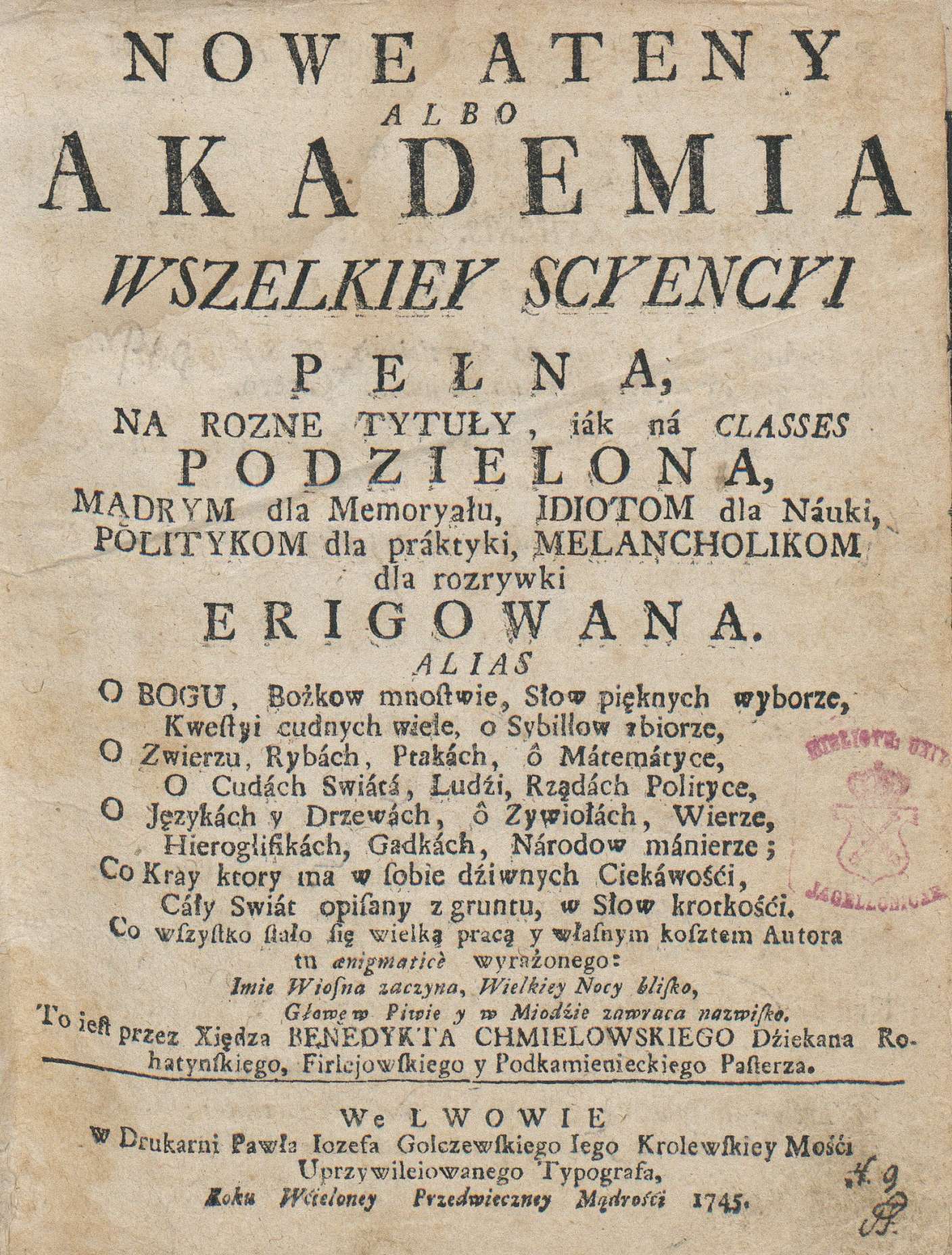
Nowe Ateny (New Athens) is the abbreviated title of the first Polish-language encyclopedia, authored by the 18th-century Polish priest Benedykt Joachim Chmielowski. The first edition was published in 1745–1746 in Lwów (Lviv); the second edition was updated and expanded in 1754–1764.
The first part of the full title was: New Athens or the Academy full of all science, divided into subjects and classes, for the wise ones to record, for the idiots to learn, for the politicians to practice, for the melancholics to entertain issued...
The book uses the Polish language as the main text, and primarily Latin for the in-line references. Chmielowski also included anecdotes in the text, and tales about strange and exotic topics.
The first edition of the encyclopedia contains 938 pages, organized by subject rather than alphabetically. Chmielowski compiled data from a few hundred references, dating from antiquity to his contemporary.
Almost every sentence in the book is in-line referenced, frequently in Latin, a lingua franca in Poland among the educated classes as in most of 18th century Central and Western Europe. Chmielowski added personal annotations as well; for example, "Dragons existed for sure, I myself held, visiting Radziwills' castle, a rib of a dragon bigger than a regular sabre". Judging from the inclusion of numerous stories, anecdotes, and descriptions of strange phenomena and exotic countries (like China and Japan), the encyclopedia was directed towards a rather popular audience and aimed to arouse readers' curiosity and desire for learning.
The encyclopedia was a controversial topic during the Enlightenment period. Some critics argued that it was a waste of time and money, and that it would only serve to spread ignorance and superstition. Others argued that it was a dangerous tool that could be used to challenge authority and traditional beliefs.
Nowe Ateny is the source of a few memorable and amusing "definitions", often quoted in Poland to this day:
The humor was probably unintentional by the author.[citation needed] Rather, he did not see the benefit of defining the most common animals of the time and place for his intended audience. Furthermore, the entry for "Horse" does contain more detailed exposition beyond the initial "definition".
Hub AI
Nowe Ateny AI simulator
(@Nowe Ateny_simulator)
Nowe Ateny
Nowe Ateny (New Athens) is the abbreviated title of the first Polish-language encyclopedia, authored by the 18th-century Polish priest Benedykt Joachim Chmielowski. The first edition was published in 1745–1746 in Lwów (Lviv); the second edition was updated and expanded in 1754–1764.
The first part of the full title was: New Athens or the Academy full of all science, divided into subjects and classes, for the wise ones to record, for the idiots to learn, for the politicians to practice, for the melancholics to entertain issued...
The book uses the Polish language as the main text, and primarily Latin for the in-line references. Chmielowski also included anecdotes in the text, and tales about strange and exotic topics.
The first edition of the encyclopedia contains 938 pages, organized by subject rather than alphabetically. Chmielowski compiled data from a few hundred references, dating from antiquity to his contemporary.
Almost every sentence in the book is in-line referenced, frequently in Latin, a lingua franca in Poland among the educated classes as in most of 18th century Central and Western Europe. Chmielowski added personal annotations as well; for example, "Dragons existed for sure, I myself held, visiting Radziwills' castle, a rib of a dragon bigger than a regular sabre". Judging from the inclusion of numerous stories, anecdotes, and descriptions of strange phenomena and exotic countries (like China and Japan), the encyclopedia was directed towards a rather popular audience and aimed to arouse readers' curiosity and desire for learning.
The encyclopedia was a controversial topic during the Enlightenment period. Some critics argued that it was a waste of time and money, and that it would only serve to spread ignorance and superstition. Others argued that it was a dangerous tool that could be used to challenge authority and traditional beliefs.
Nowe Ateny is the source of a few memorable and amusing "definitions", often quoted in Poland to this day:
The humor was probably unintentional by the author.[citation needed] Rather, he did not see the benefit of defining the most common animals of the time and place for his intended audience. Furthermore, the entry for "Horse" does contain more detailed exposition beyond the initial "definition".