
Hubbry Logo
Numerical sign problemNumerical sign problemMain
Open search
Numerical sign problem
Community hub
Numerical sign problem
logo
7 pages, 0 posts
0 subscribers
Be the first to start a discussion here.
Numerical sign problem
from Wikipedia

In applied mathematics, the numerical sign problem is the problem of numerically evaluating the integral of a highly oscillatory function of a large number of variables. Numerical methods fail because of the near-cancellation of the positive and negative contributions to the integral. Each has to be integrated to very high precision in order for their difference to be obtained with useful accuracy.

The sign problem is one of the major unsolved problems in the physics of many-particle systems. It often arises in calculations of the properties of a quantum mechanical system with large number of strongly interacting fermions, or in field theories involving a non-zero density of strongly interacting fermions.

Overview

[edit]

In physics the sign problem is typically (but not exclusively) encountered in calculations of the properties of a quantum mechanical system with large number of strongly interacting fermions, or in field theories involving a non-zero density of strongly interacting fermions. Because the particles are strongly interacting, perturbation theory is inapplicable, and one is forced to use brute-force numerical methods. Because the particles are fermions, their wavefunction changes sign when any two fermions are interchanged (due to the anti-symmetry of the wave function, see Pauli principle). So unless there are cancellations arising from some symmetry of the system, the quantum-mechanical sum over all multi-particle states involves an integral over a function that is highly oscillatory, hence hard to evaluate numerically, particularly in high dimension. Since the dimension of the integral is given by the number of particles, the sign problem becomes severe in the thermodynamic limit. The field-theoretic manifestation of the sign problem is discussed below.

The sign problem is one of the major unsolved problems in the physics of many-particle systems, impeding progress in many areas:

The sign problem in field theory

[edit]

[a]In a field-theory approach to multi-particle systems, the fermion density is controlled by the value of the fermion chemical potential . One evaluates the partition function by summing over all classical field configurations, weighted by , where is the action of the configuration. The sum over fermion fields can be performed analytically, and one is left with a sum over the bosonic fields (which may have been originally part of the theory, or have been produced by a Hubbard–Stratonovich transformation to make the fermion action quadratic)

where represents the measure for the sum over all configurations of the bosonic fields, weighted by

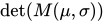
where is now the action of the bosonic fields, and is a matrix that encodes how the fermions were coupled to the bosons. The expectation value of an observable is therefore an average over all configurations weighted by :

If is positive, then it can be interpreted as a probability measure, and can be calculated by performing the sum over field configurations numerically, using standard techniques such as Monte Carlo importance sampling.

The sign problem arises when is non-positive. This typically occurs in theories of fermions when the fermion chemical potential is nonzero, i.e. when there is a nonzero background density of fermions. If , there is no particle–antiparticle symmetry, and , and hence the weight , is in general a complex number, so Monte Carlo importance sampling cannot be used to evaluate the integral.

Reweighting procedure

[edit]

A field theory with a non-positive weight can be transformed to one with a positive weight by incorporating the non-positive part (sign or complex phase) of the weight into the observable. For example, one could decompose the weighting function into its modulus and phase:

where is real and positive, so

Note that the desired expectation value is now a ratio where the numerator and denominator are expectation values that both use a positive weighting function . However, the phase is a highly oscillatory function in the configuration space, so if one uses Monte Carlo methods to evaluate the numerator and denominator, each of them will evaluate to a very small number, whose exact value is swamped by the noise inherent in the Monte Carlo sampling process. The "badness" of the sign problem is measured by the smallness of the denominator : if it is much less than 1, then the sign problem is severe. It can be shown[5] that

where is the volume of the system, is the temperature, and is an energy density. The number of Monte Carlo sampling points needed to obtain an accurate result therefore rises exponentially as the volume of the system becomes large, and as the temperature goes to zero.

The decomposition of the weighting function into modulus and phase is just one example (although it has been advocated as the optimal choice since it minimizes the variance of the denominator[6]). In general one could write

where can be any positive weighting function (for example, the weighting function of the theory).[7] The badness of the sign problem is then measured by

which again goes to zero exponentially in the large-volume limit.

Methods for reducing the sign problem

[edit]

The sign problem is NP-hard, implying that a full and generic solution of the sign problem would also solve all problems in the complexity class NP in polynomial time.[8] If (as is generally suspected) there are no polynomial-time solutions to NP problems (see P versus NP problem), then there is no generic solution to the sign problem. This leaves open the possibility that there may be solutions that work in specific cases, where the oscillations of the integrand have a structure that can be exploited to reduce the numerical errors.

In systems with a moderate sign problem, such as field theories at a sufficiently high temperature or in a sufficiently small volume, the sign problem is not too severe and useful results can be obtained by various methods, such as more carefully tuned reweighting, analytic continuation from imaginary to real , or Taylor expansion in powers of .[3][9]

List: current approaches

[edit]

There are various proposals for solving systems with a severe sign problem:

  • Contour deformation: The field space is complexified and the path integral contour is deformed from to another -dimensional manifold embedded in complex space.[10]
  • Meron-cluster algorithms: These achieve an exponential speed-up by decomposing the fermion world lines into clusters that contribute independently. Cluster algorithms have been developed for certain theories,[5] but not for the Hubbard model of electrons, nor for QCD i.e. the theory of quarks.
  • Stochastic quantization: The sum over configurations is obtained as the equilibrium distribution of states explored by a complex Langevin equation. So far, the algorithm has been found to evade the sign problem in test models that have a sign problem but do not involve fermions.[11]
  • Fixed-node Monte Carlo: One fixes the location of nodes (zeros) of the multiparticle wavefunction, and uses Monte Carlo methods to obtain an estimate of the energy of the ground state, subject to that constraint.[14]
  • Diagrammatic Monte Carlo: Stochastically and strategically sampling Feynman diagrams can also render the sign problem more tractable for a Monte Carlo approach which would otherwise be computationally unworkable.[15]

See also

[edit]

Footnotes

[edit]

References

[edit]
Revisions and contributorsEdit on WikipediaRead on Wikipedia
from Grokipedia
The numerical sign problem is a major obstacle in that arises in simulations of quantum many-body systems and lattice field theories when the probability weights or Boltzmann factors become negative, complex, or oscillating, leading to severe cancellations between positive and negative contributions and an exponential degradation of the as system size or inverse temperature increases. This issue fundamentally limits the applicability of standard importance-sampling techniques, which rely on positive-definite measures, rendering simulations inefficient or impossible for certain parameter regimes. The sign problem manifests prominently in fermionic systems due to the antisymmetric nature of the wave function, as well as in bosonic theories with complex actions, such as quantum chromodynamics (QCD) at finite baryon density where a chemical potential introduces a complex phase. In contexts like the Hubbard model for strongly correlated electrons, it prevents accurate studies of phenomena such as high-temperature superconductivity, Mott insulators, and quantum critical points, where the problem's severity often peaks near phase transitions. For instance, in determinant quantum Monte Carlo methods applied to the square-lattice Hubbard model, the average phase factor (a measure of sign-problem severity) forms a "dome" in the doping-temperature plane, correlating with pseudogap and potential d-wave superconducting phases. Despite its challenges, the sign problem has spurred diverse mitigation strategies, including complex , which extends sampling to complex manifolds; Lefschetz methods, which deform integration contours to regions of minimal phase oscillation; and density-of-states approaches, such as the LLR algorithm, that reconstruct observables from sign-averaged distributions. These techniques have shown promise in toy models and specific cases like the heavy-dense QCD limit or the repulsive at half-filling, but a general, controlled solution remains elusive, with ongoing research exploring and path-integral reformulations to bypass the issue. The problem's persistence underscores its status as one of the most significant unsolved challenges in numerical simulations of , impacting fields from condensed matter to .

Core Concepts

Definition and Origin

The numerical sign problem refers to the computational difficulty encountered when evaluating multi-dimensional integrals whose integrands exhibit rapid oscillations due to complex phase factors, resulting in severe cancellations among positive and negative contributions that render standard numerical methods inefficient or infeasible. This issue fundamentally arises in the context of , particularly when computing partition functions or path integrals for fermionic systems or systems at finite , where the effective Boltzmann weight transitions from real and positive to complex-valued, preventing the direct application of probabilistic sampling techniques like . The problem was first recognized in the 1980s during early numerical simulations of lattice (QCD) at finite density, where introducing a made the QCD action complex and disrupted the inherent to methods. Pioneering works, such as those by Hasenfratz et al. in 1983 and Nakamura in 1984, highlighted these challenges in lattice gauge theories with dynamical fermions. One key early response to the sign problem came in 1999 with the introduction of meron-cluster algorithms by Chandrasekharan and Wiese, which provided a strategy to mitigate severe sign oscillations in fermionic systems using cluster-based updates. A basic illustrative example of the sign problem appears in the simple fermionic two-site Hubbard model, where the partition function involves the determinant of a 2x2 fermion matrix that incorporates hopping and on-site interactions; at finite chemical potential or away from half-filling, this determinant acquires a complex phase, leading to oscillatory contributions that cause exponential signal-to-noise degradation in numerical evaluations.

Mathematical Formulation

The numerical sign problem arises in the evaluation of expectation values for observables in systems described by path integrals where the weight function becomes complex-valued, leading to oscillatory integrands that hinder Monte Carlo sampling. In general, the observable OO is given by the ratio of integrals O=dσO[σ]ρ[σ]dσρ[σ],O = \frac{\int d\sigma \, O[\sigma] \rho[\sigma]}{\int d\sigma \, \rho[\sigma]}, where σ\sigma represents the integration variables (e.g., fields or configurations), O[σ]O[\sigma] is the operator evaluated on configuration σ\sigma, and ρ[σ]\rho[\sigma] is the complex weight function, which can be decomposed as ρ[σ]=eiθ[σ]ρ[σ]\rho[\sigma] = e^{i\theta[\sigma]} |\rho[\sigma]| with θ[σ]\theta[\sigma] the phase and ρ[σ]|\rho[\sigma]| the modulus serving as a positive probability density for importance sampling. This decomposition allows rewriting the integrals in terms of averages over ρ[σ]|\rho[\sigma]|, but the phase factor eiθ[σ]e^{i\theta[\sigma]} introduces cancellations, making numerical estimation inefficient as the variance grows with the severity of oscillations. In fermionic systems, such as those encountered in quantum field theories or many-body physics, the weight ρ[σ]\rho[\sigma] incorporates a fermionic that becomes complex under certain conditions, notably at finite μ\mu. Specifically, ρ[σ]det(M[σ])\rho[\sigma] \propto \det(M[\sigma]), where M[σ]M[\sigma] is the fermion matrix depending on the bosonic configuration σ\sigma; for μ=0\mu = 0, MM is real and positive-definite (or anti-Hermitian), yielding a real determinant, but nonzero μ\mu renders MM non-Hermitian and det(M)\det(M) complex, sourcing the phase θ[σ]\theta[\sigma]. The full partition function takes the form Z=DϕeS[ϕ]det(M[ϕ]),Z = \int \mathcal{D}\phi \, e^{-S[\phi]} \det(M[\phi]), where ϕ\phi denotes bosonic fields, S[ϕ]S[\phi] is the real bosonic action, and the determinant arises from integrating out fermions, highlighting the oscillatory contribution from det(M[ϕ])\det(M[\phi]) as the primary origin of the problem. The severity of the sign problem is quantified by the average phase factor eiθ\langle e^{i\theta} \rangle, which measures the degree of cancellation and typically exhibits exponential decay with system size. In the thermodynamic limit, eiθeΔFV/T\langle e^{i\theta} \rangle \sim e^{-\Delta F V / T}, where ΔF\Delta F is the difference in free energy between the original complex measure and the modulus ρ|\rho|, VV is the spacetime volume, and TT the temperature; this scaling implies that the signal-to-noise ratio deteriorates exponentially, rendering direct Monte Carlo integration infeasible for large VV. This measure underscores the non-perturbative nature of the challenge, as even mild phase fluctuations accumulate destructively over the volume.

Physical Contexts

In Quantum Field Theory

In quantum field theories, particularly those involving s at finite density, the numerical sign problem emerges due to the introduction of a μ\mu that couples to conserved charges, such as . This μ\mu modifies the in the fermionic action, typically appearing as D+m+μγ0D + m + \mu \gamma^0, where DD is the covariant , mm is the mass, and γ0\gamma^0 is the temporal Dirac matrix. For real μ0\mu \neq 0, the det(D+m+μγ0)\det(D + m + \mu \gamma^0) becomes complex-valued, as the operator is no longer γ5\gamma^5-hermitian, leading to a phase that oscillates and violates the positivity of the measure required for efficient . A example occurs in lattice (QCD) at finite density, where the grand canonical partition function takes the form Z=DUeSg[U]det(D[U,μ]),Z = \int \mathcal{D}U \, e^{-S_g[U]} \det(D[U, \mu]), with the integral over gauge fields UU, the pure gauge action Sg[U]S_g[U], and the fermion determinant arising from integrating out quark fields. At μ=0\mu = 0, the determinant is real and positive (up to a known sign for staggered fermions), enabling standard . However, nonzero real μ\mu induces a nontrivial phase in det(D[U,μ])\det(D[U, \mu]), resulting in exponentially suppressed signal-to-noise ratios in averages, as contributions from different configurations cancel due to the oscillating . For imaginary chemical potential μ=iμI\mu = i \mu_I, the sign problem is absent because the determinant remains real and positive, allowing direct lattice simulations. This regime benefits from the Roberge-Weiss symmetry, a Z3\mathbb{Z}_3 periodicity in μI/T\mu_I / T with period 2π/32\pi / 3 (where TT is the ), stemming from the center symmetry of the SU(3) gauge group and leading to first-order transition lines at μI/T=(2k+1)π/3\mu_I / T = (2k+1)\pi / 3 for integer kk. These properties enable exploration of the QCD phase diagram along the imaginary μ\mu axis and extrapolation techniques to real μ\mu, though they do not circumvent the sign problem for physically relevant real values. In four-dimensional QCD, the sign problem's severity is particularly acute, with the average phase factor eiϕ\langle e^{i\phi} \rangle decaying exponentially with the lattice spacetime volume V=Ns3NtV = N_s^3 N_t and a severity parameter depending on μ/T\mu / T. For fixed lattice spacing and spatial extent, increasing NtN_t to access lower temperatures worsens the exponential suppression linearly with NtN_t, amplifying phase cancellations and rendering direct simulations infeasible for realistic Nt8N_t \gtrsim 8 in studies of the quark-gluon plasma phase transition.

In Many-Body Systems

In non-relativistic many-body physics, the numerical sign problem manifests prominently in simulations of fermionic systems using auxiliary-field (AFQMC) methods. In these approaches, the imaginary-time evolution operator is decomposed via a Hubbard-Stratonovich transformation, leading to a probabilistic weight given by the ensemble average eΔτH\langle e^{-\Delta \tau H} \rangle, where HH is the Hamiltonian and Δτ\Delta \tau is the time step. For fermions, this weight incorporates a arising from the single-particle , which introduces oscillatory phases or negative values due to the antisymmetric nature of the fermionic , resulting in severe sign oscillations that degrade statistical efficiency. A canonical example is the , which describes interacting electrons on a lattice and is central to understanding correlated materials. At half-filling, where the μ=0\mu = 0, particle-hole symmetry ensures that the fermionic determinant is real and positive on bipartite lattices, eliminating the sign problem and allowing reliable simulations. However, introducing doping—deviating from half-filling—breaks this symmetry, leading to complex phases in the elements and the emergence of a severe sign problem that exponentially suppresses the signal-to-noise ratio. The sign problem also arises in quantum spin models with geometric , where competing interactions prevent a unique alignment. In such systems, like the antiferromagnetic Heisenberg model on non-bipartite lattices, quantum simulations encounter negative Boltzmann weights due to the interference from frustrated bonds that favor conflicting spin configurations. For instance, in the spin-1/2 triangular lattice Heisenberg model, the frustration from the 120-degree Néel order introduces sign oscillations in the path integrals, complicating the study of properties and low-temperature phases. A particularly relevant case is the two-dimensional t-J model, derived from the strong-coupling limit of the and widely used to model in cuprates. At zero doping (J-only limit), the model reduces to the Heisenberg antiferromagnet, which is sign-problem-free on bipartite lattices; however, finite hole doping introduces mobile fermions whose determinants generate complex actions, causing exponential signal suppression that hinders direct simulations of superconducting pairing and stripe phases.

Consequences for Computation

Severity and Exponential Scaling

The numerical sign problem renders many quantum many-body simulations computationally intractable due to the exponential degradation of statistical efficiency in methods. The core issue stems from the average phase factor, defined as σ=eiθ\sigma = |\langle e^{i\theta} \rangle|, which measures the cancellation due to oscillatory weights. This quantity typically decays exponentially with system volume VV as σeΔFV/T\sigma \sim e^{-\Delta F V / T}, where ΔF\Delta F is the difference in free energy between the full and its absolute-value counterpart, and TT is the . This exponential suppression implies that the sign problem's severity grows rapidly with system size, often limiting reliable simulations to small volumes. In estimators, the variance of observables scales inversely with σ2\sigma^2, leading to Vare2ΔFV/T\mathrm{Var} \sim e^{2 \Delta F V / T}. Achieving a fixed relative precision thus requires a number of samples scaling as e2ΔFV/Te^{2 \Delta F V / T}, resulting in exponential computational cost. This scaling establishes the sign problem as fundamentally hard; Troyer and Wiese demonstrated that solving it in time would imply a polynomial-time solution to all NP-complete problems, proving its . One naive approximation to circumvent the sign problem is phase quenching, which replaces the full weight ρ\rho with its modulus ρ|\rho| to generate positive-definite distributions amenable to standard sampling. However, this introduces systematic biases by neglecting phase cancellations, rendering results approximate and unreliable for precise physics, particularly in regimes where σ\sigma is small. In three-dimensional systems, the severity parameter f=ΔF/Tf = \Delta F / T typically ranges from 0.1 to 1, severely restricting simulations to volumes with V/T310V / T^3 \lesssim 10, beyond which signal-to-noise ratios become impractically low.

Impact on Monte Carlo Methods

The numerical sign problem severely disrupts Monte Carlo simulations by undermining the foundational principle of importance sampling, which relies on positive-definite weights to interpret configurations as probabilities in a stochastic process. When the fermion determinant becomes complex due to finite chemical potential or other asymmetries, the weights acquire oscillating phases, preventing direct probabilistic sampling and leading to exponentially vanishing efficiency as the average phase factor eiθ\langle e^{i\theta} \rangle approaches zero. This failure manifests as an inability to generate unbiased configurations efficiently, rendering standard algorithms like hybrid Monte Carlo inapplicable without modifications. A key consequence is the degradation of the signal-to-noise ratio, where the effective sample size NeffN_{\text{eff}} collapses to Neff=Nσ2N_{\text{eff}} = N \sigma^2, with NN the total number of samples and σ2eiθ2\sigma^2 \approx \langle e^{i\theta} \rangle^2 the squared average . Since eiθ\langle e^{i\theta} \rangle decays exponentially with system and inverse —consistent with the exponential scaling of the problem's severity—statistical errors in observables grow exponentially, demanding infeasibly large NN to achieve reliable precision. This noise dominance overwhelms the physical signal, making variance estimates unreliable and simulations practically useless beyond mild parameter regimes. In lattice (QCD), this impact is particularly acute: simulations at to temperature ratios μ/T>1\mu/T > 1 become infeasible, as the overwhelming noise obscures signals for or other finite-density observables, limiting reliable computations to μ/T1\mu/T \lesssim 1. One common workaround involves sampling from the phase-quenched ensemble, where configurations are generated using the absolute value of the to maintain positive weights, followed by reweighting with the . However, this approach suffers from dramatically increased autocorrelation times in the , exacerbating critical slowing down and further inflating computational costs, especially near phase transitions.

Basic Mitigation Strategies

Reweighting Procedure

The reweighting procedure addresses the numerical sign problem by sampling from a sign-problem-free ensemble and correcting for the oscillatory phase through importance sampling. In this approach, configurations are generated according to the phase-quenched probability distribution P0[σ]=ρ[σ]Z0P_0[\sigma] = \frac{|\rho[\sigma]|}{Z_0}, where ρ[σ]\rho[\sigma] is the original integrand (e.g., eS[σ]detM[σ]e^{-S[\sigma]} \det M[\sigma] in lattice QCD), ρ[σ]|\rho[\sigma]| is its modulus, and Z0=Dσρ[σ]Z_0 = \int D\sigma \, |\rho[\sigma]| is the corresponding partition function, which admits efficient Monte Carlo sampling since it is real and positive. Observables in the original ensemble are then obtained via phase reweighting. For an observable O[σ]O[\sigma], its expectation value is given by O=Oeiθ0eiθ0,\langle O \rangle = \frac{\langle O e^{i\theta} \rangle_0}{\langle e^{i\theta} \rangle_0}, where θ[σ]\theta[\sigma] is the phase of ρ[σ]\rho[\sigma] (i.e., eiθ=ρ/ρe^{i\theta} = \rho / |\rho|), and the averages 0\langle \cdot \rangle_0 are taken with respect to the phase-quenched distribution P0P_0. The full partition function follows similarly as Z=Z0eiθ0Z = Z_0 \langle e^{i\theta} \rangle_0. This method is exact in principle, as it relies on the identity for reweighting between ensembles differing by a known factor. The statistical error of reweighted observables is amplified by fluctuations in the . The variance of O\langle O \rangle is approximately Var(O)O20O2σ2N,\mathrm{Var}(O) \approx \frac{\langle O^2 \rangle_0 - \langle O \rangle^2}{\sigma^2 N}, where NN is the number of sampled configurations, and σ=eiθ0\sigma = |\langle e^{i\theta} \rangle_0| is the magnitude of the average , which quantifies the severity of the problem (with σ1\sigma \to 1 indicating negligible oscillations). As σ\sigma decreases, the effective deteriorates exponentially, requiring N1/σ2N \sim 1/\sigma^2 samples for reliable estimates. This procedure is effective only in regimes where the phase fluctuations are mild, such as small μ\mu (e.g., μ/T1\mu/T \lesssim 1) and high temperatures TT, where σ\sigma remains sufficiently large (typically σ0.1\sigma \gtrsim 0.1). It becomes impractical when σ<103\sigma < 10^{-3}, as the noise overwhelms the signal even with massive computational resources. Historically, reweighting was applied in early 2000s lattice studies to compute Taylor coefficients of the equation of state at finite density via expansions around μ=0\mu = 0. For instance, expansions of the pressure up to fourth order in μq/T\mu_q/T were obtained by reweighting quark determinants and fermionic operators, enabling estimates of thermodynamic quantities relevant to heavy-ion collisions. These efforts demonstrated the method's utility for perturbative access to finite-density physics before more advanced techniques emerged.

Series Expansions and Analytic Continuation

One approach to circumventing the numerical sign problem involves perturbative series expansions of thermodynamic observables around zero chemical potential, where simulations are free from phase oscillations. In lattice (QCD), the pressure p(μ)/T4p(\mu)/T^4 can be expanded as a in powers of the baryon chemical potential over temperature, p(μ)/T4=n=0cn(μB/T)np(\mu)/T^4 = \sum_{n=0} c_n (\mu_B / T)^n, with coefficients cnc_n computed via stochastic estimators of the corresponding derivatives at μB=0\mu_B = 0. These derivatives are evaluated using reweighting from the zero-chemical-potential ensemble, allowing reliable calculations up to eighth or higher order in recent studies. This method exploits the absence of the sign problem at μB=0\mu_B = 0, providing an indirect probe of finite-density physics through the series coefficients. To extend the applicability of these to larger real μB/T\mu_B / T, techniques are employed, transforming the power series into forms that better capture the analytic structure in the . Padé approximants, which represent the series as ratios of polynomials, offer improved convergence beyond the radius limited by nearby singularities, while Bayesian methods incorporate prior information on the functional form to estimate uncertainties in the . For instance, the HotQCD collaboration utilized Padé approximants on Taylor coefficients up to sixth order to analytically continue the equation of state, reliably estimating properties up to μB/T2\mu_B / T \approx 2 in the temperature range around the pseudocritical crossover. In lattice models exhibiting the problem, such as fermionic systems or frustrated spin models, cluster expansions provide an alternative perturbative framework, particularly effective at high s. These high-temperature expansions express the partition function as a series in the inverse β=1/T\beta = 1/T, using connected diagrams on finite clusters that are exactly solvable without issues. For small system sizes, numerical linked-cluster expansions sum contributions from increasingly larger clusters to obtain results, often converging faster than direct reweighting methods due to the suppression of unphysical contributions at high TT. The utility of these series methods is inherently bounded by the , determined by the distance to the nearest singularity in the complex plane. In QCD, the Roberge-Weiss periodicity under imaginary μB\mu_B imposes a fundamental limit, with the closest singularity typically at μBiπT/3\mu_B \sim i \pi T / 3, yielding a convergence radius of approximately μB/Tπ/3\mu_B / T \approx \pi / 3 for real expansions.

Advanced Techniques

Contour Deformation Methods

Contour deformation methods address the numerical sign problem by exploiting the analyticity of the path integral in the to shift integration contours away from oscillatory regions. In the context of path integrals, the action S(z)S(z) is extended holomorphically to complex fields zz, allowing deformation of the original real contour while preserving the integral's value, provided no singularities are crossed. This approach draws on Picard-Lefschetz theory, which provides a framework for deforming contours to steepest descent paths known as Lefschetz thimbles, where the imaginary part of the action Im(S)\mathrm{Im}(S) remains constant along each thimble, thereby minimizing phase oscillations from exp(iIm(S))\exp(i \mathrm{Im}(S)). The core of the Lefschetz thimble method involves identifying critical points of the action where S(zc)=0\nabla S(z_c) = 0, and constructing thimbles as downward flow lines emanating from these points. The flow equation governing the thimble is given by dzdt=S(z),\frac{dz}{dt} = \overline{\nabla S(z)}, where the overline denotes complex conjugation, ensuring the flow is anti-holomorphic and that Re(S)\mathrm{Re}(S) decreases monotonically while Im(S)\mathrm{Im}(S) stays constant. This deformation reduces the sign problem by aligning the integration path with directions of minimal phase variation, as demonstrated in toy models like the one-site , where phase fluctuations are significantly suppressed compared to the original real contour. The full path integral is then a sum over relevant thimbles, weighted by intersection numbers that account for how the original contour intersects the dual thimble structure. Applications of these methods have proven effective in specific physical contexts suffering from severe sign problems. In 0+1-dimensional quantum field theories, such as quantum mechanical models like the Thirring model, contour deformations enable accurate computation of time-dependent correlation functions, validated against exact solutions from the and . Similarly, in heavy-dense QCD, where the fermion determinant introduces strong oscillations at finite , Lefschetz thimble integrations yield reliable estimates of observables like the charge density and Polyakov loop near the critical . To perform Monte Carlo sampling on these deformed manifolds, hybrid Monte Carlo algorithms have been adapted for Lefschetz thimbles by incorporating constraint forces that keep trajectories on the thimble surface. These methods, tested on scalar ϕ4\phi^4 theories, generate configurations with positive-definite effective actions but face challenges from residual sign problems arising in multi-thimble contributions. Normalization is further complicated by the need to compute intersection numbers accurately, as incorrect weighting can lead to biased results; for instance, in heavy-dense QCD, multiple thimbles (up to three) must be included to capture the full intersection structure.

Cluster and Diagrammatic Approaches

Cluster and diagrammatic approaches to the numerical problem leverage graph-based sampling techniques to enhance and promote cancellations of oscillating phases in simulations, particularly for fermionic systems where the sign problem originates from antisymmetric wave functions. These methods discretize the configuration space into clusters or diagrams, allowing updates that flip multiple elements simultaneously and thereby mitigate the of signal-to-noise ratios. The meron-cluster algorithm addresses the fermion sign problem by identifying and collectively updating "merons," which are topological defects in world-line configurations that contribute negative signs. In the , merons appear as pairs or clusters causing phase oscillations, and the algorithm builds clusters around these defects to improve sampling efficiency and ergodicity across sign sectors. Introduced for systems like the , this approach enables simulations at finite densities and temperatures where traditional methods fail due to severe sign cancellations. Diagrammatic Monte Carlo (DiagMC) expands the partition function or Green's functions in terms of skeleton Feynman diagrams, sampling connected graphs stochastically where positive and negative contributions cancel pairwise, alleviating the problem. This technique is particularly effective for dilute Fermi gases, where it computes thermodynamic by summing series of diagrams up to high orders without direct of fermionic determinants. In the context of the Fermi polaron problem, DiagMC has yielded precise results for resonant interactions in ultracold atomic gases, demonstrating convergence even in regimes with strong correlations. Stochastic perturbation theory, integrated within DiagMC frameworks, resums infinite diagrammatic series through sampling of Feynman graphs, bypassing the computational overhead of full calculations that exacerbate the problem. By focusing on connected diagrams and using bold-line propagators that incorporate effects, this method achieves sign-problem tolerance in interacting systems. In frustrated spin systems, loop-cluster updates significantly reduce sign oscillations, improving autocorrelation times by factors of 10 to 100 in small clusters compared to local updates. These algorithms construct loops along world-lines and flip them collectively, enhancing exploration of the configuration space while preserving .

Emerging Developments

The inchworm (IWC) method represents a hybrid deterministic- approach designed to address the numerical sign problem in simulating strongly correlated fermionic systems, particularly for real-time dynamics and nonequilibrium processes. Introduced as an iterative solution to the Dyson equation, IWC employs sampling to evaluate insertions in a perturbation series while deterministically updating the , thereby avoiding the computation of full determinants that exacerbate sign oscillations in traditional techniques. This framework was formalized in foundational work demonstrating its efficacy for quantum impurity models and open quantum systems, where it propagates Green's functions step-by-step, reusing prior computations to extend simulation times efficiently. A key variant, bold diagrammatic Monte Carlo (BDMC), extends self-consistent perturbation theory by incorporating "bold" lines that represent fully dressed propagators and vertices, allowing for the resummation of infinite diagrammatic series while mitigating the sign problem through cancellations inherent in the bold vertex functions. In BDMC, the sampling focuses on skeleton diagrams with dressed building blocks, which reduces the proliferation of sign-inconsistent terms compared to bare diagrammatic expansions, enabling convergence even in regimes with moderate sign fluctuations. This approach has proven particularly robust for polaron models and interacting many-body systems, where the self-consistent dressing enhances numerical stability. Recent advancements in IWC-related algorithms have targeted doped Hubbard models, where the sign problem intensifies away from half-filling. A 2024 perturbative scheme employs strong-coupling expansion around a particle-hole symmetric reference point (with zero and nearest-neighbor hopping only), treating doping via first-order corrections in the and next-nearest-neighbor hopping using dual fermion theory informed by continuous-time data for two-particle vertices. This method resolves the sign problem for doping levels up to 10% in cuprate-like parameters (U/t = 8, t'/t = -0.3), revealing pseudogap features at antinodal momenta and coherent quasiparticles at nodal points on an 8×8 lattice at low temperatures (T/t = 0.1). IWC algorithms notably reduce the exponential error growth associated with the sign problem in real-time , achieving subexponential scaling in propagation time and applicability to dissipative open without auxiliary field sign issues. Building on diagrammatic expansions, these methods have been analyzed through 2025 for multi-orbital impurities, confirming their numerical exactness and sign suppression via iterative resummation.

Quantum Computing and Applications

Quantum computing offers a promising avenue to circumvent the numerical sign problem in simulations of fermionic systems by leveraging the inherent ability of quantum hardware to represent superpositions and anti-symmetric wavefunctions without classical sampling of oscillating phases. Variational quantum eigensolvers (VQE) enable direct optimization of trial wavefunctions on quantum devices, avoiding the need for over sign-oscillating distributions typical in classical methods. This approach maps fermionic operators to qubits via transformations like Jordan-Wigner, allowing exact representation of the fermionic statistics and thus bypassing the sign problem entirely for ground-state calculations in small to medium-sized systems. Similarly, quantum implementations of stochastic series expansion (SSE) have been developed, where the quantum computer performs the series expansion and operator sampling in a sign-problem-free manner by preparing and measuring superposition states directly, demonstrating efficiency advantages over classical SSE for frustrated spin systems. Machine learning techniques have emerged as powerful tools to mitigate the sign problem by learning effective mappings that reduce phase cancellations in Monte Carlo sampling. Neural networks can be trained to approximate complex contour deformations or reweighting factors that minimize the average phase, such as in the where restricted Boltzmann machines guide projective simulations to alleviate sign oscillations away from half-filling. Flow-based generative models, which transform simple distributions into complex target distributions via invertible neural networks, enable efficient sampling of fermionic lattice field theories by learning the phase-quenching structure, potentially reducing the severity of the sign problem in theories with mild oscillations. For instance, has been applied to find integration paths beyond traditional Lefschetz thimbles to address the sign problem in lattice field theories. In heavy-dense QCD, there is significant overlap between sign-optimized manifolds and Lefschetz thimbles, which can improve convergence in high-density regimes. Recent advancements highlight interdisciplinary applications, such as overcoming the sign problem in Wigner phase-space dynamics through adaptive corrections to trajectories, enabling reliable simulations in high-dimensional settings previously intractable due to exponential sign cancellations. In a 2024 study, sequential-clustering particle annihilation via discrepancy estimation () adaptively mitigates negative weights in particle-based Wigner methods, achieving stable dynamics for with up to dozens of . Additionally, the constant offset method introduces shifts in fermionic path integrals to minimize sign averages, particularly effective in two-dimensional systems like the doped , where it reduces the sign problem severity by orders of magnitude without altering physical observables. These developments, spanning 2023–2025, underscore the potential of hybrid quantum-ML paradigms to tackle longstanding computational barriers in quantum many-body physics.

References

Add your contribution
Related Hubs
User Avatar
No comments yet.