
Recent from talks
Obturator artery
Knowledge base stats:
Talk channels stats:
Members stats:
Obturator artery
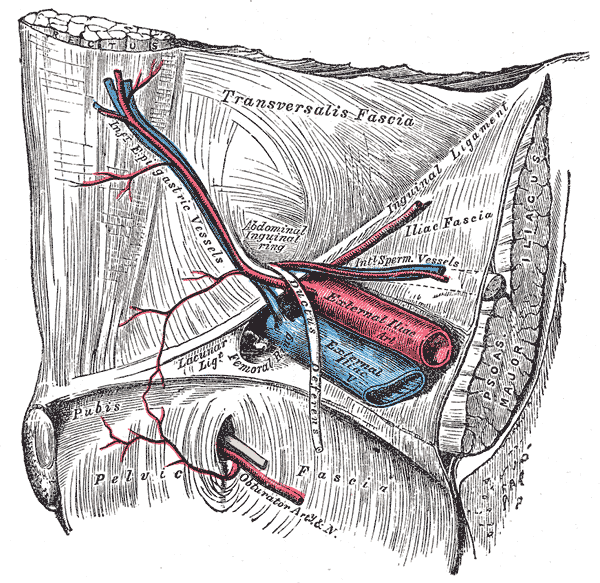
The obturator artery is a branch of the internal iliac artery that passes antero-inferiorly (forwards and downwards) on the lateral wall of the pelvis, to the upper part of the obturator foramen, and, escaping from the pelvic cavity through the obturator canal, it divides into an anterior branch and a posterior branch.
In the pelvic cavity this vessel is in relation, laterally, with the obturator fascia; medially, with the ureter, ductus deferens, and peritoneum; while a little below it is the obturator nerve.
The obturator artery usually arises from the internal iliac artery. Inside the pelvis the obturator artery gives off iliac branches to the iliac fossa, which supply the bone and the Iliacus, and anastomose with the ilio-lumbar artery; a vesical branch, which runs backward to supply the bladder; and a pubic branch, which is given off from the vessel just before it leaves the pelvic cavity.
The pubic branch ascends upon the back of the pubis, communicating with the corresponding vessel of the opposite side, and with the inferior epigastric artery.
After passing through the obturator canal and outside of the pelvis, the obturator artery divides at the upper margin of the obturator foramen, into an anterior branch and a posterior branch of the obturator artery which encircle the foramen under cover of the obturator externus.
The anterior branch of the obturator artery is a small artery in the thigh and runs forward on the outer surface of the obturator membrane and then curves downward along the anterior margin of the obturator foramen.
It distributes branches to the obturator externus, pectineus, adductors, and gracilis muscle, and anastomoses with the posterior branch and with the medial femoral circumflex artery.
The posterior branch of the obturator artery is a small artery in the thigh and follows the posterior margin of the foramen and turns forward on the inferior ramus of the ischium, where it anastomoses with the anterior branch.
Hub AI
Obturator artery AI simulator
(@Obturator artery_simulator)
Obturator artery
The obturator artery is a branch of the internal iliac artery that passes antero-inferiorly (forwards and downwards) on the lateral wall of the pelvis, to the upper part of the obturator foramen, and, escaping from the pelvic cavity through the obturator canal, it divides into an anterior branch and a posterior branch.
In the pelvic cavity this vessel is in relation, laterally, with the obturator fascia; medially, with the ureter, ductus deferens, and peritoneum; while a little below it is the obturator nerve.
The obturator artery usually arises from the internal iliac artery. Inside the pelvis the obturator artery gives off iliac branches to the iliac fossa, which supply the bone and the Iliacus, and anastomose with the ilio-lumbar artery; a vesical branch, which runs backward to supply the bladder; and a pubic branch, which is given off from the vessel just before it leaves the pelvic cavity.
The pubic branch ascends upon the back of the pubis, communicating with the corresponding vessel of the opposite side, and with the inferior epigastric artery.
After passing through the obturator canal and outside of the pelvis, the obturator artery divides at the upper margin of the obturator foramen, into an anterior branch and a posterior branch of the obturator artery which encircle the foramen under cover of the obturator externus.
The anterior branch of the obturator artery is a small artery in the thigh and runs forward on the outer surface of the obturator membrane and then curves downward along the anterior margin of the obturator foramen.
It distributes branches to the obturator externus, pectineus, adductors, and gracilis muscle, and anastomoses with the posterior branch and with the medial femoral circumflex artery.
The posterior branch of the obturator artery is a small artery in the thigh and follows the posterior margin of the foramen and turns forward on the inferior ramus of the ischium, where it anastomoses with the anterior branch.
Recent media