Hubbry Logo
Iliacus muscleIliacus muscleMain
Open search
Iliacus muscle
Community hub
Iliacus muscle
logo
8 pages, 0 posts
0 subscribers
Be the first to start a discussion here.
Iliacus muscle
Iliacus muscle
from Wikipedia
Iliacus muscle
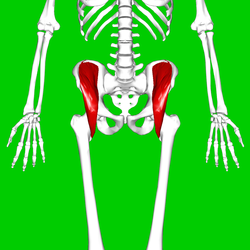
Position of iliacus muscle (shown in red)
The iliacus and nearby muscles
Details
Pronunciation/ɪˈl.əkəs/
OriginUpper two-thirds of the iliac fossa
InsertionBase of the lesser trochanter of femur
ArteryMedial femoral circumflex artery, iliac branch of iliolumbar artery
NerveFemoral nerve
ActionsFlexes and rotates medially thigh[citation needed]
AntagonistGluteus maximus
Identifiers
Latinmusculus iliacus
TA98A04.7.02.003
TA22594
FMA22310
Anatomical terms of muscle

The iliacus is a flat, triangular muscle which fills the iliac fossa. It forms the lateral portion of iliopsoas, providing flexion of the thigh and lower limb at the acetabulofemoral joint.

Structure

[edit]

The iliacus arises from the iliac fossa on the interior side of the hip bone, and also from the region of the anterior inferior iliac spine (AIIS). It joins the psoas major to form the iliopsoas.[1] It proceeds across the iliopubic eminence through the muscular lacuna to its insertion on the lesser trochanter of the femur.[1] Its fibers are often inserted in front of those of the psoas major and extend distally over the lesser trochanter.[2]

Nerve supply

[edit]

The iliopsoas is innervated by the femoral nerve and direct branches from the lumbar plexus.[3]

Function

[edit]

In open-chain exercises, as part of the iliopsoas, the iliacus is important for lifting (flexing) the femur forward (e.g. front scale). In closed-chain exercises, the iliopsoas bends the trunk forward and can lift the trunk from a lying posture (e.g. sit-ups, back scale) because the psoas major crosses several vertebral joints and the sacroiliac joint. From its origin in the lesser pelvis the iliacus acts exclusively on the hip joint.[2]

Additional images

[edit]

Notes

[edit]

References

[edit]
[edit]
Revisions and contributorsEdit on WikipediaRead on Wikipedia
from Grokipedia
The iliacus muscle is a fan-shaped, triangular muscle located in the iliac fossa of the pelvis, forming the iliac portion of the iliopsoas muscle complex, which serves as the primary flexor of the hip joint and stabilizer of the pelvis on the femur. It originates primarily from the upper two-thirds of the iliac fossa, the internal lip of the iliac crest, the lateral aspect of the sacrum, the ventral sacroiliac ligament, and the lower portion of the iliolumbar ligament. The muscle fibers converge inferiorly to merge with the tendon of the psoas major muscle, inserting collectively onto the anterior surface of the lesser trochanter of the femur, with some fibers attaching directly to the femur. As part of the unit, the iliacus muscle enables flexion of the at the joint, particularly during activities like walking, running, and , while also contributing to slight abduction and external of the when acting in concert with the psoas major. It is innervated by the (L1-L3 spinal segments), which provides motor supply through its anterior branches, ensuring coordinated contraction for lower limb movement. Blood supply to the iliacus arises mainly from the iliac branches of the internal and external iliac arteries, including the lumbar branch of the iliopsoas artery, supporting its metabolic demands during dynamic hip actions. Clinically, the iliacus muscle is encased by the iliac fascia and is relevant in conditions such as tendinopathy, , or hematomas, which can cause anterior and mimic other abdominal pathologies due to its deep pelvic position. Variations in its anatomy, such as accessory slips or atypical insertions, occur in a small percentage of individuals and may influence surgical approaches in the pelvic region.

Anatomy

Origin and insertion

The iliacus muscle exhibits a triangular, fan-shaped morphology that fills the iliac fossa, providing a broad base for its attachment within the pelvis. It originates primarily from the superior two-thirds of the on the internal surface of the ilium. Additional origins encompass the internal lip of the , the lateral aspect of the , and the anterior sacroiliac and iliolumbar ligaments. The muscle fibers converge inferiorly to insert at the base and lateral aspect of the lesser of the , typically merging with the tendon of the psoas major to form the . This combined insertion contributes to the formation of the compartment.

Structure and relations

The iliacus muscle is a flat, triangular muscle that fills the , with its muscle fibers fanning out superiorly and converging inferiorly to form a that merges with the tendon of the psoas major, collectively inserting onto the lesser of the . The muscle is enveloped by the iliac fascia, a layer of that separates it from the anteriorly and contributes to the formation of the compartment within the retroperitoneum, where it lies posterior to abdominal viscera such as the kidneys, , , and colon on the respective sides. Anteriorly, the iliacus is related to peritoneal contents, including the on the right and the on the left, while posteriorly it abuts the hip joint capsule, separated by the subtendinous iliac (also known as the iliopectineal ), which prevents friction during movement. Inferiorly, the unit, including the iliacus, passes through the muscular lacuna (lacuna musculorum) beneath the , coursing over the to enter the . Anatomical variations of the iliacus muscle include the presence of accessory slips arising from the or the , as well as variable degrees of fusion with the psoas major tendon, ranging from complete merging to partial separation; additionally, a supernumerary iliacus minor or the iliocapsularis muscle—a small accessory head inserting onto the hip joint capsule—may occur in some individuals.

Blood supply

The iliacus muscle, situated within the iliac fossa of the , receives its primary arterial blood supply from the iliac branch of the iliolumbar artery, a major branch of the that ascends along the to nourish the muscle's substance. This vessel provides the dominant nutrient flow, ensuring oxygenation and metabolic support to the fan-shaped muscle fibers originating from the . Additional arterial contributions arise from the , which supplies branches to the distal aspects of the muscle near its insertion on the , along with minor inputs from the , obturator artery, and . Venous drainage of the iliacus muscle follows a parallel course to its arterial supply, with the iliolumbar veins collecting deoxygenated blood from the muscle and directing it toward the internal iliac veins, ultimately joining the common iliac vein to return to the . This efficient vascular network supports the muscle's role in hip flexion while minimizing stasis in the deep pelvic compartment. In surgical contexts, such as pelvic procedures involving the for or lumbar spine interventions, precise awareness of the iliolumbar artery's trajectory over the iliacus muscle is essential to prevent iatrogenic injury, which could lead to hemorrhage or compromised muscle viability. Similarly, during urological or gynecological operations in the , ligation or disruption of these vessels must be avoided to maintain regional perfusion.

Innervation

The iliacus muscle receives its primary innervation from direct branches of the , which originates from the posterior divisions of the ventral rami of spinal nerves L2 through L4 within the . These branches typically enter the muscle on its deep surface in the , prior to the femoral nerve passing beneath the , providing consistent motor supply to facilitate hip flexion as part of the group. In addition to motor fibers that drive , the conveys sensory afferents, including proprioceptive fibers from muscle spindles and Golgi tendon organs, enabling feedback on muscle length and tension. Anatomical variations in innervation occur, with occasional direct branches from the (L1-L4) contributing to the iliacus, potentially independent of the pathway. Such variants can result in isolated neural supply to the iliacus, distinct from the direct branches (L1-L3) that predominantly innervate the psoas major.

Function

Primary actions

The iliacus muscle serves as a powerful hip flexor, primarily elevating the femur anteriorly in open-chain kinematics, such as lifting the thigh while seated. This action arises from its origin along the , where the muscle fibers generate a force vector that pulls the lesser of the femur forward and medially, facilitating smooth anterior elevation of the thigh relative to a fixed . The (L2-L4) innervates the muscle, enabling this contractile response during isolated hip flexion movements. In closed-chain activities, the iliacus contributes to trunk flexion by drawing the pelvis toward the fixed femur, as seen in sit-ups or rising from a . This role stabilizes the pelvis and supports anterior , enhancing overall forward bending of the torso. Additionally, the iliacus contributes to external rotation of the . This rotational component integrates with its flexor , which increases linearly with hip flexion up to approximately 15°–25° before plateauing.

Synergies and interactions

The iliacus muscle synergizes closely with the psoas major to form the complex, which collectively enhances the strength and efficiency of hip flexion by merging their tendons into a single insertion on the lesser of the . This combined action allows for more powerful and coordinated flexion compared to the muscles acting independently, as the iliacus provides additional leverage from its broad origin on the while the psoas major contributes from the . The synergy is particularly evident in dynamic movements requiring sustained hip elevation, where the distributes force to minimize strain on individual components. In opposition to hip flexion, the iliacus (as part of the ) is antagonized primarily by the and the posterior thigh muscles, including the hamstrings (biceps femoris long head, semitendinosus, and semimembranosus), which drive extension. During extension, these antagonists counteract the iliopsoas by pulling the posteriorly, maintaining balance in reciprocal movements such as walking or standing from a seated position. This antagonistic relationship ensures smooth transitions between flexion and extension, preventing excessive anterior . The iliacus contributes to pelvic stabilization during gait and posture to control trunk alignment and prevent excessive lumbar lordosis. In upright posture, selective activation of the iliacus helps anchor the pelvis to the femur, while abdominal co-contraction provides anterior counterforce for overall trunk stability. During gait, this interaction supports the swing phase by dynamically stabilizing the coxofemoral joint, reducing compensatory deviations in pelvic tilt. In biomechanical contexts like running and climbing, the (including the iliacus) interacts to counter gravitational forces through eccentric loading, decelerating the during swing and facilitating against body weight. This role is critical in energy transfer, where the muscle absorbs impact in running strides and generates upward lift in ascents, coordinating with hip extensors for fluid motion. Such interactions highlight the iliopsoas's importance in maintaining while mitigating shear stresses on the lumbo-pelvic .

Clinical significance

Injuries and pathology

Iliopsoas strain or commonly arises from overuse in athletes, such as runners, dancers, or those involved in sports requiring repetitive flexion, leading to microtrauma and of the muscle-tendon unit including the iliacus component. Patients typically experience anterior or pain that worsens with activity, accompanied by weakness in flexion and possible tenderness upon . This often manifests as a dull ache exacerbated by prolonged standing or sudden movements, distinguishing it from acute tears. Iliacus hematoma represents a serious injury, frequently triggered by direct trauma to the pelvis or spontaneous bleeding in patients on anticoagulation therapy, resulting in accumulation of blood within the muscle belly. The hematoma can expand rapidly due to the iliacus muscle's enclosed position within the iliac fossa, predisposing to compression of the adjacent femoral nerve and subsequent neuropathy characterized by quadriceps weakness, sensory loss in the anterior thigh, and knee buckling. Such events are more prevalent in individuals with coagulopathies, where even minor strain can initiate hemorrhage. Anticoagulant use heightens the risk of hematoma specifically, independent of trauma. The iliacus muscle is also implicated in iliopsoas and internal , where friction between the iliopsoas and underlying bony structures, such as the iliopectineal eminence or , irritates the adjacent . This repetitive friction generates audible or palpable snapping during hip extension or flexion, often accompanied by localized pain and inflammation that may involve the iliacus insertion. In chronic cases, thickening contributes to persistent , altering normal gliding mechanics. Key risk factors for these pathologies include repetitive hip flexion demands in athletic pursuits, which overload the complex, as well as poor such as imbalances that increase strain on the iliacus. Underlying hip further elevates susceptibility by promoting and compensatory overuse of the iliacus, exacerbating or formation through altered stability.

Diagnostic and therapeutic approaches

Diagnosis of iliacus muscle-related issues typically involves a combination of clinical evaluation and imaging modalities to identify conditions such as tears, hematomas, or associated bursitis. Ultrasound serves as an effective, dynamic tool for assessing the iliopsoas complex, including the iliacus, in cases of anterior hip pain, allowing real-time visualization of muscle integrity and fluid collections. Magnetic resonance imaging (MRI) is considered the preferred modality for detailed evaluation of the iliopsoas muscle and tendon, providing high-resolution images to detect tears, inflammation, or bursitis while differentiating from other hip pathologies. For iliopsoas bursitis specifically, ultrasound, computed tomography (CT), and MRI play key roles in confirming the diagnosis, often guiding fluid aspiration for further analysis. Electromyography (EMG), particularly needle EMG of the iliacus, is utilized to assess nerve involvement, such as in femoral neuropathy, by evaluating muscle electrical activity and localizing lesions proximal to the inguinal ligament. Clinical tests focus on assessing muscle tightness, weakness, or dysfunction. The is a standard maneuver to evaluate tightness, where the patient lies and flexes one hip while extending the other; a positive result indicates limited extension due to shortened hip flexors. Similarly, the iliopsoas stretch test, involving resisted hip flexion or passive stretching, helps identify hypertonicity or weakness in the group, including the iliacus component. Therapeutic approaches prioritize conservative management for most iliacus-related conditions. Initial treatment includes rest to avoid aggravating activities, application of ice for 20 minutes every 1-2 hours to reduce inflammation and pain, and nonsteroidal anti-inflammatory drugs (NSAIDs) to manage swelling and discomfort. is a cornerstone, emphasizing exercises for the to improve flexibility and strengthen supporting muscles, often continued for at least three months in cases. For iliopsoas bursitis, ultrasound-guided injections of corticosteroids and local anesthetics into the provide diagnostic confirmation and symptomatic relief in the majority of patients, avoiding more invasive options. Surgical interventions are reserved for cases due to the iliacus's proximity to major vascular structures like the and vein, which necessitates careful preoperative planning to minimize risks. Procedures may include tendon release or lengthening at the lesser for persistent , performed arthroscopically or percutaneously to alleviate snapping or impingement. In instances of significant formation causing compression, such as femoral neuropathy, surgical evacuation via a retroperitoneal approach is indicated to decompress the nerve and restore function, though conservative drainage may suffice in select cases.

References

Add your contribution
Related Hubs
User Avatar
No comments yet.