Hubbry Logo
Ofer PrisonOfer PrisonMain
Open search
Ofer Prison
Community hub
Ofer Prison
logo
8 pages, 0 posts
0 subscribers
Be the first to start a discussion here.
Ofer Prison
Ofer Prison
from Wikipedia

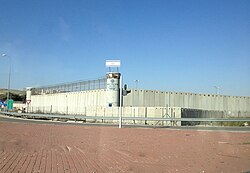
Ofer Prison (Hebrew: כלא עופר, Kele Ofer), formerly officially known as Incarceration Facility 385 (מתקן כליאה 385‎), is an Israeli military incarceration facility in the Israeli-occupied West Bank, between Beitunia and Giv'at Ze'ev. It is one of three prison facilities along with Megiddo and Ktzi'ot, the latter two located in Israel and not in the West Bank. Ofer Prison is run by the Israel Prison Service and like the other two facilities, used to be operated by the Israel Defense Forces' Military Police Corps.

Key Information

When under IDF control, it was capable of holding up to 800 prisoners, both tried and those under administrative detention.

NGOs have stated that the imprisonment of children is one of the human rights abuses taking place in Ofer Prison.[1]

History

[edit]

Camp Ofer was founded in December 1968, at the location of a former Jordanian Army base from before the Six-Day War. It was named after lieutenant colonel Zvi Ofer, the commander of the Haruv Reconnaissance Unit, who was killed in action earlier in the same year.[citation needed]

The prison was built in the base in 1988, after the onset of the First Intifada. Following the Oslo Accords, and the numerous prisoner releases of 1995, Ofer's remaining prisoners and detainees were moved to Megiddo Prison, and Ofer was closed.[2]

It was officially re-opened on March 29, 2002, as part of Operation Defensive Shield. Its full construction was set to be completed on August 10, 2002.

On October 3, 2006, control of Ofer Prison was moved to the Israel Prison Service, making it the last incarceration facility for Palestinians to be moved to the IPS (although two detention centers in the West Bank are still controlled by the Military Police Corps).

Human rights abuses

[edit]

Many detainees at Ofer prison have reported systematic humiliation and abuse, including beatings by guards and near-constant handcuffing, and conditions as brutal as what they had endured at Sde Teiman detention camp.[3]

Non-governmental organizations such has Machsom Watch have reported the imprisonment of children in Ofer Prison.[1] A delegation of British MPs visiting the facilities alleged that handcuffing children was a human rights abuse.[4] A delegation of British lawyers who also visited the facilities observed the use of iron shackles on children, which they considered to be in breach of Article 40 of the UN Convention on the Rights of the Child and the UN Standard Minimum Rules.[5][failed verification]

Torture and death of Adnan al-Bursh

[edit]

On April 19, 2024, Dr. Adnan al-Bursh, the head of orthopedics at Al-Shifa Hospital in Gaza City, died at Ofer Prison. He had been arrested by Israeli forces in the Gaza Strip. The Israeli authorities did not notify his family and refused to disclose any details about his death. Fellow prisoners who knew him and had been released said that al-Bursh appeared badly tortured and starved before his death in custody.[6] Palestinian authorities and advocacy groups have attributed his death to torture and mistreatment in custody, with the OHCHR confirming his body showed signs of torture.[7]

Gideon Levy wrote in Haaretz that al-Bursh was tortured and beaten to death in an Israeli jail, and that the response of the Israel Prison Service—“The service does not address the circumstances of the deaths of detainees who are not Israeli citizens.”—was pure audacity.[8]

Staff

[edit]

As of 2006, Ofer Prison is staffed by the Israel Prison Service, which took control of it in 2006. The staff consists of jailors and officers, as well as a contingent of IPS's special unit, Rapid Response Unit (Keter), and interrogators from the Shabak.[citation needed]

Before IPS, the prison was run by the IDF's Military Police Corps. The staff included soldiers who completed the Palestinian detainees' jailors (Hebrew: מטפלי עצורי השטחים, Metaplei Atzurei HaShtahim) course, including the Company for Special Tasks (abbr. Palmam). The prison as a whole was a battalion-level unit, commanded by a lieutenant colonel.[citation needed]

Commanders

[edit]

Ofer Prison is headed by Colonel Eran Fire.

References

[edit]
Revisions and contributorsEdit on WikipediaRead on Wikipedia
from Grokipedia

Ofer Prison is a military detention facility operated by the Israel Defense Forces (IDF) in the , located between and . It primarily holds detained on suspicion of security offenses, including terrorism-related activities, often under orders that permit holding without formal charges or trial. Established as part of 's post-1967 occupation security infrastructure, the facility functions under military jurisdiction distinct from civilian prisons managed by the . Following the October 7, 2023, attacks on , a new section was constructed at Ofer to detain increased numbers of suspects from Gaza, with IDF statements emphasizing improved conditions to meet legal requirements. The prison has been notable for internal prisoner dynamics, such as temporary cooperation between rival Palestinian factions, and has faced persistent allegations of , inadequate medical care, and mistreatment, though such claims predominantly originate from advocacy organizations and media outlets with documented anti- leanings, prompting Israeli rebuttals citing oversight and compliance mechanisms.

Location and Facilities

Site and Infrastructure

Ofer Prison is situated within the in the , specifically in the area of village, approximately 10 kilometers west of and northwest of . The facility lies along Highway 443, accessible via checkpoints that separate it from surrounding Palestinian areas. As part of a secured installation in occupied territory, the prison is surrounded by perimeter fencing, watchtowers, and controlled access points to prevent unauthorized entry. The infrastructure comprises multiple detention wings for holding security prisoners, administrative buildings operated by the (IPS), and adjacent structures including a military court and additional detention facilities in Ofer Camp. These components support , , and incarceration processes, with separate entrances for the prison and court areas. The site's layout emphasizes compartmentalization for security, integrating electronic surveillance and barriers typical of Israeli military detention centers in the .

Capacity and Operations

Ofer Prison functions as a high-security detention facility under the management of the (IPS), specializing in security prisoners and administrative detainees primarily from the . Following the transfer of operational control from the (IDF) to the IPS on October 3, 2006, the facility has been adapted for larger-scale incarceration of individuals charged or detained under security-related pretexts, including those awaiting military court proceedings at the adjacent Ofer Military Court. The prison's capacity supports the holding of several hundred to over a thousand inmates at peak periods, as evidenced by reports of more than 400 Palestinian prisoners detained there alongside other facilities during specific escalations. Expansions since the IPS takeover have enabled it to handle surges in detainee numbers, such as the doubling of overall Palestinian prisoners system-wide to over 10,000 within weeks after , 2023, with Ofer accommodating hundreds in that context. has been a recurring issue, with IPS system-wide occupancy exceeding designed limits—reaching 165% in some metrics by mid-2025—prompting internal adjustments like infrastructure upgrades at Ofer to enhance holding capabilities. Daily operations emphasize containment and risk mitigation for high-threat populations, featuring segregated housing units, restricted movement outside cells, and continuous monitoring by IPS staff trained in security protocols. Inmate routines typically include scheduled meals, limited outdoor exercise, and hygiene access, though detainee accounts and NGO monitoring highlight constraints like reduced water availability (e.g., 45 minutes daily in some cases) and basic rations amid density pressures. Legal visits and family contact are permitted under supervised conditions, with administrative detainees—numbering over 3,500 system-wide as of October 2025—facing indefinite holds without charge, subject to periodic reviews. IPS maintains adherence to domestic and international norms for treatment, including complaint mechanisms, while organizations like , which focus on Palestinian rights and have documented systemic issues, report deviations such as inadequate medical care and hygiene, potentially exacerbated by post-2023 influxes; these claims warrant scrutiny given the groups' orientation but align with patterns in verified detainee releases.

Historical Development

Establishment Post-Six-Day War

Following Israel's victory in the , which concluded on June 10, 1967, the Israel Defense Forces (IDF) assumed control of the , including the establishment of a to administer security and detain individuals suspected of threats to public order. This occupation framework necessitated expanded incarceration infrastructure for Palestinian security detainees, as arrests rose significantly in the ensuing decades; by the late 1980s, over one million had been detained since 1967 according to estimates from monitors. Ofer Prison, situated on the grounds of an existing IDF base northwest of near , was established in 1988 as Incarceration Facility 385 to address the acute overcrowding in detention centers triggered by mass arrests at the outset of the in December 1987. The facility was constructed hastily under IDF oversight to hold thousands of Palestinians charged with security offenses, incorporating a court, interrogation units, and holding cells integrated into the base's perimeter. Initial capacity focused on short-term and trial processing, reflecting the 's need for rapid expansion amid widespread unrest involving stone-throwing, Molotov cocktails, and organized resistance. The prison's design emphasized security over long-term habitation, with prefabricated structures and fenced enclosures adapted from the base's logistics area, enabling efficient processing of detainees under military orders like Order No. 378, which governed arrests without trial in occupied territories. Early operations prioritized segregation of high-risk prisoners, setting the stage for Ofer's role as a primary hub for , distinct from pre-1967 Jordanian facilities or earlier ad hoc IDF camps.

Evolution Under IDF and IPS Control

Following its establishment after the 1967 Six-Day War, Ofer Prison functioned under the exclusive operational control of the Israel Defense Forces (IDF), primarily detaining Palestinian security suspects, including those held under administrative detention without trial. The facility's military administration emphasized rapid processing of detainees amid ongoing counterterrorism operations in the West Bank, with IDF personnel handling security, interrogations, and daily operations. A significant administrative shift occurred on October 3, 2006, when responsibility for Ofer Prison was formally transferred from the IDF to the (IPS), marking the completion of the handover for Israel's last major military-run facility for Palestinian inmates. This move aligned with a 2004-2006 reorganization of the prison , during which IPS assumed control of other sites like Megiddo in 2005 and Ketziot earlier in 2006, aiming to centralize management under a agency specialized in long-term incarceration. Post-transfer, IPS implemented standardized protocols for prisoner classification, medical care, and rehabilitation programs, though the facility retained its high-security designation for handling terrorism-related convictions and detentions. Under IPS oversight, Ofer has adapted to fluctuating detainee volumes driven by conflict escalations, including absorbing hundreds of transfers from IDF temporary sites like Sde Teiman by mid-2024, where over 700 were relocated amid efforts to phase out detention amid legal challenges. This evolution has emphasized IPS's role in scaling capacity for security prisoners—primarily West Bank charged with offenses under law—while integrating electronic monitoring and oversight mechanisms for select releases. By 2025, the facility processes sentenced inmates, remand cases, and administrative detainees, reflecting IPS's broader mandate to balance security imperatives with structured custodial standards.

Expansion During Intifadas

The Ofer Prison complex was constructed in 1988 on an existing Israel Defense Forces base near , shortly after the erupted in December 1987, to accommodate the sharp rise in Palestinian arrests amid widespread unrest and security operations. This development responded to the need for dedicated facilities to hold detainees from the occupied territories, as and trial-based incarcerations surged into the hundreds during the uprising. The facility operated through the early 1990s but was closed at an unspecified later date, likely following prisoner releases under the . It was reopened in 2002 amid the Second Intifada (September 2000–2005), when mass arrests resumed in response to escalated Palestinian attacks, including suicide bombings, necessitating expanded military detention capacity across the . The reactivation aligned with broader Israeli efforts to detain over 1,000 individuals under administrative orders alone by the early 2000s, bolstering Ofer's role in processing and holding security prisoners.

Administration and Security

Commanders and Staff

Ofer Prison is administered by the , a civilian agency responsible for managing detention facilities, including those holding security prisoners from the . The facility's leadership consists of a appointed by IPS headquarters, who directs operations, enforces security directives, and coordinates with military and intelligence units for detainee processing. Upon the transfer of control from the Israel Defense Forces to IPS on October 3, 2006, Col. (res.) Avi Lev-Ari, previously the assistant warden, assumed the role of warden, overseeing the integration of military protocols into civilian administration while Ofer became the sole IPS facility beyond the Green Line. In March 2014, the serving warden was dismissed following the accidental release of a Palestinian security detainee due to an administrative error, with the official reassigned to a supervisory role at another IPS site as disciplinary action. By May 29, 2023, Brig.-Gen. (res.) David held the position of prison commander, informing a National Security Committee tour that expansions were underway to enhance capacity amid rising security detainee populations, including new wings and infrastructure upgrades. Staffing draws from IPS ranks, comprising commissioned officers, non-commissioned guards, and support personnel with mandatory training in counter-terrorism, de-escalation, and compliance with detention laws; many hold prior IDF service, enabling specialized handling of high-threat inmates such as those affiliated with militant groups.

Security Protocols and Measures

Ofer Prison, as a high-security facility under the (IPS), houses security prisoners in dedicated wings separate from general population areas, typically accommodating around 100 inmates per wing in cells holding 30-40 individuals. These arrangements facilitate intensified monitoring to counter organized activities linked to external terrorist affiliations, such as cell phones or coordinating via written messages. Physical security features include a , gates at entry points, and fire and smoke detection systems to enhance containment and early threat identification. Internal protocols emphasize legal to prevent prisoners from directing operations from within, including restrictions on communications and routine searches to disrupt and planning. Guards are equipped to respond to inmate aggressions, such as stabbings or improvised assaults, while maintaining order through denial of collective demands during unrest like hunger strikes, without compromising baseline rights. Following the , 2023, attacks, protocols were reinforced with extended lockdowns, limiting movement to essential activities and increasing staff vigilance against heightened risks from the approximately 70% of security prisoners convicted of murder-related offenses. These measures align with broader IPS strategies for security prisoners, prioritizing over concessions to deter internal threats and external influence.

Prisoner Demographics

Types of Detainees and Charges

Ofer Prison primarily holds Palestinian residents of the suspected or convicted of security offenses under Israeli military law, with detainees categorized as administrative detainees (held indefinitely without trial or formal charges based on classified intelligence of future threats), remand prisoners awaiting military court proceedings, and sentenced security prisoners serving terms for proven violations. As of October 2025, across Israeli facilities including Ofer, administrative detainees numbered approximately 3,544, remand cases stood at 3,378, and sentenced security prisoners at 1,461, reflecting a system expanded post-October 7, 2023, to address heightened threats. Security charges prosecuted at Ofer's adjacent military court predominantly involve "hostile terrorist activity," encompassing membership in designated terrorist organizations like or , planning or carrying out attacks on Israeli civilians or forces, possession of weapons or explosives, and incitement to violence. Additional common offenses fall under "disturbance of public order," such as throwing stones or Molotov cocktails during confrontations with , which Israeli military orders classify as endangering personnel and justifying detention to prevent escalation. While the majority of cases center on threats—often substantiated by confessions, , or leading to conviction rates exceeding 99% in military courts—a minority involve non-security "classic criminal" offenses like or illegal presence in proper, though face unified military regardless. Facilities like Ofer also accommodate minors in separate wings for similar charges, with recent expansions accommodating transfers from Gaza amid operations against militant networks. Israeli authorities cite these practices as causally linked to reducing terrorist incidents through preemptive and punitive measures against empirically identified risks. The population of detainees at Ofer Prison has fluctuated in response to security operations and arrest rates in the , with expansions to increase capacity during periods of heightened incarceration needs. In April 2022, the announced plans to construct 480 additional inmate spaces at Ofer to address overcrowding amid rising numbers of security prisoners. Further modifications, including room for 100 additional inmates, were approved in May 2024 as part of emergency incarceration provisions extended due to ongoing conflicts. Post-October 7, 2023, the facility saw increased usage alongside a broader surge in Palestinian security detainees across Israeli prisons, which doubled from around 5,000 to over within two weeks, with hundreds processed or held at Ofer near . By mid-2025, overall Palestinian prisoner numbers exceeded 11,000, including administrative detainees without trial, many of whom passed through or were held at Ofer prior to transfer. Specific peaks include 99 Palestinian child prisoners in March 2015 during military operations. Notable cases at Ofer include the extended detention of minors, such as the eight-month hold of U.S.-Palestinian teenager Mohammed Zaher Ibrahim in 2025, who was arrested during a raid and released amid international advocacy. The facility has also served as a primary site for and hearings at the adjacent Ofer Military Court for security suspects, including those involved in attacks, with releases of dozens of such detainees occurring in February 2025 and October 2025 as part of hostage exchanges. In September 2024, a three-day operation by prison staff targeted Section 23, involving against Palestinian detainees, highlighting internal management of high-security wings.

Security Incidents Involving Prisoners

Riots and Internal Unrest

On January 21, 2019, Palestinian security prisoners at Ofer Prison initiated during searches for items such as mobile phones, setting fire to at least one cell and clashing with guards. The unrest involved approximately 1,000 inmates, some of whom participated in a coordinated protesting Israeli restrictions on prisoner privileges and payments from the Palestinian Authority to families of inmates. Initial reports indicated six Palestinian inmates and three guards sustained light injuries, though the later revised the figure to 17 Palestinian injuries requiring hospital evacuation after using riot dispersal equipment. Following the clashes, inmates refused prison-issued meals, escalating the protest until an agreement was reached between Israeli and Palestinian authorities to address some demands. Internal disturbances recurred on February 16, 2025, when prisoners in the military wing disrupted order by knocking on cell doors during an inspection tour, prompting a operation described by officials as a involving high-ranking terrorist inmates. The characterized the event as part of broader challenges in managing security , with Commissioner Katy Yaakobi referring to prisons as Israel's "eighth front" amid ongoing conflicts. Palestinian advocacy groups claimed subsequent assaults by forces on inmates, though Israeli reports emphasized restoring control without detailing further casualties. Such incidents often stem from coordinated actions by factions like or , protesting administrative measures such as reduced family visits or transfers between facilities, as seen in parallel unrest at other prisons like Ketziot in 2021. These events highlight tensions over prison conditions, with Israeli authorities attributing disruptions to efforts by inmates to maintain operational command structures linked to external militant groups.

Responses to External Threats

In response to violent protests and riots approaching the Ofer Prison facility, Israel Defense Forces (IDF) units stationed at the adjacent have employed standard measures, including , rubber-coated bullets, and, in cases of perceived lethal threats such as stone-throwing or firebomb attacks, live ammunition. These responses aim to prevent breaches of the perimeter and protect the facility housing security prisoners, with post-incident investigations typically conducted by military authorities to assess proportionality. On April 4, 2014, approximately 1,000 gathered in the nearby village of for a in support of hunger-striking prisoners, hurling stones and Molotov cocktails at IDF troops near the prison entrance; forces responded with and , resulting in reports of 13 Palestinian injuries from live fire according to Palestinian sources, though Israeli officials described the actions as defensive against rioters endangering personnel. Similar clashes erupted on May 15, 2014, during Nakba Day commemorations outside Ofer Prison, where protesters threw stones and other projectiles; IDF soldiers fired live rounds, killing two Palestinian teenagers amid the unrest, an incident later probed by Israeli amid international calls for investigation, with the IDF maintaining the shootings targeted threats to troops. In February 2013, over 1,000 demonstrators massed outside the prison in solidarity with striking inmates, leading to stone-throwing and subsequent IDF dispersal operations that injured around 200 Palestinians per local reports; the military emphasized preventing the crowd from advancing toward the facility, which could facilitate escape attempts or assaults. More recently, on November 28, 2023, IDF troops conducted operations near Ofer and to preempt anticipated riots, firing on stone-throwers and reporting two Palestinian deaths in the ensuing clashes; the army stated the incursion was to neutralize gathering threats before they escalated into direct attacks on the prison area. These incidents underscore the prison's integration with IDF base defenses, including reinforced perimeters, surveillance, and rapid-response teams, calibrated to external agitation often coordinated via Palestinian media or militant networks inciting violence against detention sites.

Allegations of Mistreatment

Reported Incidents and Deaths

Dr. Adnan al-Bursh, a 50-year-old Palestinian orthopedic surgeon and head of the orthopedics department at in Gaza, died on April 19, 2024, while in custody at Ofer Prison, approximately four months after his in December 2023. Palestinian officials and advocates, including the Palestinian Prisoners' Club, attributed his death to and medical neglect during detention, citing autopsy findings of broken ribs and other injuries. Israeli authorities reported that al-Bursh suffered from a pre-existing illness, denied responsibility for his death under IDF oversight, and launched a police investigation into the circumstances. Beyond this case, no other individual deaths at Ofer Prison have been publicly documented with specific attribution in available reports since October 2023, though broader accounts of fatalities in Israeli detention facilities—totaling at least 75 Palestinian detainees by September 2025—highlight systemic concerns including abuse and inadequate medical care that may extend to Ofer. Released detainees from Ofer have frequently alleged severe physical mistreatment, including beatings causing broken bones, electric shocks, prolonged handcuffing leading to , and exposure to unsanitary conditions resulting in skin diseases and infections. In July 2024, eight Palestinian prisoners released from Ofer were admitted to Hospital in Gaza with injuries from reported and threats during . Palestinian rights organizations, such as the Commission of Detainees' Affairs and Palestinian Prisoners Society, detailed in October 2024 ongoing incidents at Ofer involving guard assaults, denial of medication, and in cells lacking basic ventilation or , exacerbating health deteriorations among detainees, particularly those from Gaza transferred post-October 7, 2023. Testimonies from freed Gazan detainees describe routine strip searches, starvation rations, and psychological coercion, with some reporting encounters with medical professionals at Ofer who themselves endured repeated sessions. Israeli Prison Service responses have included investigations into specific complaints but maintain that such allegations often stem from security necessities amid heightened threats from detainees linked to militant activities.

Investigations and Counterclaims

Israeli authorities initiated an investigation into the death of Palestinian orthopedic surgeon Adnan al-Bursh, who died on April 19, 2024, while detained at . Al-Bursh, head of orthopedics at Gaza's , had been arrested in December 2023; his family reported visible injuries upon viewing his body and demanded a judge-led probe, citing suspicions of . The expert on health called for a thorough, independent investigation, describing the circumstances as "horrifying" given al-Bursh's medical background and lack of prior health issues reported by associates. Similar scrutiny arose over the February 8, 2024, death of 21-year-old Muhammad Elsbar at Ofer, who suffered from requiring regular medical intervention; Palestinian rights groups alleged neglect contributed, though no public details emerged from any Israeli probe. In response to broader abuse claims, including those from released detainees describing beatings and medical denial at Ofer, the (IDF) denied systematic , asserting that detentions follow legal protocols and that specific allegations are examined case-by-case. The IDF emphasized that many detainees arrive with pre-existing injuries from combat or affiliations, countering narratives of prison-induced harm. Israeli Prison Service (IPS) officials have maintained that internal reviews address complaints, but critics, including human rights organizations, contend these rarely result in prosecutions, with data showing over 99% of related police abuse probes historically closing without charges. Following a reported three-day IPS operation at Ofer on August 25, 2024, involving alleged violence against detainees, no independent international oversight was granted despite calls from NGOs. Counterclaims from Israeli sources highlight security imperatives post-October 7, 2023, arguing that enhanced measures prevent riots and escapes rather than constitute mistreatment, while attributing some deaths to detainees' combat-related wounds or underlying conditions rather than custodial abuse.

Administrative Detention Practices

Administrative detention at Ofer Prison, a facility under Israeli Defense Forces (IDF) administration, permits the holding of Palestinian suspects without criminal charges or trial based on classified intelligence indicating a potential . This practice derives from British Mandate-era regulations adapted into Israeli orders for the , such as Military Order 1651, allowing initial detention orders by regional commanders for up to six months, subject to . Orders must be confirmed by a military judge within 48 hours of issuance, though interrogations can precede this by up to 20 days in some cases under extended authority. Hearings occur at the military court complex adjacent to Ofer Prison, where detainees appear before ; however, the underlying evidence remains secret, presented only to the judge ex , limiting defense arguments to challenging the order's necessity or proportionality. Renewals, typically every four to six months, follow similar non-adversarial procedures, with appeals available to the Military Court of Appeals in but rarely resulting in release due to the classified nature of proceedings. As of October 2025, held approximately 3,544 in across facilities including Ofer, a sharp increase from pre-2023 levels attributed to intelligence on planned attacks. Ofer serves as a primary intake and holding site for administrative detainees, processing hundreds during security operations, with many transferred from initial IDF arrests. Detainees, often including political activists or suspected militants, receive no access to the allegations against them, a measure Israeli authorities defend as essential to protect sources and prevent threats from materializing, though human rights groups like argue it enables indefinite holding without . Post-October 7, 2023, applications surged, with Ofer implicated in housing uncharged individuals amid broader sweeps, though official Israeli data emphasizes targeted use against imminent dangers rather than .

Israeli Security Rationale

Israel operates Ofer Prison, located in the near , as a military detention facility primarily for Palestinian security prisoners suspected or convicted of involvement in terrorism against Israeli targets, including planning attacks, affiliation with groups such as or , and incitement to violence. The Israel Defense Forces (IDF) and classify detainees here as posing direct threats to Israeli civilians and soldiers, with the prison's role enabling rapid apprehension and holding of individuals from surrounding areas amid persistent low-level violence, such as stabbings, shootings, and bombings that have claimed hundreds of Israeli lives since the Second Intifada. The core security rationale for detentions at Ofer emphasizes preventive action based on intelligence from the Israel Security Agency (Shin Bet), where —renewable every four to six months following —is employed when evidence of an imminent threat exists but cannot be presented in open court without endangering sources, agents, or ongoing operations. Israeli Supreme Court rulings uphold this as a proportionate response to neutralize "ticking bomb" scenarios, arguing that criminal trials would allow terrorist networks to adapt or retaliate, thereby justifying temporary suspension of full to safeguard state security and public safety. This approach is framed as causally necessary given empirical patterns of : data indicate that over 70% of released Palestinian security prisoners from prior waves, including those held at Ofer, were re-arrested for terrorism-related activities within years, underscoring the predictive value of intelligence-led detention in disrupting cycles of violence rather than reacting post-attack. Facilities like Ofer, equipped for interrogations since at least 2022 expansions, facilitate extraction of actionable intelligence to avert operations, as evidenced by thwarted plots documented in annual security reports.

International and NGO Critiques

The Office, in its July 2024 thematic report on detention amid Gaza hostilities, cited Ofer Prison as a site of reported ill-treatment, including a Palestinian detainee's account of forced and degrading acts during processing, and the death of Gazan physician Adnan Ahmad Ateya Al Bursh on April 19, 2024, under circumstances raising suspicions of or inadequate medical care. The report detailed systemic issues across Israeli facilities like Ofer, such as extreme overcrowding (cells for five holding 13–20 detainees, often sleeping on floors), restricted rations, limited access (one hour of water daily), and prevalent abuses including beatings, , , and like genital assaults. At least 53 detainee deaths were linked to such conditions or neglect since , 2023. Israeli NGO B'Tselem's August 2024 report "Welcome to Hell," based on 55 testimonies from detained post-October 7, 2023, referenced Ofer Prison specifically in accounts of transfers from Gaza, where detainees endured brief confinement in small, filthy rooms without food, water, or sanitation before release, as well as chronic overcrowding (10 in six-person cells), forced stripping, and issuance of ill-fitting uniforms amid broader patterns of humiliation, starvation, and denial of medical aid. The organization described Israel's prison network, including sites like Ofer, as repurposed into " camps" enforcing deliberate suffering through policies of isolation, punitive measures, and unchecked guard violence. In late August 2024, Gaza-based Al Mezan Center for Human Rights documented a three-day operation (August 25–27) by Israeli Prison Service forces in Ofer's Section 23, where special units allegedly used batons, fists, and attack dogs against detainees refusing to surrender personal copies, injuring seven with head and back wounds that went untreated, prompting a and court boycotts over religious rights violations and inhumane conditions. Al Mezan framed this as breaching international standards like the Rules on religious freedom and the Fourth Convention's prohibitions on torture. Amnesty International has spotlighted Ofer Prison in campaigns against , urging the release of Palestinian defender Munther Amira in February 2024 after his four-month hold without charges or trial, arguing such practices enable prolonged arbitrary confinement lacking . Similar calls targeted other Ofer detainees, emphasizing the facility's role in detaining activists and civilians amid opaque security rationales.

Recent Developments

Post-October 2023 Events

Following the attack on on , 2023, Israeli forces launched extensive arrest operations across the and during incursions into Gaza, detaining thousands of suspected of security offenses, with Ofer Prison serving as a primary and holding facility for many from these operations. The overall Palestinian detainee population in Israeli custody rose sharply from around 5,000 prior to the attack to over 7,000 by late October 2023, contributing to severe overcrowding at facilities like Ofer, where cells designed for fewer occupants held dozens under heightened security measures. Detainees transferred to Ofer, including civilians from Gaza, reported exposure to intense interrogations, physical restraints, and unsanitary conditions amid the influx, with some alleging beatings and denial of basic needs during initial processing. Israeli Prison Service officials attributed capacity strains to the necessity of isolating high-risk individuals linked to and other groups, implementing temporary expansions and transfers to manage the surge while maintaining order against prisoner attempts at coordinated resistance. In July 2024, eight —two women and six men—were released from Ofer to Gaza without charges and recounted experiences of , including electric shocks, prolonged handcuffing, and threats, claims echoed by other former detainees describing similar treatment as a pattern in the facility post-October 2023. These accounts, documented by Palestinian and international observers, contrasted with Israeli statements emphasizing that such allegations often stem from unverified sources and that disciplinary actions follow verified abuses, amid broader UN reports noting over 50 detainee deaths in custody nationwide since October 2023, though specific Ofer attributions remain disputed. By early 2024, Ofer had processed hundreds of Gazan detainees captured during IDF operations, with released individuals like a Khan Younis resident in August 2024 detailing months of systematic humiliation, starvation rations, and skin ailments from poor hygiene, prompting calls from rights groups for independent inspections. Israeli authorities countered that enhanced restrictions, including limited family visits and legal access, were essential to prevent intelligence leaks and attacks, as evidenced by prior prisoner-orchestrated assaults from within facilities.

2025 Prisoner Exchanges and Conditions

In October 2025, Ofer played a central role in releases under a U.S.-brokered ceasefire agreement between and . On October 13, 2025, Israeli authorities freed 96 Palestinian serving life sentences from the facility as part of the deal's first phase, which involved releasing Israeli hostages held since October 2023. Preparations at Ofer included assembling 107 detainees for transfer and release, amid heightened activity around the documented by media. These releases from Ofer formed part of a broader exchange totaling nearly 2,000 Palestinian detainees, including approximately 1,700 from Gaza held without formal charges and 250 convicted of life-term offenses for attacks on Israelis dating back decades. However, for 154 of the freed individuals—many from Ofer and similar facilities—release came with orders, forcing outside Palestinian territories and prompting criticism from families and advocates as "inhumane." Post-release testimonies from detainees held at Ofer highlighted allegations of substandard conditions, including , inadequate nutrition, restricted hygiene access, and . A 16-year-old Palestinian-American released in October 2025 described meals consisting of minimal portions like rice and lentils, compounded by unsanitary facilities and disease outbreaks such as . Earlier reports from March 2025 noted similar issues at Ofer, such as deliberate neglect and punitive measures amid the ongoing conflict. These claims, drawn largely from detainee accounts and Palestinian-affiliated organizations like Defense for Children International-Palestine, have not been independently verified by neutral observers, though they align with broader patterns reported by released prisoners across Israeli facilities. Despite the exchanges, over 9,000 Palestinian detainees remained in Israeli custody as of mid-October 2025, with continued assertions from groups of systemic issues like hunger strikes, isolation, and medical neglect in prisons including Ofer. Israeli officials have maintained that such conditions reflect security necessities for high-risk "security prisoners," countering allegations by emphasizing compliance with , though specific responses to Ofer-related claims in 2025 were limited in public statements.

References

Add your contribution
Related Hubs
User Avatar
No comments yet.