


Community hub
Recent from talks
Contribute something
Nothing was collected or created yet.
Tackle (gridiron football position)
View on Wikipedia


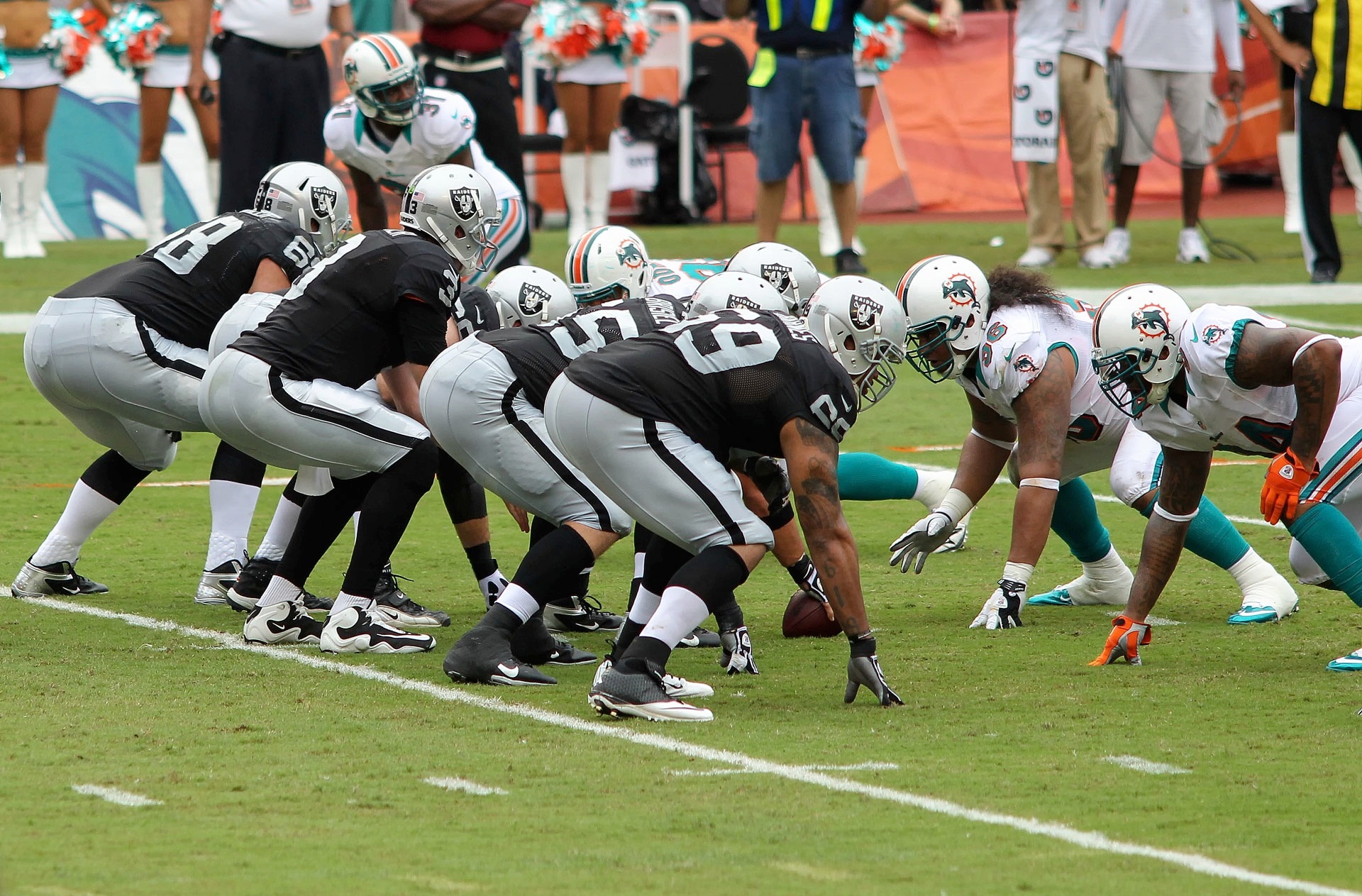
A tackle (T), also called an offensive tackle (OT) and subcategorized as a left tackle or right tackle, is an American football position that flanks the two guards on the offensive line. Like other offensive linemen, their objective is to block during each offensive play, physically preventing defenders from tackling or disrupting the offensive ball carrier with the intention of advancing the football downfield. A tackle is considered the most important position on the offensive line, primarily in charge of perimeter protection against defensive ends and edge rushers.
Left tackles have historically been more desired, but the distinction between right and left have become less relevant over time.[1][2] In the NFL, offensive tackles often measure over 6 ft 4 in (193 cm) and weigh over 300 lb (140 kg). According to Sports Illustrated football journalist Paul Zimmerman, offensive tackles consistently achieve the highest cognitive ability scores relative to the other positional groups.[3] The Wonderlic is taken before the draft to assess each player's aptitude for learning and problem solving.
History
[edit]Historically, in the one-platoon system of football, "tackle" referred to a two-way player that played both offense and defense. In the two-platoon system, players began playing only offense or defense, hence offensive tackle and defensive tackle.
Left tackle
[edit].jpg)
The left tackle (LT) is usually the team's best pass blocker.[4] Of the two tackles, the left tackles will often have better footwork and agility than the right tackle in order to counteract the pass rush of defensive ends. When a quarterback throws a forward pass, the quarterback's shoulders are aligned roughly perpendicular to the line of scrimmage, with the non-dominant shoulder closer to downfield. The vast majority of quarterbacks are right-handed, so they turn their backs to defenders coming from the left side, creating a vulnerable "blind side" that the left tackle must protect. (Conversely, teams with left-handed quarterbacks tend to have their better pass blockers at right tackle for the same reason.)
A 2006 book by Michael Lewis, The Blind Side: Evolution of a Game, made into a 2009 motion picture, shed light on the workings of the left tackle position. The book and the film's introduction discuss how the annual salary of left tackles in the NFL skyrocketed in the mid-1990s. Premier left tackles are now highly sought after and are often the second highest paid players on a roster after the quarterback; in the 2013 NFL draft three of the first four picks were left tackles, and usually at least one left tackle is picked in the first five positions.[5] Recent examples include Joe Alt (2024, 5th overall pick), Andrew Thomas (2020, 4th overall pick), Brandon Scherff (2015, 5th overall pick), Eric Fisher (2013, 1st overall pick), Luke Joeckel (2013, 2nd overall pick), Lane Johnson (2013, 4th overall pick), Matt Kalil (2012, 4th overall pick), Trent Williams (2010, 4th overall pick), and Jake Long (2008, 1st overall pick).
Right tackle
[edit]
The right tackle (RT) is typically one of the team's most effective run blockers.[6] Since most running plays are directed towards the strong side (the side with the tight end) of the offensive line, the right tackle often contends with the defending team's best run stoppers. They must be capable of gaining traction in their blocks to impede defenders from tackling the ball carrier or create a hole—an area between offensive lineman that forms immediately after the ball is snapped. This is a result of blocking strategies and techniques, generating enough space for the ball carrier to run between and advance the ball.
Swing tackle
[edit]A swing tackle is a backup offensive tackle who can play both right and left tackle. Most often, this role is performed by the second-string left tackle as it is more common for a left tackle to be able to play right than vice versa. Swing tackles are also commonly used as a tight end in jumbo formations to add more mass to the offensive line.
References
[edit]- ^ Tucker, Ross. "There is no longer a distinction between left tackles and..." The New York Times. Retrieved May 19, 2020.
- ^ Thomas, Jeanna (June 28, 2016). "Right tackles matter but still fall behind LTs". SBNation.com. Retrieved May 19, 2020.
- ^ Zimmerman, Paul (1984). The New Thinking Man's Guide to Pro Football. Simon and Schuster. ISBN 9780671453947.
- ^ Burton, Larry. "What's the Difference Between a Right and Left Tackle?". Bleacher Report. Retrieved May 19, 2020.
- ^ Weisman, Larry (March 30, 2009), "Keepers of the blind side: Left tackles the new money position", USA Today
- ^ Burton, Larry. "What's the Difference Between a Right and Left Tackle?". Bleacher Report. Retrieved May 19, 2020.

Tackle (gridiron football position)
View on GrokipediaOverview
Role and Responsibilities
In gridiron football, the tackle position refers to players who serve as linemen on both the offensive and defensive sides of the ball. On offense, tackles flank the guards at the ends of the line, primarily responsible for protecting the quarterback during passing plays by engaging defensive ends and outside linebackers, while also creating lanes for running plays through drive blocking.[8] On defense, tackles align in the interior opposite the offensive guards, tasked with penetrating the line to disrupt running plays and collapse the pocket on passes to pressure the quarterback.[8] Tackles require exceptional physical attributes to handle their demanding roles, typically standing between 6 feet 2 inches and 6 feet 8 inches tall and weighing 300 to 330 pounds, allowing them to dominate through size and leverage while maintaining mobility.[9] Essential skills include maintaining a low pad level for leverage to control opponents, precise hand placement to strike and control blockers or rushers, and agile footwork to mirror movements in pass protection or pursuit.[10] These attributes enable tackles to execute basic blocking schemes on offense, such as pass protection where they mirror edge rushers to provide a clean pocket, contrasted with run blocking that emphasizes driving defenders off the line to open gaps.[11] Defensive tackles often align in 2-technique (head-up on the guard) or 3-technique (outside shoulder of the guard) positions to optimize gap control and penetration.[12] The position's impact is evident in key metrics: elite offensive tackles help provide quarterbacks with more time in the pocket (averaging over 2.5 seconds), while strong defensive tackles boost run defense efficiency with win rates exceeding 35% on run plays, limiting opponent yards per carry under 4.0.[13] Notably, the left offensive tackle often faces the quarterback's blind side, heightening its strategic importance against premier pass rushers.[3]Historical Development
The tackle position originated in the late 19th century as American football diverged from rugby influences, forming part of a structured offensive line that included a center, two guards, two tackles, and two ends to facilitate ball advancement in the emerging gridiron game.[14] By the 1880s, during the Walter Camp era, these positions were formalized through rule committees that emphasized line play in scrimmages, with tackles positioned outside the guards to support blocking and interference.[15] In his 1891 treatise American Football, Camp highlighted tackles as bearing "the most responsible work of any man along the line," tasked with body-checking opponents to create openings for runners while also repelling defensive advances, reflecting the era's focus on physical, run-oriented strategies.[16] Significant rule changes reshaped the tackle's role over time. The 1906 legalization of the forward pass, introduced amid concerns over game brutality, transformed offensive tactics from mass formations to aerial attacks, compelling tackles to prioritize quarterback protection over solely run blocking and altering line dynamics to include more lateral spacing. This shift was gradual but pivotal, as early pass restrictions—such as requiring seven players on the line—evolved to demand greater agility from tackles in pass sets.[17] Decades later, the 1978 Mel Blount Rule prohibited defensive backs from jamming receivers beyond five yards downfield, which significantly increased league-wide passing volume, with passing attempts rising by about 10% in the following seasons, intensifying pressure on tackles to sustain longer protections against edge rushers.[18] Positional specialization accelerated in the mid-20th century. Before the two-platoon system's dominance in the 1950s, which separated offensive and defensive units following World War II roster expansions, tackles functioned as versatile linemen alternating sides of the ball, often prioritizing endurance for full-game participation in an era of limited substitutions.[4] Post-1980s, as passing schemes proliferated and sophisticated defenses emerged, the left tackle emerged as a premium role due to the near-universal use of right-handed quarterbacks, positioning it to shield the QB's blind side from dominant pass rushers like those in 4-3 schemes.[19] Differences between college and professional levels further highlight the position's evolution. Since the 1990s, the NCAA's wider hash marks—spaced 40 feet apart compared to the NFL's 18 feet, 6 inches—have influenced tackle alignments by creating asymmetrical field space, often requiring offensive lines to adjust splits for balanced run-pass options and exposing tackles to varied leverage based on ball placement.[20]Offensive Tackle
General Duties
Offensive tackles are positioned at the ends of the offensive line, flanking the guards, and are responsible for blocking defensive ends and outside linebackers. Their primary duties include pass protection, where they prevent edge rushers from reaching the quarterback by using techniques like the kick-slide to maintain pocket integrity, and run blocking, where they seal the outside edge or pull to create lanes for running backs.[21][22] These players typically stand 6 feet 5 inches to 6 feet 8 inches tall and weigh 300 to 330 pounds, requiring a combination of size, strength, agility, and quick footwork to counter speedy pass rushers and powerful run defenders. Success demands precise hand placement, leverage, and the ability to mirror opponents in both man and zone blocking schemes.[7]Left Tackle
The left tackle is the offensive lineman positioned on the far left side of the line, primarily responsible for protecting the quarterback's blind side during pass plays. This role demands elite athleticism to contain the opponent's strongest pass rusher, typically the right defensive end, who exploits speed and power to disrupt plays from the quarterback's left. Effective left tackles must mirror the rusher's movements while maintaining leverage, often requiring superior foot speed and hand placement to prevent sacks.[19] The position's premium status evolved in the late 20th century as pass-oriented offenses grew, with the left tackle becoming the "blindside protector" for right-handed quarterbacks, who comprise the vast majority in the NFL. This shift was accelerated by dominant left-side rushers like Lawrence Taylor in the 1980s, elevating the left tackle's value in draft selections and contracts. Since the 2010s, top left tackles have commanded annual salaries exceeding $20 million, reflecting their critical impact on quarterback safety and team success, as seen in deals like Andrew Thomas's $29.4 million average annual value with the New York Giants.[19][23][24] Key techniques for left tackles include the kick-slide, a lateral footwork pattern that sets depth to counter edge rushers' speed rushes, allowing the blocker to redirect without overcommitting. Against complex defensive schemes like stunts and twists—where rushers exchange gaps—left tackles adapt by communicating with adjacent linemen and using quick hand strikes to maintain pocket integrity. These adaptations build on general offensive tackle duties but emphasize reactive agility on the blind side.[25] Left tackles face elevated injury risks, particularly concussions from head-up collisions with charging defensive linemen, as offensive linemen experience some of the highest rates of such impacts per studies on professional play. Research from the 2010s and into the 2020s highlights that linemen sustain frequent helmet-to-helmet contacts during pass protection, contributing to long-term brain health concerns despite rule changes aimed at reducing high-speed clashes.[26][27]Right Tackle
The right tackle, positioned on the offensive line's right side adjacent to the tight end or wide receiver, plays a crucial role in supporting the run game by sealing the edge against outside runs and providing interior assistance through double-team blocks on defensive tackles. Unlike the left tackle, who often faces the quarterback's blindside and premium pass rushers, the right tackle typically contends with less dominant edge defenders, allowing greater emphasis on run-blocking duties. This positioning enables the right tackle to execute power blocking techniques, particularly in short-yardage situations, where they drive defenders laterally to create lanes for the running back. In addition to edge sealing, right tackles frequently engage in pull blocking for plays like traps and sweeps, where they loop around the line to block linebackers or secondary defenders at the point of attack. These techniques are integral to gap schemes, emphasizing direct engagement and leverage to control defensive linemen. Historically, right tackles were undervalued in NFL drafts before the 2000s, often selected later than left tackles due to the perceived lower pressure on the right side, but their importance has risen with the adoption of zone blocking schemes that demand athleticism and versatility in run support. According to Pro Football Focus (PFF) data, right tackles in gap schemes achieve higher run block grades compared to their pass-blocking metrics, underscoring their foundational role in ground-based offenses.Swing Tackle
The swing tackle serves as a versatile backup offensive tackle in gridiron football, capable of competently playing both the left and right tackle positions to provide essential depth and emergency coverage for the offensive line. This role allows teams to maintain roster flexibility, often enabling them to carry only eight offensive linemen instead of nine by relying on the swing tackle's ability to back up both sides effectively. Swing tackles typically enter rotations during specific situational plays, such as jumbo packages for added protection in short-yardage scenarios or pass-heavy sets, alternating alignments to adapt to game flow and personnel needs.[28][29] Training for the swing tackle position emphasizes developing ambidextrous footwork and blocking techniques to handle the distinct demands of either alignment, ensuring quick adaptability without compromising pass protection or run support. Coaches focus on drills that build proficiency in mirroring stances and explosive first steps from both sides, often incorporating rapid snap counts in practice to simulate in-game transitions. This preparation is vital, as the position requires seamless integration into the line on short notice, drawing on the foundational differences between left tackle's blindside pass protection and right tackle's emphasis on edge run blocking.[30] Since the 2010s, the utilization of swing tackles has grown in the NFL, driven by rising injury rates among offensive linemen that have necessitated deeper, more adaptable benches to sustain line integrity throughout grueling seasons. Data from the NFL Players Association indicates injuries per team per week climbed from 3.2 to 3.7 between 2009 and 2010, a trend that persisted and underscored the need for versatile backups amid increased physical demands from pass-oriented offenses. Teams like the Kansas City Chiefs in the 2020s have exemplified this shift, regularly deploying swing tackles such as Chukwuebuka Godrick and Wanya Morris for rotational depth and injury replacement to protect high-profile quarterbacks.[31][32][33] One of the primary challenges for swing tackles is sustaining peak conditioning and mental sharpness despite irregular playing time, as they must remain game-ready for sudden activations while typically handling 20-30% of offensive snaps in rotational or relief roles. This intermittent usage demands rigorous stamina maintenance through conditioning regimens, as fatigue can impair technique during critical moments like emergency starts. The position's rotational nature also tests recovery between alignments, requiring constant vigilance to avoid the performance dips seen in less versatile linemen.[34][35]Defensive Tackle
General Duties
Defensive tackles primarily align on the interior of the defensive line, typically in head-up, shade, or angled stances relative to the center or guards to control key gaps. A head-up alignment, such as the 0-technique directly over the center or the 4-technique over the offensive tackle, positions the player to defend both adjacent gaps symmetrically.[36] Shade alignments include the 1-technique on the inside shoulder of a guard or the 3-technique on the outside shoulder, allowing angled penetration into the A- or B-gaps while often drawing double teams from offensive linemen.[37] These stances enable defensive tackles to disrupt plays from the snap, balancing run support and pass-rush opportunities against interior blockers.[36] In run defense, defensive tackles focus on gap control, shedding blocks, and tackling in open space to halt the ball carrier behind the line of scrimmage. Gap control involves maintaining responsibility for one or two gaps—either penetrating a single gap aggressively in a one-gap scheme or reading and reacting to control two gaps in a two-gap approach—preventing offensive linemen from creating running lanes.[36] Shedding blocks requires using hand techniques like the push-pull or punch-slap to disengage from guards or centers, often after stacking the blocker to maintain leverage and pursue the runner.[36] Once free, they must tackle effectively in space, aiming to limit gains and force negative plays, which counters the protection efforts of offensive interior linemen.[38] For pass rush, defensive tackles employ two-gap techniques to occupy blockers and create lanes or one-gap techniques to explode into a specific gap for disruption. In the two-gap method, they control both sides of their alignment to read the quarterback's drop before reacting, while one-gap prioritizes immediate penetration to collapse the pocket.[36] Common moves include the bull rush, a power-driven technique where the tackle drives their hands into the blocker's chest to push them back into the quarterback, and the rip, an under-arm maneuver that dips the shoulder to slip past the edge of the block after gaining initial leverage.[39][40] These actions pressure the passer from the interior, complementing edge rushers. A key metric for evaluating defensive tackles' run defense effectiveness is run stop percentage (RSP), calculated aswhere stops are tackles that limit the offense to a successful defensive outcome, such as gains of 0-2 yards or losses.[41][38] Elite defensive tackles achieve a high RSP, reflecting their ability to consistently disrupt runs and contribute to overall defensive success.[41]