


Community hub
Recent from talks
Contribute something to knowledge base
Content stats: 0 posts, 0 articles, 1 media, 0 notes
Members stats: 0 subscribers, 0 contributors, 0 moderators, 0 supporters
Subscribers
Supporters
Contributors
Moderators
Hub AI
Greater omentum AI simulator
(@Greater omentum_simulator)
Hub AI
Greater omentum AI simulator
(@Greater omentum_simulator)
Greater omentum
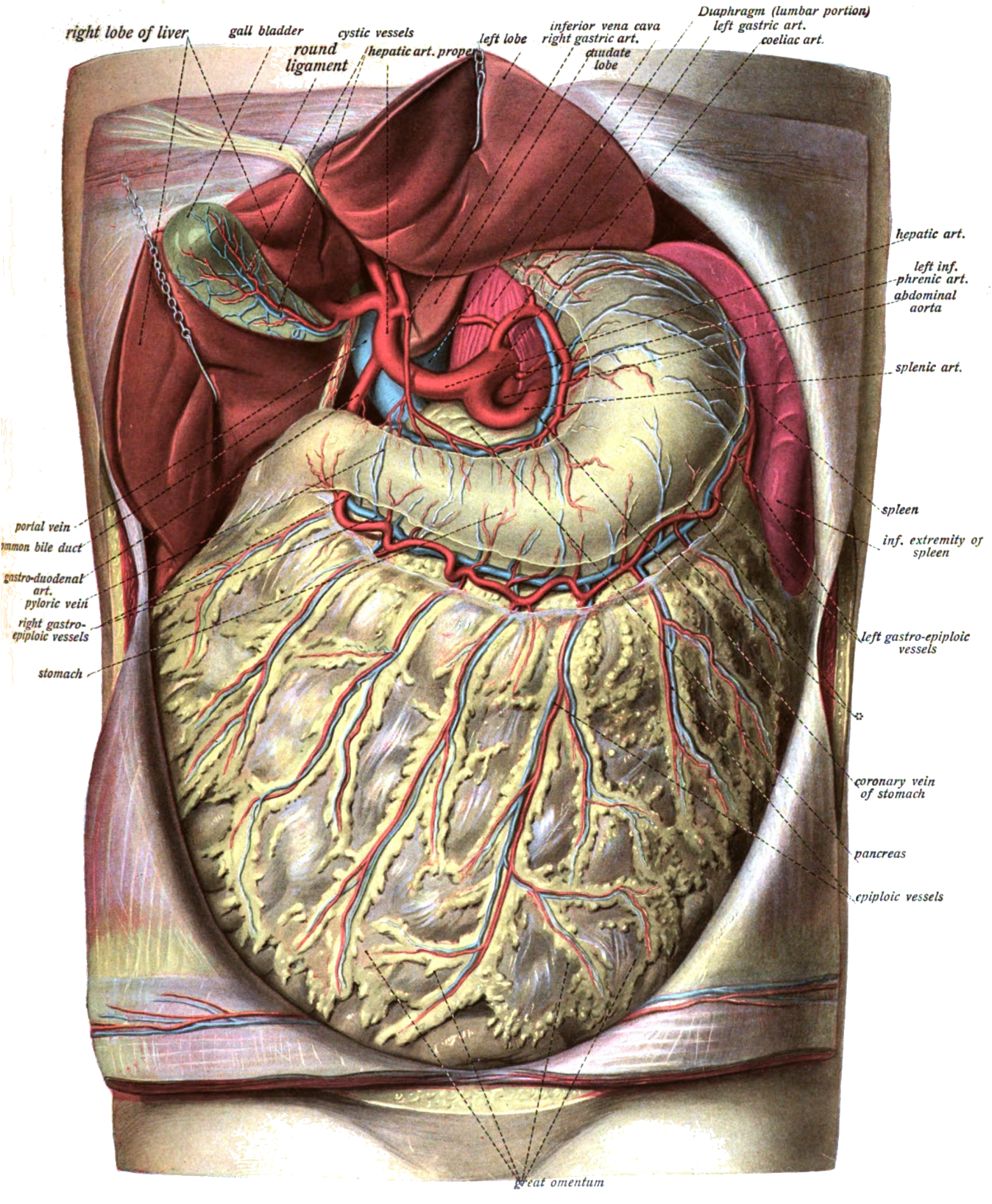
The greater omentum (also the great omentum, omentum majus, gastrocolic omentum, epiploon, or, especially in non-human animals, caul) is a large apron-like fold of visceral peritoneum that hangs down from the stomach. It extends from the greater curvature of the stomach, passes in front of the small intestines, and doubles back to ascend to the transverse colon before reaching to the posterior abdominal wall. The greater omentum is larger than the lesser omentum, which hangs down from the liver to the lesser curvature. The common anatomical term "epiploic" derives from "epiploon", from Greek epipleein 'to float or sail on', since the greater omentum appears to float on the surface of the intestines. It is the first structure observed when the abdominal cavity is opened anteriorly (from the front).
The greater omentum is the larger of the two peritoneal folds. It consists of a double sheet of peritoneum, folded on itself so that it has four layers.
The two layers of the greater omentum descend from the greater curvature of the stomach and the beginning of the duodenum. They pass in front of the small intestines, sometimes as low as the pelvis, before turning on themselves, and ascending as far as the transverse colon, where they separate and enclose that part of the intestine.
These individual layers are easily seen in the young, but in the adult they are more or less inseparably blended.
The left border of the greater omentum is continuous with the gastrosplenic ligament; its right border extends as far as the beginning of the duodenum.
The greater omentum is usually thin, and has a perforated appearance. It contains some adipose tissue, which can accumulate considerably in obese people. It is highly vascularised.
The greater omentum is often defined to encompass a variety of structures. Most sources include the following three:
The splenorenal ligament (or lienorenal ligament) (from the left kidney to the spleen) is occasionally considered part of the greater omentum. It is derived from the peritoneum, where the wall of the general peritoneal cavity comes into contact with the lesser sac between the left kidney and the spleen; the splenic artery and vein pass between its two layers. It contains the tail of the pancreas, the only intraperitoneal portion of the pancreas, and splenic vessels. One or more of the preceding sentences incorporates text in the public domain from the 20th edition of Gray's Anatomy (1918)
Greater omentum
The greater omentum (also the great omentum, omentum majus, gastrocolic omentum, epiploon, or, especially in non-human animals, caul) is a large apron-like fold of visceral peritoneum that hangs down from the stomach. It extends from the greater curvature of the stomach, passes in front of the small intestines, and doubles back to ascend to the transverse colon before reaching to the posterior abdominal wall. The greater omentum is larger than the lesser omentum, which hangs down from the liver to the lesser curvature. The common anatomical term "epiploic" derives from "epiploon", from Greek epipleein 'to float or sail on', since the greater omentum appears to float on the surface of the intestines. It is the first structure observed when the abdominal cavity is opened anteriorly (from the front).
The greater omentum is the larger of the two peritoneal folds. It consists of a double sheet of peritoneum, folded on itself so that it has four layers.
The two layers of the greater omentum descend from the greater curvature of the stomach and the beginning of the duodenum. They pass in front of the small intestines, sometimes as low as the pelvis, before turning on themselves, and ascending as far as the transverse colon, where they separate and enclose that part of the intestine.
These individual layers are easily seen in the young, but in the adult they are more or less inseparably blended.
The left border of the greater omentum is continuous with the gastrosplenic ligament; its right border extends as far as the beginning of the duodenum.
The greater omentum is usually thin, and has a perforated appearance. It contains some adipose tissue, which can accumulate considerably in obese people. It is highly vascularised.
The greater omentum is often defined to encompass a variety of structures. Most sources include the following three:
The splenorenal ligament (or lienorenal ligament) (from the left kidney to the spleen) is occasionally considered part of the greater omentum. It is derived from the peritoneum, where the wall of the general peritoneal cavity comes into contact with the lesser sac between the left kidney and the spleen; the splenic artery and vein pass between its two layers. It contains the tail of the pancreas, the only intraperitoneal portion of the pancreas, and splenic vessels. One or more of the preceding sentences incorporates text in the public domain from the 20th edition of Gray's Anatomy (1918)
Recent media
Recent media