Hubbry Logo
One timerOne timerMain
Open search
One timer
Community hub
One timer
logo
8 pages, 0 posts
0 subscribers
Be the first to start a discussion here.
One timer
One timer
from Wikipedia
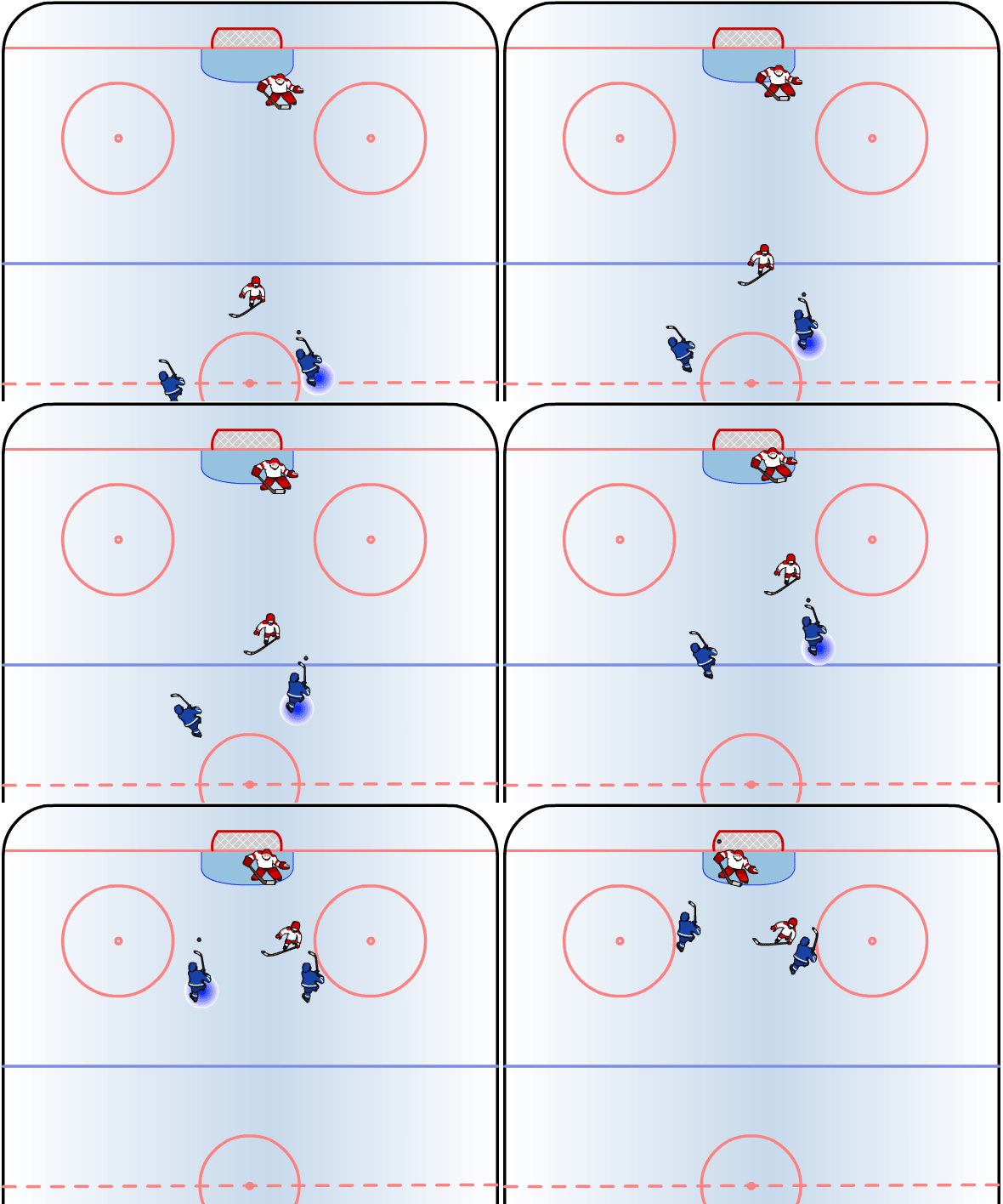
In this diagram, the blue team is executing a one-timer on a scoring play.

In ice hockey, a one-timer is a shot that occurs when a player meets a teammate's pass with an immediate slapshot, without any attempt to control the puck on their stick.[1] An effective one-timer requires precise timing on the part of both players involved, especially the shooter. This play improves the shooter's chances at scoring a goal.[2] A wrist shot can also be done on a one-timer, though the puck is released far slower than a slapshot one-timer.

The effectiveness of the one-timer comes from three things:

  1. The angle from goal between the pass and the shot
  2. The change of direction of the puck
  3. The speed of the puck after the shot

Greater angle, change of direction and/or speed increases the chances of the puck going into the net. Lesser angle, change of direction and/or speed decreases the chance of the puck going into the net.

Either way, the one-timer enjoys a greater success rate than a one-on-one shot between shooter and goalie.

The reason it is called a one-timer is that the player has only one time to connect.

References

[edit]
Revisions and contributorsEdit on WikipediaRead on Wikipedia
from Grokipedia
In ice hockey, a one-timer is a shot executed by immediately striking a moving puck received from a teammate's pass, without any attempt to control or stop it on the stick blade, often using a slapshot technique for rapid release and power. This offensive maneuver is prized for its speed and element of surprise, as it forces goaltenders to react quickly without time to fully to the shooter, making it one of the most effective and dangerous shots in the sport beyond tip-ins. The one-timer typically originates from coordinated plays, such as during power plays or cycle setups, where precise passing and positioning allow the shooter to transfer weight from back to front while timing the swing to meet the puck between their feet for optimal accuracy and velocity. One-timers have become a hallmark of high-level play in the National Hockey League (NHL), contributing significantly to scoring efficiency by capitalizing on brief defensive lapses and challenging goaltenders' lateral movement. Their execution demands strong timing, open body stance, and communication between passer and shooter, often resulting in goals that shift game momentum due to their explosive nature. Renowned for this skill, players like Alex Ovechkin of the have mastered the one-timer from the left faceoff circle, amassing 137 such power-play goals as of April 2025—including his record-breaking 895th NHL career goal on April 6, 2025—which underscores its role in record-breaking careers. Other NHL stars, including David Pastrnak, , and , have been voted by goaltenders as possessing elite one-timer abilities, highlighting the shot's prominence in modern professional hockey.

Definition and Technique

Description

A one-timer is a shooting technique in ice hockey where a player immediately strikes the puck with a slapshot upon receiving a pass from a teammate, without first stopping or controlling it on the stick blade. This direct redirection of the puck from its incoming motion to the shot maintains its , distinguishing the one-timer from other shots that involve puck handling. The technique demands precise timing between the passer and shooter, as well as accurate pass placement to ensure the puck arrives at the optimal point on the receiving player's blade. It is typically executed from key offensive zones such as the faceoff circles or the slot, where players position themselves to receive cross-seam passes during rushes or set plays. In contrast to controlled shots like the wrist shot, which allow the player to settle the puck before releasing, the one-timer prioritizes speed and surprise over deliberate aiming. Mechanically, the one-timer leverages the puck's existing , avoiding any deceleration that would occur during stick control, which enables shot speeds often reaching 90-100 mph or higher. This motion-to-motion transfer creates a powerful, rapid release that is particularly effective from the left or right circles on power plays, catching goaltenders off guard.

Execution

To execute a one-timer effectively, the shooter must position themselves in the offensive zone's circles, typically near the hash marks, to optimize alignment and quick release. For a right-handed shooter, the preferred spot is the left circle, where the pass arrives on their strong side; conversely, left-handed shooters station in the right circle. The delivers a low, flat pass or a saucer pass directly to the shooter's stick blade, allowing minimal foot movement from the receiver to maintain balance and surprise. The mechanical steps begin with receiving the pass on the fly without stickhandling, aligning the stick perpendicular to the puck's path for clean contact. As the puck approaches, the shooter tracks it with their eyes while shifting weight from the back leg to the front leg, bending the knees for stability and rotating the hips and shoulders toward the net. The release involves a quick wrist snap and minimal backswing, akin to a slapshot, to propel the puck toward the upper corner of the net; the should be slightly open to impart lift. Follow-through keeps the stick pointing at the target, with hands leading the motion for accuracy. Equipment plays a key role in enhancing the shot's lift and precision, with curved stick blades recommended for better puck elevation and control during the wrist snap. A moderate stick flex, around 85-95 for adults, provides the necessary power without sacrificing quickness, while a lower kick point facilitates a faster release. Pass speeds should be synchronized with the shooter's timing and reaction. Training drills emphasize building timing and coordination through basic setups. Stationary passing exercises involve a partner delivering consistent passes to a fixed shooter, focusing on blade alignment and weight transfer without movement. Progress to 2-on-1 drills, where the shooter receives a pass while skating into position, simulating game-like scenarios to refine quick releases and anticipation.

History

Origins

The one-timer shot in ice hockey evolved gradually from earlier techniques like puck redirects, which were common in informal settings where players practiced quick deflections off passes to surprise goaltenders. This foundational approach, lacking a single inventor, transitioned into more structured play as forward passing rules liberalized in the late , permitting passes across all zones to boost offensive flow and enable faster transitions. In the and , the technique began appearing more frequently in amateur and minor professional leagues, facilitated by improvements in rink conditions through widespread adoption of mechanical systems in indoor arenas, which provided smoother for precise passing and reduced puck bounce. These advancements, building on artificial technology pioneered in the early , allowed for quicker, more reliable puck movement. The , which doubled the league to 12 teams and diluted defensive talent, further encouraged experimental passing tactics, including one-timers on power plays to exploit weaker coverage. By the 1970s, players like incorporated quick-release shots off passes into power-play strategies, leveraging the era's more open ice to score 246 power-play goals over his career, many from direct receptions near the net. Rule changes promoting offense, combined with these tactical shifts, marked the technique's entry into professional play without a defined originator. Advancements in equipment, such as the introduction of aluminum shafts in the early , enhanced the one-timer's viability by offering lighter, more durable sticks that permitted faster shot releases from incoming passes, solidifying its role in evolving professional strategies.

Popularization

The one-timer emerged as a prominent offensive weapon in professional hockey during the , largely through the ' dynasty led by and . Gretzky's visionary playmaking, often delivering precise cross-ice passes, set up Kurri for devastating one-timers, particularly on power plays, which became a hallmark of the team's high-octane style. This partnership contributed to multiple Stanley Cup-winning goals, helping the Oilers secure five championships between 1984 and 1990 and elevating the shot's visibility across the league. In the 1990s, the technique underwent further refinement, exemplified by the ' dynamic duo of center and winger . Oates, renowned for his pinpoint passing, frequently threaded the puck to Hull in the slot for quick one-timers, powering Hull to multiple 50-goal seasons, including 72 goals in 1989–90, 86 in 1990–91, and 70 in 1991–92. This era's emphasis on rapid execution was influenced by advancing coaching strategies that prioritized quick-release shots to exploit goaltender positioning. The NHL's high-scoring environment of the , with league-wide goals per game averaging around 6.5 to 7.0, amplified the one-timer's role in offensive schemes. Subsequent rule changes following the 2004–05 lockout, notably the elimination of the two-line pass restriction, facilitated longer, faster transitions that enhanced power-play setups for one-timers, leading to a noticeable uptick in their deployment and effectiveness in goal production by the early .

Notable Examples and Players

Iconic Goals

One of the most memorable one-timer goals in NHL history occurred in Game 5 of the 1984 Final, where scored on a precise pass from to help the secure a 5-4 victory against the . Kurri's goal in the second period, assisted by Gretzky from behind the net, exemplified their chemistry and contributed to Edmonton's championship run. In the 1990s, exemplified the power-play potency of the one-timer during his record-setting 86-goal season with the , leveraging his quick release to score numerous such goals and contribute to one of the highest-scoring individual campaigns in league history. A modern highlight came in the 2018 playoffs when Alex Ovechkin scored a crucial left-circle one-timer against the in Game 3, giving the Capitals a 2-1 series lead. With the Capitals on the power play, Ovechkin took a pass from Nicklas Backstrom and rifled a shot past Penguins goaltender Matt Murray, overwhelming the defense and igniting Washington's path to their first . In April 2025, Ovechkin added to his legacy by scoring his 894th career goal, a power-play one-timer from his signature left circle position, tying Wayne Gretzky's all-time NHL record for power-play goals during a game against the . These goals illustrate the one-timer's dramatic impact in high-stakes moments.

Specialists

Alex Ovechkin is renowned for his one-timer proficiency, holding the NHL record with 127 power-play one-timers as of early 2024. His signature setup from the left circle, characterized by a quick release and powerful wrist shot, has been instrumental in amassing over 900 career goals as of November 2025. Brett Hull emerged as a master of the one-timer during the 1990s, leveraging his low stance and exceptional chemistry with passers to score numerous such goals en route to 741 career totals. This technique defined his style as one of the league's premier goal scorers, emphasizing precision and velocity from the right circle. Jari Kurri pioneered one-timer excellence in the 1980s, scoring 601 career goals, many of which came via this method, particularly in right-wing positions fed by linemate . His ability to capitalize on cross-seam passes highlighted a seamless partnership that elevated Edmonton's offensive dominance. Among modern players, and stand out for their one-timer accuracy, as noted in a 2022 NHL goalies poll where both received votes for elite threats. Draisaitl, in particular, has demonstrated high power-play efficiency, converting over 30% of his shots in recent seasons.

Strategic Role

Advantages

The one-timer's primary advantage lies in its speed and element of surprise, as the puck is shot directly from the pass without stopping, allowing velocities exceeding 100 mph—such as the 106 mph one-timer recorded by forward in 2025 or the 103.77 mph one-timer by Utah Mammoth defenseman Michael Kesselring in 2024—compared to average NHL shot speeds of approximately 60-70 mph. This rapid release significantly reduces the goaltender's reaction window, which is already limited to as low as 0.152 seconds for visual stimuli from high-speed shots in professional play, often catching both the goalie and defenders off-balance before they can adjust positioning. In power-play scenarios, the one-timer excels due to its suitability for circle setups where it can exploit screens and lateral goalie movements, with NHL data indicating that approximately 50% of power-play goals from the 2017-2018 season were scored via one-touch or one-timer shots. Although on-net accuracy stands at 42%—lower than the 50% for wrist shots—the technique yields higher overall scoring efficiency, as successful one-timers rank among the most dangerous non-tip shots, outperforming other types in predictive goal-scoring value. The shot also enhances team synergy by rewarding precise passing and coordinated offensive movement, turning a simple pass into an immediate threat and elevating overall play efficiency, as evidenced by teams like the scoring 40% of their non-rebound power-play goals via one-timers in the 2015-2016 season. Furthermore, the one-timer provides a psychological edge by forcing penalty-kill units to collapse defensively, spreading coverage and creating rebound opportunities that further amplify offensive pressure.

Challenges

Executing a one-timer demands precise alignment between the incoming pass and the shooter's stick , as any misalignment can result in a failed . indicate that only 42% of one-timer shots end up on net, compared to 50% for other shot types, with the remaining 58% often missing due to imperfect pass timing or quality that disrupts puck control. This low on-net rate underscores the shot's reliance on seamless passer-shooter coordination, where even slight variations in pass speed or trajectory can cause the puck to bobble or deflect off the blade. The physical demands of a one-timer pose risks to the shooter, as the high-velocity swing—often akin to a —can strain the wrists, , and shoulders through repetitive torque and impact. For instance, frequent have been linked to tears in the and dorsal ulnotriquetral ligament injuries in the , commonly referred to as "hockey wrist." Additionally, goalies frequently anticipate one-timers by observing the shooter's body lean and weight shift, enabling them to adjust positioning and improve save rates; when properly set, this allows goalies to cover key areas effectively against the shot's speed. Defensive teams counter one-timers through strategies like lane clogging, where players position themselves to block direct passing and shooting lanes, particularly on power plays. Goalies often employ the butterfly technique to seal the lower net, neutralizing low one-timers that are common from the circles. Since the , widespread adoption of video scouting and has further diminished the element of surprise, as teams dissect opponent tendencies to preempt setups and reduce one-timer opportunities. Mastering the one-timer requires extensive training, with coaches emphasizing thousands of repetitions to develop timing and . Rookies and less experienced players particularly struggle without established chemistry with passers, as the shot's success hinges on intuitive read-and-react dynamics that build over repeated drills.

Variations in Hockey

The one-timer represents a rare variation of the standard one-timer, executed by receiving a pass and redirecting the puck with the back side of the blade for shots from tighter angles where a might be obstructed. This technique demands exceptional hand-eye coordination and stick control, often employed in high-pressure situations near the net or during quick transitions. In professional play, players like and have showcased this skill, using it to surprise goaltenders by flipping the puck mid-stride without a full wind-up. A tip-in one-timer modifies the traditional slap by involving a subtle redirection or "tip" of the incoming pass while in motion, typically mid-air or just above the ice, rather than a full contact. This variation blurs the line with deflections but maintains the one-touch principle, allowing for rapid scoring in crowded net-front areas during power plays or scrambles. It is particularly effective against screened goaltenders, as the puck's altered trajectory is harder to track. Examples abound in competitive hockey, such as Brady Fleurent's for the Admirals, where a precise tip-in off a pass resulted in a clean finish. Off-wing adaptations involve shooters positioning on their non-dominant side—such as a left-handed shot in the right faceoff circle—to enable cross-net one-timers that exploit angular deception. This setup increases the shot's difficulty due to reduced power from the off-side but enhances unpredictability, forcing defenders to commit earlier. Alex Ovechkin exemplifies this approach, consistently favoring the left wing as a right-handed shooter to maximize one-timer opportunities from the circles, a tactic that has defined his power-play dominance. Post-2020, one-timers have evolved with hybrid integrations like saucer passes, where the puck is lofted over opposing sticks or screens before landing flat for an immediate shot, improving visibility and speed through traffic. This adaptation counters modern defensive screening tactics, allowing elevated passes to create cleaner shooting lanes. Notable instances include Frank Vatrano's goal off a saucer from , highlighting how such passes elevate the one-timer's effectiveness in professional games.

In Other Sports

In soccer, the one-timer concept finds its closest parallel in the "one-touch shot" or volley, where a player receives a pass and immediately strikes the ball toward goal without first controlling it, often using the foot or head. This technique is permitted under FIFA's Laws of the Game for open play, allowing quick strikes as long as the ball is not deliberately touched twice in succession during restarts like free kicks. It was popularized during the 1970s by Ajax Amsterdam's philosophy under , which emphasized fluid, rapid one-touch passing and finishing to overwhelm defenses through positional interchange and speed. A notable example is Luis Suárez's goal in the second leg of the round of 16 against on March 16, 2016, where he volleyed a cross from teammate directly into the top corner, contributing to Barcelona's 3-1 victory that night (5-1 aggregate). Unlike hockey's stick-based one-timer, soccer variants rely on foot precision or headers, adapting to the sport's emphasis on lower-body control and aerial duels. Studies of professional matches indicate that one-touch shots account for a majority of goals—around 67% in analyzed elite competitions—and exhibit higher conversion rates compared to efforts, enhancing surprise and reducing defensive reactions. In other sports, analogous quick-release techniques exist but lack the one-timer's centrality in hockey. Basketball occasionally features "one-touch layups," where a player catches an outlet pass in transition and immediately finishes at the rim without , as seen in fast-break plays by teams like the to exploit spacing. employs "quick-stick" or quick-release shots, catching a pass and firing without cradling the ball to maintain momentum, though these are situational rather than a staple tactic. Neither sport sees the prevalence or strategic emphasis equivalent to the NHL, where one-timers define power-play dynamics.

References

Add your contribution
Related Hubs
User Avatar
No comments yet.