Hubbry Logo
OpenEMROpenEMRMain
Open search
OpenEMR
Community hub
OpenEMR
logo
8 pages, 0 posts
0 subscribers
Be the first to start a discussion here.
OpenEMR
OpenEMR
from Wikipedia
Initial releaseAugust 13, 2002; 23 years ago (2002-08-13)
Stable release
7.0.3.4[1] / 18 May 2025; 5 months ago (18 May 2025)
Repository
Operating systemLinux, Unix-like, macOS, Windows
Available in34 languages
TypeMedical practice management software, Electronic Medical Records
LicenseGNU General Public License
Websitewww.open-emr.org

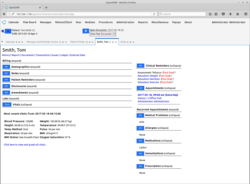
OpenEMR is a medical practice management software which also supports Electronic Medical Records (EMR). It is ONC Complete Ambulatory EHR certified[2][3][4] and features fully integrated electronic medical records, practice management for a medical practice, scheduling, and electronic billing.

The server side is written in PHP and can be employed in conjunction with a LAMP "stack", though any operating system with PHP support is supported.

OpenEMR is free and open-source software subject to the terms of the GNU General Public License (GPL). It is actively internationalized and localized in multiple languages, and free support is available in online forums around the world. At the time of this writing, commercial support is offered by over 30 vendors in over 10 countries.[5]

Features

[edit]

[6]

  • ONC Complete Ambulatory EHR Certified
  • Patient Demographics
  • Patient Scheduling
  • Electronic Medical Records
  • Prescriptions
  • ePrescribing -requires OpenEMR specific integration by a third party such as what is provided by: WENO Exchange, NewCrop, and Allscripts
  • EPCS (ePrescribe controlled substances) - requires OpenEMR specific integration provided by a third party such as what is provided by WENO Exchange, NewCrop, and Allscripts
  • Medical Billing
  • Clinical Decision Rules
  • Patient Portal
  • Reports
  • Advantages and benefits of free and open-source software
  • Security
  • Multilanguage Support

Adoption

[edit]

In the US, it has been estimated that there are more than 5,000 installations of OpenEMR in physician offices and other small healthcare facilities serving more than 30 million patients.[7] Internationally, it has been estimated that OpenEMR is installed in over 15,000 healthcare facilities, translating into more than 45,000 practitioners using the system which are serving greater than 90 million patients.[7] The Peace Corps plan to incorporate OpenEMR into their EHR system.[8][9][10][11][12] Siaya District Hospital, a 220-bed hospital in rural Kenya, is using OpenEMR.[13][14][15][16][17] HP India is planning to utilize OpenEMR for their Mobile Health Centre Project.[18] There are also articles describing single clinician deployments[19][20][21] and a free clinic deployment.[22] Internationally, it is known that there are practitioners in Pakistan,[23] Puerto Rico, Australia, Sweden, the Netherlands, Israel, India,[18][24] Malaysia, Nepal, Indonesia, Bermuda, Armenia, Kenya,[13][14][15][16][17][25] and Greece that are either testing or actively using OpenEMR for use as a free electronic medical records program in the respective languages.[26]

Awards

[edit]

OpenEMR has received a Bossie Award in the "Best Open Source Applications" category in both 2012 and 2013.[27][28][29]

Development

[edit]

The official OpenEMR code repository was migrated from CVS to git on 20 October 2010.[30] The project's main code repository is on GitHub.[31][32] There are also official mirrored code repositories on SourceForge,[33] Google Code,[34] Gitorious,[35] Bitbucket,[36] Assembla,[37] CodePlex[38] and Repo.or.cz.[39]

OpenEMR Foundation

[edit]

The OpenEMR Foundation is a nonprofit entity that was organized April, 2019 to support the OpenEMR project. The OpenEMR Foundation is the entity that holds the ONC EHR Certification with SLI Compliance.[3]

OEMR[40] was a nonprofit entity that was organized in July, 2010 to support the OpenEMR project.[41] OEMR was the former entity that held the ONC EHR Certifications with ICSA and InfoGard Labs.[3][42][43]

Certification

[edit]
  • OpenEMR versions 4.1.0 (released on 9/23/2011), 4.1.1 (released on 8/31/2012) and 4.1.2 (released on 8/17/2013) have 2011 ONC Complete Ambulatory EHR Certification by ICSA Labs.[2][3][4][42][44]
  • OpenEMR version 4.2.0 (released 12/28/2014), 4.2.1 (released 3/25/2016) and 4.2.2 (released on 5/19/2016) have 2014 ONC Modular Ambulatory EHR Certification by InfoGard Laboratories.[43]
  • OpenEMR version 5.0.0 (released 2/15/2017), 5.0.1 (released 4/23/2018), 5.0.2 (released 8/4/2019) has 2014 ONC Complete Ambulatory EHR Certification by InfoGard Laboratories.[43][45][46]

History

[edit]

OpenEMR was originally developed by Synitech and version 1.0 was released in June 2001 as MP Pro (MedicalPractice Professional).[47] Much of the code was then reworked to comply with the Health Insurance Portability and Accountability Act (HIPAA) and to improve security, and the product was reintroduced as OpenEMR version 1.3 a year later, in July 2002.[48] On 13 August 2002 OpenEMR was released to the public under the GNU General Public License (GPL), i.e. it became a free and open-source project and was registered on SourceForge.[49][failed verification] The project evolved through version 2.0 and the Pennington Firm (Pennfirm) took over as its primary maintainer in 2003.[47] Walt Pennington transferred the OpenEMR software repository to SourceForge in March 2005.[50] Mr. Pennington also established Rod Roark, Andres Paglayan and James Perry Jr. as administrators of the project.[47] Walt Pennington, Andres Paglayan and James Perry eventually took other directions and were replaced by Brady Miller in August 2009.[51] Robert Down became an administrator of the project in March 2017.[51] Matthew Vita was an administrator of the project from July 2017 until February 2020.[51] Jerry Padgett became an administrator of the project in June 2019.[51] Stephen Waite became an administrator of the project in February 2020.[51] Stephen Nielson became an administrator of the project in January 2022. Asher Densmore-Lynn became an administrator of the project in January 2024. So at this time Rod Roark, Brady Miller, Robert Down, Jerry Padgett, Stephen Waite, Stephen Nielson, and Asher Densmore-Lynn are the project's co-administrators.[51]

In 2018 Project Insecurity found almost 30 security flaws in the system, which were all responsibly addressed.[52]

References

[edit]
[edit]
Revisions and contributorsEdit on WikipediaRead on Wikipedia
from Grokipedia
OpenEMR is a free and open-source electronic health records (EHR) and medical practice management software application designed to assist healthcare providers in managing patient data, appointments, billing, and administrative tasks. Originally developed in 2002 by a group of physicians seeking an affordable solution for their practices, it has evolved into a comprehensive platform supporting clinical workflows, including patient registration, encounter documentation, prescription management, and reporting. The software is built using PHP, MySQL/MariaDB, JavaScript, CSS, and HTML, ensuring compatibility with various operating systems and web servers. Key features of OpenEMR include fully integrated electronic health records, scheduling tools, with support for standards like HL7 and X12, multilingual capabilities for , and a robust portal for secure access to records. It complies with HIPAA standards for data privacy and security, making it suitable for use and internationally. In 2022, OpenEMR version 7.0 achieved ONC certification as an EHR through the SLI Compliance Certification Body, enabling eligible providers to meet federal meaningful use requirements under the . The project is actively maintained by a global community of developers, clinicians, and volunteers through the OpenEMR Foundation, with ongoing updates addressing regulatory changes, such as preparations for the 2025 ONC HTI-1 certification. As the most widely adopted open-source EHR system, OpenEMR powers thousands of practices worldwide, promoting accessible and customizable healthcare technology without licensing fees.

Overview

Description

OpenEMR is a free and open-source (EHR) and medical practice management system designed to support the management of data and operational workflows in healthcare settings. It enables the creation and maintenance of electronic medical records, scheduling, billing processes, and customizable reporting to streamline administrative and clinical tasks. The software primarily targets small to medium-sized medical practices, clinics, and healthcare providers operating in environments, where resources may be limited and efficient management is essential. As an open-source solution, OpenEMR offers a cost-effective alternative to EHR systems by eliminating licensing fees and allowing full customization to meet specific practice needs without . This approach empowers users to adapt the system freely while benefiting from community-driven enhancements and support. OpenEMR was initially publicly released in , with the current stable version as of May 2025 being 7.0.3.4.

Licensing and Platforms

OpenEMR is released under the GNU General Public License version 3.0 (GPLv3), which permits users to freely use, modify, and distribute the software, provided that derivative works are also distributed under the same license terms. This open-source licensing model fosters community-driven development and ensures accessibility for healthcare providers worldwide without proprietary restrictions. The software supports deployment on various operating systems, including , systems, macOS, and Windows, making it versatile for different IT environments. As a web-based application, OpenEMR requires a server environment with versions 8.1 through 8.4, versions 5.7 through 8.4 or versions 10.5 through 11.4, and a compatible such as or . These prerequisites enable seamless integration with standard LAMP/LEMP stacks, ensuring compatibility across diverse hardware configurations. Deployment options for OpenEMR include self-hosted on-premises installations for organizations seeking full control over their infrastructure, cloud-based setups on platforms like (AWS) or for and , and third-party hosting providers that offer pre-configured environments. This flexibility allows practices of varying sizes to choose models that align with their security, compliance, and resource needs, with official guides available for each approach. OpenEMR provides multilingual support for over 30 languages, enabling clinics to serve diverse populations by allowing interface translations and in users' preferred languages, such as English, Spanish, and . This is managed through a dedicated system that supports ongoing contributions to expand and refine language packs.

History

Origins and Early Development

OpenEMR originated in 2001 as a product known as "Medical Practice Pro" (MP Pro), developed by Synitech, a focused on affordable healthcare software solutions. The initial version 1.0 was released in June 2001, designed primarily as a basic electronic medical record (EMR) system tailored for solo practitioners and small medical offices to manage patient records, scheduling, and basic billing functions. In 2002, the project transitioned to an open-source model, with version 1.3 released under the GNU General Public License (GPL) and renamed OpenEMR to reflect its new status as freely available software. This release included significant rework to ensure compliance with the Health Insurance Portability and Accountability Act (HIPAA), addressing security and privacy requirements for handling . The code was made publicly available, marking a shift from proprietary development to community-driven contributions, though the project remained hosted independently until its migration to in March 2005. Early development in the mid-2000s was led by key maintainers, including the Pennington Firm, which assumed primary responsibility in January 2004 and contributed enhancements to core functionality. Rod Roark joined as a core developer and administrator around 2005, followed by Brady Miller in 2009, both playing pivotal roles in stabilizing and expanding the . The project faced notable challenges, including limited that relied heavily on volunteer efforts from a small of developers, physicians, and IT professionals, resulting in slower progress compared to larger software initiatives. Additionally, version control evolved from CVS to in October 2010, a migration that preserved historical commits but required substantial coordination to maintain project continuity.

Key Milestones and Releases

In 2010, the OpenEMR project migrated its code repository from CVS to on October 30, enhancing developer collaboration through distributed version control and mirroring on platforms like . The Electronic Medical Records (OEMR) nonprofit organization was formed in July 2010 to support the project's growth and ensure accessibility for users worldwide. Key releases from this period marked significant advancements in functionality and compliance. Version 4.1.0, released on September 23, 2011, achieved the project's first ONC Complete EHR , enabling eligibility for meaningful use incentives under the 2011 criteria. Version 5.0.2 followed on August 4, 2019, introducing over 50 new features and security enhancements contributed by a large community of developers. More recent releases continued to build on these foundations. Version 7.0.0, released on July 19, 2022, brought numerous improvements, including ONC 2015 Cures Update Certification and updates to support modern interfaces and multilingual capabilities across 36 languages. The OpenEMR Foundation, established in April 2019 as a 501(c)(3) nonprofit, assumed responsibility for holding certifications and providing funding support for ongoing development. In 2025, the project addressed evolving regulatory needs with version 7.0.3.4, released on May 18, focusing on stability through bug fixes, security patches, and improvements like enhanced registration and support. Concurrently, a campaign launched on sought $200,000 to achieve ONC HTI-1 compliance by the December 31 deadline, targeting new standards to maintain eligibility for healthcare providers. The Foundation played a key role in coordinating these efforts, including grants for certification-related work.

Features

Core Modules

OpenEMR's core modules provide the foundational tools for managing essential clinical and administrative workflows in medical practices. These modules enable efficient handling of data, appointment coordination, record-keeping, and financial processes, forming the backbone of the system's functionality for daily operations. The demographics and registration module facilitates the intake and management of comprehensive information through customizable forms. Users can capture primary details such as name, date of birth, sex, identification, , and contact information, along with secondary data including preferred language, race, , type, and . details are entered via dedicated sections that support multiple carriers, policy numbers, and coverage types, ensuring accurate registration during new creation or updates. Allergy documentation is integrated into the record, allowing staff to record allergen types, reactions, and dates, with alerts triggered during encounters to prevent adverse events. Scheduling in OpenEMR is managed through a built-in system that supports appointment booking, tracking, and . Providers and staff can book appointments by selecting available time slots based on predefined schedules, details, and provider availability, with options to categorize visits by type or reason. The system includes automated reminders sent via or to reduce no-shows, configurable by lead time and delivery method. integration allows with external tools for broader visibility, though the core functionality relies on the internal multi-user for practice-wide coordination. The electronic medical records (EMR) module supports charting, vital signs tracking, and document management to maintain a centralized patient chart. Encounter-based charting enables providers to document visits, diagnoses, and treatments using forms for history, physical exams, and plans, with support for free-text notes and structured data entry. Vital signs are recorded via a dedicated form that captures measurements like height, weight, , temperature, and , with historical trends viewable over time for longitudinal analysis. Document management allows uploading, scanning, and organizing files such as lab results, images, and consent forms within the patient record, with categorization and search capabilities for quick retrieval. Billing and claims processing are handled through an integrated module that streamlines coding, submissions, and financial reporting. It supports for diagnoses and CPT/HCPCS for procedures, with selection during encounters via the fee sheet interface, including search and validation to ensure compliance. Insurance claims are generated electronically in formats like CMS-1500 or UB-04 for submission to payers, automating eligibility checks and secondary billing. Reporting tools produce summaries of encounters, payments, and aging , with filters for date ranges, providers, and insurers to aid in practice management.

Advanced Capabilities

OpenEMR supports advanced ePrescribing capabilities through integrations with Surescripts, the leading national e-prescribing network in the United States, enabling providers to transmit electronic prescriptions directly to pharmacies and access comprehensive medication history for patients. This integration is typically facilitated via certified resellers such as NewCrop or Exchange, which handle secure transmission of prescriptions, including controlled substances compliant with EPCS standards, while ensuring real-time eligibility checks and formulary information to reduce errors and improve . The patient portal in OpenEMR provides a secure, web-based interface for patients to access their health records, facilitating features like viewing lab results, , and allergies, as well as secure messaging with providers for non-urgent communications. Patients can also self-schedule appointments through the portal, which integrates with the system's scheduling module to check availability and confirm bookings without staff intervention, enhancing accessibility and engagement in care management. This portal, available in versions 6.0 and later, supports preliminary record creation for new patients and is often extended via content management systems like for customized user experiences. For , OpenEMR incorporates video consultation capabilities through API-driven modules such as Comlink Telehealth, allowing seamless integration of virtual visits within the EHR , including appointment scheduling, secure video links, and post-visit . Complementing this, the system's reporting tools offer dashboards for visualizing key performance indicators, such as patient outcomes and compliance metrics, alongside customizable reports for encounters, billing, and population health to support data-driven decision-making. These features enable practices to generate tailored insights, for instance, tracking rates or revenue cycles, directly from the interface. In 2025, OpenEMR version 7.0.3 introduced enhanced APIs, including improved FHIR support, to bolster interoperability with external systems like health information exchanges, allowing for automated and reduced manual entry. This release also implemented workflow automation tools, such as rule-based triggers for tasks like referral management and reminder notifications, streamlining clinical and administrative processes across , billing, and patient engagement modules.

Development

Technical Architecture

OpenEMR is built primarily on the LAMP stack, utilizing as its core server-side scripting language to handle backend logic and dynamic content generation. The latest stable version as of November 2025 is 7.0.4. The application employs a modular code structure, allowing for extensible components through a dedicated module system that organizes code into self-contained units for easier maintenance and customization. This architecture supports a three-tiered design, separating the , , and data access to facilitate scalability and integration with web servers like . For data storage, OpenEMR relies on or as its management system, storing patient records, encounters, and administrative data in a structured schema that ensures compliance with healthcare standards. The database supports efficient querying for features like reporting and billing, with compatibility across versions such as MariaDB 10.5 and later. On the frontend, OpenEMR uses , , and CSS to render user interfaces, incorporating responsive design principles to ensure accessibility across desktops, tablets, and mobile devices. enhances interactivity, such as form validations and dynamic updates, while the responsive framework adapts layouts using techniques like Bootstrap for improved usability on varied screen sizes. Development practices emphasize reliability through unit testing with tools like PHPUnit, integrated into continuous integration pipelines via GitHub Actions to validate code across PHP and database versions. Contributions follow structured guidelines, encouraging developers to report issues and submit pull requests through the official GitHub repository, with reviews ensuring adherence to coding standards and security best practices.

Community and Governance

The OpenEMR Foundation, established on December 11, 2019, as a 501(c)(3) , serves as the primary entity overseeing the project's funding, organization of events, and maintenance of legal compliance. It supports the open-source OpenEMR initiative by managing donations, which are directed toward development, certification efforts, and community activities. The Foundation's , including Chair Stephen Waite and Brady , handles strategic decisions and ensures the project's . Prior to the Foundation's formation, the OpenEMR Medical Record (OEMR) group, a founded in July 2010, provided essential support through event coordination and advocacy for accessible electronic health records. OEMR organized annual member meetings and board sessions to foster collaboration among contributors and promote the software's adoption, particularly in underserved communities regardless of socioeconomic or geographic barriers. The OpenEMR community comprises a global network of developers, translators, and users who collaborate on enhancements and localization efforts. Active participation occurs through online forums hosted at community.open-emr.org, where discussions cover development, translations into multiple languages, and user support. Community events include monthly foundation conference calls open to the public and periodic member meetings, facilitating knowledge sharing and project alignment. Governance is managed by the Foundation's board, which guides major decisions, while day-to-day contributions are coordinated via the project's GitHub repository, where volunteers submit pull requests for code improvements and bug fixes following established guidelines. Funding primarily derives from individual and organizational donations to the Foundation, supplemented by grants, as exemplified by the 2025 certification campaign launched to cover compliance testing and updates. This model ensures transparent, community-driven stewardship of the project.

Certification and Compliance

ONC Certification

OpenEMR achieved its initial ONC certification with version 4.1.0 in 2011, earning status as a Complete (EHR) through testing by ICSA Labs. This certification confirmed compliance with the 2011 Edition Base EHR criteria, enabling eligible providers to participate in federal incentive programs under the Health Information Technology for Economic and Clinical Health (HITECH) Act. Subsequent releases have sustained and expanded ONC certification under evolving standards. Versions up to 5.0.2, released in 2019, met the 2014 Edition Complete EHR requirements, with certification granted by InfoGard Laboratories. More recently, OpenEMR 7.0.0 obtained 2015 Edition Cures Update in 2022 via SLI Compliance, addressing advanced criteria for (such as FHIR-based data exchange), patient access (including API-enabled health information sharing), and (encompassing secure electronic health information export and audit logging). These certifications ensure OpenEMR supports seamless data exchange across healthcare systems while safeguarding patient information. To align with the ONC Health Data, Technology, and (HTI-1) Final Rule, OpenEMR is undergoing updates for compliance by the December 31, 2025, deadline. The OpenEMR Foundation is spearheading a $200,000 community funding campaign, launched on October 30, 2025, to cover development, testing, and certification costs, focusing on integration of Core Data for (USCDI) version 3—which expands data elements for demographics, , and care coordination—and new APIs for enhanced patient engagement and real-time data access. This effort builds on prior certifications to maintain OpenEMR's role in promoting nationwide health IT .

Security and Standards

OpenEMR incorporates robust authentication mechanisms to safeguard access to sensitive patient data. (RBAC) is implemented, allowing administrators to assign permissions based on user roles. Two-factor authentication (2FA) is supported via (TOTP) and (U2F) protocols, which users can enable through the system's user settings menu to add an extra layer of verification during login. Additionally, comprehensive audit logging tracks user actions, including logins, data access, and modifications, adhering to the Integrating the Healthcare Enterprise (IHE) Audit Log specification for traceability and compliance auditing. Data protection in OpenEMR emphasizes HIPAA compliance through advanced encryption and secure handling practices. Patient data is encrypted using AES-256 algorithms both at rest and in transit, with support for FIPS-compliant ciphers to meet federal security requirements. Secure patient portals enable encrypted communication and access to health records, incorporating features like session timeouts and secure file uploads to prevent unauthorized exposure. Backup protocols include automated encryption of exported data and , allowing users to configure preferences for protecting information during storage or transfer. OpenEMR supports key healthcare standards to facilitate and accurate data exchange. Integration with HL7 FHIR enables seamless API-based communication between systems, supporting resource-based for electronic health records. For clinical coding, it incorporates terminology to standardize diagnoses and procedures, alongside native code sets for billing and reporting. These features build upon ONC baselines by extending compatibility to international and cross-system workflows. Recent enhancements in 2025 have strengthened OpenEMR's security posture for global deployment. Version 7.0.3, released on March 23, 2025, includes patches addressing vulnerabilities such as (XSS) issues identified in prior releases, along with improved access controls. OpenEMR supports configurations for GDPR compliance, including data privacy controls that can accommodate European users without compromising core HIPAA alignments.

Adoption and Impact

Global Usage Statistics

OpenEMR has seen significant adoption within the , with estimates indicating over 5,000 installations in physician offices and small healthcare facilities, collectively serving more than 30 million patients as of early 2025. Globally, OpenEMR is deployed in more than 15,000 facilities across over 180 countries, impacting over 90 million patients, with particularly strong uptake in developing regions such as , , and . Over 100,000 healthcare providers utilize the system worldwide as of early 2025, according to self-reported metrics by the OpenEMR Foundation. Enhanced capabilities contributed to increased interest during the . These metrics are primarily self-reported by the OpenEMR Foundation via its official website and corroborated by partner surveys conducted up to early 2025.

Case Studies and Success Stories

In the United States, small clinics have leveraged OpenEMR to achieve substantial cost reductions in (EHR) implementation and maintenance, often avoiding the high licensing fees associated with systems that can exceed $15,000 to $50,000 annually per clinic. For instance, Dr. Mark Anthony, a plastic surgeon in , praised OpenEMR for providing a high-quality, cost-effective EHR solution that met his practice's needs without ongoing costs. This open-source approach has enabled solo and small-group practices to allocate resources toward patient care rather than software expenses, with users reporting up to 80% reductions in overall EHR-related expenditures through self-hosted deployments. Internationally, the U.S. Peace Corps adopted OpenEMR in 2013 for deployment across 77 developing countries, including numerous posts in Africa, to support mobile clinics serving volunteers in remote, low-resource settings. Through a cloud-based implementation called DrCloudEMR, Peace Corps Medical Officers used laptops and mobile devices to record patient data, synchronize records, and manage supplies, facilitating quality care tracking and reporting in areas with limited infrastructure. In India, a modified version of OpenEMR was integrated into an eHealth Center in rural Haryana's Village Chausala, enabling telemedicine consultations with tertiary hospitals via mobile connectivity and serving approximately 7,000 residents who previously traveled 8 km for basic care. Over five months, the system handled 3,677 patient visits, with over 50% repeat consultations and expanded reach to 33% of patients from neighboring areas, demonstrating scalability in underserved rural environments. These implementations highlight OpenEMR's role in enhancing , such as streamlining billing processes to reduce claim processing time by up to 40% through automated coding and eligibility verification. In low-resource settings, the software's lightweight design and offline capabilities have proven vital for scalability, allowing clinics to manage growing volumes without proportional increases in administrative overhead. In 2025, OpenEMR continues preparations for ONC HTI-1 compliance to help U.S. practices meet Promoting requirements ahead of the December 31 deadline, with community-funded updates addressing necessary standards.

Awards and Recognition

Notable Awards

OpenEMR has received InfoWorld's Bossie Award in the "Best Applications" category in both 2012 and 2013. It has also earned recognition from for its widespread adoption and quality as an project, receiving the Open Source Excellence badge for achieving over 100,000 total downloads and maintaining high . This accolade underscores the software's reliability and utility in healthcare settings, as evidenced by its 4.9 out of 5 rating from more than 80 user reviews on the platform. In , OpenEMR's project coordinator Robert Down was honored as one of the Top 100 Healthcare Leaders by the International Forum on Advancements in Healthcare (IFAH), highlighting the project's impact on accessible electronic health records through open-source innovation. This recognition emphasizes OpenEMR's role in advancing global healthcare technology, though no major project-specific awards have been documented since as of late 2025.

Community Contributions

OpenEMR's development relies heavily on a global of volunteers, including software developers, healthcare professionals, educators, and organizations, who contribute through , , testing, translations, and financial support. The project maintains an active presence on , where contributions are welcomed from diverse stakeholders, fostering a collaborative environment that has sustained the software's evolution since its inception. The operates via forums, chat channels, and annual conferences, enabling knowledge sharing and problem-solving among users worldwide. Key types of community contributions include software enhancements, such as new features for electronic health records and practice management, often driven by real-world clinical needs. For instance, major releases like version 5.0.1 involved over 50 contributors who implemented numerous improvements, including enhanced patient portals and reporting tools. Similarly, version 5.0.2 saw contributions focused on security upgrades and interoperability features from a comparable group of participants. Community members also develop and share custom forms, modules, and plugins, such as those for FHIR integration and appointment reminders, which extend the core system's functionality without proprietary costs. Financial contributions through platforms like Open Collective support infrastructure, certification efforts, and developer stipends, with donations funding initiatives such as hardware for low-resource deployments and educational programs. The project participates in , engaging students in open-source healthcare development and contributing code for features like improvements and enhancements. Notable individual contributors include Brady Miller, who serves as project manager and leads core development; Robert Down, a key leader in and advocacy; and Arnab Naha, who advanced Meaningful Use compliance and clinical decision rules. Other volunteers, such as David Eschelbacher and Matthew Vita, have focused on security modules and internationalization efforts. The community's emphasis on accessibility has led to translations in over 40 languages and adaptations for low-income settings, exemplified by deployments in disaster relief scenarios like post-Hurricane Maria in . Overall, these efforts ensure OpenEMR remains a free, ONC-certified solution, with ongoing contributions addressing emerging standards like FHIR and HIPAA compliance.

References

Add your contribution
Related Hubs
User Avatar
No comments yet.