Recent from talks
Nothing was collected or created yet.
Open and closed maps
View on WikipediaIn mathematics, more specifically in topology, an open map is a function between two topological spaces that maps open sets to open sets.[1][2][3] That is, a function is open if for any open set in the image is open in Likewise, a closed map is a function that maps closed sets to closed sets.[3][4] A map may be open, closed, both, or neither;[5] in particular, an open map need not be closed and vice versa.[6]
Open[7] and closed[8] maps are not necessarily continuous.[4] Further, continuity is independent of openness and closedness in the general case and a continuous function may have one, both, or neither property;[3] this fact remains true even if one restricts oneself to metric spaces.[9] Although their definitions seem more natural, open and closed maps are much less important than continuous maps. Recall that, by definition, a function is continuous if and only if the preimage of every open set of is open in [2] (Equivalently, if and only if the preimage of every closed set of is closed in ).
Early study of open maps was pioneered by Simion Stoilow and Gordon Thomas Whyburn.[10]
Definitions and characterizations
[edit]If is a subset of a topological space then let and (resp. ) denote the closure (resp. interior) of in that space. Let be a function between topological spaces. If is any set then is called the image of under
Competing definitions
[edit]There are two different competing, but closely related, definitions of "open map" that are widely used, where both of these definitions can be summarized as: "it is a map that sends open sets to open sets." The following terminology is sometimes used to distinguish between the two definitions.
A map is called a
- "Strongly open map" if whenever is an open subset of the domain then is an open subset of 's codomain
- "Relatively open map" if whenever is an open subset of the domain then is an open subset of 's image where as usual, this set is endowed with the subspace topology induced on it by 's codomain [11]
Every strongly open map is a relatively open map. However, these definitions are not equivalent in general.
- Warning: Many authors define "open map" to mean "relatively open map" (for example, The Encyclopedia of Mathematics) while others define "open map" to mean "strongly open map". In general, these definitions are not equivalent so it is thus advisable to always check what definition of "open map" an author is using.
A surjective map is relatively open if and only if it is strongly open; so for this important special case the definitions are equivalent. More generally, a map is relatively open if and only if the surjection is a strongly open map.
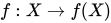
Because is always an open subset of the image of a strongly open map must be an open subset of its codomain In fact, a relatively open map is a strongly open map if and only if its image is an open subset of its codomain. In summary,
- A map is strongly open if and only if it is relatively open and its image is an open subset of its codomain.
By using this characterization, it is often straightforward to apply results involving one of these two definitions of "open map" to a situation involving the other definition.
The discussion above will also apply to closed maps if each instance of the word "open" is replaced with the word "closed".
Open maps
[edit]A map is called an open map or a strongly open map if it satisfies any of the following equivalent conditions:
- Definition: maps open subsets of its domain to open subsets of its codomain; that is, for any open subset of , is an open subset of
- is a relatively open map and its image is an open subset of its codomain
- For every and every neighborhood of (however small), is a neighborhood of . We can replace the first or both instances of the word "neighborhood" with "open neighborhood" in this condition and the result will still be an equivalent condition:
- For every and every open neighborhood of , is a neighborhood of .
- For every and every open neighborhood of , is an open neighborhood of .
- for all subsets of where denotes the topological interior of the set.
- Whenever is a closed subset of then the set is a closed subset of
- This is a consequence of the identity which holds for all subsets
If is a basis for then the following can be appended to this list:
- maps basic open sets to open sets in its codomain (that is, for any basic open set is an open subset of ).
Closed maps
[edit]A map is called a relatively closed map if whenever is a closed subset of the domain then is a closed subset of 's image where as usual, this set is endowed with the subspace topology induced on it by 's codomain
A map is called a closed map or a strongly closed map if it satisfies any of the following equivalent conditions:
- Definition: maps closed subsets of its domain to closed subsets of its codomain; that is, for any closed subset of is a closed subset of
- is a relatively closed map and its image is a closed subset of its codomain
- for every subset
- for every closed subset
- Whenever is an open subset of then the set is an open subset of
- If is a net in and is a point such that in then converges in to the set
- The convergence means that every open subset of that contains will contain for all sufficiently large indices
A surjective map is strongly closed if and only if it is relatively closed. So for this important special case, the two definitions are equivalent. By definition, the map is a relatively closed map if and only if the surjection is a strongly closed map.
If in the open set definition of "continuous map" (which is the statement: "every preimage of an open set is open"), both instances of the word "open" are replaced with "closed" then the statement of results ("every preimage of a closed set is closed") is equivalent to continuity. This does not happen with the definition of "open map" (which is: "every image of an open set is open") since the statement that results ("every image of a closed set is closed") is the definition of "closed map", which is in general not equivalent to openness. There exist open maps that are not closed and there also exist closed maps that are not open. This difference between open/closed maps and continuous maps is ultimately due to the fact that for any set only is guaranteed in general, whereas for preimages, equality always holds.
Examples
[edit]The function defined by is continuous, closed, and relatively open, but not (strongly) open. This is because if is any open interval in 's domain that does not contain then where this open interval is an open subset of both and However, if is any open interval in that contains then which is not an open subset of 's codomain but is an open subset of Because the set of all open intervals in is a basis for the Euclidean topology on this shows that is relatively open but not (strongly) open.
If has the discrete topology (that is, all subsets are open and closed) then every function is both open and closed (but not necessarily continuous). For example, the floor function from to is open and closed, but not continuous. This example shows that the image of a connected space under an open or closed map need not be connected.
Whenever we have a product of topological spaces the natural projections are open[12][13] (as well as continuous). Since the projections of fiber bundles and covering maps are locally natural projections of products, these are also open maps. Projections need not be closed however. Consider for instance the projection on the first component; then the set is closed in but is not closed in However, for a compact space the projection is closed. This is essentially the tube lemma.
To every point on the unit circle we can associate the angle of the positive -axis with the ray connecting the point with the origin. This function from the unit circle to the half-open interval [0,2π) is bijective, open, and closed, but not continuous. It shows that the image of a compact space under an open or closed map need not be compact. Also note that if we consider this as a function from the unit circle to the real numbers, then it is neither open nor closed. Specifying the codomain is essential.
Sufficient conditions
[edit]Every homeomorphism is open, closed, and continuous. In fact, a bijective continuous map is a homeomorphism if and only if it is open, or equivalently, if and only if it is closed.
The composition of two (strongly) open maps is an open map and the composition of two (strongly) closed maps is a closed map.[14][15] However, the composition of two relatively open maps need not be relatively open and similarly, the composition of two relatively closed maps need not be relatively closed. If is strongly open (respectively, strongly closed) and is relatively open (respectively, relatively closed) then is relatively open (respectively, relatively closed).
Let be a map. Given any subset if is a relatively open (respectively, relatively closed, strongly open, strongly closed, continuous, surjective) map then the same is true of its restriction to the -saturated subset
The categorical sum of two open maps is open, or of two closed maps is closed.[15] The categorical product of two open maps is open, however, the categorical product of two closed maps need not be closed.[14][15]
A bijective map is open if and only if it is closed. The inverse of a bijective continuous map is a bijective open/closed map (and vice versa). A surjective open map is not necessarily a closed map, and likewise, a surjective closed map is not necessarily an open map. All local homeomorphisms, including all coordinate charts on manifolds and all covering maps, are open maps.
Closed map lemma—Every continuous function from a compact space to a Hausdorff space is closed and proper (meaning that preimages of compact sets are compact).
A variant of the closed map lemma states that if a continuous function between locally compact Hausdorff spaces is proper then it is also closed.
In complex analysis, the identically named open mapping theorem states that every non-constant holomorphic function defined on a connected open subset of the complex plane is an open map.
The invariance of domain theorem states that a continuous and locally injective function between two -dimensional topological manifolds must be open.
Invariance of domain—If is an open subset of and is an injective continuous map, then is open in and is a homeomorphism between and
In functional analysis, the open mapping theorem states that every surjective continuous linear operator between Banach spaces is an open map. This theorem has been generalized to topological vector spaces beyond just Banach spaces.
A surjective map is called an almost open map if for every there exists some such that is a point of openness for which by definition means that for every open neighborhood of is a neighborhood of in (note that the neighborhood is not required to be an open neighborhood). Every surjective open map is an almost open map but in general, the converse is not necessarily true. If a surjection is an almost open map then it will be an open map if it satisfies the following condition (a condition that does not depend in any way on 's topology ):
- whenever belong to the same fiber of (that is, ) then for every neighborhood of there exists some neighborhood of such that
If the map is continuous then the above condition is also necessary for the map to be open. That is, if is a continuous surjection then it is an open map if and only if it is almost open and it satisfies the above condition.
Properties
[edit]Open or closed maps that are continuous
[edit]If is a continuous map that is also open or closed then:
- if is a surjection then it is a quotient map and even a hereditarily quotient map,
- A surjective map is called hereditarily quotient if for every subset the restriction is a quotient map.
- if is an injection then it is a topological embedding.
- if is a bijection then it is a homeomorphism.
In the first two cases, being open or closed is merely a sufficient condition for the conclusion that follows. In the third case, it is necessary as well.
Open continuous maps
[edit]If is a continuous (strongly) open map, and then:
- where denotes the boundary of a set.
- where denote the closure of a set.
- If where denotes the interior of a set, then where this set is also necessarily a regular closed set (in ).[note 1] In particular, if is a regular closed set then so is And if is a regular open set then so is
- If the continuous open map is also surjective then and moreover, is a regular open (resp. a regular closed)[note 1] subset of if and only if is a regular open (resp. a regular closed) subset of
- If a net converges in to a point and if the continuous open map is surjective, then for any there exists a net in (indexed by some directed set ) such that in and is a subnet of Moreover, the indexing set may be taken to be with the product order where is any neighbourhood basis of directed by [note 2]
See also
[edit]- Almost open map – Map that satisfies a condition similar to that of being an open map
- Closed graph – Property of functions in topology
- Closed linear operator – Linear operator whose graph is closed
- Local homeomorphism – Mathematical function revertible near each point
- Quasi-open map – Function that maps non-empty open sets to sets that have non-empty interior in its codomain
- Quotient map (topology) – Topological space construction
- Perfect map – Continuous closed surjective map, each of whose fibers are also compact sets
- Proper map – Map between topological spaces with the property that the preimage of every compact is compact
- Sequence covering map
Notes
[edit]- ^ a b A subset is called a regular closed set if or equivalently, if where (resp. ) denotes the topological boundary (resp. interior, closure) of in The set is called a regular open set if or equivalently, if The interior (taken in ) of a closed subset of is always a regular open subset of The closure (taken in ) of an open subset of is always a regular closed subset of
- ^ Explicitly, for any pick any such that and then let be arbitrary. The assignment defines an order morphism such that is a cofinal subset of thus is a Willard-subnet of
Citations
[edit]- ^ Munkres, James R. (2000). Topology (2nd ed.). Prentice Hall. ISBN 0-13-181629-2.
- ^ a b Mendelson, Bert (1990) [1975]. Introduction to Topology (Third ed.). Dover. p. 89. ISBN 0-486-66352-3.
It is important to remember that Theorem 5.3 says that a function is continuous if and only if the inverse image of each open set is open. This characterization of continuity should not be confused with another property that a function may or may not possess, the property that the image of each open set is an open set (such functions are called open mappings).
- ^ a b c Lee, John M. (2003). Introduction to Smooth Manifolds. Graduate Texts in Mathematics. Vol. 218. Springer Science & Business Media. p. 550. ISBN 9780387954486.
A map (continuous or not) is said to be an open map if for every closed subset is open in and a closed map if for every closed subset is closed in Continuous maps may be open, closed, both, or neither, as can be seen by examining simple examples involving subsets of the plane.
- ^ a b Ludu, Andrei (15 January 2012). Nonlinear Waves and Solitons on Contours and Closed Surfaces. Springer Series in Synergetics. p. 15. ISBN 9783642228940.
An open map is a function between two topological spaces which maps open sets to open sets. Likewise, a closed map is a function which maps closed sets to closed sets. The open or closed maps are not necessarily continuous.
- ^ Sohrab, Houshang H. (2003). Basic Real Analysis. Springer Science & Business Media. p. 203. ISBN 9780817642112.
Now we are ready for our examples which show that a function may be open without being closed or closed without being open. Also, a function may be simultaneously open and closed or neither open nor closed.
(The quoted statement in given in the context of metric spaces but as topological spaces arise as generalizations of metric spaces, the statement holds there as well.) - ^ Naber, Gregory L. (2012). Topological Methods in Euclidean Spaces. Dover Books on Mathematics (reprint ed.). Courier Corporation. p. 18. ISBN 9780486153445.
Exercise 1-19. Show that the projection map π1:X1 × ··· × Xk → Xi is an open map, but need not be a closed map. Hint: The projection of R2 onto is not closed. Similarly, a closed map need not be open since any constant map is closed. For maps that are one-to-one and onto, however, the concepts of 'open' and 'closed' are equivalent.
- ^ Mendelson, Bert (1990) [1975]. Introduction to Topology (Third ed.). Dover. p. 89. ISBN 0-486-66352-3.
There are many situations in which a function has the property that for each open subset of the set is an open subset of and yet is not continuous.
- ^ Boos, Johann (2000). Classical and Modern Methods in Summability. Oxford University Press. p. 332. ISBN 0-19-850165-X.
Now, the question arises whether the last statement is true in general, that is whether closed maps are continuous. That fails in general as the following example proves.
- ^ Kubrusly, Carlos S. (2011). The Elements of Operator Theory. Springer Science & Business Media. p. 115. ISBN 9780817649982.
In general, a map of a metric space into a metric space may possess any combination of the attributes 'continuous', 'open', and 'closed' (that is, these are independent concepts).
- ^ Hart, K. P.; Nagata, J.; Vaughan, J. E., eds. (2004). Encyclopedia of General Topology. Elsevier. p. 86. ISBN 0-444-50355-2.
It seems that the study of open (interior) maps began with papers [13,14] by S. Stoïlow. Clearly, openness of maps was first studied extensively by G.T. Whyburn [19,20].
- ^ Narici & Beckenstein 2011, pp. 225–273.
- ^ Willard, Stephen (1970). General Topology. Addison-Wesley. ISBN 0486131785.
- ^ Lee, John M. (2012). Introduction to Smooth Manifolds. Graduate Texts in Mathematics. Vol. 218 (Second ed.). p. 606. doi:10.1007/978-1-4419-9982-5. ISBN 978-1-4419-9982-5. Archived from the original on 2022-10-13. Retrieved 2021-09-12.
Exercise A.32. Suppose are topological spaces. Show that each projection is an open map.
- ^ a b Baues, Hans-Joachim; Quintero, Antonio (2001). Infinite Homotopy Theory. K-Monographs in Mathematics. Vol. 6. p. 53. ISBN 9780792369820.
A composite of open maps is open and a composite of closed maps is closed. Also, a product of open maps is open. In contrast, a product of closed maps is not necessarily closed,...
- ^ a b c James, I. M. (1984). General Topology and Homotopy Theory. Springer-Verlag. p. 49. ISBN 9781461382836.
...let us recall that the composition of open maps is open and the composition of closed maps is closed. Also that the sum of open maps is open and the sum of closed maps is closed. However, the product of closed maps is not necessarily closed, although the product of open maps is open.
References
[edit]- Narici, Lawrence; Beckenstein, Edward (2011). Topological Vector Spaces. Pure and applied mathematics (Second ed.). Boca Raton, FL: CRC Press. ISBN 978-1584888666. OCLC 144216834.
- Schaefer, Helmut H.; Wolff, Manfred P. (1999). Topological Vector Spaces. GTM. Vol. 8 (Second ed.). New York, NY: Springer New York Imprint Springer. ISBN 978-1-4612-7155-0. OCLC 840278135.
- Trèves, François (2006) [1967]. Topological Vector Spaces, Distributions and Kernels. Mineola, N.Y.: Dover Publications. ISBN 978-0-486-45352-1. OCLC 853623322.
Open and closed maps
View on GrokipediaDefinitions
Open maps
In topology, an open map is a function between topological spaces that preserves the openness of sets under direct images. Specifically, a map between topological spaces and is defined to be open if, for every open set , the image is an open set in .[3] Formally, this condition can be stated as: for all , where denotes the topology on , it holds that , with the topology on .[4] This definition appears in standard treatments of general topology and underscores the map's behavior with respect to the open sets of the codomain.[5] The role of an open map lies in its preservation of structural openness from the domain to the codomain, ensuring that the topological features of open subsets in translate directly into open subsets in .[3] Unlike continuous maps, which focus on preimages of open sets, open maps emphasize the direct images , thereby highlighting how the topology on interacts with the mapping process. This preservation is crucial in contexts where the openness in the codomain must align with the mapped structure from the domain, without requiring surjectivity or other additional properties.[4]Closed maps
A map between topological spaces is called a closed map if the image under of every closed subset of is closed in .[6] Formally, is closed if for every closed set , belongs to the family of closed sets in , denoted , which consists of the complements of open sets in the topology on .[7] This property ensures that closed maps preserve the "closedness" of subsets under the function's action, distinguishing them from the dual concept of open maps, which instead map open sets to open sets.[8] In particular, the focus on closed sets—defined as complements of open sets—avoids direct overlap with openness conditions, emphasizing instead the behavior of boundaries and limits in the codomain.[9] Closed maps are useful for controlling the closure of images of subsets.[6]Characterizations and variants
Equivalent conditions
A map between topological spaces is open if and only if for every subset , where denotes the interior operator.[10] Dually, a map is closed if and only if for every subset , where the bar denotes the closure operator.[10] This condition ensures that the image under respects closures in a manner symmetric to how the interior condition characterizes openness. For surjective maps, additional equivalences arise in terms of preimages and saturation: a surjective is open if the saturation of every open set in (with respect to the fibers of ) is open.[10] A bijective map is a homeomorphism if and only if it is open; equivalently, if and only if it is closed.[11] This holds because openness of a bijection implies bicontinuity, as the inverse maps open sets to open sets via the direct images under .Strong and relative versions
In topology, the usual notion of an open map requires that the image of every open set in the domain is open in the entire codomain. Specifically, for a function between topological spaces and , is open if for every open set , the set is open in .[12] Analogously, a closed map is one where the image of every closed set in is closed in .[12] To address non-surjective maps, relative versions of these concepts are defined with respect to the subspace topology on the image . A map is a relative open map if for every open set , the set is open in the subspace , meaning there exists an open set such that .[13] Similarly, is a relative closed map if the image of every closed set in is closed in the subspace , i.e., there exists a closed set such that for every closed .[13] These relative notions weaken the usual versions by focusing openness or closedness locally within the image rather than the full codomain. When is surjective, so that , the subspace topology on coincides with the topology on , and thus the usual and relative versions of openness (or closedness) are equivalent.[14] In non-surjective cases, the relative condition is strictly weaker than the usual one; for instance, any inclusion map of a subspace is relative open (and relative closed) onto its image by the definition of the subspace topology, but it is open only if itself is open in .[13] These variants emerged in the development of quotient topology, where the standard constructions assume surjective maps to ensure the quotient map is both continuous and open (or closed), but extensions to non-surjective settings, such as in general identification spaces or momentum maps, necessitated the relative notions to preserve topological properties within the image.[15]Examples
Continuous maps that are open or closed
A fundamental example of a continuous open map arises in product spaces. Consider the projection map defined by , where and are topological spaces equipped with the product topology on . This map is continuous by the definition of the product topology, as the preimage of any open set is , which is open in the product space.[16] Moreover, is open: the image of a basic open set (with open in and open in ) is , which is open in . This holds more generally for arbitrary open sets in the product, as they are unions of such basic opens, and images preserve unions. To verify explicitly, suppose is open; then for opens and , so , which is open in . Thus, projections illustrate how continuity and openness combine in coordinate extractions from products.[17] Another illustrative case is the inclusion map where is a closed subset of a topological space . The map is always continuous when inherits the subspace topology from . Furthermore, is a closed map precisely when is closed in : for any closed set , is closed in (as the intersection of a closed set in with the closed ), and is thus closed in . This property highlights how embeddings of closed subsets preserve closedness under continuous inclusion, preserving the topological structure in a restrictive yet faithful manner.[18]Maps that are open or closed but not continuous
A classic example of a map that is open but not continuous is the identity map on a set with at least two elements, where the domain is equipped with the indiscrete topology (also known as the trivial topology, in which the only open sets are and ) and the codomain is equipped with the discrete topology (in which every subset is open). The images of the open sets in the domain are (which is open in the discrete topology) and (which is open in the discrete topology), so the map is open.[19] However, it is not continuous, because the preimage of a singleton (which is open in the discrete codomain) is , and singletons are not open in the indiscrete domain unless .[19] This example also illustrates that the map is closed, since the closed sets in the indiscrete domain are and , whose images are closed in the discrete codomain.[19] Another example of an open map that is not continuous arises in the cofinite topology on an uncountable set , where the open sets are and the complements of finite subsets of . Consider the identity map , where the codomain has the discrete topology. The image of any nonempty open set in the domain is cofinite in , and every subset (including cofinite sets) is open in the discrete codomain, so the map is open. It is not continuous, however, because the preimage of a singleton (open in the discrete codomain) is , which has uncountable complement and thus is not open in the cofinite topology. For a closed map that is not continuous, consider the identity map , where the domain has the cofinite topology and the codomain has the standard Euclidean topology. The closed sets in the cofinite topology are the finite subsets and itself; their images under the identity are finite (hence closed in the standard topology) or (closed), so the map is closed.[20] The map is not continuous, as the preimage of the open interval (open in the standard codomain) is , whose complement in is (uncountable, hence not finite), so is not open in the cofinite domain.[20] A further illustration of a closed but discontinuous map is found in the countable Fort space, a topology on a countable infinite set where is countably infinite and : the open sets are all subsets of and all cofinite subsets of .[21] The projection map (sending to some fixed point in and fixing points in ) to equipped with the discrete topology is closed, as the images of closed sets (which include the finite subsets of and all subsets containing ) are finite or all of , both closed in the discrete topology. It is not continuous, because the preimage of a singleton (open in the discrete codomain) is if , which does not contain and is not all of , hence not open in the Fort space topology.Sufficient conditions
Conditions involving continuity
In topology, a fundamental result concerning closed maps involves continuous bijections between specific types of spaces. Specifically, if is a compact space and is a Hausdorff space, then any continuous bijection is a closed map.[22] Moreover, such a bijection is in fact a homeomorphism, as its inverse is also continuous. This theorem highlights how continuity, combined with compactness of the domain and Hausdorff separation in the codomain, suffices to ensure the map is closed and thus a topological embedding in the bijective case. Another key condition arises in the context of quotient maps, which are surjective continuous maps that identify the topology of the codomain via saturation of preimages. A continuous surjective map that is also open is necessarily a quotient map.[3] This follows because the openness ensures that the preimage condition for open sets in aligns precisely with the quotient topology definition. Such maps are particularly useful in constructing new spaces by gluing or identification while preserving topological structure. For injective continuous maps, openness provides a sufficient condition for the map to be an embedding, meaning it is a homeomorphism onto its image equipped with the subspace topology. If is a continuous injection and open (onto its image), then embeds as an open subspace of .[23] This property is essential in differential topology and manifold theory, where embeddings distinguish submanifolds from mere immersions. Continuous maps inherently preserve connectedness: if is a connected space and is continuous, then is connected in .[24] When the continuous map is additionally open, this preservation extends to ensuring the image is an open connected subset, reinforcing the map's role in maintaining global connectivity properties under openness.[24]Conditions from topological properties
A fundamental sufficient condition for a continuous map to be closed arises from compactness in the domain and the Hausdorff property in the codomain. Specifically, if is compact and is Hausdorff, then maps closed subsets of to closed subsets of . This follows because the continuous image of a closed subset of —which is compact—is closed in the Hausdorff space .[25] Local homeomorphisms provide a condition for openness independent of global compactness. A map is a local homeomorphism if every point in has an open neighborhood on which restricts to a homeomorphism onto its image, which is open in . Consequently, is an open map, as the image of any open set in is a union of such open images. Covering maps, being surjective local homeomorphisms between topological spaces (typically with path-connected and locally path-connected base), inherit this openness property.[26] Proper maps offer another intrinsic condition for closedness, particularly in settings involving locally compact spaces. A continuous map is proper if the preimage of every compact subset of is compact in . When is Hausdorff, such a proper map is closed, since the image of a closed subset of has compact preimages under the inverse, ensuring closure in . This generalizes the compact-to-Hausdorff case, where compactness makes every continuous map proper.[27] In the context of linearly ordered topological spaces (LOTS), known as chains with the order topology, strictly monotone maps—strictly order-preserving functions—satisfy closedness under surjectivity. A surjective strictly monotone map between chains maps closed sets to closed sets, as the order preservation ensures that intervals and their complements behave accordingly under the map. In fact, such surjections are homeomorphisms, reinforcing their closed (and open) nature.[28]Properties and relations
Preservation under composition
In topology, the composition of two open maps is open. If and are open maps between topological spaces, then for any open set , is open in , and thus is open in .[29] Similarly, the composition of two closed maps is closed: if is closed, then is closed in , and is closed in .[30] However, the composition of an open map with a closed map (in either order) need not be open or closed.[31] When the maps are surjective, the preservation of openness or closedness under composition holds without additional conditions, as the property relies only on the images of open or closed sets, and surjectivity ensures the images cover the codomain but is not required for the basic result. At a higher level, the classes of open and closed maps are closed under composition, enabling the definition of categories where the objects are topological spaces and the morphisms are open maps (or closed maps). Such categories have been studied, though they lack certain limits, such as binary products in the case of open maps.[32] This structure relates to monoidal or enriched category theory in topology, where open maps play a role in models of spatial processes.Connections to quotient maps and homeomorphisms
A continuous surjective map between topological spaces is a quotient map if it endows with the quotient topology, meaning a subset is open precisely when is open in . Since is continuous and surjective, the forward direction holds automatically, but the converse requires additional structure. If is also an open map, then for any with open, set , which is open, and ; openness of ensures is open in . Similarly, if is closed, the argument uses closed complements: if is open, its complement is closed, and surjectivity with closedness of implies the complement of is closed, so is open.[33] Homeomorphisms, which are topological isomorphisms, can be characterized using openness or closedness for bijective continuous maps. Specifically, a bijective continuous map is a homeomorphism if and only if it is open, meaning it maps open sets to open sets; equivalently, if it is closed. This follows because for a bijection, the inverse is continuous if and only if is open: the preimage under of an open set in is the image under of that set in , so openness of ensures continuity of . The closed characterization is analogous, using closed sets. In algebraic topology, covering maps provide a key connection, as the universal covering space of a path-connected, locally path-connected space is a covering map, which is a local homeomorphism and hence an open map. A local homeomorphism means every point in has a neighborhood homeomorphic via to a neighborhood in , implying openness since local images of open sets are open. Universal covers, being simply connected covering spaces, thus identify discrete fibers evenly while preserving openness, facilitating computations of fundamental groups via the Galois correspondence between subgroups and covers.[34] Open quotient maps play a crucial role in algebraic topology for constructing spaces by identifying fibers, such as in group actions where orbits form fibers. When a group acts continuously on a space satisfying suitable conditions (e.g., freely and properly), the quotient map is a covering map, hence open, ensuring the quotient topology respects local Euclidean structure and allows lifting of paths and homotopies through the fibers. This identification of fibers via openness preserves key invariants like homotopy groups above the base dimension, enabling applications in bundle theory and classification of manifolds.[34]References
- https://proofwiki.org/wiki/Definition:Fort_Space/Countable
