


Community hub
Recent from talks
Contribute something to knowledge base
Content stats: 0 posts, 0 articles, 1 media, 0 notes
Members stats: 0 subscribers, 0 contributors, 0 moderators, 0 supporters
Subscribers
Supporters
Contributors
Moderators
Operation Cedar Falls
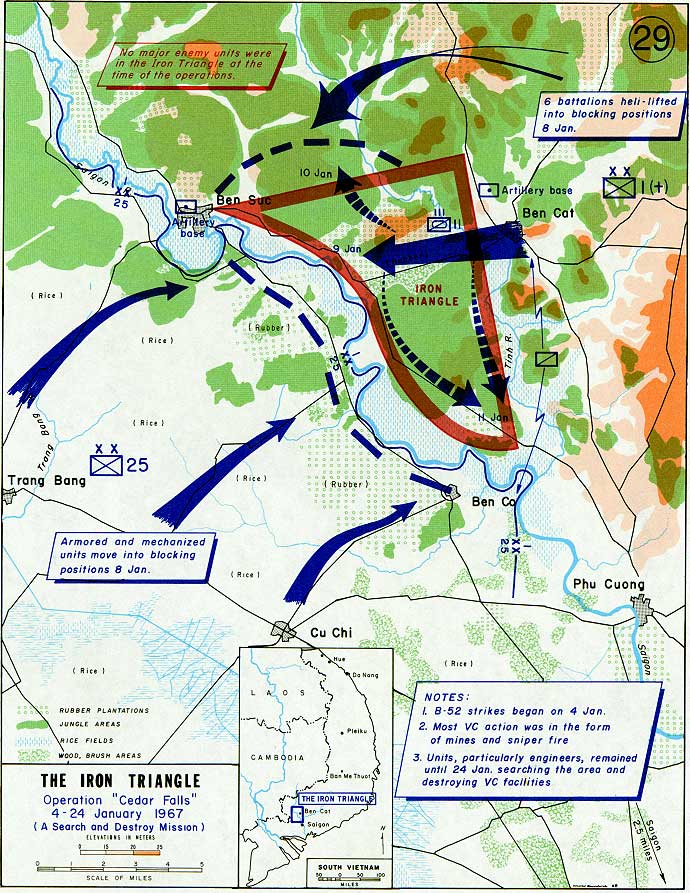
Operation Cedar Falls was a military operation of the Vietnam War conducted primarily by US forces that took place from 8 to 26 January 1967. The aim of the massive search-and-destroy operation was to eradicate the Iron Triangle, an area northwest of Saigon that had become a major stronghold of the Viet Cong (VC).
It was the largest American ground operation of the Vietnam war: two Army divisions, one infantry and one paratrooper brigade, and one armored cavalry regiment participated in the operation. Altogether, it involved 30,000 US and South Vietnamese troops. The VC, however, chose to evade the massive military force by fleeing across the border to Cambodia or by hiding in a complex system of tunnels. Still, the Allied forces uncovered and destroyed some of the tunnel complexes as well as large stockpiles of VC supplies. In the course of the operation, so-called tunnel rats were introduced to infiltrate the Viet Cong's tunnel systems.
In an attempt at the permanent destruction of the Iron Triangle as a VC stronghold, Operation Cedar Falls also entailed the complete deportation of the region's civilian population to so-called New Life Villages, the destruction of their homes, and the defoliation of whole areas. Following this, the area was declared a free-fire zone and adults who were found in the zone following deportations were considered "enemy combatants" afterwards.
Most senior officers involved in planning and executing the operation later evaluated it as a success. Most journalists and military historians, however, paint a bleaker picture. They argue that Cedar Falls failed to achieve its main goal since the VC's setback in the Iron Triangle proved to be only temporary. Moreover, critics argue that the harsh treatment of the civilian population was both morally questionable and detrimental to the US effort to win Vietnamese hearts and minds and drove many into the ranks of the VC instead. Therefore, some authors cite Operation Cedar Falls as a major example of the misconceptions and inadequate perceptions of US strategy in Vietnam and for its morally troublesome consequences.
The planning for Operation Cedar Falls evolved out of the broader strategic aims which MACV, the United States' unified command structure for its military forces in South Vietnam, had formulated for 1967. Following the war's earlier stages, in which the insertion of major US ground troops had averted the collapse of the South Vietnamese regime and during which the Americans had built up their forces, COMUSMACV General William C. Westmoreland planned to go on the offensive during 1967. In particular, he planned to clear major People's Army of Vietnam (PAVN) or VC strongholds and to push communist forces into South Vietnam's lightly populated border regions where US forces would be able to make more lavish use of their firepower.
The town of Bến Súc was located in a central area of the Iron Triangle and politically controlled by the VC. Prior to 1964, the town was ostensibly neutral, with both ARVN and VC presence. In 1964 the ARVN outpost was overrun and the area was declared a liberated zone, with the VC establishing its own governing apparatus. Bến Súc was described by Jonathan Schell as an important marketplace town for the region with a population of 3,500, and a refuge point for people fleeing from continual combat operations and US/ARVN aerial and artillery nearby. The area was located in proximity to several free-fire zone, and the village was surrounded by the daily presence of bombardment in nearby hills and forests and occasional bombardment from US forces.
On Westmoreland's order, Lieutenant General Jonathan O. Seaman, Commanding General, II Field Force, Vietnam, began planning for an operation code named Operation Junction City aimed at disrupting VC control of War Zone C. When the strength of Seaman's troops built up, however, he suggested to additionally target another major VC stronghold: the so-called "Iron Triangle". This was the nickname for an area of approximately 155 square kilometers located some 20 kilometers north of Saigon which, being bounded by the Saigon River to the southwest, Than Dien Forest to the north, and the Thi Tinh River to the east, had a roughly triangular shape. Virtually since the beginning of the Second Indochinese War, this area had become a major VC staging ground and rear area which, by 1966, South Vietnamese government officials or military forces had not dared to enter in years. Due to the Iron Triangle's location, shape, and the scope of VC activity there, it had been called a "dagger pointed at the heart of Saigon." Westmoreland agreed and so it was decided that Operation Junction City was to be preceded by Operation Cedar Falls.
Since earlier efforts to clear the VC from the Iron Triangle had failed, Operation Cedar Falls was intended to achieve nothing less than its complete eradication as an enemy sanctuary and base of operations. Therefore, Operation Cedar Falls was to involve not only an assault on regular VC forces and their infrastructure, but also the deportation of the area's entire civilian population, the complete destruction of their homes, the area's defoliation, and its categorization as a free-fire zone.
Operation Cedar Falls
Operation Cedar Falls was a military operation of the Vietnam War conducted primarily by US forces that took place from 8 to 26 January 1967. The aim of the massive search-and-destroy operation was to eradicate the Iron Triangle, an area northwest of Saigon that had become a major stronghold of the Viet Cong (VC).
It was the largest American ground operation of the Vietnam war: two Army divisions, one infantry and one paratrooper brigade, and one armored cavalry regiment participated in the operation. Altogether, it involved 30,000 US and South Vietnamese troops. The VC, however, chose to evade the massive military force by fleeing across the border to Cambodia or by hiding in a complex system of tunnels. Still, the Allied forces uncovered and destroyed some of the tunnel complexes as well as large stockpiles of VC supplies. In the course of the operation, so-called tunnel rats were introduced to infiltrate the Viet Cong's tunnel systems.
In an attempt at the permanent destruction of the Iron Triangle as a VC stronghold, Operation Cedar Falls also entailed the complete deportation of the region's civilian population to so-called New Life Villages, the destruction of their homes, and the defoliation of whole areas. Following this, the area was declared a free-fire zone and adults who were found in the zone following deportations were considered "enemy combatants" afterwards.
Most senior officers involved in planning and executing the operation later evaluated it as a success. Most journalists and military historians, however, paint a bleaker picture. They argue that Cedar Falls failed to achieve its main goal since the VC's setback in the Iron Triangle proved to be only temporary. Moreover, critics argue that the harsh treatment of the civilian population was both morally questionable and detrimental to the US effort to win Vietnamese hearts and minds and drove many into the ranks of the VC instead. Therefore, some authors cite Operation Cedar Falls as a major example of the misconceptions and inadequate perceptions of US strategy in Vietnam and for its morally troublesome consequences.
The planning for Operation Cedar Falls evolved out of the broader strategic aims which MACV, the United States' unified command structure for its military forces in South Vietnam, had formulated for 1967. Following the war's earlier stages, in which the insertion of major US ground troops had averted the collapse of the South Vietnamese regime and during which the Americans had built up their forces, COMUSMACV General William C. Westmoreland planned to go on the offensive during 1967. In particular, he planned to clear major People's Army of Vietnam (PAVN) or VC strongholds and to push communist forces into South Vietnam's lightly populated border regions where US forces would be able to make more lavish use of their firepower.
The town of Bến Súc was located in a central area of the Iron Triangle and politically controlled by the VC. Prior to 1964, the town was ostensibly neutral, with both ARVN and VC presence. In 1964 the ARVN outpost was overrun and the area was declared a liberated zone, with the VC establishing its own governing apparatus. Bến Súc was described by Jonathan Schell as an important marketplace town for the region with a population of 3,500, and a refuge point for people fleeing from continual combat operations and US/ARVN aerial and artillery nearby. The area was located in proximity to several free-fire zone, and the village was surrounded by the daily presence of bombardment in nearby hills and forests and occasional bombardment from US forces.
On Westmoreland's order, Lieutenant General Jonathan O. Seaman, Commanding General, II Field Force, Vietnam, began planning for an operation code named Operation Junction City aimed at disrupting VC control of War Zone C. When the strength of Seaman's troops built up, however, he suggested to additionally target another major VC stronghold: the so-called "Iron Triangle". This was the nickname for an area of approximately 155 square kilometers located some 20 kilometers north of Saigon which, being bounded by the Saigon River to the southwest, Than Dien Forest to the north, and the Thi Tinh River to the east, had a roughly triangular shape. Virtually since the beginning of the Second Indochinese War, this area had become a major VC staging ground and rear area which, by 1966, South Vietnamese government officials or military forces had not dared to enter in years. Due to the Iron Triangle's location, shape, and the scope of VC activity there, it had been called a "dagger pointed at the heart of Saigon." Westmoreland agreed and so it was decided that Operation Junction City was to be preceded by Operation Cedar Falls.
Since earlier efforts to clear the VC from the Iron Triangle had failed, Operation Cedar Falls was intended to achieve nothing less than its complete eradication as an enemy sanctuary and base of operations. Therefore, Operation Cedar Falls was to involve not only an assault on regular VC forces and their infrastructure, but also the deportation of the area's entire civilian population, the complete destruction of their homes, the area's defoliation, and its categorization as a free-fire zone.
Recent media
Recent media