Hubbry Logo
search
logo
1701878

Operation Cedar Falls

logo
Community Hub0 Subscribers

Wikipedia

from Wikipedia
Operation Cedar Falls
Part of the Vietnam War

Operation Cedar Falls
Date8–26 January 1967
Location
Result Inconclusive
Belligerents
United States
South Vietnam
North Vietnam
Viet Cong
Units involved
1st Infantry Division
25th Infantry Division
196th Light Infantry Brigade
173rd Airborne Brigade
11th Armored Cavalry Regiment
272nd Regiment
165th Regiment
Phu Loi Local Force Battalion
Strength
30,000 Unknown
Casualties and losses

United States 72 killed
South Vietnam 11 killed
7 vehicles destroyed

VC Claim:
3,000 casualties
US body count: 720 killed
280 captured
512 suspects detained
540 defected
590 individual and 29 crew-served weapons recovered

Operation Cedar Falls was a military operation of the Vietnam War conducted primarily by US forces that took place from 8 to 26 January 1967. The aim of the massive search-and-destroy operation was to eradicate the Iron Triangle, an area northwest of Saigon that had become a major stronghold of the Viet Cong (VC).

It was the largest American ground operation of the Vietnam war:[1] two Army divisions, one infantry and one paratrooper brigade, and one armored cavalry regiment participated in the operation.[2] Altogether, it involved 30,000 US and South Vietnamese troops.[1] The VC, however, chose to evade the massive military force by fleeing across the border to Cambodia or by hiding in a complex system of tunnels. Still, the Allied forces uncovered and destroyed some of the tunnel complexes as well as large stockpiles of VC supplies. In the course of the operation, so-called tunnel rats were introduced to infiltrate the Viet Cong's tunnel systems.[3]

In an attempt at the permanent destruction of the Iron Triangle as a VC stronghold, Operation Cedar Falls also entailed the complete deportation of the region's civilian population to so-called New Life Villages, the destruction of their homes, and the defoliation of whole areas. Following this, the area was declared a free-fire zone and adults who were found in the zone following deportations were considered "enemy combatants" afterwards.[4]

Most senior officers involved in planning and executing the operation later evaluated it as a success. Most journalists and military historians, however, paint a bleaker picture. They argue that Cedar Falls failed to achieve its main goal since the VC's setback in the Iron Triangle proved to be only temporary. Moreover, critics argue that the harsh treatment of the civilian population was both morally questionable and detrimental to the US effort to win Vietnamese hearts and minds and drove many into the ranks of the VC instead. Therefore, some authors cite Operation Cedar Falls as a major example of the misconceptions and inadequate perceptions of US strategy in Vietnam and for its morally troublesome consequences.

Background

[edit]

The "Iron Triangle"

[edit]

The planning for Operation Cedar Falls evolved out of the broader strategic aims which MACV, the United States' unified command structure for its military forces in South Vietnam, had formulated for 1967. Following the war's earlier stages, in which the insertion of major US ground troops had averted the collapse of the South Vietnamese regime and during which the Americans had built up their forces, COMUSMACV General William C. Westmoreland planned to go on the offensive during 1967. In particular, he planned to clear major People's Army of Vietnam (PAVN) or VC strongholds and to push communist forces into South Vietnam's lightly populated border regions where US forces would be able to make more lavish use of their firepower.[2]: 131–5 

The town of Bến Súc was located in a central area of the Iron Triangle and politically controlled by the VC. Prior to 1964, the town was ostensibly neutral, with both ARVN and VC presence. In 1964 the ARVN outpost was overrun and the area was declared a liberated zone, with the VC establishing its own governing apparatus.[5] Bến Súc was described by Jonathan Schell as an important marketplace town for the region with a population of 3,500, and a refuge point for people fleeing from continual combat operations and US/ARVN aerial and artillery nearby. The area was located in proximity to several free-fire zone, and the village was surrounded by the daily presence of bombardment in nearby hills and forests and occasional bombardment from US forces.[5]

On Westmoreland's order, Lieutenant General Jonathan O. Seaman, Commanding General, II Field Force, Vietnam, began planning for an operation code named Operation Junction City aimed at disrupting VC control of War Zone C. When the strength of Seaman's troops built up, however, he suggested to additionally target another major VC stronghold: the so-called "Iron Triangle". This was the nickname for an area of approximately 155 square kilometers located some 20 kilometers north of Saigon which, being bounded by the Saigon River to the southwest, Than Dien Forest to the north, and the Thi Tinh River to the east, had a roughly triangular shape. Virtually since the beginning of the Second Indochinese War, this area had become a major VC staging ground and rear area which, by 1966, South Vietnamese government officials or military forces had not dared to enter in years. Due to the Iron Triangle's location, shape, and the scope of VC activity there, it had been called a "dagger pointed at the heart of Saigon."[6] Westmoreland agreed and so it was decided that Operation Junction City was to be preceded by Operation Cedar Falls.[7]

Since earlier efforts to clear the VC from the Iron Triangle had failed, Operation Cedar Falls was intended to achieve nothing less than its complete eradication as an enemy sanctuary and base of operations. Therefore, Operation Cedar Falls was to involve not only an assault on regular VC forces and their infrastructure, but also the deportation of the area's entire civilian population, the complete destruction of their homes, the area's defoliation, and its categorization as a free-fire zone.[7]: 19 

Opposing forces and terrain

[edit]

American intelligence indicated that the VC's Military Region IV headquarters were located in the Iron Triangle; their destruction thus was a principal aim of the operation. Moreover, the 272nd Regiment, the 1st and 7th Battalions of Military Region IV under the VC 165th Regiment, the Phu Loi Local Force Battalion, plus three local force companies, as well as the 2nd, 3rd, and 8th Battalions of the 165th Regiment were suspected to operate in the Iron Triangle.[7]: 19 

To strike against this enemy force, II Field Force organized the single largest ground operation of the American war in Vietnam[1]: 100  involving the equivalent of three US divisions,[8] some 30,000 US and South Vietnamese troops. The US units involved were the 1st and 25th Infantry Division, the 196th Infantry Brigade, the 173rd Airborne Brigade, as well as the 11th Armored Cavalry Regiment. Throughout the operation these units were supposed to bear the brunt of the fighting; South Vietnamese troops were planned to search villages in the region, perform logistical tasks, as well as organizing the deportation of the civilian population.[9]

As often during the Vietnam War, the terrain of the area of operations constituted a major problem for military planners. Indeed, the reason why the VC were able to establish the Iron Triangle as a major sanctuary was that its terrain made it difficult for larger military forces to access this region. Therefore, another major aim of the operation was to destroy large parts of the vegetation through defoliants and bulldozers in order to make the Iron Triangle more easily accessible for future operations.

Battle plan

[edit]

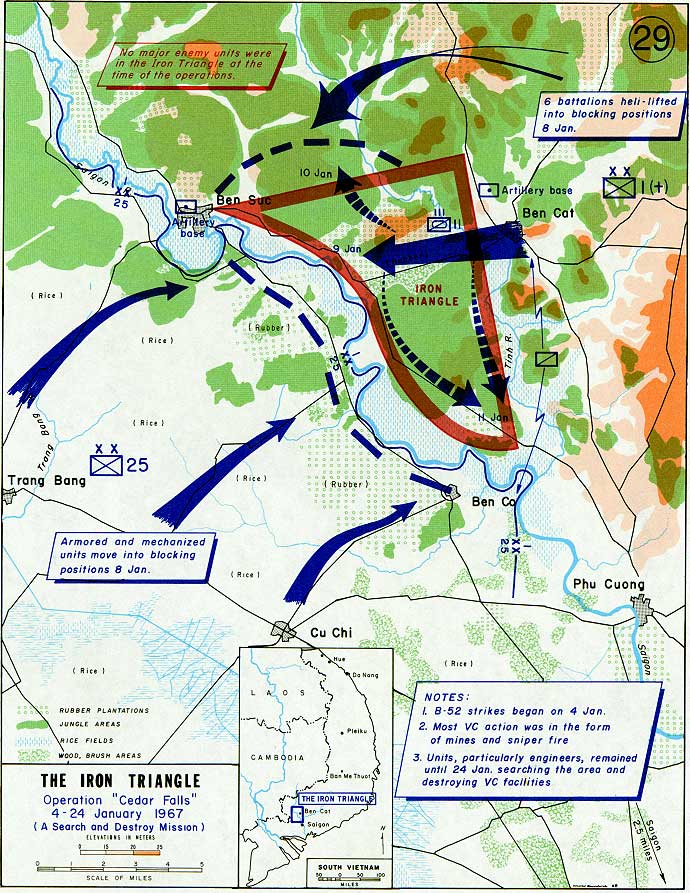
Operation Cedar Falls was planned as a "hammer and anvil" operation. Under the cloak of deceptive deployments on seemingly routine operations, the 25th Infantry Division with the 196th Infantry Brigade attached to it was to assume blocking positions west of the Iron Triangle, along the Saigon River, while one brigade of the 1st Infantry Division was assigned the same task along the Thi Tinh River east of the area of operations. The remaining units were then supposed to "hammer" the VC against this "anvil" by rapidly moving through the Iron Triangle, scouring it for enemy troops and installations, and clearing it of civilians. A tight encirclement of the area was to prevent communist units from retreating.

Operation Cedar Falls was scheduled to begin on 5 January 1967, when weather conditions were most favorable. It was divided into two distinct phases. During preparatory phase I, 5-9 January, the "anvil" was set up by positioning the relevant units along the Iron Triangle's flank, and an air assault on Bến Súc, a key fortified VC village, was to take place on 8 January (D-day). These operations were to be succeeded by the completion of the area's encirclement as well as a concerted drive of American forces through the Iron Triangle (the "hammer") from both the south and the west in phase II.[7]: 23 

Battle

[edit]

Phase I

[edit]

Positioning forces and the assault on Bến Súc

[edit]
United States Army M113 and M48A3 tank deploy along a road between the jungle and rubber plantation.

Starting on 5 January, blocking forces assumed their positions to south of the Iron Triangle along the Saigon River (the 25th Infantry Division and the 196th Infantry Brigade) and east of it (1st Infantry Division) to set up the anvil. On D-day, finally, elements of the 1st Infantry Division's 2d Brigade commenced the planned air assault on the village of Bến Súc.

Bến Súc was the main pillar of the VC's dominance over the Iron Triangle. This fortified village functioned as a major supply and political center with its population organized as rear service companies. Achieving complete tactical surprise, American forces were able to encircle and seal off the village against only light resistance. A South Vietnamese battalion was then flown in to search the village and interrogate its inhabitants. As a result of these actions, a complex tunnel and storage system was uncovered and large quantities of supplies were obtained and later destroyed. The allied forces, however, were able to arrest only lower ranking VC military or political personnel.[7]: 31–9 

Following the village's screening, 106 villagers were detained; the remaining inhabitants of Bến Súc and of surrounding villages, some 6,000 individuals, two-thirds of them children,[10] were deported, along with their belongings and live stock, in trucks, river boats and helicopters to relocation camps.[7]: 39–40  After the deportation of the village's population, Bến Súc was systematically erased by USAECV engineers who first burned the village's buildings to the ground and then leveled their remnants as well as the surrounding vegetation using bulldozers. In order to collapse tunnels too deep for the demolition teams to find and crush, the village was then subjected to heavy air bombardment.[9]: 187–8 

General Bernard William Rogers, who served as assistant division commander of the 1st Infantry Division during Operation Cedar Falls, notes that, during the forced evacuation of Bến Súc, inhabitants were "moved as humanely as possible", were allowed to take their possessions and livestock with them, and were even given medical treatment.[7]: 34–9  However, he concedes that "It was to be expected that uprooting the natives of these villages would evoke resentment, and it did"; he goes on to describe the "sight of the natives of Bến Súc with their carts, chickens, hogs, rice" as "pathetic and pitiful."[7]: 39  Moreover, he reports grave difficulties occurring during the inhabitants' resettlement to the village of Phu Loi. He quotes Westmoreland as having said "Unfortunately, the resettlement phase was not as well planned or executed as the actual evacuation. For the first several days the families suffered unnecessary hardships."[7]: 40  When interviewed more than 15 years later, one resident of the village recalled how they were not allowed to take anything from their homes, and how, from the very start of the operation, the army killed villagers.[11] Journalist Jonathan Schell, who wrote an extensive article on the operation for The New Yorker, confirms the government's assessments. Those South Vietnamese officials, who were charged with the relocation of the villagers, were not informed of their task to organize a refugee camp until 24 hours before the forced evacuation began.[9]: 133–6  As a result, the surprised inhabitants of Phu Loi were forced to house the deportees from Bến Súc in their already jammed dwellings.[9]: 123–4 

Phase II

[edit]
An infantryman checks a tunnel entrance during Operation Cedar Falls

With phase I largely completed, US forces initiated phase II. Following saturation bombing and artillery fire, elements of the 1st Infantry Division along with the 173rd Airborne Brigade and the 11th Armored Cavalry Regiment began their massive thrust into the Iron Triangle first cutting the area into half and then conducting a thorough search which covered the entire area of responsibility as Seaman had demanded.[7]: 53  Meanwhile, the blocking forces of the 25th Infantry Division and of the attached 196th Infantry Brigade conducted search and destroy operations west of the Saigon River and sealed the river itself by patrolling it on open boats.[2]: 144 

However, this massive military punch largely encountered air. Perhaps forewarned or anticipating the attack, the VC had chosen to evade allied forces by either fleeing across the border into Cambodia or hiding in complex underground systems. As a result, one of the largest military ground operations since the Korean War and the single largest ground operation of the War in Vietnam[1] was characterized by skirmishes and other small unit actions rather than large-scale combat. Allied troops were overwhelmingly engaged in extensive searches and patrolling during daytime and ambushing during the night; casualties were suffered primarily from sniper fire, land mines, and booby traps.[10]: 108 

B Company, 65th Engineer Battalion clear vegetation from around the town of Phu Hoa Dong with a D-7 bulldozer, 26 January

While allied forces thus failed to search and destroy significant contingents of enemy forces, they did manage to uncover parts of the VC's complex tunnel system where large amounts of VC supplies and documents were found. In order to infiltrate these vast underground complexes, the US military used specifically trained teams (so-called "tunnel rats") for the first time in the war.[3] After having been searched, tunnel complexes were destroyed using a combination of acetylene gas and conventional demolition charges.[10]: 108 

A significant part of the operation was also characterized by large-scale combat engineering and chemical operations. Tankdozers, bulldozers, and Rome plows were used by USAECV in jungle-clearing operations in which enemy held terrain was cleared of its vegetation in order to conduct search-and-destroy operations and to destroy enemy installments. Chemicals were used to defoliate parts of the area and to contaminate enemy rice supplies which American forces were unable to remove.[7]: 61–73 

Results and aftermath

[edit]

Casualties

[edit]
Men of the 2nd Battalion, 503rd Airborne Infantry, 173rd Airborne Brigade guard VC prisoners captured in the Thanh Dien Forest

The operation was officially terminated on 26 January 1967. The American military claimed that in its course almost 750 VC were killed, 280 were taken prisoner, and 540 defected in the Chieu Hoi ("open-arms") program; an additional 512 suspects were detained and almost 6,000 individuals were deported. Moreover, allied forces captured 23 crew-served weapons, 590 individual weapons, over 2,800 explosive items, 60,000 rounds of small arms ammunition, and enough rice to feed 13,000 troops for an entire year. Also, large numbers of enemy documents were obtained, and a massive complex of tunnels, bunkers, and other structures was destroyed. Some 100 bunkers, 25 tunnels, and over 500 structures were destroyed. Finally, in order to deny the VC cover and make future penetrations of the area simpler, eleven square kilometers of jungle were cleared.[7]: 75 

In comparison, Allied losses were light. US forces lost 72 killed and 337 wounded, while South Vietnamese casualties amounted to 11 killed and 8 wounded. U.S. equipment lost included two tanks and five armored personnel carriers destroyed; damage was sustained by three tanks, nine APC's, one tankdozer, two jeeps and two light observation helicopters.[7]: 75  The VC claimed to have inflicted more than 3,000 casualties on the Allied units and forced the operation to a halt.[12]

Whether these casualty figures were solely enemy combatants during this operation is questioned by first-hand observer and embedded journalist Jonathan Schell, writing for The New Yorker. During the assault on villages around Bến Súc, villagers not explicitly following ARVN orders to amass for evacuation were to be declared VC. He was told of the shooting of unarmed individuals include a man riding his bicycle too quickly past a patrol, a woman carrying surgical and medical supplies allegedly wearing VC uniform, three civilians crossing on a rafter, whom were all subsequently declared as VC, with US forces not discerning whether they were combatants or not.[5] In the villages of Rach Kien, Bung Cong, and Rach Bap, all were declared free-fire zones as villagers were declared VC and hostile civilians captured were classified as Chieu Hoi or detainees.[5]

The Iron Triangle after January 1967

[edit]
Destroyed Vietnamese house, January 1967

Even though the VC suffered a serious setback, its members swiftly managed to reestablish their domination over the Iron Triangle. Two days after the operation's termination, VC forces reentered the Iron Triangle, and within ten days the area was, according to an official US report, "literally crawling with what appeared to be Vietcong."[8]: 428  Only a year after the termination of Operation Cedar Falls, the VC used this area as a staging ground for their attacks on Saigon during the 1968 Tet Offensive.[6]: 329 [1] Moreover, both inside the Iron Triangle as well as in the relocation camps, to which the inhabitants of Bến Súc were deported, measures such as saturation bombing and in particular the deportation of the civilian population caused tremendous resentment. Following the operation, the VC thus returned to an area in which local peasants were more hostile of the allies and more supportive of the VC than they had been prior to the occupation.[6]: 329 

Assessment

[edit]
Refugee tent near Phu Loi Base Camp, 29 January 1967

Senior US commanders involved were convinced that this operation had been an unqualified success. According to Rogers, Westmoreland thought that it was "very impressive in its results".[7]: 76  Summarizing the effects on the enemy, Seaman argued that the enemy's offensive capabilities had been disrupted. Moreover, he predicted that the losses suffered by the VC would have a "serious psychological impact" on "the VC-dominated populace" and that they now would have to "re-evaluate the relative capabilities of their forces as opposed to ours."[7]: 77  General William DePuy, then commander of the 1st Infantry Division, noted a "complete breakdown in confidence and morale on the part of the VC" and called Cedar Falls a "decisive turning point in the III Corps area; a tremendous boost of morale of the Vietnamese Government and Army; and a blow from which the VC in this area may never recover."[7]: 79 

In the literature on the Vietnam War, the operation is evaluated much more negatively. Phillip Davidson is one of the few authors who sees it as part of a meaningful broader strategy. While he concedes that it missed some of its short-term goals, he holds that, along with its follow-up Operation Junction City, it had beneficial long term strategic consequences: It dealt a serious blow to the North Vietnamese strategy of protracted guerilla warfare by permanently driving the VC's main force from the more populated areas and across the Cambodian border.[8]: 429–30 : 434–5  This conclusion, however, is contested by Shelby L. Stanton, who noted the same effect as Davidson but interpreted it as detrimental to the American military strategy. Instead of driving the VC into a more "vulnerable posture", as had been intended by MACV, they were in fact driven into Cambodia and hence into a region beyond the allied forces' reach where, together with the PAVN, they established sanctuaries immune to US attacks.[2]: 133  In fact, as Davidson also acknowledged, they had demonstrated the capability of recovering and returning to the area within just a few days.[8]: 428 

Most authors, though, focus on the short-term outcome of the operation. They argue that, for all its impressive statistics, the operation failed to achieve its primary goal: Whereas it did deal a serious blow to the VC, communist forces swiftly reestablished their dominant position in the Iron Triangle. Moreover, the saturation bombing and artillery fire as well as the forced deportation of 6,000 civilians are considered tactics which, in addition to being morally highly questionable, were militarily counterproductive as well. While writing from completely different, if not opposed, political points of view, both journalist Stanley Karnow and political scientist Guenter Lewy cite the deportations as an example of a larger military strategy which deliberately displaced hundreds of thousands of the very people the US claimed to defend and thus alienated them from the South Vietnamese regime and their American allies.[13]: 64–5 : 110–3 [14]

Some authors therefore see the operation as a prime example of what they consider as the fundamental misconceptions of America's military commitment in Southeast Asia[6]: 329 [14]: 463–4  as well as of the moral ambiguities or even outright atrocities caused by it; one author even cites the operation as an example of how not to wage an asymmetric war.[15]

References

[edit]
[edit]

Grokipedia

from Grokipedia
Operation Cedar Falls was a large-scale search-and-destroy military operation conducted by United States and Army of the Republic of Vietnam (ARVN) forces from 8 to 26 January 1967 in the Iron Triangle, a densely fortified Viet Cong (VC) stronghold northwest of Saigon comprising Binh Duong and Tay Ninh provinces.[1] The operation targeted VC main force units, base camps, tunnel networks, and supply caches to disrupt enemy control over the area and deny sanctuary near the capital, involving approximately 30,000 U.S. troops from the 1st and 25th Infantry Divisions, 173d Airborne Brigade, and 11th Armored Cavalry Regiment, alongside ARVN elements including the 5th Infantry Division.[1][2] Key actions included air assaults on Ben Suc village, systematic tunnel rat operations, and Rome Plow bulldozer clearing of jungle cover, resulting in the destruction of over 1,100 bunkers, 525 tunnels, 500 structures, 3,700 tons of rice, and substantial weapons caches, with U.S. forces claiming 720–750 VC killed and 280–488 captured or surrendered via the Chieu Hoi program.[1][2] U.S. losses totaled 72 killed and 337 wounded, with ARVN suffering 11 killed and 8 wounded, reflecting the enemy's tactic of evasion over direct engagement, as VC units largely dispersed into adjacent sanctuaries rather than contesting the assault.[2] Tactically, the operation achieved the evacuation of nearly 6,000 civilians from Ben Suc prior to its demolition to eliminate VC support infrastructure, yielding valuable intelligence from captured documents on enemy logistics and command structures.[1] Notable achievements encompassed the neutralization of the VC's Military Region IV headquarters and extensive base complexes, marking one of the largest U.S. ground offensives of the war and demonstrating the efficacy of combined arms in counterinsurgency against fortified positions.[1] Controversies arose from the razing of Ben Suc and associated civilian displacements, with resettlement efforts criticized for inadequate planning despite the military rationale of severing VC logistics; enemy forces reinfiltrated the Iron Triangle within days of the operation's end, underscoring limits in achieving permanent denial of the terrain amid porous borders and local sympathies.[1] Overall, Cedar Falls inflicted equivalent losses to three VC battalions and forced tactical adaptations by the enemy, though its strategic impact was constrained by the insurgency's resilience and reliance on external sanctuaries.[1]

Strategic Context

The Iron Triangle's Role in VC Operations

![Operation Cedar Falls map showing the Iron Triangle][float-right] The Iron Triangle encompassed approximately 115 square miles of dense jungle terrain in Bình Dương Province, situated about 25 miles northwest of Saigon, bounded by the Saigon River to the west, the Thi Tinh River to the east, and Provincial Route 13 to the north.[3] This geography provided natural concealment and defensive advantages, facilitating Viet Cong (VC) entrenchment as a fortified base area since the early 1960s.[4] The region's intricate tunnel networks, extending from nearby Cu Chi, served as critical infrastructure for VC logistics, command posts, and sustainment, including hidden hospitals, weapons caches, and small-scale manufacturing facilities integrated among civilian hamlets.[5] [6] As a principal sanctuary in Military Region 4 under the Central Office for South Vietnam (COSVN), the Iron Triangle enabled the VC to maintain operational momentum against Saigon, housing headquarters elements and forward supply depots that supported guerrilla and main force activities.[5] VC units utilized the area to stage infiltrations and rocket attacks on the capital, exemplified by intensified bombings and assaults in 1966 that threatened urban stability.[7] By late 1966, intelligence indicated the presence of several thousand VC fighters, including main force regiments, local forces, and administrative cadres, who blended with the population to evade detection while coordinating insurgency efforts.[4] This embedded control allowed the VC to recruit, train, and resupply, perpetuating threats such as those precursor to the 1968 Tet Offensive preparations.[5] The Iron Triangle's role extended to sustaining broader VC infrastructure, with tunnels providing multi-level complexes for storage, medical care, and command redundancy, shielded by the surrounding briar and foliage. Dominance over the area ensured a steady flow of materiel from northern supply lines, bolstering the VC's capacity for hit-and-run operations proximate to Saigon without exposing core assets to immediate counteraction.[5]

VC Threats and Necessity for Large-Scale Response

The Iron Triangle, encompassing approximately 115 square miles of dense jungle and villages about 30 miles northwest of Saigon, functioned as a fortified Viet Cong (VC) sanctuary that enabled sustained aggression against South Vietnamese and allied forces.[4] By 1964, VC units had consolidated control over key population centers like Ben Suc, executing uncooperative village leaders, conscripting civilians for fortification labor, and establishing associations to enforce taxes, recruitment, and ideological compliance.[4] This impunity from the sanctuary base supported recruitment drives that bolstered local battalions and facilitated ambushes on Army of the Republic of Vietnam (ARVN) convoys along vital routes, as well as terrorist bombings in the Saigon-Cholon vicinity that targeted civilians to undermine government authority.[4] Escalating VC operations in 1966, including the April 13 mortar and sapper attack on Tan Son Nhut Air Base near Saigon—which caused 140 casualties and destroyed 12 U.S. helicopters and nine aircraft—highlighted the direct threat emanating from Iron Triangle logistics and staging areas.[8] U.S. intelligence identified the region as hosting Military Region IV headquarters, elements of the 9th People's Liberation Armed Forces Division, multiple local VC battalions, and supply caches linked to Cambodian infiltration routes, signaling preparations for intensified 1967 offensives aimed at urban disruption. Such buildup allowed VC forces to maintain operational tempo, evading smaller-scale ARVN sweeps while coordinating cross-border resupply to sustain raids and terror tactics. The entrenched nature of VC infrastructure in the Iron Triangle—featuring interconnected tunnels, bunkers, and base camps—rendered piecemeal responses ineffective, as sanctuaries perpetuated a cycle of enemy-initiated engagements and civilian victimization that eroded South Vietnamese control over adjacent population centers.[4] Addressing this required a multidivisional envelopment to dismantle the hub, enforce attrition on VC units, and sever the causal pathway from secure rear areas to frontline terrorism and ambushes, thereby restoring allied initiative and protecting Saigon from dagger-like incursions.[4]

Planning and Intelligence

Operational Objectives and Deception Measures

The operational objectives of Operation Cedar Falls centered on disrupting Viet Cong main force units and infrastructure in the Iron Triangle region northwest of Saigon, including the destruction of extensive tunnel networks, bunkers, base camps, and supply depots to deny the enemy sanctuary and logistical support. Commanders sought to inflict heavy casualties on Viet Cong personnel through capture or elimination, while interdicting their ability to launch attacks on nearby Allied positions. A focal point was the village of Ben Suc, a fortified Viet Cong stronghold housing political cadres, administrative functions, and storage facilities, which intelligence identified as integral to enemy control of the area. Planning for the operation began in late 1966 under U.S. Military Assistance Command, Vietnam (MACV), with execution commencing on January 8, 1967, marking it as the largest Allied offensive to date in terms of troop commitment.[1][9][10] Intelligence preparation was pivotal, drawing on "pattern activity analysis" techniques introduced in mid-1966, which integrated aerial sensor data, agent reports, and photographic reconnaissance to map Viet Cong troop movements, resupply routes, and habitual operating patterns with high fidelity. This methodology, applied on an unprecedented scale, enabled MACV to forecast enemy dispositions and reactions, confirming the presence of Viet Cong Military Region IV headquarters elements in the target zone and validating the feasibility of a cordon-and-sweep strategy. The 172d Military Intelligence Detachment played a key role in synthesizing these inputs, providing actionable insights that minimized operational uncertainties and supported the selection of infiltration routes. Such empirically derived predictions contrasted with prior reliance on less systematic human intelligence, yielding verifiable successes in aligning forces against anticipated enemy concentrations.[1][10][11] Deception measures were integral to preserving surprise and inducing enemy complacency, involving staged diversions and misdirection to mask force concentrations. Units like the 173d Airborne Brigade conducted feints from staging areas near Phu Loi in the Cau Dinh Jungle, simulating unrelated reconnaissance or security patrols to draw Viet Cong reconnaissance away from the Iron Triangle. Additional ruses included deceptive deployments under the guise of routine operations, prepositioning assault elements while feeding ambiguous indicators to suggest activity elsewhere, thereby discouraging Hanoi from reinforcing the sector or relocating assets. These tactics, coordinated at II Field Force level, exploited known Viet Cong reliance on agent networks and aimed to replicate the effects of prior small-scale deceptions, ensuring the main effort remained undetected until commitment.[10][11]

Force Assembly and Terrain Challenges

Operation Cedar Falls assembled a multinational force of approximately 30,000 U.S. and Army of the Republic of Vietnam (ARVN) troops to conduct the largest ground operation of the war to date.[12][13] The U.S. contingent included the 1st Infantry Division with its organic brigades and attached elements, the 2nd Brigade of the 25th Infantry Division, the 196th Light Infantry Brigade, the 173rd Airborne Brigade as Task Force Deane, the 11th Armored Cavalry Regiment providing tank and mechanized support, and the 1st Brigade of the 9th Infantry Division in later phases.[14] ARVN forces comprised the 5th Infantry Division under Brigadier General Phan Quoc Thuan, alongside the 2nd Battalion of the 7th Regiment, elements of the 5th River Assault Group, two airborne battalions, Task Force Alpha with the 1st and 5th Marine Battalions, the 1st Airborne Task Force, and ranger battalions such as the 35th and 36th.[14] This assembly targeted an estimated several thousand Viet Cong (VC) fighters in the Iron Triangle, including regiments of the 9th VC Division such as the 271st, 272nd, and 273rd, as well as local force battalions like Phu Loi.[14] Supporting assets encompassed armored personnel carriers and tanks for breakthrough operations, field artillery batteries for fire support, and B-52 Stratofortress bombers delivering Arc Light strikes to soften dense areas prior to ground advances.[14] The Iron Triangle's terrain presented formidable obstacles, characterized by thick jungle canopy limiting visibility and fields of fire, extensive river systems including the Saigon and Thi Kinh Rivers that both aided in sealing the operational area and hindered logistics through potential flooding and restricted crossings, and a vast network of Cu Chi tunnels spanning approximately 155 miles (250 kilometers) laced with booby traps, punji stakes, and mines.[14][15] These underground complexes, often booby-trapped at entrances and branching into multiple levels, allowed VC forces to evade detection and mount ambushes while complicating mechanized movement confined largely to existing trails and roads.[14] Seasonal conditions in January 1967, though in the drier period, still amplified challenges from muddy terrain and swollen waterways that impeded supply lines and vehicle mobility.[14] To mitigate these environmental advantages favoring VC guerrilla tactics, allied commanders prioritized engineering adaptations before full commitment of infantry. Rome Plow-modified bulldozers, tankdozers, and standard earthmovers—totaling 54 machines operated by about 600 engineers—cleared over 365 acres of jungle for landing zones, firebreaks, and new routes, countering enemy concealment and mobility.[14] Chemical defoliation complemented mechanical clearing to expose hidden positions, while rapid road improvements and bridge construction, such as on the Thi Kinh River, facilitated armored ingress and sustained logistics in the otherwise impenetrable landscape.[14] These measures, including the destruction of tunnels via explosives and acetylene gas, aimed to deny the VC their subterranean sanctuaries and surface cover.[14]

Execution of the Operation

Sealing the Area and Initial Engagements

The sealing of the Iron Triangle commenced on January 8, 1967, with U.S. forces employing a multi-phased cordon to isolate approximately 60 square miles of Viet Cong stronghold territory bounded by the Saigon River to the southwest, the Thi Tinh River to the east, and lines north to Ben Cat and Ben Suc.[1] Elements of the 1st Infantry Division, 25th Infantry Division, 11th Armored Cavalry Regiment, and 173d Airborne Brigade, supported by one South Vietnamese infantry division, executed simultaneous maneuvers including airborne insertions and airmobile assaults from the east and north, riverine patrols establishing blocks along the Saigon River, and ground advances to prevent enemy exfiltration.[1][9] On January 9, the 11th Armored Cavalry Regiment conducted a ground march westward from Ben Cat to secure the western perimeter, while the 25th Infantry Division's River Assault Group reinforced blocking positions along the Saigon River, trapping dispersed Viet Cong units within the encirclement.[1] Extensive helicopter airlifts facilitated rapid troop deployments, enabling the cordon to tighten before significant enemy reaction.[1] This surprise achieved minimal initial U.S. losses, with light resistance confirming intelligence assessments of fragmented Viet Cong formations rather than concentrated main-force battalions.[1] Early skirmishes involved ambushes and sniper fire against advancing elements, particularly from the 1st Infantry Division's 3d Brigade in the Thanh Dien Forest area, where U.S. forces killed approximately 40 Viet Cong in initial contacts without reporting heavy casualties on their side.[1] These engagements yielded small caches but no major infrastructure finds, underscoring the cordon's success in disrupting escape routes and setting conditions for subsequent penetration sweeps.[1] The operation's deception measures, including feigned local patrols prior to D-Day, contributed to the low enemy preparedness observed in these opening clashes.[1]

Assault on Ben Suc and Infrastructure Destruction

The assault on Ben Suc, a key Viet Cong stronghold in the Iron Triangle, began on January 8, 1967, as part of Phase I of Operation Cedar Falls. Elements of the U.S. 1st Infantry Division, including the 1st Battalion, 26th Infantry Regiment, executed a helicopter-borne air assault to seize the village, achieving tactical surprise against Viet Cong forces. Artillery barrages preceded the landings to neutralize defenses and prepare landing zones, enabling rapid infantry deployment into the fortified area.[16][17] Viet Cong resistance proved limited overall due to the unexpected assault but included fierce engagements in isolated pockets of bunkers and tunnels. Combined arms tactics integrated infantry sweeps with engineer support to clear and methodically dismantle infrastructure. Following loudspeaker warnings for evacuation, U.S. engineers used bulldozers and demolition teams to raze over 300 structures, including command posts and support facilities, rendering the village uninhabitable as a base. This destruction targeted Viet Cong logistics and operational hubs embedded within civilian areas.[4][17] Searches by U.S. and Army of the Republic of Vietnam paratroopers uncovered significant Viet Cong assets, including command bunkers stocked with rice caches sufficient to sustain thousands of fighters, a 200-foot-deep vertical shaft leading to an underground hospital complex with surgical equipment, medical supplies, and 32 patients, as well as nearby weapons factories producing explosive charges. Captured documents provided detailed insights into Viet Cong order-of-battle, unit strengths, and operational plans, compromising regional command structures. These discoveries, verified through on-site exploitation, inflicted substantial disruption on Viet Cong logistics and intelligence capabilities in the Iron Triangle.[4][17]

Sweeps, Tunnels, and Phase II Clearance

Following the assault on Ben Suc, U.S. and South Vietnamese forces initiated systematic battalion-level sweeps across the Iron Triangle from January 10 to 26, 1967, as part of Phases I and II clearance operations. These sweeps were guided by pattern activity analysis derived from intelligence, which identified probable Viet Cong (VC) movement corridors and base areas to direct search patterns effectively.[4] Supporting B-52 Arc Light strikes targeted suspected enemy concentrations, creating denial zones and disrupting VC evasion attempts during the sweeps.[18] A major focus of the clearance was the extensive VC tunnel network, with specialized tunnel rat teams—volunteer infantrymen equipped with minimal gear—entering entrances to map, booby-trap, or destroy sections.[19] Methods included deploying satchel charges for structural collapse and limited use of tear gas or smoke grenades to flush occupants, though larger networks resisted such tactics due to design features like water barriers.[19] Engineers developed innovative destruction techniques, such as pumping acetylene gas into tunnels via blowers and igniting it to cause explosions, enabling the demolition of 424 tunnel entrances.[17] To counter VC hit-and-run tactics and booby traps, units employed scout dogs for detection and electronic mine detectors, ensuring thorough clearance despite enemy avoidance of major confrontations.[4] During these operations, forces encountered sporadic hot fights, such as engagements where infantry elements killed dozens of VC in close-quarters ambushes, while capturing over 700 prisoners whose interrogations yielded valuable intelligence on remaining infrastructure.[4] Adaptations to VC evasion included coordinated infantry-engineer teams that systematically razed bunkers and caches uncovered in the sweeps, aiming for comprehensive area denial in the densely vegetated terrain.[17]

Military Results

Enemy Casualties and Captures

U.S. and ARVN forces reported 2,728 Viet Cong and North Vietnamese Army personnel killed during Operation Cedar Falls, based on body counts from ground engagements, aerial strikes, and artillery fire, with these figures derived from post-operation assessments.[1] [2] Independent analyses and some unit-level confirmations placed verified kills lower, at approximately 720 to 750, reflecting direct observations rather than extrapolated estimates.[2] These losses equated to the effective degradation of several Viet Cong battalions, as main-force units like elements of the 9th Viet Cong Division and Military Region IV headquarters were disrupted and forced to disperse or withdraw.[1] In terms of captures, allied forces detained 99 prisoners of war, many of whom provided intelligence through interrogations and yielded captured documents revealing Viet Cong operational plans.[2] Additionally, 137 ralliers—Viet Cong defectors under the Chieu Hoi program—surrendered, contributing to further erosion of enemy cohesion; some reports aggregated prisoners and detainees up to 280, including high-value targets such as regional operations officers.[2] [4] These captures, combined with the seizure of individual and crew-served weapons, underscored the operation's attrition on enemy manpower without prompting decisive counterengagements. Allied casualties remained comparatively low at 72 U.S. killed in action and 337 wounded, alongside 11 ARVN killed and 8 wounded, indicating Viet Cong tactics emphasized evasion over prolonged combat against superior firepower and maneuver.[2] This disparity highlighted tactical advantages in sealing the Iron Triangle, though official body counts faced general skepticism in Vietnam War reporting due to incentives for inflation; nonetheless, captured documents and defector testimonies corroborated significant disruption to Viet Cong regional forces.[1]

Destruction of VC Bases and Supplies

U.S. and South Vietnamese forces systematically destroyed over 1,100 bunkers during Operation Cedar Falls, which had served as fortified hideouts and command posts for Viet Cong units in the Iron Triangle.[4][16] Additionally, 424 tunnels were neutralized, collapsing extensive underground networks used for storage, movement, and evasion.[4] These actions eliminated critical infrastructure that enabled Viet Cong persistence in the densely vegetated terrain. A total of 509 structures, including base camps and support facilities, were razed, stripping the area of operational cover and denying the Viet Cong localized manufacturing and assembly capabilities.[4] Engineers employed bulldozers and explosives to clear jungle foliage and demolish these sites, preventing rapid reconstitution. The operation also yielded the destruction or capture of substantial materiel, encompassing hundreds of enemy weapons, significant ammunition stockpiles, and over 3,700 tons of rice essential for sustaining guerrilla forces.[1][16] This comprehensive denial of bases and supplies undermined Viet Cong self-sufficiency in the region, as local caches of food and munitions—previously hoarded in bunkers and tunnels—were eradicated, compelling dependence on protracted infiltration routes from Cambodian sanctuaries.[20] The resultant logistical strain curtailed their capacity to mount sustained operations without external resupply, effectively buying time for allied control of the Iron Triangle.[1]

Civilian Dimensions

Population Relocation and Village Demolition

During Operation Cedar Falls, which commenced on January 8, 1967, U.S. and Army of the Republic of Vietnam (ARVN) forces initiated the systematic evacuation of approximately 6,000 civilians, primarily from the village of Ben Suc and three surrounding hamlets in the Iron Triangle, to disrupt Viet Cong (VC) support networks.[21][22] Warnings were broadcast via helicopter loudspeakers and leaflets by South Vietnamese forces, directing residents to assemble at designated points such as Ben Suc's old schoolhouse, with instructions to bring personal belongings or risk being classified as VC sympathizers.[21][23] The process, overseen by ARVN units including the 1st Airborne Task Force for security, checkpoints, and screening, involved transporting evacuees—comprising 582 men, 1,651 women, and 3,754 children—via CH-47 Chinook helicopters, South Vietnamese Navy craft along the Saigon River, and secured truck convoys along the Ben Cat-Ben Suc road.[21][22] Evacuation efforts continued through January 16, 1967, with minimal organized resistance due to the operation's tactical surprise, though isolated small-arms fire and booby traps were reported; many civilians complied promptly, and some assisted in identifying VC personnel during interrogations conducted by U.S. military intelligence and ARVN teams.[21][23] Relocated families, totaling around 520 households from Ben Suc, were directed to resettlement camps such as Phu Cuong (primary site), Phu Loi, Ben Cat, and Duc Hoa in Binh Duong Province, where temporary shelters, medical aid, and government rations were provided to mitigate immediate hardships like unemployment and loss of farmland access.[21][22] Following clearance sweeps, Ben Suc and adjacent villages were demolished to deny VC re-infiltration and eliminate fortified bases, bunkers, and supply caches integrated into civilian infrastructure.[21] Engineers employed bulldozers, tankdozers, Rome plows, and over 10,000 pounds of explosives to raze structures, burn homes with gasoline, and collapse tunnel networks via aerial bombing, rendering the area a free-fire zone as part of broader efforts to secure cleared territory against enemy return.[21][23] This destruction, completed by mid-January, targeted VC political and logistical centers while aiming to prevent the villages from serving as future sanctuaries.[21]

Verified Civilian Casualties and VC Exploitation of Civilians

U.S. military after-action reports for Operation Cedar Falls documented minimal verified civilian fatalities, primarily attributable to incidental crossfire, artillery adjustments, or unexploded ordnance in the operational area from January 8 to 26, 1967, with estimates in the low dozens based on investigations by participating units like the 1st Infantry Division. These figures contrasted sharply with higher casualty claims propagated by Viet Cong sources and echoed in some contemporaneous media accounts, which often lacked independent verification and aligned with insurgent narratives aimed at undermining allied operations.[9] The prior relocation of approximately 6,000 civilians from villages such as Ben Suc minimized exposure during sweeps and infrastructure denial, though challenges in distinguishing combatants persisted due to Viet Cong integration with noncombatants. Viet Cong forces in the Iron Triangle exploited civilian populations by embedding main force units and infrastructure within villages, compelling locals to serve as porters for supplies and human shields during engagements to deter allied fire.[24] This co-location tactic, combined with extensive tunnel networks beneath hamlets, forced U.S. troops to navigate mixed environments where civilians were endangered by proximity to combatants, as evidenced by post-operation analyses of VC evasion strategies.[4] Additionally, VC units rigged civilian homes and paths with booby traps, including punji stakes and grenades, contributing to noncombatant risks even after allied sweeps; engineers encountered hundreds such devices during clearance phases.[4] Following the operation, intelligence reports indicated VC reprisals against suspected collaborators among returning villagers, including executions to reassert control, underscoring the insurgents' reliance on coercion to maintain influence in cleared areas.[25] Such practices highlighted the causal role of VC embedding in elevating civilian vulnerabilities, often overlooked in assessments prioritizing allied actions alone.

Assessments and Controversies

Evidence of Tactical Success and Disruption

Operation Cedar Falls, conducted from January 8 to 26, 1967, in the Iron Triangle northwest of Saigon, resulted in the dispersal of Viet Cong (VC) main force units and local infrastructure, severely limiting their capacity for coordinated offensives against the capital in the immediate aftermath. U.S. and South Vietnamese forces, employing over 30,000 troops including armored elements, conducted sweeps that forced VC elements equivalent to three battalions into fragmented retreats, with losses widely scattered across the operational area, disrupting command structures and logistics networks previously enabling threats to Saigon.[1] Captured VC personnel, including 12 high-ranking officials and the Military Region IV operations officer, yielded interrogations confirming operational disarray, while documents revealed manpower shortages and recruitment strains, indicative of induced panic within VC ranks.[4][26] Tactical outcomes included a confirmed enemy body count of approximately 720 killed against 72 U.S. and 11 South Vietnamese fatalities, yielding a kill ratio exceeding 10:1, alongside 280 prisoners and seizure of over 500 individual weapons, bunkers, and supply caches.[4][9] This degradation extended to infrastructure denial, with Allied forces destroying extensive tunnel complexes, base camps, and rice stockpiles—estimated at thousands of tons—verified through captured VC supply council records and notebooks detailing pre-operation fortifications rendered unusable.[1][26] Such metrics underscored the efficacy of massed, multi-brigade maneuvers in penetrating and dismantling fortified sanctuaries, contrasting with prior incremental pacification efforts that allowed VC reconstitution. Intelligence harvested from the operation, including exploited documents and defector insights identifying specific VC elements, directly informed subsequent planning for Operation Junction City in War Zone C, enabling preemptive positioning against displaced enemy formations.[1] This transfer of actionable data from Cedar Falls sweeps validated the approach of decisive, area-denial operations in preempting enemy recovery, as evidenced by the absence of major VC thrusts toward Saigon in the ensuing months prior to Junction City's launch on February 22, 1967.[16]

Criticisms of Civilian Impact and Media Narratives

Critics of Operation Cedar Falls, including anti-war journalists and activists, characterized the destruction of Ben Suc and adjacent hamlets as a war crime involving the deliberate leveling of civilian infrastructure without due regard for non-combatants. Jonathan Schell's contemporaneous 1967 New Yorker dispatch described U.S. Army engineers bulldozing and dynamiting over 1,000 homes in Ben Suc—a village of roughly 3,000 residents—after herding inhabitants into relocation camps, framing the policy as one that preemptively deemed rural populations "hostile civilians" based on their proximity to Viet Cong sanctuaries.[23] Schell contended that this scorched-earth approach, which included razing rice stores and livestock pens, exemplified a broader U.S. strategy of overwhelming firepower that prioritized military objectives over humanitarian considerations.[23] Such relocations were decried as forced uprooting that severed communities from ancestral lands, exacerbating poverty and resentment among displaced South Vietnamese peasants. Anti-war commentators argued that evicting thousands—estimated at 6,000 from the Iron Triangle area—into makeshift camps like those at Phu Loi, where refugees endured tent living amid inadequate supplies, contradicted the U.S. "hearts and minds" doctrine by fostering perceptions of American forces as occupiers rather than liberators.[27] This viewpoint, echoed in left-leaning periodicals, posited that the operation's civilian toll, including unverified reports of stray artillery deaths and property seizures, fueled Viet Cong recruitment by portraying the insurgency as defenders against foreign devastation.[9] Media narratives amplified these allegations, with outlets like The New Yorker publishing detailed accounts of village obliteration that shaped public discourse on U.S. overreach. Schell's reporting, drawing from embedded observations, highlighted unconfirmed stories of civilian hardships and minor excesses by troops, such as looting or rough handling during extractions, which intertwined with North Vietnamese propaganda claiming systematic atrocities to erode American domestic support.[23] [9] Winter Soldier Investigation testimonies from some Cedar Falls veterans later corroborated isolated instances of abusive conduct toward detainees or villagers suspected of Viet Cong ties, though these remained anecdotal and did not lead to widespread legal accountability.[28] These critiques framed Cedar Falls within a larger indictment of search-and-destroy tactics as counterproductive to pacification, asserting that the visible civilian disruptions—such as the January 1967 imagery of flattened hamlets and refugee influxes—bolstered enemy morale and propaganda by demonstrating U.S. indifference to South Vietnamese welfare.[27] Despite the absence of documented mass killings akin to later scandals, detractors maintained that the operation's scale of demolition inherently violated principles of proportionality under international norms, prioritizing short-term battlefield gains over long-term allegiance.[23]

Long-Term Strategic Effects and Rebuttals to Pacification Failures

Operation Cedar Falls inflicted disruptions that prompted a temporary Viet Cong exodus from the Iron Triangle to Cambodian border sanctuaries, enabling short-term pacification of the cleared zones through base destruction and supply denial, though VC activity resurged via infiltration routes by mid-1968.[1] These effects compounded prior and subsequent operations, contributing to VC main force weakening in the year leading to the Tet Offensive of January 1968, where the failure to ignite widespread urban uprisings—particularly around Saigon—was partly attributable to eroded base infrastructure and personnel losses from actions like Cedar Falls.[1][4] Rebuttals to narratives of pacification failure emphasize that VC reconstitution relied heavily on untouchable external havens in Cambodia for logistics, training, and recovery, rendering permanent area denial infeasible without cross-border pursuit, which political restrictions precluded.[1] U.S. Army analyses document the operation's role in a turning point for counterinsurgency tactics, with verified VC personnel losses equivalent to three battalions amid broader 1967 attrition, empirically pressuring Hanoi to escalate North Vietnamese Army regular deployments over depleted southern insurgent units starting in 1968.[1] Given the Viet Cong's strategy of total war—integrating military assets into civilian hamlets and employing terrorism to coerce populations—Cedar Falls' scale was causally required to dismantle entrenched infrastructure, including over 1,100 bunkers and 3,700 tons of rice caches, preventing sustained operational tempo without which VC logistics would have collapsed earlier.[16] Assessments dismissing these outcomes as pyrrhic often stem from sources exhibiting institutional biases in academia and press, which prioritized visible tactical rebounds over cumulative strategic erosion and underplayed VC civilian exploitation, thus skewing causal interpretations toward presumed U.S. overreach.[29]
User Avatar
No comments yet.