Hubbry Logo
Amphibious warfareAmphibious warfareMain
Open search
Amphibious warfare
Community hub
Amphibious warfare
logo
8 pages, 0 posts
0 subscribers
Be the first to start a discussion here.
Amphibious warfare
Amphibious warfare
from Wikipedia

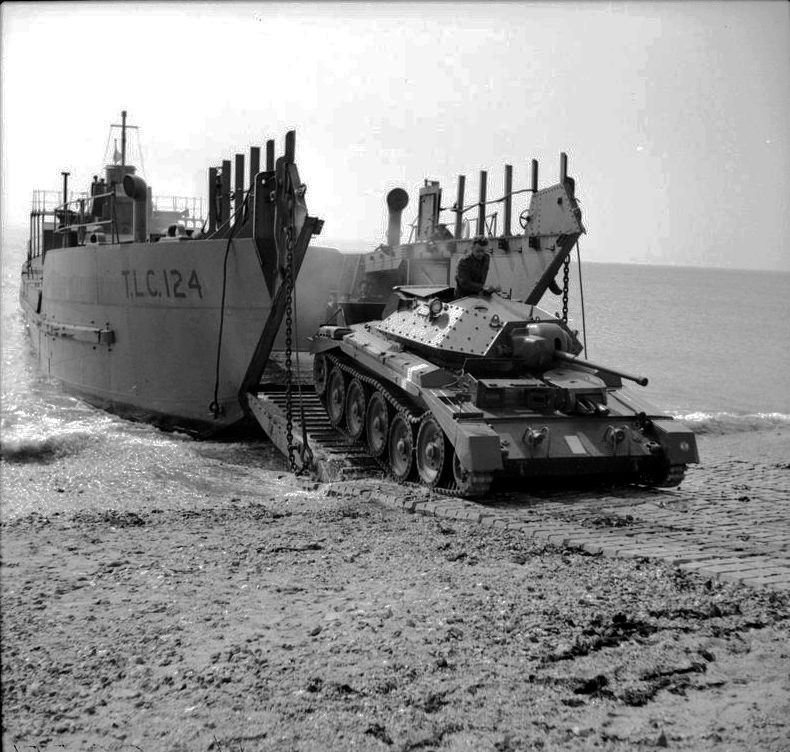
A Crusader tank landing on a beach from a Tank Landing Craft in a 1942 test

Amphibious warfare is a type of offensive military operation that today uses naval ships to project ground and air power onto a hostile or potentially hostile shore at a designated landing beach.[1] Through history the operations were conducted using ship's boats as the primary method of delivering troops to shore. Since the Gallipoli Campaign, specialised watercraft were increasingly designed for landing troops, material and vehicles, including by landing craft and for insertion of commandos, by fast patrol boats, zodiacs (rigid inflatable boats) and from mini-submersibles. The term amphibious first emerged in the United Kingdom and the United States during the 1930s with introduction of vehicles such as Vickers-Carden-Loyd Light Amphibious Tank or the Landing Vehicle Tracked.[note 1]

Amphibious warfare includes operations defined by their type, purpose, scale and means of execution. In the British Empire at the time these were called combined operations which were defined as "...operations where naval, military or air forces in any combination are co-operating with each other, working independently under their respective commanders, but with a common strategic object."[2] All armed forces that employ troops with special training and equipment for conducting landings from naval vessels to shore agree to this definition. Since the 20th century, an amphibious landing of troops on a beachhead is acknowledged as the most complex of all military maneuvers. The undertaking requires an intricate coordination of numerous military specialties, including air power, naval gunfire, naval transport, logistical planning, specialized equipment, land warfare, tactics, and extensive training in the nuances of this maneuver for all personnel involved.

South Korean Type 88 K1 MBT comes ashore from an American LCAC in March 2007.

In essence, amphibious operations consist of the phases of strategic planning and preparation, operational transit to the intended theatre of operations, pre-landing rehearsal and disembarkation, troop landings, beachhead consolidation and conducting inland ground and air operations. Historically, within the scope of these phases a vital part of success was often based on the military logistics, naval gunfire and close air support. Another factor is the variety and quantity of specialised vehicles and equipment used by the landing force that are designed for the specific needs of this type of operation. Amphibious operations can be classified as tactical or operational raids such as the Dieppe Raid, operational landings in support of a larger land strategy such as the Kerch–Eltigen Operation, and a strategic opening of a new Theatre of Operations, for example the Operation Avalanche. The purpose of amphibious operations is usually offensive, except in cases of amphibious withdrawals, but is limited by the plan and terrain. Landings on islands less than 5,000 km2 (1,900 sq mi) in size are tactical, usually with the limited objectives of neutralising enemy defenders and obtaining a new base of operation. Such an operation may be prepared and planned in days or weeks, and would employ a naval task force to land less than a division of troops.

Two Australian M113s disembarking from a landing craft during a training exercise in 2019

The intent of operational landings is usually to exploit the shore as a vulnerability in the enemy's overall position, forcing redeployment of forces, premature use of reserves, and aiding a larger allied offensive effort elsewhere. Such an operation requiring weeks to months of preparation and planning, would use multiple task forces, or even a naval fleet to land corps-size forces, including on large islands, for example Operation Chromite. A strategic landing operation requires a major commitment of forces to invade a national territory in the archipelagic, such as the Battle of Leyte, or continental, such as Operation Neptune. Such an operation may require multiple naval and air fleets to support the landings, and extensive intelligence gathering and planning of over a year. Although most amphibious operations are thought of primarily as beach landings, they can exploit available shore infrastructure to land troops directly into an urban environment if unopposed. In this case non-specialised ships can offload troops, vehicles and cargo using organic or facility wharf-side equipment. Tactical landings in the past have utilised small boats, small craft, small ships and civilian vessels converted for the mission to deliver troops to the water's edge.

Preparation and planning

[edit]

A naval landing operation requires vessels to troops and equipment and might include amphibious reconnaissance. Military intelligence services obtain information on the opponent. Amphibious warfare goes back to ancient times. The Sea Peoples menaced the Egyptians from the reign of Akhenaten as captured on the reliefs at Medinet Habu and Karnak. The Hellenic city states routinely resorted to amphibious assaults upon each other's shores, which they reflected upon in their plays and other art. The landing at Marathon by the Persians on 9 September 490 BC was the largest amphibious operation until the landings at the Battle of Gallipoli.

Marines

[edit]
The Bayeux Tapestry depicts the 1066 Norman invasion of England with a force of some 8,000 infantry and heavy cavalry landed on the English shore.

In 1537 Charles V, Holy Roman Emperor and King of Spain, decided to train and assign amphibious-assault skilled units to the Royal Armada specifically for fighting on and from ships. The Spanish Marines were born under the name Compañías Viejas del Mar de Nápoles ("All-Spanish Sea Companies of Naples"). The idea was to set up a permanent assignation of land troops to the Royal Spanish Navy that would be available for the Crown.

The first "professional" marine units were already task-trained amphibious troops, but instead of being disbanded, they were kept for the Spanish Crown's needs. Their first actions took place all along the Mediterranean Sea, where the Turks and pirate settlements were risks for commerce and navigation: Algiers, Malta and Gelves.

In 1565, the island of Malta was invaded by the Ottoman Turks during the Great Siege of Malta, forcing its defenders to retreat to the fortified cities. A strategic choke point in the Mediterranean Sea, its loss would have been so menacing for the kingdoms of Western Europe that forces were urgently raised to relieve the island. It took four months to train, arm and move a 5,500-man amphibious force to lift the siege.

Other countries adopted the idea and subsequently raised their own early marine forces as well.

Development

[edit]

From the 15th to the 20th centuries, several European countries established and expanded overseas colonies. Amphibious operations mostly aimed to settle colonies and to secure strong points along navigational routes. Amphibious forces were fully organized and devoted to this mission,[citation needed] although the troops not only fought ashore, but on board ships.

By their nature amphibious assaults involve highly complex operations, demanding the coordination of disparate elements; when accomplished properly a paralyzing surprise to the enemy can be achieved. However, when there is a lack of preparation and/or coordination, often because of hubris, disastrous results can ensue.

Ottoman-Habsburg wars

[edit]

During the Ottoman–Habsburg wars, all sides employed numerous and well-trained marine infantry and a combination of naval and land force. However, where Ottomans would favor disembarking their troops aside from their targets and initiating land attacks, Spanish and Genoese fleets made a breakthrough by investing in quick, direct disembarks protected by artillery, which often startled their enemies. Andrea Doria and Alfonso d'Avalos performed one such assault to relieve the Siege of Nice, surprising the French and Ottoman troops by bombarding the shore and landing the Spanish tercios directly. In contrast, during the amphibious assault on Mahdia by Doria and Bernardino de Mendoza, the Ottoman approach proved its obsolescence when Dragut landed a relief army away from the imperial position only to be cut short by their contravallation, ultimately failing to prevent the capture of the city.[3]

Terceras Landing

[edit]

Álvaro de Bazán, Marquis of Santa Cruz, was an early developer of amphibious warfare.[4] The "Terceras Landing" in the Azores Islands on 25 May 1583, was a military feat as Bazán and the rest of commanders decided to make a fake landing to distract the defending forces (5,000 Portuguese, English and French soldiers). Special seagoing barges were also arranged to unload cavalry horses and 700 artillery pieces on the beach; special rowing boats were armed with small cannons to support the landing boats; special supplies were readied to be unloaded and support the 11,000-man landing force strength. The total strength of the amphibious force was 15,000 men, including an armada of 90 ships. The operation resulted in complete victory.

Queen Anne's War

[edit]

A superb example of successful combined operations, of both military branches and different imperial units, is the Siege of Port Royal (1710). The siege was a combined arms, British/Colonial American amphibious assault upon the Acadian Provincial capital Port-Royal (Acadia) of French Canada, during Queen Anne's War (the name of the American theater of the War of the Spanish Succession). The battle is known as the seminal moment in the conquest of Acadia. The siege resulted in the British imperial Force conquering French Arcadia and renaming Port Royal, Annapolis Royal.

The War of Jenkin's Ear

[edit]

One famous instance of a failed amphibious assault was in 1741 at the Battle of Cartagena de Indias in New Granada, when a large British amphibious assault force commanded by Admiral Edward Vernon, and including a contingent of 200 Virginia "Marines"(not originally meant to be so) commanded by Lawrence Washington (older half brother of George Washington), failed to overcome a much smaller, but very heavily fortified Spanish defence force and were forced to retreat back to the ships and call off the operation.

King George's War

[edit]

The Siege of Louisbourg (1745) took place in 1745 when a New England colonial force aided by a small British fleet captured Louisbourg, the capital of the French province of Île-Royale (present-day Cape Breton Island) during the War of the Austrian Succession, known as King George's War in the British colonies.

The northern British colonies regarded Louisbourg as a menacers, calling it the "American Dunkirk" due to its use as a base for privateers. There was regular, intermittent warfare between the French and the Wabanaki Confederacy on one side and the northern New England colonies on the other (See the Northeast Coast Campaigns of 1688, 1703, 1723, 1724). For the French, the Fortress of Louisbourg also protected the chief entrance to Canada, as well as the nearby French fisheries. The French government had spent 25 years in fortifying it, and the cost of its defenses was reckoned at thirty million livres.[5] Although the fortress's construction and layout was acknowledged as having superior seaward defences, a series of low rises behind them made it vulnerable to a land attack. The low rises provided attackers places to erect siege batteries. The fort's garrison was poorly paid and supplied, and its inexperienced leaders mistrusted them. The colonial attackers were also lacking in experience, but ultimately succeeded in gaining control of the surrounding defences. The defenders surrendered in the face of an imminent assault.

Louisbourg was an important bargaining chip in the peace negotiations to end the war, since it represented a major British success. Factions within the British government were opposed to returning it to the French as part of any peace agreement, but these were eventually overruled, and Louisbourg was returned, over the objections of the victorious British North Americans, to French control after the 1748 Treaty of Aix-la-Chapelle, in return for French concessions elsewhere.

French and Indian War

[edit]
A drawing depicting the amphibious landing of British troops during the Siege of Quebec in 1759

The Siege of Louisbourg (1758) was a pivotal operation of the British military in 1758 (which included Colonial American Provincial and Ranger units) during the Seven Years' War (known in the United States as the French and Indian War), a war that ended the French colonial era in Atlantic Canada and led to the subsequent British campaign to capture all of French North America by the war's end.[6]

Another major amphibious landing took place during the Seven Years' War, the Siege of Quebec in 1759. The British, in addition to colonial American Ranger units, had raised experimental light infantry units to integrate aspects of the ranger ideal into the regular army. They also produced the first specially designed landing-craft in order to enable their troops to cross the Saint Lawrence River in force. After considering and rejecting a number of plans for landings on the north shore of the river, Major General James Wolfe and his brigadiers decided in late August to land upriver of the city.[7]

The British prepared for their risky deployment upstream. Troops had already been aboard landing ships and drifting up and down the river for several days when on 12 September Wolfe made a final decision on the British landing site, selecting L'Anse-au-Foulon. Wolfe's plan of attack depended on secrecy and surprise—a key element of a successful amphibious operation—a small party of men would land by night on the north shore, climb the tall cliff, seize a small road, and overpower the garrison that protected it, allowing the bulk of his army (5,000 men) to ascend the cliff by the small road and then deploy for battle on the plateau.[8] The operation proved a success, leading to the surrender of the city, and heavily influenced subsequent engagements.

In 1762 a British force, with a small colonial American ranger contingent, successfully landed at Havana in Cuba, besieged the city and captured it after a two-month campaign thanks to improved coordination of land and sea forces.[citation needed] In the same year, 1762, British Royal Navy sailors and marines succeed in taking the capital of the East Indies: Manila in the Philippines as well.

American Revolutionary War

[edit]

In 1776 Samuel Nicholas and the Continental Marines, the "progenitor" of the United States Marine Corps, made a first successful landing in the Raid of Nassau in the Bahamas. In 1782 The British rebuffed a long Franco-Spanish attempt to seize Gibraltar by water-borne forces. In 1783 a Franco-Spanish force invaded the British-held island of Minorca.

The Second British Empire

[edit]
British and American movements during the Chesapeake Campaign

In 1798 Minorca experienced yet another of its many changes of sovereignty when captured by a British landing.

As the British Empire expanded worldwide, four colonies (Halifax, in Nova Scotia; Bermuda; Gibraltar; and Malta) were designated Imperial fortresses,[9][10][11][12][13][14] from which Britain's domination of the oceans and the Mediterranean and Caribbean seas was maintained, including its ability to deny safe passage to enemy naval and merchant vessels while protecting its own merchant trade, as well as to its ability to project superior naval and military force anywhere on the planet.

This was demonstrated during the American War of 1812, when the ships of the North America Station of the Royal Navy and military forces of the British Army, Board of Ordnance, and Royal Marines, maintained a blockade of much of the Atlantic seaboard of the United States of America, carried out amphibious raids such as the 22 June 1813 Battle of Craney Island,[15] and then launched the Chesapeake Campaign (defeating American forces in the Battle of Bladensburg, capturing and burning Washington, DC, and raiding Alexandria, Virginia),[16][17] from Bermuda.

The point is further reinforced by Britain's poor showing during the war in the battles upon the Great Lakes and Lake Champlain. Without great naval fortresses or forward reinforced ports the Royal Navy was unable to hold and command the lakes, or stop amphibious raiding into Canada, such as the many raids on York (now Toronto) during the conflict. However, the strategic situation changed with the construction of HMS St Lawrence which was manned by Royal Navy sailors, rather than the landsman that had hitherto been used to complement the somewhat ad hoc flottilas used in the skirmishes on the lakes. Concurrently, the British would inflict the single biggest maritime loss of either side during the war by landing a force of 136 Royal Marines and sailors at the privateer base in Pettipaug, Connecticut. In this amphibious action, more akin to a "Commando" raid, they destroyed 26 vessels, capturing 2 and blowing up warehouses storing ammunition and supplies; under the noses of the American regulars and militia tasked with guarding the important base.

Industrial era

[edit]

In the Mexican–American War, US forces under Winfield Scott launched the first major amphibious assault in US history, and its largest amphibious assault until WWII, in the 1847 Siege of Veracruz.

During the Crimean War of 1853–1856 the anti-Russian alliance launched an Anglo-French amphibious operation against Russia at Bomarsund, Finland on 8 August 1854.

Ships of the North Atlantic Blockading Squadron bombarding Fort Fisher prior to the ground assault, during the American Civil War

During the American Civil War of 1861–1865 the United States made several amphibious assaults along the coastlines of the Confederate States. Actions at Hatteras Inlet (August 1861) and at Port Royal, South Carolina were the first of many attacks, others occurring on Roanoke Island, NC; Galveston, TX; Fort Sumter, Morris Island and James Island, SC; and several more. The largest such clash happened in January 1865 at Fort Fisher—the largest and most powerful fort in the world at the time—which protected the entrance of Wilmington, North Carolina. The assaulting force consisted of over 15,000 men and 70 warships with over 600 guns.

During the American Civil War, the Mississippi Marine Brigade was established to act swiftly against Confederate forces operating near the Mississippi River and its tributaries. The unit consisted of artillery, cavalry and infantry with the United States Ram Fleet used as transportation.[18]

Amphibious warfare during the War of the Pacific of 1879 to 1883 saw coordination of army, navy and specialized units. The first amphibious assault of this war took place during the Battle of Pisagua when 2,100 Chilean troops successfully took Pisagua from 1,200 Peruvian and Bolivian defenders on 2 November 1879. Chilean Navy ships bombarded beach defenses for several hours at dawn,[citation needed] followed by open, oared boats landing army infantry and sapper units into waist-deep water, under enemy fire. An outnumbered first landing-wave fought at the beach; the second and third waves in the following hours succeeded in overcoming resistance and moving inland. By the end of the day, an expeditionary army of 10,000 had disembarked at the captured port.

Japanese landing on Liaodong Peninsula, 1909

In 1881 Chilean ships transported approximately 30,000 men, along with their mounts and equipment, 500 miles (800 km) in order to attack Lima.[19] Chilean commanders commissioned purpose-built, flat-bottomed landing craft that would deliver troops in shallow water closer to the beach, possibly[original research?] the first purpose-built amphibious landing-craft in history:[20] "These [36 shallow draft, flat-bottomed] boats would be able to land three thousand men and twelve guns in a single wave".

Neutral military observers closely studied landing tactics and operations during the War of the Pacific: two Royal Navy ships monitored the Battle of Pisagua; United States Navy observer Lt. Theodorus B. M. Mason included an account in his report The War on the Pacific Coast of South America. The USS Wachusett with Alfred Thayer Mahan in command, was stationed at Callao, Peru, protecting American interests during the final stages of the War of the Pacific. He formulated his concept of sea power while reading a history book in an English gentleman's club in Lima, Peru. This concept became the foundation for his celebrated The Influence of Sea Power upon History (1890).[21][22]

An amphibious assault took place on the beaches of Veracruz, Mexico in 1914, when the United States Navy attacked and occupied the city as result of the Tampico Affair.

Modern operations

[edit]
German invasion fleet during Operation Albion

World War I marked the beginning of the first modern amphibious warfare operations. However, tactics and equipment were still rudimentary and required much improvisation.

At the time, British Royal Marine Light Infantry (merged with the Royal Marine Artillery in the 1920s to form the Royal Marines) were used primarily as naval parties onboard Royal Navy warships to maintain discipline and man ships' guns. The RMLI joined a new Royal Navy division, the Royal Naval Division, formed in 1914 (out of those not needed on ships) to fight on land; however, throughout the conflict, army units were depended upon to provide the bulk, if not all, of troops used in amphibious landings.

The first amphibious assault of the war was the Battle of Bita Paka (11 September 1914) was fought south of Kabakaul, on the island of New Britain, and was a part of the invasion and subsequent occupation of German New Guinea by the Australian Naval and Military Expeditionary Force (AN&MEF) shortly after the outbreak of the First World War.[23] The first British amphibious assault of the war ended in disaster in November 1914. A large British Indian Army force was directed to launch an amphibious assault on Tanga, German East Africa. British actions prior to the assault, however, alerted the Germans to prepare to repel an invasion. The Indian forces suffered heavy casualties when they advanced on the city, forcing them to withdraw back to their boats, leaving much of their equipment behind.[24]

A plan was devised to land British heavy tanks from pontoons in support of the Third Battle of Ypres, but this was abandoned.[25]

The Imperial Russian Army and Navy also grew adept to amphibious warfare in the Black Sea, conducting many raids and bombardments on Ottoman positions.[26]

On 11 October 1917, German land and naval forces launched an amphibious assault, code named Operation Albion, on the islands of Saaremaa (Ösel), Hiiumaa (Dagö) and Muhu (Moon); they controlled the entrance to the Gulf of Riga. By the end of the month German forces had successfully overrun the islands forcing the Russians to abandon them with the loss of some 20,000 troops, 100 guns and the pre-dreadnought battleship Slava. The capture of the islands opened a route for German naval forces into the Gulf of Finland threatening the city of Petrograd, a fact that contributed to the cessation of hostilities on the Eastern front.

Gallipoli

[edit]
V Beach about two days after the landing, seen from the bow of the River Clyde

The first large scale amphibious operations, ones that were to heavily influence theorists in the decades to come, were conducted as part of the Battle of Gallipoli in 1915 against the Ottoman Empire during World War I. The Gallipoli peninsula forms the northern bank of the Dardanelles, a strait that provided a sea route to what was then the Russian Empire, one of the Allied powers during the war. Intending to secure it, Russia's allies Britain and France launched a naval attack followed by an amphibious landing on the peninsula with the eventual aim of capturing the Ottoman capital of Constantinople (modern-day Istanbul). Although the naval attack was repelled and the land campaign failed, the campaign was the first modern amphibious landing, and featured air support, specialized landing craft and a naval bombardment.

The seaplane tender HMS Ark Royal supported the landings under the command of Commander Robert Clark-Hall. Seaplanes were used for aerial reconnaissance, ground support for the troops landing at Anzac Cove and the bombing of fortifications. Ark Royal was augmented by a squadron from the No. 3 Squadron of the Royal Naval Air Service, operating from a nearby island.

Initial landings, starting on 25 April, took place in unmodified rowing boats that were extremely vulnerable to attack from the shore defences. The first purpose-built landing craft were built for the campaign. SS River Clyde, built as a collier, was adapted to be a landing ship for the Landing at Cape Helles. Openings were cut in her steel hull as sally ports from which troops would emerge onto gangways and then to a bridge of smaller boats from the ship to the beach. Boiler plate and sandbags were mounted on her bow, and behind them a battery of 11 machine guns was installed. The machine gun battery was manned by Royal Naval Air Service men. Work began on painting River Clyde's hull sandy yellow as camouflage, but this was incomplete by the time of the landing.[27]

It was soon clear that the Turkish defence was equipped with rapid-fire weapons, which meant that ordinary landing boats were inadequate for the task. In February 1915, orders had been placed for the design of purpose built landing craft. A design was created in four days resulting in an order for 200 'X' Lighters (or X-lighters)[28] with a spoon-shaped bow to take shelving beaches and a drop down frontal ramp.

Anzac Beach amphibious landing, on 25 April 1915

The first use took place after they had been towed to the Aegean and performed successfully in the 6 August landing at Suvla Bay of IX Corps, commanded by Commander Edward Unwin.

'X' Lighters, known to the soldiers as 'Beetles', carried about 500 men, displaced 200 tons (or 160 tons according to some sources)[29] and were based on London barges being 105 feet 6 inches long, 21 feet wide, and 7 feet 6 inches deep. The engines mainly ran on heavy oil and ran at a maximal speed of approximately 8 knots (9.2 mph). The sides of the ships were bullet proof, and was designed with a ramp on the bow for disembarkation.[30]

The lessons of the Gallipoli campaign had a significant impact upon the development of amphibious operational planning,[31] and have since been studied by military planners prior to operations such as the Normandy Landings in 1944 and during the Falklands War in 1982.[32] The campaign also influenced US Marine Corps amphibious operations during the Pacific War, and continues to influence US amphibious doctrine.

During the interwar period the campaign "became a focal point for the study of amphibious warfare" in the United Kingdom and United States,[33] because it involved the four types of amphibious operations: the raid, demonstration, assault and withdrawal.[31] Analysis of the campaign before World War II led to a belief among many armed forces that amphibious assaults could not succeed against modern defences. The perception continued until the Normandy Landings in June 1944, despite some successful examples of amphibious operations earlier in the war, such as those in Italy, and at Tarawa and in the Gilbert Islands in the Pacific.[34] Although the negative perception prevailed among Allied planners in the interwar years, the war situation after 1940 meant that such operations had to be considered. However, despite early successes in North Africa and Italy, it was not until Normandy that the belief that opposed landings could not succeed was completely excised.

Interwar developments

[edit]

One of the first amphibious landings involving armour was conducted by the Irish National Army in 1922, during the Irish Civil War. Landings against Republican rebels at Westport, Fenit and Cork all involved armour cars. The Westport and Fenit landings involved light armoured cars and 18-pounder artillery guns being hoisted off the ships by crane. Heavier armoured cars were used at Cork, resulting in some difficulty. While Irish troops could reach the coast in small boats from naval vessels offshore, the ships had to dock to unload the heavy vehicles and artillery guns. These operations were a major success for the Irish government forces, mainly due to the element of surprise and the use of armoured vehicles and artillery. Government forces were able to capture all the major towns and cities in southern Ireland.[35]

The Alhucemas landing on 8 September 1925, performed by a Spanish-French coalition against rebel Berber tribesmen in the north of Morocco, was an amphibious landing where tanks were used for the first time and massive aerial and naval gunfire support was employed by the landing forces, directed by spotting personnel with communication devices.

Floating depots were organized with medical, water, ammunition and food supplies, to be dispatched ashore when needed. The barges used in this landing were the surviving "K" boats from Gallipoli, upgraded in Spanish shipyards.

In 1938, Japanese forces attacked Chinese defenders over the Yangtze River at the Battle of Wuhan. Soon, the Japanese would later further improve its techniques upon seaborne assaults by the Second Sino-Japanese War. By World War II, marines such as the Special Naval Landing Force used amphibious landings to attack and sweep across territories in South East Asia. Their technique of surprise landings with naval support inspired the British and American landings in World War II such as D-Day and the Pacific Campaign.[36][37]

Britain

[edit]
The Landing Craft Mechanized was designed by Inter-Service Training and Development Centre from 1938 as the first specialized amphibious ship for the transportation of tanks.

During the inter-war period, the combination of the negative experience at Gallipoli and economic stringency contributed to the delay in procuring equipment and adopting a universal doctrine for amphibious operations in the Royal Navy.

The costly failure of the Gallipoli campaign coupled with the emerging potential of airpower satisfied many in naval and military circles that the age of amphibious operations had come to a close.[38] Still, throughout the 1920s and 1930s, animated discussion in Staff Colleges in Britain and the Indian Army Staff College at Quetta surrounded the strategic potential of the Dardanelles campaign compared with the strategic stalemate of the Western Front. The economic austerity of the worldwide economic depression and the government's adoption of the Ten Year Rule assured that such theoretical talk would not result in the procurement of any large scale equipment.

Despite this outlook, the British produced the Motor Landing Craft in 1920, based on their experience with the early 'Beetle' armoured transport. The craft could put a medium tank directly onto a beach. From 1924, it was used with landing boats in annual exercises in amphibious landings. It was later called Landing Craft, Mechanized (LCM) and was the predecessor of all Allied landing craft mechanised (LCM).[39]

The Army and Royal Navy formed a landing craft committee to "recommend... the design of landing craft".[38] A prototype motor landing craft, designed by J. Samuel White of Cowes, was built and first sailed in 1926.[40] It weighed 16 tons and had a box-like appearance, having a square bow and stern. To prevent fouling of the propellers in a craft destined to spend time in surf and possibly be beached, a crude waterjet propulsion system was devised by White's designers. A Hotchkiss petrol engine drove a centrifugal pump which produced a jet of water, pushing the craft ahead or astern, and steering it, according to how the jet was directed. Speed was 5–6 knots and its beaching capacity was good.[41] By 1930, three MLC were operated by the Royal Navy.

The Inter-Service Training and Development Centre, which helped to pioneer modern amphibious warfare doctrine, came under the command of Combined Operations Headquarters in June 1940. Pictured, the badge of Combined Operations.

For a short journey, from shore to shore, the cargo could be rolled or carried into the boat over its ramp. On longer journeys, ship to shore, a derrick would lower the MLC into the sea from the transporting vessel. The derrick would then lower the vehicle or cargo load. Upon touching down on shore, soldiers or vehicles exited by the bow ramp.

Although there was much official apathy toward amphibious operations, this began to change in the late 1930s. The Royal Naval Staff College at Greenwich, drafted a document detailing combined operations requirements and submitted it to the Chiefs of Staff in 1936. The document recommended the establishment of an inter-service 'Training and Development Centre', with a permanent force of Royal Marines attached to it. Its functions were to "train in all methods for the seizure of defended beaches; develop the materiel necessary for such methods, with special regard to protection of troops, speed of landing, and the attainment of surprise; and develop methods and materiel for the destruction or neutralization of enemy defenses, including bombardment and aircraft co-operation.[41]

The Inter-Service Training and Development Centre was established at Fort Cumberland, near Portsmouth in 1938,[42] and brought together representatives from the Royal Navy, Army, and Royal Air Force convened with the portfolio of developing methods and equipment to use in Combined Operations.

The Centre examined certain specific problems, including craft for landing tanks, beach organisation, floating piers, headquarters ships, amphibian tanks, underwater obstacles, the landing of water and petrol and the use of small craft in amphibious raids[41] By the end of 1939 the ISTDC had codified a policy for landings, and defended it at Staff College discussions. Operational experience during the Second World War introduced modifications to this landing policy, but it was essentially the policy used in the Torch and Husky landings four years later.[38]

The essential shape of this landing policy is described by Bernard Fergusson in The Watery Maze,

The system provided for an approach under cover of darkness in fast ships carrying special craft; the craft being sent ashore while the ships lay out of sight of land; small-craft smoke and gun protection while the beachhead was seized; the landing of a reserve; the capture of a covering position far enough inland to secure the beach and anchorage from enemy fire; the bringing in of ships carrying the main body; and finally the discharge of vehicles and stores by other craft specially designed to do so directly on to beaches. And in all this it was important to achieve tactical surprise.[41]

Among the many tactical innovations introduced by the centre, codified in the Manual on Combined Operations and the Standard Naval Bombardment Code, was the use of Floating Piers (pontoons) to bridge the water gap, the creation of Smoke Generating devices to obscure the assault and the use of infrared directional beacons for landing accuracy. The centre also played a role in the development of the first specialized landing crafts, including the Assault Landing Craft, the Mechanized Landing Craft (LCM(1)), the Landing Craft Tank (Mk. 1), Support Landing Craft LCS(1), LCS(2) and Landing Ship Infantry.[43]

Divisional-sized amphibious landing exercises were carried out by the British Army in the 1930s.[44][45]

United States

[edit]
LCVPs, known as 'Higgins Boats', were the first specialized landing craft for the US Navy. Pictured, USS Darke LCVP 18, possibly with Army troops as reinforcements at Okinawa, 1945.

In contrast to the British attitude, the U.S. military, especially the Marine Corps remained enthusiastic at the possibilities of amphibious warfare. The Marine Corps was searching for an expanded mission after World War I, during which it had merely been used as a junior version of the Army infantry. During the 1920s, it found a new mission—to be a fast-reacting, light infantry fighting force carried rapidly to far off locations by the US Navy. Its special role would be amphibious landings on enemy-held islands, but it took years to figure out how to do that. The Mahanian notion of a decisive fleet battle required forward bases for the Navy close to the enemy. After the Spanish–American War the Marines gained the mission of occupying and defending those forward bases, and began a training program on Culebra Island, Puerto Rico.[46]

As early as 1900 the General Board of the United States Navy considered building advance bases for naval operations in the Pacific and the Caribbean. The Marine Corps was given this mission in 1920, but the challenge was to avoid another disaster like Gallipoli. The conceptual breakthrough came in 1921 when Major "Pete" Ellis wrote Advanced Base Operations in Micronesia a secret 30,000-word manifesto that proved inspirational to Marine strategists and highly prophetic.[47][48] To win a war in the Pacific, the Navy would have to fight its way through thousands of miles of ocean controlled by the Japanese—including the Marshall, Caroline, Marianas and Ryukyu island chains. If the Navy could land Marines to seize selected islands, they could become forward bases.

Ellis argued that with an enemy prepared to defend the beaches, success depended on high-speed movement of waves of assault craft, covered by heavy naval gunfire and attack from the air. He predicted that the decisive action would take place on the beach itself, so the assault teams would need not just infantry but also machine gun units, light artillery, light tanks, and combat engineers to defeat beach obstacles and defenses. Assuming the enemy had its own artillery, the landing craft would have to be specially built to protect the landing force. The failure at Gallipoli came because the Turks could easily reinforce the specific landing sites. The Japanese would be unable to land new forces on the islands under attack.[49]

Not knowing which of the many islands would be the American target, the Japanese would have to disperse their strength by garrisoning many islands that would never be attacked. An island like Eniwetok in the Marshall Islands, would, Ellis estimated, require two regiments, or 4,000 Marines. Guided by Marine observer aircraft, and supplemented by Marine light bombers, warships would provide enough firepower so that Marines would not need any heavy artillery (in contrast to the Army, which relied heavily on its artillery). Shelling defended islands was a new mission for warships. The Ellis model was officially endorsed in 1927 by the Joint Board of the Army and Navy (a forerunner of the Joint Chiefs of Staff).[46]

However, actual implementation of the new mission took another decade because the Marine Corps was preoccupied in Central America and the Navy was slow to start training in how to support the landings. The prototype advanced base force officially evolved into the Fleet Marine Force (FMF) in 1933.[50] In 1939, during the annual Fleet Landing Exercises, the FMF became interested in the military potential of Andrew Higgins's design of a powered, shallow-draught boat. These LCVPs, dubbed the 'Higgins Boats', were reviewed and passed by the U.S. Naval Bureau of Construction and Repair. Soon, the Higgins boats were developed to a final design with a ramp, and were produced in large numbers.

Second World War

[edit]
Into the Jaws of Death: Troops from the U.S. 1st Division landing on Omaha beach as part of Operation Overlord

By the Second World War tactics and equipment had moved on. The first use of British landing craft in an opposed landing in the Second World War, saw the disembarkation of French Foreign Legionnaires of the 13th Demi-Brigade and supporting French Hotchkiss H39 tanks on the beach at Bjerkvik, eight miles (13 km) above Narvik, on 13 May during the Norwegian campaign.[51][52]

The first major and successful amphibious operation was Operation Ironclad, a British campaign to capture Vichy French-controlled Madagascar. The naval contingent consisted of over 50 vessels, drawn from Force H, the British Home Fleet and the British Eastern Fleet, commanded by Rear Admiral Edward Neville Syfret.

The fleet included the aircraft carrier Illustrious, her sister ship Indomitable and the aging battleship Ramillies to cover the landings. The first wave of the British 29th Infantry Brigade and No. 5 Commando landed in assault craft on 5 May 1942, follow-up waves were by two brigades of the 5th Infantry Division and Royal Marines. Air cover was provided mainly by Fairey Albacore and Fairey Swordfish torpedo bombers which attacked Vichy shipping.

Purpose-built landing craft were among the vessels used at the evacuation from Dunkirk (Operation Dynamo)[53] and an amphibious operation was tried out at Dieppe in 1942. The operation proved a costly failure, but the lessons, hard learned, were used later. Many small-scale operations were conducted by the Allies on the Axis-held coast of Europe, including raids on the Lofoten Islands, St Nazaire and Bruneval.

Specialized infantry landing craft

[edit]
Canadian landings at Juno Beach in the Landing Craft Assault

In the run up to World War II, many specialized landing craft, both for infantry and vehicles, were developed. In November 1938, the Inter-Service Training and Development Centre proposed a new type of landing craft.[38] Its specifications were to weigh less than ten long tons, to be able to carry the thirty-one men of a British Army platoon and five assault engineers or signallers, and to be so shallow drafted as to be able to land them, wet only up to their knees, in eighteen inches of water.[38] All of these specifications made the Landing Craft Assault; a separate set of requirements was laid down for a vehicle and supplies carrier, although previously the two roles had been combined in the Motor Landing Craft.

J. S. White of Cowes built a prototype to the Fleming design.[54] Eight weeks later the craft was doing trials on the Clyde. All landing craft designs must find a compromise between two divergent priorities; the qualities that make a good sea boat are opposite those that make a craft suitable for beaching.[55] The craft had a hull built of double-diagonal mahogany planking. The sides were plated with "10lb. DIHT" armour, a heat treated steel based on D1 steel,[56] in this case Hadfield's Resista 14".[57]

USS LCI-326, a Landing Craft Infantry, during training for D-Day

The Landing Craft Assault remained the most common British and Commonwealth landing craft of World War II, and the humblest vessel admitted to the books of the Royal Navy on D-Day. Prior to July 1942, these craft were referred to as "Assault Landing Craft" (ALC), but "Landing Craft; Assault" (LCA) was used thereafter to conform with the joint US–UK nomenclature system.[58]

The Landing Craft Infantry was a stepped up amphibious assault ship, developed in response to a British request for a vessel capable of carrying and landing substantially more troops than the smaller Landing Craft Assault (LCA). The result was a small steel ship that could land 200 troops, traveling from rear bases on its own bottom at a speed of up to 15 knots. The original British design was envisioned as being a "one time use" vessel which would simply ferry the troops across the English Channel, and were considered an expendable vessel. As such, no troop sleeping accommodations were placed in the original design. This was changed shortly after initial use of these ships, when it was discovered that many missions would require overnight accommodations.

The first LCI(L)s entered service in 1943 chiefly with the Royal Navy (RN) and United States Navy. Some 923 LCI were built in ten American shipyards and 211 provided under lend-lease to the Royal Navy.

Specialized vehicle landing craft

[edit]

Following the Inter-Service Training and Development Centre's (ISTDC) successful development of the infantry carrying LCA, attention turned to the means of efficiently delivering a tank to a beach in 1938. Inquires were made of the army as to the heaviest tank that might be employed in a landing operation. The army wanted to be able to land a 12-ton tank, but the ISTDC, anticipating weight increases in future tank models specified 16 tons burthen for Mechanised Landing Craft designs.[38] Another governor on any design was the need to land tanks and other vehicles in less than approximately 2+12 feet of water.[59]

Design work began at John I. Thornycroft Ltd. in May 1938 with trials completing in February 1940.[41] Although early LCM(1)s were powered by two Thornycroft 60 bhp petrol engines, the majority were powered by Chrysler, in-line, 6-cylinder Crown petrol engines. Constructed of steel and selectively clad with armour plate, this shallow-draft, barge-like boat with a crew of 6, could ferry a tank of 16 long tons to shore at 7 knots (13 km/h). Depending on the weight of the tank to be transported the craft might be lowered into the water by its davits already loaded or could have the tank placed in it after being lowered into the water.

Although the Royal Navy had the Landing Craft Mechanised at its disposal, in 1940, Prime Minister Winston Churchill demanded an amphibious vessel capable of landing at least three 36-ton heavy tanks directly onto a beach, able to sustain itself at sea for at least a week, and inexpensive and easy to build. Admiral Maund, Director of the Inter-Service Training and Development Centre (which had developed the Landing Craft Assault[citation needed]), gave the job to naval architect Sir Roland Baker, who within three days completed initial drawings for a 152-foot (46 m) landing craft with a 29-foot (8.8 m) beam and a shallow draft. Ship builders Fairfields and John Brown agreed to work out details for the design under the guidance of the Admiralty Experimental Works at Haslar. Tank tests with models soon determined the characteristics of the craft, indicating that it would make 10 knots (19 km/h; 12 mph) on engines delivering about 700 hp (520 kW).[60] Designated the LCT Mark 1, 20 were ordered in July 1940 and a further 10 in October 1940.[citation needed]

The first LCT Mark 1 was launched by Hawthorn Leslie in November 1940. It was an all-welded 372-ton steel-hulled vessel that drew only 3 feet (0.91 m) of water at the bow. Sea trials soon proved the Mark 1 to be difficult to handle and almost unmanageable in some sea conditions. The designers set about correcting the faults of the Mark 1 in the LCT Mark 2. Longer and wider, three Paxman diesel or Napier Lion petrol engines replaced the Hall-Scotts, and 15 and 20 lb. armoured shielding was added to the wheelhouse and gun tubs.

A Canadian LST off-loads an M4 Sherman during the Allied invasion of Sicily in 1943.

The Mark 3 had an additional 32-foot (9.8 m) midsection that gave it a length of 192 feet (59 m) and a displacement of 640 tons. Even with this extra weight, the vessel was slightly faster than the Mark 1. The Mk.3 was accepted on 8 April 1941, and was prefabricated in five sections. The Mark 4 was slightly shorter and lighter than the Mk.3, but had a much wider beam (38 ft 9 in (11.81 m)) and was intended for cross channel operations as opposed to seagoing use. When tested in early assault operations, like the ill-fated Canadian commando raid on Dieppe in 1942, the lack of manoeuvring ability led to the preference for a shorter overall length in future variants, most of which were built in the United States.

When the United States entered the war in December 1941, the U.S. Navy had no amphibious vessels at all, and found itself obliged to consider British designs already in existence. One of these, advanced by K.C. Barnaby of Thornycroft, was for a double-ended LCT to work with landing ships. The Bureau of Ships quickly set about drawing up plans for landing craft based on Barnaby's suggestions, although with only one ramp. The result, in early 1942, was the LCT Mark 5, a 117-foot craft with a beam of 32 feet that could accommodate five 30-ton or four 40-ton tanks or 150 tons of cargo. With a crew of twelve men and one officer, this 286 ton landing craft had the merit of being able to be shipped to combat areas in three separate water-tight sections aboard a cargo ship or carried pre-assembled on the flat deck of an LST. The Mk.5 would be launched by heeling the LST on its beam to let the craft slide off its chocks into the sea, or cargo ships could lower each of the three sections into the sea where they were joined.[60]

A further development was the Landing Ship, Tank designation, built to support amphibious operations by carrying significant quantities of vehicles, cargo, and landing troops directly onto an unimproved shore. The British evacuation from Dunkirk in 1940 demonstrated to the Admiralty that the Allies needed relatively large, ocean-going ships capable of shore-to-shore delivery of tanks and other vehicles in amphibious assaults upon the continent of Europe. The first purpose-built LST design was HMS Boxer. To carry 13 Churchill infantry tanks, 27 vehicles and nearly 200 men (in addition to the crew) at a speed of 18 knots, it could not have the shallow draught that would have made for easy unloading. As a result, each of the three (Boxer, Bruiser, and Thruster) ordered in March 1941 had a very long ramp stowed behind the bow doors.

In November 1941, a small delegation from the British Admiralty arrived in the United States to pool ideas with the United States Navy's Bureau of Ships with regard to development of ships and also including the possibility of building further Boxers in the US.[61] During this meeting, it was decided that the Bureau of Ships would design these vessels. The LST(2) design incorporated elements of the first British LCTs from their designer, Sir Rowland Baker, who was part of the British delegation. This included sufficient buoyancy in the ships' sidewalls that they would float even with the tank deck flooded.[62] The LST(2) gave up the speed of HMS Boxer at only 10 knots but had a similar load while drawing only 3 feet forward when beaching.

In three separate acts dated 6 February 1942, 26 May 1943, and 17 December 1943, Congress provided the authority for the construction of LSTs along with a host of other auxiliaries, destroyer escorts, and assorted landing craft. The enormous building program quickly gathered momentum. Such a high priority was assigned to the construction of LSTs that the previously laid keel of an aircraft carrier was hastily removed to make room for several LSTs to be built in her place. The keel of the first LST was laid down on 10 June 1942 at Newport News, Va., and the first standardized LSTs were floated out of their building dock in October. Twenty-three were in commission by the end of 1942. Lightly armored, they could steam cross the ocean with a full load on their own power, carrying infantry, tanks and supplies directly onto the beaches. Together with 2,000 other landing craft, the LSTs gave the troops a protected, quick way to make combat landings, beginning in summer 1943.[63]

D-Day

[edit]
A large landing craft convoy crosses the English Channel on 6 June 1944.

The most famous amphibious assaults of the war, and of all time, were the Normandy landings on 6 June 1944, in which British, Canadian, and US forces landed at Utah, Omaha, Gold, Juno and Sword beaches in the largest amphibious operation in history.

The organizational planning of the landings (Operation Neptune) was in the hands of Admiral Bertram Ramsay. It covered the landing of the troops and their re-supply. Many innovative elements were included in the operation to ensure its success.

Operation Pluto was a scheme developed by Arthur Hartley, chief engineer with the Anglo-Iranian Oil Company, to construct an undersea oil pipeline under the English Channel between England and France to provide logistical support to the landed armies. Allied forces on the European continent required a tremendous amount of fuel. Pipelines were considered necessary to relieve dependence on oil tankers, which could be slowed by bad weather, were susceptible to German submarines, and were also needed in the Pacific War. Geoffrey William Lloyd, the Minister for Petroleum gained the support of Admiral Mountbatten, Chief of Combined Operations for the operation.[64]

Two types of pipeline were developed. The first type was the flexible HAIS pipe with a 3 inch (75 mm) diameter lead core, weighing around 55 long tons per nautical mile (30 t/km), was essentially a development by Siemens Brothers (in conjunction with the National Physical Laboratory) of their existing undersea telegraph cables, and known as HAIS (from Hartley-Anglo-Iranian-Siemens). The second type was a less flexible steel pipe of similar diameter, developed by engineers from the Iraq Petroleum Company and the Burmah Oil Company.[65]

PLUTO Pump from Sandown on the Isle of Wight

In June 1942 the Post Office cable ship Iris laid lengths of both Siemens' and Henleys' cable in the Clyde. The pipeline was completely successful and PLUTO was formally brought into the plans for the invasion of Europe. The project was deemed "strategically important, tactically adventurous, and, from the industrial point of view, strenuous"[citation needed]. After full-scale testing of an 83 km (45 nautical mile) HAIS pipe across the Bristol Channel between Swansea in Wales and Watermouth in North Devon, the first line to France was laid on 12 August 1944, over the 130 km (70 nautical miles) from Shanklin Chine on the Isle of Wight across the English Channel to Cherbourg Naval Base. A further HAIS pipe and two HAMELs followed. As the fighting moved closer to Germany, 17 other lines (11 HAIS and 6 HAMEL) were laid from Dungeness to Ambleteuse in the Pas-de-Calais.

In January 1945, 305 tonnes (300 long tons) of fuel was pumped to France per day, which increased tenfold to 3,048 tonnes (3,000 long tons) per day in March, and eventually to 4,000 tons (almost 1,000,000 Imperial gallons) per day. In total, over 781 000 m3 (equal to a cube with 92 metre long sides or over 172 million imperial gallons) of gasoline had been pumped to the Allied forces in Europe by VE day, providing a critical supply of fuel until a more permanent arrangement was made, although the pipeline remained in operation for some time after.[when?]

Portable harbours were also prefabricated as temporary facilities to allow rapid offloading of cargo onto the beaches during the Allied invasion of Normandy. The Dieppe Raid of 1942 had shown that the Allies could not rely on being able to penetrate the Atlantic Wall to capture a port on the north French coast. The problem was that large ocean-going ships of the type needed to transport heavy and bulky cargoes and stores needed sufficient depth of water under their keels, together with dockside cranes, to off-load their cargo and this was not available except at the already heavily defended French harbours. Thus, the Mulberries were created to provide the port facilities necessary to offload the thousands of men and vehicles, and tons of supplies necessary to sustain Operation Overlord and the Battle of Normandy. The harbours were made up of all the elements one would expect of any harbour: breakwater, piers, roadways etc.

Overall aerial view of the Mulberry B harbour "Port Winston" in September 1944

At a meeting following the Dieppe Raid, Vice-Admiral John Hughes-Hallett declared that if a port could not be captured, then one should be taken across the Channel.[66] The concept of Mulberry harbours began to take shape when Hughes-Hallett moved to be Naval Chief of Staff to the Overlord planners.

The proposed harbours called for many huge caissons of various sorts to build breakwaters and piers and connecting structures to provide the roadways. The caissons were built at a number of locations, mainly existing ship building facilities or large beaches like Conwy Morfa around the British coast. The works were let out to commercial construction firms including Balfour Beatty, Costain, Nuttall, Henry Boot, Sir Robert McAlpine and Peter Lind & Company, who all still operate today, and Cubitts, Holloway Brothers, Mowlem and Taylor Woodrow, who all have since been absorbed into other businesses that are still operating.[67] On completion they were towed across the English Channel by tugs[68] to the Normandy coast at only 4.3 Knots (8 km/h or 5 mph), built, operated and maintained by the Corps of Royal Engineers, under the guidance of Reginald D. Gwyther, who was appointed CBE for his efforts.

By 9 June, just 3 days after D-Day, two harbours codenamed Mulberry "A" and "B" were constructed at Omaha Beach and Arromanches, respectively. However, a large storm on 19 June destroyed the American harbour at Omaha, leaving only the British harbour still intact but damaged, which included damage to the 'Swiss Roll' which had been deployed as the most western floating roadway had to be taken out of service. The surviving Mulberry "B" came to be known as Port Winston at Arromanches. While the harbour at Omaha was destroyed sooner than expected, Port Winston saw heavy use for 8 months—despite being designed to last only 3 months. In the 10 months after D-Day, it was used to land over 2.5 million men, 500,000 vehicles, and 4 million tonnes of supplies providing much needed reinforcements in France.[69][70]

Other

[edit]

Other large amphibious operations in the European theatre of World War II and the war in the Pacific include:

Europe:

Location Operation Date Notes
Norway Operation Weserübung (German: Unternehmen Weserübung) 9 April 1940 German attack on Norway and Denmark
Cross English Channel Operation Sea Lion (German: Unternehmen Seelöwe) planned 20 September 1940 Not carried out after Germany failed to gain air supremacy, postponed indefinitely on 17 September 1940
East Africa Operation Appearance 16 March 1941 Beach landing at Berbera
Battle of Crete Operation Mercury (German: Unternehmen Merkur) 20 May 1941 Axis invasion of Crete. Primarily an airborne assault. The battle lasted about 10 days
Crimea Feodosia Landing December 1941 Soviet forces established a bridgehead on the Kerch Peninsula which they maintained until May 1942, but failed to prevent the fall of Sevastopol.
Crimea Yevpatoria assault January 1942 Stormy weather prevented the reinforcement of Soviet troops from Sevastopol who landed at Yevpatoria and occupied part of the town for 4 days.
North Africa campaign Operation Torch 8 November 1942 Three Allied task-forces covering the coasts of French Morocco and Algeria
Sicily Operation Husky 9 July 1943 Largest amphibious operation of World War II in terms of size of landing-zone and number of divisions put ashore on the first day; see also Operation Mincemeat (disinformation), Operation Ladbroke (glider landings) and Operation Fustian (parachute brigade, with glider-borne forces in support)
Salerno Operation Avalanche 9 September 1943 Also involved two supporting operations: in Calabria (Operation Baytown, 3 Sept) and Taranto (Operation Slapstick, 9 September).
Crimea Kerch-Eltigen Operation November 1943 Soviet landings preceding the recapture of the Crimean Peninsula from German and Romanian forces.
Anzio Operation Shingle 22 January 1944 Bridgehead pinned down until 23 May 1944, when a breakout (Operation Diadem) allowed a move on Rome
Southern France Operation Dragoon 15 August 1944 Operation Dragoon forced a German retreat and accelerated the liberation of France. See also preliminary effort (Operation Sitka), diversion (Operation Span), airborne operations (1st Airborne Task Force)

Pacific:

Location Operation Date Notes
Malaya Battle of Kota Bharu 8 December 1941 Following failure to implement Operation Matador (1941), ~5,200 Japanese troops landed on beaches at Kota Bharu
Philippines Philippines campaign (1941–1942) 8 December 1941 Preliminary landings on Batan Island then Camiguin Island, north of Luzon, and at Vigan, Aparri, and Gonzaga (northern Luzon) were followed by main attack—43,110 men, supported by artillery and approximately 90 tanks, landed at three points along the east coast of Lingayen Gulf
Guadalcanal Guadalcanal campaign 7 August 1942
Tarawa Battle of Tarawa 20 November 1943
Makin atoll Battle of Makin 20 November 1943
Philippines Philippines Campaign (1944–45) 20 October 1944 After capture of the Gilbert Islands, some of the Marshall Islands, and most of the Marianas Islands, landings on Leyte and Mindoro allowed some 175,000 men to cross the broad beachhead and participate in the Battle of Luzon within a few days
Iwo Jima Battle of Iwo Jima 19 February 1945 As part of the American invasion of the island of Iwo Jima, designated Operation Detachment, during the Battle of Iwo Jima the U.S. Marines landed on and eventually captured the island of Iwo Jima.
Okinawa Battle of Okinawa 1 April 1945 The series of battles fought in the Ryukyu Islands, centered on the island of Okinawa, included the largest amphibious assault in the Pacific War during World War II, the 1 April 1945 invasion of the island of Okinawa itself.[71]
Korea Seishin Landing Operation 13 August 1945 Three Soviet amphibious landings in northern Korea in the rear of the Japanese Kwantung Army
Malaya Operation Zipper planned 9 September 1945 British-planned Indian Ocean amphibious assault to capture Port Swettenham as a staging area for a later invasion of Singapore. Cancelled after the Surrender of Japan, replaced by the unopposed Operation Jurist and Operation Mailfist on 28 August 1945.
Japanese home islands Operation Downfall planned 1 November 1945 Massive Allied invasion planned for Kyushu and Honshu, would have been the largest amphibious invasion in history. Canceled after the Surrender of Japan, US troops occupy Tokyo unopposed on 28 August 1945 instead

Korean War

[edit]
Landing craft approach Blue Beach during the Inchon landings on 15 September 1950, covered by the U.S. Navy destroyer USS De Haven (DD-727) (bottom center).

During the Korean War the U.S. X Corps, consisting of the 1st Marine Division and 7th Infantry Division landed at Inchon. Conceived of and commanded by U.S. General Douglas MacArthur, this landing is considered by many military historians to have been a tactical jewel, one of the most brilliant amphibious maneuvers in history [72] (See analysis in main article).

The success of this battle eventually resulted in link up with U.S. Army forces that broke out of the Pusan perimeter, and led by the 1st Cavalry Division and its Task Force Lynch, cleared much of South Korea. A second landing by the Tenth Corps on the east coast approached the Chosin Reservoir and hydroelectric plants that powered much of Communist China's heavy industry, and led to intervention by Chinese forces on behalf of North Korea. Amphibious landings also took place during the First Indochina War, notably during Operation Camargue, one of the largest of the conflict.[73]

Suez Crisis and Falklands War

[edit]

The British Royal Marines made their first post-World War II amphibious assault during the Suez Crisis of 1956 when they successfully landed at Suez on 6 November as part of a joint seaborne/airborne operation code-named Operation Musketeer.

Despite all the progress that was seen during World War II, there were still fundamental limitations in the types of coastline that were suitable for assault. Beaches had to be relatively free of obstacles, and have the right tidal conditions and the correct slope. However, the development of the helicopter fundamentally changed the equation.

The first use of helicopters in an amphibious assault came during the Anglo-French-Israeli invasion of Egypt in 1956 (the Suez War). Two British light fleet carriers were pressed into service to carry helicopters, and a battalion-sized airborne assault was made. Two of the other carriers involved, HMS Bulwark (R08) and HMS Albion, were converted in the late 1950s into dedicated "commando carriers."

Nearly 30 years later in the Falklands War, the 1st Marines Brigade of the Argentine Marine Corps along with Navy's Special Forces performed Operation Rosario landing at Mullet Creek near Stanley on 2 April 1982, while later the Royal Marines' 3 Commando Brigade, (augmented by the British Army's Parachute Regiment) landed at Port San Carlos on 21 May 1982 during Operation Sutton.

Landing at Cyprus

[edit]

The Turkish Armed Forces launched an amphibious assault on 20 July 1974, on Kyrenia, following the 1974 Cypriot coup d'état. The Turkish naval force provided naval gunfire support during the landing operation and transported the amphibious forces from the port of Mersin to the island. The Turkish landing forces consisted of around 3,000 troops, tanks, armoured personnel carriers and artillery pieces.[citation needed]

Iran-Iraq war

[edit]

During the Iran–Iraq War, the Iranians launched Operation Dawn 8 (Persian: عملیات والفجر ۸), in which 100,000 troops comprising 5 Army divisions and 50,000 men from the IRGC and the Basij advanced in a two-pronged offensive into southern Iraq. Taking place between 9 and 25 February, the assault across the Shatt al-Arab achieved significant tactical and operational surprise. The Iranians launched their assault on the peninsula at night, their men arriving on rubber boats. Iranian Navy SEALs spearheaded the offensive despite a shortage of gear. Prior to this action Iranian Naval Commandos performed reconnaissance of the Faw Peninsula. The Iranian SEALs penetrated an obstacle belt and isolated Iraqi bunkers whose troops had taken cover from the heavy rains inside or were sleeping. Iranian demolition teams detonated charges on the obstacles to create a path for the Iranian infantry waiting to begin their assault.

Not only did the amphibious landings provide a significant lodgement behind Iraq's tactical front, but they also created a psychological shock wave throughout the Persian Gulf region. Soon after the initial landings, Iranian combat engineers were able to construct bridges to improve the flow of ground troops into the lodgement area. Iran managed to maintain their foothold in Al-Faw against several Iraqi counter-offensives and chemical attacks for another month despite heavy casualties until a stalemate was reached. The Faw Peninsula was later recaptured by Iraqi forces, by the massive and illegal use of chemical weapons, the same day as the US launched Operation Praying Mantis on Iran, destroying their navy.

Persian Gulf War

[edit]

During the Persian Gulf War, Assault Craft Unit 5 was able to position U.S. Marine and naval support off the coast of Kuwait and Saudi Arabia. This force was composed of 40 amphibious assault ships, the largest such force to be assembled since the Battle of Inchon.[74] The objective was to fix the six Iraqi divisions deployed along the Kuwaiti coast. The purpose behind this amphibious maneuver (known as an amphibious demonstration) was to prevent 6 Iraqi divisions poised for the defense of the littorals from being able to actively engage in combat at the real front. The operation was extremely successful in keeping more than 41,000 Iraqi forces from repositioning to the main battlefield. As a result, the Marines maneuvered through the Iraq defense of southern Kuwait and outflanked the Iraqi coastal defense forces.

Elem War

[edit]
LTTE cadres embarking a Sea Tigers boat.

During the Sri Lankan civil war the LTTE used amphibious warfare in some of their successful battles such as Battle of Pooneryn in 1992 and Second Battle of Elephant Pass in 2000 to overrun and capture Sri Lankan Army bases.

Iraq War

[edit]

An amphibious assault was carried out by Royal Marines, U.S. Marines and units of the Polish special forces when they landed at the Al-Faw Peninsula on 20 March 2003 during the Iraq War.

Invasion of Anjouan

[edit]

On 25 March 2008, Operation Democracy in Comoros was launched in the Comoros by government and African Union troops. The amphibious assault led to the ousting of Colonel Bacar's government, which had taken over the autonomous state of Adjouan.

Battle of Kismayo (2012)

[edit]

From 28 September to 1 October 2012, the Kenya defence Force launched an assault in conjuncture with allied forces from Africa to liberate the city of Kismayo from insurgent control in a first of its kind by an African military. The operation, known as Operation Sledge Hammer, started with the landing of Somali and Kenyan troops outside the city of Kismayo. By 1 October, the coalition forces were able to push Al-Shabaab out of the city.

See also

[edit]

Notes

[edit]

References

[edit]

Further reading

[edit]
[edit]
Revisions and contributorsEdit on WikipediaRead on Wikipedia
from Grokipedia
Amphibious warfare refers to operations launched from the sea by naval and landing forces against hostile or potentially hostile shores, involving the coordinated use of ships, , and to project combat power ashore. This form of warfare encompasses a expeditionary operation where an amphibious force, embarked in shipping, is introduced to accomplish specific missions, such as seizing objectives, establishing a lodgment, or supporting larger campaigns. It requires close integration between naval, ground, and air components to overcome challenges like enemy defenses, terrain, and over water. The concept of amphibious operations dates back to ancient times, with early examples including Persian and Greek assaults across water barriers, but systematic development emerged in the during colonial expansions and world wars. In the United States, amphibious doctrine evolved significantly after the Spanish-American War of 1898, where joint Navy-Army landings highlighted the need for specialized tactics, leading to the establishment of formal training and equipment innovations by the 1920s. marked a pivotal advancement, as the U.S. Marine Corps refined amphibious assault techniques through exercises and operations, enabling large-scale invasions across the Pacific and Europe. Key types of amphibious operations include assaults for direct combat, raids for temporary incursions, demonstrations to deceive enemies, and withdrawals for extraction, each tailored to strategic objectives like securing beachheads or disrupting enemy lines. Notable historical examples demonstrate its impact: the 1944 () involved over 156,000 Allied troops landing on five beaches, turning the tide in Europe; the 1945 Iwo Jima assault secured airfields for B-29 bombers; and the 1950 Inchon landing in Korea reversed North Korean advances through bold maneuver. These operations underscore amphibious warfare's role in enabling , surprise, and sustained in contested environments.

Fundamentals

Definition and Types

Amphibious warfare refers to military operations launched from the sea by an amphibious force embarked in ships or craft, with the primary purpose of introducing a landing force ashore to accomplish an assigned mission, integrating naval gunfire, air support, and ground maneuver elements. This form of warfare emphasizes the projection of combat power across water barriers onto potentially hostile territory, requiring seamless coordination among naval, ground, and aviation components to overcome environmental and tactical obstacles. The term "amphibious" derives from the Ancient Greek amphibios, meaning "having a double life" or "living on both land and water," combining amphi- ("both") and bios ("life"). In military usage, it evolved into a formalized concept by the early 20th century with the development of specialized landing doctrines. Amphibious operations are categorized into several types based on their objectives and execution methods, including assaults, raids, demonstrations, withdrawals, and other specialized actions. Within assaults—the principal type—involves establishing a force on a hostile or potentially hostile shore, often distinguished by surface assaults using for direct beach landings and vertical envelopment employing helicopters to insert troops inland, bypassing coastal defenses. Hybrid operations integrate both surface and vertical approaches to maximize flexibility and surprise, adapting to and enemy dispositions. Key concepts in amphibious warfare center on the ship-to-shore movement, which encompasses the tactical transport of personnel, equipment, and supplies from offshore vessels to the objective area under , culminating in the establishment of a to secure initial lodgment for sustained operations. This phase highlights unique challenges, such as the vulnerability of forces during transit, the need for precise inter-service synchronization, and the complexities of shifting from sea-based to land maneuver in contested littorals.

Strategic Principles

Amphibious warfare offers strategic advantages rooted in its ability to exploit the maritime domain for operational flexibility. By leveraging sea-based maneuver, forces can achieve surprise through unpredictable landing sites, bypassing heavily fortified land defenses and enemy strongpoints along predictable overland routes. This approach enables rapid , allowing commanders to strike distant objectives without the constraints of terrestrial logistics lines, thereby disrupting adversary cohesion and creating opportunities for decisive maneuver. Central to amphibious strategy are key doctrinal principles that ensure coordinated execution across domains. Unity of command is paramount, requiring seamless joint integration of naval, ground, and air forces to synchronize efforts from sea to shore, as emphasized in joint military doctrine. Economy of force dictates allocating minimal resources to peripheral tasks, concentrating combat power at critical points to overwhelm defenses efficiently. Maintaining momentum is essential, involving sustained offensive action to transition quickly from maritime transit to inland advances, preventing enemy recovery and exploitation of landing vulnerabilities. Doctrinal frameworks further refine these principles for amphibious contexts. The U.S. Marine Corps' MCDP 1, Warfighting, applies philosophy to amphibious operations, stressing speed, initiative, and adaptability to outpace adversaries in fluid maritime environments. Similarly, the British emphasize raiding principles within broader maritime , focusing on specialized, high-mobility assaults to seize key or disrupt enemy operations with minimal footprint. These frameworks underscore amphibious warfare's role in broader joint campaigns, prioritizing integrated effects over isolated actions. Despite these strengths, amphibious operations carry inherent risks and limitations that demand meticulous planning. Forces remain vulnerable during transit and initial landing phases to enemy anti-access/area-denial capabilities, such as mines, , and missiles, necessitating robust naval superiority to protect the . Logistical complexities arise from the need to sustain operations across the sea-air-land interface, where establishment can be contested, amplifying dependence on secure . Failure to mitigate these factors can result in high attrition and operational failure, as historical doctrines warn.

Historical Development

Ancient and Medieval Periods

Amphibious operations in antiquity relied heavily on oared galleys and rudimentary bridging to transport and deploy across water barriers, often emphasizing surprise and overwhelming numbers to compensate for the lack of coordinated naval-land tactics. During the Persian invasion of Greece in 480 BCE, King Xerxes assembled a massive fleet of over 1,200 warships, tenders, and transports to support his army's advance, crossing the Hellespont via pontoon bridges constructed from boats and cables to enable the movement of an army estimated by modern historians at around 200,000–300,000 men, including troops, , and support personnel along the Thracian coast. The fleet facilitated coastal landings, such as at Phalerum Bay near , where troops were disembarked to press inland after the fall of , though the subsequent naval defeat at Salamis disrupted further amphibious support. Similarly, employed amphibious tactics in 326 BCE to cross the swollen Hydaspes River against King Porus, using a fleet of ships assembled from the Indus to execute a surprise nighttime upstream crossing under monsoon cover, allowing his forces to outflank the enemy and secure victory despite elephant charges. This maneuver highlighted the use of boats for rapid deployment in riverine environments, though high water levels and weather posed significant risks to stability and timing. The Roman expeditions to Britain under in 55–54 BCE exemplified early large-scale amphibious landings, utilizing a fleet of about 80 transport vessels and warships to ferry two legions across the Channel, where troops waded ashore under missile fire from British chariots and warriors at a site near Deal. Caesar's forces faced disorganized disembarkation due to shallow-draft ships grounding on beaches, leading to initial casualties as soldiers formed shield walls in the surf, but numerical superiority and reinforcements eventually repelled the defenders. These operations underscored the vulnerabilities of unopposed landings without specialized , including high exposure to enemy fire and logistical strains from tidal currents and storms that damaged vessels during the return voyage. In the medieval period, amphibious warfare evolved with versatile vessels like longships enabling swift raids, though operations remained ad hoc, weather-dependent, and prone to heavy losses from contested beaches. Viking incursions from the 8th to 11th centuries exploited the longship's shallow draft and speed—up to 20 knots under sail—to beach directly on hostile shores for surprise assaults, as seen in the 793 CE raid on , where warriors disembarked rapidly to plunder inland sites before retreating. These tactics prioritized mobility over sustained logistics, allowing forces to navigate rivers and estuaries for deep penetrations, such as the 845 CE siege of Paris, but lacked integrated doctrine, resulting in vulnerability to counterattacks and abandonment of gains due to supply shortages. The of in 1066 demonstrated scaled-up amphibious invasion with a fleet of around 700 vessels transporting 7,000–8,000 men and horses across the Channel, landing unopposed at Pevensey Bay after favorable winds delayed but ultimately aided the crossing. Techniques included horse transports with padded hulls to prevent injury during rough seas, followed by immediate fortification of beachheads using prefabricated wooden castles, though the operation's success hinged on surprise and minimal initial resistance, avoiding the high casualties typical of opposed landings. Conversely, the in 1274 and 1281 failed despite assembling fleets of 900 and over 4,000 ships, respectively, to land troops on ; initial beachheads were established, but typhoons—known as —destroyed much of the armada, exacerbating limitations in , joint coordination between Mongol and Korean-Chinese sailors, and exposure to Japanese defenses. These episodes illustrated persistent challenges, including weather's decisive role in disrupting unescorted transports and the absence of standardized procedures for offloading, often leading to disorganized retreats and thousands of drownings. Overall, ancient and medieval amphibious efforts prioritized elemental surprise and mass over doctrinal refinement, with casualties frequently exceeding 20–30% in contested scenarios due to rudimentary vessels and environmental hazards.

Early Modern Era

The Early Modern Era marked a transition in amphibious warfare from medieval ad-hoc raids to more structured operations driven by the rise of professional navies, , and colonial ambitions during the age of from the 16th to 18th centuries. European powers increasingly integrated naval with ground assaults to seize overseas territories, disrupt trade, and counter rival empires, often employing galleys and sailing ships for rapid deployment. This period saw the fusion of projection with , laying groundwork for modern expeditionary forces amid conflicts like the Ottoman-Habsburg wars and Anglo-Spanish rivalries. In the Ottoman-Habsburg wars, amphibious assaults highlighted the role of galley fleets in Mediterranean operations. The Siege of Malta in 1565 exemplified this, as the launched a massive expedition with over 200 vessels, including 130 , to transport approximately 30,000 troops for an amphibious landing against Hospitaller. Ottoman janissaries executed shore assaults using smaller boats to breach fortifications like the of on July 15, despite fierce resistance that ultimately repelled the invasion after four months. These operations relied on galley oar power for close-in maneuvers and supply, contrasting with earlier medieval precedents by incorporating heavy bombardment from shipboard guns to soften defenses. Spanish efforts in the Atlantic further advanced amphibious tactics during colonial expansion. The Terceras Landing, or Battle of Terceira, in 1582 involved a Spanish fleet under the Marquis of Santa Cruz conducting an amphibious assault on the to secure Portuguese loyalist positions amid the . Approximately 10,000 troops landed on , overwhelming French and Portuguese defenders through coordinated naval gunfire and infantry advances, securing Spanish control of the archipelago. This operation demonstrated the use of sailing ships for long-distance troop transport and longboats for contested beachheads, setting a model for Iberian overseas conquests. Similarly, the of 1588 aimed at a grand amphibious invasion of , with 130 ships ferrying 20,000-25,000 soldiers from the to link with the of Parma's army for a cross-Channel landing. English counter-raids, including fireship attacks in the Channel, disrupted the plan, forcing the Armada's retreat without achieving the shore assault, though it underscored the vulnerabilities of large-scale amphibious coordination. By the 17th century, the (VOC) employed amphibious operations to challenge Portuguese dominance in . VOC forces conducted targeted landings to capture strategic ports, such as the 1641 assault on , where a fleet of 20 ships transported 1,500 troops who used longboats to land under cover of naval bombardment, seizing the fortress after a brief . These actions integrated company marines with local allies for hit-and-run raids on routes, emphasizing economic disruption over prolonged occupation and relying on sailing vessels for agile deployment across the . Into the 18th century, British colonial amphibious raids proliferated during wars with France and Spain. Queen Anne's War (1702-1713) featured numerous British landings in North America and the Caribbean, including the 1710 expedition against Port Royal in Acadia, where 4,000 troops from New England colonies used shallow-draft transports and longboats to navigate coastal waters and capture the French fortress after a short siege. These operations often involved militia forces in opportunistic assaults on weakly defended outposts, supported by Royal Navy ships for blockade and gunfire. Later, the War of Jenkins' Ear (1739-1748) saw British amphibious attacks on Spanish Caribbean ports, such as the 1740 Siege of St. Augustine, where an expedition of 3,000 men under James Oglethorpe landed via longboats to besiege the town, though disease and Spanish resistance forced withdrawal. The 1741 assault on Cartagena de Indias, led by Admiral Edward Vernon with 27,000 troops, represented the era's largest amphibious effort but failed due to logistical strains and tropical fevers, highlighting the limits of sail-era sustainment. In King George's War (1744–1748), New England colonial forces executed a successful landing in Gabarus Bay on May 11, 1745, to besiege the French fortress of Louisbourg, supported by a naval blockade that prevented reinforcements. This operation involved transporting 4,000 troops in a makeshift fleet and culminated in the fortress's surrender on June 26, 1745, after combined land-sea assaults, though an initial amphibious attack on the Island Battery failed with heavy losses. During the French and Indian War (1754–1763), British forces emphasized amphibious operations to secure North American coastal strongholds, most notably the 1758 capture of Louisbourg. Under General Jeffrey Amherst, over 13,000 troops landed near the fortress despite rough seas and French resistance, establishing batteries with naval gunfire support to breach defenses and force surrender on July 26, 1758. This victory opened sea routes for further advances, highlighting the integration of naval blockades and troop landings but also exposing vulnerabilities to weather and defensive fortifications. During the American Revolutionary War (1775–1783), British amphibious operations included landings such as the 1776 assault on Long Island, where troops debarked under fire to outflank Continental Army positions. Techniques in this era centered on sailing ships as primary transports, with frigates and galleons carrying across oceans while longboats or pinnaces ferried parties to shore under protective fire from ship-mounted cannons. Early fortification assaults integrated —specialized shipboard troops—for rapid debarkation, often scaling walls or breaching immediately after landing to exploit surprise. These methods prioritized speed and over mass, as wind-dependent vessels limited maneuverability, and troops faced challenges like surf and enemy batteries without specialized . A key innovation was the establishment of permanent marine units to professionalize amphibious roles. In 1664, King Charles II formed the and Albany's Maritime Regiment of Foot, soon known as the Royal Marines, as dedicated shipboard for naval operations. For the first two centuries, their primary duty was providing amphibious assault troops, serving in boarding actions, shore raids, and garrison duties aboard vessels, thus bridging naval and land warfare in colonial campaigns.

19th and Early 20th Centuries

The period of the 19th and early 20th centuries marked a transition in amphibious warfare from colonial raids reliant on sail power to industrialized operations enabled by steam propulsion and ironclad vessels, often in support of imperial expansion. Building on early modern marine units, colonial powers conducted amphibious raids during imperial conflicts, exemplified by the Opium Wars (1839–1842 and 1856–1860), where British forces used gunboat diplomacy to coerce Chinese concessions. In the First Opium War, British-Indian troops landed at Chusan Island in July 1840 and advanced on ports like Ningpo, employing steam-powered vessels such as the ironclad gunboat HMS Nemesis for shallow-water support and rapid troop deployment, which overwhelmed Qing defenses lacking modern naval capabilities. These operations secured treaty ports through targeted landings and blockades, but logistical strains in tropical environments, including disease outbreaks and supply shortages over extended supply lines, hampered sustained advances. The Crimean War (1853–1856) featured large-scale Allied amphibious landings as a precursor to modern assaults, with Anglo-French forces disembarking 50,000 troops at Kalamita Bay on September 14, 1854, under naval cover to outflank Russian positions. This enabled the subsequent Battle of Alma, though the operation revealed challenges from rifled muskets, which extended defensive fire ranges to 500 yards, increasing casualties during beach exits and inland marches. In the (1861–1865), Union riverine assaults exemplified evolving tactics, such as the 1862 amphibious capture of , where steam transports and gunboats supported 10,000 troops in a contested landing against Confederate forts, securing coastal access for blockades. The later assault on in December 1864–January 1865 involved coordinated naval bombardment and troop landings, marking one of the war's largest amphibious efforts despite initial repulses due to entrenched defenses. Technological innovations drove these shifts, with steam-powered ships providing reliable transport and maneuverability independent of winds, as seen in the ' use of paddle steamers for inland riverine support. Ironclads, introduced during the Civil War, offered armored protection for close shore bombardments, while early —primarily modified ship's boats and flat-bottomed barges—facilitated troop debarkation, though they remained vulnerable to surf and enemy fire. emerged as a hallmark of imperial strategy, using shallow-draft vessels to project power along rivers and coasts, as in British operations in and U.S. efforts in under Commodore Perry in 1853–1854. Persistent challenges included logistical burdens in remote or tropical theaters, where monsoons, , and unreliable local supply chains delayed reinforcements, as experienced by British forces during landings at Canton in 1857. The advent of rifled weapons and improved further complicated beach assaults by enabling defenders to engage landing forces at greater distances, contributing to high casualties in operations like the Crimean landings and underscoring the need for enhanced . These factors highlighted amphibious warfare's reliance on naval-army coordination amid industrialization's uneven global spread.

World War I

The amphibious operations of marked a significant evolution in scale and complexity compared to earlier colonial-era landings, as they confronted entrenched defenses and modern weaponry in a global conflict. The most prominent example was the , launched by the Allies in 1915 to seize control of the Strait and open a supply route to by forcing a naval passage and landing troops on the Ottoman-held Gallipoli Peninsula. The initial naval bombardment in February 1915 failed due to Ottoman minefields and coastal forts, prompting a shift to amphibious assault. On April 25, 1915, Allied forces, including British, French, Australian, and New Zealand troops (collectively known as ANZAC), executed landings: ANZAC forces targeted beaches north of Gaba Tepe at what became , while British and French divisions aimed for at the peninsula's southern tip. These operations relied on open boats towed by destroyers, lacking specialized , which exposed troops to Ottoman machine-gun fire and artillery from elevated positions. The campaign's failures stemmed from multiple factors, including inadequate reconnaissance that underestimated Ottoman fortifications and terrain challenges—steep cliffs and ravines at confined troops to narrow beachheads, preventing rapid inland advances. Ottoman forces, under commanders like Mustafa Kemal, rapidly reinforced and exploited the element of surprise, counterattacking effectively and turning the landings into a prolonged stalemate of . By late 1915, after months of attrition, disease, and failed offensives like the August , Allied commanders evacuated the peninsula by January 1916, marking one of the war's largest withdrawals. The operation highlighted the vulnerabilities of amphibious assaults without integrated joint planning between naval and ground forces, as well as the limitations of improvised landing methods against defended shores. Beyond Gallipoli, saw other amphibious efforts, though smaller in scope. In April 1918, British forces conducted the , a commando-style assault on the German-held Belgian port to block access to the by scuttling blockships and landing marines on the harbor mole to neutralize shore batteries. Despite heavy losses from German fire and adverse weather, the raid partially succeeded in disrupting submarine operations and boosting Allied morale. In the Pacific theater, minor naval landings occurred as Allied powers seized German colonies early in the war; Australian forces amphibiously occupied , including , in September 1914, while Japanese troops conducted landings to capture Micronesian islands and the fortified base at Tsingtao in by November 1914, securing Allied control over former German Pacific holdings with limited resistance. These operations underscored critical lessons for amphibious warfare, emphasizing the need for specialized to enable swift debarkation beyond zones, improved command structures to synchronize with advances, and better to mitigate high attrition from guns and entrenched defenses on beaches. The alone resulted in over 250,000 Allied casualties, including approximately 56,000 deaths, with disease accounting for a significant portion among the 213,000 British and Irish losses. This staggering toll, alongside the Zeebrugge Raid's 583 British casualties, influenced post-war assessments by revealing the operational challenges of large-scale amphibious assaults in the era of industrialized warfare, shaping subsequent thinking on littoral operations.

Interwar Developments

During the , major powers sought to address the shortcomings of amphibious operations exposed in , focusing on doctrinal refinement and technological experimentation to enable effective ship-to-shore movements and rapid landings. Britain, influenced by the Gallipoli campaign's failures, prioritized small-scale raiding over large-scale assaults, with the Royal Marines maintaining an amphibious training focus at units like the Amphibious Training Unit at . In the , British efforts included the development of prototype , such as the 16-ton motor landing craft designed by of , which first sailed in and featured a box-like hull for beaching. These prototypes informed early exercises emphasizing raiding tactics, though comprehensive joint doctrine remained underdeveloped until the late . The led in doctrinal innovation, formalizing the Advanced Base doctrine through Marine Corps Order No. 7 in 1921, which established the Advanced Base Force to seize and defend forward bases in potential Pacific conflicts against . This built on Major Earl H. "Pete" Ellis's 1921 plan, Advanced Base Operations in , envisioning amphibious assaults on island chains to support naval operations. By 1933, the was created to operationalize these concepts, conducting rigorous exercises in , including XIII in 1932, which simulated a large-scale landing in the to test ship-to-shore and coordination. These "tentacle" maneuvers, involving multiple prongs of assault from transports, highlighted challenges in and led to refinements in technique. A pivotal publication, the Tentative Manual for Landing Operations issued in January 1934, codified joint air-naval-ground integration, stressing and artillery preparation for landings. Other nations applied amphibious tactics in colonial and regional conflicts. Japan's Imperial Navy refined its capabilities through operations in , including the 1932 landing at during the , where (SNLF) executed urban assaults from ships, and subsequent invasions following the 1937 , which tested integrated naval-infantry tactics on a larger scale. employed amphibious elements in colonial policing, such as naval bombardments and troop deployments during the 1925-1927 , where marines supported ground forces with coastal landings and gunfire to suppress uprisings. These efforts, while not as doctrinally advanced as the U.S. model, demonstrated practical adaptations for in imperial contexts.

World War II

Amphibious warfare played a pivotal role in , enabling the Allies to project power across vast oceanic distances and reclaim territories from Axis control in both the Pacific and European theaters. Building on interwar doctrinal developments, these operations evolved into large-scale, joint efforts involving naval, air, and ground forces, with innovations in and proving essential. The war saw approximately 61 major amphibious assaults worldwide, marking a shift from defensive to offensive strategies that ultimately contributed to Allied victory by isolating enemy strongholds and opening multiple fronts. In the Pacific Theater, Japanese forces initially dominated through rapid amphibious landings in from late 1941 to early 1942, capturing key territories like Malaya and to secure resources and establish defensive perimeters. The campaign in Malaya, launched in December 1941, involved coordinated naval transports and landings that overwhelmed British defenses, culminating in the fall of on February 15, 1942. This success relied on surprise, superior troop mobility, and minimal opposition, allowing Japan to seize and other islands by early 1942. In response, the initiated its island-hopping campaign, beginning with the landing in August 1942, the first major Allied amphibious offensive in the Pacific, which tested new tactics and amid dense jungle terrain. Subsequent assaults, such as in November 1943, highlighted the ferocity of fortified atolls, where U.S. Marines faced heavy casualties from entrenched Japanese defenses despite . By 1945, operations like demonstrated matured amphibious doctrine, with carrier-based aircraft providing critical to suppress enemy positions during landings. In the European Theater, Allied amphibious operations focused on the Mediterranean and Atlantic coasts to relieve pressure on the Soviet front and bypass Axis fortifications. Operation Torch in November 1942 marked the first large-scale U.S. amphibious assault, landing over 100,000 troops on Moroccan and Algerian beaches to secure North Africa from Vichy French and German forces, despite challenges from neutral defenses and rough seas. This was followed by Operation Husky in July 1943, an invasion of Sicily involving four U.S. and four British divisions, which established a foothold in southern Europe and forced Italy's surrender. These operations underscored the importance of multinational coordination and naval bombardment in overcoming coastal defenses. Overall, amphibious warfare involved millions of troops across theaters, with the U.S. Army alone participating in 58 of the 61 major operations, supported by evolving carrier-based air cover that neutralized enemy aircraft and fortifications. These assaults were decisive in the Allied victory, enabling the reconquest of strategic islands and mainland positions while disrupting Axis logistics. However, they came at high cost; for instance, the sector during the in suffered approximately 2,400 U.S. casualties on D-Day alone due to intense German resistance and terrain obstacles.

Post-World War II Conflicts

Amphibious warfare in the post-World War II era shifted from large-scale invasions to more targeted operations, influenced by the advent of nuclear deterrence, advanced airpower, and helicopter technology, which often reduced the reliance on traditional beach assaults. During the , such operations were employed in limited conflicts to achieve strategic reversals or evacuations, while post-Cold War examples emphasized deception and rapid interventions. In the (1950-1953), the under General executed Operation Chromite, an amphibious landing at Inchon on September 15, 1950, which involved 75,000 troops and reversed North Korean advances by cutting supply lines. This bold assault, supported by naval gunfire and air strikes, recaptured within two weeks and enabled the UN to push north. Later that year, the from December 10-24, 1950, marked one of the largest amphibious withdrawals in history, extracting 105,000 U.S. troops and 91,000 Korean civilians under fire from Chinese forces. U.S. Navy ships provided covering fire while transports loaded personnel and equipment, preventing encirclement during the retreat from the Chosin Reservoir. The of 1956 saw Anglo-French forces conduct Operation Musketeer, a combined airborne and amphibious assault on , , on November 5-6, to seize the . Over 20,000 troops landed using helicopters for the first large-scale combat insertion, alongside , capturing the port in hours despite political backlash that halted further advances. This operation demonstrated the integration of vertical envelopment but was compromised by international pressure, leading to a . During the Falklands War in 1982, British forces executed Operation Sutton, landing 4,000 troops at San Carlos Water on East Falkland on May 21, under intense Argentine air attacks that sank six ships. The Royal Marines and Paras secured beachheads using landing craft and helicopters, establishing a lodgment that enabled the advance to Stanley, culminating in Argentine surrender on June 14. This distant amphibious campaign highlighted the challenges of sustaining operations over 8,000 miles from home bases. In the Iran-Iraq War (1980-1988), amphibious actions were limited but significant, particularly Iran's Operation Dawn-8 in 1986, an amphibious assault that captured the . Iraq responded with naval and air strikes, but Iranian forces also conducted marshland amphibious incursions during the in 1984, employing speedboats and infantry to probe Iraqi defenses in the . These operations underscored the role of littoral warfare in disrupting oil exports amid the broader "Tanker War." The 1991 Persian Gulf War featured U.S. Marine Corps deception operations, including amphibious feints off 's coast with Task Force 161 (Sharp Edge), involving mock landings and electronic warfare to divert Iraqi forces from the main ground assault. Over 17,000 Marines afloat simulated an invasion, pinning down 10 Iraqi divisions and contributing to the coalition's swift liberation of Kuwait in 100 hours. No actual landing occurred, reflecting a trend toward over-the-horizon maneuvers. In the 2003 Iraq War, amphibious diversions supported the ground invasion, notably the Royal ' seizure of the on March 20 using helicopters and from , securing oil facilities and enabling the advance on . Concurrently, U.S. conducted a feint at with 15th MEU, using to draw Iraqi attention southward while the main thrust came from . These actions cleared southern rapidly, with minimal opposition. The 2008 invasion of by African Union-backed Comorian forces on March 25 exemplified a small-scale amphibious intervention, with 1,500 troops landing via speedboats and helicopters to oust rebel leader . Supported by Tanzanian and Senegalese elements, the operation overran key sites in hours, restoring Union of control with light casualties. More recently, during the 2022 , Russian forces attempted amphibious assaults in the Black Sea, including a failed landing near and the flagship, illustrating modern vulnerabilities to anti-ship missiles and drones in contested littoral environments. These efforts aimed to support ground operations but suffered heavy losses, highlighting the evolution of amphibious risks amid advanced precision weaponry. Post-World War II amphibious operations increasingly incorporated helicopters for vertical assault, as seen in and Falklands, allowing over-the-beach mobility and reducing exposure to coastal defenses. The dominance of and precision strikes further scaled down traditional mass landings, favoring feints, , and rapid extractions in asymmetric conflicts.

Doctrine and Planning

Operational Phases

Amphibious operations are structured around five sequential phases to ensure coordinated execution across naval, ground, and air forces, as outlined in joint military doctrine such as JP 3-02 (updated April 2025). These phases—known by the PERMA: , embarkation, rehearsal, movement, and action—provide a framework for projecting power from sea to shore while minimizing vulnerabilities during the transition. The sequence may vary based on operational needs, but all phases are essential for achieving objectives such as seizing a or supporting larger campaigns. The planning phase initiates the operation upon receipt of a directive and extends through , focusing on detailed coordination between naval and landing forces. Key elements include intelligence gathering through to assess enemy dispositions, terrain, and environmental factors; rehearsal exercises to validate procedures and timing; and contingencies for variables like , , and surf conditions that can severely impact feasibility. Planners prioritize combat loading of ships to enable rapid debarkation in tactical order, ensuring forces can respond to dynamic threats. The embarkation phase involves the loading of the landing force, equipment, and supplies onto assigned shipping, organized to support the landing force . This phase ensures that forces and are positioned for efficient movement and action, with communications support for loading at piers or beaches. The rehearsal phase tests the operation through exercises, such as actual landings or command post simulations, to refine plans, identify vulnerabilities, and ensure combat readiness while maintaining operational security. In the movement phase, or naval transit, the amphibious transports the landing force from assembly points to the objective area, maintaining security against , air, or surface threats. The naval , known as the Commander, Amphibious Task Force (CATF), exercises primary control during this sea-based transit to position forces optimally for the landing. This phase emphasizes stealth and speed to preserve surprise, culminating when assault elements reach their launch positions. The action phase encompasses the execution from arrival in the objective area through mission accomplishment and termination, including the assault, advance inland, and consolidation. The involves debarkation from ships and the seizure of a or , marking the most vulnerable period due to exposure to defensive fires. Ground forces, under the Commander, Landing Force (CLF), execute the initial landings using waves of troops and vehicles to overwhelm defenses and establish a lodgment. This typically spans 24 to 72 hours, depending on scale and resistance, with air and naval gunfire providing suppressive support to facilitate rapid penetration. During the advance inland, the landing force links up with assigned objectives, expanding the secured area through maneuver against inland defenses. Supported by follow-on echelons, this shifts focus from survival to offensive operations, integrating and ground mobility to outpace enemy reinforcements. The CLF assumes tactical control ashore, coordinating with the CATF for continued naval and . The consolidation finalizes the operation by building up , reinforcing positions, and preparing for sustained operations or extraction. This involves establishing supply lines from the , integrating reserve forces, and transitioning to oversight for broader campaign integration. Reorganization ensures the force can defend against counterattacks while enabling exploitation of gains. The CATF and CLF operate in a co-equal command during planning but transition to unified control under the higher joint force commander post-landing. Overall command occurs within a framework, where the CATF handles transit and support, and the CLF directs ground actions post-debarkation, ensuring seamless integration under a higher . This , refined through , balances naval dominance at with ground force agility ashore.

Logistics and Support

Logistics in amphibious warfare encompasses the complex process of delivering, sustaining, and maintaining forces across the sea-to-shore interface, where traditional land-based supply lines are absent or underdeveloped. Effective ensures that forces receive essential supplies, including , , , and medical resources, to transition from to sustained operations ashore. This requires coordinated efforts between naval, ground, and air assets to overcome the inherent vulnerabilities of operating in a contested littoral environment. Pre-positioning supplies is a of amphibious , utilizing floating bases such as maritime prepositioning ships (MPS) to store equipment and in strategic ocean areas for rapid deployment. These ships, part of the U.S. Navy's Maritime Prepositioning Force (MPF), enable the assembly of a Marine air-ground (MAGTF) in a secure area by offloading pre-stocked directly to the shore or via connectors like . supply points serve as initial distribution nodes on the landing , where incoming waves of supplies are sorted, stored temporarily, and disseminated to forward units, often under the protection of secured perimeters. resupply complements these methods by airlifting critical items to inland positions, bypassing congested areas and supporting vertical tactics during the consolidation phase. Over-the-beach (OTB) presents significant challenges, as supplies must be transferred directly from ships to unsecured shorelines without established ports, exposing assets to enemy and environmental hazards like surf and . These operations are particularly vulnerable to from coastal defenses, which can target supply points and incoming craft, disrupting the flow of and forcing of high-value items such as and over less critical goods. and receive top priority due to their perishable nature and direct impact on ; shortages can halt mechanized advances or air operations within hours, necessitating rigorous and phased delivery to align with operational tempo. Support roles are integral to mitigating these challenges, with naval gunfire providing to neutralize enemy and protect logistic nodes during the landing and buildup phases. from delivers precision strikes against threats to supply lines, while engineer units perform essential tasks such as clearing beach obstacles—like mines, , and craters—to facilitate the rapid establishment of supply points and vehicle routes. These enablers extend the reach and resilience of amphibious forces, allowing sustainment even under fire. In modern U.S. doctrine, sustainment rates emphasize efficiency through advanced connectors; for instance, the (LCAC) can deliver up to 60 tons of payload per trip at speeds exceeding 40 knots, enabling a notional throughput of approximately 150 tons per hour when multiple craft operate in rotation from amphibious ships. This capability supports the rapid buildup required for a MAGTF, with LCACs reducing transit times and enhancing OTB in contested environments.

Specialized Forces

Specialized forces in amphibious warfare consist of dedicated units trained specifically for operations involving the projection of power from sea to land, distinct from conventional or personnel. These forces emphasize versatility, rapid deployment, and integration with naval assets to conduct assaults, secure beachheads, and support broader campaigns. Originating from early modern naval roles in shipboard security and boarding actions, they have evolved into expeditionary capabilities focused on global responsiveness. The (USMC) serves as a primary example of such forces, functioning as the nation's expeditionary force in readiness with a core mission in amphibious and crisis response operations. USMC units are organized as Marine Air-Ground Task Forces (MAGTFs), which combine ground, aviation, and logistics elements for self-sustained operations, enabling them to execute , rapid reaction, and initial occupation tasks in contested environments. A typical (MEU), the smallest MAGTF, comprises approximately 2,200 personnel, including a command element, , , and , allowing for deployment from amphibious ships to respond within days to emerging threats. The British , as the commando arm of the Royal Navy, specialize in high-mobility amphibious raids and littoral maneuver, providing scalable forces for and conventional assaults. Their roles extend to insertions, against coastal targets, and serving as a rapid reaction force for and commitments, evolving from traditional to a optimized for distributed maritime operations. Royal Marines units, such as those within 3 Commando Brigade, integrate with naval task groups to conduct joint amphibious tasks, emphasizing agility over mass in expeditionary scenarios. Russian , part of the , maintains a capability for amphibious assaults and coastal defense, structured into and regiments capable of independent operations or supporting larger fleet actions. These units perform roles in securing landing zones, conducting raids, and acting as occupation forces in littoral regions, with an evolution toward enhanced mobility and integration with airborne elements for contexts. A standard Russian includes multiple battalions of motorized troops, support, and companies, totaling around 2,500-3,000 personnel for sustained operations. Training for these specialized forces prioritizes amphibious-specific skills through dedicated schools and exercises, ensuring proficiency in transitioning from sea to shore under combat conditions. In the USMC, the Assault Amphibian School at Camp Pendleton provides instruction in vehicle operations, water survival, and small boat handling, while joint exercises like those with allied navies reinforce interoperability. undergo rigorous commando training at the Commando Training Centre Royal Marines (CTCRM) in Lympstone, which includes amphibious assault phases focusing on boat drills, cliff assaults, and survival in austere environments over 32 weeks. training, conducted at facilities like the Frunze Academy branches, emphasizes naval integration, with drills in landing tactics, reconnaissance swims, and multi-domain exercises to prepare for Baltic and scenarios. These programs cultivate a mindset of expeditionary adaptability, distinguishing marine forces from land-centric infantry.

Equipment and Technology

Landing Craft Evolution

The development of landing craft reached a pivotal stage during World War II, building on interwar prototypes such as early shallow-draft boats tested by the U.S. Navy in the 1920s and 1930s. One of the most influential designs was the Landing Craft, Vehicle, Personnel (LCVP), commonly known as the Higgins boat, introduced in 1941 by Andrew Higgins of Higgins Industries. This 36-foot wooden craft featured a hinged bow ramp for rapid troop debarkation and could carry up to 36 fully equipped soldiers or a light vehicle at speeds of around 12 knots. Complementing personnel-focused craft like the LCVP were larger tank transports, such as the Landing Ship, Tank (LST), which entered service in 1942 with a distinctive bow design incorporating large doors and a ramp to enable direct offloading of vehicles and heavy equipment onto beaches. The LST's flat-bottomed hull and shallow draft allowed it to beach effectively, transporting up to 2,100 tons of cargo including tanks and artillery. Following , landing craft evolved to emphasize greater versatility and capacity, transitioning from the personnel-centric LCVP to more robust utility models like the Landing Craft, Utility (LCU). The LCU series, starting with the LCU-1610 class in the , expanded capabilities for vehicles and supplies while maintaining beaching functionality, with designs incorporating stronger hulls and improved systems. Among key international designs, the British (LCM) series, originating in the early , provided a foundational model for vehicle transport with its 45-foot length and bow ramp capable of carrying a . The LCM Mark I, developed in 1938 and refined through 1940 trials, influenced Allied amphibious tactics by enabling efficient shore delivery of up to 30 tons of cargo at 8-9 knots. During the , the produced equivalents such as the Polnocny-class landing ships and smaller craft like the T-4, which mirrored LCM and LCU functions for rapid troop and vehicle deployment, often with reinforced hulls suited to Baltic and operations. Modern LCUs, such as the U.S. Navy's LCU 1700-class vessels introduced in the 2020s, exemplify ongoing refinements with speeds of 11 knots and payloads reaching up to 170 tons, allowing transport of main battle tanks or equivalent over 1,200 nautical miles. These craft prioritize durability and modularity, with bow ramps supporting quick unloading in contested littorals, while maintaining the core principles of WWII designs but with enhanced survivability features.

Amphibious Vehicles and Ships

Amphibious vehicles and ships are specialized platforms designed to transport troops, equipment, and supplies from sea to shore, enabling forces to conduct assaults over beaches or austere landing sites. These assets form the backbone of amphibious operations by providing protected mobility across water and land, often integrating with landing craft for over-the-beach delivery. Key examples include purpose-built trucks, tracked vehicles, and large-deck warships that support vertical and surface assaults. One of the earliest purpose-built amphibious vehicles was the , a 2.5-ton, six-wheel-drive developed by the U.S. in 1942 based on the GMC 6x6 cargo chassis. The , nicknamed "Duck," featured a boat-like hull, propeller, and rudder for water propulsion, allowing it to carry up to 25 troops or 5,000 pounds of cargo at speeds of 50 mph on land and 6.4 mph in water. Over 21,000 units were produced during , proving essential for logistical support in operations like the Normandy invasion and Pacific island campaigns by ferrying supplies directly from ships to shore. Modern amphibious vehicles build on this foundation with enhanced armor and firepower. The Assault Amphibious Vehicle (AAV-7A1), introduced by the U.S. Marine Corps in 1982, is a tracked personnel carrier that can transport a three-person crew plus 25 combat-loaded Marines or up to 8,000 pounds of cargo. Powered by a 400-horsepower diesel engine, it achieves 45 mph on roads and 7 knots (approximately 8 mph) in water using waterjet propulsion, with a combat weight of 26 tons and operational range of 300 miles on land or 19 miles at sea. The AAV-7A1's aluminum armor protects against small arms and artillery fragments, and it mounts a 25mm chain gun for fire support during beach assaults. Amphibious ships provide the seagoing platforms for these vehicles, with landing platform docks (LPDs) serving as versatile transport hubs. The U.S. Navy's San Antonio-class LPD, commissioned starting in 2006, is a 25,000-ton measuring 684 feet in length that embarks up to 800 , their vehicles, and helicopters for expeditionary missions. It features a for launching LCACs and AAVs, aviation facilities for up to four CH-53 helicopters, and self-defense systems including close-in weapon systems and missile launchers. These ships support amphibious assaults by enabling rapid ship-to-shore movement at speeds over 22 knots. For vertical assault capabilities, amphibious assault ships like the Wasp-class LHD offer carrier-like functionality. The Wasp-class, entering service in 1989, displaces 40,500 tons and operates as a multipurpose platform with a 844-foot supporting up to 30 aircraft, including AV-8B Harriers and MV-22 Ospreys, alongside well-deck operations for surface craft. With capacity for 1,894 troops, these ships facilitate helicopter-borne assaults and include medical facilities with 64 beds and six operating rooms for sustained operations. They achieve speeds exceeding 20 knots and have been integral to Marine Corps since the 1990s. Advancements in the 1980s introduced high-speed hovercraft to accelerate ship-to-shore transit. The Landing Craft Air Cushion (LCAC), a U.S. Navy asset operational since 1986, uses an air cushion system to skim over water and land at speeds of 40+ knots (46+ mph) while carrying a 60-75 ton payload, such as an M1 Abrams tank or 180 troops. Measuring 88 feet long with a crew of five, the LCAC operates from LPD and LHD well decks, extending assault ranges by reducing transit times from 25 to 5 miles offshore. This capability has enhanced the flexibility of amphibious forces in modern expeditionary warfare.

Modern Innovations

In the 21st century, amphibious warfare has evolved through the integration of unmanned systems, , and networked operations to address contested maritime environments. These innovations enhance force projection while mitigating vulnerabilities in (A2/AD) scenarios, enabling more distributed and survivable operations. Key technologies include unmanned surface vessels (USVs) designed for mine countermeasures, which reduce risks to manned assets during amphibious approaches. The U.S. Navy's Mine Countermeasures USV (MCM USV), a semi-autonomous, diesel-powered , supports mine detection and neutralization with long-endurance capabilities, allowing integration into littoral operations without exposing crews. Similarly, vertical takeoff and landing (VTOL) drones launched from landing helicopter docks (LHDs) provide persistent surveillance and strike options; for instance, Turkey's LHD has been adapted to deploy Bayraktar TB3 VTOL unmanned combat aerial vehicles, extending operational reach in amphibious scenarios. Advanced composites further enable stealth features in amphibious by reducing cross-sections through radar-absorbent materials like carbon-based laminates, which offer lightweight strength and electromagnetic wave deflection for low-observable hulls. Notable systems reflect ongoing efforts to modernize amphibious assault capabilities. The , developed by the U.S. Marine Corps for high-speed, armored ship-to-shore transport, was canceled in 2011 due to cost overruns exceeding $14 billion and reliability issues, but its design influenced subsequent programs by emphasizing water-jet propulsion and enhanced mobility. The program, restructured from the Marine Personnel Carrier (MPC) in the 2010s, achieved initial operational capability in 2020. Wheeled platforms for troop transport with improved protection and C4ISR integration are in production and deployment as of 2025, including the delivery of the 300th vehicle in September 2025, to replace aging assets. As of 2025, ACVs have seen their first operational deployment in the during exercises, enhancing Marine Corps ship-to-shore capabilities. Emerging trends incorporate principles, where real-time data links enable shared across amphibious forces. The U.S. Department of Defense's framework facilitates seamless information fusion via tactical data links like , allowing amphibious units to coordinate strikes and dynamically. Hypersonic threats, such as maneuverable glide vehicles traveling at Mach 5+, pose significant risks to amphibious fleets by compressing response times and challenging traditional defenses, prompting investments in directed-energy countermeasures. Green propulsion systems, including hybrid-electric drives, enhance sustainability and efficiency; the U.S. Navy's America-class amphibious assault ships employ combined diesel-electric and gas turbine (CODLAG) setups, reducing fuel consumption by up to 30% during low-speed operations. A primary challenge is countering A2/AD strategies through distributed lethality, which disperses amphibious assets to complicate enemy targeting. The U.S. Marine Corps' emphasizes small, mobile units equipped with anti-ship missiles to create "stand-in forces" within A2/AD bubbles, enhancing while preserving larger fleet elements. This approach integrates unmanned systems and networked sensors to enable agile, lethal operations in contested littorals.

Notable Operations

Gallipoli Campaign

The of 1915 represented an early and ill-fated attempt at large-scale amphibious warfare during , aimed at seizing control of the Strait to weaken the and relieve pressure on Allied fronts. championed a predominantly , envisioning a swift bombardment by Allied warships to force passage through the strait and capture without significant ground involvement. This approach faltered in February and March 1915, as Ottoman mines, mobile artillery, and fort defenses inflicted heavy damage on the fleet, sinking three battleships and compelling a pivot to a combined operation involving infantry landings under General Sir Ian Hamilton. The revised plan called for amphibious assaults on the Gallipoli Peninsula to secure beachheads and advance inland, but it suffered from inadequate joint coordination between naval and army elements, vague objectives, and insufficient resources for the terrain's challenges. Execution began with the main landings on April 25, 1915, targeting multiple sites along the peninsula. At , Australian and New Zealand troops from the Australian and New Zealand Army Corps (ANZAC) encountered immediate chaos: strong currents drifted landing boats northward, depositing soldiers on steep, rugged cliffs rather than the intended flat beaches, leading to disorganized advances under enfilading Ottoman fire and confusion in command. Concurrently, British forces of the 29th Division landed at , facing fierce resistance that pinned them to narrow beachheads. A subsequent push in August 1915 at Suvla Bay aimed to outflank Ottoman lines but was marred by delays from hesitant leadership, nighttime navigation errors, and rapid Ottoman reinforcements, resulting in stalled momentum and further entrenchment. These operations devolved into an eight-month of , exacerbated by disease, supply shortages, and the peninsula's harsh summer heat, mirroring the attrition on the Western Front but on a confined scale. Tactical shortcomings were evident in the absence of specialized landing craft, forcing reliance on improvised methods that amplified vulnerabilities. Troops were typically rowed ashore in open cutters and lifeboats towed from larger transports, exposing them to prolonged Ottoman machine-gun and artillery fire during the approach; at V Beach near Cape Helles, for instance, approximately 50% of those in the initial landings were killed or wounded before reaching the shore. To mitigate this, the collier SS River Clyde was converted into a makeshift landing ship by cutting portholes and siphons for troop exit, then beached at V Beach to serve as a pier, allowing about 2,000 British soldiers to disembark directly—though still under devastating fire that turned the site into a bloodbath. Such ad hoc solutions highlighted the era's doctrinal immaturity in amphibious assaults, where naval gunfire support proved insufficient against entrenched defenders, and the lack of purpose-built vessels contributed to high initial losses estimated at up to 50% in some sectors. The campaign's aftermath underscored its profound failures, culminating in a successful but humiliating evacuation from late December 1915 to January 9, 1916, during which Allied forces withdrew over 80,000 troops with only minor casualties thanks to meticulous deception and favorable weather. Total casualties reached approximately 500,000, including around 252,000 Allied (with about 44,000 deaths) and 282,000 Ottoman (with 87,000 killed), encompassing both battle and non-battle losses such as . Strategically, the debacle prompted a decisive shift away from the theater, discrediting Churchill's peripheral approach and reallocating resources to other fronts like the Somme, while bolstering Ottoman morale and prolonging their participation in the .

D-Day Invasion

The D-Day invasion, codenamed , represented the largest amphibious assault in , involving coordinated land, sea, and air forces to establish a Western Front against Nazi-occupied during . Launched on June 6, 1944, the operation targeted the coast in northern , with Allied forces from the , , , and other nations executing a complex maneuver across five designated beaches: and for American troops, and for British forces, and Juno for Canadians. This assault aimed to secure a foothold for the liberation of , overcoming formidable German defenses including the Atlantic Wall fortifications. Planning for emphasized logistical innovation to sustain the invasion force amid the challenges of open beaches exposed to tidal surges and enemy fire. Central to this was the development of Mulberry harbors—temporary, prefabricated artificial ports towed across the to provide sheltered unloading facilities—and breakwaters, which consisted of sunken blockships and concrete caissons forming protective reefs closer to shore. Mulberry A was positioned off in the American sector, while Mulberry B operated near Arromanches at in the British sector, enabling the rapid offloading of supplies and vehicles essential for sustaining over a million troops in the ensuing weeks. These engineering feats addressed the vulnerability of direct beach landings by creating viable ports within days of the assault. Execution of the landings unfolded under intense combat conditions, with more than 156,000 Allied troops disembarking on the first day via and supported by naval bombardment. While , , Juno, and beaches saw relatively successful advances despite rough seas and scattered opposition, encountered severe resistance from entrenched German positions, resulting in heavy casualties and near-failure of the assault before U.S. Rangers and breakthroughs. Airborne operations preceded the sea landings, with paratrooper drops by American 82nd and 101st Divisions and British 6th Airborne Division securing flanks and key inland objectives. Allied air supremacy, achieved through prior campaigns that neutralized the , was crucial in enabling these drops—over 18,000 paratroopers were inserted shortly after midnight—and in suppressing German reinforcements throughout the day. Innovations like , a collection of specialized armored vehicles developed under British Major-General , proved vital for overcoming Normandy's terrain and defenses; these included modified tanks such as the (AVRE) for breaching obstacles, flail tanks for mine clearance, and bridging vehicles for traversing gaps. Deployed primarily on British and Canadian beaches, these engineer-adapted Churchills and Shermans facilitated rapid infantry advances where standard equipment faltered. By D+3 (June 9, 1944), Allied forces had linked the initial beachheads into a cohesive lodgment area spanning approximately 60 miles, marking a turning point that accelerated the liberation of and contributed to the eventual defeat of .

Korean War Landings

The Inchon landing, codenamed Operation Chromite, was a pivotal amphibious assault launched by United Nations forces on September 15, 1950, under the command of General Douglas MacArthur. This operation aimed to reverse the North Korean People's Army (NKPA) advance by striking deep behind enemy lines at the port city of Inchon, approximately 150 miles northwest of the Pusan Perimeter where UN troops were defending. MacArthur's plan involved landing approximately 70,000 troops, primarily from the U.S. 1st Marine Division, the U.S. 7th Infantry Division, and Republic of Korea (ROK) units, supported by a naval task force of 261 ships, including numerous Landing Ship Tanks (LSTs) for direct beach delivery of troops and vehicles. Despite vehement opposition from naval and joint staff advisors who deemed Inchon tactically unfeasible, MacArthur persisted, leveraging intelligence on the port's vulnerabilities to execute a bold maneuver. The assault began with a 48-hour naval and air bombardment from over 250 vessels, followed by the seizure of Wolmi-do, a fortified island guarding Inchon's harbor, by the , at 6:30 a.m. on D-Day; the island was secured within hours with minimal UN casualties of 17 killed and 107 wounded. Main landings then proceeded in two waves using 500 , capturing Inchon by the end of the day and severing NKPA supply lines to the south, which enabled a rapid advance to Kimpo Airfield and the recapture of by September 28. The operation faced severe challenges, including Inchon's extreme of up to 30 feet, which limited viable landing windows to just a few hours daily and stranded several vessels on mudflats during low tide. The harbor's approaches were heavily mined, requiring Teams (UDT-3) to conduct the first combat diver operations, clearing paths under fire despite the risks posed by reversing currents and enemy defenses. These obstacles were overcome through meticulous planning and the use of Japanese-manned LSTs for , resulting in light UN overall—around 566 killed and wounded across the Inchon-Seoul campaign—compared to thousands of NKPA losses. Operation Chromite dramatically shifted the war's momentum, forcing the NKPA's retreat from and restoring UN initiative, but it drew criticism for MacArthur's over-optimism in pursuing total victory. The success encouraged an advance to the , which provoked Chinese intervention in November 1950, escalating the conflict into a prolonged . Subsequent amphibious operations included the October 1950 landing at , delayed by extensive minefields cleared by UDT teams, and the December 1950 evacuation at , which withdrew 105,000 troops and 98,000 civilians under fire using over 190 ships.

Suez Crisis and Falklands War

The of 1956 exemplified a coordinated multinational amphibious operation aimed at regaining control of the following its nationalization by . Operation Musketeer commenced on 5 November with French paratroopers seizing and Raswa to secure flanks, followed by British amphibious landings at starting at 4:30 a.m. on 6 November. Royal Marine Commandos from , transported via landing craft from ships like HMS Bulwark and supported by tanks from HMS Salerno, established a amid ; this marked the first combat use of helicopters for troop insertion in an amphibious assault. The combined airborne-amphibious tactics enabled a rapid advance, with 2nd Battalion The Parachute Regiment linking up with commandos to push inland, capturing key infrastructure by day's end. Despite military success in securing , the operation faced immediate international backlash. U.S. economic pressure, including threats to withhold financial aid and sell sterling bonds, combined with resolutions demanding a , halted advances at midnight on 6-7 . Anglo-French-Israeli forces withdrew by , replaced by a UN Emergency Force, underscoring how political constraints could undermine amphibious even after tactical gains. The assault's speed—over 1,000 troops ashore within hours—highlighted effective joint operations but revealed dependencies on allied political support. In contrast, the Falklands War of 1982 tested the limits of long-range amphibious warfare, as Britain assembled a sailing over 8,000 miles from the to counter Argentina's invasion of the islands on 2 April. The pivotal amphibious assault at San Carlos Water on began on 21 May, with 3 Commando Brigade—comprising 40, 42, and 45 Royal Marine Commandos, plus 2 and 3 Parachute Regiments—landing via (LCUs and LCVPs) and limited helicopters under cover of darkness. The site's sheltered waters and surrounding hills provided deception against Argentine reconnaissance, enabling surprise despite no dedicated minesweepers; initial opposition was light, allowing unloading of artillery and vehicles. British tactics emphasized vertical envelopment and air defense, with Sea Harrier jets from and Invincible providing critical cover that downed over 20 Argentine aircraft during the "Bomb Alley" battles from 21-25 May, securing the beachhead for force buildup. The sinking of HMS Sheffield by an Argentine missile on 4 May heightened awareness of surface ship vulnerabilities, prompting greater reliance on helicopters—such as Sea Kings and —for troop lifts, resupply, and evacuation, compensating for reduced ship exposure in the exclusion zone. This shift was vital amid intense air attacks that sank five British vessels, including the logistics ship Atlantic Conveyor on 25 May, which carried additional helicopters. The extended supply lines, spanning thousands of miles and vulnerable to submarine and air threats, strained operations, requiring improvised forward bases like Teal Inlet for sustainment. Both conflicts illustrated enduring lessons on amphibious warfare's interplay with and . The Suez operation's rapid but aborted assault demonstrated how U.S. and UN intervention could nullify military momentum, forcing a humiliating withdrawal despite minimal Egyptian resistance. In the Falklands, Harrier-enabled beachheads succeeded where political will sustained the effort, but the campaign exposed the fragility of distant supply chains—evident in shortages after Atlantic Conveyor losses—necessitating adaptive tactics like overland "yomping" to advance on Port Stanley. These cases highlight amphibious forces' potency in decolonization-era disputes, tempered by international pressures and operational reach.

Contemporary Examples

In the , amphibious warfare has evolved to address , multinational coalitions, and great-power competition, often integrating rapid deployment for humanitarian and stability operations. A prominent example is the 2012 Battle of in , where Kenyan Defence Forces, integrated into the Mission in (AMISOM), executed Operation —an amphibious assault landing troops on beaches north of the city to dislodge Al-Shabaab militants from their key port stronghold. This operation, involving militia from the , secured northern suburbs and led to the capture of by late September, disrupting the group's funding networks. Similarly, during the 2011 NATO-led intervention in Libya under , U.S. Marine Corps elements from the 22nd and 26th Marine Expeditionary Units (MEUs) provided support from amphibious assault ships like the , positioned off the coast with over 1,000 Marines, helicopters, and AV-8B Harrier jets for potential evacuations, maritime interdiction, and airstrikes against Gaddafi forces. NATO's amphibious forces, including contributions from allied navies, enforced arms embargoes and conducted coastal operations outside the main command structure, enhancing the coalition's flexibility in a enforcement mission. Ongoing multinational exercises in the exemplify preparations for contested amphibious operations amid rising tensions. In 2025, the U.S.-led Sama Sama exercise with the , , , and others involved combat drills off Western , including amphibious landings and surface warfare simulations to counter potential invasions. Earlier that year, U.S. forces with allies like , , and rehearsed simultaneous amphibious assaults and raids during Talisman Sabre, emphasizing interoperability in the theater. These drills, part of broader U.S. Central Command and Command efforts, focus on distributed maritime operations against peer adversaries. Modern echoes of Gulf tanker protections during the Iran-Iraq appear in responses to Houthi threats in the since 2023, where U.S. and allied naval forces, including amphibious ready groups, have supported to safeguard shipping lanes from drone and attacks disrupting global trade. These hybrid threats—combining unmanned aerial vehicles, anti-ship missiles, and asymmetric tactics—have compelled amphibious forces to adapt defenses, such as enhanced air cover and electronic warfare, to protect expeditionary operations in vulnerable littorals. As of November 2025, amphibious ready groups continue to contribute to multinational patrols and defensive operations in the region amid persistent attacks. In the Black Sea theater of the Russo-Ukrainian War, amphibious landings have encountered substantial challenges, as demonstrated by the deterrence of planned Russian assaults due to Ukrainian drones and missiles inflicting heavy losses on the Russian Black Sea Fleet, including landing ships and the cruiser Moskva, amid a lack of assured naval superiority. The difficulty of concealing the massing of amphibious assets from surveillance and intelligence has rendered preparations visible and logistically complex, fostering sea denial and restricting large-scale offensive operations. Humanitarian evacuations highlight amphibious units' versatility in non-combat roles. In August 2021, the 24th MEU, embarked on the Amphibious Ready Group, deployed over 2,000 Marines to International Airport in to secure the (NEO), processing more than 122,000 evacuees amid advances before the U.S. withdrawal deadline. This rapid airlift support underscored MEUs' role in crisis response, drawing on amphibious capabilities for forward positioning. From 2023 to 2025, the U.S. Marine Corps has advanced to enable distributed operations in the , emphasizing small, mobile units for and littoral maneuver against anti-access/area-denial threats. This includes integrating long-range missiles and unmanned systems into Marine Littoral Regiments for expeditionary advanced basing, enhancing amphibious forces' resilience in contested environments like island chains.

References

Add your contribution
Related Hubs
User Avatar
No comments yet.