Operation Moolah
Operation Moolah
Main page
847426

Operation Moolah

logo
Community Hub0 subscribers
Read side by side
from Wikipedia

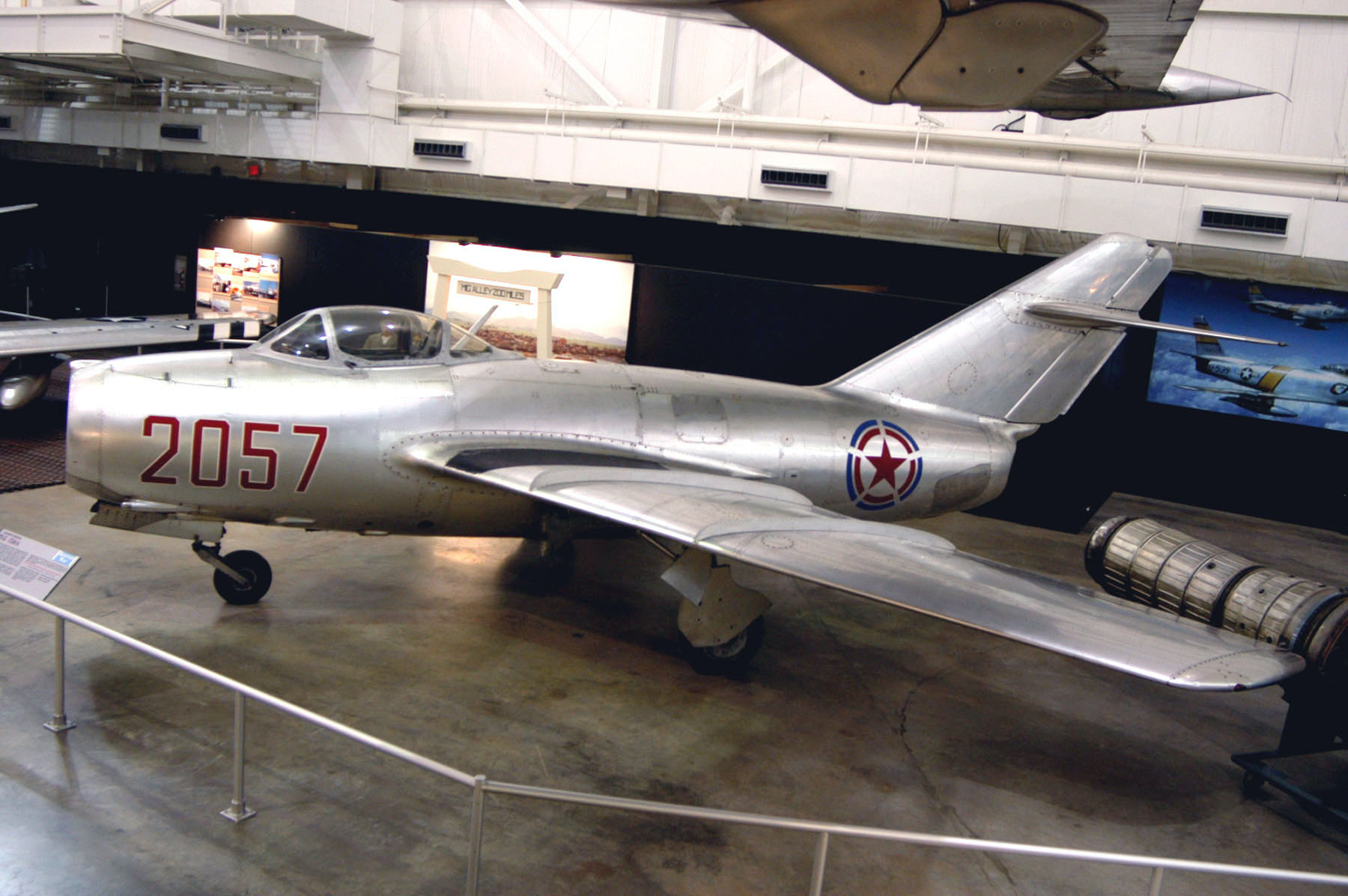
MiG-15 in the Korean War Gallery at the National Museum of the United States Air Force.

Operation Moolah was a United States Air Force (USAF) effort during the Korean War to obtain through defection a fully capable Soviet MiG-15 jet fighter.[1] Communist forces introduced the MiG-15 to Korea on November 1, 1950.[2] USAF pilots reported that the performance of the MiG-15 was superior to all United Nations aircraft, including the USAF's newest plane, the F-86 Sabre.[3] The operation focused on influencing Communist pilots to defect to South Korea with a MiG for a financial reward. The success of the operation is disputable since no Communist pilot defected before the armistice was signed on July 27, 1953. On September 21, 1953, North Korean pilot Lieutenant No Kum-Sok flew his MiG-15 to the Kimpo Air Base, South Korea, unaware of Operation Moolah.[4]

Background

[edit]
Gun camera photo of a MiG-15 being attacked by a USAF fighter.

The appearance of the MiG-15 Soviet fighter over the Korean peninsula in November 1950 was initially thought to have placed United Nations aircraft, especially the USAF F-86, at a disadvantage. In a dogfight, the MiG-15 outperformed the F-86 Sabre at higher initial acceleration and could outdistance it in a dive, even though the Sabre had higher terminal velocity. The MiG was also more maneuverable above 10,000 m (33,000 ft) although the F-86 was more maneuverable below that altitude. The MiG-15 was also armed with a heavy 37 mm cannon that could shoot down USAF bombers. United States military planners at the Strategic Air Command (SAC) were aware of the cannon but knew little more about the technical aspects of the aircraft, including flight performance. By the end of the war, UN air forces had gained ascendancy over the MiGs due to superior tactics, techniques, and procedures (TTPs), better-trained pilots, upgraded Sabres, and especially due to the withdrawal of Soviet pilots from the conflict.[5]

The appearance of the MiG-15 over North Korea led to speculation over the Soviet Union's involvement in the Korean War. USAF pilots reported hearing Russian spoken over the radio communications channels used by the MiG-15s. Prior to the November 1950 sighting of the MiG-15s by USAF pilots, Soviet MiG-15 regiments were stationed at the Moscow Air Defence District to protect the capital against a possible NATO bombing.[6]

Some UN prisoners of war reported talking to Soviet pilots while in captivity in North Korea. According to General Mark Clark, the commanding general of the UN Command had enough intelligence to claim that the Soviets were covertly lending their pilots in support of North Korean forces.[7] According to Lieutenant No Kum-Sok, by February 1951, some half-a-dozen Soviet Air pilots visited North Korean pilots at their northeast China air base at Jilin. The plain clothes officers were there to investigate the ability of the North Korean pilots and determine if they were capable enough to fly the new MiG-15. By March, the Soviet 324th Fighter Air Division, led by Colonel Ivan Kozhedub, deployed to Jilin and began training the first class of North Korean air force pilots on the MiG-15. One month later, these same Russian pilots entered combat on behalf of North Korea, though internationally their involvement was never announced. The Soviets had gone to great lengths to hide their involvement in the war, including painting Chinese and North Korean insignia on their planes. By the end of the war, the Russians had provided half the aircraft and 5,000 pilots in support of the Communist war effort against the UN.[8]

Origins

[edit]
MiG-15 delivered by No Kum-Sok, a defecting North Korean pilot to the US Air Force

Speculation exists about the origin of Operation Moolah. According to Captain Alan Abner, the idea of the operation originated from his office at the Army's Psychological Warfare Branch, in Washington DC. According to intelligence reports that they received, dissatisfaction within the Soviet Air Force, even to the extent of some desertions by disgruntled pilots, led to the promising belief of possible future defections by some pilots. The plan set forth an offer of $100,000 (equivalent to $1,093,781 in 2022) for a Soviet MiG-15 and political asylum for the pilot. The plan was marked Top Secret and requested the offer be passed by rumor through ranks of Communist forces to ensure that the offer would not be attributable to the US. The plan was delivered to The Pentagon on a Monday, and by that Saturday, details of the plan had been published in The Washington Post with the title, "Gen. Mark Clark Offers $100,000 Reward for Russian Jet." Abner was disappointed because the article did not mention that his organization had conceived the plan.[9]

A second version of this story originates from General Mark W. Clark. According to him, the origin of Operation Moolah was from a war correspondent closely associated with the general but was not identified in Clark's book, From the Danube to the Yalu. The war correspondent developed the idea of the metaphor "silver bullet" and its effect on the Chinese in early 1952. He then developed and wrote a fictitious interview between an "anonymous" and a nonexistent Air Force general suggesting the MiG reward. The Far East Air Force (FEAF) headquartered in Tokyo was given the fictitious interview and thought the idea was worth looking into and passed it onward to the Department of the Air Force in Washington, DC. The idea circulated the Pentagon and the Department of State until it was transmitted back to Clark from the Department of the Army through a message that he received in November 1952.[10]

According to Herbert Friedman[citation needed], the unidentified war correspondent was Edward Hymoff, the Bureau Chief of the International News Service and former World War II OSS veteran,[11] whom he interviewed.[12] Another source attributes the idea to Major Donald Nichols, commanding officer of the 6004th Air Intelligence Service Squadron.[13]

Execution

[edit]
Operation Moolah propaganda leaflet promising a $100,000 reward to the first North Korean pilot to deliver a Soviet MiG-15 to UN forces

On March 20, 1953, the Joint Chiefs of Staff approved the plan. The approved operation was forwarded on April 1, 1953, to the Joint Psychological Committee at FEAF in Tokyo, Japan, where it was staffed, approved, and advanced to Clark. He dubbed the plan Operation Moolah. The plan offered $50,000 to any pilot who flew a fully mission capable MiG-15 to South Korea. The first pilot to defect would be awarded an additional $50,000. The plan also included complete political asylum, resettlement in a non-Communist country, and anonymity if desired.

SFC Furl A. Krebs loads an M16A1 cluster adapter at the FEC (Far Eastern Command) Printing Plant, Yokohama, Japan. The bomb type adapter will contain 22,500 psychological warfare leaflets sized 5 by 8 inches (130 mm × 200 mm).

If such a defection occurred, the propaganda value would be significant to UN forces. The defection of the pilot would be articulated to the global audience that the pilot fled from the perils of Communism and a totalitarian regime for freedom in South Korea.[14] The operation would also create North Korean and Chinese trepidation and mistrust of their pilots. A Soviet defection would provide vital intelligence and demonstrate the Soviet Union was an active participant in the war. UN forces would also have the opportunity to test the MiG-15s capabilities and establish procedures against the MiG-15's technical advantages over the F-86 Sabre.[15]

On April 26, armistice negotiations between Communist forces and the UN began. Clark issued the offer of Operation Moolah on the 27th to coincide with Operation Little Switch, the exchange of sick and wounded POWs between the Communist and the UN forces. The timing was intentional because the US and South Korean President Syngman Rhee were not able to agree upon the conditions of the armistice.[16] The intent of Operation Moolah was to discourage captured Communist forces from returning to North Korea or China. The effect was to demonstrate that Communist POWs were treated better under the care of UN forces and did not wish to return to their home country.

General Clark announced the offer on April 27, 1953, through a shortwave radio transmission. The transmission, translated into Korean, Mandarin, Cantonese, and Russian, was broadcast by 14 radio stations in Japan and South Korea into North Korea and China. Clark stated: "To all brave pilots who wish to free themselves from the Communist yoke and start a new, better life with proper honor ... you are guaranteed refuge, protection, humane care and attention. If pilots so desire, their names will be kept secret forever ..."[17]

B-29 Superfortress in flight over Korea

On the night of April 26, 1953, two B-29 Superfortress bombers dropped 1.2 million leaflets over Communist bases in the Yalu River Basin. These leaflets were written in Russian, Chinese, and Korean.[18] According to General Clark, immediately after the drop of the leaflets on April 26, UN aircraft did not make visual contact with any MiG aircraft for the following eight days. Though weather may have been a factor, he opines that the leaflets had a direct effect and believes that senior Communist military leaders began to screen for politically unreliable pilots. Incidentally, immediately after the leaflet drop in April, a radio-jamming transmitter whose location could not be identified began to jam all UN Russian-language broadcasts of Gen. Clark's MIG-15 offer, but Chinese and Korean broadcasts were unhindered.[19]

On May 10, US B-29 bombers returned at night to drop an additional 40,000 Operation Moolah leaflets over the Sinuiju and Uiju Airfields. The UN broadcast the same message delivered by General Clark in April translated in Russian, Chinese, and Korean. That would be replicated on the evening of May 18, with an additional 90,000 leaflets.[18][20]

MiG-15 flights were rumored to have decreased drastically or ceased after the April leaflet drop and radio broadcasts of the offer. However, it has been reported that MiG-15 sorties were suspended for eight days,[21] but a large formation of approximately 166 MiG-15s was sighted on April 30.[22] Thirty MiG-15s were sighted on May 1, forty-four on May 2, and from May 3 to 7, not a single MiG-15 was sighted, almost certainly because of poor weather conditions.[18] One noticeable change was the paint pattern of the Communist aircraft. Prior to April 27, all MiG-15s were painted the same pattern as the Soviet air force, with the red star, but after the 27th, all Communist aircraft had Chinese and North Korean markings.[23] On May 27, North Korean dictator Kim Il Sung gave a radio speech to the "heroes" of the North Korean Air Force that their country would assume a larger role in the defense of North Korean airspace. Kim also exhorted his countrymen to ensure military discipline and equipment is fortified to ensure victory against the UN forces.[clarification needed][24]

According to Lieutenant No Kum-Sok, the North Korean pilot who defected after the Korean War was over, his vice battalion commander, Captain Kim Jung-Sup was summoned to Sinuiju, the North Korean Air Force headquarters in early May 1953 for one week. The purpose of his trip was unknown to No, but rumors had circulated throughout the command that Lieutenant No was under investigation, questioning his loyalty to the Democratic People's Republic of Korea. No continued to fly and assumed that his vice battalion commander had defended his loyalty to the Communist regime. Coincidentally, with the death of Soviet Premier Joseph Stalin on March 5, 1953, and the significant loss of Russian aircraft, the Soviet Union grounded and recalled their pilots from the Korean theater. The Soviet Union had gone to great lengths to disguise their involvement in the Korean War. Russian pilots were taught Mandarin in order to deceive UN pilots.[25] USAF pilots noted after the 27th, they had not heard any Russian chatter on the intercoms of MiG-15s from the Soviet Union's "Honchos" pilots.[22]

Between May 8–31, 56 MiG-15s were destroyed with only one F-86 loss in the same period. USAF pilots noticed that Communist pilots who observed USAF aircraft flying near their airspace prior to any engagement, bailed from their aircraft to ensure their personal survival.[26]

General Clark received reports of the poor quality of Communist pilots after the leaflet drops of Operation Moolah, their worst piloting of the war. Communist pilots flew fewer sorties in the 90 days after Operation Moolah than in the 90 days before the first leaflet drop. UN pilots shot down 155 MiG-15s with a loss of only three F-86 aircraft during that period.[27]

The Korean Armistice Agreement was signed on July 27, 1953, ceasing all combat operations. Not one single pilot had defected to South Korea. The effectiveness of Operation Moolah was difficult to assess. Though UN forces did not recover a single MiG-15 aircraft, Operation Moolah had residual effects on Communist forces. There is some evidence to believe that the Soviet Union feared a defection from its pilots more than the Chinese or North Korean regimes. US intelligence reports indicated that Soviet Far Eastern audiences were shown films depicting the failure of US intelligence agents bribing the crew and passengers of a Czech plane into defecting to the west. Presumably the Russians may have well believed that the UN reward offer would appeal to airmen from their satellite countries in the Warsaw Bloc.

The leaflets used in Operation Moolah carried the photo of Lieutenant Franciszek Jarecki, who had flown his Lim2 (license version of MiG 15bis) from Poland to political asylum in Denmark in March 1953.[28]

Aftermath

[edit]
MiG-15 pilot Lieutenant No Kum-Sok, pictured in 1953 wearing typical North Korean flight clothing.
No Kum-Sok's MiG-15, minutes after landing at Kimpo.
Repainted in USAF markings and insignia, the MiG-15b is under guard and awaiting flight-testing at Okinawa.

Early in the morning on September 21, 1953, Lieutenant No Kum-Sok flew a MiG-15bis, bort number 'Red 2057', of the 2nd Regiment, Korean People's Air Force, from Sunan Air Base, just outside Pyongyang, North Korea and landed before 10:00 a.m. at Kimpo Air Base in South Korea. He was immediately taken into the base headquarters for interrogation and physical examination. Shortly afterwards, he was taken by helicopter to a secluded US military base at Oryu-dong, just outside Seoul, where the Fifth Air Force Intelligence Office was located. His aircraft was disassembled and loaded onto a C-124 Globemaster and shipped off the next day to Kadena Air Base on Okinawa. The next morning, South Korean newspapers mentioned the defecting North Korean pilot and his award of $100,000. No, though, was unaware of Operation Moolah and its rewards. No was later advised by the Central Intelligence Agency (CIA) to decline the reward money in exchange for paid education at an American college of his choosing.[29] President Dwight D. Eisenhower did not support Operation Moolah. He thought it unethical to offer money to a defector and was concerned about the North Korean reaction to the defection due to the uneasy armistice agreement.[30]

One of his handlers from the CIA was Larry Chin, who was arrested by the Federal Bureau of Investigation (FBI) in 1985 for spying. In the aftermath of No's defection, five of his fellow pilots were executed.[31]

According to No, the reward would not have motivated any North Korean pilots to defect, for a number of reasons. First, the offer made available in April 1953 was advertised through leaflets dropped at North Korean air bases on the Yalu River. However, at that point in the war, all Russian, Chinese, and North Korean MiG-15s were stationed in Manchuria, so it was unlikely that any MiG-15 pilots had seen the leaflets. Secondly, even if the USAF had dropped leaflets in Manchuria, a North Korean pilot would not have trusted the authenticity of the offer. Nor were North Korean pilots generally aware of the purchasing power of the American dollar. Had Operation Moolah instead guaranteed freedom and a job in the United States, it would have been viewed as a more tempting offer.[32]

Even though it was not directly influenced by Operation Moolah, No's defection did allow the USAF insight into the aircraft and the state of the northern air forces. For the next several months, No answered numerous questions related to North Korea's military and the support it received from the Soviet Union and China. He also provided valuable insight to American test pilots prior to their evaluation of the MiG at Kadena Air Base. The test pilots were Major Chuck Yeager and Captain Harold "Tom" Collins, led by Major General Albert Boyd, the commander of the Wright Air Development Center.[33] Major Yeager later stated, "Flying the MiG-15 is the most demanding situation I have ever faced. It's a quirky airplane that has killed a lot of its pilots."[34]

Testing of the MiG-15 lasted 11 days. It revealed that the aircraft was a reasonably good fighter, but lacked the technological sophistication of American aircraft, such as the F-86. Major Yeager was able to fly the aircraft to 0.98 Mach before it became dangerously uncontrollable. While the MiG-15 did have a faster climb rate and operated in a higher altitude ceiling than the F-86, it suffered from problems with oscillation, poor pressurization, unexpected pitch-up at high speeds, unrecoverable spins, sudden stalls, and a particularly dangerous emergency fuel pump that could cause the aircraft to explode if improperly activated.[35] Despite such shortcomings, Yeager and Collins determined that the MiG-15 and F-86 were equally capable. Pilot experience and training proved to be the most important factor during dogfights. Maj. Yeager said, "The pilot with the most experience will whip your ass no matter what you're flying!"[36]

After the testing of the MiG-15bis, it was again disassembled and each part was scrutinized and evaluated by engineers. The Americans offered to return the aircraft to North Korea, but there was no response. The MiG-15 was crated and shipped to Wright-Patterson Air Force Base, in Dayton, Ohio, in February 1954. From March to October 1954, the MiG-15bis, was tested at Eglin AFB, Florida. It was flown extensively in comparisons with the B-36, B-47, F-84 and F-86 before returning to Wright-Patterson AFB, Ohio, in October.[37][38] Further evaluation of the aircraft continued until it was damaged in a hard landing in 1956. The aircraft was donated to the National Museum of the US Air Force for restoration and display, where it remains.[39][40]

Example for future psychological operations

[edit]
The $100,000 check awarded to No Kum-Sok as a reward for bringing the MiG-15 to South Korea.

Operation Moolah has been replicated multiple times since 1953. The Kuomintang, Chinese nationalists, dropped leaflets over mainland China, offering 28 to 113 kilograms (1,000 to 4,000 oz) of gold to Communist Chinese pilots who defected to Taiwan. The more modern the aircraft, the more gold the defecting pilot would receive.[41] In 1966, the Joint Chiefs of Staff approved Operation Fast Buck, an exact replica of Operation Moolah, to secure a MiG-21 and the Soviet Mil Mi-6 "Hook" helicopter. Other goals of this operation were also to acquire intelligence, force the government of North Vietnam to evaluate the loyalty of its pilots and reduce MiG sorties.[42] Operation Diamond, a Mossad covert operation, was similar to Operation Fast Buck; an Iraqi MiG-21 pilot successfully defected, and the captured MiG was evaluated by the Israeli Air Force, USAF, and the US Navy.

Portrayal in fiction

[edit]

In Episode 243 of Season 11 of M*A*S*H, a lightly wounded North Korean pilot winds up at the 4077 M*A*S*H. He landed due to engine trouble, with no intention of defecting, but an Army PR man offers him a deal very much like Operation Moolah, even citing Gen. Mark Clark by name.[citation needed]

In the 1983 film Under Fire, fictional characters portrayed by Nick Nolte and Ed Harris discuss a leaflet drop in Africa offering a new home and swimming pool to any opposition pilot who defects. Nolte's character says it is a false offer but Harris counters that its effect is to ground the opposition air force - air force superiors will not allow their aircraft to fly for fear of the pilots defecting.

Lieutenant No's defection was the subject of a mission in Chuck Yeager's Air Combat, a 1991 combat flight simulator.

References

[edit]
Revisions and contributorsEdit on WikipediaRead on Wikipedia
from Grokipedia
Operation Moolah was a United States Air Force psychological warfare initiative during the Korean War designed to acquire an intact Soviet MiG-15 jet fighter through the defection of a communist bloc pilot, offering a reward of $100,000 and political asylum to the first individual to deliver such an aircraft to United Nations forces.[1][2] Launched in early 1953 amid escalating air battles in "MiG Alley," the operation sought to address the technological uncertainty surrounding the MiG-15, which had proven a formidable adversary to American F-86 Sabre jets, by enabling direct examination of its design and capabilities.[1][3] Propaganda efforts included leaflet drops from B-29 bombers over North Korean airfields and radio broadcasts in multiple languages targeting North Korean, Chinese, and Soviet pilots, emphasizing financial incentives and guarantees of safe passage to friendly territory.[1][2] Despite extensive dissemination, no defections occurred before the Korean Armistice Agreement on July 27, 1953, rendering the operation unsuccessful in its wartime objectives.[1] However, on September 21, 1953, North Korean pilot No Kum-sok independently defected from Pyongyang to Kimpo Air Base in South Korea with his MiG-15bis, motivated by ideological disillusionment rather than prior awareness of the bounty, though he later received the $100,000 reward after verification.[4][1] Post-defection analysis revealed critical details, such as the MiG-15's use of a reverse-engineered Rolls-Royce Nene engine and performance characteristics that informed U.S. countermeasures and future aircraft development.[1]

Strategic Context

The MiG-15 Threat in the Korean War

The Soviet-designed Mikoyan-Gurevich MiG-15 entered combat operations in the Korean War on November 1, 1950, marking a significant escalation in aerial threats to United Nations forces.[5] Featuring a swept-wing configuration for enhanced high-speed stability and powered by a Klimov VK-1 turbojet engine, the MiG-15 achieved a maximum speed of 668 mph and a climb rate exceeding 10,000 feet per minute.[6] [7] Its armament consisted of two 23 mm NR-23 cannons and one 37 mm N-37 cannon, providing formidable firepower against contemporary jet fighters and bombers.[8] In the Yalu River region known as MiG Alley, the MiG-15 demonstrated tactical superiority over early U.S. jets such as the F-80 Shooting Star and F-84 Thunderjet, outpacing and outclimbing them in engagements through late 1950 and into 1951.[9] This advantage resulted in unfavorable kill ratios for U.N. aircraft initially, with MiG-15 pilots exploiting superior acceleration and altitude performance to intercept and down U.S. fighters and strategic bombers, prompting temporary halts in daylight B-29 Superfortress raids.[10] The imbalance persisted until the deployment of North American F-86 Sabre jets in December 1950, which began to counter the MiG's edge, though communist forces maintained numerical advantages in MiG Alley skirmishes.[11] The Soviet Union supplied hundreds of MiG-15s to North Korean and Chinese forces, enabling sustained operations that inflicted substantial losses on U.S. air assets and challenged American aerial superiority.[12] This technology transfer directly correlated with increased U.N. aircraft vulnerabilities, as MiG-15 formations numbering up to nearly 400 in single-day sightings overwhelmed early jet responses and protected communist ground advances.[5] The interceptor's performance underscored the urgency for the U.S. to acquire intact examples for evaluation, highlighting gaps in matching Soviet jet propulsion and aerodynamics.[13]

U.S. Intelligence Gaps and Aerial Superiority Challenges

U.S. intelligence on the MiG-15 during the Korean War relied heavily on examinations of crashed aircraft and interrogations of captured pilots, which provided only partial insights into its design and capabilities.[14] Wreckage recovery operations, such as those yielding engine components and avionics fragments, failed to deliver comprehensive data on integrated systems, precise engine performance under full operational conditions, or nuanced flight characteristics like turn rates and stability envelopes.[14] These methods could not replicate the Soviet fighter's holistic performance, leaving analysts without hands-on evaluation essential for developing effective countermeasures.[13] The North American F-86 Sabre achieved rough parity with the MiG-15 in low- to medium-altitude dogfights, benefiting from superior pilot training, radar gunsights, and hydraulic controls that enhanced maneuverability.[15] However, the MiG-15 demonstrated advantages in high-altitude interception, with its VK-1 engine enabling better climb rates—up to 12,500 feet per minute—and a service ceiling exceeding 50,000 feet, outpacing the Sabre's capabilities in those regimes.[16] This inferiority contributed to U.S. losses exceeding 100 F-86s to MiG-15s by mid-1953, alongside vulnerabilities in bomber escort missions where MiGs exploited altitude edges to engage B-29 formations.[17] In the broader Korean War air campaign, United Nations forces aimed to secure aerial superiority to enable unrestricted close air support for ground operations, but MiG-15 units operating from sanctuary bases across the Yalu River in China presented persistent numerical and tactical challenges.[12] These bases, including Antung, allowed Communist forces to amass over 1,000 MiG-15s by 1953 while evading direct strikes due to political restrictions on bombing Chinese territory, enabling massed intercepts that overwhelmed UN fighters in "MiG Alley."[12][18] The resulting imbalance hampered U.S. efforts to neutralize North Korean supply lines and achieve decisive air dominance until armistice negotiations.[12]

Origins and Planning

Initial Proposals and Internal Deliberations

In late 1952, United States Air Force psychological warfare specialists, drawing on intelligence assessments of deteriorating morale among communist pilots subjected to political purges and rigid ideological controls, proposed a defection incentive program to secure an intact Soviet MiG-15 for technical evaluation.[1][2] The rationale centered on exploiting structural weaknesses in communist regimes, including forced conscription of pilots with limited loyalty and the coercive nature of their indoctrination, which fostered underlying discontent amenable to monetary and asylum incentives.[1] Key early advocates included USAF Captain Alan K. Abner, who in 1952 suggested a $10,000 reward disseminated through rumors to maintain operational secrecy, and journalist Edward Hymoff, who in the fall of that year pitched a more ambitious $100,000 offer combined with broadcasts and political asylum guarantees directly to General Mark W. Clark during a flight to Tokyo.[1] These proposals aligned with broader psychological warfare objectives to sow distrust within enemy ranks and compel resource-draining countermeasures, such as intensified pilot screenings, without regard for ethical constraints beyond strategic efficacy.[1][19] Internal deliberations involved coordination between Far East Air Forces (FEAF) under Commander General Otto P. Weyland, who endorsed the plan's alignment with aerial intelligence priorities, and input from the CIA, which recommended against proceeding due to perceived risks of failure or escalation but was ultimately overruled.[1] Discussions weighed secrecy versus overt propaganda, with the Pentagon refining reward structures before forwarding to higher command.[1] The operation gained formal approval from the United Nations Joint Psychological Warfare Committee on April 1, 1953, coinciding with protracted armistice negotiations that underscored the urgency of gaining technological parity against the MiG-15 threat.[1][19]

Development of Incentives and Propaganda

The incentives for Operation Moolah were formalized in early 1953, offering a tax-free reward of $100,000 to any pilot, crew member, or ground personnel who delivered a serviceable MiG-15 to United Nations lines, along with guarantees of political asylum, personal protection, and optional anonymity.[1] This amount, equivalent to approximately $1 million in 2025 dollars, emphasized tangible financial gain to appeal to individual self-interest amid the austere living conditions and ideological indoctrination prevalent in communist air forces.[4] The proposal, initially conceived in 1952 by psychological warfare specialist Edward Hymoff, received approval from the United Nations Joint Psychological Warfare Committee on April 1, 1953.[1] Propaganda materials were developed concurrently by the U.S. Far East Air Forces' (FEAF) psychological warfare units, particularly the 1st Radio Broadcasting and Leaflet Group, headquartered at APO 500.[1] By April 20, 1953, data sheets for leaflet production were prepared, leading to the printing of 1.2 million copies in various formats—ranging from 4x5 inches to 8x10 inches in blue and tan colors—by the 3rd Reproduction Company at the Omiya Printing Plant in Japan.[1] These leaflets were crafted in Korean (codes 2508 and 2510), Chinese (code 5502), and Russian (codes 5701 and 5703) to target the multinational composition of MiG-15 pilots, reflecting intelligence assessments that North Korean, Chinese, and Soviet aviators operated the aircraft.[1] The messaging integrated pragmatic inducements with psychological leverage, promising safe conduct procedures such as flying to designated points like Paengnyong-do Island followed by Kimpo Air Base at 6,100 meters altitude, where defectors would lower landing gear and rock wings to signal intent, with UN escorts providing protection from potential attacks.[1] This approach drew on causal understanding of defector motivations, prioritizing escape from execution risks for deserters and purges in communist hierarchies over ideological appeals, while sowing potential distrust among enemy pilots to disrupt operational cohesion.[1] Radio broadcasts complementing the leaflets, initiated on April 27, 1953, by General Mark W. Clark and relayed through 14 stations in multiple languages, reinforced these offers by highlighting prospects of freedom and prosperity.[1]

Operational Execution

Leaflet Campaigns and Delivery Methods

Two B-29 Superfortress bombers dropped more than one million reward leaflets over the Yalu River region on the night of April 26–27, 1953, targeting Chinese and North Korean air bases known as MiG Alley sanctuaries.[1][2] The leaflets, printed in Russian, Chinese, and Korean, detailed the $100,000 cash reward and political asylum offer for any Communist pilot defecting with an operational MiG-15 to UN-controlled territory.[1] These initial drops marked the tactical launch of Operation Moolah's psychological operations phase, focusing on airfields such as those near Sinuiju and Uiju to reach Soviet, Chinese, and North Korean pilots.[2] Leaflet dissemination continued via B-29s and reconnaissance variants like the RB-29 through the armistice on July 27, 1953, with millions dispersed overall to ensure repeated exposure across enemy-held areas including Pyongyang and the Yalu River basin.[1][19] Delivery employed leaflet bombs released from high-altitude bombers to cover broad swaths of territory, prioritizing night missions to evade antiaircraft fire and MiG intercepts while maximizing scatter over pilot concentrations.[19] Communist forces responded with intensified radio jamming, particularly targeting Russian-language frequencies shortly after the April drops, though UN broadcasts persisted in multiple languages to reinforce the defection message.[3] The campaigns coordinated leaflet drops with radio propaganda from the Voice of the United Nations Command, which aired General Mark W. Clark's initial English broadcast—subsequently translated and repeated in Russian, Chinese, and Korean—to amplify the reward offer despite jamming interference from unidentified North Korean transmitters.[1][3] This integrated approach aimed for psychological penetration into enemy cockpits, with broadcasts timed to overlap flight operations and leaflet dispersal patterns over key MiG deployment zones.[1]

Supporting Psychological Warfare Elements

In addition to leaflet drops, Operation Moolah employed radio broadcasts as a complementary dissemination channel to reinforce defection incentives among Communist aircrews. Starting on April 27, 1953, the United Nations Command transmitted messages from 14 stations based in Japan and Korea, delivering the reward offer and asylum guarantees in Korean, Russian, Mandarin, and Cantonese.[1] These broadcasts emphasized a $100,000 cash prize—$50,000 base reward plus a $50,000 bonus for the first successful defection—along with assurances of refuge, personal protection, name secrecy, and relocation to a non-Communist country, effectively promising non-repatriation to deter fears of post-defection retribution.[1] [20] This multi-channel approach aligned with U.S. psychological operations doctrine, which sought redundancy to penetrate restricted enemy environments and amplify message credibility through varied media. Radio supplemented aerial leaflet campaigns by enabling repeated, targeted appeals during peak listening periods, potentially reaching pilots and support staff isolated from physical propaganda.[20] Broadcasts extended the operation's reach beyond visual drops, fostering doubt about Soviet and Chinese aircraft superiority while highlighting defector privileges unavailable under Communist regimes.[1] To indirectly influence pilots, messages addressed non-aircrew personnel, such as ground crews and base staff, urging them to relay defection opportunities and underscoring U.S. commitments to safe passage without forced return.[20] This tactic aimed to create peer pressure within units, exploiting hierarchical dependencies to erode morale among elite MiG squadrons. No explicit family safety promises were detailed in core propaganda, though broader asylum narratives implied protection from reprisals affecting dependents.[1] Effectiveness indicators emerged through operational intelligence, including a reported eight-day grounding of MiG-15s immediately following the campaign launch and a 21% decline in sorties during May-June 1953 compared to prior months, per 1st Radio Broadcasting and Leaflet Group assessments.[1] UN Commander General Mark W. Clark cited post-drop intelligence on deteriorated Communist pilot performance—the war's lowest—as evidence of psyop penetration, though direct leaflet recovery or intercepted communications confirming message dissemination in camps were not publicly documented.[20] These metrics suggested auxiliary channels contributed to temporary disruptions in enemy air operations, validating the integrated doctrine despite no immediate defections.[1]

Short-Term Outcomes

Absence of Immediate Defections

Despite the intensive leaflet campaigns, which included the airdrop of approximately 1 million leaflets over North Korean airfields by the end of April 1953 and an additional 500,000 in May, no verified defections of MiG-15 pilots occurred during the active phase of Operation Moolah.[1] Radio broadcasts amplifying the $100,000 reward and political asylum offer similarly failed to prompt any pilot to fly intact to UN-controlled territory, such as Paengnyong-do Island, before the Korean Armistice Agreement took effect.[2] This absence persisted even amid reports of erratic Communist air behavior, including a temporary decline in MiG sorties following the initial drops.[1] Communist forces responded to the psychological operation with heightened controls that curtailed defection opportunities. Immediately after the April 27, 1953, leaflet launch, MiG-15s were grounded for eight days, reflecting restricted flight operations to mitigate risks.[1] Soviet jamming of Russian-language broadcasts and increased vigilance, including potential purges of pilots deemed unreliable, further enforced loyalty and limited autonomous missions.[1] These measures, enacted by North Korean, Chinese, and Soviet commands, prioritized operational security over individual incentives, ensuring no pilot could execute an undetected defection.[2] The armistice, signed on July 27, 1953, concluded active leaflet and broadcast efforts without achieving the core objective of acquiring an intact MiG-15 through defection during hostilities.[1] U.S. intelligence thus remained without a serviceable enemy aircraft for evaluation at war's end, underscoring the efficacy of enemy preventive protocols in neutralizing the operation's immediate appeal.[2]

Enemy Countermeasures and Responses

Communist authorities in North Korea and China issued statements through state media denouncing the U.S. defection offer as an act of bribery intended to undermine socialist solidarity, while asserting the unshakeable loyalty of their pilots to the communist cause.[21] These pronouncements emphasized ideological commitment over material incentives, framing the leaflets as imperialist propaganda designed to sow discord without acknowledging any internal doubts among aircrews.[1] In response to the leaflet drops commencing on 27 April 1953, enemy forces implemented immediate operational restrictions, including an eight-day grounding of all MiG-15 pilots across North Korean and Chinese units, which halted combat sorties and limited exposure to defection instructions.[1] Aerial reconnaissance and sortie data subsequently revealed a 21 percent decline in MiG missions from May to June 1953 relative to the prior two months, attributable to heightened flight controls and dispersal of aircraft to remote fields to evade potential defections or U.S. intercepts.[1] Security protocols at MiG bases were intensified, with guards patrolling airfields more rigorously and restricting pilot movements to prevent unauthorized takeoffs, as corroborated by post-war defector accounts and U.S. intelligence overflights.[1] Possession of Operation Moolah leaflets was decreed a capital offense by North Korean command, leading to summary executions of individuals suspected of disloyalty or contact with the materials, enforced through political commissars embedded in units.[22] Soviet advisors, integral to MiG operations, directed enhanced ideological indoctrination sessions for pilots, reinforcing anti-defection oaths and surveillance within squadrons to counteract perceived morale erosion from the psychological campaign, though these efforts focused primarily on non-Soviet aircrews to maintain operational cohesion.[1] Additionally, Soviet radio countermeasures jammed English and Russian-language broadcasts promoting the offer, while allowing Korean and Chinese frequencies to penetrate, prioritizing containment of influence on their own personnel.[1]

Long-Term Results and Defection

The No Kum-sok Incident

On September 21, 1953, North Korean People's Army Air Force Senior Lieutenant No Kum-sok, aged 21, defected during a routine training flight by diverting his MiG-15bis (serial 2015357, nose marking 2057) from Sunan Air Base near Pyongyang southward across the demilitarized zone to Kimpo Air Base in South Korea, where he landed without incident.[23][24] No had completed about 100 combat sorties prior to the armistice and cited deep-seated disillusionment with the communist regime, including resentment over its oppressive control and personal hardships like his father's death amid famine conditions, as his primary drivers for seeking freedom in the South.[25][4] Though No later stated he had no prior knowledge of Operation Moolah's specifics, his independent motivations aligned with the psychological operation's aim to erode loyalty among enemy pilots; the U.S. Far East Command's decision to honor the $100,000 reward—despite the program's formal suspension after the July 1953 armistice—underscored the incentives' enduring appeal and potential for post-operational defections.[24][26] Immediately after landing, No was detained by South Korean forces, then debriefed by U.S. intelligence officers, including CIA asset Arseny Yankovsky (alias "Andy Brown"), who confirmed his bona fides.[4][27] U.S. examiners verified the aircraft's operational integrity, finding no sabotage or booby-traps, which allowed for its safe disassembly and transport to Japan for analysis.[24] No received the reward check in recognition of delivering the first intact enemy jet, affirming the operation's latent psychological leverage even after active leaflet drops ceased.[26]

Acquisition and Examination of the MiG-15

Following No Kum-sok's defection on September 21, 1953, the MiG-15bis was secured at Kimpo Air Base and prepared for initial evaluation. It was ferried to Okinawa for flight testing, where U.S. Air Force test pilots Captain H.E. "Tom" Collins and Major Chuck Yeager conducted assessments, confirming the aircraft's powerful Klimov VK-1 engine and hydraulically boosted ailerons provided superior high-altitude performance compared to prior intelligence estimates.[24][26] In December 1953, the aircraft was disassembled and airlifted to Wright-Patterson Air Force Base for detailed technical examination and reassembly. Engineers there dissected components, revealing the VK-1 engine's derivation from the Rolls-Royce Nene with enhancements yielding approximately 5,950 pounds of thrust, advanced hydraulic systems for control surfaces exceeding expectations, and an ASP-1N optical gunsight that offered precision but lacked the ranging capabilities of later Western systems. These findings corrected overestimations of MiG vulnerabilities and highlighted manufacturing quality inconsistencies in Soviet copies.[26][28] Comparative evaluations against the F-86 Sabre validated the MiG-15bis's advantages in turn radius and climb rate, attributable to its lighter wing loading and engine power-to-weight ratio, while exposing limitations such as restricted rear visibility from the framed canopy and shorter combat radius without external tanks. Flight tests at Eglin Air Force Base further quantified these traits, informing tactical adjustments like emphasizing F-86 energy management in dogfights.[24][29] No Kum-sok's extensive debriefings supplemented hardware analysis with operational intelligence, detailing North Korean pilot training regimens emphasizing formation tactics over individual maneuvers and revealing MiG employment doctrines focused on massed intercepts rather than prolonged engagements. This human-sourced data enabled U.S. forces to refine countermeasures against communist air strategies, enhancing overall effectiveness in post-armistice threat assessments.[26][25]

Assessment of Effectiveness

Measurable Impacts and Residual Effects

U.S. records indicate that MiG-15 operations were suspended for eight days immediately following the launch of Operation Moolah on April 27, 1953, reflecting an initial enemy effort to mitigate defection risks.[1] This was followed by a 21% reduction in MiG sorties during May and June 1953 compared to the prior 60 days, attributable to increased pilot caution and mutual suspicion fostered by the propaganda campaign.[1] Such disruptions contributed to broader psychological strain on communist air units, eroding operational cohesion at minimal direct cost to U.S. forces, as the initiative relied primarily on leaflets and broadcasts rather than combat resources.[20] Post-operation data from the U.S. Air Force documented a 55:1 kill ratio in favor of F-86 Sabre pilots over the subsequent 90 days, with 165 MiG-15s destroyed, signaling degraded enemy pilot proficiency and engagement quality—described as displaying "far more enthusiasm than ability."[1] These metrics suggest the defection incentives indirectly amplified the effectiveness of allied air superiority by diverting enemy focus toward internal security measures.[20] The operation's residual strategic value materialized through the unrelated but temporally proximate defection of North Korean Lieutenant No Kum-sok on September 21, 1953, yielding an intact MiG-15 for technical evaluation at U.S. facilities.[1] This acquisition furnished empirical data on Soviet avionics, aerodynamics, and engine performance, enhancing American comprehension of adversary capabilities and informing iterative improvements in fighter jet designs beyond the immediate conflict.[30]

Criticisms and Debates on Success

Critics contend that Operation Moolah's failure to elicit any defections during its active period—from the public announcement on April 27, 1953, to the Korean Armistice Agreement on July 27, 1953—demonstrates overreliance on financial incentives amid entrenched communist indoctrination and coercive controls, such as family hostages and political commissars monitoring pilots.[1] Approximately 1.5 million leaflets were disseminated over North Korean and Chinese airfields in April and May 1953, yet no pilots responded, leading some analysts to argue the campaign inadequately addressed ideological barriers and the high personal risks of defection.[1] Defenders counter that short-term disruptions evidenced partial efficacy, with U.S. psychological warfare reports citing an eight-day grounding of MiG-15 operations immediately after initial leaflet drops, linked to enemy pilots conducting intensified aircraft inspections for potential sabotage.[1] This paranoia correlated with reduced sortie rates in the 90 days following the announcement compared to the preceding period, suggesting induced morale strain that temporarily hampered communist air responses without requiring defections.[31] Debates persist on evaluating success beyond defection tallies, emphasizing tangible intelligence gains from post-armistice MiG acquisition and the operation's precedent for targeting regime fissures through publicized rewards.[32] The sole relevant defector's unawareness of the offer indicates no direct causal link to individual actions but supports indirect effects via widespread doubt; limited outcomes stem more from enemy safeguards like vetting and reprisal threats than inherent psyop shortcomings.[4][1]

Reactions and Controversies

Allied and Domestic Critiques

In Britain, the operation drew sharp rebuke in parliamentary and ecclesiastical circles. A Labour peer in the House of Lords denounced it as "dastardly," while Prime Minister Winston Churchill questioned its timing amid ongoing armistice negotiations, viewing the publicity as potentially disruptive to peace efforts.[1] British Catholic publications amplified ethical qualms, with the Catholic Herald branding it a "deplorable business," the Catholic Times decrying it as an "ill service to humanity," and The Tablet dismissing it as a strategic blunder that undermined civilized norms of warfare.[1] These critiques reflected unease among some Allied leaders with incentivizing betrayal through monetary rewards, contrasting the U.S. military's portrayal of the effort as a routine psychological operation akin to historical inducements in asymmetric conflicts. Domestically in the United States, President Dwight D. Eisenhower opposed the bounty, deeming it unethical to lure defectors with cash rather than ideological conviction and expressing concern over possible escalation on the Korean Peninsula.[1] The CIA similarly advised against proceeding, citing risks in execution and reliability of any defector motivated by financial gain.[1] Despite military proponents emphasizing pragmatic intelligence gains—evident in the operation's launch under General Mark W. Clark on April 27, 1953—these high-level reservations underscored tensions between outcome-driven realism and qualms over propriety in Cold War psyops, though no formal congressional opposition materialized.[1]

Communist Propaganda Responses

Soviet and Chinese media dismissed Operation Moolah as a futile imperialist scheme, portraying the $100,000 reward as a bribe insufficient to sway ideologically committed pilots. Official narratives emphasized the unbreakable solidarity of communist forces, with broadcasts asserting that such offers only strengthened resolve against capitalist subversion.[1] In practice, these claims masked operational anxieties, as evidenced by the Soviet Union's immediate jamming of Russian-language defection broadcasts and the grounding of pilots for eight days following the leaflet drops on April 27, 1953, to prevent any opportunistic flights.[3][1] North Korean propaganda, disseminated via Pyongyang radio, labeled the leaflets as Yankee psychological warfare aimed at sowing discord, while state directives required pilots to destroy materials on sight under threat of execution for possession.[1] Media outlets claimed unanimous pilot rejection, framing the operation as evidence of U.S. desperation amid battlefield setbacks. When defections occurred, such as those involving MiG-15 pilots, regime responses amplified traitor accusations to justify loyalty purges; for example, surviving pilots were compelled to publicly denounce defectors like Kenneth Rowe as "the worst traitor of North Korea" to avert collective punishment.[1] Post-war defector testimonies confirm these tactics reinforced internal surveillance, inadvertently underscoring enforcement vulnerabilities by revealing the regime's reliance on coercion over genuine allegiance.[1] Such propaganda efforts, while maintaining surface-level unity, correlated with measurable disruptions, including a 21% drop in communist sorties during May-June 1953, suggesting the narratives served more to contain internal doubts than to neutralize the psychological impact.[1] Chinese media echoed Soviet lines, using the campaign to depict defectors as class enemies warranting elimination, which facilitated purges in volunteer air units as verified in declassified accounts of heightened political commissar oversight.[33]

Legacy

Influence on Subsequent U.S. Psychological Operations

Operation Moolah established an early model for U.S. psychological operations employing monetary bounties to induce defections among enemy air personnel, aiming to secure advanced technology and disrupt adversary capabilities. Launched in March 1953 with a $100,000 reward for delivering an intact MiG-15, the campaign utilized extensive leaflet drops and radio broadcasts to target communist pilots, though no defections occurred during its active phase. Despite this, it achieved measurable strategic effects by prompting the temporary withdrawal of skilled Soviet pilots, thereby enhancing United Nations air superiority through the substitution of less proficient local operators; this outcome grounded MiG operations for approximately eight days and exposed Soviet direct involvement, yielding psychological leverage without physical capture.[32][1] These empirical results informed doctrinal shifts in U.S. Air Force psychological warfare units, shifting emphasis from assured defections to broader metrics of disruption, such as reduced enemy operational tempo and morale erosion via integrated propaganda channels. Post-Korean War analyses underscored the value of incentive-based appeals in psyops, validating multi-modal dissemination—leaflets from B-29 bombers and voice broadcasts—to amplify credibility and reach isolated targets like pilots under totalitarian control. This approach prioritized causal mechanisms of doubt and self-interest over ideological persuasion alone, influencing the evolution of psywar doctrine to incorporate quantifiable indirect gains, as evidenced in later USAF evaluations of air-psyop synergy.[32] The operation's legacy extended to Cold War strategies against communist regimes, reinforcing bounties as viable tools for human intelligence acquisition and technological evaluation. It prefigured programs like the CIA's handling of high-value defectors, where financial incentives facilitated access to Soviet military secrets, and paralleled Vietnam-era efforts such as Chieu Hoi, which offered cash, amnesty, and resettlement to elicit over 100,000 defections by incentivizing individual rationality amid systemic coercion. By demonstrating that psyops could compel behavioral changes—such as pilot reassignments—without guaranteed yields, Moolah promoted a realist framework in U.S. planning, favoring pragmatic disruption over unattainable absolutes in confronting ideologically rigid adversaries.[32][34]

Cultural Depictions and Historical Interpretations

In the television series MAS*H, Operation Moolah inspired the plot of the episode "Foreign Affairs" (Season 6, Episode 18, aired February 1, 1982), in which U.S. military intelligence offers a $100,000 reward to entice a North Korean MiG-15 pilot to defect, mirroring the operation's bounty mechanism while fictionalizing interactions among 4077th MASH personnel for dramatic effect.[35] The episode highlights the psychological allure of defection incentives amid wartime desperation but compresses timelines and inflates the reward amount beyond the initial $50,000 offer announced by General Mark Clark on April 27, 1953.[36] Historiographical treatments of Operation Moolah, particularly in psychological operations literature, frame it as a calculated but ultimately unfruitful bid to counter Soviet MiG-15 superiority through defection inducements, with analyses emphasizing deficiencies in message dissemination and target audience receptivity as key to its lack of direct success.[37] Works on Korean War air campaigns, such as those detailing MiG Alley engagements, portray the leaflet drops and radio broadcasts as bold disruptions that forced Communist air forces to divert resources toward counter-propaganda and pilot restrictions, even absent defections during the operation's April-to-July 1953 window.[33] No Kum-sok's independent defection on September 21, 1953, is often cited in these accounts not as a Moolah triumph but as serendipitous validation of underlying pilot vulnerabilities the operation sought to exploit.[1] Interpretations diverge along ideological lines, with conservative military histories lauding Moolah's ingenuity in asymmetrically challenging Communist technological edges via non-kinetic means, crediting it with measurable secondary impacts like heightened enemy operational caution evidenced by reduced MiG sorties post-leaflet campaigns.[4] Progressive critiques, influenced by academic skepticism toward U.S. covert incentives, occasionally decry it as manipulative coercion unlikely to yield ethical intelligence gains, though such views underweight empirical data on leaflet-induced disruptions over moral qualms.[37] Recent 2020s discussions in defense analyses draw parallels to contemporary reward programs for capturing adversary drones or eliciting pilot defections from Russia and China, positioning Moolah as an early model of incentive-driven human intelligence that prioritized verifiable disruptions over guaranteed acquisitions.[1]

References

User Avatar
No comments yet.