


Community hub
Recent from talks
Contribute something
Nothing was collected or created yet.
North American F-86 Sabre
View on Wikipedia
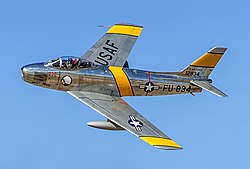
The North American F-86 Sabre, sometimes called the Sabrejet, is a transonic jet fighter aircraft. Produced by North American Aviation, the Sabre is best known as the United States' first swept-wing fighter that could counter the swept-wing Soviet MiG-15 in high-speed dogfights in the skies of the Korean War (1950–1953), fighting some of the earliest jet-to-jet battles. Considered one of the best and most important fighter aircraft in that war, the F-86 is also rated highly in comparison with fighters of other eras.[6] Although it was developed in the late 1940s and was outdated by the end of the 1950s, the Sabre proved versatile and adaptable and continued as a front-line fighter in numerous air forces.
Key Information


Its success led to an extended production run of more than 7,800 aircraft between 1949 and 1956, in the United States, Japan, and Italy. In addition, 738 carrier-modified versions were purchased by the US Navy as FJ-2s and -3s. Variants were built in Canada and Australia. The Canadair Sabre added another 1,815 aircraft and the significantly redesigned CAC Sabre (sometimes known as the Avon Sabre or CAC CA-27), had a production run of 112. The Sabre is by far the most-produced Western jet fighter, with a total production of all variants at 9,860 units.[1]
Development
[edit]
North American Aviation had produced the propeller-powered P-51 Mustang in World War II, which saw combat against some of the first operational jet fighters. By late 1944, North American proposed its first jet fighter to the U.S. Navy, which became the FJ-1 Fury. It was an unexceptional transitional jet fighter that had a straight wing derived from the P-51.[7] Initial proposals to meet a United States Army Air Forces (USAAF) requirement for a medium-range, single-seat, high-altitude, jet-powered day escort fighter/fighter bomber were drafted in mid-1944.[8] In early 1945, North American Aviation submitted four designs.[8] The USAAF selected one design over the others and granted North American a contract to build three examples of the XP-86 ("experimental pursuit"). Deleting specific requirements from the FJ-1 Fury, coupled with other modifications, allowed the XP-86 to be lighter and considerably faster than the Fury, with an estimated top speed of 582 mph (937 km/h), versus the Fury's 547 mph (880 km/h).[8] Despite the gain in speed, early studies revealed the XP-86 would have the same performance as its rivals, the XP-80 and XP-84. Because these rival designs were more advanced in their development stages, it was feared that the XP-86 would be cancelled.
Crucially, the XP-86 was not able to meet the required top speed of 600 mph (970 km/h);[9] North American had to quickly devise a radical change that could leapfrog its rivals. The F-86 was the first American aircraft to take advantage of flight research data seized from the German aerodynamicists at the end of World War II.[10] These data showed that a thin, swept wing could greatly reduce drag and delay compressibility problems that had bedeviled fighters such as the Lockheed P-38 Lightning when approaching the speed of sound.[citation needed] By 1944, German engineers and designers had established the benefits of swept wings based on experimental designs dating back to 1940. A study of the data showed that a swept wing would solve their speed problem, while a slat on the wing's leading edge that extended at low speeds would enhance low-speed stability.
Because development of the XP-86 had reached an advanced stage, the idea of changing the sweep of the wing was met with resistance from some senior North American staff. Despite stiff opposition, after good results were obtained in wind tunnel tests, the swept-wing concept was eventually adopted. Performance requirements were met by incorporating a 35° swept-back wing, using modified NACA four-digit airfoils, NACA 0009.5–64 at the root and NACA 0008.5–64 at the tip,[11] with an automatic slat design based on that of the Messerschmitt Me 262 and an electrically adjustable stabilizer, another feature of the Me 262A.[12][13] Many Sabres had the "6–3 wing" (a fixed leading edge with a 6-inch extended chord at the root and a 3-inch extended chord at the tip) retrofitted after combat experience was gained in Korea.[12][14] This modification changed the wing airfoils to the NACA 0009-64 modified configuration at the root and the NACA 0008.1–64 mod at the tip.[11][dead link]
The XP-86 prototype, which led to the F-86 Sabre, was rolled out on 8 August 1947.[15] The first flight occurred on 1 October 1947 with George Welch at the controls,[16] flying from Muroc Dry Lake (now Edwards AFB), California.[10][15]
The United States Air Force's Strategic Air Command had F-86 Sabres in service from 1949 through 1950. The F-86s were assigned to the 22nd Bomb Wing, the 1st Fighter Wing, and the 1st Fighter Interceptor Wing.[17] The F-86 was the primary U.S. air combat fighter during the Korean War, with significant numbers of the first three production models seeing combat.
The F-86 Sabre was also produced under license by Canadair, Ltd, as the Canadair Sabre. The final variant of the Canadian Sabre, the Mark 6, is generally rated as having the highest capabilities of any Sabre version.[18][Note 1]
Breaking sound barrier and other records
[edit]
The F-86A set its first official world speed record of 671 miles per hour (1,080 km/h) on September 15, 1948, at Muroc Dry Lake, flown by Major Richard L. Johnson, USAF.[19] Five years later, on 18 May 1953, Jacqueline Cochran became the first woman to break the sound barrier, flying a "one-off" Canadian-built F-86 Sabre Mk 3, alongside Chuck Yeager.[20] Col. K. K. Compton won the 1951 Bendix air race in an F-86A with an average speed of 553.76 mph (891.19 km/h).

On 2 February 1958, a team of Pakistan Air Force F-86 Sabres called "Falcons" set a world record at PAF Base Masroor by performing a loop while in a 16 aircraft diamond formation. The team was led by then Wing Commander Zafar Masud.[citation needed]
Design
[edit]Overview
[edit]The F-86 was produced as both a fighter-interceptor and fighter-bomber. Several variants were introduced over its production life, with improvements and different armament implemented (see below). The XP-86 was fitted with a General Electric J35-C-3 jet engine that produced 4,000 lbf (18 kN) of thrust. This engine was built by GM's Chevrolet division until production was turned over to Allison.[21] The General Electric J47-GE-7 engine was used in the F-86A-1 producing a thrust of 5,200 lbf (23 kN), while the General Electric J73-GE-3 engine of the F-86H produced 9,250 lbf (41 kN) of thrust.[22]

The fighter-bomber version (F-86H) could carry up to 2,000 lb (910 kg) of bombs, including an external fuel-tank type that could carry napalm.[23] Unguided 2.75-inch (70-millimeter) rockets were used on some fighters on training missions, but 5-inch (127 mm) rockets were later carried on combat operations. The F-86 could also be fitted with a pair of external jettisonable jet fuel tanks (four on the F-86F beginning in 1953) that extended the range of the aircraft. Both the interceptor and fighter-bomber versions carried six 0.50 in (12.7 mm) M3 Browning machine guns with electrically-boosted feed in the nose (later versions of the F-86H carried four 20 mm (0.79 in) cannon instead of machine guns).[citation needed] Firing at a rate of 1,200 rounds per minute,[24] the 0.50 in (12.7 mm) guns were harmonized to converge at 1,000 ft (300 m) in front of the aircraft, using armor-piercing (AP) and armor-piercing incendiary (API) rounds, with one armor-piercing incendiary tracer (APIT) for every five AP or API rounds.[citation needed] The API rounds used during the Korean War contained magnesium, which were designed to ignite upon impact, but burned poorly above 35,000 ft (11,000 m) as oxygen levels were insufficient to sustain combustion at that height.[citation needed] Initial planes were fitted with the Mark 18 manual-ranging computing gun sight. The last 24 F-86A-5-Nas and F-86Es were equipped with the A-1CM gunsight-AN/APG-30 radar, which used radar to automatically compute a target's range, which later proved to be advantageous against MiG opponents over Korea.[25]
Flying characteristics
[edit]The transition to the Sabre's swept wings and jet engine saw many accidents and incidents, since even experienced pilots had to learn new handling techniques and flying characteristics. Early on in the jet age, some US manufacturers instituted safety and transition programs where experienced test and production pilots toured operational fighter squadrons to provide instruction and demonstrations designed to lower the accident rate.[26]
As F-86 models continued to be upgraded, the learning process continued. Important design changes included switching from an elevator/stabilizer to an all-flying tail, discontinuation of leading edge slats for a solid wing with a small forward-mounted wing fence, increased internal fuel capacity, increased engine power, and an internal missile bay (F-86D). While the solid leading edge and increased internal fuel capacity increased combat performance, they exacerbated a dangerous and often fatal handling characteristic: the nose was raised prematurely from the runway during take-off.[27] The danger of over-rotation is now a major area of instruction and concern for current F-86 pilots. The 1972 Sacramento Canadair Sabre accident resulting in 22 fatalities and 28 other casualties was a result of over-rotation on take-off.
Operational history
[edit] |
Korean War
[edit]
The F-86 entered service with the USAF in 1949, joining the 1st Fighter Wing's 94th Fighter Squadron and became the primary air-to-air jet fighter used by the Americans in the Korean War. While earlier straight-winged jets such as the P-80 and F-84 initially achieved air victories, when the swept-wing MiG-15 was introduced in November 1950, it outperformed all UN-based aircraft.
Introduction of the MiG-15 and comparisons
[edit]In response, three squadrons of F-86s were rushed to the Far East in December.[28] The MiG-15 was superior to early F-86 models in ceiling, firepower, acceleration, turning, rate of climb, and ability to zoom climb. The F-86 was marginally faster, and could out-dive the MiGs. When the F-86F was introduced in 1953, the two aircraft became more closely matched, and by the end of the war, many American combat-experienced pilots were claiming a marginal superiority for the F-86F.
The heavier firepower of the MiG, and many other contemporary fighters, was addressed by “Project Gun-Val”[29] which saw the combat testing of seven F-86Fs each armed with four 20 mm T-160 cannons (such F-86s were designated as F-86F-2s). Despite being able to fire only two of the four 20 mm cannon at a time, the experiment was considered a success and signaled the end of the decades-long use of the Browning .50 caliber in the air-to-air role.[30]
Although the F-86A could be safely flown through Mach 1, the F-86E's all-moving tailplane greatly improved maneuverability at high speeds.[30] The MiG-15 could not safely exceed Mach 0.92, an important disadvantage in near-sonic air combat. Far greater emphasis had been given to the training, aggressiveness, and experience of the F-86 pilots.[31] American Sabre pilots were trained at Nellis, where the casualty rate of their training was so high, they were told, "If you ever see the flag at full staff, take a picture." Despite rules of engagement to the contrary, F-86 units frequently initiated combat over MiG bases in the Manchurian "sanctuary".[32]
In October 1951, the Soviets managed to recover a downed Sabre, and in their investigation of the type they concluded that the Sabre's advantage in combat was due to the APG-30 gun-sight that facilitated accurate fire at longer ranges.[25]

Deployment of MiGs and Sabres
[edit]The needs of combat operations balanced against the need to maintain an adequate force structure in Western Europe led to the conversion of the 51st Fighter-Interceptor Wing from the F-80 to the F-86 in December 1951. Two fighter-bomber wings, the 8th and 18th, converted to the F-86F in the spring of 1953.[33] No. 2 Squadron, South African Air Force (SAAF) also distinguished itself flying F-86s in Korea as part of the 18 FBW.[34]

The MiGs flown from bases in Manchuria by Chinese, North Korean, and Soviet VVS pilots were pitted against two squadrons of the 4th Fighter-Interceptor Wing forward-based at K-14, Kimpo, Korea.[28] The North Koreans and their allies periodically contested air superiority in MiG Alley, an area near the mouth of the Yalu River (the boundary between Korea and China) over which the most intense air-to-air combat took place.
On 17 June 1951, at 01:30, Suwon Air Base was bombed by two Polikarpov Po-2 biplanes, who each dropped a pair of fragmentation bombs. One scored a hit on the 802nd Engineer Aviation Battalion's motor pool, damaging some equipment, and two bombs burst on the flightline of the 335th Fighter Interceptor Squadron. One F-86A Sabre (FU-334 / 49-1334) was struck on the wing and began burning, eventually gutting the aircraft. Prompt action by personnel who moved aircraft away from the burning Sabre prevented further loss. Eight other Sabres were damaged in the brief attack, four seriously, and one F-86 pilot was among the wounded. The North Koreans subsequently credited Lt. La Woon Yung with this attack.[35]
Evaluations of the success of the F-86
[edit]By the end of hostilities, F-86 pilots were initially credited by American sources with having shot down 792 MiGs for a loss of only 78 Sabres in air-to-air combat, a victory ratio of 10:1.[36] Of the 41 American pilots who earned the designation of ace during the Korean War, all but one flew the F-86 Sabre, the exception being a Navy Vought F4U Corsair night fighter pilot. However, after the war, the USAF reviewed its figures in an investigation code-named Sabre Measure Charlie and downgraded the kill ratio of the North American F-86 Sabre against the Mikoyan-Gurevich MiG-15 by half, to 5:1.[37] Internally, the USAF accepted that its pilots had actually downed about 200 MiGs[38]
Soviet data records only 335 MiG-15s lost in Korea to all causes, including accidents, antiaircraft fire, and ground attacks.[39] Chinese claims of their losses amount to 224 MiG-15s in Korea.[40] North Korean losses are not known, but according to North Korean defectors, their air force lost around 100 MiG-15s during the war.[41] Thus, 659 MiG-15s are admitted as being lost, many of these to F-86 Sabres.[42] The Soviets claimed to have downed over 600 Sabres,[43] together with the Chinese claims (211 F-86s shot-down), although these cannot be reconciled with the number of Sabres recorded as lost by the US.[44]
Suggested reasons for the F-86's success include the fact that many of the American pilots were experienced World War II veterans, while the North Koreans and the Chinese lacked combat experience,[31] but United Nations pilots suspected many of the MiG-15s were being flown by experienced Soviet pilots who also had combat experience in World War II. Former Communist sources now acknowledge Soviet pilots initially flew the majority of MiG-15s that fought in Korea, but they also dispute that more MiG-15s than F-86s were shot down in air combat. Later in the war, North Korean and Chinese pilots increased their participation as combat flyers.[32][45]
The status of many claimed air-to-air victories in the Korean War has been increasingly debated as more data becomes available, showing that instances of over-claiming abounded on both sides. The research by Dorr, Lake and Thompson claimed an F-86 kill ratio closer to 2:1.[46] A recent RAND report made reference to "recent scholarship" of F-86 v MiG-15 combat over Korea and concluded that the actual kill:loss ratio for the F-86 was 1.8:1 overall, and likely closer to 1.3:1 against MiGs flown by Soviet pilots.[38] However, this ratio did not count the number of aircraft of other types (including the B-29, A-26, F-80, F-82, F-84 and Gloster Meteor) shot down by MiG-15 pilots.
Data-matching with Soviet records suggests that US pilots routinely attributed their own combat losses to "landing accidents" and "other causes".[47] According to official US data ("USAF Statistical Digest FY1953"), the USAF lost 224 F-86 fighters in Korea.[48] Of these, 184 were lost in combat (78 in air-to-air combat, 19 by anti-aircraft guns, 26 were "unknown causes" and 61 were "other losses") and 66 in incidents.[49] South African Air Force lost 6 F-86s in the war.[50] This gives 256 confirmed F-86 losses during the Korean War.
1958 Taiwan Strait crisis
[edit]
The Republic of China Air Force was an early recipient of surplus USAF Sabres. From December 1954 to June 1956, the ROC Air Force received 160 ex-USAF F-86F-1-NA through F-86F-30-NA fighters. By June 1958, the Republic of China on Taiwan had built up an impressive fighter force, with 320 F-86Fs and seven RF-86Fs having been delivered.[51]
Sabres and MiGs were shortly to battle each other in the skies of Asia once again in the Second Taiwan Strait Crisis. In August 1958, the Chinese Communists of the People's Republic of China attempted to force the Nationalists off the islands of Quemoy and Matsu by shelling and blockade. ROCAF F-86Fs flying combat air patrol over the islands found themselves confronted by People's Liberation Army Air Force MiG-15s and MiG-17s, and numerous dogfights resulted.
During these battles, the ROCAF Sabres introduced a new element into aerial warfare. Under a secret effort designated Operation Black Magic, the U.S. Navy had provided the ROC with the AIM-9 Sidewinder, its first infrared-homing air-to-air missile, which was just entering service with the United States. A small team from VMF-323, a Marine FJ-4 Fury squadron with later assistance from China Lake and North American Aviation, initially modified 20 of the F-86 Sabres to carry a pair of Sidewinders on underwing launch rails and instructed the ROC pilots in their use flying profiles with USAF F-100s simulating the MiG-17. The MiGs enjoyed an altitude advantage over the Sabres, as they had in Korea, and PLAAF MiGs routinely cruised over the ROCAF Sabres, only engaging when they had a favorable position. The Sidewinder took away that advantage and proved to be devastatingly effective against the MiGs.[52]
Pakistan Air Force
[edit]
In 1954, Pakistan started receiving the first of a total of 102 F-86F Sabres under the Mutual Defense Assistance Program. Many of these aircraft were F-86F-35s from USAF stocks, but some were from the later F-86F-40-NA production block (made specifically for export). Many of the F-35s were brought up to F-40 standards before they were delivered to Pakistan, but a few remained F-35s. The F-86 was operated by nine Pakistan Air Force (PAF) squadrons at various times: Nos. 5, 11, 14, 15, 16, 17, 18, 19, and 26 Squadrons.[53]
Moreover, in April 1959, a PAF F-86F flown by Flight Lieutenant Yunis of the No. 15 Squadron "Cobras" shot down an Indian Canberra Spy Plane over Rawalpindi marking the first aerial victory for the Pakistan Air Force.[54][55][56]
In 1966, Pakistan acquired 90 ex-Luftwaffe CL-13 Mk.6s via Iran due to postwar US sanctions. They were known as the F-86E in the PAF, not to be confused with the North American F-86E variants).[57]
The last of the Sabres were withdrawn from PAF service in 1980 and were replaced with the Shenyang F-6 fighters. In total Pakistani pilots flew 320,185 hours in the Sabres out of which about 4,500 hours were flown in wartime operations.[57] They are now on display at PAF Museum and various cities around Pakistan.
1960–1961 Bajaur Campaign
[edit]In late 1960, regular and irregular Afghan forces invaded the Bajaur area of North West Frontier Province in an attempt to annex the region. In response, PAF F-86s were sent in order to support the Pakistani Forces and local Pakistani Pashtun tribesmen who were fighting the Afghan infiltrators. The Sabres also executed bombing runs on Royal Afghan Army positions in Kunar which were attacking Frontier Corps border posts. Although the Royal Afghan Air Force had seven MiG-17 squadrons[58] and another MiG-21 squadron being operationalized, no known dogfight has been recorded between the two sides.[59][60][61]
Indo-Pakistani War of 1965
[edit].jpg)
The Sabre was no longer a world-class fighter (due to availability of supersonic jets). However, various sources state the F-86 gave the PAF a technological advantage in 1965.[62][63][64]
- Air to air combat

In the air-to-air combat of the Indo-Pakistani War of 1965, the PAF Sabres claimed to have shot down 15 Indian Air Force (IAF) aircraft, comprising nine Hunters, four Vampires, and two Gnats.[citation needed] India, however, admitted a loss of 14 combat aircraft to the PAF's F-86s.[65] The F-86s of the PAF had the advantage of being armed with AIM-9B/GAR-8 Sidewinder missiles, whereas none of its Indian adversaries had this capability. Despite this, the Indian Air Force claimed that seven F-86 Sabres were shot down by Folland Gnats and six F-86 Sabres were shot down by Hawker Hunters.[66]
- Ground attack

The F-86F remained a potent aircraft for use against ground targets. On the morning of 6 September 1965, six F-86s of No. 19 Squadron struck advancing columns of the Indian army using 5-in (127-mm) rockets along with their six .50-in (12.7-mm) M3 Browning machine guns. On the same day, eight F-86 fighters of the same squadron executed airstrikes on the IAF Pathankot.[67][68] In East Pakistan, F-86s from the No. 14 Squadron struck the Indian airbases of Kalaikunda, Bagdogra, Barrackpore and Agartala which resulted in the destruction of more than 20 Indian aircraft. The airstrikes on Kalaikunda in particular were highly successful after which the No. 14 Squadron was nicknamed "Tail Choppers".[69]
In total, Pakistani B-57 Canberras and F-86s destroyed around 39 Indian warplanes on the ground at various IAF airbases.[70][71] However, India claims losing 22 aircraft on the ground.[65]
1971 Civil conflict and subsequent Indo-Pakistani war
[edit]- Air-to-air combat

The CL-13B Mk.6 Sabres (known as the F-86E in PAF) were the mainstay of the PAF's day-fighter operations during the 1971 War, and had the challenge of dealing with the threat from IAF Folland Gnats, Hawker Hunters, Sukhoi Su-7s and Mig-21s.[72]
At the beginning of the war, PAF had eight squadrons of F-86 Sabres.[73] Along with the newer fighter types such as the Mirage III and the Shenyang F-6, the Sabres were tasked with the majority of operations during the war. In East Pakistan, PAF's only Tail Choppers squadron was equipped with 16 F-86Es out of which four were modified to fire AIM-9/GAR-8 missiles.[74]
In the Battle of Boyra Indian Folland Gnats of 22 Squadron IAF shot down two F-86Es and severely damaged one F-86E.[75][76]
PAF F-86s performed well, with Pakistani claims of downing 31 Indian aircraft in air-to-air combat. These included 17 Hawker Hunters, eight Sukhoi Su-7 "Fitters", one MiG 21, and three Gnats[citation needed] while losing seven F-86s. The most interesting of these was a battle between two Sabres and four MiG-21s. One MiG was shot down, without any Sabres lost. This was achieved due to the greater low-speed performance of the Sabre in comparison to the delta-winged MiG-21.[77]
India, however, claims to have shot down 11 PAF Sabres for the loss of 11 combat aircraft to the PAF F-86s.[78] The IAF numerical superiority overwhelmed the sole East Pakistan Sabres squadron (and other military aircraft)[75][79] which were either shot down, or grounded by Pakistani fratricide as they could not hold out, enabling complete air superiority for the IAF.[80]
- Ground attack
In East Pakistan, the F-86Es of the Tail Choppers took active part in several CAS and COIN missions against Mukti Bahini militants and irregular Indian forces.[74]
On 15 April 1971, a formation of four Sabres led by Flight Lt. Abbas Khattak strafed and rocketed many rebel strongholds at Bhairab Bazar to support the Pakistan Army's efforts in re-capturing food stocks and silos from the Mukti-Bahini militants.[74][81][82]
On 26 April 1971, Flight Lt. Abbass led another Sabre formation at Patuakhali where surviving rebels had regrouped after facing a defeat at Barisal by the hands of the Army. The Sabres struck several rebel strongpoints to soften up resistance after which SSG units were inserted via Mi-8s to clear out the area.[74]
On the Western Front, F-86Es and F-86Fs from various PAF squadrons played a vital role in backing the Pakistan Army's counter attacks at several sectors with Air support.
At Shakargarh and Marala sectors, PAF F-86F/Es from the No. 17, No. 18 and 26 Squadrons alongside Shenyang F-6s took part in air support missions backing Pakistan's I Strike Corps counter attacks against the Indian army's I Corps. Although ill-equipped for anti-tank roles, the Sabres were modified to carry general purpose bombs in an effort to provide as much effective air support as possible.[83][57]
In the Battle of Chamb, F-86Fs from No. 26 Squadron "Black Spiders" and F-86Es from No. 18 Squadron supported Iftikhar Janjua's forces in capturing Chumb flying 146 air support sorties. At one point, the Indian Army suffered a major blow at Akhnur when Sabres from No. 18 Squadron destroyed their ammunition dumps.[84]
At Sulemanki, F-86Es of No. 17 Squadron "Tigers" flew 55 CAS sorties in support of the IV Corps offensive in which they claimed six Indian tanks and a number of military vehicles destroyed.[85]
At Thar, F-86E and Fs belonging to the No. 19 Squadron struck Indian army positions during their Close Air Support missions. In total, they destroyed eight Indian tanks and several military vehicles while also damaging two military trains.[86]
Guinea-Bissau War of Independence
[edit]In 1958, the Forca Aerea Portuguesa (FAP) received 50 F-86Fs from ex-USAF stocks. A few former Norwegian Air Force F-86Fs were also purchased as spares in 1968–69.
The FAP deployed some of its F-86F Sabres to Portuguese Guinea in 1961, being based at AB2 – Bissalanca Air Base, Bissau. These aircraft formed "Detachment 52", initially equipped with eight F-86Fs (serials: 5307, 5314, 5322, 5326, 5354, 5356, 5361, and 5362) from the Esquadra 51, based at the BA5 – Monte Real Air Base. These aircraft were used in the Guinea-Bissau War of Independence, in ground-attack and close-support operations against the insurgent forces. In August 1962, 5314 overshot the runway during an emergency landing with bombs still attached on underwing hardpoints and burned out. F-86F 5322 was shot down by enemy ground fire on 31 May 1963; the pilot ejected safely and was recovered. Several other aircraft suffered combat damage but were repaired.
In 1964, 16 F-86Fs based at Bissalanca returned to mainland Portugal due to U.S. pressure. They had flown 577 combat sorties, of which 430 were ground-attack and close-air-support missions.
Philippine Air Force
[edit]The Philippine Air Force (PAF) first received the Sabres in the form of F-86Fs in 1957, replacing the North American P-51 Mustang as their primary interceptor. F-86s first operated from Basa Air Base, known infamously as the "Nest of Vipers", where the 5th Fighter Wing of the PAF was based. Later on, in 1960, the PAF acquired the F-86D as their first all-weather interceptor. The most notable use of the F-86 Sabres was in the Blue Diamonds aerobatic display team, which operated eight Sabres until the arrival of the newer, supersonic Northrop F-5. The F-86s were subsequently phased out of service in the 1970s as the Northrop F-5 Freedom Fighter and Vought F-8 Crusaders became the primary fighters and interceptors of the PAF. Antonio Bautista was a Blue Diamonds pilot and a decorated officer. He was killed on 11 January 1974 during a combat sortie against rebels in the south of the country.[citation needed]
Indian Air Force
[edit]Though the Indian Air Force never operated the F-86 Sabre, a small group of IAF pilots trained on the aircraft in the United States in 1963–65 under a brief diplomatic arrangement. The training contributed to doctrinal exposure rather than operational deployment,as India would instead field the Folland Gnat against the F-86 in conflicts with F-86-armed Pakistan.[87]
Soviet Sabre
[edit]During the Korean War the Soviet search for an intact U.S. F-86 Sabre for evaluation and study purposes was largely frustrated due to the U.S. military's policy of destroying disabled or abandoned weapons and equipment, with USAF pilots destroying most of their downed Sabres by strafing or bombing. One F-86 was downed in a tidal area, and subsequently submerged, preventing its destruction. The aircraft was ferried to Moscow and a new OKB (Soviet Experimental Design Bureau) was established to study the F-86, which later became part of the Sukhoi OKB. "At least one F-86… was sent to the Soviet Union, the Russians [sic] admitted, and other planes and prizes such as U.S. G-suits and radar gun sights also went."[88]
The Soviets studied and copied the optical gunsight and radar from the captured aircraft to produce the ASP-4N gunsight and SRC-3 radar. Installed in the MiG-17, the gunsight system was later used against American fighters in the Vietnam War.[Note 2] The F-86 studies also contributed to the development of aircraft aluminum alloys such as V-95.[90][failed verification]
Feather Duster
[edit]The old but nimble MiG-17 had become such a serious threat against the Republic F-105 Thunderchief over North Vietnam that the USAF created project "Feather Duster" to test which tactics supersonic American fighters could use against fighters such as the MiG-17. ANG F-86H units proved to be an ideal stand-in for the Soviet jets. One pilot remarked, "In any envelope except nose down and full throttle", either the F-100 or F-105 was inferior to the F-86H in a dogfight.[91][92]
Variants
[edit]North American F-86
[edit]


.jpg)

- XF-86
- three prototypes, originally designated XP-86, North American model NA-140
- YF-86A
- this was the first prototype fitted with a General Electric J47 turbojet engine.
- F-86A
- 554 built, North American model NA-151 (F-86A-1 block and first order of A-5 block) and NA-161 (second F-86A-5 block)
- DF-86A
- A few F-86A conversions as drone directors
- RF-86A
- 11 F-86A conversions with three cameras for reconnaissance
- F-86B
- 188 ordered as upgraded A-model with wider fuselage and larger tires but delivered as F-86A-5, North American model NA-152
- F-86C
- Original designation for the YF-93A, two built, 48–317 & 48–318,[93] order for 118 cancelled, North American model NA-157
- YF-95A
- Prototype all-weather interceptor, two built, designation changed to YF-86D, North American model NA-164
- F-86D/L
- Production transonic all-weather search-radar equipped interceptor originally designated F-95A, 2,506 built. The F-86D had only 25 percent commonality with other Sabre variants, with a larger fuselage, larger afterburning engine, and a distinctive nose radome. Sole armament was Mk. 4 unguided rockets instead of machine guns. F-86Ls were upgraded F-86Ds.
- F-86E
- Improved flight control system and an "all-flying tail" (This system changed to a full power-operated control with an "artificial feel" built into the aircraft's controls to give the pilot forces on the stick that were still conventional, but light enough for superior combat control. It improved high-speed maneuverability); 456 built, North American model NA-170 (F-86E-1 and E-5 blocks), NA-172, essentially the F-86F airframe with the F-86E engine (F-86E-10 and E-15 blocks); 60 of these built by Canadair for USAF (F-86E-6)
- F-86E(M)
- Designation for ex-RAF Sabres diverted to other NATO air forces
- QF-86E
- Designation for surplus RCAF Sabre Mk. Vs modified to target drones
- F-86F
- Uprated engine and larger "6–3" wing without leading-edge slats, 2,239 built; North American model NA-172 (F-86F-1 through F-15 blocks), NA-176 (F-86F-20 and −25 blocks), NA-191 (F-86F-30 and -35 blocks), NA-193 (F-86F-26 block), NA-202 (F-86F-35 block), NA-227 (first two orders of F-86F-40 blocks comprising 280 aircraft that reverted to leading-edge wing slats of an improved design), NA-231 (70 in third F-40 block order), NA-238 (110 in fourth F-40 block order), and NA-256 (120 in final F-40 block order); 300 additional aircraft in this series assembled by Mitsubishi in Japan for Japanese Air Self-Defense Force. Sabre Fs had much improved high-speed agility, coupled with a higher landing speed of over 145 mph (233 km/h). The F-35 block had provisions for a new operational role: the tactical nuclear attack using newer, smaller, and lighter nuclear weapons ("second generation" nuclear ordnance). The F-40 had a new slatted wing with a slightly higher span, resulting in a slight decrease in speed, but also much better agility at both high and low speeds and a reduced landing speed of 124 mph (200 km/h). The USAF upgraded many previous F versions to the F-40 standard. One E and two Fs were modified for improved performance via rocket boost.
- F-86F(R)
- F-86F-30 (52-4608) had a Rocketdyne AR2-3 with 3,000–6,000 lbf (13,000–27,000 N) thrust at 35,000 ft (11,000 m), giving a top speed of mach 1.22 at 60,000 ft (18,000 m).[30]
- F-86F-2
- Designation for 10 aircraft modified to carry the M39 cannon in place of the M3 .50 caliber machine gun "six-pack". Four F-86E-10s (serial numbers 51-2803, 2819, 2826 and 2836) and six F-86F-1s (serial numbers 51-2855, 2861, 2867, 2868, 2884 and 2900) were production-line aircraft modified in October 1952 with enlarged and strengthened gun bays, then flight tested at Edwards Air Force Base and the Air Proving Ground at Eglin Air Force Base in November. Eight were shipped to Japan in December and seven forward-deployed to Kimpo Airfield as "Project GunVal" for a 16-week combat field trial in early 1953. Two were lost to engine compressor stalls after ingesting excessive propellant gases from the cannons.[94][Note 3][95]
- QF-86F
- About 50 former Japan Self-Defense Forces (JASDF) F-86F aircraft converted to drones for use as targets by the U.S. Navy
- RF-86F
- Some F-86F-30s converted with three cameras for reconnaissance; also 18 Japan Self-Defense Forces (JASDF) aircraft similarly converted
- TF-86F
- Two F-86F converted to two-seat training configuration with lengthened fuselage and slatted wings under North American model NA-204
- YF-86H
- Extensively redesigned fighter-bomber model with deeper fuselage, uprated engine, longer wings and power-boosted tailplane, two built as North American model NA-187
- F-86H
- Production model, 473 built, with Low Altitude Bombing System (LABS) and provision for nuclear weapon, North American model NA-187 (F-86H-1 and H-5 blocks) and NA-203 (F-86H-10 block)
- QF-86H
- Target conversion of 29 aircraft for use at United States Naval Weapons Center
- F-86J
- Single F-86A-5-NA, 49-1069, flown with Orenda turbojet under North American model NA-167 – same designation reserved for A-models flown with the Canadian engines but project not proceeded with
- F-86K
- F-86L
- B.Kh.17
- (Thai: บ.ข.๑๗) Royal Thai Air Force designation for the F-86F.[96]
North American FJ Fury
[edit]- See: North American FJ-2/-3 Fury for production figures of U.S. Navy versions.
CAC Sabre (Australia)
[edit]_CAC_Sabre_Mk.32_landing_at_Avalon_during_the_2015_Australian_International_Airshow.jpg)
Two types based on the U.S. F-86F were built under licence by the Commonwealth Aircraft Corporation (CAC) in Australia, for the Royal Australian Air Force as the CA-26 (one prototype) and CA-27 (production variant). The RAAF operated the CA-27 from 1956 to 1971.[97] The CAC Sabres included a 60% fuselage redesign, to accommodate the Rolls-Royce Avon Mk 26 engine, which had roughly 50% more thrust than the J47, as well as 30 mm Aden cannon and AIM-9 Sidewinder missiles. As a consequence of its powerplant, the Australian-built Sabres are commonly referred to as the Avon Sabre. CAC manufactured 112 of these aircraft.[98] Ex-RAAF Avon Sabres were operated by the Royal Malaysian Air Force (TUDM) between 1969 and 1972. From 1973 to 1975, 23 Avon Sabres were donated to the Indonesian Air Force (TNI-AU); five of these were ex-Malaysian aircraft.[99]
CA-27 marques:
- Mk 30: 21 built, wing slats, Avon 20 engine.
- Mk 31: 21 built, 6–3 wing, Avon 20 engine.
- Mk 32: 69 built, four wing pylons, F-86F fuel capacity, Avon 26 engine.[100]
Canadair Sabre
[edit]
The F-86 was also manufactured by Canadair in Canada as the CL-13 Sabre to replace its de Havilland Vampires, with the following production models:


- Sabre Mk.1
- One built, prototype based on F-86A-5 with 5,200 lbf (23,000 N) (static thrust) GE J47-GE-13 engine.
- Sabre Mk.2
- 350 built, based on F-86E with all flying tailplane and with GE J47-GE-13 engine.
- Sabre Mk.3
- One built in Canada as a test-bed for the 6,000 lbf (27,000 N) (static thrust) Orenda 3 jet engine, with structural modifications to fit the larger diameter Orenda.
- Sabre Mk.4
- 438 built with extensive detail modifications from Mk.2.
- Ten built for the RCAF, and 428 to RAF as the Sabre F.4.
- Sabre Mk.5
- 370 built with more powerful 6,355 lbf (28,270 N) (static thrust) Orenda 10 engine and "6-3" extended leading edges.
- 370 built for RCAF, from which 75 were later passed on to the German Air Force.
- Sabre Mk.5A
- Mk.5 in which radar and gunsights were replaced with ballast.
- Sabre Mk.6
- 655 built with 7,275 lbf (32,360 N) Orenda 14 (static thrust).
- 390 built for the RCAF, 225 for the German Air Force, six to Colombia and 34 to South Africa.
Production summary
[edit] |
- NAA built a total of 6,297 F-86s and 1,115 FJs,
- Canadair built 1,815,
- Australian CAC built 112,
- Fiat built 221, and
- Mitsubishi built 300;
- for a total Sabre/Fury production of 9,860.
Production costs
[edit]| F-86A | F-86D | F-86E | F-86F | F-86H | F-86K | F-86L | |
|---|---|---|---|---|---|---|---|
| Program R&D cost | 4,707,802 | ||||||
| Airframe | 101,528 | 191,313 | 145,326 | 140,082 | 316,360 | 334,633 | |
| Engine | 52,971 | 75,036 | 39,990 | 44,664 | 214,612 | 71,474 | |
| Electronics | 7,576 | 7,058 | 6,358 | 5,649 | 6,831 | 10,354 | |
| Armament | 16,333 | 69,986 | 23,645 | 17,669 | 27,573 | 20,135 | |
| Ordnance | 419 | 4,138 | 3,047 | 17,117 | 4,761 | ||
| Flyaway cost | 178,408 | 343,839 | 219,457 | 211,111 | 582,493 | 441,357 | 343,839 |
| Maintenance cost per flying hour | 135 | 451 | 187 |
Note: The costs are in approximately 1950 United States dollars and have not been adjusted for inflation.[20]
Operators
[edit]
- Source: F-86 Sabre Jet: History of the Sabre and FJ Fury[101]
.jpg)
.jpg)


.jpg)
.jpg)

.jpg)

_(4).jpg)


- Acquired 28 F-86Fs in 1960. The Sabres were in reserve at the time of the Falklands War but were reinstated to active duty against possible Chilean involvement. Retired in 1986.
 Australia


- 5 F-86F Sabres delivered, no operational unit.
 Bolivia


- Royal Canadian Air Force (RCAF)

- Acquired four F-86Fs from Spanish Air Force (s/n 2027/2028), five USAF F-86F (s/n 51-13226) and other nine Canadair Mk.6; assigned to Escuadron de Caza-Bombardero.
 Denmark

- 59 F-86D-31NA(38) F-86D-36NA(21)s in service from 1958–1966 ESK 723, ESK 726, ESK 728[105]
 Ethiopia

- Acquired 14 F-86Fs in 1960.[106]
 West Germany

- German Air Force (Luftwaffe) – see North American F-86D Sabre and Canadair Sabre

- Acquired 10 CL.13 Mk2 (F-86E) from Yugoslavia.
 Indonesia

- Acquired an unknown number of F-86s from the Royal Australian Air Force.
 Iran
Iran

- Acquired an unknown number of F-86Fs.[106]
 Iraq
Iraq

- Bought some examples but they were never operated and were returned.
 Japan
Japan

- Japanese Air Self-Defense Force (JASDF)
- Acquired 180 U.S. F-86Fs, 1955–1957. Mitsubishi built 300 F-86Fs under license 1956–1961, and were assigned to 10 fighter hikōtai or squadrons. JASDF called F-86F the "Kyokukō" (旭光, Rising Sunbeam) and F-86D the "Gekkō" (月光, Moon Light). Their Blue Impulse Aerobatic Team, a total of 18 F-models were converted to reconnaissance version in 1962. Some aircraft were returned to the Naval Air Weapons Station China Lake, California, as drones.
 Norway

- Acquired 115 F-86Fs, 1957–1958; and assigned to seven squadrons, Nos. 331, 332, 334, 336, 337, 338 and 339.
 Pakistan

- Acquired 120 U.S.-built F-86F-35-NA and F-86F-40-NAs, last of North American Aviation's production line, 1954–1960s. Used from 1955 to 1980.
 Peru
Peru

- Acquired 26 U.S.-built F-86Fs in 1955, assigned to Escuadrón Aéreo 111, Grupo Aéreo No.11 at Talara air force base. Finally retired in 1979.
 Philippines

- Acquired 50 F-86Fs in 1957. Retired in the late 1970s.
 Portugal

- Acquired 65 Sabres including 50 U.S.-built F-86Fs, in 1958 and 15 ex-Royal Norwegian Air Force airframes. In Portugal, they served in Squadron 201 (formerly Sqn. 50 and later Sqn. 51, before being renamed in 1978) and Squadron 52, both based at Air Base No. 5, Monte Real. In 1961, the Portuguese Air Force deployed some of its F-86Fs to Portuguese Guinea, where they formed Detachment 52, based at Base-Aerodrome No. 2, Bissalanca/Bissau.
 Taiwan (Republic of China)

- Acquired 320 U.S.-built F-86Fs,7 RF-86Fs,18 F-86Ds, The 18 F-86Ds back to U.S. military and US send 6 to Republic of Korea Air Force,8 to Philippine Air Force in 1966.
 Saudi Arabia

- Acquired 16 U.S.-built F-86Fs in 1958, and three F-86Fs from Norway in 1966; and assigned to No. 7 Squadron RSAF at Dhahran.
 South Africa

- Loaned 22 U.S.-built F-86F-30s during the Korean War and saw action with 2 Squadron SAAF.
 South Korea

- Acquired 112 U.S.-built F-86Fs and 10 RF-86Fs, beginning 20 June 1955; and assigned to ROKAF 10th Wing. It also served with the ROKAF Black Eagles aerobatic team for annual event from 1959 to 1966. The last F-86s retired in 1990.
 Spain
Spain

- Acquired 270 U.S.-built F-86Fs, 1955–1958; designated C.5s and assigned to 5 wings: Ala de Caza 1, 2, 4, 5, and 6. Retired 1972.
 Thailand

- Acquired 40 U.S.-built F-86Fs, 1962; assigned to RTAF Squadrons, Nos. 12 (Ls), 13, and 43.

 Tunisia

- Acquired 15 used U.S.-built F-86F in 1969.
 Turkey

- Acquired 107 ex-RCAF Canadair CL-13 Sabre Mk.2 “F-86E(M)„ in 1954, retired 1968.[107][108]
 United Nations

- Received 5 F-86E(M)s from Italy as MAP redeployment 1963, manned by Philippine pilots; F-86F units from Ethiopia and Iran also used in ONUC.
 United States

 Venezuela

- Acquired 30 U.S.-built F-86Fs, October 1955 – December 1960; and assigned to one group, Grupo Aéreo De Caza No. 12, three other squadrons.
 Yugoslavia

- Acquired 121 Canadair CL-13s and F-86Es, operating them in several fighter aviation regiments between 1956 and 1971.
Civil aviation
[edit]According to the FAA there are 50 privately owned and registered F-86s in the US, including Canadair CL-13 Sabres.[109][Note 4]
Notable pilots
[edit]- Sqn Ldr (later Air commodore) M. M. Alam, Pakistan Air Force, became a flying ace by shooting down five Indian Air Force fighters within one minute in the Indo-Pakistani War of 1965. He was awarded the Sitara-e-Jurat ("The star of courage") and bar.[110][111]
- Colonel Edwin "Buzz" Aldrin, USAF test pilot and NASA astronaut of Apollo 11 fame. Credited with having shot down two MiGs over Korea.
- Major Rudolf Anderson, Jr. USAF (4028th Strategic Reconnaissance Squadron). Shot down and killed in 1962 while flying a U-2 spy plane over Cuba during the Cuban Missile Crisis.
- Colonel Royal N. Baker (13 victories), commander USAF 4 FIW.
- Wing Commander John Robert Baldwin DSO & Bar, DFC & Bar, AFC was a Royal Air Force fighter pilot and the top scoring fighter ace flying the Hawker Typhoon exclusively during the Second World War. He was posted missing, presumed killed, during service with the United States Air Force in the Korean War flying a Sabre.
- Lieutenant Colonel Antonio Bautista of the Philippine Air Force received the Distinguished Conduct Star for his valor and bravery in providing close air support to ground forces.
- Major General Frederick C. Blesse (10 victories)
- Major (later Lt Col) John F. Bolt, US Marine Corps, 6 victories while on exchange duty with the 39th FS, 51st FG, previously 6 victories in World War II and the only Marine to become an ace in two wars.
- 1st Lieutenant [Later Colonel] John Boyd, USAF, flying 22 missions in the F-86E and F models, with the 25th FIS (51st FIW) June–July 1953.
- 1st Lieutenant John M. Conroy, completed "Operation Boomerang" on 21 May 1955, a record-setting coast-to-coast and back in one day during daylight hours of 5058 miles in 11 hours, 26 mins, 33 secs.
- Major George Davis (14 victories), USAF 4 FIW, awarded the Medal of Honor posthumously
- Lieutenant Commander Theodore H Faller, 13 August 1979 – U.S. Navy Lieutenant Commander Theodore "Ted" Faller was killed when his QF-86 Sabre suffered an engine failure moments after takeoff.[112] Faller managed to bring the stricken aircraft down in a vacant lot 600 yards south of the Ridgecrest Heights Elementary School, later renamed Theodore Faller Elementary School.[113]
- Captain Manuel "Pete" Fernandez, (14.5 victories), USAF 4 FIW
- Colonel Francis S. "Gabby" Gabreski (six and one-half victories), USAF 51 FIW commander, top European U.S. ace in World War II
- Colonel Vermont Garrison (five victories), USAF 4 FIW, ace in World War II and combat veteran of three wars
- Colonel Ralph "Hoot" Gibson (five victories), USAF 4 FIW
- Major John Glenn, a U.S. Marine Corps exchange pilot with the USAF 51 FIW (3 victories). First American astronaut to orbit the Earth, later a U.S. Senator from Ohio.
- Lieutenant Colonel Virgil "Gus" Grissom, astronaut in the Mercury, Gemini and Apollo programs, died in a fire during testing for the Apollo 1 mission.
- Major (later Colonel) James P. Hagerstrom, (8 1/2 victories) World War II ace.
- 1st Lieutenant Robert A. "Bob" Hoover, USAF 52 FIW, North American Aviation experimental engineering test pilot.[114]
- Captain James Horowitz (1 victory), USAF 4 FIW, novelist and author of The Hunters under the pen name James Salter
- Colonel James Jabara (15 victories), USAF 4 FIW
- Colonel James H. Kasler (six victories), USAF 4 FIW and only three-time recipient of the Air Force Cross
- Captain Iven Kincheloe (five victories) USAF 51 FIW, test pilot selected to fly the North American X-15
- Second Lieutenant Gene Kranz, NASA flight director for Gemini and Apollo and assistant flight director on Project Mercury- flew with 69th FBS in South Korea
- 1st Lt (later Major) James F. Low, only Korean War USAF pilot to reach ace status while still a 2nd Lt; inspiration for the character of 2nd Lt Ed Pell in the novel and movie The Hunters by James Horowitz (a.k.a. James Salter); later a Vietnam War POW
- Squadron Leader Andy Mackenzie, DFC. RCAF Second World War fighter ace (8.5 victories); taken POW when his F-86 was shot down while flying with the USAF 51 FIW in Korea in 1952.[115]
- Colonel Walker "Bud" Mahurin, USAF 4 FIG commander and World War II ace
- Major General Howard Thomas Markey, first chief judge of the United States Court of Appeals for the Federal Circuit
- Captain Joseph C. McConnell (16 victories), USAF 51 FIW, who later died in a crash at Edwards Air Force Base testing the F-86H
- Colonel (later General) John C. Meyer (two victories), USAF 4 FIW commander, World War II ace, and later Vice Chief of Staff of the USAF.
- Squadron Leader Sarfaraz Ahmed Rafiqui (two victories), Officer Commanding of PAF's No. 5 Squadron, awarded the Hilal-i-Jur'at and later KIA during the Indo-Pakistani War of 1965.
- Brigadier General James Robinson Risner (eight victories), USAF awarded the Air Force Cross, later Vietnam War POW
- Colonel Harrison R. Thyng (five victories), USAF 4 FIW commander
- Major (later Colonel) William T. Whisner Jr. (5 1/2 victories), World War II ace
Surviving aircraft
[edit]Specifications (F-86F-40-NA)
[edit]
Data from The North American Sabre[116] and North American F-86F-40-NA[117]
General characteristics
- Crew: 1
- Length: 37 ft 1 in (11.30 m)
- Wingspan: 39 ft 1 in (11.91 m)
- Height: 14 ft 1 in (4.29 m)
- Wing area: 313.4 sq ft (29.12 m2)
- Airfoil: root: NACA 0009-64 mod.; tip: NACA 0008.1-64 mod.[118]
- Empty weight: 11,125 lb (5,046 kg)
- Gross weight: 15,198 lb (6,894 kg)
- Max takeoff weight: 18,152 lb (8,234 kg)
- Fuel capacity: JP-4 fuel: 437 US gallons (364 imp gal; 1,650 L) internals + 2 x 200 US gallons (170 imp gal; 760 L) drop tanks
- Powerplant: 1 × General Electric J47-GE-27 turbojet engine, 5,910 lbf (26.3 kN) thrust
Performance
- Maximum speed: 687 mph (1,106 km/h, 597 kn) at sea level at 14,212 lb (6,446 kg) combat weight
- 678 mph (589 kn; 1,091 km/h)
- 599 mph (521 kn; 964 km/h) at 35,000 ft (10,668 m) at 15,352 lb (6,964 kg)
- 597 mph (519 kn; 961 km/h) at 21,148 ft (6,446 m)
- 599 mph (521 kn; 964 km/h) at 22,835 ft (6,960 m)
- Stall speed: 124 mph (200 km/h, 108 kn)
- Range: 1,525 mi (2,454 km, 1,325 nmi)
- Combat range: 414 mi (666 km, 360 nmi) with two 1,000 lb (454 kg) bombs and 2x 200 US gallons (170 imp gal; 760 L) drop tanks[119]
- Service ceiling: 49,600 ft (15,100 m) at combat weight
- Rate of climb: 9,000 ft/min (46 m/s) at sea level
- Time to altitude: 30,000 ft (9,144 m) in 5 minutes 12 seconds
- Lift-to-drag: 15
- Thrust/weight: 0.39 (combat weight) – 0.29 (maximum takeoff weight)[120]
Armament
- Guns: 6 x 0.50 in (12.7 mm) M3 Browning machine guns (1,800 rounds in total)
- Rockets: variety of rocket launchers; e.g.: 2 Matra rocket pods with 18 SNEB 68 mm rockets per pod
- Bombs: 5,300 lb (2,400 kg) of payload on four external hardpoints, bombs were usually mounted on outer two pylons as the inner pairs were plumbed for two 200 US gallons (760 L) drop tanks which gave the Sabre a more useful range. A wide variety of bombs could be carried (max standard loadout being two 1,000 pounds (450 kg) bombs plus two drop tanks), napalm canisters and could have included a tactical nuclear weapon.
Avionics
See also
[edit]
- Aircraft in fiction#F-86 Sabre for notable appearances in the media.
- Semi-Automatic Ground Environment
- Tactical Air Command
Related development
- CAC Sabre
- Canadair Sabre
- North American F-86D Sabre
- North American F-100 Super Sabre
- North American FJ-1 Fury
- North American FJ-2/-3 Fury
- North American FJ-4 Fury
- North American YF-93
Aircraft of comparable role, configuration, and era
- Dassault Mystère
- FMA IAe 33 Pulqui II
- Grumman F-9 Cougar
- Hawker Hunter
- Lavochkin La-15
- Mikoyan-Gurevich MiG-15
- Mikoyan-Gurevich MiG-17
- Republic F-84F Thunderstreak
- Saab 29 Tunnan
Related lists
References
[edit]Notes
[edit]- ^ Quote: "The Canadair Sabre Mk 6 was the last variant and considered to be the 'best' production Sabre ever built."
- ^ The MiG-17 was a development of the MiG-15 upgraded with a more advanced wing and afterburner (the Sabre's all-flying tail would not be employed until the supersonic MiG-19). The MiG-17 proved to be a deadly foe in Vietnam in the 1960s against more advanced U.S. supersonic opponents; some, such as the F-4 Phantom, actually lacked the guns and radar gunsight introduced by the F-86.[89]
- ^ MiG Alley: Sabres Vs. MiGs Over Korea. was researched by North American tech rep John L. Henderson. The aircraft were F-86E-10s: 51-2303, -2819, -2826 and -2836; and F-86F-1's 51-2855, −2862, −2867, −2868, −2884 and −2900.
- ^ Although privately registered in the US, two F-86s are actually owned by an individual for display purposes only in a private museum collection.[109]
Citations
[edit]- ^ a b Winchester 2006, p. 184
- ^ "F-86 Sabre – Nine Fascinating Facts About America's Iconic Cold War Jet Fighter". 9 October 2018.
- ^ "F-86 Sabre Jet". Recoverycurios.com. Retrieved 2 March 2022.
- ^ "F-86H Sabre an overlooked gem at Museum of Aviation". 30 August 2016.
- ^ a b "North American F-86F – Vintage Flying Museum".
- ^ "MiG-15 'Fagot'." Archived 27 July 2011 at the Wayback Machine mnangmuseum.org. Retrieved: 19 July 2011.
- ^ Goebel, Greg. "Sabre Ancestor: FJ-1 Fury." vectorsite.net. Retrieved: 19 July 2011.
- ^ a b c Werrell 2005, p. 5
- ^ Werrell 2005, p. 6.
- ^ a b "North American F-86." Aviation History On-line Museum. Retrieved: 20 August 2010.
- ^ a b Lednicer, David. "The Incomplete Guide to Airfoil Usage." Archived 20 April 2010 at the Wayback Machine ae.illinois.edu, 15 October 2010. Retrieved: 19 July 2011.
- ^ a b Blair 1980.
- ^ Radinger & Schick 1996, pp. 15, 32.
- ^ Bevan, Duncan. "F-86 Sabre wings explained." Archived 26 July 2011 at the Wayback Machine tripod.com. Retrieved: 7 June 2011.
- ^ a b Werrell 2005, pp. 9–10
- ^ "North American F-86 Sabre (Day-Fighter A, E and F Models)." Archived 24 February 2015 at the Wayback Machine National Museum of the United States Air Force. Retrieved: 7 June 2011.
- ^ "Planes of Perrin, North American F-86L "Dog Sabre." perrinairforcebase.net. Retrieved: 20 August 2010.
- ^ Joos 1971, p. 3.
- ^ Wagner, The North American Sabre Retrieved: 20 August 2010.
- ^ a b Knaack 1978, p. 52
- ^ Leyes & Fleming 1999, pp. 243, 530.
- ^ Goebel, Greg (1 August 2002). "F-86E Through F-86L". faqs.org. Retrieved 27 November 2017.
- ^ "North American F-86H Sabre". National Museum of the US Air Force. 29 May 2015. Retrieved 7 November 2017.
- ^ Dunlap 1948, pp. 310–311.
- ^ a b "To Snatch a Sabre". Smithsonianmag.com. Retrieved 2 March 2022.
- ^ Hoover 1997, pp. 184–185.
- ^ Hoover 1997, p. 184.
- ^ a b Thompson, Warren. "Sabre: The F-86 in Korea." Flight Journal, December 2002. Retrieved: 30 June 2011.
- ^ "Evaluation of Aircraft-Armament Installation (F-86F with 206 RK Guns)" (PDF). apps.dtic.mil. Archived from the original (PDF) on 8 March 2022. Retrieved 25 September 2023.
- ^ a b c Ray Wagner, The North American Sabre
- ^ a b "Fact Sheet: The United States Air Force in Korea." Archived 16 July 2007 at the Wayback Machine National Museum of the United States Air Force. Retrieved: 7 June 2011.
- ^ a b " 'Bud' Mahurin." acepilots/com. Retrieved: 20 August 2010.
- ^ "USAF Organizations in Korea, Fighter-Interceptor 4th Fighter-Interceptor Wing." Maxwell Air Force Base. Retrieved: 30 June 2011.
- ^ McGregor, Col. P.M.J. "The History of No 2 Squadron, SAAF, in the Korean War." rapidttp.com. Retrieved: 19 July 2011.
- ^ American Aviation Historical Society, Vol. 30, 1985.
- ^ Thompson & McLaren 2002.
- ^ Brune 1996, p. 215
- ^ a b Stillion, John and Scott Perdue. "Air Combat Past, Present and Future." Archived 6 October 2012 at the Wayback Machine Project Air Force, Rand, August 2008. Retrieved" 11 March 2009.
- ^ Igor Seidov and Stuart Britton. Red Devils over the Yalu: A Chronicle of Soviet Aerial Operations in the Korean War 1950–53 (Helion Studies in Military History). Helion and Company 2014. ISBN 978-1909384415. p. 554.
- ^ Zhang, Xiaoming. Red Wings over the Yalu: China, the Soviet Union, and the Air War in Korea (Texas A&M University Military History Series). College Station: Texas A&M University, 2002. ISBN 978-1-58544-201-0.
- ^ Kum-Suk No and J. Roger Osterholm. A MiG-15 to Freedom: Memoir of the Wartime North Korean Defector who First Delivered the Secret Fighter Jet to the Americans in 1953. McFarland, 2007. ISBN 978-0786431069. p. 142.
- ^ "Korean War Air Loss Database (KORWALD)" (PDF). Archived from the original (PDF) on 17 June 2019. Retrieved 21 March 2016.
- ^ Sewell, Stephen L. "Russian Claims from the Korean War 1950–53." Archived 1 November 2006 at the Wayback Machine korean-war.com. Retrieved: 19 July 2011.
- ^ Zhang, Xiaoming. Red Wings over the Yalu: China, the Soviet Union, and the Air War in Korea. College Station: Texas A&M University Press, 2002. ISBN 1-58544-201-1.
- ^ Zampini, Diego. "Lt. Col. George Andrew Davis." acepilots.com, 8 July 2011. Retrieved: 20 August 2010.
- ^ Dorr, Robert F., Jon Lake and Warren E. Thompson. Korean War Aces. London: Osprey Publishing, 2005. ISBN 1-85532-501-2.
- ^ "Welcome to the Air Combat Information Group". Archived from the original on 4 June 2013.
- ^ USAF Statistical Digest FY1953, p. 28
- ^ "USAF Losses in Korea". Alternatewars.com. Retrieved 2 March 2022.
- ^ ""Six were written off during action."/F-86F in Foreign Service. Joe Baugher. 1999". Archived from the original on 31 January 2019. Retrieved 21 February 2019.
- ^ "Taiwan in Time: 'MiG busters' in action – Taipei Times". 3 July 2016.
- ^ Robbins, Robby. "323 Death Rattlers." Archived 29 May 2015 at the Wayback Machine inreach.com. Retrieved" 20 August 2010.
- ^ Khan, Muhammad Zafrulla; Emmerson, John K. (1954). "United States-Pakistan Mutual Defense Assistance Agreement (May 19, 1954)". Middle East Journal. 8 (3). Middle East Institute: 338–340. JSTOR 4322618.
- ^ "PAF Sabre Draws First Blood". DefenceJournal. Archived from the original on 11 January 2001.
- ^ "The First Blood, Rawalpindi". Pakistan Air Force. 10 April 1959. Archived from the original on 26 August 2022. Retrieved 29 September 2022.
- ^ Azmat Ansari (4 March 2020). "Forgotten PAF heroes". Dawn.
- ^ a b c Gp Capt Sultan M Mali. "F-86 F&E Sabres in Pakistan Air Force". Defence Journal. Archived from the original on 21 February 2001.
- ^ Flight Magazine 1990 or The Encyclopaedia of World Air Forces
- ^ Asfandyar Bhittani (12 November 2017). "The Heroes Of Bajaur". Frontier Pakistani.
- ^ "Jun 1961 – 'Pakhtoonistan' Dispute. – Military Operations in Frontier Areas. – Pakistani Allegations of Afghan Incursions" (PDF). Keesing's Record of World Events. Retrieved 20 June 2022.
- ^ Jackson, Robert. "Pakistan's Sabres at War". Pakistan Institute for Air Defence Studies. Archived from the original on 30 April 2003. Retrieved 23 May 2023.
- ^ Air Commodore Jamal Hussain (Ret'd). "Excellence in Air Combat:PAF's Forte". Defence Journal. Archived from the original on 3 January 2003.
- ^ "Pakistan's Air Power" (PDF). Flight International. No. 5 May 1984. p. 1208. Archived from the original on 30 April 2013. Retrieved 22 October 2009..
- ^ Kaiser Tufail (10 August 2018). Col John Andreas Olsen (ed.). "Routledge Handbook of Air Power". Defence Journal. Routledge, London and New York.
- ^ a b "1965 Losses". Archived 21 July 2006 at the Wayback Machine bhart-rakshak.com. Retrieved: 20 August 2010.
- ^ Rakshak, Bharat. "IAF Kills in 1965." Archived 5 November 2006 at the Wayback Machine bharat-rakshak.com. Retrieved: 20 August 2010.
- ^ "Devastation of Pathankot". Defence Journal. Archived from the original on 11 January 2001.
- ^ Syed Sajad Haider. Flight of the falcon. Vanguard Books, Lahore.
- ^ "Tail Choppers:Birth of a Legend". Defence Journal. Archived from the original on 15 September 2019. Retrieved 20 August 2010.
- ^ Moiz Khan (23 September 2022). "1965 Air War and the PAF's Air Dominance". Centre for Aerospace and Security Studies.
India lost minimum of 66 aircraft, in which 39 were destroyed by the PAF in its air to ground strikes.
- ^ Air Chief Marshal Anwar Shamim. Cutting Edge PAF – via Amazon.com.
- ^ South Asian Military Handbook. United States Central Intelligence Agency. 1973. pp. GLOS -12 .
The US F-86 fighter has long been the mainstay of the Pakistan Air Force, and in spite of its subsonic performance, Islamabad is still seeking more. They were heavily committed during the 1971 war. Bangladesh captured about eight F-86s at the end of the war, but needs spare parts and technical assistance to keep them operational.
- ^ ""India and Pakistan: Over the Edge." Time, 13 December 1971. Retrieved: 11 March 2009.
- ^ a b c d Kaiser Tufail (13 October 2012). "The Last Stand – Air War 1971". Aeronaut.
- ^ a b "1971 Indo-Pakistani war." Archived 25 February 2020 at the Wayback Machine subcontinent.com. Retrieved: 30 June 2011.
- ^ Pillarisetti, Jagan. "Pakistani Air Losses of the 1971 War (Official List)". www.bharat-rakshak.com. Archived from the original on 6 May 2021. Retrieved 11 May 2021.
- ^ Tufail, Air Cdre M. Kaiser."It is the Man Behind the Gun." Archived 12 November 2020 at the Wayback Machine defencejournal.co, 2001. Retrieved: 25 November 2015.
- ^ "IAF Losses in 1971." Archived 7 September 2006 at the Wayback Machine Bharat Rakshak.com. Retrieved: 20 August 2010.
- ^ "Bangladesh, The Liberation War." memory/loc.gov. Retrieved: 30 June 2011.
- ^ Singh 2004, p. 30.
- ^ Group Captain (R) Husseini & Pakistan Air Force. "Trauma & Reconstruction (1971–1980)". PAF over the Years. Directorate of Media Affairs, Pakistan Air Force. p. 69.
- ^ Amer Islam. "From the Chronicles of 1971". Hilal English.
- ^ Kaiser Tufail (14 April 2010). "Air Support in Shakargarh – 1971 War". Aeronaut.
- ^ Kaiser Tufail (10 May 2010). "Air Support in Chamb – 1971 War". Aeronaut.
- ^ Kaiser Tufail (12 June 2010). "Sundry Air Support – 1971 War". Aeronaut.
- ^ Kaiser Tufail (12 October 2009). "Air Support in Thar – 1971 War". Aeronaut.
- ^ Gupta, Anchit (23 June 2022). "Beyond Borders: IAF Pilots on a Sabre Adventure". IAFHistory. Retrieved 5 May 2025.
- ^ Sauter, Mark. "Ghost pilots and mystery aircraft of the Korean War." Korean Confidential, 4 December 2012. Retrieved: 31 March 2013. Archived 15 February 2015 at the Wayback Machine
- ^ Davies 2009, p. 21
- ^ "Soviet Sabre." Captured Planes. Retrieved: 30 June 2011.
- ^ Michel 2007, p. 333.
- ^ Davis, Larry H. "We interview Les Waltman." Sabre-pilots.org. Retrieved: 19 July 2011.
- ^ "North American YF-93A Fact Sheet." Archived 27 October 2014 at the Wayback Machine National Museum of the United States Air Force. Retrieved: 20 August 2010.
- ^ Thompson & McLaren 2002, pp. 139–55.
- ^ "AD 31528 - OPERATIONAL SUITABILITY TEST OF THE T-160 20MM GUN INSTALLATION IN F-86F-2 AIRCRAFT" (PDF). Archived from the original (PDF) on 17 February 2017. Retrieved 27 April 2016.
- ^ "Thai Military Aircraft Designations". designation-systems.net. Retrieved 18 March 2025.
- ^ "Sabre." RAAF Museum. Retrieved: 20 August 2010.
- ^ Wilson 1994, pp. 73–74.
- ^ Wilson 1989, p. 110.
- ^ Wilson 1994, p. 74
- ^ Dorr 1993, pp. 65–96
- ^ "Phased Out Aircraft". Bangladesh Air Force. Archived from the original on 1 October 2020. Retrieved 25 September 2020.
- ^ "The history of the Bolivian Air Force begins with its creation as such on September 26, 1957, the year in which it became an independent structure of the Army". Fab.bo. Retrieved 2 March 2022.
- ^ "North American F-86 Sabre Registry – A Warbirds Resource Group Site". Warbirdregistry.org.
- ^ Schrøder 1991, p. 62
- ^ a b Baugher, Joe. "F-86 Foreign Service." USAAC/USAAF/USAF Fighter and Pursuit Aircraft: North American F-86 Sabre. Retrieved: 20 August 2010.
- ^ "www.tayyareci.com F-86 tayyaresi, F-86, F-86E, Sabre .. 1951–2006 Period TUAF Aircrafts [sic] 1951–2006 dönemi Turk HvKK UCAKLARI". www.tayyareci.com. Retrieved 4 April 2021.
- ^ "Canadair F-86E Sabre". ApexMaket.
- ^ a b "FAA Registry: F-86." Archived 4 December 2015 at the Wayback Machine FAA. Retrieved: 17 May 2011.
- ^ Tufail, Air Cdre M. Kaiser. "Alam's Speed-shooting Classic." Archived 12 December 2018 at the Wayback Machine defencejournal.com. Retrieved: 20 August 2010.
- ^ Pushpindar, Singh. Fiza ya: Psyche of the Pakistan Air Force. New Delhi: Himalayan Books, 1991. ISBN 81-7002-038-7.
- ^ "Faller, Theodore, LCDR." togetherweserved.com. Retrieved: 25 November 2015.
- ^ Goldstrand, Theresa. "Faller's heroic act remembered by community." The New Review (Ridgecrest, California), 14 August 2014. Retrieved: 25 November 2015.
- ^ Hoover 1997, p. 145.
- ^ "S/L Andy MacKenzie RCAF (Ret)." Sabre Jet Classics, Volume 10, Number 1, Winter 2003.
- ^ Wagner 1963, p. 145.
- ^ Baugher, Joe. "North American F-86F-40-NA." joebaugher.com. Retrieved: 28 September 2020.
- ^ Lednicer, David. "The Incomplete Guide to Airfoil Usage". m-selig.ae.illinois.edu. Retrieved 16 April 2019.
- ^ Futrell 2000, p. 639
- ^ Defense Technical Information Center – A History from the XF-108 to the Advanced Tactical Fighter p. 90
- ^ Wolff, Christian. "AN/APG-5". RadarTutorial.eu. Retrieved 18 September 2025.
- ^ Wolff, Christian. "AN/APQ-30". RadarTutorial.eu. Retrieved 18 September 2025.
- ^ RAND R-227 (Abridged) Air Defense Study (U) (PDF) (Report). RAND Corporation. 15 October 1851. p. 15. DTIC ADA412608. (360 pages)
Bibliography
[edit]- Allward, Maurice. F-86 Sabre. London: Ian Allan, 1978. ISBN 0-7110-0860-4.
- Avila Cruz, Gonzalo (January–February 2004). "Birth of a Modern Force: North American F-86F Sabres in Spain". Air Enthusiast (109): 29–45. ISSN 0143-5450.
- Baldini, Atilio; Núñez Padin, Jorge F. (2009). Núñez Padin, Jorge Felix (ed.). F-86F-30-NA Sabre. Serie Fuerza Aérea (in Spanish). Vol. 16. Bahía Blanca, Argentina: Fuerzas Aeronavales. ISBN 978-987-20557-5-2. Archived from the original on 22 February 2013. Retrieved 20 May 2016.
- Blair, Mac (18 March 1980). "Evolution of the F-86". American Institute of Aeronautics and Astronautics. AIAA Evolution of Aircraft Wing Design Symposium. doi:10.2514/6.1980-3039.
- Brune, Lester H. (1996). The Korean War: Handbook of the literature and research (1996 ed.). Greenwood Publishing Group. ISBN 0-313-28969-7.
- Curtis, Duncan. North American F-86 Sabre. Ramsbury, UK: Crowood, 2000. ISBN 1-86126-358-9.
- Davies, Peter (2009). USN F-4 Phantom II vs VPAF MiG-17: Vietnam 1965–72. Oxford, UK: Oxford. ISBN 978-1-84603-475-6.[permanent dead link]
- Dorr, Robert F (1993). F-86 Sabre Jet: History of the Sabre and FJ Fury. St. Paul, Minnesota: Motorbooks International Publishers. ISBN 0-87938-748-3.
- Futrell, Robert F. (2000). The United States Air Force in Korea, 1950–1953. Air Force History and Museums Program. ISBN 0-16-048879-6.
- Dunlap, Roy F (1948). Ordnance Went Up Front. Plantersville, SC: Samworth Press.
- Gordon, Doug (May–June 1999). "Early Days of the 81st: The 81st TFW USAFE in the 1950s". Air Enthusiast (81): 36–43. ISSN 0143-5450.
- Gordon, Doug (September–October 2003). "Sabre with 'Eyes': The Career of the RF-86". Air Enthusiast. No. 107. pp. 2–11. ISSN 0143-5450.
- Hoover, R.A. (1997). Forever Flying: Fifty Years of High-Flying Adventures, From Barnstorming in Prop Planes to Dogfighting Germans to Testing Supersonic Jets: An Autobiography. New York: Pocket Books. ISBN 978-0-6715-3761-6.
- Jenkins, Dennis R. and Tony R. Landis. Experimental & Prototype U.S. Air Force Jet Fighters. North Branch, Minnesota: Specialty Press, 2008. ISBN 978-1-58007-111-6.
- Joos, Gerhard W. (1971). Canadair Sabre Mk 1–6, Commonwealth Sabre Mk 30–32 in RCAF, RAF, RAAF, SAAF, Luftwaffe & Foreign Service. Kent, UK: Osprey Publications Limited. ISBN 0-85045-024-1.
- Käsmann, Ferdinand C.W. Die schnellsten Jets der Welt: Weltrekord- Flugzeuge (in German). Oberhaching, Germany: Aviatic Verlag-GmbH, 1994. ISBN 3-925505-26-1.
- Knaack, Marcelle Size (1978). Encyclopedia of US Air Force Aircraft and Missile Systems, Volume 1, Post-World War Two Fighters, 1945–1973. Washington, DC: Office of Air Force History. ISBN 0-912799-59-5.
- Leyes, Richard A.; Fleming, William A. (1999). The History of North American Small Gas Turbine Aircraft Engines. (Library of Flight Series). Washington, D.C.: AIAA. ISBN 978-1-56347-332-6.
- Matos, José (March 2025). "Double-Edged Sword". Aeroplane. Vol. 53, no. 3. pp. 49–55. ISSN 0143-7240.
- Michel, Marshall L. III. (2007). Clashes: Air Combat Over North Vietnam, 1965–1972. Annapolis, Maryland: Naval Institute Press. ISBN 978-1-59114-519-6.
- Radinger, Willy; Schick, Walter (1996). Me 262: Entwicklung und Erprobung des ersten einsatzfähigen Düsenjäger der Welt, Messerschmitt Stiftung (in German). Berlin: Avantic Verlag GmbH. ISBN 3-925505-21-0.
- Robinson, Robbie NATO F-86D/K Sabre Dogs 120 p. Le Havre, France: Editions Minimonde76, 2018. ISBN 978-2-9541818-3-7.
- Schrøder, Hans (1991). Royal Danish Airforce. Copenhagen, Denmark: Tøjhusmuseet. ISBN 87-89022-24-6.
- Singh, Sarina; et al. (2004). Pakistan & the Karakoram Highway. London: Lonely Planet Publications. ISBN 0-86442-709-3.
- Swanborough, F. Gordon. United States Military Aircraft Since 1909. London: Putnam, 1963. ISBN 0-87474-880-1.
- Thompson, Warren E.; McLaren, David R. (2002). MiG Alley: Sabres vs. MiGs Over Korea. North Branch, Minnesota: Specialty Press. ISBN 1-58007-058-2.
- United States Air Force Museum Guidebook. Wright-Patterson AFB, Dayton, Ohio: Air Force Museum Foundation, 1975.
- Wagner, Ray. American Combat Planes – Second Edition. New York: Doubleday and Company, 1968. ISBN 0-370-00094-3.
- Wagner, Ray (1963). The North American Sabre. London: Macdonald. No ISBN.
- Werrell, Kenneth P (2005). Sabres Over MiG Alley. Annapolis, Maryland: Naval Institute Press, 2005. ISBN 1-59114-933-9.
- Westrum, Ron. Sidewinder. Annapolis, Maryland: Naval Institute Press, 1999. ISBN 1-55750-951-4.
- Wilson, Stewart (1989). Meteor, Sabre and Mirage in Australian Service. Weston Creek: Aerospace Publications. ISBN 0-9587978-2-X.
- Wilson, Stewart (1994). Military Aircraft of Australia. Weston Creek: Aerospace Publications, 1994. ISBN 1-875671-08-0.
- Winchester, Jim, ed. (2006). Military Aircraft of the Cold War. The Aviation Factfile. London: Grange Books plc. ISBN 1-84013-929-3.
External links
[edit]
- F-86 Sabre Pilots Association
- Four-part series about the F-86 Sabre – Extended F-86 Sabre article set
- Warbird Alley: F-86 Sabre page – Information about F-86s still flying today
- Sabre site
- F-86 in Joe Baugher's U.S. aircraft site
| International | |
|---|---|
| National | |

North American F-86 Sabre
View on GrokipediaDevelopment
Origins and initial design
Following World War II, the United States Army Air Forces (USAAF) identified a pressing need for a jet-powered day fighter capable of high-altitude operations and medium-range escort duties, driven by encounters with advanced Axis and Allied jets such as the German Messerschmitt Me 262 and the British Gloster Meteor, which highlighted the superiority of turbojet propulsion over piston engines for future aerial superiority.[5][6] In late 1944, amid these evolving threats, North American Aviation responded to a USAAF requirement for such an aircraft by proposing the XP-86, initially envisioning a single-seat jet fighter with straight wings derived from the P-51 Mustang's laminar-flow airfoil to optimize low-speed handling and efficiency.[7][8] The project's chief designer, Edgar Schmued—who had previously led the P-51 Mustang team—oversaw the integration of early jet technology, marking North American's shift from piston-engine expertise to full turbojet designs.[9] By early 1945, the company submitted refined proposals, leading to USAAF approval for two prototypes and a full-scale mockup, which was inspected and greenlit on June 20, 1945, after wind tunnel tests confirmed the basic airframe's viability despite initial straight-wing limitations.[7][1] Captured German aerodynamic research, including data from Focke-Wulf projects like the Ta 183, prompted a critical redesign in 1945, replacing the straight wings with a 35-degree swept configuration to delay compressibility effects at transonic speeds and enhance high-speed stability.[10][11] This evolution aligned the XP-86 with axial-flow jet engine advancements; while the prototype incorporated an interim Allison J35 turbojet, production models transitioned to the more powerful and reliable General Electric J47, providing approximately 5,200 pounds of thrust and enabling the aircraft's role as a dedicated jet interceptor.[12][13]Testing, records, and production
The prototype XP-86 Sabre, initially designed with straight wings but modified to incorporate a 35-degree swept-wing configuration during construction based on wind tunnel data and German aerodynamic research, conducted its maiden flight on October 1, 1947, at Muroc Dry Lake in California, piloted by North American Aviation test pilot George Welch.[14][7] The flight lasted 1 hour and 18 minutes, during which Welch reached an altitude of 35,000 feet and evaluated the aircraft's handling with its General Electric J35-C turbojet engine producing 4,000 pounds of thrust.[14] Subsequent test flights focused on refining the swept-wing modifications, which improved high-speed stability but introduced challenges such as aileron reversal and buffeting near transonic speeds, addressed through adjustments to the hydraulic actuators and leading-edge slats.[7] On April 26, 1948, during a high-altitude test flight, George Welch pushed the XP-86 beyond the sound barrier for the first time in a swept-wing jet fighter prototype, diving at a 40-degree angle from approximately 37,500 feet and reaching Mach 1.04 (about 670 mph at that altitude) before recovering at around 25,000 feet.[15] This unpowered dive, influenced by data from the Bell X-1 program, demonstrated the swept wing's effectiveness in delaying shock wave formation but carried significant risks, including potential structural failure from compressibility effects and control loss due to the prototype's limited instrumentation and the J35 engine's inability to sustain powered supersonic flight.[16] The achievement was not publicly announced at the time to maintain a competitive edge over Soviet designs, though it validated the XP-86's transonic potential ahead of formal certification.[15] The F-86 program amassed several international records in its early years, underscoring its performance edge. On September 15, 1948, an F-86A established the first official world absolute speed record for jet aircraft at 670.981 mph over a 3-kilometer course at Muroc Dry Lake, flown by U.S. Air Force Major Richard L. Johnson.[17] In testing that year, the aircraft demonstrated a practical altitude capability of approximately 41,000 feet, approaching its service ceiling under combat loads.[3] Following successful prototype evaluations, the U.S. Air Force authorized full-scale production of the F-86A in late 1947, with the first production aircraft rolling out from North American Aviation's Inglewood, California facility in May 1948.[3] Initial contracts called for 188 units in the first batch, expanding to a total of 554 F-86A fighters by 1950, equipped with the more powerful J47-GE-7 engine delivering 5,200 pounds of thrust.[18] The Inglewood assembly line, leveraging modular construction techniques from earlier P-51 Mustang production, ramped up to deliver the first operational F-86As to the 1st Fighter Group at March Air Force Base in 1949, marking the transition from experimental testing to frontline deployment.[19]Design
Airframe and aerodynamics
The North American F-86 Sabre featured an all-metal semi-monocoque fuselage designed for structural efficiency and aerodynamic smoothness, integrating the engine intake beneath the forward cockpit section.[20] The baseline airframe incorporated low-mounted swept wings with a 35-degree leading-edge sweepback angle, a wingspan of 37 feet 1 inch, and a wing area of 235 square feet, which contributed to its transonic performance capabilities.[1][20] Later variants, such as the F-86F, featured a modified "6-3" wing with a thinner airfoil section and adjusted leading-edge slats to enhance low-speed handling and stall characteristics.[21] For enhanced low-speed handling, the wings included hydraulically actuated flaps along the trailing edge and automatic full-span leading-edge slats that deployed to improve lift at high angles of attack.[20] Key aerodynamic innovations in the F-86 airframe enabled effective operation near the speed of sound, including thin airfoil sections with streamwise thickness ratios of approximately 9.5 percent at the root and 8.5 percent at the tip to minimize drag rise in the transonic regime.[20] Dive brakes, positioned on either side of the fuselage aft of the wings, provided rapid deceleration during high-speed dives, while hydraulic-powered ailerons and elevators ensured responsive control despite the swept-wing configuration's inherent stability challenges.[20] These features collectively defined the Sabre's agility, allowing it to maintain maneuverability in dogfights at varying speeds. The cockpit layout prioritized pilot situational awareness with a frameless bubble canopy that offered near-360-degree visibility, a significant advancement over earlier framed designs.[22] Ejection seats were introduced in later production models to enhance crew survivability, building on the initial F-86A's basic seat design.[23] For the F-86A variant, the airframe had an empty weight of 10,094 pounds and a maximum takeoff weight of 15,660 pounds, reflecting its lightweight construction optimized for jet propulsion integration.[22]Powerplant, performance, and handling
The North American F-86 Sabre was powered exclusively by variants of the General Electric J47 axial-flow turbojet engine, which provided the propulsion necessary for its transonic performance. The initial F-86A model incorporated the J47-GE-7 engine, rated at 5,200 lbf (23.1 kN) of thrust without augmentation.[24] Subsequent upgrades, particularly in the F-86F variant, utilized the more advanced J47-GE-27, delivering 5,910 lbf (26.3 kN) of dry thrust and up to 7,650 lbf (34.0 kN) with water-methanol injection for short bursts, enhancing acceleration and climb rates during combat.[25] This engine evolution significantly improved the Sabre's responsiveness, with the J47's single-spool design offering reliable operation across a wide altitude range despite early turbojet limitations like compressor stalls at extreme maneuvers.[26] Performance metrics underscored the F-86's role as a benchmark transonic fighter, with the F-86A achieving a top speed of 678 mph (1,091 km/h) at sea level under combat weight.[1] Its service ceiling reached 40,000 ft (12,200 m), allowing effective interception at high altitudes, while ferry range extended to 1,200 miles (1,930 km) with external drop tanks.[1] Later models like the F-86F benefited from the upgraded engine and aerodynamic refinements, pushing maximum speeds to approximately 685 mph (1,103 km/h) and improving rate of climb to 9,000 ft/min (46 m/s), though sustained supersonic dashes were limited by transonic drag.[27] Fuel capacity supported these capabilities, with 1,338 lb (607 kg) of internal JP-4 fuel—equivalent to about 206 US gallons—and provisions for two wingtip-mounted 200-US-gallon (757 L) underwing drop tanks containing aviation kerosene (jet fuel) and serving purely as fuel containers without weapons or equipment, enabling extended missions without excessive refueling demands.[25] In terms of handling, the F-86 excelled in roll and transonic stability, with a high roll rate at moderate speeds that gave pilots a decisive edge in evasive maneuvers and gun-ranging adjustments during dogfights. In the F-86E and later variants, the all-flying horizontal stabilizer contributed to responsive pitch control, allowing stable flight near Mach 0.9, where many contemporaries buffeted uncontrollably. However, the aircraft's 35-degree swept wings imparted early jet-era limitations, including a tendency toward abrupt stalls at high angles of attack above 20 degrees, often accompanied by wing drop or pitch-up, requiring disciplined speed management to avoid departure from controlled flight.[28] Armament loads could marginally degrade these traits by shifting the center of gravity, but the Sabre's overall agility remained a hallmark of its design.[1]Armament and avionics
The primary armament of the North American F-86 Sabre consisted of six 0.50 in (12.7 mm) M3 Browning machine guns mounted in the forward fuselage nose section.[29] These air-cooled, electrically operated guns provided reliable firepower for air-to-air combat, with each fed by an ammunition box in the lower fuselage holding 267 rounds, for a total capacity of 1,602 rounds across all guns.[17] The M3 variant was selected for its enhanced rate of fire, capable of 1,100 to 1,200 rounds per minute per gun, compared to the earlier M2's 800 rounds per minute, allowing for concentrated bursts in short engagements.[25] The machine guns were synchronized and harmonized to converge their fire patterns at approximately 1,000 ft (300 m) ahead of the aircraft, ensuring maximum density of fire within typical dogfight ranges while minimizing dispersion beyond the convergence point.[24] Recoil from the high-velocity rounds (muzzle velocity of about 2,870 ft/s or 875 m/s) was managed through reinforced mounting brackets and the aircraft's structural integration, which distributed forces to prevent excessive vibration or frame stress during sustained firing.[29] Ammunition loadouts could be adjusted for mission profiles, with pilots often opting for full loads in air superiority roles or reduced quantities to extend range, though the standard configuration prioritized balanced combat endurance of about 10-13 seconds of continuous fire across all guns.[25] For versatility in air-to-ground and multi-role operations, the F-86 featured two underwing pylons rated for up to 2,000 lb (910 kg) total external stores, enabling carriage of conventional bombs such as 500 lb or 1,000 lb general-purpose units, or rocket pods launching High Velocity Aircraft Rockets (HVAR) or Folding-Fin Aerial Rockets (FFAR).[30] These options expanded the Sabre's tactical flexibility, though external loads imposed minor performance penalties on speed and maneuverability.[1] Later production upgrades incorporated provisions for early air-to-air missiles like the AIM-9 Sidewinder on select models, enabling short-range infrared-guided armament for enhanced close-combat effectiveness.[31] Avionics in the F-86 emphasized simplicity and reliability for day fighter operations, centered on the A-1CM gyroscopic gunsight for lead computation and aiming.[32] Starting with the F-86E, this was augmented by the AN/APG-30 X-band radar rangefinder, a compact nose-mounted unit providing automatic range measurement from 450 to 9,000 ft (140 to 2,740 m) to feed the gunsight, significantly improving hit probability in high-speed intercepts without a full search radar.[33] Communication relied on the AN/ARC-3 VHF radio transceiver, operating across eight crystal-controlled channels in the 100-156 MHz band for air-to-air and air-to-ground voice relay at up to 8 W output power.[32] Navigation support was limited to the AN/ARN-6 automatic direction finder (radio compass) for homing on ground stations, supplemented by basic instrumentation like a magnetic compass and clock, reflecting the era's focus on visual flight rules over advanced inertial systems.[32]Operational history
Korean War engagements
The North American F-86 Sabre entered combat during the Korean War in December 1950, when the United States Air Force's 4th Fighter-Interceptor Wing deployed the aircraft to counter the Soviet-designed MiG-15, which had surprised UN forces with its high performance.[1] The first confirmed aerial victory occurred on December 17, 1950, when Lt. Col. Bruce Hinton of the 4th Fighter Group downed a MiG-15 near the Yalu River.[1] Numerous F-86 Sabres served in the theater, facing MiG-15s operated primarily by Soviet, Chinese, and North Korean pilots.[34] Intense dogfights unfolded in "MiG Alley," the region along the Yalu River in northwestern Korea, where, according to USAF records, F-86 pilots claimed 792 confirmed MiG-15 kills against 78 Sabre losses to enemy fighters, yielding a claimed 10:1 kill ratio and an overall 78% success rate in engagements; however, later analyses suggest the actual ratio was closer to 2:1 due to overclaiming.[35][36] The MiG-15 held advantages in climb rate and high-altitude performance, prompting F-86 pilots to adopt hit-and-run tactics: diving on MiG formations from below or the side, firing briefly, and disengaging to avoid prolonged pursuits over Chinese territory.[35] Despite these limitations, the Sabre's superior turning radius at medium altitudes allowed it to outmaneuver the MiG in sustained turns, while U.S. pilots' extensive training and experience—many were World War II veterans—outmatched the often less seasoned communist aviators, who included Soviet regulars flying covertly.[35] The addition of radar-ranging gunsights to later F-86 models in 1951 significantly improved aiming accuracy in high-speed jet combat, contributing to the shift in air superiority.[34] Beyond air-to-air combat, F-86 Sabres supported ground operations, including Operation Strangle, a major interdiction campaign launched in May 1951 to sever North Korean supply lines by targeting bridges, rail yards, and roads.[37] In this role, Sabres provided close air support and escorted bomber formations, strafing targets with their six .50-caliber machine guns while defending against MiG intercepts.[37] These missions continued through escalating battles in 1952, such as large-scale engagements over Taehwa-do Island, until the armistice on July 27, 1953, which ended major hostilities and preserved UN control of the skies.[38]Taiwan Strait Crisis
The Second Taiwan Strait Crisis began on August 23, 1958, when the People's Republic of China (PRC) launched an intense artillery bombardment against the Republic of China (ROC)-held islands of Kinmen (Quemoy) and Matsu, escalating tensions and threatening invasion. In response, the United States reinforced Taiwanese defenses by deploying F-86D all-weather interceptor squadrons from Okinawa to bases on Taiwan, including the 26th Fighter Interceptor Squadron to Hsinchu Air Base on September 27, providing night air defense alerts amid the PRC's air incursions. These deployments, part of a broader U.S. commitment under the Formosa Resolution, aimed to deter PRC aggression and support ROC forces without direct U.S. combat involvement beyond defensive patrols.[39][40][41] The Republic of China Air Force (ROCAF) relied heavily on its F-86F Sabre fleet for frontline operations, conducting combat air patrols over the strait to intercept PRC Il-28 bombers and MiG-15/17 fighters. Equipped with AIM-9 Sidewinder missiles supplied by the U.S. Military Assistance Advisory Group (MAAG) starting in August 1958, ROCAF F-86Fs achieved air superiority in 12 major engagements from August 14 to October 10, downing 32 PLAAF aircraft while suffering only one loss to enemy action. Notable successes included the Sidewinder's combat debut on September 24, when four F-86Fs downed four MiG-15bis without losses, and a September 9 battle where 12 Sabres destroyed seven MiG-17s. Tactics drew from Korean War experience, emphasizing radar-directed intercepts and hit-and-run maneuvers adapted for missile employment.[42][43][44] U.S. support extended beyond F-86D deployments to include carrier-based naval aviation reinforcements from the Seventh Fleet, such as F3H Demons and F2H Banshees from USS Shangri-La and other carriers, which provided additional air cover and logistics for ROCAF operations. This assistance enabled ROCAF Sabres to claim at least 12 confirmed MiG victories during intensified patrols in September, with no F-86 losses attributed to air-to-air combat. The combined efforts maintained control of the airspace, protecting resupply convoys to Kinmen and Matsu.[45][43] The F-86's performance deterred a full-scale PRC invasion, contributing to a ceasefire by October 1958 as artillery fire subsided and air clashes ended. This crisis marked the last major U.S. combat commitment involving the F-86 Sabre, transitioning the aircraft toward training and reserve roles as supersonic jets like the F-100 entered service.Indo-Pakistani conflicts
The Pakistan Air Force (PAF) extensively employed the North American F-86 Sabre, primarily the F-86F variant, during the Indo-Pakistani wars of 1965 and 1971, leveraging its agility for air superiority and ground support roles against the Indian Air Force (IAF). By the early 1960s, the PAF maintained an inventory of approximately 102 F-86Fs, which formed the backbone of its fighter force and enabled effective interception and strike operations. These aircraft, supplied directly from U.S. stocks rather than licensed production, were configured for dogfighting with six .50 caliber machine guns and, in some cases, AIM-9 Sidewinder missiles for beyond-visual-range engagements. In the 1965 war, PAF F-86Fs played a central role in air superiority missions, particularly in defensive dogfights over key sectors such as Lahore and Sargodha, where they intercepted IAF incursions using tight turning maneuvers at low to medium altitudes. According to PAF records, Squadron Leader Muhammad Mahmood Alam downed nine IAF aircraft, with five Hawker Hunters destroyed in a single engagement over Sargodha on September 7 using cannon fire and evasive tactics. Overall, PAF records attribute around 25 aerial victories to F-86s against only four losses in these combats, bolstered in later phases by the integration of Sidewinder missiles on select aircraft, which allowed for heat-seeking shots at ranges up to three miles. Tactics emphasized combat air patrols and rapid intercepts, often coordinated with ground radar for early warning, contributing to the denial of IAF air dominance in the western theater. The 1965 engagements enhanced PAF morale, as the Sabre's performance against numerically superior IAF forces—despite the aircraft's aging design—reinforced perceptions of qualitative edge and tactical proficiency. However, vulnerabilities emerged against smaller, more maneuverable IAF types like the Folland Gnat, which claimed several Sabre kills through close-range ambushes. During the 1971 war, particularly in operations over East Pakistan (now Bangladesh), the F-86's role shifted toward low-level strikes and intercepts amid intensified IAF pressure from advanced jets like the Hawker Hunter and Folland Gnat. PAF F-86s conducted close air support and interdiction missions, employing general-purpose bombs and rockets against ground targets while avoiding anti-aircraft artillery through low-altitude approaches; these accounted for about 29% of PAF's total sorties, or roughly 857 flights. The aircraft suffered heavily, with approximately 17 F-86s lost in combat to IAF Hunters and Gnats, contributing to a total of 28 Sabres destroyed or captured, including 11 self-destructed in the east to prevent seizure. In one notable action on December 4, IAF Gnats from No. 22 Squadron intercepted and downed three PAF Sabres near the border. By 1971, the F-86's obsolescence was evident against supersonic IAF threats like the MiG-21, which outmatched it in speed and missile technology, leading to PAF retreats in the east and the capture of remaining aircraft by advancing Indian forces. This marked the Sabre's declining effectiveness in high-intensity conflicts, prompting the PAF to phase it out in favor of newer platforms post-war.Other international operations
During the Portuguese Colonial War in Guinea-Bissau from 1963 to 1974, the Portuguese Air Force deployed eight F-86F Sabres to Bissalanca airfield as part of Operation Atlas starting in 1961, employing them for counter-insurgency missions against the African Party for the Independence of Guinea and Cape Verde (PAIGC) guerrillas.[46] These aircraft conducted ground attack and close air support operations, armed with bombs and rockets, accumulating over 577 sorties including more than 430 operational missions before their withdrawal in late 1964 due to logistical challenges and the type's vulnerability to ground fire.[47] One F-86F was lost to PAIGC anti-aircraft fire during these engagements, marking the end of the Sabre's active combat role in the colony.[48] The Philippine Air Force acquired 40 F-86F Sabres in 1957 under the U.S. Military Defense Assistance Program, utilizing them primarily for air defense and anti-insurgency patrols against communist groups such as the New People's Army and Moro National Liberation Front throughout the 1950s and 1960s.[49] A subsequent batch of 20 F-86D all-weather interceptors arrived in 1961, enhancing night operations and intruder interception capabilities from bases like Basa Air Base.[50] These Sabres supported ground forces in counter-insurgency efforts until their phased retirement, with the last units decommissioned in 1988 after serving in routine patrols and training roles.[51] In the 1950s, the Indian Air Force conducted brief evaluations and pilot training on ex-U.S. Air Force F-86A and F-86F Sabres as part of U.S.-sponsored programs, focusing on conversion and gunnery exercises to familiarize personnel with transonic jet operations without adopting the type for frontline service.[52] This non-combat exposure, conducted at U.S. facilities, informed IAF tactics against similar adversaries but did not lead to acquisitions, as the service prioritized other jet fighters like the Folland Gnat for operational use.[53] The Soviet Union obtained a captured U.S. F-86A Sabre (serial 49-1319) during the Korean War in 1951 through a coordinated operation involving the 64th Fighter Aviation Corps, transporting it to the Air Force Research Flight Test Institute at Zhukovsky for detailed evaluation and reverse-engineering efforts.[54] Engineers under V.V. Kondratyev's project at TsAGI dissected the aircraft's swept-wing design, hydraulic controls, and General Electric J47 engine, influencing subsequent Soviet designs like early Sukhoi prototypes, though no licensed production ensued due to preference for indigenous MiG-15 derivatives.[55] Test flights and component integration on Soviet airframes provided insights into Western transonic performance but did not result in operational adoption.[56] In the 1960s, the Colombian Air Force operated six Canadair Sabre Mk 4 fighters, acquired in 1956, for general air defense and patrol duties, retiring them in 1966 amid modernization with Mirage 5 jets. Similarly, the Venezuelan Air Force employed 55 F-86F Sabres delivered starting in 1955 for territorial surveillance and border patrols along its extensive frontiers, including operations against potential incursions until their replacement by more advanced types in the late 1960s.[57] These missions highlighted the Sabre's adaptability in low-intensity regional security roles across South America.[58]Variants
U.S. production models
The initial production variant of the F-86 Sabre was the F-86A, serving as the U.S. Air Force's first swept-wing jet fighter. A total of 554 units were manufactured by North American Aviation, measuring 37.6 feet in length and powered by the General Electric J47-GE-7 turbojet engine with 5,200 pounds of thrust. This model achieved a top speed of 658 miles per hour at sea level and was armed with six 0.50-inch machine guns, marking its role as an early transonic day fighter optimized for air superiority missions.[59][60] Subsequent improvements led to the F-86E and F variants, which introduced hydraulically boosted flying controls for enhanced maneuverability at high speeds and the "6-3" wing configuration featuring 6% thickness and leading-edge slats to improve low-speed handling and stall characteristics. The F-86F, the most prolific day fighter version, saw 2,239 units produced, incorporating an improved "bubble" canopy for better pilot visibility and the more powerful J47-GE-27 engine delivering 5,910 pounds of thrust. These models could carry up to 2,000 pounds of bombs or rockets in addition to their standard armament, enabling a dual fighter-bomber capability.[59][9] To support training requirements, the TF-86F was developed as a dual-control, two-seat trainer based on the F-86F airframe, with an extended fuselage to accommodate the second cockpit while retaining the J47-GE-27 engine and slatted wings. Two prototypes were built, facilitating advanced pilot instruction in jet operations and tactics without significant performance compromises.[59] The RF-86F reconnaissance variant adapted the F-86F for photographic missions by replacing the forward fuselage armament with a camera nose installation, including vertical and oblique cameras for tactical intelligence gathering. Only 8 units were produced, primarily serving with reconnaissance wings during the early Cold War period to provide high-speed aerial surveying capabilities.[59] The F-86H was a single-seat fighter-bomber variant derived from the F-86F, featuring a more powerful J47-GE-17 engine with afterburner providing up to 7,650 pounds of thrust, enlarged wingtip fuel tanks, and reinforced structure for ground attack roles. A total of 473 units were produced between 1954 and 1955, equipping tactical fighter-bomber squadrons with enhanced low-level performance and a top speed of approximately 685 mph.[61][1]| Variant | Production Units | Key Features | Engine | Top Speed (mph) |
|---|---|---|---|---|
| F-86A | 554 | Swept wings, six 0.50-in guns | J47-GE-7 (5,200 lb thrust) | 658 |
| F-86E/F | 2,239 (F only) | Hydraulic controls, "6-3" wing (6% thickness), bubble canopy | J47-GE-27 (5,910 lb thrust) | 685 |
| TF-86F | 2 (prototypes) | Dual controls, extended fuselage | J47-GE-27 | ~685 |
| RF-86F | 8 | Camera-equipped nose | J47-GE-27 | ~685 |
Interceptor and specialized variants
The F-86D, nicknamed "Sabre Dog," represented the primary all-weather interceptor variant of the Sabre family, redesigned with a prominent radome in the nose to house the AN/APG-37 radar for target acquisition up to 20 miles. This system integrated with the Hughes E-4 fire control setup, which included an analog computer for guiding the aircraft onto intercept courses and automatically firing its armament during collision attacks. Unlike the day fighters, the F-86D dispensed with machine guns in favor of a ventral tray holding 24 × 2.75-inch Folding-Fin Aerial Rockets (FFAR), optimized for engaging high-altitude bombers. A total of 2,504 F-86Ds were produced between 1951 and 1954, entering service with U.S. Air Defense Command squadrons to counter potential Soviet bomber incursions.[62] Powering the F-86D was the General Electric J47-GE-17 afterburning turbojet, delivering 7,650 lbf of thrust with afterburner for a top speed of approximately 683 mph at sea level. The airframe featured a lengthened fuselage by 1 foot 5 inches to accommodate the radar and avionics, along with enlarged tail surfaces for stability during night operations. One notable achievement came on November 18, 1952, when an F-86D set a world speed record of 698.5 mph at 10,000 feet, demonstrating its potential despite the added weight of electronics. The variant's single-seat cockpit included a clamshell canopy for improved visibility, though pilots noted challenges in maintaining radar lock during high-speed intercepts.[63] The F-86K served as a simplified, single-seat export interceptor derived from the F-86D, tailored for NATO allies under the Mutual Defense Assistance Program, with approximately 340 units built primarily for tail-chase engagements rather than head-on intercepts. It replaced the rocket tray with four 20 mm M24A1 cannons and incorporated the APG-37 radar paired with the lighter MG-4 fire control system, reducing complexity while retaining all-weather capability. Production included 120 aircraft assembled by North American in the U.S. and 221 licensed by Fiat in Italy, with deliveries commencing in 1955. Some F-86Ks were later retrofitted with AIM-9 Sidewinder missiles for enhanced versatility.[64][65] The F-86L variant upgraded existing F-86Ds for integration with the Semi-Automatic Ground Environment (SAGE) network, featuring the AN/ARR-39 data-link receiver for ground-directed intercepts and extended "F-40" wings with leading-edge slats for improved low-speed handling. Approximately 981 F-86Ds underwent conversion starting in 1957, with the L-model's avionics allowing automated vectoring from remote direction centers, significantly enhancing cold war air defense responsiveness. These aircraft retained the J47-GE-17 engine and rocket armament but benefited from uprated hydraulics and reinforced structures to support the additional electronics. Service life extended into the early 1960s, primarily with Air National Guard units before replacement by more advanced interceptors.[21] Experimental efforts with the YF-86F prototype included installation of the Canadian Orenda turbojet engine, which produced over 6,500 lbf of thrust, to assess performance gains over the standard J47 in high-altitude tests conducted by North American for potential U.S. adoption. Additionally, featherweight modifications—reducing empty weight by approximately 1,000 pounds through lighter materials and simplified systems—were applied to F-86F airframes. These tests prioritized conceptual enhancements in thrust-to-weight ratio and drag reduction, influencing later Sabre optimizations without entering full production.[66][67] Postwar, numerous F-86 airframes were converted into QF-86 drones for aerial target practice, serving the U.S. Navy and Army in missile and gunnery training from the 1970s onward. Conversions included the QF-86E (about 66 from ex-RCAF Mk.5s for Army use) and QF-86F (around 50 from JASDF F-86Fs for Navy operations), fitted with remote control systems, telemetry antennas, and recovery parachutes while removing cockpits and armaments. These unmanned variants simulated adversary aircraft maneuvers at ranges like Point Mugu and Holloman AFB, accumulating thousands of flight hours until the mid-1990s when they were phased out in favor of newer targets.[30][68]Licensed production variants
The licensed production of the F-86 Sabre extended its reach beyond the United States, with several nations manufacturing variants under license to incorporate local engines and modifications tailored to their operational needs. These efforts resulted in adaptations that enhanced performance in specific environments, such as high-altitude operations or regional defense requirements, while maintaining the core swept-wing design of the original aircraft. In Australia, the Commonwealth Aircraft Corporation (CAC) produced the CA-27 Sabre, also known as the Avon Sabre, from 1953 to 1958, building a total of 112 aircraft. This variant was based on the North American F-86F but featured significant redesigns, including a lengthened fuselage to accommodate the Rolls-Royce Avon RA.7 turbojet engine, which provided 7,500 lbf of thrust for improved speed and climb rate. The CA-27s were finished in a distinctive silver lacquer paint scheme to reduce drag during high-speed flights, and several Mk 32 models contributed to world speed records set by Royal Australian Air Force pilots in the late 1950s.[69] Canada's Canadair facility manufactured the largest number of licensed Sabres, producing 1,815 CL-13 models between 1950 and 1958. Powered by the indigenous Avro Orenda J5 turbojet delivering 6,500 lbf of thrust, these aircraft outperformed many U.S. variants in acceleration and service ceiling. The CL-13B Mk 6, the final production version, incorporated leading-edge slat extensions for better low-speed handling and maneuverability, making it particularly effective for cold-weather operations with the Royal Canadian Air Force. Over 1,100 served with the RCAF, with exports to allies like the United Kingdom and South Africa.[70][71] Japan's Mitsubishi Heavy Industries built more than 300 F-86F Sabres under license from 1956 to 1961 for the Japan Air Self-Defense Force (JASDF), assembling them from U.S.-supplied components before full local production. These aircraft retained the General Electric J47 engine of the U.S. F-86F-40 but included modifications for Japan's island defense role, such as enhanced radar integration. The Mitsubishi Sabres formed the backbone of JASDF fighter squadrons through the 1960s, with notable service in aerobatic displays by the Blue Impulse team.[21] Italy's Fiat Aviazione undertook licensed production of the F-86K all-weather interceptor variant, assembling 221 units starting in 1956 using North American-supplied kits. Equipped with the Wright J65-W-6 engine (a licensed version of the Armstrong Siddeley Sapphire providing 7,230 lbf thrust) and AN/APG-37 radar for night operations, these Sabres equipped Italian Air Force squadrons for NATO commitments. Production emphasized radar-guided firepower with four 20 mm cannons, marking Fiat's entry into jet manufacturing.[72]Production
U.S. manufacturing and costs
North American Aviation manufactured the F-86 Sabre at its primary facilities in Inglewood, California, and Columbus, Ohio, with production spanning from 1949 to 1956. The Inglewood plant initiated assembly of early models like the F-86A, while the Columbus facility ramped up output for later variants such as the F-86F to support wartime demands.[14][73] U.S. production totaled 6,297 aircraft across all variants, with output peaking at 1,000 aircraft per month in 1952 amid the Korean War escalation. This rapid scaling drew on World War II lessons in mass production, enabling North American to deliver thousands of airframes efficiently. The unit cost started at approximately $178,000 for early models like the F-86A in 1949 dollars but rose to about $220,000 for later variants like the F-86F, reflecting enhancements in avionics, engines, and materials.[60][19] The supply chain relied on established partners, including General Electric for J47 turbojet engines and Alcoa for high-strength aluminum alloys critical to the airframe's swept-wing design. These integrations facilitated streamlined manufacturing and helped mitigate bottlenecks in component delivery.[20][74] The F-86 program bolstered post-war U.S. aviation industry growth by sustaining jobs and technological advancements at North American, while export sales to allies generated over $100 million in revenue, reinforcing America's role in global air defense.[75][20]International licensed production
The North American F-86 Sabre was produced under license in several countries, enabling the transfer of technology and bolstering allied air forces during the Cold War. In Canada, Canadair Ltd. entered into a licensing agreement with North American Aviation in 1949, leading to full technology transfer by 1952 and the manufacture of 1,815 aircraft between 1950 and 1958. These included variants powered by the indigenous Avro Canada Orenda turbojet engine, which offered improved performance over the original U.S. J47. Canadair Sabres were exported to the Royal Air Force (430 Mk 4 units), West Germany (300 Mk 5 and 6 units), South Africa (34 Mk 6 units), and Colombia (6 Mk 6 units), supporting NATO and other allied operations.[4][70][76] Australia's Commonwealth Aircraft Corporation (CAC) produced 112 Sabres from 1954 to 1961 under a licensing arrangement, adapting the design to incorporate the Rolls-Royce Avon turbojet engine and local avionics for enhanced reliability and firepower, including two 30 mm Aden cannons. The Avon-powered Australian Sabres achieved superior thrust and altitude performance compared to the U.S. J47-equipped models, contributing to their effectiveness in Royal Australian Air Force service. This program facilitated cost efficiencies through U.S. military aid and licensing, strengthening regional defense capabilities without full reliance on imports.[77][78] In Japan, Mitsubishi Heavy Industries built 300 F-86F Sabres under license starting in 1955, primarily for the Japan Air Self-Defense Force, with assembly from U.S. components initially transitioning to local manufacturing. Italy's Fiat Aviazione produced 221 F-86K interceptors from 1955 to 1958 under license, equipping Italian Air Force squadrons and incorporating modifications for all-weather operations. These efforts, alongside Canadian and Australian programs, contributed to a global F-86 production total of 9,860 units across all variants, promoting standardization among NATO allies and fostering postwar industrial recovery in participant nations.[79][30][70]Operators
Primary U.S. and allied operators
The United States Air Force was the primary operator of the North American F-86 Sabre, introducing the aircraft into service in 1949 as its first operational swept-wing jet fighter. The F-86 equipped numerous tactical and air defense wings during the early Cold War period. By the mid-1950s, as more advanced fighters like the F-100 Super Sabre entered service, the USAF began phasing out the F-86 from frontline units, with active-duty retirement largely complete by 1958; Air National Guard squadrons continued operations into the early 1960s. Pilot training and gunnery instruction for the F-86 were conducted at Tyndall Air Force Base in Florida, which established interceptor courses using the Sabre starting in 1951 to prepare crews for air defense missions.[80][81][82] Among NATO allies, the Royal Air Force received 438 Canadair-built Sabre Mk 4 aircraft (designated as Sabre F.4 in RAF service) between 1953 and 1954, with early evaluation using three Canadair Mk 2 aircraft designated as Sabre F.2. These Sabres equipped ten squadrons of the RAF's 2nd Tactical Air Force in Germany, including Nos. 3, 4, 93, 112, 130, and 234, providing frontline defense against potential Soviet incursions in Europe until their replacement by the Hawker Hunter in 1956. The aircraft's superior performance, powered by the Orenda engine in later marks, enabled effective patrols and exercises under NATO commitments, marking the RAF's brief but significant adoption of the Sabre as a stopgap measure for continental air defense.[70][83] The West German Luftwaffe received 225 Canadair Sabre Mk 6 aircraft between 1956 and 1958, equipping several wings for air defense roles until the early 1960s.[84] The Italian Air Force acquired approximately 420 Sabres, including 179 Canadair Mk 4, 121 Fiat-built F-86K, and 120 ex-USAF F-86K, serving from 1956 to the late 1960s in interceptor and training roles.[84] The Royal Canadian Air Force initially integrated U.S.-built F-86A Sabres through exchange programs with the USAF, allowing Canadian pilots to gain operational experience during the Korean War, before transitioning to domestically produced Canadair Sabres starting in 1951. Approximately 1,183 Canadair Sabres of various marks served with the RCAF, equipping 12 squadrons for air defense and NATO deployments in Europe, with the aircraft remaining a cornerstone of Canadian fighter operations until the mid-1960s. This shift to local production under license from North American Aviation enabled the RCAF to tailor the Sabre for Arctic patrols and continental defense, leveraging upgrades like the more powerful Orenda engine for enhanced performance in cold-weather environments.[85][70] Other key Western allies included the South African Air Force, which operated 22 U.S.-built F-86F Sabres as fighter-bombers with No. 2 Squadron during the Korean War from 1953, conducting close air support and interdiction missions as part of the USAF's 18th Fighter-Bomber Wing; post-war, the SAAF acquired 34 Canadair Sabre Mk 6s for home defense and interceptor roles until the late 1970s. The Hellenic Air Force received 110 modified F-86E(M) Sabres starting in 1954, equipping the 341st, 342nd, and 343rd Squadrons for air superiority and patrol duties over the Aegean Sea, where they maintained vigilance against regional threats until retirement in 1965. These operations underscored the F-86's versatility in bolstering NATO's southern and African flanks during the early Cold War.[86][87] The Japanese Air Self-Defense Force operated 480 F-86F Sabres, including 180 U.S.-built and 300 license-produced by Mitsubishi, from 1955 to the 1980s in air defense and training roles.[84]Export and secondary operators
The North American F-86 Sabre saw extensive export to secondary operators outside primary U.S. and NATO allies, with over 2,000 units delivered to more than 20 nations through the U.S. Military Assistance Program (MAP) and other channels, often facing maintenance difficulties in remote or underdeveloped regions due to limited spare parts and technical support. The Pakistan Air Force (PAF) received 102 F-86F Sabres from 1954 to the 1960s under the MAP, forming the backbone of its fighter fleet as its primary interceptor during the 1965 Indo-Pakistani War and remaining in frontline service through the 1970s before gradual replacement by more modern types.[88][89][84] The Republic of China Air Force (ROCAF) in Taiwan acquired approximately 320 U.S.-built F-86F Sabres, plus 7 RF-86F and 18 F-86D variants, starting from deliveries in 1954; these served as the ROCAF's primary frontline aircraft through the 1958 Taiwan Strait Crisis and into the 1980s, bolstered by upgrades to extend their operational life amid ongoing threats from mainland China.[90][91][84] In Latin America, secondary operators included the Colombian Air Force, which received 18 F-86F and Mk 6 Sabres (4 ex-Spanish, 5 ex-U.S., 9 Canadair) between 1955 and 1960 for air defense roles; the Venezuelan Air Force, which operated 30 F-86F models acquired between 1955 and 1960 and later transferred 4 F-86K interceptors to Honduras; and the Honduran Air Force, which acquired 4 ex-Venezuelan F-86K Sabres in 1970 along with 4 ex-U.S. F-86Fs and 10 ex-Yugoslav CL-13 Mk 2 in 1974, using them primarily as trainers and for border security patrols until retirement in the 1980s, hampered by logistical challenges in rugged terrain.[92][93][30][84] Other notable secondary operators included Argentina (28 F-86F from 1960 to 1986), Norway (115 F-86F from 1957 to 1963), the Philippines (50 F-86F from 1957 to early 1970s), Spain (270 F-86F from 1955 to 1972), South Korea (122 F-86F/RF-86F from 1955 to 1980s), and Turkey (106 F-86D/F from 1950s to 1970s), among others.[84]Post-service history
Civil and display uses
After retiring from military service, numerous F-86 Sabres transitioned to civilian ownership, with at least ten airworthy examples registered in the United States by the early 2020s.[94] These aircraft, often maintained by private collectors and warbird organizations, participate in airshows and heritage flights, showcasing the jet's agile handling and historical significance. For instance, the F-86F known as "Beauteous Butch II" (civil registration N286CF, ex-USAF 52-5116) completed a seven-year restoration in 2022 and returned to flight under FAA certification, demonstrating the ongoing commitment to preserving flyable examples.[94] The F-86 has a legacy in civilian racing, highlighted by its early successes in speed competitions. In 1951, U.S. Air Force Colonel K. K. Compton set a benchmark by winning the Bendix Trophy race in an F-86A, averaging 553.76 mph over the course. While modern unlimited-class racing at events like Reno has shifted toward piston-engine aircraft, restored F-86s occasionally appear in demonstration races or high-speed heritage events, though active jet racers remain limited to a handful worldwide. In film and media, the F-86 has portrayed its era's jet-age drama, appearing in Howard Hughes' 1957 production Jet Pilot, where it depicted both American and Soviet fighters in aerial sequences filmed with real aircraft.[95] It also featured prominently in the 1983 epic The Right Stuff, representing the high-speed test flights of the 1950s space race pioneers.[96] Warbird restorations for such roles or private flying typically require extensive overhauls, with airframes like the 2025-completed F-86F at Classic Fighters of America incorporating modernized cockpits while retaining historical authenticity.[97] Display teams in the 1950s helped popularize the F-86's aerobatic potential, serving as precursors to modern units like the Thunderbirds. The U.S. Air Force's Sabre Dancers, formed in 1950 by the 94th Fighter Squadron, flew four F-86A Sabres in formation routines, while the official Thunderbirds incorporated F-86s for supersonic demonstrations during their 1954 international tour.[98] Today, static exhibits preserve the type's legacy at institutions such as the Hill Aerospace Museum in Utah, where an F-86F (serial 52-4978) is displayed in Utah Air National Guard markings, honoring Korean War ace Captain Clifford Jolley.[99] Recent FAA approvals have enabled ex-museum F-86s to resume civilian flights, with around ten active examples supporting airshows and commemorative events into 2025.[94]Surviving aircraft and restorations
As of 2025, approximately 22 North American F-86 Sabre variants remain airworthy worldwide, primarily operated by private owners and heritage groups for airshows and commemorative flights. The United States accounts for the majority, with 18 airworthy examples, followed by two in Australia, one in France, and one in South Africa. Over 100 additional airframes are preserved in static displays at museums and memorials globally, with the U.S. hosting more than 60% of these, Canada around 20%, and the remainder scattered across Europe, Asia, and other regions.[100] Notable surviving examples include the F-86A on static display at the National Museum of the United States Air Force in Dayton, Ohio, which represents the early production model and is exhibited in the Korean War Gallery to illustrate the aircraft's initial operational role. In Canada, the Canadair CL-13B Sabre Mk. 6 (serial 23015) is preserved at the National Air Force Museum of Canada at CFB Trenton, Ontario. Another Canadian-built example, the CL-13 Sabre serial 1815—the last produced by Canadair in 1958—was fully restored to static display standard and unveiled at the Royal Aviation Museum of Western Canada on January 22, 2025, marking the facility's 50th anniversary.[1][101][102] Recent preservation efforts highlight ongoing commitment to the Sabre's legacy. In Australia, the CAC CA-27 Sabre A94-983, a locally produced variant, underwent maintenance including engine inspections in 2024 and remains flyable, based at the RAAF Museum at Point Cook, Victoria, where it participates in heritage flights. A significant static restoration project culminated in May 2025 with the unveiling of CAC Sabre A94-906 at Mildura Airport in New South Wales, reassembled from recovered parts for ground display after years of volunteer work. In France, the Canadair-built CL-13B Sabre (serial 42146), operated by Mistral Warbirds, continues as one of Europe's few airworthy examples, with appearances at UK airshows including the Midlands Air Festival and Clacton Airshow in 2025 following recent avionics updates. For Pakistan, while no major 2023 restoration in Islamabad was documented, the Pakistan Air Force Museum in Karachi maintains several F-86F examples in static condition, with periodic maintenance to combat environmental degradation.[103][104][105] Preservation of surviving F-86s faces significant challenges, particularly the scarcity of original parts due to the aircraft's age and the end of production in the 1950s, leading to reliance on salvaged components from wrecks or reproductions fabricated by specialized groups. Organizations like the Commemorative Air Force in the U.S. contribute by maintaining airworthy examples—such as their F-86F—and supporting part fabrication through heritage programs, though high costs and regulatory hurdles for jet operations limit broader efforts. These initiatives ensure that a representative fleet endures for educational and commemorative purposes.[106][107]| Country | Airworthy Examples | Notable Static Displays |
|---|---|---|
| United States | 18 (e.g., F-86F at Planes of Fame Air Museum, California) | F-86A at National Museum of the US Air Force, Ohio; F-86F at Air Force Armament Museum, Florida |
| Canada | 0 (recent restorations static) | CL-13B at National Air Force Museum, Trenton; CL-13 at Royal Aviation Museum, Winnipeg |
| Australia | 2 (e.g., CAC Sabre A94-983 at RAAF Museum) | CAC Sabre A94-906 at Mildura Airport (unveiled 2025) |
| France | 1 (CL-13B with Mistral Warbirds) | None noted |
| Other | 1 (South Africa) | Various in Pakistan, UK museums |