Hubbry Logo
Network interface deviceNetwork interface deviceMain
Open search
Network interface device
Community hub
Network interface device
logo
8 pages, 0 posts
0 subscribers
Be the first to start a discussion here.
Network interface device
from Wikipedia
Two simple NIDs, carrying six lines each, on the outside of a building
A German copper phone line termination box, called Abschlusspunkt LinienTechnik (APL, "Demarcation point")

In telecommunications, a network interface device (NID; also known by several other names) is a device that serves as the demarcation point between the carrier's local loop and the customer's premises wiring. Outdoor telephone NIDs also provide the subscriber with access to the station wiring and serve as a convenient test point for verification of loop integrity and of the subscriber's inside wiring.

Naming

[edit]

Generically, an NID may also be called a network interface unit (NIU),[1] telephone network interface (TNI), system network interface (SNI), or telephone network box.

Australia's National Broadband Network uses the term network termination device or NTD.

A smartjack is a type of NID with capabilities beyond simple electrical connection, such as diagnostics.

An optical network terminal (ONT) is a type of NID used with fiber-to-the-premises applications.

Wiring termination

[edit]

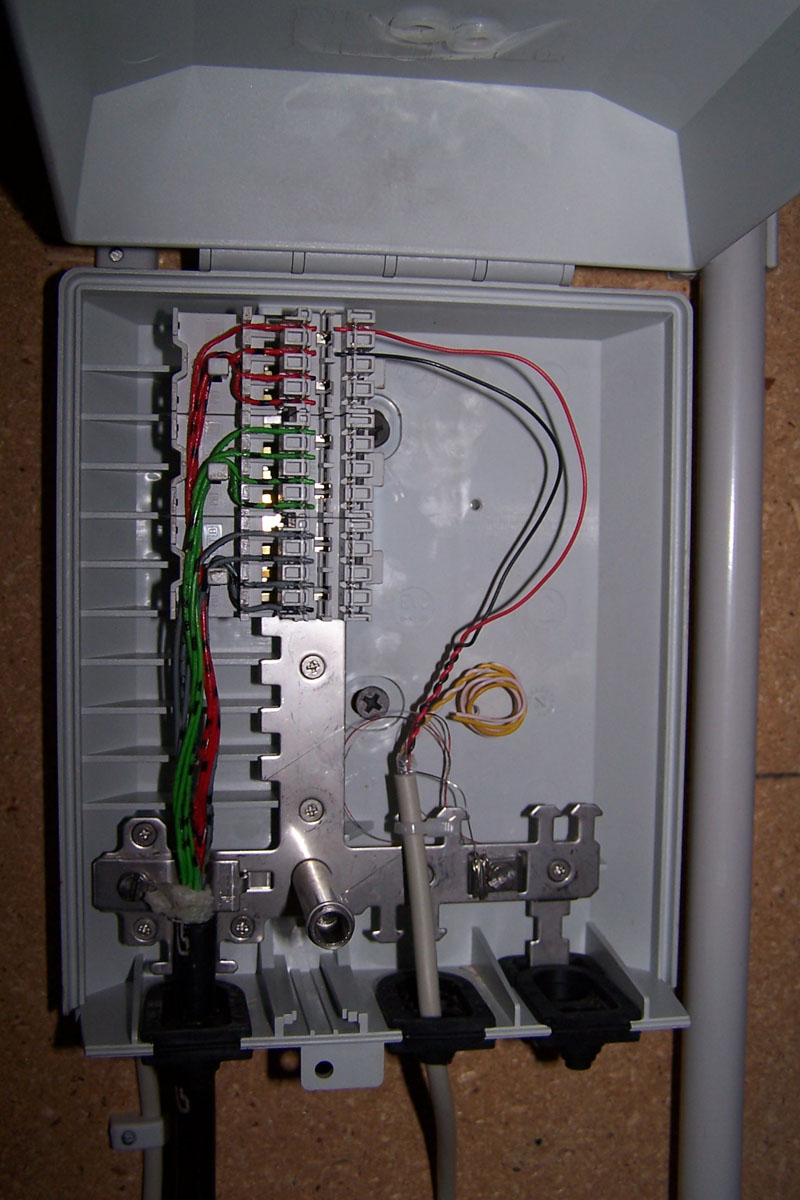
The simplest NIDs are essentially just a specialized set of wiring terminals. These will typically take the form of a small, weather-proof box, mounted on the outside of the building. The telephone line from the telephone company will enter the NID and be connected to one side. The customer connects their wiring to the other side. A single NID enclosure may contain termination for a single line or multiple lines.

In its role as the demarcation point (dividing line), the NID separates the telephone company's equipment from the customer's wiring and equipment. The telephone company owns the NID and all wiring up to it. Anything past the NID is the customer's responsibility. To facilitate this, there is typically a test jack inside the NID. Accessing the test jack disconnects the customer premises wiring from the public switched telephone network and allows the customer to plug a "known good" telephone into the jack to isolate trouble. If the telephone works at the test jack, the problem is the customer's wiring, and the customer is responsible for repair. If the telephone does not work, the line is faulty and the telephone company is responsible for repair.

Most NIDs also include "circuit protectors", which are surge protectors for a telephone line. They protect customer wiring, equipment, and personnel from any transient energy on the line, such as from a lightning strike to a utility pole.

Simple NIDs are "dumb" devices, as they contain no digital logic. They have no capabilities beyond wiring termination, circuit protection, and providing a place to connect test equipment.

Smartjack

[edit]
Three smartjacks for T-1 circuits, in two shelves; a 66 block is on the left

Several types of NIDs provide more than just a terminal for the connection of wiring. Such NIDs are colloquially called smartjacks or Intelligent Network Interface Devices (INIDs) as an indication of their built-in "intelligence", as opposed to a simple NID, which is just a wiring device. Smartjacks are typically used for more complicated types of telecommunications service, such as T1 lines. Plain old telephone service lines generally cannot be equipped with smartjacks.

Despite the name, most smartjacks are much more than a simple telephone jack. One common form for a smartjack is a printed circuit board with a face plate on one edge, mounted in an enclosure.

A smartjack may provide signal conversion, converting codes and protocols, e.g., framing types, to the type needed by the customer equipment. It may buffer and/or regenerate the signal, to compensate for signal degradation from line transmission, similar to what a repeater does.

Smartjacks also typically provide diagnostic capabilities. A very common capability provided by a smartjack is loopback, such that the signal from the telephone company is transmitted back to the telephone company. This allows the company to test the line from the central telephone exchange, without the need to have test equipment at the customer site. The telephone company usually has the ability to remotely activate loopback, without even needing personnel at the customer site. When looped back, the customer equipment is disconnected from the line.

Additional smartjack diagnostic capabilities include alarm indication signal, which reports trouble at one end of the line to the far end. This helps the telephone company know if trouble is present in the line, the smartjack, or customer equipment. Indicator lights to show configuration, status, and alarms are also common.

Smartjacks typically derive their operating power from the telephone line, rather than relying on premises electrical power, although this is not a universal rule.

Optical network terminals

[edit]
An optical network terminal mounted to the outside of a building, with the cover open

In fiber-to-the-premises systems, the signal is transmitted to the customer premises using optical fiber technologies. Unlike many conventional telephone technologies, this does not provide power for premises equipment, nor is it suitable for direct connection to customer equipment. An optical network terminal (ONT, an ITU-T term), also known as an optical network unit (ONU, an IEEE term), is used to terminate the optical fiber line, demultiplex the signal into its component parts (voice telephone, television, and Internet access), and provide power to customer telephones. If the device combines all these services into one it is known as an IAD. As the ONT must derive its power from the customer premises electrical supply, many ONTs have the option for a battery backup in order to maintain service in the event of a power outage or it will go in alarm mode if disconnected and customer may be notified of this.[2] These terminals are used in both active optical networks and passive optical networks. Typically, an ONT connects via a fiber-optic cable to an OLT to complete a connection. An ONT can work in Single Family Unit/SFU mode (modem/bridge) or Home Gateway Unit/HGU mode (router). In passive optical networks, Management is provided by the OLT via OMCI, in case of a GPON connection, and OAM in case of a EPON connection. Authentication and encryption is done via LOID for EPON and PLOAM password, GPON serial number or others for GPON.

Environmental conditions

[edit]

According to Telcordia GR-49 requirements for telecommunications, NIDs vary based on three categories of environmental conditions:[3]

  1. Normal conditions: This refers to a normal environment that is expected in most areas of any service provider. Temperatures are expected to be in the range of −20 to 32 °C (−4 to 90 °F), and humidity is expected to be less than 90% RH. No unusual contamination is expected.
  2. Severe climatic conditions: These cover environments more severe than those of a normal environment (i.e., higher humidity, high lightning activity, exposure to salt-laden atmosphere, and exposure to contaminants). Temperatures are expected to be in the range of −40 to 43 °C (−40 to 109 °F), and humidity may exceed 90% RH. Jacks installed in NIDs in such environments are known to become contaminated and develop low insulation resistances and low dielectric breakdown voltages when subjected to high humidity. These problems can cause noisy lines or even service outages.
  3. Flooded conditions: These cover areas of a service provider prone to flooding, such as in coastal or flood plain locations. After a flooding incident, temperature is expected to be in the range of 4.5 to 38 °C (40 to 100 °F), and humidity may exceed 90% RH. The requirements are not to determine if the NID will function during a flood, but to review the ability of the NID to function after the flood has subsided.

Service providers must decide which condition best suits their application.

See also

[edit]

Citations

[edit]
  1. ^ "network interface device". Federal Standard 1037C. United States: National Telecommunications and Information Administration. 1996-08-23.
  2. ^ "What is an Optical Network Terminal (ONT)?". Verizon Communications, Inc. Archived from the original on 2012-10-06.
  3. ^ GR-49-CORE Generic Requirements for Outdoor Telecommunication Network Interface Devices (NIDs), Telcordia.

General references

[edit]
Revisions and contributorsEdit on WikipediaRead on Wikipedia
from Grokipedia
A network interface device (NID) is a hardware component installed at a customer's that serves as the between a carrier's and the customer's internal wiring, enabling the connection of , , or other services while allowing for clear separation of responsibilities between the provider and the end user. Typically housed in a weatherproof mounted on the exterior of a building, the NID consists of protected compartments: one accessible only by the carrier for and testing, and another for customer connections via registered jacks compliant with FCC Part 68 standards. The primary purpose of the NID is to facilitate reliable interconnection, support troubleshooting by permitting disconnection of customer wiring from the carrier's network without service interruption to others, and comply with regulatory requirements for unbundled network elements under the , where incumbent local exchange carriers must provide nondiscriminatory access to NIDs on a stand-alone basis. Ownership of the NID generally resides with the provider, while the inside wiring beyond it falls under the customer's control, a division rooted in FCC policies from the Computer II proceedings in the 1980s that promoted competition in by standardizing the interface point. In modern , NIDs vary by service type; basic models support analog voice and DSL over lines using RJ-11 or RJ-45 connectors, while advanced variants like smartjacks provide testing for T1/E1 circuits, and optical network terminals (ONTs) function as NIDs for fiber-to-the-premises (FTTP) deployments by converting optical signals to electrical ones for in-home use. These devices ensure , protect against electrical surges, and adapt to evolving technologies, remaining essential for both residential and commercial installations despite the shift toward wireless and all-IP networks.

Overview

Definition and Purpose

A network interface device (NID) is a telecommunications apparatus that establishes the demarcation point, or boundary, between a service provider's external network facilities and the customer's internal wiring system. This demarcation ensures clear separation of responsibilities, with the provider maintaining the infrastructure up to the NID and the customer handling all wiring and equipment beyond it. Typically mounted on the exterior of a building, the NID connects the provider's local loop—such as copper, fiber, or coaxial lines—to the premises wiring, preventing issues in the customer's setup from affecting the broader network. The primary functions of an NID include signal termination and conversion, where it adapts incoming signals from the provider's medium to formats compatible with customer equipment; protection against electrical faults, surges, or strikes originating from inside wiring; and facilitating service testing, activation, and disconnection. By incorporating protective elements like fuses or arrestors, the NID safeguards the provider's network from damage while allowing technicians to isolate and diagnose issues via built-in test points without needing access to the customer's interior space. This design supports efficient and , ensuring reliable service delivery. In practical use cases, NIDs play a across various network technologies to maintain integrity. For (DSL) services, the NID terminates the provider's twisted-pair copper line at the premises, converting and protecting the high-frequency DSL signals to prevent interference and ensure stable connectivity. In fiber optic networks, it serves as the handoff for optical signals, preserving signal quality during the transition to electrical interfaces inside the building. Similarly, in cable networks, the NID connects drops, shielding against and enabling seamless integration with customer modems or routers. These applications highlight how the NID upholds network reliability by isolating potential disruptions. A key aspect of NID deployment involves loop qualification and service handoff. Loop qualification assesses the electrical and physical characteristics of the line from the provider's central office to the NID—such as , levels, and distance—to determine if it can support the desired service speeds and quality. Upon qualification, the service handoff occurs at the NID, where the provider completes provisioning and transfers operational control to the customer, minimizing on-site interventions and enhancing deployment efficiency.

Historical Development

The origins of the network interface device (NID) trace back to the late 1970s and early 1980s, when the began developing the Network Interface Unit (NIU) as a means to interface (POTS) lines with customer premises wiring amid growing deregulation pressures. This device emerged in response to the need for a clear boundary between carrier-owned infrastructure and customer equipment, following the 1968 Carterfone decision that opened the network to third-party devices and subsequent FCC rulings promoting competition. By the early 1980s, NIUs were deployed by to standardize connections for analog voice services, incorporating basic protection features like surge suppressors to safeguard the (PSTN). A pivotal milestone occurred with the 1984 divestiture of , which broke up the monopoly and mandated a standardized to delineate responsibilities between carriers and customers. This regulatory shift, enforced by the Modified Final Judgment, required the establishment of a physical interface—formalized as the NID—where the carrier's ended and customer wiring began, facilitating easier troubleshooting and third-party equipment attachment. In the 1990s, the introduction of smartjacks enhanced NIDs for digital T1 lines, adding intelligent features such as testing and performance monitoring to support higher-speed data services without disrupting the network. These "smart" variants complied with emerging standards like ANSI T1.403-1989, which specified electrical interfaces for DS1 (T1) metallic connections between carriers and customers. The transition to digital services in the 2000s marked a significant , as NIDs adapted to technologies like DSL and fiber optics, shifting from simple analog protectors to multifunctional units supporting high-speed data transmission. With the rise of DSL in the early 2000s, NIDs incorporated splitter functionality to separate voice and data signals over existing copper lines, while fiber deployments introduced optical network terminals (ONTs) as advanced NIDs for services. The ANSI T1.403 standard, revised in 1995 and 1999, played a key role in ensuring for these digital interfaces, defining signal specifications that enabled reliable customer-side connections. Post-2010 developments integrated NIDs more deeply with VoIP and ecosystems, driven by FCC regulations emphasizing (CPE) compatibility and network neutrality. These updates, including enhanced surge protection and remote management capabilities, reflected FCC efforts to promote competition and reliability in IP telephony and high-speed .

Terminology

Common Names and Acronyms

A network interface device (NID) is the primary term used in to denote the demarcation equipment between a service provider's network and the customer's premises wiring. Alternative acronyms include NIU, standing for Network Interface Unit, which is often used interchangeably in and contexts to describe similar interfacing hardware. For digital leased lines such as T1 or E1, the combined acronym CSU/DSU refers to the Channel Service Unit/Data Service Unit, a specialized form of network interface that handles signal conversion and protection at the digital handoff point. These varied names arose due to the progressive shift in from analog voice systems, which relied on simple protectors, to networks requiring more robust interface units, leading to terminology adaptations across standards bodies and applications. The multiplicity reflects historical fragmentation in industry specifications before unification efforts in the late . In formal standards, Telcordia GR-49-CORE establishes generic requirements for outdoor NIDs, focusing on their design, testing, and environmental resilience for telephone networks. Similarly, Recommendation G.703 outlines the physical and electrical characteristics of hierarchical digital interfaces that underpin the operation of related network interface equipment. The colloquial term "demarc," short for , is widely used in the industry to refer to the physical location or device marking this network boundary, originating as a clipped form of "demarcation" in telecom jargon since the mid-20th century.

Regional Variations

In , particularly in the United States and , network interface devices (NIDs) are mandated by the (FCC) under Part 68 of its rules to serve as the for both copper-based and fiber-optic connections, ensuring clear separation between provider and customer responsibilities. These NIDs must include a for disconnecting customer premises wiring, facilitating compliance with unbundling requirements for services. For business lines, enhanced NIDs known as smartjacks are commonly deployed, providing testing and monitoring to support T1/E1 circuits and other high-speed links. In , the equivalent device is typically the Network Terminator (NT), standardized by the European Telecommunications Standards Institute (ETSI) for integration with ISDN and DSL services. The NT performs layer 1 termination functions at the user-network interface, enabling synchronization and signaling for and access under ETSI EN 301 141 specifications. This approach emphasizes harmonized electrical and protocol interfaces across member states, often incorporating NT1 for termination and NT2 for higher-layer functions in ISDN setups. In the region, terminology and implementations vary due to localized strategies; in , the Home Gateway Unit (HGU) is widely used as an integrated NID for FTTH deployments, combining ONU functionality with routing, , and VoIP capabilities to support national gigabit access initiatives. In , Optical Network Units (ONUs) predominate in the country's extensive PON-based FTTH rollout, serving as the customer-side interface for high-speed fiber services under policies promoting universal coverage. Global efforts toward harmonization are guided by recommendations, yet regional differences persist in ownership models—ranging from provider-supplied in regulated markets to customer-owned in liberalized environments.

Types

Electrical NIDs

Electrical NIDs are specialized devices that interface copper-based signals between the service provider's network and the customer's wiring, primarily using twisted-pair cables. These devices ensure reliable transmission of analog and digital signals while providing against electrical hazards. They are commonly deployed in residential and commercial settings where legacy remains prevalent. The core components of an electrical NID include a protector block, a jack for wiring, and integrated surge suppression mechanisms. The protector block, often a 5-pin unit, safeguards against conditions by shunting excess current to ground, typically using gas discharge tubes or solid-state devices compliant with industry standards. The jack, usually an RJ-11 or similar , allows for easy disconnection and reconnection of inside wiring, facilitating without interrupting service provider access. Surge suppression is embedded within these components to mitigate transient voltages from or power line faults, protecting both the network and equipment. In terms of signal handling, electrical NIDs facilitate the conversion and termination of signals from the carrier's twisted-pair lines to the customer's premises, supporting services such as (POTS), (DSL), and T1/E1 circuits. For POTS, the NID passes analog voice signals with nominal -48 V DC battery voltage and ringing up to 103 Vrms at 20-30 Hz. DSL variants, including ADSL2+ and VDSL2, are accommodated by splitting voice and data frequencies over the same pair, while T1/E1 digital lines operate at 1.544 Mbps or 2.048 Mbps, respectively, using balanced twisted-pair cabling for noise immunity. Key specifications for electrical NIDs include limits on loop resistance and voltage protection to maintain over distance. For instance, DSL deployments are viable up to approximately 6,000 feet on 24 AWG twisted-pair, beyond which degrades performance, while T1 lines share similar reach constraints on 22 AWG cable. Voltage protection is rated for -48 DC nominal operation, with tolerance up to -60 DC and surge handling per Telcordia criteria to prevent damage from transients exceeding 1,500 . These parameters ensure compatibility with existing loops without requiring extensive upgrades. Electrical NIDs offer advantages in cost-effectiveness for legacy copper networks, where deployment leverages widespread existing twisted-pair at lower upfront costs compared to alternatives. Additionally, they enable straightforward field testing through functionality, allowing technicians to remotely activate a loop at the NID to verify carrier-side signal quality without accessing customer premises, thereby reducing operational expenses and downtime.

Optical NIDs

Optical network interface devices (NIDs), commonly implemented as optical network terminals (ONTs), serve as the endpoint for fiber optic connections in broadband access networks, performing the critical function of converting incoming optical signals into electrical signals for customer premises equipment. In fiber-to-the-home (FTTH) and fiber-to-the-building (FTTB) deployments, the ONT acts as the primary form of optical NID, interfacing directly with the service provider's optical distribution network to deliver high-speed internet, voice, and video services. Modern ONTs also support higher-speed passive optical network (PON) standards, such as XGS-PON providing symmetric 10 Gbit/s speeds and emerging 25G-PON systems offering up to 25 Gbit/s downstream, enabling multi-gigabit broadband as of 2025. A key role of the ONT is to terminate passive optical network (PON) signals, such as those in gigabit PON (GPON) systems, which operate at downstream rates of 2.488 Gbit/s and upstream rates of 1.244 Gbit/s to support symmetric or asymmetric demands. This conversion enables the ONT to bridge the photonic layer of the fiber infrastructure with the electrical (LAN) at the customer site, ensuring compatibility with standard devices like routers and computers. Core components of an ONT include an optical module, typically using (SFP) interfaces to handle signal reception and transmission over single-mode fiber; a unit to energize the device, often supporting AC or DC input for residential or commercial use; and Ethernet outputs via RJ-45 ports to connect to the customer's LAN, providing gigabit speeds for distribution. These elements are integrated into a compact designed for indoor or outdoor mounting at the . Optical NIDs adhere to established standards for interoperability and performance. The IEEE 802.3ah standard defines Ethernet operations, administration, and maintenance (OAM) protocols, enabling fault detection, performance monitoring, and remote in optical access networks, particularly for ONTs in Ethernet PON (EPON) setups. Complementing this, the G.984 series specifies interfaces, with G.984.2 outlining physical media dependent specifications and G.984.3 detailing the transmission convergence layer for framing, ranging, and dynamic bandwidth allocation. Higher-speed standards like G.9807.1 for 25G-PON build on these foundations. In deployment, optical NIDs are integral to both passive optical networks (), which use non-powered splitters for cost-effective signal distribution to multiple users, and active optical networks (AONs), which employ powered switches for routed connectivity in larger-scale environments. Within PON architectures like , the ONT manages upstream through serial number registration and password-based ONU activation, while supporting (QoS) via traffic prioritization, GEM port mapping, and dynamic scheduling to ensure low-latency delivery for real-time applications.

Hybrid and Emerging Types

Hybrid network interface devices combine multiple transmission technologies to leverage existing infrastructure while supporting modern services. For instance, in cable networks, adapters are integrated into intelligent NIDs to enable coax-to-Ethernet conversion, utilizing existing wiring to connect an Optical Network Terminal (ONT) to a gateway with up to 2.5 Gbps throughput and latency under 2.5 ms, facilitating high-definition streaming and low-latency applications. This hybrid approach minimizes deployment costs by avoiding new cabling and enhances reliability through secure onboarding protocols. Emerging types include NIDs designed for fixed access (FWA), where devices such as Residential Gateways (5G-RGs) serve as demarcation points, connecting to the 5G core network via NG-RAN and supporting mmWave handoff through multi-access (PDU) sessions for seamless transitions between and wireline paths. These NIDs enable hybrid access modes like load-balancing or , improving resilience in delivery. Additionally, Ethernet NIDs (eNIDs) conform to Metro Ethernet Forum (MEF) standards, such as MEF 3.0, providing Layer 2 demarcation for services with features like OAM (Operations, Administration, and Maintenance) for fault isolation and performance monitoring in mobile backhaul and business connectivity. As of 2025, trends in NIDs emphasize AI-enabled self-diagnostics, with commercial implementations like Cisco's Provider Connectivity Assurance (PCA) NIDs incorporating AI-driven analytics for predictive fault detection, performance monitoring, and automated issue resolution, reducing operational costs in networks. Integration with IoT allows NIDs to process data locally at the network edge, supporting low-latency applications in environments by interfacing with and edge nodes for enhanced connectivity in smart cities and industrial IoT. Challenges in adopting hybrid and emerging NIDs include ensuring with legacy systems, as seen in devices like the x6010 NID that maintain with older Point System platforms to support gradual migrations without service disruptions. Experimental developments, such as (PoF) technologies, aim to deliver electrical power alongside data signals over optical fibers to remotely power NIDs in FTTx deployments, addressing limitations in traditional powering methods but facing hurdles in efficiency and safety for widespread adoption.

Installation and Configuration

Wiring Termination

The wiring termination at a network interface device (NID) involves connecting the customer-side premises wiring to the NID's customer-accessible terminals, which are typically located on the interior side of the device to facilitate easy access without disturbing the carrier's facilities. This process ensures a reliable interface for services such as (POTS) or Ethernet, using standardized connectors and blocks that support twisted-pair cabling. Standard terminations on the customer side of the NID include modular jacks like RJ-11 for POTS lines, which accommodate single- or multi-pair connections, and RJ-45 jacks for Ethernet or data services, following TIA/EIA-568 wiring schemes such as T568A or T568B. For multi-line setups, punch-down blocks such as the 66-type are commonly used, featuring insulation displacement contacts (IDCs) that secure 22-26 AWG solid copper wires without , allowing for organized distribution to internal outlets. These terminations support unshielded twisted-pair (UTP) cabling, with Category 3 minimum for voice and Category 5e or higher recommended for data to ensure performance. The installation procedure begins with the carrier or terminating their external facilities (e.g., twisted-pair or ) on the network side of the NID, after which the or a licensed handles the premises wiring connections on the side. Wires are stripped, inserted into the appropriate IDC slots or jacks while maintaining pair twists to minimize interference, and secured using a punch-down tool; polarity must be preserved (Tip positive, Ring negative for POTS) to avoid signal reversal issues. Grounding is essential, with the wiring shield or ground wire bonded to the NID's grounding terminal per () requirements to protect against surges and (). Tools for wiring termination and initial verification include punch-down tools for IDC blocks, wire strippers, and butt sets (lineman's test sets) to check for dial tone and continuity on POTS lines by connecting directly to the NID's customer terminals. Best practices emphasize using 24 AWG UTP cable for optimal signal integrity, avoiding splices or extensions that could degrade performance, and documenting connections for future maintenance. In DSL deployments, bridge taps—unused parallel wire segments—should be eliminated from premises wiring to prevent signal reflections that attenuate high-frequency DSL signals. Common issues in NID wiring termination include , which arises from untwisted pairs or improper IDC seating and is mitigated by maintaining at least 0.5 inches of twist length near terminations and adhering to category-rated cabling standards. Exceeding the recommended 24 AWG can increase , while reversed polarity may cause no or faulty ; these are addressed through pre-connection testing with tone generators and polarity indicators.

Demarcation and Testing

The network interface device (NID) serves as the , defining the legal and technical boundary between the carrier's network and the customer's premises wiring, where the carrier's responsibility and liability for service end. This split ensures that issues on the customer side, such as faulty inside wiring, fall under customer maintenance, while carrier obligations cover the loop up to the NID . The NID typically includes a protector and a network interface jack within a weatherproof , accessible only to authorized personnel for network-side connections, reinforcing this boundary. Testing at the NID verifies connectivity and performance across the demarcation, focusing on initial setup validation to confirm the carrier's delivery meets specifications. For electrical NIDs supporting T1 lines, testing isolates segments by reflecting signals back toward the source, commonly using Extended Superframe (ESF) or Alternate Mark Inversion (AMI) formats as defined in industry standards. In ESF mode, enables messaging for remote activation, while AMI relies on simpler bipolar signaling without framing overhead. Bit Error Rate Testing (BERT) complements by transmitting pseudo-random bit sequences (PRBS) over T1 circuits to measure error rates, ensuring with thresholds typically below 10^-6 errors per bit for reliable service. For optical NIDs in fiber deployments, an assesses signal strength by measuring received light levels in dBm, confirming loss budgets within acceptable limits, such as under 0.5 dB per connector for single-mode fiber. Access protocols at the NID facilitate remote diagnostics without physical intervention. Yellow alarm insertion signals downstream failures by transmitting a continuous unframed all-ones pattern or bit-stuffing in T1 frames, alerting the far-end equipment to issues like loss of frame alignment. This alarm, also known as Remote Alarm Indication (), propagates bidirectionally to isolate faults at the demarcation. Remote loop-up uses , embedding 5-bit or 12-bit codes within T1 payloads per ANSI T1.403, allowing carriers to activate from a central without on-site access to the NID. These protocols enable efficient , with loop-up codes repeating for at least 5 seconds to trigger the NID response. Documentation of NID demarcation and testing is formalized through service orders, which specify the exact location—often on an exterior wall or pedestal—and record test outcomes to confirm compliance. These orders include details like measured bit error rates, levels, and verification results, serving as a legal record of the handoff and baseline for future maintenance. Carriers must provide this information to customers or competitive providers upon request, ensuring transparency at the boundary point.

Features and Functionality

Smartjack Capabilities

A smartjack is an intelligent variant of an interface device (NID) designed primarily for business-grade T1 and E1 circuits, integrating Extended Superframe (ESF) framing with Channel Service Unit (CSU) functionality to serve as the between the carrier network and . This integration allows the smartjack to handle signal regeneration, line equalization, and basic protection against surges while enabling advanced management features over the T1/E1 interface. Key capabilities include automatic testing initiated remotely via commands sent through the ESF Facility Data Link (FDL), which facilitates in-service without disrupting data traffic by reflecting signals back toward the carrier's central office. Performance monitoring is another core feature, where the smartjack accumulates near-end and far-end error statistics such as errored seconds (ES), severely errored seconds (SES), and unavailable seconds (UAS), aligned with G.775 criteria for (PDH) signals in E1 applications and equivalent ANSI parameters for T1. These metrics, gathered in 15-minute intervals over 24 hours, are reported back via the FDL using (CRC-6) for error detection, ensuring non-intrusive assessment of line quality. The primary benefits of smartjack capabilities lie in , as remote and performance data retrieval minimize on-site interventions—commonly referred to as "truck rolls"—by allowing carriers to diagnose and isolate faults from afar, thereby reducing maintenance costs. Additionally, support for fractional T1/E1 configurations enables provisioning of partial bandwidth (e.g., 4 to 24 channels out of 24/32 total), optimizing resource use for applications like voice PBX or data routing without requiring full circuit dedication. Smartjacks originated under standards such as ANSI T1.403-1999, which specifies the electrical and functional interface for DS1 signals including ESF error performance monitoring. Over time, they have evolved to incorporate hybrid capabilities for transitioning legacy T1 services to Ethernet backhaul, with modern implementations from vendors like Westell achieving compliance with Metro Ethernet Forum (MEF) specifications.

Monitoring and Diagnostics

Monitoring and diagnostics for network interface devices (NIDs) involve a combination of protocols, local indicators, and carrier-grade tools to assess performance, detect faults, and ensure service reliability across electrical, optical, and hybrid deployments. These mechanisms enable remote and on-site evaluation of key parameters such as , link status, and error rates, facilitating timely intervention to maintain network stability. Simple Network Management Protocol (SNMP) is widely used for remote polling of NID performance data, allowing network operators to query metrics like interface status, levels, and error counters in real-time. In optical NIDs such as ONTs, SNMP traps provide asynchronous notifications for events like threshold exceedances or link failures, supporting proactive management in carrier environments. Syslog complements SNMP by enabling event logging for diagnostic purposes, where ONTs forward logs of system events, alarms, and configuration changes to centralized servers for analysis and correlation. Local diagnostics on NIDs typically include LED indicators that visually signal operational status, such as power availability, active links, and alarm conditions, aiding technicians in quick fault identification without specialized tools. Many NIDs also feature a craft port, often a serial or console interface, that grants access to (CLI) commands for in-depth troubleshooting, including tests and parameter retrieval. For instance, craft ports allow execution of diagnostic scripts to verify connectivity or isolate issues at the . Carrier operations support systems (OSS) integrate with NIDs to enable advanced alarm correlation, where multiple alerts from interconnected devices are analyzed to pinpoint root causes, reducing mean time to resolution. This includes proactive fault isolation through automated workflows that cross-reference NID data with upstream network elements, minimizing service disruptions. Such integrations often leverage standards-based interfaces to aggregate logs and traps from NIDs into a unified . Critical services delivered via NIDs, particularly in telecom backhaul and enterprise connectivity, demand high uptime targets of 99.999%, equating to less than 5.26 minutes of annual to meet carrier-grade reliability standards. Monitoring includes threshold alerts for signal loss, configured via SNMP or OSS to trigger notifications when optical or electrical levels drop below predefined limits, ensuring rapid response to potential outages. These metrics emphasize conceptual reliability over granular benchmarks, focusing on sustained in diverse deployments.

Environmental and Regulatory Aspects

Operating Conditions

Network interface devices (NIDs) designed for outdoor deployment must withstand a wide range of environmental stresses to ensure reliable operation at the customer premises . Outdoor NIDs typically operate within a range of -40°C to +65°C, accommodating conditions from freezing winters to hot summers while housed in NEMA 3R enclosures that provide protection against rain, sleet, snow, and external ice formation without being fully dust-tight. Humidity and moisture exposure pose significant risks to NID longevity, particularly in variable climates. These devices often feature an IP65 ingress protection rating, which safeguards against dust ingress and low-pressure water jets from any direction, enabling weatherproof performance in rainy or humid environments up to 95% relative humidity (non-condensing). In coastal areas, where salt-laden air accelerates corrosion, NIDs incorporate materials like galvanized steel or polymer housings with corrosion-resistant coatings to prevent degradation of electrical connections and enclosures. Power specifications for NIDs vary by type but prioritize stability and efficiency in harsh settings. Electrical NIDs commonly use -48V DC nominal power, with input ranges extending to -72V DC to support telecom-grade reliability and integration with central office batteries. Ethernet-based NIDs leverage (PoE) standards, delivering up to 30W per port via IEEE 802.3af/at, while uninterruptible power supplies (UPS) provide backup during outages, often with battery autonomy of several hours to maintain service continuity. Proper placement is essential to optimize NID performance and minimize risks. These devices are generally mounted on exterior walls at a of 1-2 meters above ground, ensuring for maintenance while protecting against flooding and facilitating cable routing. To mitigate risks, installations should avoid elevated or exposed positions near trees, power lines, or metallic structures, incorporating basic surge protection at the .

Standards and Compliance

Network interface devices (NIDs) must adhere to established telecom standards to ensure reliability, safety, and interoperability in telecommunications networks. Telcordia GR-1089-CORE specifies (EMC) and electrical safety criteria, including requirements for surge protection to safeguard equipment from transient overvoltages. This standard defines port types and surge testing levels, such as intra-building and inter-building simulations, to prevent damage in outdoor deployments. Complementing this, Telcordia GR-49-CORE outlines generic requirements for outdoor NIDs, covering one-line, multiple-line, and retrofit models, with criteria for mechanical strength, environmental resilience, and electrical performance to support demarcation between carrier and customer networks. On the international front, Recommendation G.983 defines broadband (BPON) systems, also known as ATM PON (APON), establishing protocols for optical access architectures where NIDs serve as optical network terminals (ONTs) or interfaces. This standard supports asymmetric rates of up to 622 Mbps downstream and 155 Mbps upstream, enabling fiber-to-the-home deployments with cell transport. For Ethernet-based NIDs, IEEE 802.1ag provides connectivity fault management (CFM) protocols, allowing hierarchical maintenance domains for fault detection, isolation, and performance monitoring across Ethernet virtual connections. These features enable NIDs to generate continuity checks, loopbacks, and linktrace messages for proactive service assurance. Regulatory frameworks further mandate compliance for NID deployment. In the United States, FCC Part 68 governs the connection of terminal equipment, including NIDs, to the , requiring registration to protect against network harm through tests for voltage, signal power, and surge tolerance. This ensures NIDs at the meet uniform standards for direct attachment without carrier intervention. In the , CE marking certifies conformity to the EMC Directive 2014/30/, verifying that network devices like NIDs emit and withstand without disrupting other equipment. Manufacturers must conduct emissions and immunity testing per harmonized standards such as EN 55032 before affixing the mark. Compliance testing extends to safety and program-specific audits. UL 62368-1, which replaced the legacy UL 60950-1 (harmonized with IEC 60950-1) effective December 2020 for new equipment including NIDs, addresses by mitigating risks of , electric shock, and injury through requirements for insulation, grounding, and component protection. Legacy certifications under UL 60950-1 remain valid for existing deployments as of November 2025. For broadband expansion initiatives, the Equity, Access, and Deployment (BEAD) Program, established under the of 2021, enforces ongoing audits to verify subgrantee compliance with federal funding conditions, including equipment standards and deployment reporting. These audits ensure transparency in the $42.45 billion program's use for unserved and underserved areas.

References

Add your contribution
Related Hubs
User Avatar
No comments yet.