
Recent from talks
Hora (dance)
Knowledge base stats:
Talk channels stats:
Members stats:
Hora (dance)
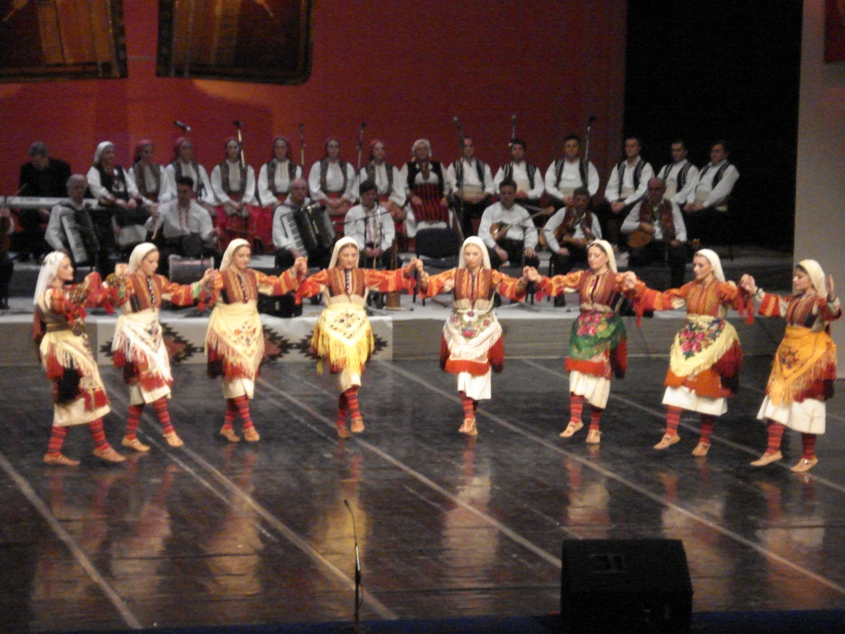
Hora, also known as horo and oro, is a type of circle dance traditionally performed in Southeast Europe. Circle dances with similar names are found in Bulgaria, Romania, Moldova, North Macedonia, Greece and Turkey, and among ethnic minorities such as the Ashkenazi Jews (Yiddish: האָרע hore), Sephardic Jews (Ladino: הורו horo) and the Roma.
The name, spelled differently in various countries, is derived from the Greek χορός (khorós): "dance", which is cognate with the Ancient Greek art form of χορεία (khoreía). The original meaning of the Greek word χορός may have been "circle".
Also, the words hora and oro are found in many Slavic languages and have the meaning of "round (dance)"; the verb oriti means "to speak, sound, sing" and previously meant "to celebrate".
The Greek χορός (khorós) is cognate with Pontic Greek χορόν (khorón), and has also given rise to the names of Bulgarian хоро (horo), Macedonian оро (oro), Romanian horă, the Turkish form hora and in Hebrew הורה (horah). The Khorumi dance of Georgia also might be connected to the Horon dance in the neighboring Turkish regions, as it rose out of the Adjara region, where Kartvelian Laz people co-existed for centuries with Greek Pontians.
Horă (plural: hore) is a traditional Romanian and Moldovan folk dance where the dancers hold each other's hands and the circle spins, usually counterclockwise, as each participant follows a sequence of three steps forward and one step back. The dance is usually accompanied by musical instruments such as the cymbalom, accordion, violin, viola, double bass, saxophone, trumpet or the pan pipes.
The hora is popular during wedding celebrations and festivals, and is an essential part of the social entertainment in rural areas. One of the most famous hore is the "Hora Unirii" ("Hora of the Union"), which became a Romanian patriotic song as a result of being the hymn when Wallachia and Moldavia united to form the Principality of Romania in 1859. During the 2006/2007 New Year's Eve celebration, when Romania and Bulgaria joined the European Union, people were dancing Hora Bucuriei ("Hora of Joy") over the boulevards of Bucharest as a tribute to the EU anthem, Ode to Joy (Romanian: Odă bucuriei). Some of the biggest hora circles can be found on early 20th century movies filmed by the Manaki brothers in Pindus, Greece, and performed by local Aromanians.
The traditional Bulgarian dance horo (Bulgarian: хоро) comes in many shapes. It is not necessary to be in a circle; a curving line of people is also acceptable. The steps used in a horo dance are extremely diverse. The horo may vary between three and seven or eight steps forward and one to five or six steps back, depending on the specific type.
In Bulgaria, each region has their own type of horo. They differ by the rhythm of the music and the steps taken. There are no two horo dances with similar steps. There are probably over one hundred types of horo dances in the Bulgarian folklore.[citation needed]
Hub AI
Hora (dance) AI simulator
(@Hora (dance)_simulator)
Hora (dance)
Hora, also known as horo and oro, is a type of circle dance traditionally performed in Southeast Europe. Circle dances with similar names are found in Bulgaria, Romania, Moldova, North Macedonia, Greece and Turkey, and among ethnic minorities such as the Ashkenazi Jews (Yiddish: האָרע hore), Sephardic Jews (Ladino: הורו horo) and the Roma.
The name, spelled differently in various countries, is derived from the Greek χορός (khorós): "dance", which is cognate with the Ancient Greek art form of χορεία (khoreía). The original meaning of the Greek word χορός may have been "circle".
Also, the words hora and oro are found in many Slavic languages and have the meaning of "round (dance)"; the verb oriti means "to speak, sound, sing" and previously meant "to celebrate".
The Greek χορός (khorós) is cognate with Pontic Greek χορόν (khorón), and has also given rise to the names of Bulgarian хоро (horo), Macedonian оро (oro), Romanian horă, the Turkish form hora and in Hebrew הורה (horah). The Khorumi dance of Georgia also might be connected to the Horon dance in the neighboring Turkish regions, as it rose out of the Adjara region, where Kartvelian Laz people co-existed for centuries with Greek Pontians.
Horă (plural: hore) is a traditional Romanian and Moldovan folk dance where the dancers hold each other's hands and the circle spins, usually counterclockwise, as each participant follows a sequence of three steps forward and one step back. The dance is usually accompanied by musical instruments such as the cymbalom, accordion, violin, viola, double bass, saxophone, trumpet or the pan pipes.
The hora is popular during wedding celebrations and festivals, and is an essential part of the social entertainment in rural areas. One of the most famous hore is the "Hora Unirii" ("Hora of the Union"), which became a Romanian patriotic song as a result of being the hymn when Wallachia and Moldavia united to form the Principality of Romania in 1859. During the 2006/2007 New Year's Eve celebration, when Romania and Bulgaria joined the European Union, people were dancing Hora Bucuriei ("Hora of Joy") over the boulevards of Bucharest as a tribute to the EU anthem, Ode to Joy (Romanian: Odă bucuriei). Some of the biggest hora circles can be found on early 20th century movies filmed by the Manaki brothers in Pindus, Greece, and performed by local Aromanians.
The traditional Bulgarian dance horo (Bulgarian: хоро) comes in many shapes. It is not necessary to be in a circle; a curving line of people is also acceptable. The steps used in a horo dance are extremely diverse. The horo may vary between three and seven or eight steps forward and one to five or six steps back, depending on the specific type.
In Bulgaria, each region has their own type of horo. They differ by the rhythm of the music and the steps taken. There are no two horo dances with similar steps. There are probably over one hundred types of horo dances in the Bulgarian folklore.[citation needed]
Recent media