Hubbry Logo
Orsini-RosenbergOrsini-RosenbergMain
Open search
Orsini-Rosenberg
Community hub
Orsini-Rosenberg
logo
8 pages, 0 posts
0 subscribers
Be the first to start a discussion here.
Orsini-Rosenberg
Orsini-Rosenberg
from Wikipedia
Orsini-Rosenberg
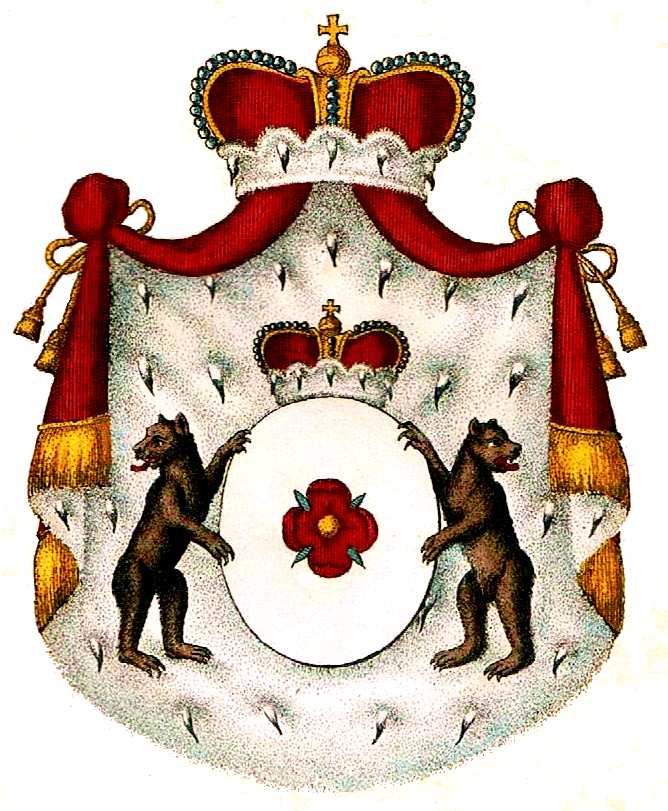
Coat of arms of Orsini-Rosenberg
Parent houseHouse of Graben von Stein
CountryAustria
Foundedfirst named in 1322
FounderKonrad ab dem Roesenperg
TitlesReichsfürst und Reichsgraf von Orsini und Rosenberg
Burggraf of Klagenfurt
Freiherr auf Lerchenau und Grafenstein

The House of Orsini-Rosenberg (also Ursin-Rosenberg) is the name of an old Austrian noble family. The family is mediatized and as such belongs to the high nobility. It originally sprang out from the Graben family (an apparent or illegitimate branch of the House of Meinhardin)[1] from Castle Alt-Grabenhofen near the city of Graz.[2]

History

[edit]
Heraldic family tree of the Graben and their descendants

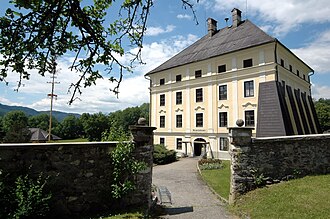
The earliest known member of the Orsini-Rosenberg family, Konrad (von Graben) ab dem Roesenperg, lived around 1322.[3][4] He was a member of the lower nobility who lived at Schloss Alt-Grabenhofen, between Reinerkogel and Rosenberg. During the 17th and 18th centuries, the success of the family arose from the steady accumulation of land, and loyalty to the Habsburg Emperor.

On 2 August 1633, Johann Andreas von Rosenberg, Herr von Rosenberg, was elevated to the Reichsfreiherrenstand with the title of Freiherr of the Holy Roman Empire, Freiherr of Lerchenau, Herr of Magereckh and Grafenstein, and in 1648 to the Austrian Grafenstand. Since 1681, the family held the title of Reichsgraf, and in 1683 they became members of the Reichstag. In the same year, they took the name of the old Italian princely Orsini family; their family name changed to Ursini-Rosenberg or Orsini-Rosenberg. On 9 October 1790, Count Franz Xaver Wolfgang was elevated to Reichsfürst von Orsini-Rosenberg.[5]

Notable members

[edit]
Franz Xaver von Orsini-Rosenberg
Thaler with the family arms (1793)

Counts of Orsini-Rosenberg (1681)

[edit]
  • Johann Andreas, 1st Baron (1600–1667)[5]
    • Georg Nikolaus, 1st Count (1623–1695)
      • Johann Friedrich, 2nd Count (1654–1723)
      • Count Josef Leopold (1670–1737)
      • Count Heinrich Georg (1678–1727)
    • Wolfgang Andreas, 1st Count (1626–1695)
      • Joseph Paris, 2nd Count (1651–1685)
        • Wolfgang Sigismund, 3rd Count (1682–1739)
          • Franz, 4th Count (1723–1795), created 1st Prince

Princes of Orsini-Rosenberg (1790)

[edit]
  • Count Wolfgang Andreas (1626–1695)[5]
    • Count Joseph Paris (1651–1685)
      • Count Wolfgang Sigismund (1682–1739)
    • Count Franz Andreas (1653–1698)
    • Count Philipp Josef (1691–1765)
      • Count Vincenz Ferrerius (1722–1794)
        • Franz Seraph, 2nd Prince 1795–1832 (1761–1832)
          • Ferdinand, 3rd Prince 1832–1859 (1790-1859)
            • Heinrich, 4th Prince 1859–1929 (1848–1929)
              • Johannes, 5th Prince 1929–1932 (1893–1932)
                • Heinrich, 6th Prince 1932–2011 (1925–2011)
                  • Johannes, 7th Prince 2011–2024 (1949–2024)
                    • Heinrich, 8th Prince 2024-Present (b.1979)
                    • Paul, Hereditary Prince of Orsini-Rosenberg (b.1982)
                  • Count Ferdinand (b. 1953)
                    • Count Konrad (b. 1982)
                    • Count Ludwig (b. 1989)
                  • Count Markus (b. 1955)
                    • Count Maximilian (b. 1988)
                  • Count Mathias (b. 1955)
                    • Count Philipp (b. 1998)
                    • Count Douglas (b. 2000)
                    • Count Leopold (b. 2004)
                • Count Johann (1926-2004)
                  • Count Andreas (b. 1954)
                    • Count Raphael (b. 1984)
                    • Count Luca (b. 1986)
                    • Count Luis (b. 1988)
                  • Count Hubertus (b. 1962)
                    • Count Paul (b. 1999)
          • Prince Friedrich (1801-1887), male heirs exist

Estates

[edit]

See also

[edit]

Notes

[edit]

Literature

[edit]
  • Hans Pawlik: Orsini-Rosenberg, Geschichte und Genealogie eines alten Kärntner Adelsgeschlechts. In: Archiv für vaterländische Geschichte und Topographie. book nr. 98. Verlag des Geschichtsvereines für Kärnten, Klagenfurt 2009. p. 1-304.
[edit]
Revisions and contributorsEdit on WikipediaRead on Wikipedia
from Grokipedia
The House of Orsini-Rosenberg is a mediatized Austrian noble family originating from the Von Graben lineage, an apparent branch of the Meinhardin house, with roots tracing to Konrad ab dem Roesenperg near around 1322. The family adopted the "Orsini" prefix in 1683 amid a seventeenth-century trend among Rosenbergs to claim legendary descent from the Roman Orsini, a connection later deemed unsubstantiated by historical analysis. Elevated through Habsburg service—receiving baronial status in 1633, comital in 1681, and princely in 1790—the house amassed estates in , including Grafenstein and Welzenegg castles, and contributed diplomats and generals to imperial administration and military endeavors. Key figures include Johann Andreas von Rosenberg (1600–1667), the first count, and Franz Xaver Wolfgang von Orsini-Rosenberg (1726–1795), the inaugural prince, a chief chamberlain under Emperor Joseph II whose court role influenced cultural depictions of Habsburg intrigue. His nephew, Franz Seraph (1761–1832), rose to general of , exemplifying the family's martial tradition. As mediatized princes, the Orsini-Rosenberg retained high noble precedence post-1806, with extant branches holding the style of Illustrious Highness and ties to historic Carinthian properties.

Origins and Genealogy

Early Rosenberg Ancestors

The Austrian Rosenberg lineage, ancestral to the Orsini-Rosenberg family, originated from the von Graben nobility in , documented as an apparent or illegitimate branch of the House of Meinhardin centered around Castle Alt-Grabenhofen near Klagenfurt. This regional noble house transitioned to the Rosenberg designation by the early 17th century, distinct from the earlier Bohemian House of Rosenberg, which rose in the 13th century through figures like Vítek of Prčice and held influence in southern until 1611 but lacks direct verified linkage to the Carinthian line. Johann Andreas Rosenberg (1600–1667), born in St. Andrä, , emerged as a foundational figure, providing military and financial support to the Habsburg emperors during the and advancing the in . His marriage to Kulmer von Rosenpichl und Hohenstein facilitated strategic alliances and land consolidations in , enhancing the family's feudal holdings and local governance roles. In 1645, Johann Andreas received elevation to the comital rank from Emperor Ferdinand III, formalizing the Counts of Rosenberg based on imperial service records. The family's documented contributions included administrative duties in regional estates and loyalty to Habsburg authority, as evidenced by archival grants and , laying the groundwork for sustained influence in Austrian lands without reliance on unverified transalpine migrations.

Adoption of the Orsini Prefix and Disputed Lineage Claims

In the mid-17th century, descendants of the Carinthian Rosenberg nobility, originating from the Von Graben lineage, began incorporating the prefix "Orsini" into their surname, forming , to associate themselves with the prestigious Italian renowned for producing multiple popes and holding senatorial offices in medieval and . This change is first evident in the nomenclature of Johann von Rosenberg (c. 1601–1659) and his son Wolfgang (1626–1695), who used the combined title by the during marriages and land acquisitions in the Habsburg domains. The lacked supporting primary documentation, such as imperial charters, notarial acts, or contemporaneous genealogical treatises explicitly tracing a biological connection to the Roman Orsini stemma. Claims of descent positioned the Rosenbergs as a purported "Carinthian branch" of the Orsini, a advanced by figures like Count Rosenberg in negotiations with Bohemian nobles around 1630–1640, where he affirmed the link while disclaiming territorial pretensions to Italian Orsini holdings. Such assertions mirrored a broader pattern among 16th- and 17th-century Alpine and Central European nobles, who fabricated ties to ancient Roman gentes—including the Orsini—to enhance precedence in electoral diets, court hierarchies, and matrimonial alliances within the , often fabricating charters or leveraging heraldic similarities without verifiable migration records. Historians assess these pretensions as instrumental for pragmatic gains, such as bolstering claims to imperial favor amid the Thirty Years' War's disruptions, rather than reflecting authenticated lineage. Genealogical scrutiny rejects mythic continuity on empirical grounds: the Rosenberg forebears trace to Konrad ab dem Roesenperg (fl. 1322), a local Carinthian of Germanic extraction tied to regional feuds and fortifications, distinct from the Orsini progenitor Ursus (c. 600 AD) and their Latin-Italic roots in papal with no pre-1600 intermarriages or branch migrations documented in archival sources like Vatican registers or Tuscan notaries. Absent DNA analysis or medieval pedigree rolls bridging the , the prefix served heraldic augmentation—evident in quartered arms combining Rosenberg roses with Orsini bears—prioritizing symbolic prestige over causal historical linkage. Later elevations, such as to princely status in , perpetuated the nomenclature without resolving the foundational disconnect.

Rise Within the Nobility

Elevation to Counts in 1681

On 29 May 1681, Holy Roman Emperor Leopold I elevated Wolfgang Andreas von Rosenberg (1626–1695) to the hereditary Imperial countship (Reichsgrafenstand), marking the family's formal integration into the ranks of the Empire's high nobility as Counts Orsini-Rosenberg. This distinction was predicated on Wolfgang Andreas's prior administrative role as Burggraf of Carinthia, to which he had succeeded his father in 1667, entailing oversight of regional governance, estate management, and defensive preparations in a strategically sensitive border province. The elevation further acknowledged his strategic acquisitions of estates in , which not only enhanced the family's patrimonial base but also aligned with Habsburg imperatives for fiscal consolidation and loyalty reinforcement amid escalating Ottoman pressures on the Empire's southeastern frontiers. These efforts exemplified practical competence in monarchical administration, including fortification maintenance and revenue optimization on Carinthian holdings, rather than reliance on titular inflation alone. Associated privileges included augmented jurisdictional rights over the family's Carinthian domains—such as lower courts and policing authority—along with mediatized standing that precluded princely precedence but enabled enrollment in the Imperial Diet (Reichstag) by 1683. This status underscored the Habsburgs' causal prioritization of proven service in rewarding noble ascents, embedding the Orsini-Rosenbergs within the Empire's governing during a era of internal stabilization and external vigilance.

Attainment of Princely Status in 1790

On 9 October 1790, Leopold II elevated Franz Xaver Wolfgang von Orsini-Rosenberg (1723–1796) from the rank of count to Reichsfürst von Orsini-Rosenberg, conferring princely status within the Empire. This distinction acknowledged the family's historical allegiance to the Habsburg dynasty and their strategic accumulation of landed estates, particularly in , which bolstered imperial administrative stability. Franz Xaver Wolfgang, an experienced who served as Imperial Ambassador to the Grand Duchy of from 1766 to 1772, exemplified the loyal service deemed worthy of such advancement. The princely title endowed the Orsini-Rosenberg lineage with immediate imperial immediacy, entitling them to a hereditary seat in the Imperial Diet (Reichstag) and enforcing primogeniture for estate inheritance, thereby securing dynastic continuity amid fragmented feudal structures. These quasi-sovereign prerogatives, typical of Reichsfürsten, enhanced their political leverage in Habsburg domains until the Empire's dissolution in 1806, when mediatization transferred certain jurisdictional rights to larger states. This elevation reflected Habsburg calculus in an era of Enlightenment rationalism and nascent revolutionary fervor, prioritizing fidelity from established Catholic to counteract subversive egalitarian ideologies that threatened monarchical hierarchies. Leopold II's prompt reward of proven adherents like the Orsini-Rosenberg served to reinforce traditional authority against ideological disruptions originating in , preserving causal chains of loyalty and order essential to imperial cohesion.

Notable Members and Contributions

Military and Diplomatic Leaders

Prince Franz Xaver Wolfgang von Orsini-Rosenberg (1723–1796) advanced Habsburg diplomatic efforts as a statesman and envoy, serving as to the and participating in key state conferences. A close associate of Emperor Joseph II, he retained influence into the reign of Francis II as and Conference, contributing to administrative stability amid emerging revolutionary pressures from . His tenure emphasized pragmatic alliances and internal coordination to preserve monarchical authority against ideological challenges. Count Philipp Josef von Orsini-Rosenberg (1691–1765) further exemplified the family's diplomatic service, acting as imperial ambassador to during a period of Venetian-Habsburg tensions over Adriatic trade and territorial influences. His negotiations supported Habsburg interests in maintaining buffer states and commercial routes essential for imperial cohesion. On the military front, Prince Franz von Orsini-Rosenberg (1761–1832), son of Vinzenz, rose to the rank of Feldmarschalleutnant in the Habsburg army, commanding cavalry units in defensive operations. His service included engagements against Ottoman incursions and the French revolutionary forces in the 1790s, where troop deployments under his oversight helped secure frontier loyalties and repel incursions threatening dynastic territories. These efforts underscored the Orsini-Rosenbergs' role in bolstering Habsburg military resilience through disciplined command and adherence to imperial oaths.

Administrative and Cultural Figures

Johann Andreas von Orsini-Rosenberg (1600–1667), the first to hold the comital title in the family, directed the post-war reconstruction of estates in following the devastation of the (1618–1648), which had disrupted local economies and across Habsburg lands. His efforts included initiating of a family palace in 1650, enhancing administrative oversight of familial holdings and contributing to regional stability under imperial authority. During his tenure, the family received baronial elevation on 2 August 1633 and comital status on 29 July 1652, positions that enabled direct participation in Carinthian and resource management. Vinzenz von Orsini-Rosenberg (1722–1794) exemplified administrative leadership as of , a role involving provincial executive functions such as judicial oversight, collection, and of Habsburg policies from the mid-18th century onward. This position underscored the family's entrenched role in sustaining monarchical governance amid Enlightenment-era reforms, ensuring continuity in Catholic-dominated institutions against secular pressures. His service aligned with broader aristocratic duties that preserved feudal structures and local order in the Inner Austrian territories. The Orsini-Rosenberg line also engaged in cultural patronage through architectural endeavors that reinforced aesthetics, emblematic of imperatives to affirm Catholic visual dominance in . Ownership and maintenance of structures like the Palais Orsini-Rosenberg in , featuring Baroque portals, reflected investments in elite cultural spaces that hosted governance-related assemblies and artistic displays, linking familial prestige to the preservation of Habsburg artistic heritage. Such patronage extended to Klagenfurt properties, where family-held buildings adapted originals into enduring symbols of aristocratic continuity and religious orthodoxy.

Estates and Properties

Principal Holdings in Carinthia and Beyond

The Orsini-Rosenberg family's principal holdings in centered on fortified castles that underscored their regional authority and defensive capabilities. Grafenstein Castle, constructed in 1638 by Johann Andreas von Rosenberg, functioned as a primary fortified seat, embodying the family's preparedness against local threats and facilitating oversight of surrounding lands for agricultural and timber production. This estate contributed to economic self-sufficiency through yields from associated manors and forests, enabling the family to meet Habsburg military obligations by funding troop equipage and maintenance. Ownership has persisted continuously into 2025, highlighting enduring familial control. In Klagenfurt, Palais Rosenberg exemplified urban influence, originally built around 1580 and rebuilt circa 1650 following a fire, with subsequent modifications. Acquired by the family through strategic purchases, it served as an administrative hub and residence, generating revenue from city-adjacent properties to bolster financial independence. The palace hosted imperial visits, such as Emperor Leopold I in 1660, reinforcing the family's ties to central authority while projecting power locally; it later became the old before reverting to private ownership in 1918. Beyond , holdings extended to manors and forests in , where estates provided timber and arable outputs essential for sustaining noble duties, including provisioning units as required under imperial service. These properties, managed as entailed fideicommiss, ensured generational wealth and operational autonomy, with forest yields supporting construction and energy needs amid 17th-18th century expansions. Specific manorial revenues, though variably documented, aligned with broader noble practices of leveraging land for fiscal stability amid wartime levies.

Architectural and Economic Significance

The Orsini-Rosenberg estates underwent significant renovations in the 17th and 18th centuries, aligning with efforts to assert Catholic visual dominance in . Schloss Welzenegg was extensively remodeled in style by Wolfgang Andreas Rosenberg, incorporating decorative elements that emphasized opulent interiors and symbolic religious iconography funded by estate yields. Schloss Grafenstein's facade was updated in 1770 under Vinzenz von Orsini-Rosenberg with colossal pilasters and triangular pediments, blending defensive medieval structures with late grandeur to reflect evolving noble self-presentation. These transformations, sustained by revenues from fideicommiss estates, acted as mechanisms for cultural preservation, channeling agricultural and forestry income into architectural patronage that reinforced familial and confessional identity. Economically, the properties functioned as integrated units of production and administration, managing forests, farmlands, and local resources to ensure self-sufficiency and regional equilibrium. Holdings like Gutshof Sonnegg supported ongoing agricultural operations, while the family's Forst- und Güterverwaltung directed timber extraction and land use, providing a buffer against market volatility through hereditary control. Pre-1806 feudal prerogatives, including oversight of communal labor and resource extraction, enabled efficient localized , though reliant on obligatory services that limited relative to proto-capitalist alternatives; nonetheless, this model sustained stability by prioritizing direct stewardship over remote state extraction. Following the 1918 dissolution of the monarchy, fiscal strains prompted property disposals, exemplified by the 1926 sale of the family's remaining interest in the 543-hectare Keutschach domain, a decision driven by inheritance divisions and economic reconfiguration. Schloss Welzenegg followed in 1983, marking the end of over 300 years of possession amid rising maintenance costs and altered inheritance laws. Such transactions underscored the shift from noble entailment to market-driven asset liquidation, without compensatory state mechanisms, highlighting the causal vulnerabilities of dispersed holdings in a post-feudal .

Legacy and Contemporary Status

Mediatization and Post-Monarchical Adaptation

In 1806, amid Napoleonic reforms and the dissolution of the , the Orsini-Rosenberg family's minor sovereign territories were mediatized, transferring public authority to the while preserving private estates and princely titles as mediatized houses. This status afforded continued noble privileges, including eventual representation in Austria's Herrenhaus established in 1861, where the family held seats among 16 mediatized princely houses until 1918. Post-mediatization, Austrian recognition in 1816 formalized their elevated standing, compensating for lost through exemptions on entailed properties and jurisdictional rights over estates, enabling economic continuity via forestry and agriculture in . During the 1848 revolutions, which abolished feudal manorial courts across the empire, the family navigated upheavals by leveraging administrative ties and Habsburg loyalty, retaining core holdings like Grafenstein Castle without immediate expropriation despite widespread noble asset pressures. Following the Austro-Hungarian Empire's collapse in 1918 and the 1919 abolition of nobility titles, the Orsini-Rosenberg adapted through private land management, protecting properties against post-war land reforms and socialist attempts via legal appeals and diversification into sustainable farming. Empirical records show retention of key assets, such as Welzenegg until 1983 and Greifenburg until 1943, underscoring diplomatic and economic strategies that preserved family continuity amid republican , often in alignment with exiled Habsburg networks resisting radical redistributions.

Modern Descendants and Family Continuity

Heinrich VI (1925–2011), the sixth Prince of Orsini-Rosenberg, led the family until his death on December 11, 2011, at age 86, leaving seven children to ensure generational continuity. His eldest son, Johannes VII (born August 26, 1949, in Klagenfurt; died May 2, 2024, in Salzburg), succeeded as the seventh Prince, maintaining the family's Carinthian roots amid Austria's republican framework. Johannes VII's heir, Heinrich VIII (born July 1, 1979, in Klagenfurt), assumed leadership in 2024 as the eighth Prince, with siblings including Hereditary Prince Paul, underscoring the lineage's persistence through multiple heirs. The family sustains private residences and enterprises in , such as Grafenstein Castle—acquired in 1638 and retained as a private holding—and forestry operations including the Stein forester's lodge guesthouse in Dellach im Drautal. These adaptations reflect pragmatic management of ancestral properties for and sustainable resource use, without notable public controversies or expansions as of October 2025.

References

Add your contribution
Related Hubs
User Avatar
No comments yet.