Hubbry Logo
PC-6000 seriesPC-6000 seriesMain
Open search
PC-6000 series
Community hub
PC-6000 series
logo
8 pages, 0 posts
0 subscribers
Be the first to start a discussion here.
PC-6000 series
PC-6000 series
from Wikipedia
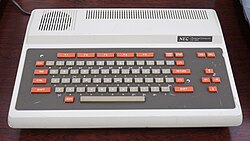
NEC PC-6001
PC-6001
ManufacturerNEC Home Electronics
TypeHome computer
Release dateNovember 1981; 44 years ago (1981-11)
Introductory price¥89,800
Units sold150,000 (PC-6001)[1]
MediaROM Cartridge, Compact Cassette
CPUZilog Z80-compatible NEC μPD780C-1 clocked at 3.8 MHz
Memory16-32 KB RAM, 20 KB ROM
Display256×192 (monochrome), 128×192 (2 colors), 64×48 (9 colors), 256×128, 128×128
GraphicsM5C6847P-1 (MC6847 clone)
InputKeyboard
PredecessorNEC PC-8000
SuccessorNEC PC-6601
NEC PC-8801

The PC-6000 series is a series of 8-bit home computers introduced in November 1981 by NEC Home Electronics. There are several models in this series, such as the PC-6001,[2] the PC-6001 MK2[3] and the PC-6001 MK2 SR.[4] There is also an American version, called the NEC TREK or NEC PC-6001A.

Several peripherals were available for the system in North America, including an expander with three cartridge ports (some of the cartridge-based games used two cartridges), a cassette-tape recorder, a 5.25" floppy disk drive, a printer, and a touchpad.

The PC-6000 series was followed by the PC-6600 series.

Development

[edit]

New Nippon Electric (新日本電気, Shin Nippon Denki) was a subsidiary of NEC and a manufacturer of consumer electronics. They manufactured the PC-8001 and its peripherals, which were successful and grew the personal computer market in Japan.

Subsequently, they started developing a low-cost home computer, which was released as PC-6001. At the same time, NEC's Electronic Devices Group developed the PC-8801 for home and business, and the Information Processing Group developed the PC-9801 for business market.

In 1983, New Nippon Electric changed its name to NEC Home Electronics. At that time, NEC group had four personal computer lines being developed by separate teams. To avoid conflict, they decided to consolidate personal computer business into two divisions; NEC Home Electronics dealt with the 8-bit home computer lines, and the Information Processing Group dealt with the 16-bit personal computer line.

NEC Home Electronics discontinued development of the PC-6000 series, the PC-6600 series, and the PC-8000 series in favor of the PC-8800 series.[5]

PC-6001

[edit]
PC-6001 motherboard

The PC-6001 has a μPD780 processor (a NEC clone of the Zilog Z80), 16 KB RAM (up to 32 KB), a General Instrument AY-3-8910 3-voice sound generator, a ROM Cartridge connector, a cassette tape interface, 2 joystick ports, a parallel printer connector, an RF modulator output and a composite video output. ROM cartridges allowed the user to easily use software such as video games.

It supports four screen modes; 32x16 characters with 4 colors, 64x48 pixel graphics with 9 colors, 128x192 graphics with 4 colors, and 256x192 graphics with 2 colors.

The Japanese version uses a chiclet keyboard while a North American version uses a typewriter keyboard.

PC-6001 MK2

[edit]
PC-6001 MK2

The PC-6001 MK2 has 64 KB memory, 16 KB video RAM, a 5+14-inch double-density floppy drive interface, a Kanji character generator, a RGB monitor out, speech synthesizer unit and a typewriter keyboard.

It supports following screen modes: 40x20 characters, 80x80 pixel graphics with 15 colors, 160x200 graphics with 15 colors, and 320x200 graphics with 4 colors.

References

[edit]
Revisions and contributorsEdit on WikipediaRead on Wikipedia
from Grokipedia
The PC-6000 series is a line of 8-bit home computers developed and manufactured by Home Electronics, primarily for the Japanese market, with the first model released in November 1981 as an affordable alternative to the company's more advanced PC-8000 and . Designed for entry-level users, the series emphasized ease of use for gaming, , and , featuring a Z80-compatible processor (μPD780C-1) clocked at approximately 4 MHz, expandable RAM starting at 16 KB (up to 64 KB in later models), and integrated support for color graphics and sound. Key models in the series include the original PC-6001 (1981), which offered 16 KB of RAM, a , two ports, a cartridge slot, and modes such as 256×192 pixels in monochrome or lower resolutions with up to 9 colors; the PC-6001 mkII (1983), which upgraded to 64 KB of RAM and 16 KB of VRAM for improved performance; and the PC-6001 mkII SR (1984), with a 3.58 MHz processor. The lineup concluded with the PC-6601 series (1983), a derivative that added a 3.5-inch drive while maintaining with earlier PC-6000 software. Audio capabilities across the series relied on the AY-3-8910 programmable sound generator, supporting three voices and noise generation, which contributed to its appeal for home entertainment. Although the PC-6000 series achieved moderate success in Japan—selling better than the preceding PC-8000 but not matching the popularity of the PC-8800—it faced obsolescence by the mid-1980s due to intensifying competition from more powerful systems and diminishing software support. A variant, the PC-6001A, was adapted for the American market with a typewriter-style keyboard but saw limited adoption outside Japan. Today, the series is preserved through emulators like PC6001VX and MAME, allowing modern enthusiasts to experience its extensive library of over 500 games and applications.

History

Development

In the early 1980s, pursued expansion into the sector amid the global personal computing surge, driven by its Computers and Communications (C&C) vision established in 1977 to integrate computing into consumer applications. The company aimed to develop an accessible line for hobbyists and families, targeting and to broaden adoption beyond business-oriented systems like the earlier PC-8001. The PC-6000 series originated from efforts by 's subsidiary Shin Nippon Denki (later NEC Home Electronics Co., Ltd.), which handled and television products, creating a distinct path from the microcomputer division's work on the PC-8001 series. Initially conceived as a more advanced 8-bit machine, the design was scaled back through internal negotiations to prioritize affordability and simplicity for entry-level users. Design priorities centered on a budget price of ¥89,800 for the PC-6001, emphasizing gaming and educational applications through an integrated cartridge system that enabled instant program loading via ROM insertion. The all-in-one form factor connected directly to televisions, with the μPD780C-1 processor—a Z80-compatible chip manufactured in-house—supporting these goals. A custom Microsoft-derived N60 was implemented to facilitate user-friendly programming, though it introduced incompatibility with PC-8001 software. Development progressed through 1981, with prototyping yielding the September announcement and November launch of the PC-6001, accompanied by 50 third-party software titles to build an initial ecosystem. Key challenges involved compacting hardware into a single unit while ensuring reliability for home environments and adapting for seamless cartridge integration.

Release and market entry

The PC-6001, the inaugural model of the PC-6000 series, was launched in in November by Home Electronics as an affordable entry into home computing. This release marked NEC's push into the burgeoning 8-bit market, positioning the series as a budget-friendly option for consumer use. Priced at ¥89,800 (approximately $408 USD based on 1981 exchange rates), the PC-6001 included built-in N60 and ports, appealing to hobbyists, families, and entry-level gamers seeking simple programming and entertainment capabilities. In the United States, an adapted version known as the NEC Trek (or PC-6001A) entered the market in October 1983 at $349, though availability remained limited compared to the Japanese rollout. Distribution in Japan occurred primarily through NEC Home Electronics' established channels, encompassing department stores and specialized electronics retailers to reach a broad domestic audience. Internationally, the effort was more restrained, with the NEC Trek marketed selectively via NEC's overseas networks rather than widespread partnerships. Early marketing emphasized the system's plug-and-play cartridge slot, color graphics, and user-friendly interface for gaming and light productivity tasks, with demonstrations featured at events like the 1982 Consumer Electronics Show to showcase its accessibility. The series saw incremental updates through 1984 but was gradually phased out by the mid-1980s as NEC redirected resources toward the more advanced PC-8801 and PC-9801 platforms.

Models

PC-6001

The PC-6001, introduced in November 1981, served as the foundational model in the PC-6000 series, targeting the burgeoning Japanese home market. This all-in-one unit featured a compact design with an integrated keyboard, measuring approximately 368 mm wide by 285 mm deep by 87 mm high and weighing 3.6 kg. It came equipped with 16 KB of RAM, expandable to 32 KB, and 24 KB of ROM, also upgradable to 32 KB, powered by a μPD780C-1 processor (a Z80-compatible chip) clocked at 4 MHz. Key innovations in the PC-6001 included its built-in for direct connection to televisions, alongside RCA composite video output, enabling easy integration into home entertainment setups. The system supported two Atari-style ports for gaming peripherals and a cassette interface for affordable data storage and program loading, reflecting its emphasis on accessibility for non-technical users. Additionally, a cartridge slot allowed for software and memory expansions, enhancing its versatility as an entry-level machine. Aimed primarily at Japanese home users interested in education and entertainment, the PC-6001 appealed to hobbyists and families through its gaming focus. For international markets, adapted the model as the PC-6001A, marketed in as the NEC Trek, which incorporated English ROM content and a keyboard layout to suit Western users.

PC-6001 MK II

The PC-6001 MK II, released by on July 1, 1983, served as a mid-cycle upgrade to the original PC-6001, priced at ¥84,800 and featuring 64 KB of RAM as standard, which could be further expanded through optional cartridges. This model addressed limitations in connectivity and input by incorporating an RS-232C serial port for peripheral integration, alongside an improved full-travel keyboard supporting up to 80-column text modes for enhanced usability. It also introduced native support for external 3.5-inch floppy drives, enabling more efficient data storage and transfer without relying on cassette tapes. Design refinements included a slightly refined for improved internal and heat management, weighing approximately 3.3 kg, which allowed for the integration of additional components like built-in voice synthesis hardware without significantly increasing bulk. The ROM now included N60 Extended BASIC, providing advanced programming features such as expanded commands and direct floppy access, which elevated the system's capabilities for both hobbyists and developers. These changes boosted overall performance, with the same μPD780C-1 CPU at 4 MHz but leveraging the increased RAM for smoother multitasking and more complex applications. The PC-6001 MK II maintained full with PC-6001 software and cartridges, ensuring a seamless transition for existing users, while its extra RAM enabled new titles specifically optimized for the enhanced hardware, such as advanced and utilities that utilized the additional memory. It solidified its role as a bridge to more sophisticated systems in the PC-6000 lineup and contributing to the series' enduring popularity in the Japanese home computing market.

PC-6001 MK II SR

The PC-6001 MK II SR, launched by in late at a price of ¥89,800, served as the culminating upgrade in the PC-6001 lineup, emphasizing enhanced multimedia capabilities and refined usability for home users. It came standard with 64 KB of RAM, doubling the capacity of earlier models in the series and enabling more complex applications without immediate expansion needs. The retained the μPD780C-1 processor (a compatible) clocked at 3.58 MHz, but introduced significant audio advancements, including a FM synthesis chip for 3-channel polyphonic alongside the existing AY-3-8910 programmable generator, allowing for richer musical expression and voice synthesis features. This made it particularly appealing for music composition, with the N66SR Extended including commands to leverage the FM capabilities for advanced audio programming. Ergonomic refinements distinguished the MK II SR, featuring a compact, rounded with a full-stroke JIS-standard keyboard of 64 keys, including dedicated function, cursor, and input options, all integrated into a lighter body weighing approximately 3.3 kg for improved portability compared to predecessors. Display options expanded to include higher-resolution text modes up to 80×25 characters and graphics modes reaching 320×200 dots in 15 colors, supported by MC6847 and MC6845 video display generators, which facilitated clearer interfaces for and gaming. It also inherited the RS-232C from the PC-6001 MK II for peripheral connectivity. These updates positioned the system as a versatile tool for enthusiasts, with bundled N66 Extended providing built-in tools for programming, including music and graphics manipulation. The MK II SR maintained full with software from prior PC-6001 models, including ROM cartridges and cassette tapes, while supporting new SR-specific expansions like enhanced audio cartridges to exploit its FM sound features. This compatibility, combined with two ports and a dedicated cartridge slot, catered to advanced gaming and creative pursuits, though the model's late release amid shifting market preferences toward floppy-equipped systems like the PC-6601 series limited its adoption primarily to dedicated hobbyists. It remains noted for bridging 8-bit home computing with more sophisticated audio and display ergonomics.

PC-6601 series

The PC-6601 series represented an evolution in NEC's PC-6000 lineup, introducing integrated floppy disk storage to enhance productivity for home and office users. Launched on November 21, 1983, the initial PC-6601 model was built on the hardware foundation of the PC-6001 MK II but incorporated a desktop form factor with a built-in 3.5-inch single-sided double-density (1D) floppy drive offering 143 KB capacity, marking a shift from cassette-based systems toward more efficient disk operations. Priced at ¥143,000, it featured a μPD780C-1 main CPU at 4 MHz (Z80-compatible), a μPD8049 sub-CPU at 8 MHz, 64 KB RAM (including 16 KB VRAM and 1 KB FD buffer), and 96 KB ROM encompassing N-BASIC interpreter, kanji ROM, speech synthesis data, and character generator. Display capabilities included 320×200 pixel graphics in 4 colors or 160×200 in 15 colors, alongside text modes up to 80×25 characters in 15 colors, with interfaces for RGB video, composite output, printer, and optional RS-232C. This series facilitated a transition to disk-based computing within the PC-6000 , supporting extensions like 2.2 for broader software compatibility and business applications, positioning it as a bridge between hobbyist gaming and professional tasks. The built-in drive allowed for up to two FDDs, enabling faster data access compared to earlier models, while the system's 496 alphanumeric/ characters plus 1,024 supported Japanese-language productivity tools. Sound was handled by a PSG chip (AY-3-8910) with three voices and basic , suitable for both applications and simple . In 1984, released the PC-6601SR variant on November 20, priced at ¥155,000, which enhanced the series' appeal for hybrid office-home use with features like an infrared wireless keyboard (battery-powered and detachable for up to 5 meters range) and upgraded FM sound synthesis (, 3 voices) alongside the existing PSG. Retaining the core specs of 64 KB RAM, 3.5-inch FDD, and Z80-compatible processing, the SR model—nicknamed ""—added ports, a superimpose function for TV integration, and cartridge expansion, emphasizing versatility for word processing and light office work. The dedicated PC-TV151 display, priced at ¥94,800, complemented its setup for professional environments. The PC-6601 series concluded the PC-6000 lineup's development by the mid-1980s, as shifted focus to more advanced platforms like the PC-8800, with the SR model serving as the final iteration emphasizing integrated storage and user-friendly peripherals.

Technical features

Hardware architecture

The PC-6000 series employed a Z80-compatible processor, specifically the NEC μPD780C-1, operating at a base clock speed of 4 MHz (precisely 3.993600 MHz, synchronized to standards). The PC-6001 MK II SR variant used a slightly slower 3.58 MHz clock. This 8-bit CPU provided the core processing capabilities, handling instruction execution within the system's 64 KB addressable memory space. Later models, including the PC-6001 MK II, MK II SR, and PC-6601 series, incorporated a secondary μPD8049 clocked at 8 MHz (7.987200 MHz) to manage operations, offloading tasks from the main processor for improved efficiency. Memory configuration in the series featured dynamic RAM (DRAM) starting at 16 KB in the base PC-6001 model, expandable to 32 KB via internal upgrades or external cartridges. Subsequent models increased this to 64 KB in the PC-6001 MK II, MK II SR, and PC-6601 series. (ROM) was 24 KB to 32 KB for the built-in N60-BASIC interpreter in early units, with later models featuring 96 KB in the PC-6001 MK II and PC-6601 or 144 KB in the PC-6001 MK II SR. Expansions were facilitated through cartridge slots supporting 16-32 KB ROM/RAM modules, such as the PC-6006, enabling additional storage and functionality without altering the core system. The architecture utilized a custom 8-bit data bus with memory banking via page-flipping techniques, supporting 1 to 4 configurable pages to extend effective memory beyond the Z80's native 64 KB limit by swapping banks dynamically. This design integrated RAM and VRAM sharing, where users could allocate portions at boot for graphics modes, optimizing the limited address space for multitasking between code, data, and display buffers. The graphics subsystem, including the MC6847-compatible video chip, interfaced directly with this bus for contended access during screen refreshes. Power was supplied via a 12 V DC input, with internal regulation to 5 V and other rails for logic and peripherals, supporting the compact all-in-one design. Build quality emphasized cost reduction through integrated surface-mount components in later revisions, combined with chiclet-style keyboards in entry models transitioning to full layouts for improved usability. Across the series, RAM progressed from 16 KB in the PC-6001 to 64 KB base in the PC-6001 MK II and SR variants, and the PC-6601 series, reflecting iterative enhancements in capacity without fundamental changes to the bus or processor core.

Graphics and sound capabilities

The PC-6000 series employed a custom video controller in its early models like the PC-6001, utilizing the Motorola video display generator (VDG) to support multiple modes tailored for gaming and basic visuals. The base PC-6001 offered a 32-column alongside three graphics resolutions: 64×48 pixels with 9 colors, 128×192 pixels with 4 colors, and 256×192 pixels with 2 colors (appearing as 4 on composite displays due to artifacting). These modes relied on a shared 16 KB of video RAM (VRAM) integrated with , limiting display pages to 1–2 without expansion, and emphasized tile-based rendering without native support for efficiency on limited hardware. Subsequent models, such as the PC-6001 MK II and PC-6601 series, upgraded the graphics subsystem by incorporating the cathode-ray tube controller (CRTC) alongside the MC6847, enabling higher resolutions and a broader color selection from a fixed palette of 27 colors derived from RGB components. Key modes included 160×200 pixels with 15 colors and 320×200 pixels with 4 colors, alongside backward-compatible emulation of original PC-6001 resolutions, all supported by 16 KB dedicated VRAM for up to 4 display pages. Video output was primarily via RF modulation for standard televisions, with optional RGB connectivity for monitors to achieve sharper, artifact-free displays. The series' sound capabilities evolved across iterations to bolster its appeal for interactive entertainment. Early models, including the PC-6001 and PC-6001 MK II, featured the General Instrument AY-3-8910 programmable sound generator (PSG), providing three square-wave channels, one noise channel, and envelope control for basic polyphonic tones and effects, output through an internal speaker. The PC-6001 MK II SR and PC-6601 retained the AY-3-8910 for compatibility, but the MK II SR additionally upgraded to the Yamaha YM2203 FM synthesis chip, adding three frequency modulation (FM) channels with operator programmability for richer instrumentation. This hybrid audio setup supported 8 octaves per channel and optional speech synthesis add-ons, though the lack of dedicated digital audio hardware confined output to simple waveforms modulated for television speakers via RF or direct audio jacks.

Software and ecosystem

Built-in software and programming

The PC-6000 series featured N60 BASIC, a custom variant of stored in ROM, serving as the primary built-in programming environment across models. This integer-based interpreter allowed users to write and execute programs immediately upon powering on the system, entering an interactive immediate mode that displayed a prompt for command input. For the original PC-6001, N60 BASIC version 1.0 provided 16 KB of base RAM, expandable to 32 KB, with support for direct hardware manipulation through statements to access memory locations and registers. N60 BASIC included specialized extensions for the series' multimedia hardware, enabling graphics operations via commands such as COLOR for palette selection, LINE for drawing vectors, and sprite handling through functions like SPRITE and . Sound generation was facilitated by the SOUND statement, which interfaced with the built-in AY-3-8910 PSG chip to produce tones, noise, and envelope effects, making it suitable for simple musical compositions or game audio. The boot process began with a memory configuration prompt, where users selected the number of "pages" (typically 1-4) to allocate between system RAM and video RAM, optimizing for different program needs; cartridges inserted in the expansion slot would auto-load if designed for it, overriding the standard startup. Machine code programming was supported via a built-in , accessible through specific commands, allowing disassembly, assembly, and of Z80 assembly routines directly from the interpreter. Subsequent models enhanced this foundation. The PC-6001 MK II integrated N60 Extended BASIC (version 2.0) and N60 Kakuchou into ROM, offering five selectable modes at boot—two for (16 KB and 32 KB N60 BASIC) and three extended variants (16 KB/32 KB Extended and full Kakuchou mode)—with 64 KB total RAM and improved command sets for higher-resolution and voice synthesis. These versions retained PEEK/POKE for low-level access while adding file management utilities for operations, such as SAVE, LOAD, and a rudimentary directory listing, though the system lacked true multitasking or a . The PC-6601 series, incorporating a built-in floppy drive, extended floppy compatibility through Kakuchou , enabling disk-based program storage and retrieval without external peripherals, while maintaining the core monitor for entry. Later ROM revisions in MK II models included basic assembler and debugger tools within the extended BASIC environment, streamlining development for advanced users.

Games and applications

The PC-6000 series supported a library of over 135 video games for the PC-6001 model alone, with additional titles for later variants like the PC-6001 MK II and PC-6601 series, distributed primarily via ROM cartridges and cassette tapes. emerged as a leading publisher, releasing more than a dozen titles that capitalized on the system's graphics and sound capabilities, including arcade-style ports such as Punch Ball Mario Bros. (1984), a variant of Nintendo's , and originals like Bomber Man (1983) and Binary Land (1983). Other notable ports included (1984) by Dempa Micomsoft, while originals like Dezeni Land (1984) by showcased adventure gameplay. Application software for the series extended beyond gaming to and creative tools, particularly with the introduction of support in the PC-6001 MK II starting in 1983, which expanded access to larger programs. Educational titles, aligned with the system's family-oriented design, included math and tutors distributed via cassettes; due to the age of the platform, many such tapes remain undigitized, limiting preserved examples, though the environment facilitated simple learning programs. Word processing software appeared in utility collections, such as the Japanese demo on the PC-6601SR Utility Disk (1985), enabling basic text editing and handling. For the PC-6001 MK II SR model, which featured enhanced FM synthesis sound via the chip, music sequencers allowed users to compose and sequence multi-voice tracks, supporting the system's three-channel PSG and additional audio channels. Hudson Soft dominated distribution, with databases cataloging over 135 PC-6001-compatible games from 48 developers, many leveraging the series' multiple graphics modes for dynamic visuals. Floppy disk compatibility from 1983 onward broadened the ecosystem, enabling ports and larger applications that were impractical on cassettes. In , RPGs and adventure games gained popularity on the PC-6000 series, utilizing its color graphics for immersive storytelling; text-parser adventures like Diamond Adventure (1982) and Alice in Wonderland (1984) exemplified these genres. These genres defined the platform's appeal among hobbyists, often blending arcade elements with narrative depth. The homebrew scene flourished through early user groups and magazine type-ins starting in 1982, with publications like Micom BASIC Magazine sharing user-coded games and utilities via printed BASIC listings that readers entered manually. Examples include (1984), a adapted from cartoons, reflecting community-driven creativity before widespread emulation.

Peripherals and expansions

Input and storage devices

The PC-6000 series featured a range of input devices tailored for home use, with the built-in keyboard serving as the primary interface. The original PC-6001 employed a chiclet-style keyboard designed for compact, family-oriented operation. In contrast, the PC-6001 MK II upgraded to a full-stroke keyboard following the JIS standard layout, incorporating 64 keys along with 5 function keys, 4 cursor keys, and a dedicated kana letter key to support Japanese input. This design improved typing comfort over the earlier model's membrane keys while maintaining compatibility with the series' software ecosystem. For gaming and interactive applications, all models included two built-in joystick ports utilizing general-purpose 8-bit parallel I/O interfaces, which were compatible with 2600-style controllers via DB-9 connectors. These ports drew from a reference circuit that later influenced the standard, allowing straightforward connection of analog or digital s without additional adapters. The ports supported simultaneous input from two controllers, enhancing multiplayer experiences in titles like . Storage options emphasized affordability and accessibility, with a cassette interface standard across the PC-6001, PC-6001 MK II, and PC-6601 models. This interface operated at 600/1200 baud rates, enabling data transfer via standard audio cassette recorders for loading programs and saving user data. This interface allowed connection to standard audio cassette recorders, a low-cost medium prevalent for distributing and utilities in the early Japanese market. For expanded capacity, the PC-6601 series featured a built-in 3.5-inch 1D (single-sided, double-density) drive offering 360 KB per disk. This marked NEC's first inclusion of 3.5-inch floppy storage in a , providing faster access times compared to cassette loading. Additional I/O capabilities supported peripheral connectivity without built-in modems, focusing on video, audio, and printing needs. All models offered RF video output for direct TV connection, alongside an RCA audio jack for external speakers or recorders. The PC-6001 MK II and later variants added a parallel printer port for dot-matrix printers and an for custom expansions, such as third-party interfaces. These features, combined with joystick sets priced at approximately ¥2,000, made the series versatile for both educational and entertainment peripherals in its era.

Expansion options

The PC-6000 series provided users with various expansion options through its cartridge slot and external peripherals, allowing upgrades, storage enhancements, and connectivity improvements that extended the system's utility beyond its base configuration. The single edge-connector cartridge slot, located on the right side of models like the PC-6001, supported ROM and RAM packs typically ranging from 8 to 32 KB, facilitating software loading, expansion, and add-ons such as language extensions for Extended BASIC. For the original PC-6001 with its standard 16 KB RAM, the official ROM/RAM Cartridge (model PC-6006) doubled to 32 KB while also enabling ROM-based software execution, effectively supporting up to four pages compared to the base one or two. This slot also accommodated specialized cartridges like the N60 Kakuchou BASIC (PCS-6001R), which added support without requiring additional hardware. External expansions further broadened capabilities, particularly for storage and display. The PC-6601 series integrated a built-in floppy controller unit with a single 3.5-inch 1D drive, marking the first NEC home computer to include such native mass storage and enabling distribution of PC-6601-specific software on disks. For earlier models like the PC-6001, the optional Expansion Unit (PC-6011 or PC-6011A) connected externally to add two additional cartridge slots, allowing simultaneous use of multiple packs for enhanced functionality, such as linking to an external PC-6031 floppy disk drive for program and data loading. In 1984, a voice synthesizer add-on became available for models like the PC-6001, providing optional speech synthesis capabilities that were later integrated directly into the PC-6001 MK II. Connectivity ports on later variants expanded add-on possibilities. The PC-6001 MK II included an RS-232C for connecting modems or mice, alongside a for printers, enabling integration with communication and output devices. The PC-6001 MK II SR model added an infrared receiver for wireless remote control, supporting hands-free operation in educational or entertainment setups. Official kits, such as multi-game bundles and the ROM/RAM packs, were designed for easy plug-and-play installation, with the expansions remaining compatible through the series' production run into the late . These options, including the PC-6011 Expansion Unit, emphasized modular upgrades that prolonged the lifespan of base systems without necessitating full replacements.

Reception and legacy

Commercial performance

The PC-6000 series achieved moderate commercial success in during the early . The PC-6001 and its MK II variant accounted for the majority of sales, while the series peaked in popularity between 1983 and 1984 amid growing interest in . In the Japanese home computer market, the series positioned it behind the dominant PC-8801 but ahead of imported systems like the Commodore 64. It competed directly with contemporaries such as the Sharp X1 and Fujitsu FM-7, benefiting from lower pricing that appealed to budget-conscious consumers, though international versions faced criticism for inadequate English-language support. Exports faced challenges that limited global penetration. The U.S. release as the NEC Trek saw limited adoption, largely due to ineffective marketing and competition from established . Despite these challenges, the series found strength in Japan's sector through widespread school adoptions, bolstering domestic sales. However, its momentum waned with the rise of the standard in 1983, which unified multiple manufacturers and captured a larger gaming-oriented audience.

Cultural impact and emulation

The PC-6000 series significantly influenced Japanese home computing culture in the early 1980s by making personal computers more accessible and appealing to families, rather than limiting them to professional or hobbyist use. Released in 1981, the PC-6001 model featured a colorful, pop design with an integrated cartridge slot for easy plug-and-play gaming, earning it the affectionate nickname "Papicom" and helping to dispel the rigid, intimidating image associated with microcomputers at the time. This shift encouraged broader adoption of home computing, with the series supporting both educational programming and entertainment software that fostered a new generation of users. Developers like Hudson Soft and Japan Falcom produced key titles for the platform, such as early entries in the Dragon Slayer series, which inspired further innovation in Japanese game development and contributed to the burgeoning domestic software ecosystem. The series bolstered NEC's dominance in the 8-bit home computer market, setting precedents for affordable, multimedia-capable systems. By establishing expectations for TV connectivity, built-in sound synthesis, and cartridge-based gaming, the PC-6000 helped shape the design priorities of subsequent platforms released in 1983, promoting a unified approach to home entertainment in Japan. Contemporary publications, including the influential I/O magazine, regularly covered the PC-6000 through columns and reviews, highlighting user programs and hardware expansions that engaged early hobbyists and laid foundational elements for Japan's otaku subculture centered on gaming and digital creativity. Today, the PC-6000 series endures as a collector's item among retro enthusiasts, with well-maintained units like the PC-6001mkII fetching 20,000 to 50,000 yen on sites due to their historical significance and scarcity of functional examples. Emulation has preserved its legacy, with MAME providing core support since the early 2000s through its integrated driver, enabling accurate reproduction of the Z80-based architecture and peripherals on modern platforms. Specialized emulators such as PC6001VX (version 4.2.15 as of October 2025, cross-platform and actively maintained) and PC6001V (version 2.1.4 as of March 2022 for Windows) offer cycle-precise emulation, supporting cassette tapes, cartridges, and even online playthroughs archived on sites like the . Active communities sustain interest in the series, exemplified by Japanese retro groups like the P6ERS.NET fan site, which hosts downloads of original and homebrew programs, doujin software, and ongoing discussions as of 2025. Homebrew development remains vibrant, with releases such as ports of classic games and new titles like a adaptation appearing as recently as 2023, allowing modern creators to explore the platform's and graphics capabilities. Overall, the PC-6000 symbolizes the dawn of Japan's computing era, embodying the playful, innovative spirit that evolved into broader culture through accessible technology and community-driven creativity.

References

Add your contribution
Related Hubs
User Avatar
No comments yet.