
Recent from talks
Pack hunter
Knowledge base stats:
Talk channels stats:
Members stats:
Pack hunter
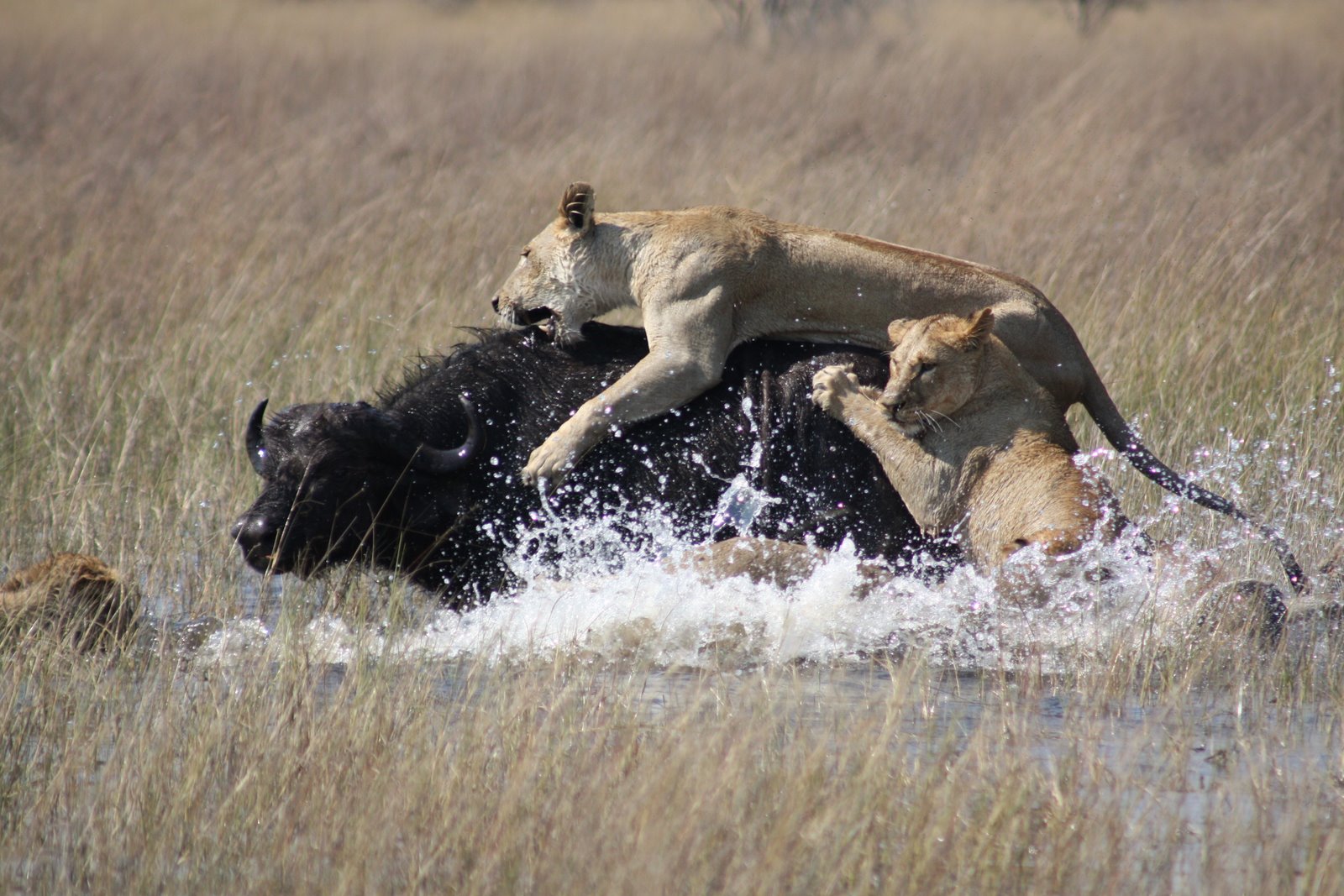
A pack hunter or social predator is a predatory animal which hunts its prey by working together with other members of its species. When hunting cooperation is across two or more species, the broader term cooperative hunting is commonly used.
A well known pack hunter is the gray wolf; humans too can be considered pack hunters. Other pack hunting mammals include chimpanzees, dolphins including orcas, lions, dwarf and banded mongooses, as well as spotted hyenas. Avian social predators include the Harris's hawk, butcherbirds, three of four kookaburra species and many helmetshrikes. Other pack hunters include ants like army ants, the goldsaddle goatfish, and occasionally crocodilians.
Pack hunting is typically associated with cooperative breeding and its concentration in the Afrotropical realm is a reflection of this. Most pack hunters are found in the southern African savannas, with a notable absence in tropical rainforests and with the exception of the wolf and coyote, higher latitudes. It is thought that either on the ancient and poor soils of the southern African savanna it is not possible for individual predators to find adequate food, or that the environment's inherent unpredictability due to ENSO or IOD events means that in very bad conditions it will not be possible to raise the young necessary to prevent declining populations from adult mortality. It is also argued that Africa's large area of continuous flat and open country, which was even more extensive while rainforest contracted during glacial periods of the Quaternary, may have helped encourage pack hunting to become much more common than on any other continent.
Around 80–95% of carnivores are solitary and hunt alone. Groups that hunt cooperatively, at least some of the time, include mammals such as wolves and wild dogs, lions, spotted hyenas, chimpanzees and humans; archosaurs such as crocodilians and birds of prey; as well as large marine fishes such as groupers and moray eels. Cooperative hunting has been linked to the social organization of animal species and the evolution of sociality and thus provides a unique perspective to study group behavior. Some non-avian theropod dinosaurs, such as Albertosaurus sarcophagus, may have displayed pack behaviour.
Understanding how cooperative hunting could evolve requires considering the circumstances that would make it beneficial.
In 1988, the ecologists Craig Packer and Lore Ruttan surveyed documented instances of cooperative hunting to make a game-theoretical model to explain under what circumstances cooperative hunting might evolve. In their model, individuals can engage in one of four hunting strategies:
Each of these strategies has a certain efficiency based on the size and number of prey that can be captured in a hunt.
The model shows that cooperative hunting for a single large prey is an evolutionarily stable strategy (ESS)—a strategy that an individual adopts because failure to do so reduces its fitness—only when solitary hunting is much less efficient. This is usually due to a prey species being too large to be taken down by a single individual predator, meaning hunting efficiency is low and hunting cost is high. In this case, the increased benefit in hunting efficiency from cooperation must compensate for the division of available meat among cooperators. Furthermore, cooperatively hunting groups are prone to invasion by cheaters and scavengers who avoid the drawbacks of hunting, so the added benefit of cooperative hunting must also outweigh these costs. Otherwise, cheating and scavenging can also be evolutionarily stable strategies. The proportion of these strategies increases in larger groups, since only a certain number of individuals are required to help make the kill, allowing others to directly benefit without participating in the hunt.
Hub AI
Pack hunter AI simulator
(@Pack hunter_simulator)
Pack hunter
A pack hunter or social predator is a predatory animal which hunts its prey by working together with other members of its species. When hunting cooperation is across two or more species, the broader term cooperative hunting is commonly used.
A well known pack hunter is the gray wolf; humans too can be considered pack hunters. Other pack hunting mammals include chimpanzees, dolphins including orcas, lions, dwarf and banded mongooses, as well as spotted hyenas. Avian social predators include the Harris's hawk, butcherbirds, three of four kookaburra species and many helmetshrikes. Other pack hunters include ants like army ants, the goldsaddle goatfish, and occasionally crocodilians.
Pack hunting is typically associated with cooperative breeding and its concentration in the Afrotropical realm is a reflection of this. Most pack hunters are found in the southern African savannas, with a notable absence in tropical rainforests and with the exception of the wolf and coyote, higher latitudes. It is thought that either on the ancient and poor soils of the southern African savanna it is not possible for individual predators to find adequate food, or that the environment's inherent unpredictability due to ENSO or IOD events means that in very bad conditions it will not be possible to raise the young necessary to prevent declining populations from adult mortality. It is also argued that Africa's large area of continuous flat and open country, which was even more extensive while rainforest contracted during glacial periods of the Quaternary, may have helped encourage pack hunting to become much more common than on any other continent.
Around 80–95% of carnivores are solitary and hunt alone. Groups that hunt cooperatively, at least some of the time, include mammals such as wolves and wild dogs, lions, spotted hyenas, chimpanzees and humans; archosaurs such as crocodilians and birds of prey; as well as large marine fishes such as groupers and moray eels. Cooperative hunting has been linked to the social organization of animal species and the evolution of sociality and thus provides a unique perspective to study group behavior. Some non-avian theropod dinosaurs, such as Albertosaurus sarcophagus, may have displayed pack behaviour.
Understanding how cooperative hunting could evolve requires considering the circumstances that would make it beneficial.
In 1988, the ecologists Craig Packer and Lore Ruttan surveyed documented instances of cooperative hunting to make a game-theoretical model to explain under what circumstances cooperative hunting might evolve. In their model, individuals can engage in one of four hunting strategies:
Each of these strategies has a certain efficiency based on the size and number of prey that can be captured in a hunt.
The model shows that cooperative hunting for a single large prey is an evolutionarily stable strategy (ESS)—a strategy that an individual adopts because failure to do so reduces its fitness—only when solitary hunting is much less efficient. This is usually due to a prey species being too large to be taken down by a single individual predator, meaning hunting efficiency is low and hunting cost is high. In this case, the increased benefit in hunting efficiency from cooperation must compensate for the division of available meat among cooperators. Furthermore, cooperatively hunting groups are prone to invasion by cheaters and scavengers who avoid the drawbacks of hunting, so the added benefit of cooperative hunting must also outweigh these costs. Otherwise, cheating and scavenging can also be evolutionarily stable strategies. The proportion of these strategies increases in larger groups, since only a certain number of individuals are required to help make the kill, allowing others to directly benefit without participating in the hunt.
Recent media