Hubbry Logo
Moray eelMoray eelMain
Open search
Moray eel
Community hub
Moray eel
logo
8 pages, 0 posts
0 subscribers
Be the first to start a discussion here.
Moray eel
Moray eel
from Wikipedia

Moray eel
Temporal range: Late Miocene – Recent [1]
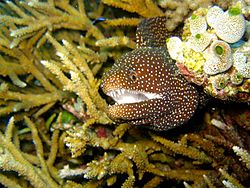
Whitemouth Moray eel in the Maldives
Scientific classification Edit this classification
Kingdom: Animalia
Phylum: Chordata
Class: Actinopterygii
Order: Anguilliformes
Suborder: Muraenoidei
Family: Muraenidae
Rafinesque, 1810
Subfamiles
Moray eel

Moray eels, or Muraenidae (/ˈmɒr, məˈr/), are a family of eels whose members are found worldwide. There are approximately 200 species in 15 genera which are almost exclusively marine, but several species are regularly seen in brackish water, and a few are found in fresh water.[2]

The English name, moray, dates back to the early 17th century, and is believed to be a derivative from Portuguese moreia, which itself derives from Latin mūrēna, in turn from Greek μύραινα, muraina; these are the Latin and Greek names of the Mediterranean moray.[3]

Anatomy

[edit]

The dorsal fin extends from just behind the head along the back and joins seamlessly with the caudal and anal fins, with the exception of the subfamily Uropterygiinae, which have fins restricted to the tip of the tail. Most species lack pectoral and pelvic fins, adding to their serpentine appearance. Their eyes are rather small; morays rely mostly on their highly developed sense of smell, lying in wait to ambush prey.[4]

The body is generally patterned. In some species, the inside of the mouth is also patterned. Their jaws are wide, framing a protruding snout. Most possess large teeth used to tear flesh or grasp slippery prey. A relatively small number of species, for example the snowflake moray (Echidna nebulosa) and zebra moray (Gymnomuraena zebra), primarily feed on crustaceans and other hard-shelled animals, and they have blunt, molar-like teeth suitable for crushing.[5]

Morays secrete a protective mucus over their smooth, scaleless skin, which in some species contains a toxin. They have much thicker skin and high densities of goblet cells in the epidermis that allows mucus to be produced at a higher rate than in other eel species. This allows sand granules to adhere to the sides of their burrows in sand-dwelling morays,[6] thus making the walls of the burrow more permanent due to the glycosylation of mucins in mucus. Placement of their small, circular gills on their flanks, far behind the mouth, requires the moray to maintain a gape / gulping motion to facilitate respiration.[clarification needed]

Jaw

[edit]
Skull and pharyngeal jaws of a Gymnothorax miliaris (goldentail moray)

The pharyngeal jaws of morays are located farther back in the head and closely resemble the oral jaws (complete with tiny "teeth"). When feeding, morays launch these jaws into the mouth cavity, where they grasp prey and transport it into the throat. Moray eels are the only known animals that use pharyngeal jaws to actively capture and restrain prey in this way.[7][8][9]

Two diagrams of head and spine, one showing the pharyngeal jaw at rest; the other showing the jaws extended into the mouth
Moray eel jaw anatomy

In addition to the presence of pharyngeal jaws, morays' mouth openings extend far back into the head, compared to fish which feed using suction. In the action of lunging at prey and biting down, water flows out the posterior side of the mouth opening, reducing waves in front of the eel which would otherwise displace prey. Thus, aggressive predation is still possible even with reduced bite times.[10] In at least one species, the California moray (Gymnothorax mordax), teeth in the roof of the mouth are able to fold down as prey slides backwards, thus preventing the teeth from breaking and maintaining a hold on prey as it is transported to the throat.

Differing shapes of the jaw and teeth reflect the respective diets of different species of moray eel. Evolving separately multiple times within the Muraenidae family, short, rounded jaws and molar-like teeth allow durophagous eels (e.g. zebra moray and genus Echidna) to consume crustaceans, while other piscivorous genera of Muraenidae have pointed jaws and longer teeth.[11][12][13] These morphological patterns carry over to teeth positioned on the pharyngeal jaw.[14][15]

Feeding behavior

[edit]

Morays are opportunistic, carnivorous predators,[16] and feed primarily on smaller fish, crabs and octopuses.[17] A spotted moray eel has been observed eating a red lionfish without harm.[18][19] Groupers, barracudas and sea snakes are among their few known predators, making many morays (especially the larger species) apex predators in their ecosystems.[20]

Cooperative hunting

[edit]

Reef-associated roving coral groupers (Plectropomus pessuliferus) have been observed recruiting giant morays to help them hunt. The invitation to hunt is initiated by head-shaking. This style of hunting may allow morays to flush prey from niches not accessible to groupers.[21][22][23]

Habitat

[edit]
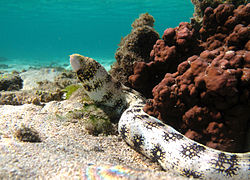
A moray occupying a dead patch reef, located in Kona, Hawaii

The moray eel can be found in both fresh and saltwater habitats. The vast majority of species are strictly marine, never entering freshwater. Of the few species known to live in freshwater, the most well-known is Gymnothorax polyuranodon.[24][25]

Echidna nebulosa occupying a live coral reef, located in Sabang, Philippines

Within the marine realm, morays are found in shallow water nearshore areas, continental slopes, continental shelves, deep benthic habitats, and mesopelagic zones of the ocean, and in both tropical and temperate environments.[25] Most species are found in tropical or subtropical environments, with only a few species (yellow moray) found in temperate ocean environments.

Although the moray eel can occupy both tropical oceans and temperate oceans, as well as both freshwater and saltwater, the majority of moray eels occupy warm saltwater environments, which contain reefs.[26] Within the tropical oceans and temperate oceans, the moray eel occupies shelters, such as dead patch reefs and coral rubble rocks, and less frequently occupies live coral reefs.[26]

Reproduction and Lifecycle

[edit]

The reproductive biology of moray eels remains incompletely understood. Most species are oviparous, with external fertilization occurring in the water column. During spawning, both males and females release gametes simultaneously, and the fertilized eggs are subsequently dispersed by ocean currents.

Following fertilization, the eggs develop into leptocephalus larvae, which are transparent and ribbon-like in appearance. These larvae remain in the pelagic zone for extended periods—often up to a year—feeding on microscopic plankton. This prolonged larval phase facilitates wide geographic dispersal prior to settlement in benthic habitats such as coral reefs or rocky substrates, where metamorphosis into juvenile eels occurs.[27][better source needed]

The transition from larva to juvenile involves significant morphological and behavioral changes, including the development of adult pigmentation, body form, and ecological habits. Juvenile moray eels typically adopt the solitary and territorial behavior characteristic of adults.

Due to their nocturnal activity and the often inaccessible environments in which reproduction occurs, direct observations of moray eel courtship and spawning behavior are rare. Consequently, their reproductive mechanisms remain one of the least documented aspects of their biology.

Environmental factors such as water temperature, photoperiod, and food availability are believed to influence spawning events. Breeding in captivity is infrequent, which further limits opportunities for scientific study of their reproductive cycle.[28][user-generated source]

Taxonomy

[edit]
Muranidae represented on a phylogenetic tree

Genera

[edit]
A representative structure of the subfamily Uropterygiinae

There are over 200 known species of moray eels, in 16 genera. These genera are in two sub-families, Muraeninae and Uropterygiinae, which are distinguished by the location of their fins.[29] In Muraeninae the dorsal fin is near the gill slits and runs down the back of the eel, and the anal fin is behind the anus.[29] In Uropterygiinae, both the dorsal and the anal fin are at the end of the tail.[29] Though this distinction can be seen between the two sub-families, there are still many varieties of genera within Muraeninae and Uropterygiinae. Of these, the genus Gymnothorax is by far the broadest, including more than half of the total number of species.

The family Muraenidae comprises the following subfamiles and genera:[30]

Evolution

[edit]

The moray eel's elongation is due to an increase in the number of vertebrae, rather than a lengthening of each individual vertebra or a substantial decrease in body depth.[31] Vertebrae have been added asynchronously between the pre-tail ("precaudal") and tail ("caudal") regions, unlike other groups of eels such as Ophicthids and Congrids.[32]

Relationship with humans

[edit]

Aquarium trade

[edit]

Several moray species are popular among aquarium hobbyists for their hardiness, flexible diets, and disease resistance. The most commonly traded species are the snowflake, zebra and goldentail moray (Gymnothorax miliaris). Several other species are occasionally seen, but are more difficult to obtain and can command a steep price on the market.[33]

Food poisoning

[edit]

Moray eels, particularly the giant moray (Gymnothorax javanicus) and yellow-edged moray (G. flavimarginatus), are known to accumulate high levels of ciguatoxins, unlike other reef fish;[34][35] if consumed by humans, ciguatera fish poisoning may result. Ciguatera is characterised by neurological, gastrointestinal, and cardiovascular problems that may persist for days after eating tainted fish. In morays, the toxins are most concentrated in the liver.[35] In an especially remarkable instance, 57 people in the Northern Mariana Islands were poisoned after eating just the head and half of a cooked yellow-edged moray.[36] Thus, morays are not recommended for human consumption.

References

[edit]

Further reading

[edit]
[edit]
Revisions and contributorsEdit on WikipediaRead on Wikipedia
from Grokipedia
Moray eels (family Muraenidae) comprise approximately 200 species of elongated, snake-like marine fish distributed worldwide in tropical and subtropical waters. These carnivorous predators typically inhabit shallow coastal environments, including reefs, rocky crevices, and beds, where they spend much of their time concealed in shelters. Lacking pectoral and pelvic fins, morays possess scaleless, thick skin, small gill openings, and a robust skull supporting powerful oral jaws armed with sharp, backward-curving teeth. A defining feature of moray eels is their unique dual-jaw system, including a secondary set of pharyngeal jaws located in the throat that can extend forward to grasp and pull prey deeper into the esophagus, enabling them to capture and swallow large items like fish, crustaceans, and cephalopods despite limited suction feeding ability. Many species exhibit vibrant color patterns—such as spots, bars, or meshes—that provide camouflage among reefs, and they are predominantly nocturnal, emerging at night to hunt. Sizes vary widely across the family, with some reaching lengths of up to 3 meters (9.8 feet) and weights exceeding 30 kilograms (66 pounds), though most are smaller. Moray eels play key ecological roles as ambush predators on , contributing to by controlling populations of smaller marine organisms, and their low makes them one of the most cosmopolitan families. Most are oviparous with occurring in the , though remains incompletely understood and varies by . Due to their striking appearances and behaviors, morays are popular in public aquariums, but some face threats from degradation and incidental capture in fisheries.

Taxonomy

Classification and etymology

Moray eels belong to the family Muraenidae within the order Anguilliformes, which encompasses true eels. Their hierarchical classification places them in the kingdom Animalia, phylum Chordata, class Actinopterygii (ray-finned fishes), order Anguilliformes, and family Muraenidae. The family is divided into two subfamilies: Muraeninae (with 189 species) and Uropterygiinae (with 40 species). This family is distinguished from other eel groups, such as the freshwater eels of the family Anguillidae, primarily by their exclusively marine or brackish habitats and absence of catadromous life cycles, where adults migrate from freshwater to the sea to spawn. The common name "" originates from the term moreia, which derives from the Latin muraena meaning "sea " or "," itself borrowed from the smyraina or muraína, referring to a type of . The family name Muraenidae was formally established by the Italian naturalist in 1815, drawing directly from the Latin root to denote this group of serpentine marine predators. As of November 2025, the Muraenidae family comprises 229 valid species across 16 , according to Eschmeyer's Catalog of Fishes, reflecting refinements based on morphological and genetic analyses. For instance, the genus represents the largest within the family, encompassing 128 species.

Genera and species diversity

The family Muraenidae encompasses 16 recognized genera and 229 valid species as of November 2025. Among these, the genus Gymnothorax is the most speciose, containing 128 , many of which exhibit diverse color patterns and inhabit coral reefs and rocky substrates. The genus Echidna follows with 11 recognized species, characterized by robust bodies and often bold spotting, while Muraena, the type genus of the family, includes 12 species primarily distributed in the and . Key genera within Muraenidae display notable morphological variations that reflect their ecological niches. Muraena species, such as the Mediterranean moray (Muraena helena), are typically large and predatory, adapted to temperate and subtropical waters of the eastern Atlantic and Mediterranean. The genus Enchelycore comprises species with elongated snouts and arched jaws equipped with prominent fangs, exemplified by the leopard moray (Enchelycore pardalis), which uses its specialized dentition for capturing prey in crevices across the Indo-Pacific. In contrast, Uropterygius includes short-finned, slender species often referred to as snake morays, such as Uropterygius concolor, which are small and uniformly colored, suited to burrowing in sandy or muddy bottoms. Overall species diversity in Muraenidae is concentrated in the tropical region, where over 70% of occur, reflecting high driven by diverse habitats; in comparison, the Atlantic hosts about 50 , with lower diversity due to more uniform environments. Recent taxonomic additions underscore ongoing discoveries, including the 2024 description of Uropterygius hades, a uniformly estuarine species found in turbid river mouths from to in the Central .

Physical description

Body structure and adaptations

Moray eels possess an elongated, serpentine body adapted for maneuvering through narrow crevices and coral reefs, with a compressed cross-section that enhances stealth and in marine environments. Their lacks scales, featuring instead a thick, smooth rich in goblet cells that secretes a copious layer; this coating serves as a protective barrier against parasites, abrasions from rocky substrates, and infection while also reducing hydrodynamic drag to facilitate smooth gliding. Across the approximately 200 in the family Muraenidae, body sizes vary widely, from the diminutive Snyder's moray (Anarchias leucurus), which attains a maximum length of 11.5 cm, to the massive (Gymnothorax javanicus), which can exceed 3 m in length and reach 30 kg in mass; most adults measure 1–1.5 m long. In terms of fin configuration, eels exhibit a highly specialized setup lacking pectoral and pelvic s entirely, a trait shared among anguilliform fishes that prioritizes flexibility over stability. Instead, they have a single continuous fin fold comprising the dorsal, caudal, and anal fins, which originates near the head and extends along the entire posterior body; this arrangement supports powerful undulating propulsion through lateral body waves, enabling efficient bursts of speed and precise control in confined spaces. Sensory adaptations in moray eels emphasize chemosensory and mechanosensory capabilities over vision, given their crepuscular and nocturnal lifestyles in low-light habitats. Eyesight is relatively poor, with small eyes suited to dim conditions, but this is offset by an acute olfactory sense provided by two tubular nostrils per side—an anterior one for sampling water currents and a posterior one for enhanced detection of chemical cues from prey or mates. The system, reduced to a few sensory pores along the head and body, detects low-frequency vibrations and water movements, aiding in predator avoidance and prey localization. openings are notably small and tube-like, positioned low on the head without opercular covers; this design necessitates active pumping of water over the gills via rhythmic mouth opening and closing, ensuring oxygenation even when the eel is stationary in its . Camouflage is achieved through diverse, cryptic coloration patterns that blend seamlessly with backgrounds, including mottled spots, bold bands, or solid tones such as the olive-green hue of the ( funebris), which results from yellow mucus overlaying brownish skin. These markings provide effective concealment among algae-covered rocks and corals, reducing visibility to both predators and prey during ambushes.

Jaws and dentition

Moray eels possess highly specialized oral jaws that are mobile and protrusible, featuring long, pointed canine-like teeth arranged in multiple rows for securely grasping prey. This enables effective biting and piercing, compensating for the eels' limited capacity for feeding, which is diminished by their elongated and reduced buccal cavity volume compared to other fishes. A distinctive feature of moray eels is their second set of pharyngeal jaws, located in the and capable of independent mobility, which protrude forward into the oral cavity to seize captured prey and transport it posteriorly toward the . These jaws can extend up to the full length of the during protraction, grasping the prey with toothed pads and retracting it in a single motion. Derived from modified arches—specifically the fourth , with the fifth arch reduced or lost—the pharyngeal jaws consist of upper and lower elements bearing rows of recurved teeth that aid in manipulation and prevent escape. Dentition in moray eels varies with feeding ecology, with most exhibiting sharp, recurved teeth in both oral and pharyngeal jaws suited for impaling soft-bodied or evasive prey. In contrast, durophagous , such as the zebra moray (Gymnomuraena zebra) and members of the genus Siderea, have independently evolved blunt, molariform teeth at least 10 times across the family, adapted for crushing the exoskeletons of crustaceans and other hard-shelled ; these teeth are shorter, wider, and pavement-like, often covering the surfaces more densely. The pharyngeal jaws are powered by a suite of specialized muscles that enable their extreme excursion and force generation. Protraction is driven primarily by the levator externi (dorsal) and rectus communis (ventral) muscles, which pull the jaws forward, while retraction in muraenine morays involves the dorsal retractor and pharyngocleitheralis muscles, with uropterygiine relying more on the latter and esophageal contraction due to the absence of a dedicated dorsal retractor. A hypertrophied fifth branchial adductor muscle provides the closing force for secure prey handling. This mechanism, unique among fishes, allows moray eels to process large or resistant prey internally without relying solely on external body movements, though knotting behaviors can assist in subduing vigorous captives.

Distribution and habitat

Global range

Moray eels (family ) are predominantly distributed in tropical and subtropical waters across all major ocean basins, with the highest species diversity concentrated in the region. This area spans from the eastward through the to , extending further to the and , where over 200 species have been documented globally, many spanning vast distances due to their pelagic larval stages. In the Atlantic Ocean, moray eels occupy both western and eastern sectors, including the and the , with multiple genera present and the widespread genus common throughout. The Eastern Pacific hosts a more limited diversity, primarily along the coast from southward, as exemplified by the California moray (), which ranges from in to and the . Specific examples illustrate these distributions: the (Muraena helena) inhabits temperate waters of the and the eastern Atlantic coast from the to , with records also in the . In the western Atlantic, the (Gymnothorax funebris) extends from and southward to , encompassing the northern and reefs. Latitudinal limits generally confine most species to between 30°N and 30°S, reflecting their preference for warm waters, though some extend into temperate zones, such as and northern , where species like Gymnothorax prasinus occur south of 25°S. Geographic barriers have shaped these patterns, notably the closure of the around 3 million years ago, which isolated Atlantic and Pacific populations and led to the divergence of sister species across the divide. High endemism characterizes isolated regions like , home to over 40 moray species, several of which—such as Gymnothorax hawaiiensis—are found nowhere else due to the islands' remoteness and long larval dispersal enabling colonization but limiting . In recent decades, has driven range expansions for some species into warming temperate waters, with poleward shifts observed in eastern Pacific populations under . Within these global ranges, moray eels predominantly favor and rocky habitats.

Environmental preferences

Moray eels predominantly inhabit shallow coastal waters, typically at depths ranging from 1 to 50 meters, with rare occurrences beyond 100 meters. Certain species, such as the Hades moray (Uropterygius hades), extend into intertidal and estuarine zones, demonstrating limited capabilities. These eels favor structured microhabitats including coral reefs, rocky crevices, beds, mangroves, and fields, where they spend diurnal hours concealed in narrow holes—often head-first for vigilance, but tail-first when fleeing threats to facilitate rapid escape. They strictly avoid open water, relying on these complex substrates for and positioning. Preferred water conditions for moray eels include warm temperatures between 20 and 30°C and levels of 30 to 35 ppt, aligning with tropical and subtropical marine environments. While primarily marine, some species exhibit tolerance for brackish conditions, particularly in estuarine or settings, though full freshwater adaptation is limited to a few taxa like the freshwater (Gymnothorax polyuranodon). Moray eels frequently engage in symbiotic associations, sharing dens with commensal species such as cleaner shrimp (Urocaridella spp.) that remove ectoparasites from their bodies and gills, or with groupers that may co-occupy crevices for mutual hunting benefits without direct competition. These interactions enhance hygiene and foraging efficiency in their structured habitats. Habitat threats, including coral bleaching from rising sea temperatures and overfishing that depletes reef complexity, significantly reduce crevice availability and impact reef-dependent populations through diminished shelter and prey resources. While most moray species are classified as Least Concern on the IUCN Red List (as of 2025), ongoing degradation exacerbates vulnerability in these habitats.

Behavior

Locomotion and sensory capabilities

Moray eels employ anguilliform locomotion, characterized by undulatory waves that propagate from head to tail along their elongated bodies, enabling efficient propulsion in complex environments. This mode supports slow cruising at speeds up to approximately 0.5 m/s during routine , with the capacity for rapid bursts to evade threats or pursue prey. Additionally, moray eels can form body knots by looping their tail under the midsection, providing leverage for anchoring during movement or manipulating large prey, such as tearing apart an carcass. The sensory capabilities of moray eels emphasize chemosensory and mechanosensory systems adapted to low-visibility habitats. Olfaction is dominant, with enlarged nares detecting from potential prey sources, often relied upon more than vision during feeding approaches. Mechanoreception occurs via the system, which senses water vibrations and movements from nearby prey or predators. Electroreception is absent, but the eel's scaleless, mucus-covered is highly touch-sensitive, facilitating and prey detection in confined crevices. Many moray eel species exhibit predominantly nocturnal activity patterns, emerging from dens at dusk to hunt and retreating during daylight to avoid diurnal predators, though some species, such as the kidako moray (Gymnothorax kidako), are diurnal. While resting in shelters, they often position with the head or tail exposed, allowing for swift escape if disturbed. These eels are solitary and highly territorial, aggressively defending individual dens through displays including wide mouth opening to reveal teeth and body inflation to appear larger, with minimal social interactions beyond occasional hunting partnerships. Additionally, giant moray eels have been observed engaging in nocturnal cleaning interactions with clear cleaner shrimp (Urocaridella antonbruunii), where the shrimp enter the eel's mouth to remove parasites, as documented in Moorea, French Polynesia, in 2023. Adaptations for stealth enhance their ambush-oriented lifestyle, including a thick layer that reduces hydrodynamic drag during undulatory motion and minimizes detectable noise in turbulent waters. Cryptic coloration, featuring mottled patterns that mimic substrates, further aids in concealing their presence from both prey and competitors.

Feeding strategies

Moray eels are carnivorous predators with a diet consisting primarily of , crustaceans such as and , octopuses, and other cephalopods. They exhibit opportunistic scavenging behavior, consuming carrion or abandoned prey when encountered during foraging. The predominant feeding strategy among moray eels is predation, in which they lie in wait within rocky crevices or coral reefs, often with only their heads exposed, before rapidly lunging forward to capture passing prey. These strikes can extend up to one-third of the eel's body length, allowing them to seize elusive targets effectively. Following the initial bite with the oral jaws, the eel's pharyngeal jaws— a secondary set located in the throat—extend forward to grasp and retract the prey into the , securing it against escape even for large or struggling items. For handling oversized prey that exceeds their gape, eels utilize a distinctive knotting , forming overhand knots by looping their flexible bodies from tail to head to compress, tear, or the . This technique, observed across multiple species including the white-mouthed (Gymnothorax favagineus), enables them to break down tough items like eels or extract lodged prey from reefs. Research from 2015 demonstrates that knotting is an energy-efficient method, reducing the metabolic cost of manipulation compared to direct tearing or pulling. Moray eels occasionally participate in cooperative hunting partnerships with roving coral groupers (Plectropomus spp.), particularly in complex reef environments where prey hides in inaccessible crevices. The grouper signals potential prey locations through rapid head shakes or body oscillations, recruiting the to investigate and flush out the target, while the eel navigates tight spaces the grouper cannot. Documented in the since a 2006 study, these non-random associations enhance overall hunting success, with groupers achieving up to five times greater capture rates when paired with morays than when hunting alone. Prey selection varies by moray species size and morphology, with smaller individuals focusing on invertebrates like crustaceans and mollusks, while larger species target and cephalopods. Durophagous moray lineages, which have independently evolved at least ten times, specialize in hard-shelled prey such as bivalves and sea urchins, developing robust cranial structures to crush exoskeletons without consistent convergence across taxa.

Reproduction and life cycle

Sexual characteristics

Moray eels (family Muraenidae) exhibit diverse sexual systems, including , protogynous hermaphroditism, and rare cases of simultaneous hermaphroditism, with the latter documented in only two within the family. Most are protogynous hermaphrodites, where individuals begin life as females and sequentially transition to males later in adulthood. This sex change typically occurs between 3 and 5 years of age, often triggered by such as the presence or absence of a dominant male in the population, which influences hormonal responses to maintain reproductive balance. Environmental factors, including fluctuations, may also play a role in initiating gonadal reorganization during this transition. In protogynous species, juveniles develop ovaries that mature into functional female gonads, producing up to approximately 10,000 pelagic eggs per spawning event. Upon sex change, the ovaries regress while testes develop, enabling males to produce for . is generally reached at 3 to 4 years, aligning with the onset of reproductive capability in both phases, though lifespan varies from 15 to 30 years or more, allowing multiple spawning cycles without after egg release. Mating behavior involves in open water, often during nocturnal spawning events. In the (Muraena helena), appears size-based, with larger individuals more likely to transition to males and females dominating smaller size classes, reflecting protogynous patterns. Simultaneous hermaphroditism, though uncommon, allows to function in both sexes concurrently, potentially enhancing reproductive opportunities in low-density habitats. Recent studies, such as those examining asymmetry, continue to explore the evolutionary drivers of these diverse sexual systems in moray eels.

Developmental stages

Moray eels exhibit an oviparous reproductive strategy involving , during which pelagic eggs measuring approximately 1 mm in diameter are released in batches into the water column. These eggs typically hatch within 36 to 48 hours, giving rise to leptocephali larvae under favorable oceanic conditions. The leptocephali stage represents a distinctive larval phase unique to anguilliform eels, including morays, characterized by transparent, leaf-shaped bodies that can reach lengths of up to 40 cm in some species before . These planktonic larvae drift passively with currents for durations ranging from 4 to 12 months in tropical species and up to 2 years in temperate ones, such as the (Muraena helena), while feeding primarily on —a gelatinous aggregate of organic . This extended pelagic phase contributes to high mortality rates due to predation, , and dispersal challenges. Upon reaching appropriate coastal settlement sites, leptocephali undergo , transforming into transparent glass eels that retain a slender, eel-like form but lose larval characteristics such as the leaf-shaped body and pectoral fins. These glass eels soon develop pigmentation, becoming pigmented elvers measuring 5 to 10 cm in length, which actively migrate to reef habitats and begin seeking shelter in crevices or dens. Post-metamorphosis growth occurs in distinct phases, beginning with the yellow phase where juveniles, typically 1 to 3 years old, reside in protective dens on reefs while rapidly increasing in size and developing adult morphology. Unlike freshwater eels, morays lack a silver phase, proceeding directly to full adult integration by around year 4, when they achieve sexual maturity and exhibit species-specific coloration and behaviors. During this juvenile period, many moray species initiate protogynous hermaphroditism, transitioning from functional females to males. Larval duration and dispersal patterns are influenced by environmental factors, with temperate species exhibiting longer leptocephali phases compared to tropical ones due to cooler water temperatures affecting growth rates. Emerging climate change impacts, including altered ocean currents and temperature shifts, may further disrupt these drift trajectories, potentially reducing success to adult habitats.

Evolutionary history

Fossil record

The fossil record of moray eels (family Muraenidae) is relatively sparse, primarily due to the fragile, lightly ossified skeletons of these elongated fishes, which do not preserve well in most sedimentary environments. The earliest known s date to the Eocene epoch, approximately 54 to 34 million years ago, encompassing primitive anguilliform forms in and . Definitive records of Muraenidae first appear during the Lutetian stage of the middle Eocene (about 48 to 41 million years ago), represented by well-preserved specimens from the Monte Bolca in , which reveal early adaptations in body form and fin structure consistent with modern s. No evidence suggests mass extinctions uniquely affecting morays, though primitive genera like Anguillavus—a (Cenomanian stage, ~94 million years ago) stem-group relative from Lebanese lagerstätten—represent basal anguilliforms ancestral to the lineage. to records are better represented in the , particularly through recent discoveries from the . A 2024 study described three Muraeninae specimens from : one partial skull with in situ otoliths from the Gatun Formation (~11 to 8 million years ago), and two vertebrae from the Late Escudo de Veraguas Formation (~3.6 to 2.6 million years ago). These fossils, attributed to new , demonstrate interoceanic migration via the seaway before its closure, filling previous gaps in the Neotropical record and underscoring the family's role in ancient ecosystems.

Phylogenetic relationships

Moray eels (family Muraenidae) occupy a basal position within the order Anguilliformes, forming the monophyletic suborder Muraenoidei, which is sister to the remaining anguilliform families. A 2013 phylogenetic analysis using morphological data from 40 moray species indicated that body elongation evolved early in the lineage, with the ancestral maximum body length stabilizing at approximately 1.5 meters, reflecting adaptations to a predating diversification into modern forms. Within the Muraenidae, two primary monophyletic subfamilies are recognized: Muraeninae, comprising the "true morays" with elongated fins, and Uropteryginae, characterized by shorter fins and more robust bodies. Durophagy, the ability to crush hard-shelled prey, has convergently evolved at least four times across genera, including independent origins in Siderea and Echidna, driven by parallel modifications in cranial and morphology despite varying degrees of convergence in structure. Molecular studies using have revealed an Indo-Pacific origin for moray eels approximately 40 million years ago, with subsequent vicariance events following the closure of the around 3-4 million years ago leading to isolation of Atlantic populations. A 2010 phylogeographic analysis demonstrated low between Indo-Pacific and Atlantic lineages, attributed to limited larval dispersal across the barrier, though multiple colonizations of the Atlantic occurred post-divergence. Key evolutionary adaptations in moray eels include the innovation of highly protrusible pharyngeal jaws, which emerged after the Eocene epoch (around 34-56 million years ago), enabling efficient prey capture and transport in low-suction feeding environments. Simultaneous hermaphroditism in morays is associated with their low population densities on reefs, facilitating mating opportunities in sparse conditions as per the low-density for hermaphroditic . A notable recent discovery is the 2011 description of Protoanguilla palau, a "living fossil" from a Palauan system, representing a new family (Protanguillidae) that bridges primitive anguilliform features with modern eels, suggesting retention of ancestral traits from the early diversification of the order.

Relationship with humans

Aquarium keeping

Moray eels are popular exhibits in public aquariums, with species like the (Gymnothorax funebris) frequently displayed due to their striking appearance and size, reaching up to 2.5 meters in length. In home aquariums, smaller species such as the (Echidna nebulosa) are more common among enthusiasts, though all require substantial space; large species demand tanks of at least 500 gallons to accommodate their growth and activity levels. Housing moray eels in captivity presents several challenges, primarily due to their elusive nature and physical requirements. As notorious , they necessitate aquariums with tight-fitting, secure lids to prevent them from wriggling through even small gaps. Ample rockwork and crevices must be provided to create secure dens, mimicking their natural habitats and reducing stress. Strong filtration systems are essential to handle their copious production and waste from feeding, maintaining water quality in their enclosed environment. Ideal water parameters include a range of 24–28°C and of 1.020–1.025 specific gravity to support their tropical origins. Feeding captive moray eels requires careful management to ensure while minimizing risks. These carnivores thrive on a varied diet of thawed or live , , and crustaceans, offered 2–3 times per week for adults to prevent overfeeding and . should be delivered using long or feeding sticks, as their poor eyesight and keen can lead to accidental bites on handlers; their powerful pharyngeal jaws can inflict deep, painful wounds prone to infection. Health maintenance is critical, as moray eels are susceptible to bacterial infections such as those caused by species, often exacerbated by suboptimal water conditions or injuries from poor handling. Their territorial aggression can result in attacks on tankmates, necessitating species-only setups or careful selection of compatible, larger companions to avoid predation. In well-managed captivity, lifespans typically range from 10 to 15 years, though this is often shorter than in the wild due to stress and disease susceptibility. Ethical considerations surround the aquarium trade in eels, as the majority are wild-caught from ecosystems, with and efforts remaining limited and largely unsuccessful beyond sporadic larval hatching in public facilities. The International Union for Conservation of Nature (IUCN) classifies several moray species as vulnerable or of conservation concern owing to overcollection for the pet trade and degradation. As of 2025, recent analyses of the marine aquarium trade indicate that at least 13 traded reef fish species, including some morays, are IUCN-threatened, underscoring the need for sustainable sourcing practices.

Culinary use and health risks

Moray eels are consumed as a delicacy in several regions, including parts of Asia, the Mediterranean, and Pacific islands, where they are prepared through grilling, frying, or curing to highlight their firm, mildly flavored flesh. In Japan, particularly in Kochi Prefecture, moray eels known as utsubo are deep-fried (karaage) or simmered in gelatin (nikogori), yielding a tender texture comparable to chicken, though consumption remains localized due to preparation challenges like bone removal. Mediterranean traditions, tracing back to ancient Greece, involve salting, smoking, or rolling the eel "sushi-style" with rice and fruits on islands like Skopelos, where it was once prized for its natural taste enhanced minimally with olive oil or herbs. In Pacific Island communities, such as those in Rarotonga, the giant moray (Gymnothorax javanicus) serves as a traditional, nutritionally rich protein source, often stewed despite associated risks. The liver of moray eels is sometimes valued for its rich flavor in these cuisines but carries elevated risks due to toxin concentration. A primary concern with consuming moray eels is (CFP), caused by of ciguatoxins (CTXs) produced by the Gambierdiscus and transferred up the from herbivorous fish to predators like morays. Moray eels are particularly susceptible, with toxins concentrating more in the liver and head than in the flesh, leading to CFP in humans upon ingestion. Symptoms typically onset 2–6 hours after consumption and include gastrointestinal effects like , , and , alongside neurological manifestations such as , pruritus, and reversal of hot and cold sensations; these can persist for weeks to months, with severe cases involving or respiratory distress. Risk factors for CFP from moray eels include larger body size, tropical habitats, and regional prevalence, with like Gymnothorax javanicus often exceeding 1 ng/g of CTX-1 in flesh, posing significant danger. A 2017 review highlighted higher risks and severity in the compared to regions, attributing this to greater Gambierdiscus abundance and moray predation on toxic prey, amid an estimated 10,000–50,000 annual CFP incidents worldwide. CTXs remain stable through cooking, freezing, or drying, amplifying the threat in traditional preparations. Prevention strategies emphasize avoiding the liver, head, and roe of moray eels, especially from endemic areas, while emerging CTX detection kits using immunoassays or liquid enable pre-consumption testing to mitigate risks. Beyond poisoning, human interactions with live moray eels carry risks from bites, which are not venomous but prone to severe bacterial infections due to oral flora including and species, necessitating prompt wound cleaning and antibiotics. Cultural taboos in regions like and further discourage consumption, viewing morays as dangerous or toxic to protect against CFP.

References

Add your contribution
Related Hubs
User Avatar
No comments yet.