Hubbry Logo
PalaDozzaPalaDozzaMain
Open search
PalaDozza
Community hub
PalaDozza
logo
8 pages, 0 posts
0 subscribers
Be the first to start a discussion here.
PalaDozza
PalaDozza
from Wikipedia

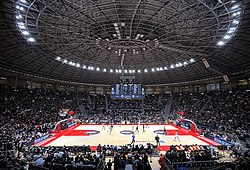
PalaDozza is an indoor sporting arena located at Piazza Azzarita Manfredi 8, in Bologna, Italy. It was named after Giuseppe Dozza, the long-time communist mayor of Bologna, who served from 1945 to 1966. In Italy, the arena is frequently nicknamed Il Madison, after Madison Square Garden. The seating capacity of the arena for basketball games is 5,721 people. It is currently home to the Fortitudo Bologna professional basketball team.

Key Information

History

[edit]

The arena was inaugurated in 1956. The arena hosted the FIBA European Champions Cup's 1965–66 season's Final Four, in which the Italian club Simmenthal Milano, won the competition.[1] It was played in front of an 8,000 capacity crowd.[2]

The Rolling Stones' first Italian concert was held here on 5 April 1967. During the band's sixth European tour.

Bruce Dickinson's first live show with Iron Maiden was performed here in October of 1981.[3][4]

The venue hosted Group B in EuroBasket Women 2025.

See also

[edit]

References

[edit]
[edit]
Revisions and contributorsEdit on WikipediaRead on Wikipedia
from Grokipedia
PalaDozza is an historic indoor multi-purpose arena located in , , renowned as the "temple of Italian " for its central role in the city's sporting heritage since its opening in 1956. Originally constructed between 1954 and 1956 on a site cleared by bombings near Porta San Felice and Porta Lame, the venue was built at the initiative of Bologna's mayor Giuseppe Dozza to provide a dedicated space for growing and events, replacing the inadequate Sala Borsa. Named PalaDozza in 1996 to honor the long-serving mayor who oversaw its creation, the arena spans 7,200 square meters with a volume of 85,000 cubic meters, featuring 48 steel columns and 18 tiers of seating. Following renovations, it now accommodates 5,570 spectators in a configuration optimized for sports, concerts, theater, and conventions. The arena's significance extends beyond sports, having hosted pivotal basketball milestones such as the 1956 inaugural Trofeo Aldo Mairano, the first derby on October 29, 1956, and the 1962 final between Milano and , while also serving as a cultural hub for landmark concerts by on April 15, 1967, and on May 26, 1968. Today, situated at Piazza Azzarita Manfredi 8 near Bologna's historic center, PalaDozza continues to draw crowds for professional games featuring teams like and , alongside diverse entertainment events. In 2025, the MUBIT Italian Basketball Museum opened within the arena, further highlighting its enduring legacy as a versatile and iconic venue.

Location and Construction

Site and Design

The PalaDozza is located at Piazza Manfredi Azzarita 8, in , , at coordinates 44°30′00″N 11°19′56″E. It sits within the historic city walls of , positioned between the Porta San Felice and Porta Lame gates on a site previously occupied by the Ospedale Maggiore, which had been cleared following wartime bombings. Construction of the arena began on March 15, 1954, and was completed in 1956, initiated by Giuseppe Dozza, Bologna's mayor from 1945 to 1966 and a key communist figure who advocated for public infrastructure projects in the post-World War II reconstruction period. The project addressed the urgent local need for dedicated indoor sports facilities, especially for and , as earlier venues like the Sala Borsa had become overcrowded. Originally named , the arena's design by Francesco Allegra of the prioritized functional multi-sport use with a basic layout lacking ornate decorations. It features a structure with a roof supported by 48 columns, evoking a modern, spaceship-like form inspired by New York City's to symbolize progressive urban development. In 1996, it was renamed PalaDozza to honor the late mayor's contributions to the city's sporting heritage.

Opening and Initial Purpose

The Palazzetto dello Sport, later known as PalaDozza, officially opened on August 9, 1956, in Bologna, Italy, addressing the pressing demand for dedicated indoor facilities for basketball and boxing amid the city's growing sports enthusiasm. Constructed under the initiative of Mayor Giuseppe Dozza, the arena was envisioned as a vital response to post-World War II urban reconstruction efforts, where Italy saw accelerated demand for public recreation spaces to support community health and social cohesion, though municipal provisions often lagged behind population growth. Its initial purpose centered on serving as a community hub for both amateur and professional sports, aligning with the era's national push toward accessible public leisure to foster physical fitness and local identity in industrial cities like Bologna. The venue quickly became a cornerstone for Emilia-Romagna's sports scene, hosting its first competitive event on September 12, 1956, with the 4th Trofeo Aldo Mairano international basketball tournament, where Italy defeated Poland 70-54, followed by the inaugural local derby between Virtus and Gira on October 29, 1956. Boxing bouts also featured prominently from the outset, catering to fans of prominent local fighters like “Gigante Cavicchi.” Early operations fell under municipal oversight, reflecting Bologna's administrative focus on public welfare projects led by Mayor Dozza. Basic amenities, including standard lighting systems and a wooden suitable for indoor and combat sports, were installed to enable immediate use for competitions, marking the arena's role in elevating the region's sporting infrastructure.

Historical Development

Early Sports Events

Following its opening, PalaDozza quickly became the primary venue for Bologna's professional basketball teams, with adopting it as their home arena starting in the 1957–58 season, initiating a period of growing dominance in Italian basketball. similarly began hosting regular games there from 1957, sharing the facility and fostering the city's emerging "Basket City" identity through local rivalries and national competitions. These early matches helped establish PalaDozza as a hub for games, with both clubs competing in the league's top tier and contributing to Bologna's post-World War II sports revival. During the , PalaDozza hosted numerous national league and cup fixtures, elevating its profile on the European stage. A landmark event was the 1965–66 European Champions Cup , held at the arena (then known as ) from March 30 to April 1, 1966, where Simmenthal Milano defeated TJ Slavia VŠ Praha 77–72 in the final to claim the title. This tournament, the first in the competition's format, drew international attention to the venue's suitability for high-stakes indoor . Beyond basketball, PalaDozza supported Bologna's broader athletic recovery in the post-war era by accommodating other sports, including boxing tournaments. Boxing events were particularly frequent, with professional bouts held twice weekly on Mondays and Fridays throughout the 1950s and 1960s, often packing the arena to capacity and attracting large crowds for local and regional fights. Attendance at PalaDozza grew steadily from the 1950s through the 1970s, reflecting rising fan interest in Bologna's sports scene, with the arena's capacity reaching up to 9,000 including standing room. Local derbies between Virtus and Fortitudo, starting with their first Serie A matchup on December 15, 1966 (a 73–66 Virtus victory), became electric affairs that routinely filled the venue, intensifying the passionate atmosphere and solidifying the arena's role in community engagement. Crowds for these games, along with national fixtures, often exceeded 7,000, underscoring the venue's cultural significance in an era of economic rebuilding.

Renovations and Modernization

The PalaDozza arena has undergone several renovations since its 1956 construction, with significant updates aimed at enhancing safety, capacity, and functionality during periods of heightened use by Bologna's basketball teams in their competitive peaks. In the 1990s, amid the success of and —who achieved multiple national and European titles—modifications focused on updating seating arrangements and bolstering safety features to accommodate larger crowds and comply with evolving regulations, though specific project details from that era remain limited in public records. These changes helped maintain the venue's role as a central hub for high-profile sports events without major structural overhauls. A major milestone came in 2000 with an important renovation that introduced modern technological elements, including the installation of a cube suspended above the court for enhanced visual displays during games and events. This upgrade improved spectator engagement and aligned the arena with contemporary broadcasting standards, supporting the ongoing legacy of in . Further post-2000 efforts emphasized and safety, such as the addition of dedicated entrances, seating, toilets, and for disabled visitors at the internal and Nannetti entrances, alongside the integration of emergency equipment like defibrillators and kits. While explicit fire safety system overhauls are not detailed in available sources, these measures contributed to overall compliance with modern venue standards. Additionally, the arena incorporated services, including connectivity via the regional EmiliaRomagnaWiFi network, facilitating digital access for attendees. In 2018, renovation work commenced to broaden the venue's versatility beyond sports, incorporating enhancements to acoustics, , and to better support non-athletic programming such as conferences and conventions. These modifications, part of a broader push to revitalize the 7,200 sqm space, included upgraded audio amplification systems suitable for live performances—previously hosting artists like and —and improved climate control with and heating. By 2019, ongoing projects added a new fixed floor covering the entire oval for reduced maintenance and multi-sport use, an energy-efficient LED system with 54 projectors meeting standards, refreshed bathrooms and seating, and LED banners along the ring. Plans also advanced for photovoltaic panels, better insulation, and advanced windows to boost energy efficiency, with a total investment exceeding €2 million for structural consolidation alone. These cumulative renovations have significantly expanded event diversity at PalaDozza, enabling year-round programming that includes business meetings, theatrical productions, and cultural exhibits alongside basketball, while preserving the integrity of its sports facilities—now with a capacity of nearly 5,500 seated spectators. The upgrades have positioned the arena as a multifunctional venue in Bologna's historic center, supporting and without altering its core architectural identity.

Facilities and Capacity

Architectural Features

The PalaDozza's primary architectural innovation is its steel roof framework, which creates a wide open span essential for unobstructed sightlines across the arena's compact urban footprint. Constructed using Dalmine steel tubes, this metal dome reaches a maximum height of 25 meters at its center, enclosing an area of 7,200 square meters while maintaining structural integrity for versatile indoor use. Designed by architect Francesco Allegra of the between 1954 and 1956, the arena embodies a functionalist approach characteristic of mid-20th-century Italian public architecture, prioritizing utility and simplicity over decorative elements. The building's provides robust foundations and perimeter walls, enabling adaptability for various configurations without excessive ornamentation. This modular quality in its construction materials supports the venue's dual role in sports and early entertainment applications. The arena's circular form, inspired by New York's , enhances its engineering efficiency by distributing loads evenly across the steel framework. Situated in Bologna's historic city center at Piazza Azzarita Manfredi, the PalaDozza integrates seamlessly with the surrounding urban fabric, positioned in close proximity to the medieval city walls and featuring a restrained exterior that respects the area's architectural heritage.

Seating and Layout

The PalaDozza arena maintains a current capacity of 5,570 seats specifically configured for games. Overall, it features over 5,000 numbered seats across its layout, complemented by 1,200 square meters of usable floor space for various activities. The internal configuration centers on a main court encircled by tiered seating divided into four distinct sections—Azzarita, Calori, Graziano, and Nannetti—encompassing parterre-level seating and upper tiers to ensure optimal sightlines from all positions. This arrangement provides excellent visibility throughout the venue, enhancing the spectator experience during events. Recent enhancements include a 360° video cube installation. For versatility, the arena supports flexible setups, including removable seating sections that allow reconfiguration for concerts or the expansion of floor space to accommodate conventions and other gatherings. is integrated through dedicated spaces for persons with disabilities, such as ramps and reserved areas, with updates aligned to contemporary standards. These elements build upon adaptations from the venue's original 1956 design.

Sports Legacy

Basketball Significance

PalaDozza has served as a long-term home arena for Bologna's premier clubs, from 1957 to 1996, 2017 to 2019, and temporarily in 2025, and from 1957 to 1996, 1999 to 2020, and since 2021. This shared history made the venue the epicenter of the intense local rivalry, with derbies often dubbed "La Rivincita" for their themes of revenge and redemption between the two teams. These matchups, hosted under PalaDozza's roof, fueled a cultural divide in the city, drawing passionate crowds and defining Italian 's competitive landscape during the late . The arena's basketball legacy elevated Bologna to the status of Italy's "Basket City," a nickname reflecting its dominance in the sport through multiple national championships and high-profile international contests. secured several titles there, including the 1983/1984 , while both clubs hosted games that showcased European talent and contributed to the city's reputation for producing champions. Fortitudo's presence further amplified this, with the venue witnessing collective successes that included over a dozen combined Italian league wins across the teams' tenures. PalaDozza's intimate atmosphere and fervent fan culture, particularly during the 1980s and 1990s, created an electric environment that intimidated opponents and amplified rivalries, often resulting in sold-out crowds of up to 5,570 spectators. Virtus achieved notable perfect home record streaks in domestic play during this era, underscoring the arena's role as a fortress. In recent years, this legacy persists, as evidenced by Virtus's 99-89 EuroLeague victory over Anadolu Efes on November 11, 2025, where they sank a club-record 18 three-pointers to maintain a perfect 4-0 home record at PalaDozza that season.

Other Sports and Tournaments

In addition to its primary role in , PalaDozza has hosted a variety of other sports, contributing to Bologna's diverse sporting landscape. has been particularly prominent, with the arena serving as a venue for national league matches and teams such as Lubia Minganti and Zinella in earlier decades. During the 2012–2013 season, Volley 2002 Bologna used PalaDozza for home games in Serie A1, including notable matches like a 3-1 loss to Rebecchi Nordmeccanica . The facility has accommodated over 30 events overall, underscoring its adaptability for court-based competitions. Boxing events trace back to the arena's origins, as PalaDozza was constructed in 1956 partly in response to demand from enthusiasts alongside basketball fans. Early programming included matches and athletics gatherings, evolving to feature indoor track meets and other track-and-field activities in its initial years. More recently, the venue revived major with the 2024 Bologna Boxing Night, where Pamela Malvina Noutcho Sawa competed for the EBU Silver European lightweight title, and a 2025 event where she claimed the IBO World Championship against Karen Carabajal. PalaDozza has also supported international tournaments, establishing a precedent for high-profile competitions beyond domestic play. In 1966, it hosted the of the FIBA European Champions Cup (now ), where Simmenthal Milano won the title by defeating Slavia VŠ Praha in the final, after beating in the semifinals. This legacy continues with the arena selected to host Group B of the FIBA Women's from June 18 to 21, featuring the Italian national team against , , and in matches that mark the tournament's return to after nearly two decades. The arena's programming occasionally extends to other disciplines like and aerial arts, as seen in the upcoming 2025 Pole & Aerial World Cup, which will feature competitions in pole art, , and hoop events from November 27 to 30. This versatility complements its basketball focus while highlighting PalaDozza's role in fostering a broad spectrum of athletic endeavors in .

Entertainment History

Notable Concerts

The PalaDozza arena has hosted numerous significant musical performances since its opening, transitioning from primarily sports-focused events to a versatile venue for rock and pop concerts in the mid-20th century. One of the earliest major rock shows in took place there on April 5, 1967, when performed two sets during their European tour, marking their first concert in and drawing enthusiastic crowds to the then-newly named Palazzo dello Sport. The venue continued to attract rock legends, including Jimi Hendrix's performance on May 26, 1968, during his second European tour, where he played two shows featuring hits like "" and "," further cementing PalaDozza's status as a key stop for international acts. In the realm of heavy metal, the arena gained further prominence on October 26, 1981, as the site of Bruce Dickinson's live debut with during their , a pivotal moment that introduced the band's new frontman and solidified PalaDozza's role in the genre's history. The performance, captured in rare footage, showcased Dickinson's dynamic stage presence alongside classics like "Twilight Zone" and "The Number of the Beast," influencing subsequent metal tours across Europe. Throughout the to , PalaDozza became a hub for key performances by international and Italian artists, attracting large crowds and highlighting its growing profile. Notable examples include shows by Italian icons such as on April 17, 1978, and on April 24, 1978, blending local folk-rock with broader appeal. Over time, concert setups at PalaDozza evolved to optimize its post-1956 design for non-sports uses, with stages typically positioned at one end of the arena to accommodate up to 5,700 spectators while integrating advanced audio-visual systems for enhanced immersion during performances.

Theatrical and Other Events

The PalaDozza arena has hosted theatrical productions and plays, particularly those requiring expansive staging for large audiences, with notable examples emerging in the late 2000s and 2010s. Comedian Corrado Guzzanti's satirical show was performed there in February 2010, drawing crowds to the venue's versatile space typically associated with sports. In 2020, responding to pandemic restrictions, the Teatro Comunale di Bologna shifted its opera season to the PalaDozza, enabling socially distanced performances of works like Gaetano Donizetti's , which premiered on October 22 and marked a significant adaptation of the arena for classical theatrical presentations. Post-2018 renovations expanded the PalaDozza's suitability for conventions, meetings, and corporate events by incorporating a 1,200 square meter flexible floor area ideal for exhibitions and assemblies. These upgrades transformed the venue into a multifunctional hub, accommodating professional gatherings alongside its core uses. A representative example is the 2019 Jr. NBA Global Championship Europe and Middle East Selection Camp, a collaborative corporate initiative with Bologna Welcome that engaged 60 young participants from 24 countries in basketball training and development activities over several days in April. Miscellaneous events at the PalaDozza further highlight its role in niche cultural programming, including international competitions in pole and aerial arts. The 2021 World Pole Art Championship, organized by the Pole Sports & Arts World Federation, was held on December 11–12, featuring elite athletes in disciplines like pole sport and artistic pole dancing. Building on this, the venue will host the Pole & Aerial World Cup by U.N.A. from November 27–30, 2025, encompassing categories such as pole art, , and . The arena also supports family-oriented holiday shows and community spectacles, enhancing its appeal during festive periods. For instance, the circus production Le Cirque Alis: Il Nuovo Mondo ran from December 5–8, 2024, presenting acrobatic feats and narrative elements suitable for all ages in a holiday-timed engagement. The PalaDozza's annual programming blends such events with broader cultural and community activities, promoting diverse entertainment that engages local residents year-round.

Current Operations

Tenants and Teams

The primary tenant of PalaDozza is , a professional basketball club that has used the arena as its home venue since 2021 for matches in Italy's Serie A2 league. The team regularly schedules home games there, such as the September 28, 2025, matchup against Givova Scafati and the October 5, 2025, game versus UEB United Eagles Cividale. Virtus Bologna, another prominent Bologna-based basketball club, maintains an occasional presence at PalaDozza, serving as a temporary home for its games during the 2025-26 season amid construction delays for its dedicated Virtus Arena. As of November 2025, is using PalaDozza temporarily for the early part of the 2025-26 season, with relocation to the new Virtus Arena scheduled for late November 2025. This includes high-profile contests like the , 2025, victory over Anadolu Efes, where set a club record with 18 three-pointers made. Earlier in the season, also hosted Bayern Munich in a friendly exhibition at the venue on September 13, 2025. Historically, leased PalaDozza as its primary venue from 2017 to 2019, during a period of shared arrangements that facilitated alternation with Fortitudo to accommodate both clubs' schedules. In 2012–2013, the volleyball team Volley Forlì Bologna 2002 similarly held tenancy rights, utilizing the arena for Serie A1 matches under a temporary while based in . These arrangements often involved coordinated booking to balance multiple tenants' needs. Tenants benefit from shared facilities at PalaDozza, including six dedicated and access to the 1,200 m² of usable floor space, including the main measuring 28 m x 15 m, for training sessions and preparations. Locker rooms are equipped for team use, with additional amenities like an on-site infirmary supporting game-day operations for both Fortitudo's domestic fixtures and Virtus's international commitments.

Management and Usage

The PalaDozza is owned by the Municipality of and operated under the city's administration as a public asset dedicated to community and cultural activities. Management responsibilities are delegated to Bologna Welcome, a public-private partnership founded by the Municipality of , the , and the , which oversees daily operations and coordinates with the Bologna Convention Bureau for specialized event support. Booking for events at the PalaDozza is handled centrally through , accommodating requests for sports matches, concerts, conventions, and other gatherings via email or phone inquiries to ensure efficient scheduling. This system emphasizes year-round utilization to optimize the venue's role in Bologna's cultural and economic landscape, with programming that includes numerous events annually across diverse formats to maintain consistent activity and accessibility for organizers and attendees. Visitor services at the PalaDozza are designed for convenience and inclusivity, featuring an on-site ticket office for event admissions, complimentary coverage throughout the arena, and dedicated features such as ramps, disabled parking, and reserved seating areas. These amenities are integrated with 's tourism infrastructure through Bologna Welcome, which provides additional support like multilingual information and linkages to local transportation and hospitality options. Post-renovation enhancements contribute to sustainable operations while supporting the venue's varied programming. The PalaDozza's modular setup enables scalable configurations, accommodating intimate conferences for around 100 participants up to full-capacity crowds of 5,570 for major events.

Cultural Impact

Nickname and Reputation

The PalaDozza arena in , , is widely known by the nickname "Il Madison," a reference to New York's , stemming from its architectural resemblance to the iconic venue and its Western-inspired design elements that evoked the grandeur of American halls. This moniker, often rendered as "Madison di Piazza Azzarita" after its location, underscores the arena's status as a central hub for European since its opening in 1956, positioning it as a smaller but equally revered counterpart in Italy's sports landscape. The venue has earned a enduring reputation as the "tempio del basket" (temple of ) in , largely due to the intense atmospheres generated by the historic rivalries between local teams and , whose derbies have drawn passionate crowds and defined the city's basketball identity. These matchups, along with championship games hosted there, have cemented its role as a for Italian hoops enthusiasts, where the electric energy of sold-out contests has become legendary. In broader cultural terms, PalaDozza holds significant recognition in as a historic venue that intertwines the city's deep-rooted sports heritage with milestones in entertainment, serving as a landmark that has hosted not only but also landmark concerts and public gatherings since 1956. This dual legacy reflects 's nickname as "Basket City" while extending to its vibrant cultural scene, making the arena a symbol of communal pride and continuity in the region. Italian media outlets have frequently portrayed PalaDozza as an integral part of Bologna's local identity, emphasizing its foundational role in the city's sports and entertainment narrative from its inception under Mayor Giuseppe Dozza. Press coverage in sources like highlights its enduring symbolism as a "tempio del basket bolognese," reinforcing its place in through stories of rivalry-fueled triumphs and cultural events that have shaped urban lore over decades.

Future Events and Plans

PalaDozza hosted Group B matches of the Women's from June 18 to 21, 2025, featuring the Italian national team against , , and , as part of a multi-country aimed at elevating in . Italy and advanced to the quarter-finals, underscoring the arena's continued role in international competitions and drawing global audiences to . As of November 2025, plans for establishing a dedicated museum, known as MUBIT ( of Italian ), within the facility continue to advance to preserve artifacts from 's storied heritage, including items from and Fortitudo clubs. Conceived through a 2019 ideas contest by the Municipality of and Bologna Welcome, the museum aims to create an innovative space for and on Italian history, with preparations ongoing for an opening by the end of 2025 in renovated portions of the arena, enhancing its cultural offerings. The arena features digital enhancements, including free high-speed EmiliaRomagnaWiFi implemented in 2024 to support and connectivity for global event audiences. These upgrades facilitate broader accessibility and modern broadcasting capabilities, aligning with Bologna's push toward tech-enabled venues. Under Bologna's municipal strategic plans, PalaDozza is positioned for long-term versatility to support the city's expanding event sector, including , concerts, and conventions, while maintaining its status as a multifunctional hub. This vision emphasizes and integration with urban infrastructure improvements, such as nearby tram expansions, to boost attendance and economic impact.

References

Add your contribution
Related Hubs
User Avatar
No comments yet.