Hubbry Logo
Miles DavisMiles DavisMain
Open search
Miles Davis
Community hub
Miles Davis
logo
8 pages, 0 posts
0 subscribers
Be the first to start a discussion here.
Contribute something
Miles Davis
Miles Davis
from Wikipedia

Miles Dewey Davis III (May 26, 1926 – September 28, 1991) was an American trumpeter, bandleader and composer. He is among the most influential and acclaimed figures in the history of jazz and 20th-century music. Davis adopted a variety of musical directions in a roughly five-decade career that kept him at the forefront of many major stylistic developments in genres such as jazz, classical, and experimental music.[1]

Key Information

Born into an upper-middle-class[2] family in Alton, Illinois, and raised in East St. Louis, Davis started on the trumpet in his early teens. He left to study at Juilliard in New York City, before dropping out and making his professional debut as a member of saxophonist Charlie Parker's bebop quintet from 1944 to 1948. Shortly after, he recorded the Birth of the Cool sessions for Capitol Records, which were instrumental to the development of cool jazz. In the early 1950s, while addicted to heroin, Davis recorded some of the earliest hard bop music under Prestige Records. After a widely acclaimed comeback performance at the Newport Jazz Festival, he signed a long-term contract with Columbia Records, and recorded the album 'Round About Midnight in 1955.[3] It was his first work with saxophonist John Coltrane and bassist Paul Chambers, key members of the sextet he led into the early 1960s. During this period, he alternated between orchestral jazz collaborations with arranger Gil Evans, such as the Spanish music–influenced Sketches of Spain (1960), and band recordings, such as Milestones (1958) and Kind of Blue (1959).[4] The latter recording remains one of the most popular jazz albums of all time,[5] having sold over five million copies in the U.S.

Davis made several lineup changes while recording Someday My Prince Will Come (1961), his 1961 Blackhawk concerts, and Seven Steps to Heaven (1963), another commercial success that introduced bassist Ron Carter, pianist Herbie Hancock and drummer Tony Williams.[4] After adding saxophonist Wayne Shorter to his new quintet in 1964,[4] Davis led them on a series of more abstract recordings often composed by the band members, helping pioneer the post-bop genre with albums such as E.S.P. (1965) and Miles Smiles (1967),[6] before transitioning into his electric period. During the 1970s, he experimented with rock, funk, African rhythms, emerging electronic music technology, and an ever-changing lineup of musicians, including keyboardist Joe Zawinul, drummer Al Foster, bassist Michael Henderson and guitarist John McLaughlin.[7] This period, beginning with Davis's 1969 studio album In a Silent Way and concluding with the 1975 concert recording Agharta, was the most controversial in his career, alienating and challenging many in jazz.[8] His million-selling 1970 record Bitches Brew helped spark a resurgence in the genre's commercial popularity with jazz fusion as the decade progressed.[9]

After a five-year retirement due to poor health, Davis resumed his career in the 1980s, employing younger musicians and pop sounds on albums such as The Man with the Horn (1981), You're Under Arrest (1985) and Tutu (1986). Critics were often unreceptive but the decade garnered Davis his highest level of commercial recognition. He performed sold-out concerts worldwide, while branching out into visual arts, film and television work, before his death in 1991 from the combined effects of a stroke, pneumonia and respiratory failure.[10] In 2006, Davis was inducted into the Rock and Roll Hall of Fame,[11] which recognized him as "one of the key figures in the history of jazz".[11] Rolling Stone described him as "the most revered jazz trumpeter of all time, not to mention one of the most important musicians of the 20th century,"[10] while Gerald Early called him inarguably one of the most influential and innovative musicians of that period.[12]

Early life

[edit]

Davis was born on May 26, 1926, to an affluent African-American family in Alton, Illinois, 15 miles (24 kilometers) north of St. Louis.[13][14] He had an older sister, Dorothy Mae (1925–1996) and a younger brother, Vernon (1929–1999). His mother, Cleota Mae Henry of Arkansas, was a music teacher and violinist, and his father, Miles Dewey Davis Jr., also of Arkansas, was a dentist. They owned a 200-acre (81 ha) estate near Pine Bluff, Arkansas, with a profitable pig farm. In Pine Bluff, he and his siblings fished, hunted, and rode horses.[15][16] Davis's grandparents were the owners of an Arkansas farm where he would spend many summers.[17]

In 1927, the family moved to East St. Louis, Illinois. They lived on the second floor of a commercial building behind a dental office in a predominantly white neighborhood. Davis's father would soon become distant to his children as the Great Depression caused him to become increasingly consumed by his job, typically working six days a week.[17] From 1932 to 1934, Davis attended John Robinson Elementary School, an all-black school,[14] then Crispus Attucks, where he performed well in mathematics, music and sports.[16] Davis had previously attended Catholic school.[17] At an early age he liked music, especially blues, big bands and gospel.[15]

The house at 1701 Kansas Avenue in East St. Louis, Illinois, where Davis lived from 1939 to 1944

In 1935, Davis received his first trumpet as a gift from John Eubanks, a friend of his father.[18] He then took weekly lessons from "the biggest influence on my life", Elwood Buchanan, a teacher and musician who was a patient of his father.[13][19] His mother wanted him to play the violin instead.[20] Against the fashion of the time, Buchanan stressed the importance of playing without vibrato and encouraged him to use a clear, mid-range tone. Davis said that whenever he started playing with heavy vibrato, Buchanan slapped his knuckles.[13][20][21] In later years Davis said, "I prefer a round sound with no attitude in it, like a round voice with not too much tremolo and not too much bass. Just right in the middle. If I can't get that sound I can't play anything."[22] The family soon moved to 1701 Kansas Avenue in East St. Louis.[17]

In his autobiography, Davis stated, "By the age of 12, music had become the most important thing in my life."[19] On his thirteenth birthday his father bought him a new trumpet,[18] and Davis began to play in local bands. He took additional trumpet lessons from Joseph Gustat, principal trumpeter of the St. Louis Symphony Orchestra.[18] Davis would also play the trumpet in talent shows he and his siblings would put on.[17]

In 1941, the 15-year-old attended East St. Louis Lincoln High School, where he joined the marching band directed by Buchanan and entered music competitions. Years later, Davis said that he was discriminated against in these competitions due to his race, but he added that these experiences made him a better musician.[16] When a drummer asked him to play a certain passage of music, and he could not do it, he began to learn music theory. "I went and got everything, every book I could get to learn about theory."[23] At Lincoln, Davis met his first girlfriend, Irene Birth (later Cawthon).[24] He had a band that performed at the Elks Club.[25] Part of his earnings paid for his sister's education at Fisk University.[26] Davis befriended trumpeter Clark Terry, who suggested he play without vibrato, and performed with him for several years.[18][26]

With encouragement from his teacher and girlfriend, Davis filled a vacant spot in the Rhumboogie Orchestra, also known as the Blue Devils, led by Eddie Randle. He became the band's musical director, which involved hiring musicians and scheduling rehearsal.[26][27] Years later, Davis considered this job one of the most important of his career.[23] Sonny Stitt tried to persuade him to join the Tiny Bradshaw band, which was passing through town, but his mother insisted he finish high school before going on tour. He said later, "I didn't talk to her for two weeks. And I didn't go with the band either."[28] In January 1944, Davis finished high school and graduated in absentia in June. During the next month, his girlfriend gave birth to a daughter, Cheryl.[26]

In July 1944, Billy Eckstine visited St. Louis with a band that included Art Blakey, Dizzy Gillespie and Charlie Parker. Trumpeter Buddy Anderson was too sick to perform,[13] so Davis was invited to join. He played with the band for two weeks at Club Riviera.[26][29] After playing with these musicians, he was certain he should move to New York City, "where the action was".[30] His mother wanted him to go to Fisk University, like his sister, and study piano or violin. Davis had other interests.[28]

Career

[edit]

1944–1948: New York City and the bebop years

[edit]
Tommy Potter, Charlie Parker, Max Roach, Miles Davis and Duke Jordan in August 1947

In September 1944, Davis accepted his father's idea of studying at the Juilliard School of Music in New York City.[26] After passing the audition, he attended classes in music theory, piano and dictation.[31] Davis often skipped his classes.[32]

Much of Davis's time was spent in clubs seeking his idol, Charlie Parker. According to Davis, Coleman Hawkins told him "finish your studies at Juilliard and forget Bird [Parker]".[29][33] After finding Parker, he joined a cadre of regulars at Minton's and Monroe's in Harlem who held jam sessions every night. The other regulars included J. J. Johnson, Kenny Clarke, Thelonious Monk, Fats Navarro and Freddie Webster. Davis reunited with Irene and their daughter Cheryl when they moved to New York City. Parker became a roommate.[26][29] Around this time Davis was paid an allowance of $40 (equivalent to $710 in 2024[34]).[35]

In mid-1945, Davis failed to register for the year's autumn term at Juilliard and dropped out after three semesters[15][26][36] because he wanted to perform full-time.[37] Years later he criticized Juilliard for concentrating too much on classical European and "white" repertoire, but he praised the school for teaching him music theory and improving his trumpet technique.

Davis began performing at clubs on 52nd Street with Coleman Hawkins and Eddie "Lockjaw" Davis. He recorded for the first time on April 24, 1945, when he entered the studio as a sideman for Herbie Fields's band.[26][29] During the next year, he recorded as a leader for the first time with the Miles Davis Sextet plus Earl Coleman and Ann Baker, one of the few times he accompanied a singer.[38]

Davis on piano with Howard McGhee (trumpet), Joe Albany (pianist, standing) and Brick Fleagle (guitarist, smoking), September 1947

In 1945, Davis replaced Dizzy Gillespie in Charlie Parker's quintet. On November 26, he participated in several recording sessions as part of Parker's group Reboppers that also involved Gillespie and Max Roach,[26] displaying hints of the style he would become known for. On Parker's tune "Now's the Time", Davis played a solo that anticipated cool jazz. He next joined a big band led by Benny Carter, performing in St. Louis and remaining with the band in California. He again played with Parker and Gillespie.[39] In Los Angeles, Parker had a nervous breakdown that put him in the hospital for several months.[39][40] In March 1946, Davis played in studio sessions with Parker and began a collaboration with Mingus that summer. Cawthon gave birth to Davis's second child, Gregory, in East St. Louis before reuniting with Davis in New York City the following year.[39] Davis noted that by this time, "I was still so much into the music that I was even ignoring Irene." He had also turned to alcohol and cocaine.[41]

Davis was a member of Billy Eckstine's big band in 1946 and Gillespie's in 1947.[42] He joined a quintet led by Parker that also included Max Roach. Together they performed live with Duke Jordan and Tommy Potter for much of the year, including several studio sessions.[39] In one session that May, Davis wrote the tune "Cheryl", for his daughter. Davis's first session as a leader followed in August 1947, playing as the Miles Davis All Stars that included Parker, pianist John Lewis and bassist Nelson Boyd; they recorded "Milestones", "Half Nelson" and "Sippin' at Bells".[39][43] After touring Chicago and Detroit with Parker's quintet, Davis returned to New York City in March 1948 and joined the Jazz at the Philharmonic tour, which included a stop in St. Louis on April 30.[39]

1948–1950: Miles Davis Nonet and Birth of the Cool

[edit]

In August 1948, Davis declined an offer to join Duke Ellington's orchestra as he had entered rehearsals with a nine-piece band featuring baritone saxophonist Gerry Mulligan and arrangements by Gil Evans, taking an active role on what soon became his own project.[44][39] Evans' Manhattan apartment had become the meeting place for several young musicians and composers such as Davis, Roach, Lewis and Mulligan who were unhappy with the increasingly virtuoso instrumental techniques that dominated bebop.[45] These gatherings led to the formation of the Miles Davis Nonet, which included atypical modern jazz instruments such as French horn and tuba, leading to a thickly textured, almost orchestral sound.[32] The intent was to imitate the human voice through carefully arranged compositions and a relaxed, melodic approach to improvisation. In September, the band completed their sole engagement as the opening band for Count Basie at the Royal Roost for two weeks. Davis had to persuade the venue's manager to write the sign "Miles Davis Nonet. Arrangements by Gil Evans, John Lewis and Gerry Mulligan". Davis returned to Parker's quintet, but relationships within the quintet were growing tense mainly due to Parker's erratic behavior caused by his drug addiction.[39] Early in his time with Parker, Davis abstained from drugs, chose a vegetarian diet, and spoke of the benefits of water and juice.[46]

In December 1948, Davis quit, saying he was not being paid.[39] His departure began a period when he worked mainly as a freelancer and sideman. His nonet remained active until the end of 1949. After signing a contract with Capitol Records, they recorded sessions in January and April 1949, which sold little but influenced the "Cool" or "West Coast" style of jazz.[39] The lineup changed throughout the year and included tuba player Bill Barber, alto saxophonist Lee Konitz, pianist Al Haig, trombone players Mike Zwerin with Kai Winding, French horn players Junior Collins with Sandy Siegelstein and Gunther Schuller, and bassists Al McKibbon and Joe Shulman. One track featured singer Kenny Hagood. The presence of white musicians in the group angered some black players, many of whom were unemployed at the time, yet Davis rebuffed their criticisms.[47] Recording sessions with the nonet for Capitol continued until April 1950. The Nonet recorded a dozen tracks which were released as singles and subsequently compiled on the 1957 album Birth of the Cool.[32]

In May 1949, Davis performed with the Tadd Dameron Quintet with Kenny Clarke and James Moody at the Paris International Jazz Festival. On his first trip abroad Davis took a strong liking to Paris and its cultural environment, where he felt black jazz musicians and people of color in general were better respected than in the U.S. The trip, he said, "changed the way I looked at things forever".[48] He began an affair with singer and actress Juliette Gréco.[48]

1949–1955: Signing with Prestige, heroin addiction and hard bop

[edit]

After returning from Paris in mid-1949, he became depressed and found little work except a short engagement with Bud Powell in October and guest spots in New York City, Chicago and Detroit until January 1950.[49] He was falling behind in hotel rent and attempts were made to repossess his car. His heroin use became an expensive addiction, and Davis, not yet 24 years old, "lost my sense of discipline, lost my sense of control over my life, and started to drift".[39][50] In August 1950, Cawthon gave birth to Davis's second son, Miles IV. Davis befriended boxer Johnny Bratton which began his interest in the sport. Davis left Cawthon and his three children in New York City in the hands of one his friends, jazz singer Betty Carter.[49] He toured with Eckstine and Billie Holiday and was arrested for heroin possession in Los Angeles. The story was reported in DownBeat magazine, which led to a further reduction in work, though he was acquitted weeks later.[51] By the 1950s, Davis had become more skilled and was experimenting with the middle register of the trumpet alongside harmonies and rhythms.[32]

In January 1951, Davis's fortunes improved when he signed a one-year contract with Prestige after owner Bob Weinstock became a fan of the nonet.[52] Davis chose Lewis, trombonist Bennie Green, bassist Percy Heath, saxophonist Sonny Rollins and drummer Roy Haynes; they recorded what became part of Miles Davis and Horns (1956). Davis was hired for other studio dates in 1951[51] and began to transcribe scores for record labels to fund his heroin addiction. His second session for Prestige was released on The New Sounds (1951), Dig (1956) and Conception (1956).[53]

Davis supported his heroin habit by playing music and by living the life of a hustler, exploiting prostitutes and receiving money from friends. By 1953, his addiction began to impair his playing. His drug habit became public in a DownBeat interview with Cab Calloway, whom he never forgave as it brought him "all pain and suffering".[54] He returned to St. Louis and stayed with his father for several months.[54] After a brief period with Roach and Mingus in September 1953,[55] he returned to his father's home, where he concentrated on addressing his addiction.[56]

Davis lived in Detroit for about six months, avoiding New York City, where it was easy to get drugs. Though he used heroin, he was still able to perform locally with Elvin Jones and Tommy Flanagan as part of Billy Mitchell's house band at the Blue Bird club. He was also "pimping a little".[57] However, he was able to end his addiction, and, in February 1954, Davis returned to New York City, feeling good "for the first time in a long time", mentally and physically stronger, and joined a gym.[58] He informed Weinstock and Blue Note that he was ready to record with a quintet, which he was granted. He considered the albums that resulted from these and earlier sessions—Miles Davis Quartet and Miles Davis Volume 2—"very important" because he felt his performances were particularly strong.[59] He was paid roughly $750 (equivalent to $8,800 in 2024[34]) for each album and refused to give away his publishing rights.[60]

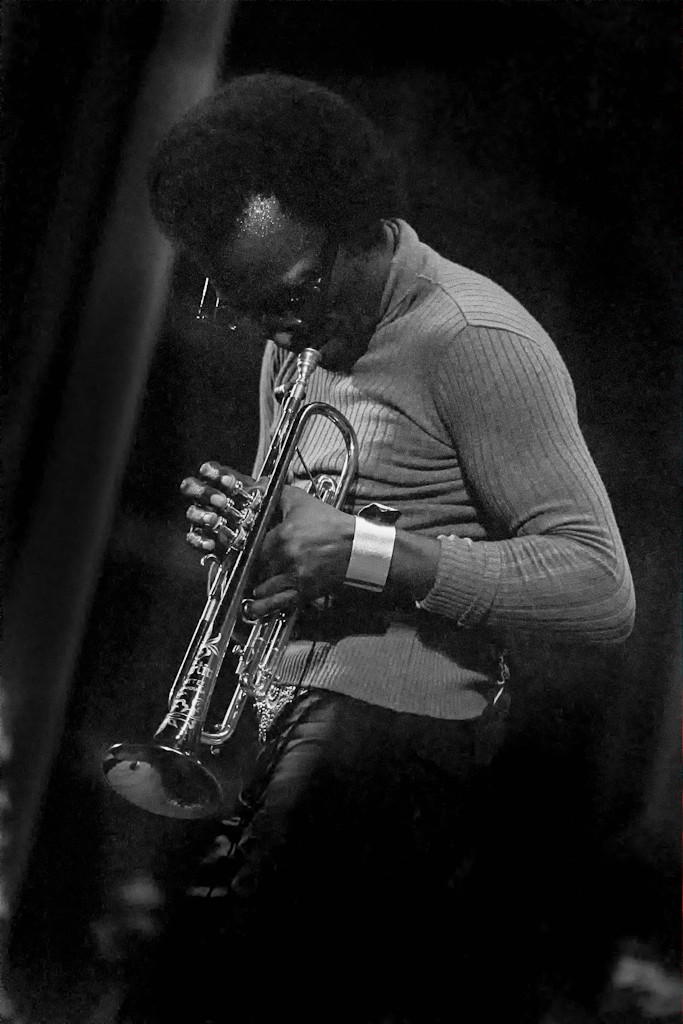
During the 1950s, Davis started using a Harmon mute on his trumpet. It became part of his signature sound for the rest of his career.

Davis abandoned the bebop style and turned to the music of pianist Ahmad Jamal, whose approach and use of space influenced him.[61] When he returned to the studio in June 1955 to record The Musings of Miles, he wanted a pianist like Jamal and chose Red Garland.[61] Blue Haze (1956), Bags' Groove (1957), Walkin' (1957), and Miles Davis and the Modern Jazz Giants (1959) documented the evolution of his sound with the Harmon mute placed close to the microphone, and the use of more spacious and relaxed phrasing. He assumed a central role in hard bop, less radical in harmony and melody, and used popular songs and American standards as starting points for improvisation. Hard bop distanced itself from cool jazz with a harder beat and music inspired by the blues.[62] A few critics consider Walkin' (April 1954) the album that created the hard bop genre.[22]

Davis gained a reputation for being cold, distant and easily angered. He wrote that in 1954 Sugar Ray Robinson "was the most important thing in my life besides music", and he adopted Robinson's "arrogant attitude".[63] He showed contempt for critics and the press.

Davis had an operation to remove polyps from his larynx in October 1955.[64] The doctors told him to remain silent after the operation, but he got into an argument that permanently damaged his vocal cords and gave him a raspy voice for the rest of his life.[65] He was called the "prince of darkness", adding a patina of mystery to his public persona.[a]

1955–1959: Signing with Columbia, first quintet and modal jazz

[edit]

In July 1955, Davis's fortunes improved considerably when he played at the Newport Jazz Festival, with a lineup of Monk, Heath, drummer Connie Kay, and horn players Zoot Sims and Gerry Mulligan.[69][70] The performance was praised by critics and audiences alike, who considered it to be a highlight of the festival as well as helping Davis, the least well known musician in the group, to increase his popularity among affluent white audiences.[70][71] He tied with Dizzy Gillespie for best trumpeter in the 1955 DownBeat magazine Readers' Poll.[72]

George Avakian of Columbia Records heard Davis perform at Newport and wanted to sign him to the label. Davis had one year left on his contract with Prestige, which required him to release four more albums. He signed a contract with Columbia that included a $4,000 advance (equivalent to $46,950 in 2024[34]) and required that his recordings for Columbia remain unreleased until his agreement with Prestige expired.[73][74]

At the request of Avakian, he formed the Miles Davis Quintet for a performance at Café Bohemia. The quintet contained Sonny Rollins on tenor saxophone, Red Garland on piano, Paul Chambers on double bass and Philly Joe Jones on drums. Rollins was replaced by John Coltrane, completing the membership of the first quintet. To fulfill Davis's contract with Prestige, this new group worked through two marathon sessions in May and October 1956 that were released by the label as four LPs: Cookin' with the Miles Davis Quintet (1957), Relaxin' with the Miles Davis Quintet (1958), Workin' with the Miles Davis Quintet (1960) and Steamin' with the Miles Davis Quintet (1961). Each album was critically acclaimed and helped establish Davis's quintet as one of the best.[75][76][77]

The style of the group was an extension of their experience playing with Davis. He played long, legato, melodic lines, while Coltrane contrasted with energetic solos. Their live repertoire was a mix of bebop, standards from the Great American Songbook and pre-bop eras, and traditional tunes. They appeared on 'Round About Midnight, Davis's first album for Columbia.[78]

In 1956, he left his quintet temporarily to tour Europe as part of the Birdland All-Stars, which included the Modern Jazz Quartet and French and German musicians. In Paris, he reunited with Gréco and they "were lovers for many years".[79][80] He then returned home, reunited his quintet and toured the US for two months. Conflict arose on tour when he grew impatient with the drug habits of Jones and Coltrane. Davis was trying to live a healthier life by exercising and reducing his use of alcohol. But he continued to use cocaine.[81] At the end of the tour, he fired Jones and Coltrane and replaced them with Sonny Rollins and Art Taylor.[82]

In November 1957, Davis went to Paris and recorded the soundtrack to Ascenseur pour l'échafaud.[42] directed by Louis Malle and starring Jeanne Moreau. Consisting of French jazz musicians Barney Wilen, Pierre Michelot and René Urtreger, and American drummer Kenny Clarke, the group avoided a written score and instead improvised while they watched the film in a recording studio.[citation needed]

After returning to New York, Davis revived his quintet with Adderley[42] and Coltrane, who was clean from his drug habit. Now a sextet, the group recorded material in early 1958 that was released on Milestones, an album on which the title track demonstrated Davis's interest in modal jazz. A performance by Les Ballets Africains drew him to slower, deliberate music that allowed the creation of solos from static harmony rather than constant changing chords.[83]

By May 1958, he had replaced Jones with drummer Jimmy Cobb, and Garland left the group, leaving Davis to play piano on "Sid's Ahead" for Milestones.[84] He wanted someone who could play modal jazz, so he hired Bill Evans, a young pianist with a background in classical music. This new edition of the sextet made their recording debut on Jazz Track (1958).[85] Evans had an impressionistic approach to piano. His ideas greatly influenced Davis. But after eight months of touring, a tired Evans left. Wynton Kelly, his replacement, brought to the group a swinging style that contrasted with Evans's delicacy.

1957–1963: Collaborations with Gil Evans and Kind of Blue

[edit]

By early 1957, Davis was exhausted from recording and touring and wished to pursue new projects. In March, the 30-year-old Davis told journalists of his intention to retire soon and revealed offers he had received to teach at Harvard University and be a musical director at a record label.[86][87] Avakian agreed that it was time for Davis to explore something different, but Davis rejected his suggestion of returning to his nonet as he considered that a step backward.[87] Avakian then suggested that he work with a bigger ensemble, similar to Music for Brass (1957), an album of orchestral and brass-arranged music led by Gunther Schuller featuring Davis as a guest soloist.

Davis accepted and worked with Gil Evans in what became a five-album collaboration from 1957 to 1962.[88] Miles Ahead (1957) showcased Davis on flugelhorn and a rendition of "The Maids of Cadiz" by Léo Delibes, the first piece of classical music that Davis recorded. Evans devised orchestral passages as transitions, thus turning the album into one long piece of music.[89][90] Porgy and Bess (1959) includes arrangements of pieces from George Gershwin's opera. Sketches of Spain (1960) contained music by Joaquín Rodrigo and Manuel de Falla and originals by Evans. The classical musicians had trouble improvising, while the jazz musicians couldn't handle the difficult arrangements, but the album was a critical success, selling over 120,000 copies in the US.[91] Davis performed with an orchestra conducted by Evans at Carnegie Hall in May 1961 to raise money for charity.[92] The pair's final album was Quiet Nights (1963), a collection of bossa nova songs released against their wishes. Evans stated it was only half an album and blamed the record company; Davis blamed producer Teo Macero and refused to speak to him for more than two years.[93] The boxed set Miles Davis & Gil Evans: The Complete Columbia Studio Recordings (1996) won the Grammy Award for Best Historical Album and Best Album Notes in 1997.

In March and April 1959, Davis recorded what some consider his greatest album, Kind of Blue. He named the album for its mood.[94] He called back Bill Evans, as the music had been planned around Evans's piano style.[95] Both Davis and Evans were familiar with George Russell's ideas about modal jazz.[96] But Davis neglected to tell pianist Wynton Kelly that Evans was returning, so Kelly appeared on only one song, "Freddie Freeloader".[95] The sextet had played "So What" and "All Blues" at performances, but the remaining three compositions they saw for the first time in the studio.

Released in August 1959, Kind of Blue was an instant success, with widespread radio airplay and rave reviews from critics.[94] It has remained a strong seller over the years. In 2019, the album achieved 5× platinum certification from the Recording Industry Association of America for sales of over five million copies in the US, making it one of the most successful jazz albums in history.[97] In 2009, the US House of Representatives passed a resolution that honored it as a national treasure.[98][99]

In August 1959, during a break in a recording session at the Birdland nightclub in New York City, Davis was escorting a blonde-haired woman to a taxi outside the club when policeman Gerald Kilduff told him to "move on".[100][101] Davis said that he was working at the club, and he refused to move.[102] Kilduff arrested and grabbed Davis as he tried to protect himself. Witnesses said the policeman hit Davis in the stomach with a nightstick without provocation. Two detectives held the crowd back, while a third approached Davis from behind and beat him over the head. Davis was taken to jail, charged with assaulting an officer, then taken to the hospital where he received five stitches.[101] By January 1960, he was acquitted of disorderly conduct and third-degree assault. He later stated the incident "changed my whole life and whole attitude again, made me feel bitter and cynical again when I was starting to feel good about the things that had changed in this country".[103]

Davis and his sextet toured to support Kind of Blue.[94] Cannonball Adderley left the group September of that year reducing the band back to a quintet. Coltrane was ready to leave as well but Davis persuaded him to play with the group on one final European tour in the spring of 1960. Coltrane then departed to form his quartet, though he returned for a couple tracks on Davis's album Someday My Prince Will Come (1961). Its front cover shows a photograph of his wife, Frances Taylor, after Davis demanded that Columbia depict black women on his album covers.[104]

1963–1968: Second quintet

[edit]
Davis performing in Antibes, France, in July 1963

In December 1962, Davis, Rollins, Kelly, Chambers and Cobb played together for the last time as the latter three wanted to leave and play as a trio. Rollins left them soon after, leaving Davis to pay over $25,000 (equivalent to $259,900 in 2024[34]) to cancel upcoming gigs and quickly assemble a new group. Following auditions, he found his new band in tenor saxophonist George Coleman, bassist Ron Carter, pianist Victor Feldman and drummer Frank Butler.[105] By May 1963, Feldman and Butler were replaced by 23-year-old pianist Herbie Hancock and 17-year-old drummer Tony Williams who made Davis "excited all over again".[106] With this group, Davis completed the rest of what became Seven Steps to Heaven (1963) and recorded the live albums Miles Davis in Europe (1964), My Funny Valentine (1965) and Four & More (1966). The quintet played essentially the same bebop tunes and standards that Davis's previous bands had played, but they approached them with structural and rhythmic freedom and occasionally breakneck speed.

In 1964, Coleman was briefly replaced by saxophonist Sam Rivers (who recorded with Davis on Miles in Tokyo) until Wayne Shorter was persuaded to leave the Jazz Messengers. The quintet with Shorter lasted through 1968, with Shorter becoming the group's principal composer. The album E.S.P. (1965) was named after his composition. While touring Europe, the group made its first album, Miles in Berlin (1965).[107]

Davis performing at Töölö Sports Hall (Messuhalli) in Helsinki, Finland, in October 1964

Davis needed medical attention for hip pain, which had worsened since his Japanese tour during the previous year.[108] He underwent hip replacement surgery in April 1965, with bone taken from his shin, but it failed. After his third month in the hospital, he discharged himself due to boredom and went home. He returned to the hospital in August after a fall required the insertion of a plastic hip joint.[109] In November 1965, he had recovered enough to return to performing with his quintet, which included gigs at the Plugged Nickel in Chicago. Teo Macero returned as his record producer after their rift over Quiet Nights had healed.[110][111]

In January 1966, Davis spent three months in the hospital with a liver infection. When he resumed touring, he performed more at colleges because he had grown tired of the typical jazz venues.[112] Columbia president Clive Davis reported in 1966 his sales had declined to around 40,000–50,000 per album, compared to as many as 100,000 per release a few years before. Matters were not helped by the press reporting his apparent financial troubles and imminent demise.[113] After his appearance at the 1966 Newport Jazz Festival, he returned to the studio with his quintet for a series of sessions. He started a relationship with actress Cicely Tyson, who helped him reduce his alcohol consumption.[114]

Material from the 1966–1968 sessions was released on Miles Smiles (1966), Sorcerer (1967), Nefertiti (1967), Miles in the Sky (1968) and Filles de Kilimanjaro (1968). The quintet's approach to the new music became known as "time no changes"—which referred to Davis's decision to depart from chordal sequences and adopt a more open approach, with the rhythm section responding to the soloists' melodies.[115] Through Nefertiti the studio recordings consisted primarily of originals composed by Shorter, with occasional compositions by the other sidemen. In 1967, the group began to play their concerts in continuous sets, each tune flowing into the next, with only the melody indicating any sort of change. His bands performed this way until his hiatus in 1975.

Miles in the Sky and Filles de Kilimanjaro—which tentatively introduced electric bass, electric piano and electric guitar on some tracks—pointed the way to the fusion phase of Davis's career. He also began experimenting with more rock-oriented rhythms on these records. By the time the second half of Filles de Kilimanjaro was recorded, bassist Dave Holland and pianist Chick Corea had replaced Carter and Hancock. Davis soon took over the compositional duties of his sidemen.

1968–1975: The electric period

[edit]

In a Silent Way was recorded in a single studio session in February 1969, with Shorter, Hancock, Holland and Williams alongside keyboardists Chick Corea and Joe Zawinul and guitarist John McLaughlin. The album contains two side-long tracks that Macero pieced together from different takes recorded at the session. When the album was released later that year, some critics accused him of "selling out" to the rock and roll audience. Nevertheless, it reached number 134 on the US Billboard Top LPs chart, his first album since My Funny Valentine to reach the chart. In a Silent Way was his entry into jazz fusion. The touring band of 1969–1970—with Shorter, Corea, Holland and DeJohnette—never completed a studio recording together, and became known as Davis's "lost quintet", though radio broadcasts from the band's European tour have been extensively bootlegged.[116][117]

Davis performing in 1971

For the double album Bitches Brew (1970), he hired Jack DeJohnette, Harvey Brooks and Bennie Maupin. The album contained long compositions, some over twenty minutes, that more often than not, were constructed from several takes by Macero and Davis via splicing and tape loops amid epochal advances in multitrack recording technologies.[118] Bitches Brew peaked at No. 35 on the Billboard Album chart.[119] In 1976, it was certified gold for selling over 500,000 records. By 2003, it had sold one million copies.[97]

In March 1970, Davis began to perform as the opening act for rock bands, allowing Columbia to market Bitches Brew to a larger audience. He shared a Fillmore East bill with the Steve Miller Band and Neil Young with Crazy Horse on March 6 and 7.[120] Biographer Paul Tingen wrote, "Miles' newcomer status in this environment" led to "mixed audience reactions, often having to play for dramatically reduced fees, and enduring the 'sell-out' accusations from the jazz world", as well as being "attacked by sections of the black press for supposedly genuflecting to white culture".[121] The 1970 tours included the 1970 Isle of Wight Festival on August 29 when he performed to an estimated 600,000 people, the largest of his career.[122] Plans to record with Hendrix ended after the guitarist's death; his funeral was the last one that Davis attended.[123] Several live albums with a transitional sextet/septet including Corea, DeJohnette, Holland, Airto Moreira, saxophonist Steve Grossman and keyboardist Keith Jarrett were recorded during this period, including Miles Davis at Fillmore (1970) and Black Beauty: Miles Davis at Fillmore West (1973).[11]

By 1971, Davis had signed a contract with Columbia that paid him $100,000 a year (equivalent to $776,420 in 2024[34]) for three years in addition to royalties.[124] He recorded a soundtrack album (Jack Johnson) for the 1970 documentary film about heavyweight boxer Jack Johnson, containing two long pieces of 25 and 26 minutes in length with Hancock, McLaughlin, Sonny Sharrock and Billy Cobham. He was committed to making music for African-Americans who liked more commercial, pop, groove-oriented music. By November 1971, DeJohnette and Moreira had been replaced in the touring ensemble by drummer Leon "Ndugu" Chancler and percussionists James Mtume and Don Alias.[125] Live-Evil was released in the same month. Showcasing bassist Michael Henderson, who had replaced Holland in 1970, the album demonstrated that Davis's ensemble had transformed into a funk-oriented group while retaining the exploratory imperative of Bitches Brew.

Davis's septet in November 1971; left to right: Gary Bartz, Davis, Keith Jarrett, Michael Henderson, Leon "Ndugu" Chancler, James Mtume and Don Alias

In 1972, composer-arranger Paul Buckmaster introduced Davis to the music of avant-garde composer Karlheinz Stockhausen, leading to a period of creative exploration. Biographer J. K. Chambers wrote, "The effect of Davis' study of Stockhausen could not be repressed for long ... Davis' own 'space music' shows Stockhausen's influence compositionally."[126] His recordings and performances during this period were described as "space music" by fans, Feather and Buckmaster, who described it as "a lot of mood changes—heavy, dark, intense—definitely space music".[127][128] The studio album On the Corner (1972) blended the influence of Stockhausen and Buckmaster with funk elements. Davis invited Buckmaster to New York City to oversee the writing and recording of the album with Macero.[129] The album reached No. 1 on the Billboard jazz chart but peaked at No. 156 on the more heterogeneous Top 200 Albums chart. Davis felt that Columbia marketed it to the wrong audience. "The music was meant to be heard by young black people, but they just treated it like any other jazz album and advertised it that way, pushed it on the jazz radio stations. Young black kids don't listen to those stations; they listen to R&B stations and some rock stations."[130] In October 1972, he broke his ankles in a car crash. He took painkillers and cocaine to cope with the pain.[131] Looking back at his career after the incident, he wrote, "Everything started to blur."[132]

After recording On the Corner, he assembled a group with Henderson, Mtume, Carlos Garnett, guitarist Reggie Lucas, organist Lonnie Liston Smith, tabla player Badal Roy, sitarist Khalil Balakrishna and drummer Al Foster. In striking contrast to that of his previous lineups, the music emphasized rhythmic density and shifting textures instead of solos. This group was recorded live in 1972 for In Concert, but Davis found it unsatisfactory, leading him to drop the tabla and sitar and play organ himself. He also added guitarist Pete Cosey. The compilation studio album Big Fun contains four long improvisations recorded between 1969 and 1972.

This was music that polarized audiences, provoking boos and walk-outs amid the ecstasy of others. The length, density, and unforgiving nature of it mocked those who said that Miles was interested only in being trendy and popular. Some have heard in this music the feel and shape of a musician's late work, an egoless music that precedes its creator's death. As Theodor Adorno said of the late Beethoven, the disappearance of the musician into the work is a bow to mortality. It was as if Miles were testifying to all that he had been witness to for the past thirty years, both terrifying and joyful.

John Szwed on Agharta (1975) and Pangaea (1976)[133]

Studio sessions throughout 1973 and 1974 led to Get Up with It, an album which included four long pieces alongside four shorter recordings from 1970 and 1972. The track "He Loved Him Madly", a thirty-minute tribute to the recently deceased Duke Ellington, influenced Brian Eno's ambient music.[134] In the United States, it performed comparably to On the Corner, reaching number 8 on the jazz chart and number 141 on the pop chart. He then concentrated on live performance with a series of concerts that Columbia released on the double live albums Agharta (1975), Pangaea (1976) and Dark Magus (1977). The first two are recordings of two sets from February 1, 1975, in Osaka, by which time Davis was troubled by several physical ailments; he relied on alcohol, codeine and morphine to get through the engagements. His shows were routinely panned by critics who mentioned his habit of performing with his back to the audience.[135] Cosey later asserted that "the band really advanced after the Japanese tour",[136] but Davis was again hospitalized, for his ulcers and a hernia, during a tour of the US while opening for Herbie Hancock.

After appearances at the 1975 Newport Jazz Festival in July and the Schaefer Music Festival in New York in September, Davis dropped out of music.[137][138]

1975–1980: Hiatus

[edit]

In his autobiography, Davis wrote frankly about his life during his hiatus from music. He called his Upper West Side brownstone a wreck and chronicled his heavy use of alcohol and cocaine, in addition to sexual encounters with many women.[139] He also stated that "Sex and drugs took the place music had occupied in my life." Drummer Tony Williams recalled that by noon (on average) Davis would be sick from the previous night's intake.[140]

In December 1975, he had regained enough strength to undergo a much needed hip replacement operation.[141] In December 1976, Columbia was reluctant to renew his contract and pay his usual large advances. But after his lawyer started negotiating with United Artists, Columbia matched their offer, establishing the Miles Davis Fund to pay him regularly. Pianist Vladimir Horowitz was the only other musician with Columbia who had a similar status.[142]

In 1978, Davis asked fusion guitarist Larry Coryell to participate in sessions with keyboardists Masabumi Kikuchi and George Pavlis, bassist T. M. Stevens and drummer Al Foster.[143] Davis played the arranged piece uptempo, abandoned his trumpet for the organ, and had Macero record the session without the band's knowledge. After Coryell declined a spot in a band that Davis was beginning to put together, Davis returned to his reclusive lifestyle in New York City.[144][145] Soon after, Marguerite Eskridge had Davis jailed for failing to pay child support for their son Erin, which cost him $10,000 (equivalent to $48,210 in 2024[34]) for release on bail.[141][143] A recording session that involved Buckmaster and Gil Evans was halted,[146] with Evans leaving after failing to receive the payment he was promised. In August 1978, Davis hired a new manager, Mark Rothbaum, who had worked with him since 1972.[147]

1980–1985: Comeback

[edit]

Having played the trumpet little throughout the previous three years, Davis found it difficult to reclaim his embouchure. His first post-hiatus studio appearance took place in May 1980.[148] A day later, Davis was hospitalized due to a leg infection.[149] He recorded The Man with the Horn from June 1980 to May 1981 with Macero producing. A large band was abandoned in favor of a combo with saxophonist Bill Evans and bassist Marcus Miller. Both would collaborate with him during the next decade.

The Man with the Horn received a poor critical reception despite selling well. In June 1981, Davis returned to the stage for the first time since 1975 in a ten-minute guest solo as part of Mel Lewis's band at the Village Vanguard.[150] This was followed by appearances with a new band.[151][152] Recordings from a mixture of dates from 1981, including from the Kix in Boston and Avery Fisher Hall, were released on We Want Miles,[153] which earned him a Grammy Award for Best Jazz Instrumental Performance by a Soloist.[154]

Davis performing in 1985

In January 1982, while Tyson was working in Africa, Davis "went a little wild" with alcohol and suffered a stroke that temporarily paralyzed his right hand.[155][156] Tyson returned home and cared for him. After three months of treatment with a Chinese acupuncturist, he was able to play the trumpet again. He listened to his doctor's warnings and gave up alcohol and drugs. He credited Tyson with helping his recovery, which involved exercise, piano playing and visits to spas. She encouraged him to draw, which he pursued for the rest of his life.[155] Takao Ogawa, a Japanese jazz journalist who befriended Davis during this period, took pictures of his drawings and put them in his book along with the interviews of Davis at his apartment in New York. Davis told Ogawa: "I'm interested in line and color, line is like phrase and coating colors is like code. When I see good paintings, I hear good music. That is why my paintings are the same as my music. They are different than any paintings."[157]

Davis resumed touring in May 1982 with a lineup that included percussionist Mino Cinelu and guitarist John Scofield, with whom he worked closely on the album Star People (1983). In mid-1983, he worked on the tracks for Decoy, an album mixing soul music and electronica that was released in 1984. He brought in producer, composer and keyboardist Robert Irving III, who had collaborated with him on The Man with the Horn. With a seven-piece band that included Scofield, Evans, Irving, Foster and Darryl Jones, he played a series of European performances that were positively received. In December 1984, while in Denmark, he was awarded the Léonie Sonning Music Prize. Trumpeter Palle Mikkelborg had written "Aura", a contemporary classical piece, for the event which impressed Davis to the point of returning to Denmark in early 1985 to record his next studio album, Aura.[158] Columbia was dissatisfied with the recording and delayed its release.

In May 1985, one month into a tour, Davis signed a contract with Warner Bros. that required him to give up his publishing rights.[159][160] You're Under Arrest, his final album for Columbia, was released in September. It included cover versions of two pop songs: "Time After Time" by Cyndi Lauper and Michael Jackson's "Human Nature". He considered releasing an album of pop songs, and he recorded dozens of them, but the idea was rejected. He said that many of today's jazz standards had been pop songs in Broadway theater and that he was simply updating the standards repertoire.

Davis collaborated with a number of figures from the British post-punk and new wave movements during this period, including Scritti Politti.[161] This period also saw Davis move from his funk inspired sound of the early 1970s to a more melodic style.[35]

1986–1991: Final years

[edit]
Davis performing in Strasbourg, 1987

After taking part in the recording of the 1985 protest song "Sun City" as a member of Artists United Against Apartheid, Davis appeared on the instrumental "Don't Stop Me Now" by Toto for their album Fahrenheit (1986). Davis collaborated with Prince on a song titled "Can I Play With U," which went unreleased until 2020.[162] Davis also collaborated with Zane Giles and Randy Hall on the Rubberband sessions in 1985 but those would remain unreleased until 2019.[163] Instead, he worked with Marcus Miller, and Tutu (1986) became the first time he used modern studio tools such as programmed synthesizers, sampling and drum loops. Released in September 1986, its front cover is a photographic portrait of Davis by Irving Penn.[160] In 1987, he won a Grammy Award for Best Jazz Instrumental Performance, Soloist. Also in 1987, Davis contacted American journalist Quincy Troupe to work with him on his autobiography.[164] The two men had met the previous year when Troupe conducted a two-day-long interview, which was published by Spin as a 45-page article.[164]

In 1988, Davis had a small part as a street musician in the Christmas comedy film Scrooged starring Bill Murray. He also collaborated with Zucchero Fornaciari in a version of Dune Mosse (Blue's), published in 2004 in Zu & Co. of the Italian bluesman. In November 1988 he was inducted into the Sovereign Military Order of Malta at a ceremony at the Alhambra Palace in Spain.[165][166][167] Later that month, Davis cut his European tour short after he collapsed and fainted after a two-hour show in Madrid and flew home.[168] There were rumors of more poor health reported by the American magazine Star in its February 21, 1989, edition, which published a claim that Davis had contracted AIDS, prompting his manager Peter Shukat to issue a statement the following day. Shukat said Davis had been in the hospital for a mild case of pneumonia and the removal of a benign polyp on his vocal cords and was resting comfortably in preparation for his 1989 tours.[169] Davis later blamed one of his former wives or girlfriends for starting the rumor and decided against taking legal action.[170] He was interviewed on 60 Minutes by Harry Reasoner. In October 1989, he received a Grande Medaille de Vermeil from Paris mayor Jacques Chirac.[171] In 1990, he received a Grammy Lifetime Achievement Award.[172] In early 1991, he appeared in the Rolf de Heer film Dingo as a jazz musician.

Davis at the North Sea Jazz Festival, 1991

Davis followed Tutu with Amandla (1989) and soundtracks to four films: Street Smart, Siesta, The Hot Spot and Dingo. His last albums were released posthumously: the hip hop-influenced Doo-Bop (1992) and Miles & Quincy Live at Montreux (1993), a collaboration with Quincy Jones from the 1991 Montreux Jazz Festival where, for the first time in three decades, he performed songs from Miles Ahead, Porgy and Bess, and Sketches of Spain.[173]

On July 8, 1991, Davis returned to performing material from his past at the 1991 Montreux Jazz Festival with a band and orchestra conducted by Quincy Jones.[174] The set consisted of arrangements from his albums recorded with Gil Evans.[175] The show was followed by a concert billed as "Miles and Friends" at the Grande halle de la Villette in Paris two days later, with guest performances by musicians from throughout his career, including John McLaughlin, Herbie Hancock and Joe Zawinul.[175] In Paris he was awarded a knighthood, the Chevalier of the Legion of Honour by French Culture Minister, Jack Lang, who called him "the Picasso of Jazz."[172] After returning to America, he stopped in New York City to record material for Doo-Bop and then returned to California to play at the Hollywood Bowl on August 25, his final live performance.[174][176]

Personal life

[edit]

In 1957,[177] Davis began a relationship with Frances Taylor, a dancer he had met in 1953 at Ciro's in Los Angeles.[178][179] They married in December 1959 in Toledo, Ohio.[180] Due to Miles Davis's physical abuse of Frances Taylor, their relationship suffered. He later wrote, "Every time I hit her, I felt bad because a lot of it really wasn't her fault but had to do with me being temperamental and jealous."[181][182][183] One theory for his behavior was that in 1963 he had increased his use of alcohol and cocaine to alleviate joint pain caused by sickle cell anemia.[184][185] He hallucinated, "looking for this imaginary person" in his house while wielding a kitchen knife. Soon after the photograph for the album E.S.P. (1965) was taken, Taylor left him for the final time.[186] She filed for divorce in 1966; it was finalized in February 1968.[187][188]

In September 1968, Davis married 23-year-old model and songwriter Betty Mabry.[189] In his autobiography, Davis described her as a "high-class groupie, who was very talented but who didn't believe in her own talent".[190] Mabry, a familiar face in the New York City counterculture, introduced Davis to popular rock, soul and funk musicians.[191] Jazz critic Leonard Feather visited Davis's apartment and was shocked to find him listening to albums by the Byrds, Aretha Franklin and Dionne Warwick. He also liked James Brown, Sly and the Family Stone, and Jimi Hendrix,[192] whose group Band of Gypsys particularly impressed Davis.[193] Davis filed for divorce from Mabry in 1969, after accusing her of having an affair with Hendrix.[190]

Davis and Cicely Tyson in 1982

On October 10, 1969, Davis was shot at five times while in his Ferrari with Marguerite Eskridge, one of his lovers. One bullet grazed his hip; Eskridge was unharmed.[120] Davis later wrote that the incident arose from a dispute among nightclub promoters.[194]

In 1970, Marguerite gave birth to their son Erin. By 1979, Davis rekindled his relationship with actress Cicely Tyson, who helped him to overcome his cocaine addiction and regain his enthusiasm for music. The two married in November 1981,[195][196] but their tumultuous marriage ended with Tyson filing for divorce in 1988, which was finalized in 1989.[197]

In 1984, Davis met 34-year-old sculptor Jo Gelbard.[198] She taught Davis how to paint; the two were frequent collaborators and were soon romantically involved, eventually leaving their respective partners and living together.[164][198][199]

By 1985, Davis was diabetic and required daily injections of insulin.[200] Davis became increasingly aggressive in his final year due in part to the medication he was taking,[198] and his aggression manifested as violence towards Gelbard.[198]

Death

[edit]
Davis's grave in Woodlawn Cemetery, with headstone inscribed with the beginning notes of one of his compositions, "Solar"[201]

In early September 1991, Davis checked into St. John's Hospital near his home in Santa Monica, California, for routine tests.[202] Doctors suggested he have a tracheal tube implanted to relieve his breathing after repeated bouts of bronchial pneumonia. The suggestion provoked an outburst from Davis that led to an intracerebral hemorrhage followed by a coma. According to Jo Gelbard, on September 26, Davis painted his final painting—and that painting, composed of dark, ghostly figures dripping blood "was full of his imminent demise".[140] After several days on life support, his machine was turned off and he died on September 28, 1991, in the arms of Gelbard.[164][203] He was 65 years old.

Davis's death was attributed to the combined effects of a stroke, pneumonia and respiratory failure.[11] According to Troupe, Davis was taking azidothymidine (AZT), a type of antiretroviral drug used for the treatment of HIV and AIDS, during his treatments in the hospital.[204]

A funeral service was held on October 5, 1991, at St. Peter's Lutheran Church on Lexington Avenue in New York City[205][206] that was attended by around 500 friends, family members and musical acquaintances, with many fans standing in the rain.[207][208][209] He was buried in Woodlawn Cemetery in the Bronx, New York City, with one of his trumpets, near the site of Duke Ellington's grave.[209][210]

At the time of his death, Davis's estate was valued at more than $1 million (equivalent to roughly $2.3 million in 2024[34]). In his will, Davis left 20 percent to his daughter Cheryl Davis; 40 percent to his son Erin Davis; 10 percent to his nephew Vincent Wilburn Jr. and 15 percent each to his brother Vernon Davis and his sister Dorothy Wilburn. He excluded his two sons Gregory and Miles IV.[211]

Views on his earlier work

[edit]

Late in his life, from the "electric period" onwards, Davis repeatedly explained his reasons for not wishing to perform his earlier works, such as Birth of the Cool or Kind of Blue. In his view, remaining stylistically static was the wrong option.[212] He commented: "'So What' or Kind of Blue, they were done in that era, the right hour, the right day, and it happened. It's over ... What I used to play with Bill Evans, all those different modes, and substitute chords, we had the energy then and we liked it. But I have no feel for it anymore, it's more like warmed-over turkey."[213] When Shirley Horn insisted in 1990 that Miles reconsider playing the ballads and modal tunes of his Kind of Blue period, he said: "Nah, it hurts my lip."[213] Bill Evans, who played piano on Kind of Blue, said: "I would like to hear more of the consummate melodic master, but I feel that big business and his record company have had a corrupting influence on his material. The rock and pop thing certainly draws a wider audience."[213] Throughout his later career, Davis declined offers to reinstate his 1960s quintet.[140]

Many books and documentaries focus on his work before 1975.[140] According to an article by The Independent, from 1975 onwards a decline in critical praise for Davis's output began to form, with many viewing the era as "worthless": "There is a surprisingly widespread view that, in terms of the merits of his musical output, Davis might as well have died in 1975."[140] In a 1982 interview in DownBeat, Wynton Marsalis said: "They call Miles's stuff jazz. That stuff is not jazz, man. Just because somebody played jazz at one time, that doesn't mean they're still playing it."[140] Despite his contempt for Davis' later work, Marsalis' work is "laden with ironic references to Davis' music of the '60s".[35] Davis did not necessarily disagree; lambasting what he saw as Marsalis's stylistic conservatism, Davis said "Jazz is dead ... it's finito! It's over and there's no point apeing the shit."[214] Writer Stanley Crouch criticized Davis's work from In a Silent Way onwards.[140]

Legacy and influence

[edit]
Miles Davis Monument, unveiled in 2001, by Grzegorz Łagowski, in Kielce, Poland

Miles Davis is considered one of the most innovative, influential and respected figures in the history of music. The Guardian described him as "a pioneer of 20th-century music, leading many of the key developments in the world of jazz."[215] He has been called "one of the great innovators in jazz",[216] and had the titles Prince of Darkness and the Picasso of Jazz bestowed upon him.[217] The Rolling Stone Encyclopedia of Rock & Roll said, "Miles Davis played a crucial and inevitably controversial role in every major development in jazz since the mid-'40s, and no other jazz musician has had so profound an effect on rock. Miles Davis was the most widely recognized jazz musician of his era, an outspoken social critic and an arbiter of style—in attitude and fashion—as well as music."[218]

William Ruhlmann of AllMusic wrote, "To examine his career is to examine the history of jazz from the mid-1940s to the early 1990s, since he was in the thick of almost every important innovation and stylistic development in the music during that period ... It can even be argued that jazz stopped evolving when Davis wasn't there to push it forward."[1] Francis Davis of The Atlantic noted that Davis's career can be seen as "an ongoing critique of bebop: the origins of 'cool' jazz..., hard bop, or 'funky'..., modal improvisation..., and jazz-rock fusion... can be traced to his efforts to tear bebop down to its essentials."[219]

His approach, owing largely to the African-American performance tradition that focused on individual expression, emphatic interaction, and creative response to shifting contents, had a profound impact on generations of jazz musicians.[220] In 2016, digital publication The Pudding, in an article examining Davis's legacy, found that 2,452 Wikipedia pages mention Davis, with over 286 citing him as an influence.[221]

The westernmost part of 77th Street in New York City has been named Miles Davis Way. He once lived on the block.

On November 5, 2009, U.S. Representative John Conyers of Michigan sponsored a measure in the United States House of Representatives to commemorate Kind of Blue on its 50th anniversary. The measure also affirms jazz as a national treasure and "encourages the United States government to preserve and advance the art form of jazz music".[222] It passed with a vote of 409–0 on December 15, 2009.[223] The trumpet Davis used on the recording is displayed on the campus of the University of North Carolina at Greensboro. It was donated to the school by Arthur "Buddy" Gist, who met Davis in 1949 and became a close friend. The gift was the reason why the jazz program at UNCG is named the Miles Davis Jazz Studies Program.[224]

In 1986, the New England Conservatory awarded Davis an honorary doctorate for his contributions to music.[225] Since 1960, the National Academy of Recording Arts and Sciences (NARAS) honored him with eight Grammy Awards, a Grammy Lifetime Achievement Award and three Grammy Hall of Fame Awards.

In 2001, The Miles Davis Story, a two-hour documentary film by Mike Dibb, won an International Emmy Award for arts documentary of the year.[226] Since 2005, the Miles Davis Jazz Committee has held an annual Miles Davis Jazz Festival.[227] Also in 2005, the Davis biography, The Last Miles was published,[228] and a London exhibition was held of his paintings, The Last Miles: The Music of Miles Davis, 1980–1991, was released detailing his final years and eight of his albums from the 1960s and 1970s were reissued in celebration of the 50th anniversary of his signing to Columbia Records.[140] In 2006, Davis was inducted into the Rock and Roll Hall of Fame.[229] In 2012, the U.S. Postal Service issued commemorative stamps featuring Davis.[229]

Miles Ahead was a 2015 American music film directed by Don Cheadle, co-written by Cheadle with Steven Baigelman, Stephen J. Rivele and Christopher Wilkinson, which interprets the life and compositions of Davis. It premiered at the New York Film Festival in October 2015. The film stars Cheadle, Emayatzy Corinealdi as Frances Taylor, Ewan McGregor, Michael Stuhlbarg and Lakeith Stanfield.[230] That same year a statue of him was erected in his home city, Alton, Illinois, and listeners of BBC Radio and Jazz FM voted Davis the greatest jazz musician.[227][231] Publications such as The Guardian have also ranked Davis among the best of all jazz musicians.[232]

In 2018, American rapper Q-Tip played Miles Davis in a theater production, My Funny Valentine.[233] Q-Tip had previously played Davis in 2010.[233] In 2019, the documentary Miles Davis: Birth of the Cool, directed by Stanley Nelson, premiered at the Sundance Film Festival.[234] It was later released on PBS' American Masters series.[235] Davis is the subject of the upcoming period romance film Davis & Juliette about his meeting Juliette Gréco in Paris in 1949. In a statement to accompany the film's announcement, English musician and co-producer Mick Jagger regarded Davis as "inarguably one of the most influential and important musicians of the 20th Century."[236]

Davis has, however, been subject to criticism. In 1990, writer Stanley Crouch, a prominent critic of jazz fusion, labeled Davis "the most brilliant sellout in the history of jazz."[140] A 1993 essay by Robert Walser in The Musical Quarterly claims that "Davis has long been infamous for missing more notes than any other major trumpet player."[237] Also in the essay is a quote by music critic James Lincoln Collier who states that "if his influence was profound, the ultimate value of his work is another matter", and calls Davis an "adequate instrumentalist" but "not a great one".[237] In 2013, The A.V. Club published an article titled "Miles Davis beat his wives and made beautiful music". In the article, writer Sonia Saraiya praises Davis as a musician, but criticizes him as a person, in particular, his abuse of his wives.[238] Others, such as Francis Davis, have criticized his treatment of women, describing it as "contemptible".[219]

In 2025 Reservoir Media acquired the rights to Davis' publishing catalog.[239]

Awards and honors

[edit]

Grammy Awards

  • Miles Davis won eight Grammy Awards and received thirty-two nominations.[240]
Year Category Work
1960 Best Jazz Composition of More Than Five Minutes Duration Sketches of Spain
1970 Best Jazz Performance, Large Group or Soloist with Large Group Bitches Brew
1982 Best Jazz Instrumental Performance, Soloist We Want Miles
1986 Best Jazz Instrumental Performance, Soloist Tutu
1989 Best Jazz Instrumental Performance, Soloist Aura
1989 Best Jazz Instrumental Performance, Big Band Aura
1990 Lifetime Achievement Award
1992 Best R&B Instrumental Performance Doo-Bop
1993 Best Large Jazz Ensemble Performance Miles & Quincy Live at Montreux

Other awards

Year Award Source
1955 Voted Best Trumpeter, DownBeat Readers' Poll
1957 Voted Best Trumpeter, DownBeat Readers' Poll
1961 Voted Best Trumpeter, DownBeat Readers' Poll
1984 Sonning Award for Lifetime Achievement in Music
1986 Doctor of Music, honoris causa, New England Conservatory
1988 Knighthood by the Knights of Malta [167]
1989 Governor's Award from the New York State Council on the Arts [241]
1990 St. Louis Walk of Fame [242]
1991 Australian Film Institute Award for Best Original Music Score for Dingo, shared with Michel Legrand
1991 Knight of the Legion of Honor
1998 Hollywood Walk of Fame
2006 Rock and Roll Hall of Fame [229]
2006 Hollywood's Rockwalk
2008 Quadruple platinum certification for Kind of Blue
2019 Quintuple platinum certification for Kind of Blue

Discography

[edit]

The following list intends to outline Davis's major works, particularly studio albums. A more comprehensive discography can be found at the main article.

Filmography

[edit]
Year Film Credited as Role Notes
Composer Performer Actor
1958 Elevator to the Gallows Yes Yes Described by critic Phil Johnson as "the loneliest trumpet sound you will ever hear, and the model for sad-core music ever since. Hear it and weep."[243]
1968 Symbiopsychotaxiplasm Yes Yes Music by Davis, from In a Silent Way[244][245]
1970 Jack Johnson Yes Yes Basis for the 1971 album Jack Johnson
1972 Imagine Yes Himself Cameo, uncredited
1985 Miami Vice Yes Ivory Jones TV series (1 episode – "Junk Love")
1986 Crime Story Yes Jazz musician Cameo, TV series (1 episode – "The War")
1987 Siesta Yes Yes Only one song is composed by Miles Davis in cooperation with Marcus Miller ("Theme For Augustine").
1988 Scrooged Yes Yes Street musician Cameo
1990 The Hot Spot Yes Composed by Jack Nitzsche, also featuring John Lee Hooker
1991 Dingo Yes Yes Yes Billy Cross Soundtrack is composed by Miles Davis in cooperation with Michel Legrand.

Notes

[edit]

References

[edit]

Further reading

[edit]
[edit]
Revisions and contributorsEdit on WikipediaRead on Wikipedia
from Grokipedia
Miles Dewey Davis III (May 26, 1926 – September 28, 1991) was an American trumpeter, , and whose career spanned nearly five decades and profoundly shaped the development of from to fusion. Emerging in the 1940s New York scene, Davis collaborated with pioneers like and , honing a distinctive, introspective trumpet style marked by economy of notes and harmonic sophistication. His leadership of the nonet in 1948–1949 introduced the aesthetic, emphasizing arranged compositions, lighter tones, and spatial dynamics over bebop's virtuosic intensity. In the 1950s, Davis formed influential quintets featuring musicians such as and , producing seminal works like the album (1957), which solidified his status as a compositional force. The 1959 recording revolutionized by pioneering modal improvisation, drawing on scales rather than chord progressions, and became the genre's highest-selling album, with over five million copies sold worldwide. Transitioning into the 1960s, Davis explored and influences before embracing electric instruments in the late decade, leading to the jazz-rock fusion era with (1969) and the landmark (1970), which integrated rhythms, amplification, and studio experimentation to expand 's audience and sonic palette. Davis's relentless innovation often involved assembling elite ensembles and adapting to cultural shifts, though his career was punctuated by hiatuses due to heroin addiction in the 1950s and health complications including a stroke in 1985. By his death from pneumonia, respiratory failure, and a stroke at age 65, Davis had earned multiple Grammy Awards, a National Medal of Arts, and enduring acclaim as one of the 20th century's most impactful musicians, with his trumpet tone and conceptual risk-taking cited as benchmarks for improvisational artistry.

Early Life

Childhood in Illinois

Miles Dewey Davis III was born on May 26, 1926, in , into an upper-middle-class family. His father, Miles Dewey Davis Jr., was a college-educated who also managed a profitable pig farm, while his mother, Cleota Mae Henry Davis, worked as a music teacher. The family relocated to shortly after his birth, where they resided in the black middle-class community amid a segregated industrial environment marked by both opportunity and racial tensions. The Davis family's relative affluence provided Miles with early access to cultural resources, including . On his 13th birthday in , his father gifted him a —though Davis later attributed it to an —and arranged lessons with local trumpeter Elwood Buchanan, a high school . These lessons introduced him to basic technique amid East St. Louis's lively local music scene, influenced by performers and marching bands. By age 13, Davis began performing with local bands, honing his skills in neighborhood settings and school ensembles. This early immersion exposed him to the raw energy of Midwestern and precursors, shaping his foundational ear for without formal classical training beyond initial guidance.

Education and Early Musical Training

Davis received his first on his 13th birthday in 1939 and began weekly lessons with Elwood Buchanan, a local trumpeter and Lincoln High School band director who was a patient of Davis's father. Buchanan provided structured instruction in music reading, proper breathing, and trumpet technique, forming the foundation of Davis's early skills. While these lessons emphasized fundamentals, Davis supplemented them through self-directed practice and listening to recordings of trumpeters like and , gradually developing a personal phrasing style marked by melodic simplicity and emotional restraint. At Lincoln High School, Davis joined the school band, where he honed ensemble playing and under Buchanan's direction, participating in local performances that exposed him to regional circuits. His involvement extended to informal gigs with East St. Louis ensembles, including stints with bands led by figures like , which allowed him to apply technical proficiency in live settings and refine an initial tone characterized by a light, airy quality distinct from the bolder styles of contemporaries. These experiences contrasted with the era's typical constraints on musicians, as Davis's upper-middle-class family background—his a successful dentist—provided and encouragement, enabling sustained focus on music without the economic pressures that often deterred pursuit of artistic careers in similar communities. In September 1944, shortly after graduating high school, Davis enrolled at the of Music in , ostensibly to study classical but primarily to access the city's scene. He attended for a brief period, absorbing benefits like enhanced and control from the rigorous curriculum, yet quickly deemed its emphasis on European classical traditions incompatible with 's improvisational demands, viewing it as overly restrictive for expressive development. Davis soon withdrew to prioritize practical immersion in performance, leveraging the technical gains while rejecting the institution's doctrinal constraints on harmonic and rhythmic freedom.

Arrival in New York and Initial Influences

In September 1944, at age 18, Miles Davis relocated from East St. Louis, Illinois, to New York City, enrolling at the Juilliard School of Music while harboring the true aim of pursuing jazz performance alongside idols Charlie Parker and Dizzy Gillespie. Shortly after arrival, Davis frequented jazz clubs on 52nd Street, the era's epicenter for modern jazz experimentation, where he immersed himself in live performances rather than formal studies. He quickly abandoned Juilliard's classical curriculum, prioritizing practical engagement with bebop pioneers over academic training. Davis actively sought out Parker, locating him through persistent inquiries in the city's jazz circles, and by early 1945 joined Parker's quintet alongside drummer , pianist Duke Jordan, and bassist Tommy Potter. This apprenticeship exposed him directly to bebop's hallmarks—rapid tempos, intricate harmonic substitutions, and spontaneous —which Parker and Gillespie exemplified in club settings. Gillespie, in particular, influenced Davis's adoption of advanced chord progressions and rhythmic complexity, though Davis later developed a more restrained, melodic approach distinct from Gillespie's virtuosic flair. Navigating New York demanded resilience amid economic precarity and racial barriers; Davis hustled for low-paying gigs in venues, where black musicians clustered amid segregation that confined opportunities to specific neighborhoods and imposed cabaret card requirements under New York's 1940 laws, often wielded discriminatorily against . These conditions fostered a survivalist ethic, compelling Davis to room with peers like Parker and Gillespie during lean periods and abstain initially from the prevalent in the scene, emphasizing to sustain his playing. Such hardships honed his adaptability, embedding bebop's intensity into his emerging style while highlighting the era's structural impediments to black artists' advancement.

Career

Bebop Apprenticeship and Early Recordings (1944–1948)

In September 1944, Miles Davis relocated to New York City, enrolling at the Juilliard School of Music while prioritizing immersion in the local jazz ecosystem, particularly the vibrant 52nd Street club scene known as "Swing Street." There, he sat in with tenor saxophonist Coleman Hawkins and encountered bebop innovators Charlie Parker and Dizzy Gillespie, whose small-group experiments emphasized rapid tempos, complex chord changes, and improvisational agility over swing-era dance rhythms. Earlier that summer, Davis had substituted as a trumpeter in Billy Eckstine's touring big band during its St. Louis stop, an ensemble that included Parker and Gillespie and introduced him to advanced harmonic practices that fueled the emerging bebop revolution. By early 1945, Davis secured a sideman role in Parker's quintet, replacing Gillespie and contributing to the core group alongside bassist Tommy Potter, pianist Duke Jordan, and drummer , which defined bebop's quintet format. On November 26, 1945, this association yielded Davis's first major recordings during a Savoy Records session billed as Charlie Parker's Reboppers, where he played trumpet on foundational tracks such as "Billie's Bounce," "Now's the Time," and "Thriving from a ," capturing bebop's rhythmic propulsion and melodic invention. These sessions highlighted Davis's nascent style amid bebop's technical rigors, though he later recounted in his discomfort with the genre's blistering speeds, noting that players like Gillespie executed tempos he found unappealing, prompting him to prioritize concise phrasing rooted in harmonic depth over virtuosic velocity. Throughout 1946 and 1947, Davis continued gigging with Parker in New York venues like the Three Deuces and Spotlite Club on 52nd Street, while experimenting with short-lived leadership roles in small combos amid the post-World War II jazz proliferation, which saw increased club activity but persistent economic precarity for sidemen reliant on irregular bookings and low-paying after-hours sets. By 1947, he collaborated with trumpeter Howard McGhee in club performances and recordings, further honing his adaptation of bebop's chromaticism into a more restrained, lyrical trumpet approach that contrasted the era's prevailing flash. This apprenticeship period, spanning continuous Parker sessions through 1948, instilled in Davis a foundational grasp of bebop's structural innovations, even as his personal limitations with its speed fostered an early divergence toward economy and space in improvisation.

Birth of the Cool and Cool Jazz Foundations (1948–1950)

In late 1948, Miles Davis assembled a nonet featuring arrangers Gerry Mulligan, John Lewis, and Gil Evans to develop a contrapuntal, chamber-like jazz approach that departed from bebop's emphasis on rapid improvisation and harmonic complexity. The ensemble, which performed live only sporadically before disbanding in 1950, prioritized composed arrangements over spontaneous solos, incorporating tuba and French horn for a lighter, more transparent texture. Core personnel across sessions included Davis on trumpet, Lee Konitz on alto saxophone, Mulligan on baritone saxophone, and Bill Barber on tuba, with rotating contributions from trombonists like Kai Winding or Mike Zwerin, hornist Junior Collins, pianists John Lewis or Al Haig, bassists Joe Shulman or Al McKibbon, and drummers Max Roach or Kenny Clarke. The group recorded twelve tracks over three Capitol Records sessions: January 21, 1949 (four tracks), April 22, 1949 (four tracks), and March 9, 1950 (four tracks). Arrangements by Mulligan ("Jeru," "Venus de Milo," "Godchild"), Lewis ("Move"), and Evans ("Boplicity," "Moon Dreams") structured the music around melodic lines and subtle interactions, reducing reliance on trumpet virtuosity in favor of harmonic space and rhythmic understatement. Davis's playing adopted a restrained, lyrical tone, using mutes sparingly to evoke rather than . These sessions yielded an understated sound that contrasted bebop's frenetic energy, fostering a "cool" aesthetic of emotional reserve and ensemble blend over individual flash. Initial releases as 78 rpm singles in 1949 drew limited attention, but the 1957 compilation album Birth of the Cool crystallized their role in originating cool jazz, influencing West Coast developments through Mulligan's subsequent piano-less quartets and similar arranged ensembles. The nonet's innovations in orchestration and pacing provided a template for post-bebop evolution, emphasizing causal links between arrangement and mood over raw technical display.

Prestige Sessions, Hard Bop, and Heroin Addiction (1949–1955)

In the early 1950s, Miles Davis fulfilled his contractual obligations to through a series of productive sessions, yielding material that exemplified the emerging style despite his growing personal instability. These recordings, often made in Rudy Van Gelder's studio, featured collaborations with key figures such as pianist and bassist , producing tracks with intensified elements and rhythmic propulsion as a counterpoint to the restraint of . For instance, the April 3, 1954, session for what became the album Walkin' included Davis on trumpet alongside Silver on piano, Heath on bass, and drummer Kenny Clarke, capturing extended improvisations on standards like "Walkin'" (13:20 duration) and "Blue 'n' Boogie." Subsequent sessions further highlighted Davis's role in hard bop's development, a genre emphasizing soulful, gospel-tinged grooves and harmonic complexity drawn from bebop roots. The June 24, 1954, date produced tracks for Bags' Groove, with tenor saxophonist Sonny Rollins joining Davis, Silver, Heath, and Clarke on pieces like the title track, which fused funky bass lines with angular solos. Additional 1954 recordings involved vibraphonist Milt Jackson and pianist Thelonious Monk, as on the April session tracks later compiled in releases like Miles Davis and the Modern Jazz Giants, where Monk's angular phrasing complemented Davis's muted trumpet for a raw, urban edge. These efforts marked Davis's transition to harder-edged playing, prioritizing emotional directness over cool's understatement, though executed amid logistical challenges from his lifestyle. Davis's immersion in New York's jazz underworld during this period introduced him to around the early 1950s, a prevalent among musicians that eroded his reliability and contributed to missed engagements. The drug's grip led to erratic behavior, including sporadic session attendance and professional unreliability, yet Prestige's flexible arrangements—often one-off dates—allowed for high-caliber output like the aforementioned albums. This addiction phase intertwined with his musical productivity, fostering introspective intensity in solos but foreshadowing deeper career disruptions by 1955.

Columbia Transition, First Quintet, and Modal Experiments (1955–1959)

In 1955, following his recovery from addiction, Miles Davis signed a long-term contract with on October 27, arranged by producer , marking a shift from his obligations with . This transition enabled higher production values and broader distribution, though initial sessions, such as the October 26 recording at Columbia's Studio D, occurred while still fulfilling Prestige commitments through marathon studio dates. Davis's acclaimed performance at the in July 1955, featuring a poised rendition of "'Round Midnight," solidified his comeback and paved the way for this deal. By late summer 1955, Davis assembled his first stable quintet to fulfill engagements, including at the Café Bohemia: himself on , Sonny Rollins on (soon replaced by ), on , on bass, and on drums. This lineup, known as the First Great , emphasized rhythmic drive and interactive , with Chambers and Jones providing a propulsive foundation that contrasted bebop's denser harmonic density. Live performances in New York clubs during 1955–1956 built Davis's reputation, showcasing the group's cohesion despite Coltrane's evolving, sometimes exploratory solos. Toward the late 1950s, Davis began experimenting with modal scales to liberate from bebop's rapid chord progressions, which he viewed as overly restrictive and frenetic, limiting melodic freedom. Influenced by George Russell's Lydian Chromatic Concept of Tonal Organization, Davis introduced this approach in the title track of the 1958 Milestones, structuring it around two modes rather than conventional changes, allowing extended, scalar exploration over fewer harmonic shifts. These experiments reduced chordal density—typically 32 changes per chorus in standards—to promote lyrical, less vertically oriented playing, foreshadowing broader stylistic evolutions while maintaining the quintet's core personnel until Coltrane's departure in 1957.

Gil Evans Collaborations and Kind of Blue Breakthrough (1957–1963)

Davis's collaborations with arranger marked a pivotal expansion of his musical palette, integrating his trumpet improvisations with lush orchestral textures that drew from traditions. Their first joint effort, Miles Ahead, released on October 21, 1957, by , featured Davis on leading a 19-piece under Evans's direction, with recordings completed in May 1957. The album's arrangements emphasized melodic lines and subtle dynamics, eschewing dense chord progressions in favor of spacious, evocative soundscapes that highlighted Davis's lyrical phrasing. The partnership continued with (1958), an instrumental reinterpretation of George Gershwin's , where Evans crafted arrangements that preserved the source material's dramatic essence while allowing Davis's muted trumpet to convey emotional depth. Recorded between July and August 1958 and released on March 9, 1959, the sessions employed a large ensemble including multiple trumpets, trombones, and woodwinds to evoke the opera's atmosphere. This project demonstrated Evans's ability to bridge Broadway opera with sensibilities, using orchestral swells and to frame Davis's introspective solos. Culminating the trilogy, (1960) explored Iberian folk motifs and classical forms, including an adaptation of Joaquín Rodrigo's . Released on July 18, 1960, the album paired Davis's and with Evans's meticulously scored , incorporating , , and percussion to mimic rhythms and Andalusian landscapes. These works collectively elevated Davis from small-group to symphonic proportions, influencing subsequent fusion of genres by prioritizing and mood over bebop's rapid harmonic changes. Amid these orchestral ventures, Davis achieved a commercial and artistic zenith with (1959), a landmark that prioritized scalar over complex chord sequences. Recorded in two sessions on March 2 and April 22, 1959, and released on August 17, 1959, the album featured Davis on trumpet, on tenor saxophone, on alto saxophone, or on piano, on bass, and on drums. Davis supplied skeletal "heads" based on modes—such as the Dorian for "So What" and Phrygian for " Sketches"—enabling spontaneous solos with greater melodic freedom and reduced reliance on predetermined changes. Kind of Blue's restrained elegance and accessibility propelled it to extraordinary sales, exceeding four million copies and earning quadruple platinum certification as the best-selling ever. Its success broadened 's audience beyond niche clubs, introducing modal techniques that resonated in rock, fusion, and academic , while cementing Davis's role in evolving the genre toward and introspection.

Second Quintet and Acoustic Mastery (1963–1968)

In 1963, Miles Davis assembled his Second Great Quintet, initially featuring tenor saxophonist George Coleman, pianist Herbie Hancock, bassist Ron Carter, and drummer Tony Williams, with Wayne Shorter replacing Coleman on tenor saxophone in 1964 to complete the enduring lineup. This configuration, comprising Davis on trumpet alongside Shorter, Hancock, Carter, and Williams, emphasized collective improvisation characterized by intense rhythmic interplay and a departure from traditional chord progressions. The group's approach, often termed "time, no changes," prioritized maintaining a steady pulse while minimizing reliance on predetermined harmonies, allowing for freer melodic exploration and spontaneous interaction among members. The quintet's debut studio album, E.S.P., recorded on January 20–22, 1965, at Columbia Studios in Hollywood and released on August 16, 1965, by , showcased this evolving style through compositions like the title track and "Itch," highlighting Shorter's compositional contributions and the rhythm section's propulsive drive. Subsequent releases, including —recorded in October 1966 and issued on February 16, 1967—further exemplified rhythmic displacement, where accents and phrasing shifted against the underlying beat, fostering a sense of forward momentum and group dialogue over extended solos. Albums such as Sorcerer (1967) and (1968) built on these elements, with tracks like "Footprints" and "Freedom " demonstrating the band's telepathic cohesion, where Williams's explosive drumming, Carter's walking bass lines, and Hancock's harmonic voicings supported Davis's spare, lyrical trumpet statements. Critics hailed the Second Quintet as the most influential small ensemble of the mid-1960s, praised for its acoustic mastery amid the era's rising rock influences, with the group's live performances and recordings capturing a pinnacle of innovation through democratic interplay rather than hierarchical solos. This period marked Davis's commitment to acoustic instrumentation, yielding six studio albums that underscored the quintet's ability to balance structure and abstraction, influencing subsequent developments before transitioning to electric explorations.

Electric Fusion Shift and Commercial Expansion (1968–1975)

Following the dissolution of his Second Great Quintet in 1968, Miles Davis pivoted toward electric instrumentation and influences, incorporating electric pianos, guitars, and amplified bass to blend with and psychedelic elements. This shift began with the album , recorded in a single session on February 18, 1969, at in , featuring musicians such as on , and on electric pianos, on organ, John McLaughlin on electric guitar, and Dave Holland on bass. Producer extensively edited the raw tapes post-session to construct cohesive tracks, emphasizing atmospheric textures over traditional structure. The landmark , recorded over three days from August 19 to 21, 1969, and released on March 30, 1970, epitomized this fusion experimentation with a large ensemble of up to 12 musicians, including multiple percussionists, electric bassists like Dave Holland and Harvey Brooks, and no traditional piano, relying instead on layered electric keyboards and guitars for dense, swirling soundscapes. Macero's innovative involved splicing and looping segments to create a collage-like effect, drawing from Davis's directives to capture the energy of contemporary rock acts. Influenced by artists such as , , and —whom Davis cited as key listening in 1968—the album merged improvisation with rock rhythms and electronic production techniques. Bitches Brew achieved significant commercial breakthrough, reaching number 35 on the and becoming Davis's first gold-certified album by 1976, appealing to younger rock audiences through ' aggressive marketing, including full-page ads in rock publications. It won the for Best Jazz Performance - Large Group at the 13th Annual on March 16, 1971. This expansion broadened jazz's market, with Davis touring amplified lineups at rock venues like East and West in 1970, featuring electrified bands with Corea, Shorter, McLaughlin, and , adapting to louder, venue-filling volumes. However, the commercialization drew backlash from jazz purists, who accused Davis of "selling out" by prioritizing accessibility over improvisational purity, viewing the rock integrations and studio manipulations as dilutions of jazz tradition. Critics argued the shift catered to pop trends for sales, though Davis maintained it reflected evolving musical realities and audience demands. Despite controversy, the period's innovations, including heavy reliance on electric amplification and multitrack editing, influenced subsequent fusion developments and sustained Davis's relevance amid declining traditional attendance.

Health Hiatus and Withdrawal (1975–1980)

Following his final public performances in mid-1975, including a concert at Hall in , Davis retired from music due to severe health deterioration. Decades of relentless touring, compounded by chronic conditions such as sickle-cell anemia—which caused brittle bones and persistent hip pain—and , had taken a profound toll. Additional ailments included ulcers, throat nodes, and , culminating in surgery in 1976, the first of multiple such procedures. These issues, exacerbated by prior injuries and , rendered sustained performance untenable, leading to a self-imposed withdrawal lasting until 1980. Davis retreated into seclusion in his apartment, eschewing public appearances and minimizing musical engagement. He sustained himself financially through a retainer from , though the absence of income from gigs and recordings imposed strains amid ongoing medical expenses. During this period, he turned to private artistic outlets, including rudimentary and , activities that later expanded but remained largely personal and non-commercial at the time. Occasional visitors reported a reclusive existence marked by and isolation, with Davis rarely venturing out or interacting with the community. This hiatus, while enabling physical recovery, fueled speculation about his condition, though he avoided formal announcements or media engagement.

Comeback Tours and Final Recordings (1980–1991)

Davis emerged from a self-imposed retirement in 1981, driven by improved health after years of complications including severe ulcers, , and that had sidelined him since 1975. His return began with recording sessions in May 1980, culminating in the July 1981 release of on , his first studio album in nearly a decade. The album featured a fusion-oriented sound with Davis employing electric trumpet augmented by and Yamaha organ, alongside a core ensemble including saxophonist on soprano and tenor, drummer , bassist , and guitarist . Critics noted its raw energy but uneven execution, reflecting Davis's deliberate adaptation to contemporary electric idioms while retaining improvisational spontaneity. Accompanying the album, Davis launched extensive U.S. tours in summer 1981 with a working anchored by Evans's versatile work—often doubling on for melodic leads—and Foster's drumming, incorporating live staples like the upbeat "Jean-Pierre" from his prior fusion era. These performances, documented in sets like the September 25, 1981, concert, showcased a revitalized stage presence, with Davis emphasizing shorter, punchier phrasing amid electric instrumentation, drawing audiences blending jazz purists and fusion enthusiasts. The tours extended into and by 1982, solidifying his commercial resurgence through high-energy sets that prioritized groove over extended solos. By the mid-1980s, Davis further adapted to pop-fusion trends, collaborating with bassist-producer on Tutu, released September 1986 by Warner Bros. Records. Miller composed five of six tracks, multilayering bass, guitar, synthesizers, drum machines, and to craft a sleek, synth-driven —explicitly a tribute to Archbishop —where Davis's overlays provided textural accents rather than dominant leads. This shift marked Davis's embrace of production techniques, including synthesizers and programmed rhythms, diverging from acoustic jazz roots toward accessible, radio-friendly electronica-infused jazz; the album earned a 1987 Grammy for Best Jazz Instrumental Performance. Follow-up efforts like Music from Siesta (1987) and Amandla! (1989) continued this trajectory, with Miller and synthesist Kei Akagi contributing to layered, groove-centric arrangements amid Davis's health fluctuations. Despite persistent respiratory ailments and exhaustion—evident in his 1988 collapse that abbreviated a European tour—Davis maintained rigorous touring into 1991, including retrospective concerts at Montreux and Paris in July that highlighted career-spanning material with septet lineups featuring saxophonists like Bob Berg. His final studio sessions, January–February 1991 at Unique Recording Studios, paired him with hip-hop producer Easy Mo Bee for Doo-Bop, blending trumpet improvisations over rap-inflected beats, samples, and new jack swing elements in an exploratory fusion of jazz and emerging urban styles; only six tracks were fully completed before sessions halted. This posthumously issued work underscored Davis's late-career pattern of stylistic reinvention, prioritizing sonic experimentation over traditional jazz structures despite physical tolls.

Musical Innovations and Techniques

Trumpet Style and Improvisational Approach

Miles Davis's trumpet style diverged from the virtuosic, high-velocity runs of contemporaries like , favoring instead a restrained, lyrical approach centered on melodic fragments, breathy attacks, and controlled . This produced a warm, intimate tone, particularly evident when employing the Harmon mute without its stem, which created a vocal-like as showcased in his solo on from the 1959 album . His articulation emphasized light, soft attacks over sharp , reflecting an adaptation to a relaxed embouchure placement—approximately one-third on the upper lip and two-thirds on the lower—which contributed to endurance by minimizing strain in the mid-register. Central to Davis's improvisational philosophy was the strategic use of silence, or "negative space," to heighten emotional impact, as articulated in his maxim: "Don't play what is there, play what is not there." This less-is-more principle evolved from his early efforts, where he occasionally matched the genre's speed but prioritized phrasing over density, toward greater sparsity in modal contexts, allowing notes to resonate amid pauses for deeper expression. In recordings spanning eras, such as the rapid yet selective lines in 1940s sessions with to the meditative, fragment-based explorations in 1960s , Davis avoided overblowing and extreme ranges, self-adjusting techniques to preserve lip stamina without formal pedagogical reliance. This approach underscored a prioritization of mood and implication over note proliferation, influencing generations by demonstrating how restraint could convey profound musical narrative, as seen in the smooth, coherent phrases of his muted sound on tracks like those from (1949–1950 sessions).

Key Contributions to Jazz Evolution

Miles Davis played a pivotal role in transitioning jazz from the dense, virtuosic of the to in the late and early , addressing bebop's limitations of rapid tempos and complex harmonic density that often prioritized technical display over melodic accessibility. By leading ensembles that emphasized arranged compositions, subtle dynamics, and collective improvisation, Davis fostered a style that incorporated lighter tones, slower paces, and spatial restraint, making more approachable to broader audiences while retaining improvisational depth. This shift causally stemmed from Davis's dissatisfaction with bebop's unrelenting intensity, enabling musicians to explore emotional nuance without the pressure of constant harmonic navigation. In the late 1950s, Davis advanced by minimizing chord progressions in favor of static scales or modes as harmonic foundations, which alleviated the improvisational constraints imposed by and hard bop's frequent chord changes that demanded rapid, formulaic responses to shifting harmonies. This approach granted soloists extended freedom to develop lyrical, scalar-based lines over prolonged sections, prioritizing melodic invention and rhythmic variation over chord-scale synchronization. Causally, it responded to the fatigue from dense progressions, allowing deeper exploration of tonal colors and reducing the of harmonic anticipation, thereby revitalizing jazz's creative potential. Davis's pivot to in the late integrated electric instrumentation, rock rhythms, and grooves into frameworks, countering the genre's declining commercial viability against the rise of amplified rock and pop dominance in the youth market. By amplifying bass and drums, incorporating wah-wah effects, and emphasizing groove-oriented structures, this evolution expanded 's audience empirically, attracting younger listeners through higher energy levels and crossover appeal without diluting improvisational core. The causal driver was 's existential threat from pop's mass accessibility, prompting Davis to hybridize forms for survival and innovation, evidenced by fusion's role in sustaining 's relevance into subsequent decades. As a bandleader from 1955 onward, Davis curated ensembles that served as incubators for emerging talent, launching careers through rigorous rehearsal demands and platform provision; for instance, his 1955-1960 quintet featured , who developed his sheet-of-sound technique under Davis before leading transformative groups, while the 1963-1968 quintet included , , , and Tony Williams, each of whom subsequently headed influential bands blending with modal and fusion elements. This practice causally amplified jazz evolution by diffusing Davis's stylistic directives—such as concise phrasing and ensemble interplay—across generations, fostering a network of innovators who propagated his emphasis on adaptability over rigid traditions.

Instrumentation and Production Choices

Davis frequently employed larger ensembles in his collaborations with arranger , expanding beyond small combo formats to achieve richer harmonic textures and orchestral depth. For Miles Ahead (1957), the instrumentation included 18 musicians: multiple trumpets, horns, trombones, , woodwinds (flutes, clarinets, oboes), French horns, and , allowing Evans to layer contrapuntal lines and create a symphonic sound that complemented Davis's solos. Similar setups characterized (1958) and (1960), where ensembles of up to 20 players incorporated strings, percussion, and exotic instruments like to adapt Gershwin and Spanish folk material, prioritizing atmospheric arrangements over dense . These choices reflected pragmatic responses to studio at , where larger sessions justified higher budgets for ambitious projects amid the label's push for crossover appeal. In the late 1960s, as Davis transitioned to electric fusion, he incorporated amplified instruments to match the volume and sustain of rock bands, addressing the acoustic limitations of traditional in louder performance venues. Albums like (1969) featured electric piano (, ), electric bass, and Fender Rhodes, expanding the quintet-plus structure to a nine-piece ensemble that blended with 's rhythmic drive. By (1970), the lineup swelled to 12-15 musicians at sessions, including dual keyboardists, electric guitars, and percussionists, enabling polyrhythmic density suited to the era's festival circuits and competing with amplified genres economically. Davis's remained the unamplified lead voice, piercing through the electric backdrop without effects until later adoption of a wah-wah mute for timbral variation, preserving his signature harmonic restraint amid the ensembles' textural evolution. Producer Teo Macero's techniques were central to Davis's fusion output, involving extensive tape splicing and editing to condense hours of loose jams into structured tracks, favoring raw energy over conventional polished takes. For , Macero assembled the double album from six sessions' worth of material using razor-blade edits, loops, and overdubs—totaling over 40 edits per track—to build hypnotic grooves, applying reverb, echo, and delay for spatial depth without altering core performances. This approach, pragmatic for capturing live-like spontaneity in studio confines, contrasted Davis's aversion to multiple retakes, as he instructed Macero to prioritize "the feeling" of one-take vitality, adapting to technological limits like analog tape's finite length. Such methods extended to live-studio hybrids like Live-Evil (1972), where editing enhanced density while retaining improvisational immediacy, reflecting Davis's economic calculus of leveraging Columbia's resources for innovative, marketable soundscapes.

Personal Life and Struggles

Marriages, Affairs, and Family Dynamics

Davis married dancer Frances Taylor on September 19, 1959, in ; the union ended in divorce in 1968 with no children. Taylor, a performer with the Dance Company, curtailed her career due to Davis's over her stage appearances and interactions with other men, a possessiveness he later detailed in his . His second marriage, to 23-year-old model and aspiring singer , occurred on September 1, 1968, and lasted only four months before dissolving in early 1969. The relationship introduced Davis to emerging and rock influences, shaping his shift toward electric jazz, though it was marked by mutual volatility and Mabry's youth compared to his 42 years. Davis wed actress on November 26, 1981, after an intermittent romance spanning the 1960s and 1970s; they divorced in 1989, again childless. , aware of his ongoing marriage to Taylor during their early involvement, endured repeated infidelities, including one Davis confessed to just five days post-wedding, which he rationalized in his as stemming from mismatched sexual dynamics. Across these marriages, Davis maintained a pattern of extramarital affairs, such as his publicized 1949–1950s romance with French singer while wed to Taylor, and later liaisons that contributed to each union's strain. He fathered four children outside matrimony: daughters with high school partner Irene Cawthon in 1944, and son (born c. 1967) with associate Marguerite Eskridge; plus sons Gregory (1946) and Miles IV (1950), also with Cawthon. Family ties were often distant; Davis provided limited involvement, leaving early children in New York under friends' care during tours, fostering lifelong tensions, including disputes over his estate among heirs like Erin and Gregory.

Drug Addiction's Impact on Life and Work

Davis's addiction began intensifying around 1949, coinciding with his involvement in the scene, where he admitted in his that many peers were similarly afflicted, rationalizing use as a mechanism for the rigors of touring and performance demands. This habit directly impaired his reliability, as he later recounted choosing jobs selectively to accommodate withdrawal cycles and fix needs, resulting in missed gigs and strained professional relationships during the early 1950s. By 1954, Davis quit after a severe withdrawal period, marking the start of sobriety that extended through much of the , during which he achieved peak productivity in recordings like those on Prestige, unencumbered by substance interference. Relapses occurred in the late and escalated in the with a shift to , which Davis used initially to manage from hip injuries but which fueled escalating and delusions, contributing to his physical and collapse by 1975. In his , he described this phase candidly: women procuring and pills for him, leading to a state where "I didn't care about music anymore. I just wanted to be numb," highlighting how the drugs dulled physical agony yet eroded his drive and creative focus. Unlike some lore linking substances to enhanced improvisation— which Davis rejected, stating he never believed heroin enabled playing like —the addiction cycles demonstrably hindered sustained output, as evidenced by his self-admitted disinterest in practice and composition amid binges. Financially, the addictions imposed heavy tolls through direct costs of and indirect losses from diminished earning capacity during unproductive spells, though Davis maintained some income via royalties; he later reflected that restored his ability to channel pain into music rather than escape it. These patterns underscore a causal link: while short-term numbing provided temporary relief, prolonged use precipitated relapses that stalled personal momentum, with Davis's intermittent clean periods correlating to his most innovative work. In his 1989 , Miles Davis confessed to repeatedly physically assaulting his first wife, Frances Taylor, attributing the violence to intense jealousy over her interactions with other men, compounded by his heavy use of alcohol and during the mid-1960s. Davis described striking her during arguments, including one instance where he knocked her unconscious in their kitchen after she praised musician , later expressing regret but framing the acts as impulsive reactions tied to his insecurities and rather than excusing them. These admissions portray the as stemming from possessive control and impaired judgment under drugs, which Davis linked causally to his history and escalating dependency, though he noted the pattern persisted even after periods of sobriety. A particularly severe episode occurred around , shortly after Taylor appeared on the cover of Davis's album E.S.P., when he beat her badly enough that she decided to end the marriage and leave him, effectively halting her dancing career due to injuries and fear. Taylor later recounted in interviews that the escalated from verbal confrontations to physical blows, often leaving her hospitalized or recovering from bruises, with Davis's fame shielding him from formal charges despite the severity. No criminal prosecution followed these incidents, which biographers attribute to Davis's status and industry connections facilitating informal resolutions over legal accountability. Davis's pattern of violence extended to his intermittent relationship with actress in the 1970s and 1980s; Tyson revealed in her 2020 memoir Just as I Am that he punched her in the chest once during an argument, immediately apologizing and claiming it was uncharacteristic, though she described ongoing emotional volatility fueled by his addiction. Tyson contextualized the act as isolated but linked it to Davis's broader struggles with trust and substance-induced , forgiving him after he sought help, yet emphasizing the incident's roots in unchecked impulses rather than mutual fault. Beyond domestic contexts, Davis frequently carried firearms for protection amid street-level threats during his heroin-using years in the , engaging in physical altercations with dealers and rivals in New York City's jazz scene, as detailed in his where he described pistol-whipping assailants in without facing convictions. In February 1973, he was arrested in New York on charges of possessing , , and an unregistered .32-caliber after police searched his following a , highlighting his ongoing entanglement with weapons and narcotics. The case was resolved without a conviction, again leveraging his prominence to avoid severe penalties, though it underscored how drug-fueled drove his armed readiness and confrontational lifestyle.

Social and Political Stance

Engagement with Civil Rights and Segregation

Davis consistently refused to perform in venues enforcing , particularly during tours in the American South in the 1950s, viewing such practices as incompatible with his principles against . He explicitly stated his aversion, declaring he would not participate in environments upholding racial separation, prioritizing personal integrity over professional opportunities in discriminatory regions. While he advocated for integrated audiences in non-segregated settings, Davis's stance reflected an individualistic resistance to systemic prejudice rather than affiliation with organized civil rights groups. Davis expressed admiration for Malcolm X's ideas, particularly endorsing theories emphasizing Black self-reliance and critiquing what he saw as overly passive approaches to integration that failed to address entrenched power imbalances. In a 1987 interview, he affirmed his support for Malcolm X's framework, distinguishing it from approaches like 's nonviolent integrationism, which he viewed as less confrontational toward racial exploitation. This alignment underscored Davis's preference for assertive in combating , aligning with Malcolm X's emphasis on dignity and autonomy over assimilation. A notable incident illustrating Davis's encounters with racial bias in urban settings occurred on August 25, 1959, following a performance at Birdland in , when he was assaulted by a outside the venue. Standing peacefully after the show, Davis was struck on the head without provocation, requiring stitches for lacerations and leading to charges of and assaulting an officer, which highlighted routine police harassment faced by Black individuals regardless of prominence. The event, occurring amid rising civil rights tensions, exemplified the personal risks of defying racial norms, reinforcing Davis's resolve against deference to authority enforcing prejudice.

Views on Race, Industry Exploitation, and Individualism

Davis frequently criticized the music industry's exploitative practices, particularly how record labels imposed restrictive contracts on black musicians to maximize profits at the expense of artistic autonomy. In his early career, he signed a deal with in 1951 that obligated him to deliver approximately 24 sides, leading to hurried sessions where he recorded tracks in groups to fulfill the commitment, often without adequate preparation or compensation reflective of future value. He later described these arrangements as trapping artists in cycles of underpayment and overwork, prompting him to seek greater control in subsequent negotiations, such as his 1955 Columbia contract, which allowed veto power over releases and better royalty terms. While embracing racial pride rooted in black cultural contributions like , Davis rejected narratives framing black individuals as perpetual victims of systemic forces, instead emphasizing personal agency and as paths to . In Miles: The Autobiography (1989), he advocated , stating that true progress required rejecting excuses tied to historical grievances and focusing on individual capability, as exemplified by his admiration for self-made black professionals like his father, a prosperous who succeeded without dependency on external aid. He critiqued dependency mindsets, including reliance on welfare systems, as fostering weakness rather than , arguing that black achievement demanded entrepreneurial initiative and internal over blame directed at white society or institutions. This individualism extended to his broader philosophy, where Davis prioritized forging one's path amid adversity, dismissing romanticized suffering as unnecessary for creative or personal triumph. In a 1989 interview, he explicitly refuted the idea that hardship or victimization was prerequisite for great art, underscoring his belief in innate talent and relentless self-improvement over external validation or pity. His favored black figures who built empires through —such as club owners or producers—over those awaiting reparative justice, viewing the latter as diluting the discipline needed for lasting independence.

Interactions with Political Figures and Events

Davis had few direct interactions with political figures, reflecting his general aversion to partisan politics and preference for artistic independence over governmental endorsement. On June 15, 1984, he met President in the Ground Floor Corridor alongside actress following a Washington Charities Dinner. In 1987, Davis attended a formal dinner hosted by Reagan to honor performer , though he later conveyed his lack of enthusiasm for the event and its social dynamics. His international tours, particularly in during the 1950s and 1960s, provided respite from domestic political pressures, allowing performances in environments less constrained by U.S. institutional biases against musicians. These engagements indirectly supported American amid rivalries, yet Davis avoided formal State Department sponsorship, unlike contemporaries such as , maintaining autonomy from official propaganda efforts. Davis expressed no affiliations with political parties and critiqued government intrusions in his autobiography, including skepticism toward bureaucratic oversight of cultural endeavors, aligning with his broader individualism. He declined overtures that might compromise his artistic integrity, such as potential White House performances tying him to administration agendas during the Reagan era.

Death and Immediate Aftermath

Final Health Decline

Davis experienced a resurgence of chronic health issues in the 1980s, including complications from sickle cell anemia that had previously necessitated hip surgery and contributed to persistent joint degeneration and arthritis. These conditions, worsened by a history of heavy cocaine and heroin use, impaired his mobility and overall endurance during performances. Diabetes, for which he received ongoing treatment, further eroded his physical capacity, exacerbating dental deterioration from habitual sugar consumption and smoking, which compromised his trumpet embouchure and restricted the power and range of his playing compared to earlier decades. Respiratory vulnerabilities intensified in his final years, with recurrent linked to decades of cigarette smoking and residual damage from substance-induced , leading to episodes of severe breathing difficulty that required medical intervention. Despite these ailments culminating in hospitalizations, Davis rejected complete retirement after emerging from a five-year withdrawal in 1980, maintaining an intensive touring regimen through and the into 1991, often performing while managing acute pain and fatigue. His determination to continue stemmed from a commitment to musical , even as health constraints forced adaptations in his onstage presence and instrumental approach.

Death and Estate Handling

Miles Davis died on September 28, 1991, at 10:46 a.m. at St. John's Hospital in , at the age of 65, from a combination of , , and a . He had been hospitalized for bronchial and breathing difficulties prior to the . A memorial service took place on October 5, 1991, at St. Peter's Lutheran Church on Lexington Avenue in , drawing 400 to 500 attendees, including numerous musicians from Davis's various bands and eras. Tributes came from collaborators such as , , and , reflecting his influence on circles. Davis's estate, valued at a minimum of $1 million, was bequeathed primarily to two of his children and other relatives via a will filed in . Disputes arose when son challenged the 1989 will, asserting that his father's ongoing drug abuse impaired his mental capacity at the time of execution. Family members, including a son, daughter, and nephew, later assumed management of the estate's assets, including . In the immediate aftermath, incomplete recordings from Davis's final sessions were finalized and issued posthumously, including the hip-hop influenced Doo-Bop (1992) and funk album Rubberband (2019, from 1985 tapes), capitalizing on unreleased material.

Legacy and Reception

Broader Cultural and Musical Influence

Davis's Birth of the Cool sessions from 1949 to 1950 introduced a subdued, introspective approach that defined , emphasizing space, understatement, and interplay over bebop's intensity. His 1959 album shifted jazz toward modal improvisation, using scales rather than chord changes to foster spontaneity and harmonic freedom, with the record selling over four million copies worldwide. By the late 1960s, Davis integrated electric guitars, bass, and keyboards into frameworks, birthing fusion on albums like (1970), which blended rock rhythms with improvisation and sold steadily through reissues. Alumni from Davis's bands profoundly shaped jazz's trajectory; saxophonist , in Davis's first great quintet from 1955 to 1958 and 1960, evolved toward modal and spiritual explorations in his post-Davis work, while pianist , featured on , advanced harmonic impressionism during their 1958-1959 collaboration. Pianist , part of the second great quintet (1963-1968), credited Davis for expanding rhythmic roles, informing his own fusion and synthesizer experiments. Trumpeter emulated Davis's phrasing and bandleading in neoclassical contexts, as seen in his quintet's echoes of Davis's 1960s interplay. Davis's compositions permeated hip-hop through sampling, with "So What" interpolated in ' "Sabotage" (1994) and influencing funk pioneers like James Brown's arranger David Matthews, who drew horn lines from it for "Cold Sweat" (1967). The 1972 album , initially divisive for its raw grooves and tape-loop effects, gained reevaluation in electronic circles for prefiguring and ambient textures, earning high retrospective rankings from and Fact.

Achievements in Innovation and Commercial Success

Davis pioneered several transformative shifts in jazz, beginning with his contributions to in the late 1940s, which emphasized restraint and subtlety over the frenetic energy of , as heard in his 1949-1950 recordings with arranger . He further innovated with on the 1959 album , introducing scale-based improvisation that simplified harmonic structures and broadened improvisational freedom, influencing generations of musicians. By the late 1960s, Davis integrated electric instruments, rock rhythms, and studio production techniques to create , exemplified by the 1970 double album , which fused jazz improvisation with and psychedelic elements to adapt to the era's rock-dominated market. These reinventions sustained his active recording and performing career from the mid-1940s until his death in 1991, spanning over four decades of stylistic evolution driven by pragmatic adaptation to technological and cultural changes rather than adherence to traditional forms. Davis's ensembles served as proving grounds for emerging talents, including saxophonist , who gained prominence in Davis's from 1955 to 1960 before launching his own groundbreaking modal and explorations. This mentorship model extended to others like pianist and drummer , fostering a pipeline of innovators who carried Davis's approaches into mainstream . Commercially, these innovations translated into measurable viability for amid competition from rock; Kind of Blue remains the best-selling album of all time, with over five million certified units sold worldwide. Davis's overall discography has exceeded nine million albums sold globally, including seven million in the United States, with multiple titles achieving gold certification for over 500,000 units each, such as Bitches Brew, which sold over one million copies and revitalized 's market presence in the 1970s. These figures underscore how Davis's willingness to incorporate electric amplification and countered perceptions of as a niche genre, enabling headlining slots at major festivals and sustained label support from .

Criticisms, Controversies, and Reevaluations

Davis's shift to electric fusion in the late 1960s, exemplified by albums like (1969) and (1970), drew sharp rebukes from traditionalists who accused him of diluting the genre's improvisational purity in favor of commercial rock influences. Critics and purists labeled this evolution a "sell-out," arguing it prioritized accessibility and sales over 's core harmonic complexity, with (1972) facing particular vitriol from both reviewers and participating musicians for its funk-infused experimentation. Post-Bitches Brew, detractors sharpened attacks on perceived opportunism, viewing Davis's arena-filling rock- hybrids as abandoning bebop's rigor for market-driven crossover appeal. Defenders countered that Davis's innovations reflected pragmatic adaptation to cultural shifts, incorporating , , and amplification to sustain jazz's amid declining audiences, rather than stagnation in bebop's technical demands, which he found limiting for broader expression. His early discomfort with bebop's frenetic tempos and substitutions informed later modal and fusion explorations, prioritizing emotional resonance over virtuosic speed, a stance that admirers hailed as against purist constraints. On a personal level, Davis faced enduring for heroin and addictions spanning decades, which exacerbated violent episodes, including documented spousal abuse toward wives like Frances Taylor and , often tied to substance-fueled rages. Accounts from ex-partners detail physical assaults and controlling behavior, compounded by allegations of pimping and general , painting a portrait of interpersonal destructiveness that biographers link causally to his chemical dependencies rather than excusing it. These flaws fueled debates over romanticizing his "tormented genius" archetype, with no evidence mitigating the harm through artistic justification. In the 2020s, reevaluations intensified scrutiny of Davis's legacy amid heightened cultural focus on , questioning whether his musical warrants overlooking documented and volatility, as estates prioritize profitable over full reckoning. While fusion pioneers credit his boundary-pushing for genre survival, skeptics decry selective that opportunistically elevates innovation while downplaying personal predations, urging a causal view: vices undermined relationships but did not forge his sound, contra mythic narratives. This tension persists, with admirers insisting evolution trumped expediency, yet without normalizing flaws as incidental to talent.

Recognition

Major Awards and Honors

Miles Davis won eight Grammy Awards during his career and posthumously, along with a Grammy Lifetime Achievement Award in 1990. His first Grammy was for Best Jazz Composition of More Than Five Minutes Duration for Sketches of Spain at the 3rd Annual Grammy Awards on April 13, 1961. Other wins included Best Jazz Instrumental Performance, Soloist, for We Want Miles in 1983 and Best Large Jazz Ensemble Performance for Miles & Quincy Live at Montreux in 1994 (posthumous). Ten of his recordings, such as Kind of Blue and Sketches of Spain, were inducted into the Grammy Hall of Fame. He received the Jazz Masters Fellowship, the nation's highest honor for , in 1990. On July 16, 1991, Davis was made a (Chevalier) of the by the French government, presented by Jack Lang. Davis was posthumously awarded a star on the for recording on February 19, 1998, located at 7060 . In 2006, he was inducted into the Rock & Roll Hall of Fame on March 13, recognizing his influence across genres.

Key Discography Highlights

Miles Davis produced over 60 studio albums across five decades, spanning , modal improvisation, , fusion, and later electronic explorations. Early in his career, —comprising nonet sessions recorded between 1949 and 1950 and released by in 1957—established the cool jazz style through arranged compositions emphasizing subtlety, space, and orchestral textures over bebop's frenetic pace, influencing developments. The 1959 Columbia release , recorded in sessions from March to May of that year with collaborators including and , introduced modal scales as a framework for , diverging from chord-based structures; it peaked at number 2 on the Jazz Albums chart and achieved 5x platinum certification by the RIAA, reflecting sustained commercial longevity. Transitioning to electric instrumentation in the late 1960s, —recorded in August 1969 and released by Columbia in 1970—employed large ensembles, multitracking, and rock rhythms under producer Teo Macero's editing, catalyzing as a genre and achieving platinum sales while broadening jazz's appeal to rock audiences. In his 1980s comeback, Tutu, recorded in early 1986 and issued by in September of that year, featured production by incorporating synthesizers, drum machines, and funk grooves, earning Davis a Grammy for Best Jazz Instrumental Performance in 1987. Davis's final studio effort, , recorded in 1991 with hip-hop producer and released posthumously by in June 1992, fused trumpet lines with rap beats and samples, extending his pattern of genre hybridization into urban contemporary sounds.

Film and Documentary Appearances

Miles Davis made several on-screen appearances during his lifetime, primarily as himself in cameos or minor roles, alongside contributions to soundtracks. In Louis Malle's (1958), Davis improvised and recorded the film's score in a single session on December 4, 1957, while viewing a of the footage, marking a pioneering instance of real-time cinematic scoring that influenced subsequent music practices. He appeared as himself in the John Lennon-hosted Imagine (1972), contributing a brief cameo during a performance segment. Davis took on roles in episodes of the series (1985), portraying Ivory Jones in the episode "The Prodigal Son," and in the (1988), with a cameo as a . His final credit came in (1991), where he played the character Billy Cross, a trumpeter mentoring the . Documentaries featuring archival footage and interviews with Davis capture pivotal moments in his career. Miles Electric: A Different Kind of Blue (2004), directed by Murray Lerner, presents full footage of Davis's August 29, 1970, performance at the Isle of Wight Festival with his fusion band, including , , Dave Holland, and , interspersed with reflections from surviving musicians on his shift to electric instrumentation amid audience controversy. Earlier television appearances, such as in The Miles Davis Story (1991 production), draw on interviews and performances to trace his evolution from to fusion, emphasizing collaborations like those with . Posthumous portrayals of Davis in film have drawn from his 1989 autobiography Miles: The Autobiography, which candidly details his heroin addiction, , and extramarital affairs, yet biopic depictions often diverge for dramatic effect. Don Cheadle's Miles Ahead (2015), which Cheadle directed and starred in as Davis, focuses on a fictionalized involving a lost master tape and interactions with a , blending real elements like Davis's withdrawal from public life (1975–1981) with invented heists and confrontations, prioritizing stylistic flair over chronological accuracy. Critics noted the film's sanitization of Davis's documented abusive behavior toward partners and its ahistorical compression of events, rendering it more as interpretive fiction than factual , potentially underplaying the causal role of his personal demons in career hiatuses. Stanley Nelson's Miles Davis: Birth of the Cool (2019) offers a more documentary-style examination using unseen footage and interviews with family and collaborators, addressing Davis's racial experiences and innovations without narrative invention, though it relies on selective sourcing that some view as emphasizing over unvarnished causal accounts from primary contemporaries.

References

Add your contribution
Related Hubs
Contribute something
User Avatar
No comments yet.