Hubbry Logo
search
logo
1937146

Palais de Chaillot

logo
Community Hub0 Subscribers
Read side by side
from Wikipedia
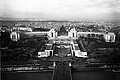
View of the Palais de Chaillot and the Jardins du Trocadéro from the Eiffel Tower in 2015
Fountain of Warsaw, with the Palais de Chaillot in the background

The Palais de Chaillot (French pronunciation: [palɛ d(ə) ʃajo]) is a building at the top of the Chaillot hill [fr] in the Trocadéro area in the 16th arrondissement of Paris, France.

Design

[edit]

The building was designed in classicising "moderne" style by architects Louis-Hippolyte Boileau, Jacques Carlu and Léon Azéma.[1] The Palais consists of two separate wings shaped to form a wide arc, which are those of the former Palais du Trocadéro with new taller portions built in front. The pair of larger central pavilions are also those of the former Palais du Trocadéro, encapsulated in new construction. The large central hall and towers of the old palais were demolished, leaving only the basement, with a wide esplanade created on top, establishing an open view from the Place du Trocadéro to the Eiffel Tower and beyond.

The buildings are decorated with quotations by Paul Valéry, and sculptural groups at the attic level by Raymond Delamarre, Carlo Sarrabezolles and Alfred Bottiau.[2] The eight gilded figures on the terrace of the Rights of Man are attributed to the sculptors Alexandre Descatoire, Marcel Gimond, Jean Paris dit Pryas, Paul Cornet, Lucien Brasseur, Robert Couturier, Paul Niclausse and Félix-Alexandre Desruelles.[3]

The buildings now house a number of museums:

History

[edit]

1937 Expo: Construction

[edit]

For the Exposition Internationale of 1937, the old 1878 Palais du Trocadéro was partly demolished and partly rebuilt to create the Palais de Chaillot.

World War II

[edit]

It was on the front terrace of the palace that Adolf Hitler was pictured during his short tour of the city in 1940, with the Eiffel Tower in the background. This became an iconic image of the Second World War. On VE Day, 8 May 1945, the U.S. Army in Paris celebrated their victory on the same spot. Over 2800 soldiers, sailors and airmen listened to the victory speech to the troops by President Harry S. Truman, and then an address by the ranking officer in Paris, Lt. Gen John C. H. Lee, commanding general of the Com-Z logistics operations of the U.S. Army in Europe since May 1942.

Post-World War II

[edit]

1948/1951: United Nations General Assembly

[edit]

In 1948, the Palais de Chaillot hosted the third United Nations General Assembly (UNGA), and, in 1951, the sixth UNGA[4] It is in the Palais de Chaillot that the UNGA adopted the Universal Declaration of Human Rights on 10 December 1948. This event is now commemorated by a stone, and the esplanade is known as the esplanade des droits de l'homme ("esplanade of human rights").

1952–1959: Temporary NATO headquarters

[edit]

The Palais de Chaillot also served as temporary NATO headquarters in Paris, from 1952 until the permanent HQ at "Palais de l'OTAN" (now Université Paris Dauphine) was inaugurated in 1959.

References

[edit]
[edit]
[edit]
Revisions and contributorsEdit on WikipediaRead on Wikipedia
from Grokipedia
The Palais de Chaillot is a monumental Art Deco building located on the Place du Trocadéro in Paris's 16th arrondissement, constructed between 1934 and 1937 by architects Léon Azéma, Jacques Carlu, and Louis-Hippolyte Boileau to replace the unpopular 1878 Palais du Trocadéro for the Exposition Internationale des Arts et Techniques dans la Vie Moderne.[1][2][3] Featuring two symmetrical curved pavilions flanking a central terrace with panoramic views of the Eiffel Tower across the Seine, the structure emphasizes monumental scale through its grand peristyle, esplanade, and integration with the surrounding gardens and fountains.[4][5] Designed to embody modern French architectural principles of harmony and monumentality, the Palais de Chaillot served as a showcase for national pavilions during the 1937 exposition, including politically charged displays by Nazi Germany and the Soviet Union positioned opposite one another.[4] Post-exposition, it hosted significant international events, such as sessions of the United Nations General Assembly in 1948 and 1951, underscoring its role in global diplomacy amid postwar reconstruction.[6] Today, the Palais houses key cultural institutions, including the Cité de l'architecture et du patrimoine, which occupies 23,000 square meters in the eastern wing and displays architectural models, casts, and artifacts spanning French history from the Middle Ages to the present, inaugurated in 2007 after extensive renovations; the Musée de l'Homme in the western wing; and the Théâtre National de Chaillot, a venue for dance and performance with three halls offering views toward the Eiffel Tower.[7][2][1] An annex along the reflecting pool temporarily served as NATO headquarters from 1952 to 1959, hosting events like the 1954 signing of the invitation for West Germany's membership.[5] The site's historical prominence continued during World War II, when German forces occupied Paris and Adolf Hitler visited the Trocadéro area in June 1940.[8]

Architecture and Design

Structural Features and Layout

The Palais de Chaillot consists of two symmetrical, semi-circular pavilions that form a wide arc, flanking a central open esplanade known as the Esplanade du Trocadéro or Esplanade des Droits de l'Homme.[9] This layout was designed to replace the demolished central hall and towers of the previous Palais du Trocadéro, utilizing the retained basement structure while creating an expansive terrace atop it.[10] The pavilions curve outward to frame views toward the Eiffel Tower and the Seine River, emphasizing spatial openness and axial alignment with the Champ de Mars.[11] Constructed primarily of reinforced concrete, the structure features rectangular forms, straight lines, and attached decorative elements on marble plaques, aligning with a classicizing moderne style.[12] The façades incorporate tall windows, columns, and arches that contribute to a sense of grandeur, with load-bearing piers lined in millstone for durability.[1][6] Beneath the esplanade lies the Théâtre National de Chaillot, integrated into the design to support cultural functions without disrupting the upper terrace's linearity.[13] Sculptural elements enhance the structural composition, including bas-reliefs by artists such as René Collamarini and Claude Grange on the wings, and monumental figures on the terrace like "La Pensée" by Étienne Martin and "Les Éléments" by Carlo Sarrabezolles, symbolizing human rights principles.[14][15][9] An Apollo statue further adorns the ensemble, reinforcing the neoclassical influences amid the moderne framework.[13] The overall configuration prioritizes symmetry and visual permeability, with the esplanade serving as a pivotal public space connecting the pavilions and extending sightlines across Paris.[16]

Architects and Construction Process

The Palais de Chaillot was designed collaboratively by three French architects—Léon Azéma, Jacques Carlu, and Louis-Hippolyte Boileau—who united in 1934 specifically for the architectural competition organized for the 1937 Exposition Internationale des Arts et Techniques dans la Vie Moderne.[17] Each had previously won the prestigious Grand Prix de Rome: Azéma in 1921, Carlu in 1920, and Boileau in 1919, lending their collective expertise in monumental public architecture to the project. Their winning design rejected the eclectic Moorish Revival style of the existing structure in favor of symmetrical, curved wings flanking a central esplanade, executed in a restrained Art Deco idiom with reinforced concrete frames clad in stone to evoke classical monumentality while accommodating modern exhibition needs.[18][19] Construction commenced in 1935 after the partial demolition of the 1878 Palais du Trocadéro, which had long been criticized for its orientalist aesthetics and structural shortcomings; the central pavilion was razed, but the side wings were preserved and adapted into the new ensemble to minimize costs and expedite the timeline.[20][21] The process involved multiple contractors due to intermittent halts caused by funding issues and labor disputes, yet the architects oversaw the integration of expansive terraces, colonnades, and interior spaces suitable for international pavilions.[22] The reinforced concrete skeleton allowed for rapid assembly, with exterior stone facing applied to achieve a timeless facade amid the Exposition's temporary structures.[23] The building was completed and inaugurated on May 24, 1937, just prior to the Exposition's opening the following day, serving as the event's primary venue overlooking the Eiffel Tower and hosting national pavilions that underscored France's interwar cultural diplomacy.[24] This timeline reflected efficient project management despite the scale, which spanned approximately 25,000 square meters and incorporated advanced engineering for its era, such as wide-span interiors for multipurpose use.[23]

Pre-1937 Context

The Palais du Trocadéro Predecessor

The Palais du Trocadéro was constructed on the Chaillot hill in Paris for the 1878 Exposition Universelle, a world's fair organized to showcase industrial and artistic achievements following France's recovery from the Franco-Prussian War.[25] The structure served as a central venue for exhibitions, concerts, and cultural displays, featuring a grand central hall flanked by two tall towers resembling minarets.[26] Its architects were Gabriel Davioud, responsible for the ornamental elements, and Jules Bourdais, who handled the structural engineering, blending eclectic influences from Moorish and Byzantine architecture with French neoclassical motifs.[26] [25] Although initially planned as a temporary edifice not intended to outlast the exposition, the palace was preserved due to its utility and public appeal, enduring for nearly six decades.[21] The surrounding gardens and fountains, designed by Jean-Charles Alphand, enhanced the site's appeal, incorporating large animal statues that contributed to its picturesque vista toward the Seine and the emerging Eiffel Tower.[21] Over the years, it hosted subsequent international expositions, including those in 1889, 1900, and 1931, functioning as a museum and performance space despite growing maintenance challenges.[26] The building faced persistent criticism for its ornate, hybrid aesthetic, often derided as mismatched and overly elaborate, which clashed with evolving tastes favoring modernism.[27] Acoustically, the central hall proved deficient, with poor sound distribution hindering its use for concerts, as documented in contemporary analyses and later archeoacoustic studies confirming inherent design flaws in reverberation and clarity.[28] By the 1930s, amid preparations for the 1937 Exposition Internationale, these issues, combined with the need for a more contemporary structure, prompted partial demolition starting in 1934–1935 to clear space for the Palais de Chaillot.[27] [26] The remaining elements, such as the gardens, were integrated into the new development, marking the end of the Trocadéro's role as a defining Parisian landmark.[21]

Construction and Early History

1937 International Exposition

The Palais de Chaillot was constructed as a centerpiece for the Exposition Internationale des Arts et Techniques dans la Vie Moderne, which took place in Paris from 25 May to 25 November 1937 and attracted over 31 million visitors.[29] The project involved the partial demolition of the predecessor Palais du Trocadéro starting in 1934, with remaining elements camouflaged or integrated into the new build to expedite completion.[30] Designed by architects Léon Azéma, Louis-Hippolyte Boileau, and Jacques Carlu, whose collaborative entry won a dedicated competition, the structure adopted an Art Deco aesthetic blended with neoclassical motifs, including a prominent colonnade.[31] The design comprised two symmetrical, arcing wings connected by a central esplanade, creating a vast open terrace overlooking the Seine River and the Eiffel Tower, while preserving the site's historic fountains.[30] Intended as a permanent legacy, the palais was envisioned to house art museums post-exposition, symbolizing the fusion of traditional craftsmanship and modern technology central to the event's theme.[30] During the exposition, the Palais de Chaillot functioned as a primary venue for cultural displays and performances, with its terraces and adjacent Jardins du Trocadéro providing the backdrop for prominent national pavilions, including those of the Soviet Union and Nazi Germany positioned in direct opposition across the gardens.[32] This arrangement underscored the prevailing ideological tensions of the era, as the pavilions represented contrasting visions of modernity amid rising European conflicts.[33] The site's elevated position enhanced its role in framing panoramic views and directing visitor flow toward key exhibits along the riverfront.[31]

Immediate Post-Exposition Adaptations

Following the closure of the 1937 Exposition Internationale on November 25, 1937, temporary exhibition installations within the Palais de Chaillot were dismantled to facilitate its conversion into permanent cultural venues. The structure's wings and galleries, originally designed to accommodate both expo displays and enduring institutions, saw the prompt installation of museum collections intended to occupy the site long-term. This process involved reallocating spaces in the Passy and Iéna wings, as well as central areas, with minimal structural alterations beyond exhibit removals and interior fittings for display cases and storage.[29] The Passy wing was dedicated to the Musée de l'Homme, an ethnographic institution conceived during the exposition's planning; its permanent collections, focusing on human anthropology and global cultures, were installed in late 1937 and opened to the public in 1938.[34] Concurrently, the Iéna wing housed the relocated collections of the Musée national de la Marine, transferred from prior locations including the Louvre during the exposition period and finalized post-closure to establish a dedicated maritime history exhibit.[35] These installations emphasized the palace's role as a hub for national heritage, with artifacts arranged to highlight French scientific and naval achievements without major renovations.[36] Central galleries accommodated the newly renamed Musée national des Monuments français, incorporating plaster casts and architectural models from predecessor institutions like the Musée de Sculpture Comparée, with setups completed by 1938 to showcase French monumental heritage.[1] The subterranean Théâtre de Chaillot, constructed as part of the original 1937 build, transitioned to regular programming shortly after the exposition, hosting performances that adapted the multipurpose hall for cultural events.[2] These adaptations ensured the palace's immediate viability as a public cultural complex, prioritizing preservation of expo-era infrastructure while embedding permanent exhibits by mid-1938.[32]

Wartime and Immediate Postwar Period

World War II Occupation and Damage

Following the fall of Paris to German forces on 14 June 1940, Adolf Hitler conducted his sole visit to the city on 23 June 1940, where he posed for photographs on the esplanade fronting the Palais de Chaillot, with the Eiffel Tower visible in the background, accompanied by architect Albert Speer and sculptor Arno Breker.[37][38] Throughout the German occupation from 1940 to 1944, the terraces of the Palais de Chaillot and the surrounding Trocadéro area functioned as a favored vantage point for Wehrmacht personnel, who frequently gathered there to admire views of the Eiffel Tower and the Seine River, as captured in period images of soldiers and officers on the site.[39][40] The Palais de Chaillot sustained negligible structural damage during World War II. Unlike Paris's industrial suburbs, which endured heavy Allied bombing, the historic core—including the Trocadéro district—escaped major destruction due to restrained aerial campaigns and limited urban combat during the city's liberation from 19 to 25 August 1944, when French Resistance fighters and Allied troops prioritized rapid advances over prolonged engagements in central landmarks.[41][42]

1948–1951 United Nations General Assembly Sessions

The Palais de Chaillot served as the venue for the third session of the United Nations General Assembly from 21 September to 12 December 1948, marking one of the early temporary sites for UN proceedings prior to the completion of the permanent headquarters in New York. This session, attended by representatives from 58 member states, involved 618 meetings across the assembly and its committees, addressing postwar reconstruction, disarmament, and human rights. The French government facilitated the handover of the venue keys to UN Secretary-General Trygve Lie on 1 September 1948, adapting the structure from its prior exposition use to accommodate plenary and committee sessions.[43] During this session, the General Assembly adopted the Universal Declaration of Human Rights on 10 December 1948, with 48 votes in favor, none against, and eight abstentions, establishing foundational principles on individual liberties and protections against tyranny.[44] The Convention on the Prevention and Punishment of the Crime of Genocide was also approved on 9 December 1948 by a vote of 55 to 0, with abstentions from several nations, defining genocide as acts intended to destroy national, ethnic, racial, or religious groups and obligating states to prevent and punish it.[45] These outcomes reflected the assembly's focus on codifying international norms amid Cold War tensions and recent wartime atrocities, though implementation faced delays due to ratification processes. The venue hosted the sixth session starting on 6 November 1951, continuing through early 1952, as the UN sought European accessibility amid ongoing debates over headquarters logistics.[46] Preparations included constructing a large U-shaped annex to expand capacity, completed by August 1951 despite aesthetic criticisms from French observers.[47] This session, with plenary meetings such as the 349th on 6 December 1951, addressed issues like Korean armistice negotiations and decolonization, though specific resolutions were formalized in New York extensions.[48] The use of Chaillot underscored Paris's interim role, bridging the gap until regular sessions stabilized in New York from 1952 onward.[49]

Mid-20th Century Uses

1952–1959 NATO Headquarters

![Former annex along the reflecting pool, which housed NATO headquarters between 1952 and 1959.](./assets/NATO_Headquarters_19521952%E2%80%931959 Following the North Atlantic Council's decision in February 1952 to establish NATO's permanent headquarters in Paris, the alliance initially occupied temporary premises constructed along the reflecting pool of the Palais de Chaillot.[50] These structures, designed by French architect Jacques Carlu, had originally been built for the United Nations' sixth session in 1951 and were intended for short-term use before demolition.[51] The site served as NATO's political headquarters from April 1952 until December 1959, accommodating administrative offices and meeting spaces amid the alliance's expansion during the early Cold War.[52] Key diplomatic events underscored the facility's role in NATO operations. The 12th NATO Ministerial Meeting occurred there from 14 to 16 December 1953, where member states coordinated responses to Soviet threats.[53] On 23 October 1954, foreign ministers signed the Accession Protocol inviting the Federal Republic of Germany to join NATO, a pivotal step in integrating postwar West Germany into Western defense structures.[54] The temporary nature of the Chaillot annex reflected NATO's transitional phase in Paris, with inadequate space prompting plans for a dedicated building. By 1959, construction of a new headquarters at Porte Dauphine, also designed by Carlu, neared completion, leading to the alliance's relocation in early 1960.[55] This move addressed growing logistical demands as NATO's membership and staff expanded, though the Chaillot site had sufficed for initial postwar consolidation.[50]

Transition to Cultural Institutions

NATO vacated the Palais de Chaillot in 1960 upon completing its permanent headquarters at Porte Dauphine in Paris, ending the temporary occupation of the central esplanade by allied military and diplomatic functions.[51] The associated annex structures, erected between the building's wings to accommodate NATO operations, were subsequently demolished, with key demolition activities occurring on August 24, 1960.[56] This clearance restored the site's original post-Exposition layout, enabling uninterrupted expansion of cultural programming without the spatial constraints imposed by the provisional installations. The Théâtre National Populaire (TNP), reinvigorated in 1951 under director Jean Vilar and housed in the central theater halls, persisted as a cornerstone of the venue's artistic output during and after the NATO era, staging productions aimed at democratizing access to high-quality theater for mass audiences.[57] Concurrently, the permanent museums in the flanking pavilions—the Musée de l'Homme in the western wing, focused on anthropology and ethnography, and the Musée National de la Marine in the eastern wing, dedicated to naval history—reasserted their prominence, benefiting from the reclaimed central space for enhanced visitor flow and exhibitions.[58] By the mid-1960s, these elements coalesced into a cohesive cultural mandate, with additional facilities like a 1963 theater opening augmenting performance capabilities.[59] Further renovations in the early 1970s culminated in a 1973 reconstruction of the theater complex, formalizing the Palais de Chaillot's enduring identity as a nexus for museums, performing arts, and heritage preservation.[60]

Modern Functions and Developments

Resident Museums and Theater

The Palais de Chaillot houses three primary cultural institutions: the Cité de l'architecture et du patrimoine, the Musée de l'Homme, and the Théâtre national de Chaillot. These entities occupy distinct sections of the structure, with the Cité and Musée in the northern and southern wings, respectively, and the theater in the central pavilion beneath the Trocadéro esplanade.[61][62][2] Together, they transformed the post-Exposition pavilion into a hub for architecture, anthropology, and performing arts starting in the late 1930s, with expansions and refocusings in subsequent decades.[58] The Cité de l'architecture et du patrimoine, installed in the "aile Paris" (northeastern wing), serves as France's premier center for architectural study and preservation, spanning 22,000 square meters. Established as a state public institution in 2004 through the merger of earlier entities like the Musée des Monuments Français (founded 1930), it displays full-scale plaster casts of French architectural masterpieces from the 11th to 19th centuries, alongside contemporary exhibits on urban planning and heritage conservation.[63][64] The institution emphasizes empirical documentation of built heritage, including a library of architectural drawings and digital resources for research.[61] The Musée de l'Homme, part of the Muséum national d'histoire naturelle, occupies the "aile Passy" (southeastern wing) and has been resident since its opening on May 20, 1937, initially under the direction of Paul Rivet. It focuses on human evolution, biological and cultural anthropology, and prehistory, exhibiting over 1,800 artifacts such as paleoanthropological remains, ethnographic objects, and anatomical models derived from the former Musée d'Ethnographie du Trocadéro.[65][66] The permanent "Galerie de l'Homme" traces human biological and social development through evidence-based displays, including skeletal collections and cultural artifacts from global expeditions.[62] The Théâtre national de Chaillot, constructed in Art Deco style for the 1937 Exposition, was inaugurated on June 1, 1937, by Firmin Gémier as a multidisciplinary venue with two auditoriums seating over 1,000 spectators combined.[2][67] Post-World War II, it evolved into one of France's five national theaters, initially hosting diverse productions before refocusing on dance under directors like Didier Deschamps (from 2007) and adopting the designation Théâtre national de la Danse in 2016 to prioritize international choreography, circus, and interdisciplinary performances.[68][69] The theater's foyer offers views of the Eiffel Tower, enhancing its role as a performative counterpart to the palace's museal functions.[70]

Renovations and Preservation Efforts

The Palais de Chaillot's renovations have predominantly focused on adapting its interior spaces to the needs of resident cultural institutions while preserving the building's 1937 neoclassical and Art Deco features, including its curved wings and esplanade designed by architects Louis-Hippolyte Boileau, Jacques Carlu, and Léon Azéma. These efforts underscore the structure's role as a protected historic site, with works emphasizing structural integrity, energy efficiency, and accessibility without altering its external silhouette overlooking the Seine.[71] A significant project transformed the eastern wing for the Cité de l'architecture et du Patrimoine, with architect Jean-François Bodin overseeing redesigns starting in 1995 and spanning 12 years of planning and construction. Key elements included restoration of the retained 19th-century metal-and-glass nave from the original Palais du Trocadéro, installation of new escalators and entrances for improved circulation, and reconfiguration of 9,000 square meters for galleries, libraries, and workshops, completed in phases from November 2006 to September 2007 at a cost of 78.184 million euros funded by the French Ministry of Culture. Preservation priorities involved respecting the layered architectural history, such as Gabriel Davioud's grand escalier, to maintain the site's patrimonial value.[71][72] In the western wing, the Musée National de la Marine's renovation, launched in October 2016 and executed by h2o architectes and Snøhetta, addressed decades of deferred maintenance following the museum's closure in March 2017. Spanning six years until reopening on November 17, 2023, the 96,000-square-foot overhaul restored over 1,000 artifacts—previously relocated to a conservation center in Dugny—and introduced immersive scenography with four thematic "stopovers," enhancing visitor flow while adhering to historic monument standards under chief architects of French heritage sites. The 77-million-dollar initiative prioritized reversible interventions to safeguard the 1937 fabric amid functional upgrades like climate control for collections.[73][36][74] The Théâtre National de Chaillot's Salle Jean Vilar, accommodating 1,168 seats, entered renovation in January 2023 under a conception-réalisation contract, targeting completion by late 2025 or early 2026. Directed by Clé Millet and incorporating LED lighting from Robert Juliat for energy savings, the works encompass full architectural refit, stage extension, acoustic improvements, and reconfiguration of Art Deco spaces for rehearsals, all while minimizing disruption to ongoing operations in adjacent halls. These measures align with France's broader heritage policies, ensuring the Palais endures as a venue for arts and exhibitions.[75][76][77]

Significance, Reception, and Criticisms

Architectural and Cultural Impact

The Palais de Chaillot exemplifies a classicising moderne architectural style, blending neoclassical forms with Art Deco elements, as designed by architects Louis-Hippolyte Boileau, Jacques Carlu, and Léon Azéma for the 1937 Exposition Internationale des Arts et Techniques dans la Vie Moderne.[2][54] Its structure consists of two symmetrical pavilions connected by a vast terrace esplanade, which replaced the earlier Moorish-inspired Palais du Trocadéro and emphasized monumental scale with clean lines and grand proportions.[74][13] This design responded to interwar trends in public architecture, incorporating emerging modernist influences while retaining French classical symmetry and monumentality.[78] Architecturally, the Palais influenced subsequent monumental projects by demonstrating how traditional motifs could adapt to modern exhibition needs, serving as a counterpoint to more starkly functionalist styles prevalent in the era.[78] The building's terraced facade and sculptural integrations, including statues by Carlo Sarrabezolles, contributed to its role as a visual anchor in Paris's urban landscape, framing views toward the Eiffel Tower and enhancing the Trocadéro site's prominence.[58] Post-1937, its enduring form has informed preservation efforts in Art Deco heritage, with recent renovations like the 2023 Musée National de la Marine update underscoring adaptive reuse of such structures.[74][73] Culturally, the Palais has shaped Paris's identity as a center for arts and heritage by housing institutions such as the Cité de l'Architecture et du Patrimoine, Musée de l'Homme, and Théâtre National de Chaillot, which collectively attract millions annually and promote French architectural history, anthropology, and performing arts.[58][79] The esplanade, renamed Esplanade des Droits de l'Homme et du Citoyen in 1985, functions as a public space for gatherings and events, symbolizing democratic values and amplifying the site's role in contemporary civic life.[9] Its panoramic vistas have cemented its status as an iconic tourist vantage point, integral to Paris's visual and experiential appeal, while the resident museums preserve artifacts and exhibits that trace evolutionary narratives in human culture and built environment.[58][80]

Contemporary Criticisms and Debates

The architectural style of the Palais de Chaillot, characterized by stripped classicism with its simplified neoclassical forms and monumental scale, has drawn contemporary criticism for evoking the aesthetics of interwar authoritarian regimes. Historians of architecture and ideology have drawn parallels between its design—commissioned for the 1937 Exposition Internationale—and the stripped classicism employed in Nazi Germany's pavilion by Albert Speer, which faced Soviet and French structures across the esplanade, fostering perceptions of a shared monumental idiom despite differing political intents.[81] [82] Such critiques, amplified in post-war analyses and echoed in modern discussions of heritage, question whether the building's imposing wings and terraces inherently convey closure or hierarchy, though defenders emphasize the intentional openness of the central esplanade as a counter to enclosed fascist symbolism.[6] Debates surrounding the resident institutions further highlight tensions over historical legacies. The Musée de l'Homme, reinstalled after a €52 million renovation completed in 2015, addressed longstanding accusations of perpetuating outdated racial typologies from its ethnographic origins, shifting focus to genomic evidence of human unity and critiquing 19th- and early 20th-century pseudoscience that ranked populations.[83] This overhaul responded to broader scholarly reevaluations of anthropology's colonial entanglements, yet some observers argue that retaining artifacts from French expeditions—such as Paul Rivet's 1937 founding collections—necessitates ongoing restitution debates to align with decolonization imperatives.[84] Similarly, exhibits in the adjacent Musée national de la Marine (merged into the Musée de la Marine in 2017 but historically housed in the Passy wing) have prompted scrutiny for glorifying naval imperialism through depictions of conquests in Africa and Asia, with critics advocating contextualization or repatriation to mitigate Eurocentric narratives.[85] Preservation initiatives, including the 2007 integration of the Cité de l'Architecture et du Patrimoine, have ignited discussions on reconciling the structure's 1937 materiality—concrete frames clad in stone—with demands for energy-efficient retrofits and universal access. Proponents of adaptive reuse cite the building's successful transition to cultural venues as evidence of resilience, while skeptics warn that incremental modernizations, such as elevator additions amid its 95-meter-wide terraces, could erode the experiential impact of its original spatial drama.[86] These tensions reflect wider European heritage discourses, where the Palais serves as a case study in negotiating interwar modernism's ideological baggage against utilitarian imperatives, without evidence of proposals for demolition or radical redesign.[87]

References

User Avatar
No comments yet.